 |
| Enchanted Peace Rose - new this year. Yes, I did - more than one. |

ICHABOD, THE GLORY HAS DEPARTED - explores the Age of Apostasy, predicted in 2 Thessalonians 2:3, to attack Objective Faithless Justification, Church Growth Clowns, and their ringmasters. The antidote is trusting the efficacious Word in the Means of Grace. John 16:8. Isaiah 55:8ff. Romans 10. Most readers are WELS, LCMS, ELS, or ELCA. This blog also covers the Roman Catholic Church, Eastern Orthodoxy, and the National Council of Churches.
Monday, March 1, 2021
Sunday, February 28, 2021
Reminiscere, The Second Sunday in Lent, 2021. Faith - Against All Odds

 |
| KJV Cambridge Lectern Bible - Complete service on video |
Reminiscere Sunday
The Second Sunday in Lent, 2020
Pastor Gregory L. Jackson
Hymn # 151 Christ, the Life of All the Living - Winkworth translation
The Confession of Sins
The Absolution
The Introit p. 16
The Absolution
The Introit p. 16
Remember, O Lord, Thy tender mercies and Thy
loving-kindnesses: for they have been ever of old.
Let not mine enemies triumph over me: God of Israel,
deliver us out of all our troubles.
Psalm. Unto
Thee, O Lord, do I lift up my soul: O my God, I trust in Thee; let me not be
ashamed.
The Kyrie p. 17
The Gloria in Excelsis
The Salutation and Collect p. 19
O God, who seest that of ourselves we have no strength,
keep us both outwardly and inwardly that we may be defended from all
adversities which may happen to the body and from all evil thoughts which may
assault and hurt the soul; through Jesus Christ, Thy Son, our Lord, who liveth,
etc.
The Gospel
Glory be to Thee, O Lord!
Praise be to Thee, O Christ!
The Nicene Creed p. 22
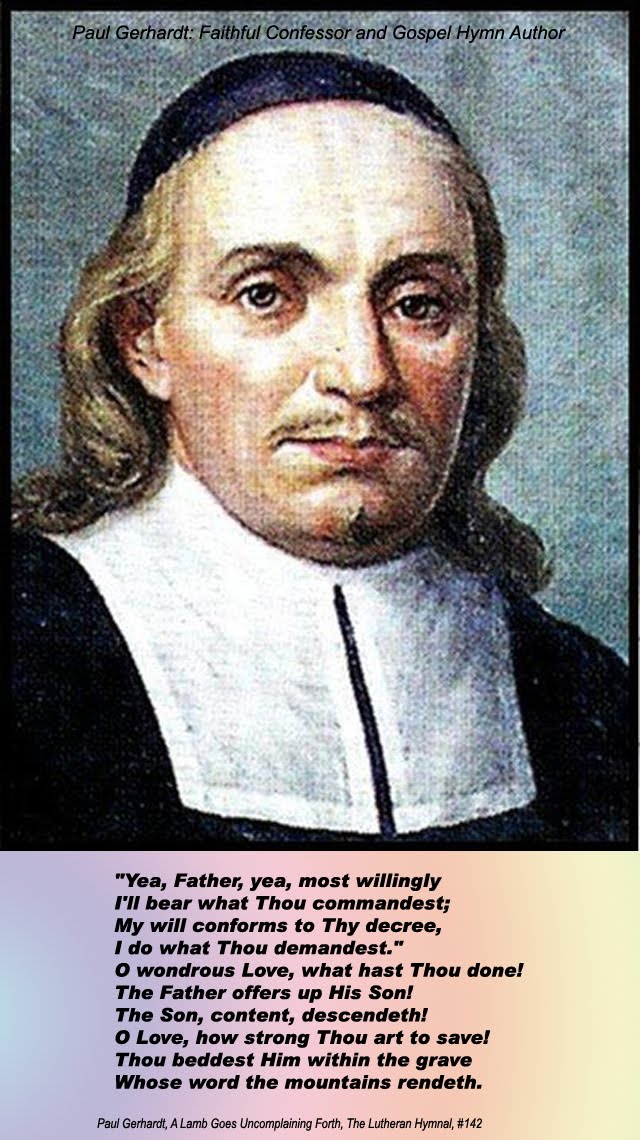
Sermon Hymn #142 A Lamb Goes Uncomplaining - Gerhardt
Praise be to Thee, O Christ!
The Nicene Creed p. 22
Sermon Hymn #142 A Lamb Goes Uncomplaining - Gerhardt
Faith - Against All Odds
The Sanctus p. 26
The Lord's Prayer p. 27
The Words of Institution
The Agnus Dei p. 28
The Nunc Dimittis p. 29
The Benediction p. 31
Hymn # 50 Lord Dismiss Us with Thy Blessing
The Lord's Prayer p. 27
The Words of Institution
The Agnus Dei p. 28
The Nunc Dimittis p. 29
The Benediction p. 31
Hymn # 50 Lord Dismiss Us with Thy Blessing

Prayers and Announcements
- Treatment and recovery - Christina Jackson, Lori Howell, Pastor Jim Shrader
- Hospitalized - a brother who has just been given the two-part Covid shot
- Today - Important speech, DEP Trump, Right Side Broadcasting
- Wednesday, 7 PM - MidWeek Lenten service, Chapter 3 Luther's Galatians. Ask for a free print copy of Galatians or a free PDF - or both.
- Making plans for video and for a literature discussion wiki.
- Thank you for the donation of the Cambridge Lectern KJV Bible. It will be used for Scripture readings, for the sermons, and the Vesper Psalms.
 |
| Lutheran Library - Gerhardt's Biography |
KJV 1 Thessalonians 4:1 Furthermore then we beseech you, brethren, and exhort you by the Lord Jesus, that as ye have received of us how ye ought to walk and to please God, so ye would abound more and more. 2 For ye know what commandments we gave you by the Lord Jesus. 3 For this is the will of God,even your sanctification, that ye should abstain from fornication: 4 That every one of you should know how to possess his vessel in sanctification and honour; 5 Not in the lust of concupiscence, even as the Gentiles which know not God: 6 That no man go beyond and defraud his brother in any matter: because that the Lord is the avenger of all such, as we also have forewarned you and testified. 7 For God hath not called us unto uncleanness, but unto holiness.
KJV Matthew 15:21 Then Jesus went thence, and departed into the coasts of Tyre and Sidon. 22 And, behold, a woman of Canaan came out of the same coasts, and cried unto him, saying, Have mercy on me, O Lord, thou Son of David; my daughter is grievously vexed with a devil. 23 But he answered her not a word. And his disciples came and besought him, saying, Send her away; for she crieth after us. 24 But he answered and said, I am not sent but unto the lost sheep of the house of Israel. 25 Then came she and worshipped him, saying, Lord, help me. 26 But he answered and said, It is not meet to take the children's bread, and to cast it to dogs. 27 And she said, Truth, Lord: yet the dogs eat of the crumbs which fall from their masters' table. 28 Then Jesus answered and said unto her, O woman, great is thy faith: be it unto thee even as thou wilt. And her daughter was made whole from that very hour.
Second Sunday In Lent
Lord God, heavenly Father, grant us, we beseech Thee, by Thy Holy Spirit, that He may strengthen our hearts and confirm our faith and hope in Thy grace and mercy, so that, although we have reason to fear because of our conscience, our sin, and our unworthiness, we may nevertheless, with the woman of Canaan, hold fast to Thy grace, and in every trial and temptation find Thee a very present help and refuge, through Thy beloved Son, Jesus Christ our Lord, who liveth and reigneth with Thee and the Holy Ghost, one true God, world without end. Amen.
Faith - Against All Odds
Introductory - Matthew 15:21-28
The Canaanite woman's story has been portrayed as an example of "hard sayings," where Jesus seems to be unduly harsh with the woman who is only asking healing for her daughter, so harsh that the disciples are annoyed with Him.
In fact, if we look at this story, lacking faith in Jesus, there is so much material to fuel the suspicions and mockery of unbelievers. It has been the center of many efforts to twist the Word of God, but that is not by accident. The Word of God is not for idle gawkers and sidewalk superintendents. They become even blinder and more obstinate by using the healing for their own damage to the Truth.
But if we read it carefully and with faith, it is an inspiring miracle that gives us goosebumps.
KJV Matthew 15:21 Then Jesus went thence, and departed into the coasts of Tyre and Sidon. 22 And, behold, a woman of Canaan came out of the same coasts, and cried unto him, saying, Have mercy on me, O Lord, thou Son of David; my daughter is grievously vexed with a devil.
Some might wonder why this woman seems to have several nationalities. For the Jewish audience, Canaanite refers to the ancient pagan race conquered by the Israelites. Mark, writing for Gentiles, calls her Greek and Syro-Phoenician. (Lenski, Mark). Thus another so-called contradiction is vanquished.
One thing we learn especially from Mark's Gospel is that Jesus was always being pursued by people and crowds looking for healing miracles. Jesus took time to teach His disciples and that was not possible with constant demands. So, the woman made sure she could find Him and ask Him.
We know this woman had already heard the Gospel - faith comes by hearing the Word, Romans 10 - because she displayed her faith in her pleas of mercy. "O Lord, Thou Son of David." Like the blind man, she saw with the eyes of faith, not obeying her life-long religion, whatever it was. The Promised Messiah would help her, she was sure. "My daughter is grievously vexed with a devil."
1. This Gospel presents to us a true example of firm and perfect faith. For this woman endures and overcomes in three great and hard battles, and teaches us in a beautiful manner the true way and virtue of faith, namely, that it is a hearty trust in the grace and goodness of God as experienced and revealed through his Word. For St. Mark says, she heard some news about Jesus, Mark 7:25 (7:25 "For a certain woman, whose young daughter had an unclean spirit, heard of him, and came and fell at his feet:"). What kind of news? Without doubt good news, and the good report that Christ was a pious man and cheerfully helped everybody. Such news about God is a true Gospel and a word of grace, out of which sprang the faith of this woman; for had she not believed, she would not have thus run after Christ etc. In like manner we have often heard how St. Paul in Romans 10:17 says that faith cometh by hearing, that the Word must go in advance and be the beginning of our salvation.
2. But how is it that many more have heard this good news concerning Christ, who have not followed him, and did not esteem it as good news?
Answer: The physician is helpful and welcome to the sick; the healthy have no use for him. But this woman felt her need, hence she followed the sweet scent, as is written in the Song of Solomon 1:3. In like manner Moses must precede and teach people to feel their sins in order that grace may be sweet and welcome to them. Therefore all is in vain, however friendly and lovely Christ may be pictured, if man is not first humbled by a knowledge of himself and he possesses no longing for Christ...
Thus many do not think of Jesus properly unless they encounter some great difficulty, sorrow, or loss. A self-satisfied modernist will look upon passages like this and make jokes about them, wonder aloud about "contradictions," and leave more scar tissue to harden the hearts of others and their own. At a gathering of liberal ministers, an academic can say, "Christianity grew through the sword," and no one will murmur. If one person objects to this nonsense, the rest will think, "One more reason to avoid the dissenter." So we can look at this miracle in the same way - most of the world mystified and a bit sarcastic - relatively few people moved by its powerful message of God's love.
23 But he answered her not a word. And his disciples came and besought him, saying, Send her away; for she crieth after us.
To some, this sounds like Jesus and His disciples were incredibly mean. Shoo her away! - that is what they think they are hearing or reading. It is not a coincidence we are singing "Lord dismiss us with a blessing..." That concept is being expressed here. The disciples do not like hearing her call out repeatedly, so they are saying, "Give her what she wants and send her away in peace."
Two parts are always together in the work of Christ. One is believing. The other is expressing that faith. Since faith comes by hearing the Word, those who realize and believe the entire portrait of Christ in the Scriptures will confess that truth and always oppose rejection of it. Jesus alone and the disciples alone would not have spread the Gospel except through this combination of faith and witnessing to the Faith.
Luther expresses this by saying that Jesus was a like a hunter chasing and exercising that witness out of her. We do that on a modest scale when youth are confirmed in the faith and asked questions in front of the congregation. That was once a great tradition in many Lutheran groups, but the liberals decided to have first communion early like the Catholics and make confirmation into nothing. As I mentioned to one member yesterday, two years of Greek were expected in college for those going to seminary. Latin did not have the same draw. Now it is a summer class before seminary and must have all the sticking power of camp-firmation classes, where a little bit of catechism is mixed with a week of fun, games, and swimming.
24 But he answered and said, I am not sent but unto the lost sheep of the house of Israel. 25 Then came she and worshipped him, saying, Lord, help me.
This is direct challenge to her and to her request for mercy. It is oddly in sync with the passage in Galatians 2, where Paul argued that he won the contest of faith being the requirement of Christian membership, not Jewish circumcision and kosher food laws. Jesus is playing the role of the Judaizers here while letting the woman prove the argument of Paul - faith in Jesus is the requirement.
She did not take the bait to argue for being - in some way - from the house of Israel. She proved her sincerity by worshiping Him (kneeling at his feet) and expressing her faith by saying "Lord, help me."
This miracle is different in Jesus not responding at once or even beginning to show what He would do (as in looking up into Heaven or designating what He would do for the sick, blind, or deaf man). The outward appearance is indifference, silence, and implied rejection. This is also explored and portrayed in Pilgrim's Progress. There are times of waiting.
26 But he answered and said, It is not meet to take the children's bread, and to cast it to dogs. 27 And she said, Truth, Lord: yet the dogs eat of the crumbs which fall from their masters' table.
This is the most direct and easily misunderstood part of the miracle. Jesus answered
her faith and patience in the words that would appeal to the Judaizers. The bread is for the Children of Israel, so it should not be taken away from them and given to the unworthy.
Jesus is not calling her a dog in this miracle but using a term for the little pet dogs that consume scraps. The dogs who licked poor Lazarus' sores were the wild, scavenger dogs. Lenski makes this distinction in his Matthew commentary.
This is certain a forewarning about Judaizers and a concise teaching about the real Children of Abraham. She answered in faith, as the New Testament teaches, pointedly in John 8 and Romans 4 - Those who believe in Christ are the true Children of Israel and heirs to the Promise. Jesus answered the objections by saying, "Before Abraham was, I AM."
Romans 4 teaches that Justification by Faith was not unique with Abraham in Genesis 15:6 but was true of all who believe in Him.
28 Then Jesus answered and said unto her, O woman, great is thy faith: be it unto thee even as thou wilt. And her daughter was made whole from that very hour.
The woman would cheerfully accept scraps, and that is the ultimate expression of faith, asking but not demanding, trusting and waiting. Her daughter was healed from that point on.
This miracle is extremely important because faith in Christ is the chief doctrine in the Word of God. This faith in Him connects with all we do, and there is a direct connection with faith and prayer.
A Good Miracle for Us All
I was counting the people exposed to error before they came to a knowledge of the true Scriptures and faith in Jesus as He is taught from the Word of God.
The Apostle Paul was trained in Pharisaical Judaism, which gave him the training to know the Messianic Promises without seeing them in Jesus and the Christians. The Risen Christ converted him to faith.
Augustine was a great classical scholar and intellectual, who looked down on the Christian Bible, though his mother prayed for him to convert. When children played and sang a song, "Take and Read," he picked up the Scriptures and the Word converted him.
Luther was a devout, Medieval Roman Catholic, who was trained in Catholic philosophy but told to earn a doctorate in Biblical studies. Exposure to the Word itself taught him how different the Scriptures were from his monastic training.
Many of us began in liberal or liberal Masonic or Justification without Faith congregations, with many errors embedded in our training. However, the defenestration (throwing out of the window) the KJV awakened many to the English version of Luther's German Bible.
In addition, many difficulties have come along for individuals, because being aware of errors is a sure way to invite trouble from the Apostates, as if Jesus ordered the disciples to sleep while He was praying.
This Canaanite woman is a miracle for those who feared the grace and mercy of God had gone away, especially since it seemed to have gone over to the other side - where the Protestants bow down to Roman Catholic Scriptures, paraments, and holy days; where the "true Gospel" is proclaimed as a version of Marxism while miracles are rejected. It is one of those twists of fortune that one man, Eugene Nida, because he could not tolerate translating in Mexico became a supervisor instead - and lived to be almost 100 years as the top man in the American Bible Society and United Bible Societies.
When we are in the Canaanite waiting time, it is difficult to bear. I know millions are waiting for the American policies they supported to receive political action. Many drop away discouraged, and that is a good term to remember. Dis-courage means being afraid, despairing, giving up.
God uses negative, destructive times to start over and often to use them for His glory. I have a long list of people who were heroically nasty, dishonest, and vindictive, but they are on my thank list now. I would have settled down to middle class ease, luxury, and going to seed if they had not driven me to a place where I could study, write, and teach the truth to people who appreciate it.
That is quite an experience to have people appreciate sermons. Few clergy have that, and I am sure that drives them into being lazy bores of finding another profession.
I can look at others in the congregation and see that faith in Christ has energized them to accomplish many things that would be impressive for a large congregation, let alone a tiny one. For example, intense interest in the hymns has made that a priority and a teaching point, which led to a blog with 15,000 views in a few months. You know - the boring, old-fashioned, irrelevant, KJV language -The Lutheran Hymnal. If anyone thinks that is a waste of time, then they believe expressions of faith in God's Word are a waste of time. And - of course - that is where many people have gone, where so many churches have become theaters, homes, and restaurants.


Luther's Sermon on the Faith of the Canaanite Woman, Matthew 15:21-28
REMINISCERE. SECOND SUNDAY IN LENT
TEXT:
Matthew 15:21-28. And Jesus went out thence, and withdrew into the parts of Tyre and Sidon. And behold, a Canaanitish woman came out from those borders and cried, saying, Have mercy on me, O Lord, thou son of David; my daughter is grievously vexed with a demon. But he answered her not a word. And his disciples came and besought him, saying, Send her away; for she crieth after us. But he answered and said, I was not sent but unto the lost sheep of the house of Israel. But she came and worshipped him, saying, Lord, help me. And he answered and said, It is not meet to take the children’s bread and cast it to the dogs. But she said, Yea, Lord: for even the dogs eat of the crumbs which fall from their masters’ table. Then Jesus answered and said unto her, O woman, great is thy faith: be it done unto thee even as thou wilt. And her daughter was healed from that hour.
1. This Gospel presents to us a true example of firm and perfect faith. For this woman endures and overcomes in three great and hard battles, and teaches us in a beautiful manner the true way and virtue of faith, namely, that it is a hearty trust in the grace and goodness of God as experienced and revealed through his Word. For St. Mark says, she heard some news about Jesus, Mark 7:25. What kind of news? Without doubt good news, and the good report that Christ was a pious man and cheerfully helped everybody. Such news about God is a true Gospel and a word of grace, out of which sprang the faith of this woman; for had she not believed, she would not have thus run after Christ etc. In like manner we have often heard how St. Paul in Romans 10:17 says that faith cometh by hearing, that the Word must go in advance and be the beginning of our salvation.
2. But how is it that many more have heard this good news concerning Christ, who have not followed him, and did not esteem it as good news?
Answer: The physician is helpful and welcome to the sick; the healthy have no use for him. But this woman felt her need, hence she followed the sweet scent, as is written in the Song of Solomon 1:3. In like manner Moses must precede and teach people to feel their sins in order that grace may be sweet and welcome to them. Therefore all is in vain, however friendly and lovely Christ may be pictured, if man is not first humbled by a knowledge of himself and he possesses no longing for Christ, as Mary’s Song says, “The hungry he hath filled with good things; and the rich he hath sent empty away,” Luke 1:53. All this is spoken and written for the comfort of the distressed, the poor, the needy, the sinful, the despised, so that they may know in all times of need to whom to flee and where to seek comfort and help.
3. But see in this example how Christ like a hunter exercises and chases faith in his followers in order that it may become strong and firm. First when the woman follows him upon hearing of his fame and cries with assured confidence that he would according to his reputation deal mercifully with her, Christ certainly acts differently, as if to let her faith and good confidence be in vain and turn his good reputation into a lie, so that she could have thought: Is this the gracious, friendly man? or: Are these the good words, that I have heard spoken about him, upon which I have depended? It must not be true; he is my enemy and will not receive me; nevertheless he might speak a word and tell me that he will have nothing to do with me. Now he is as silent as a stone. Behold, this is a very hard rebuff, when God appears so earnest and angry and conceals his grace so high and deep; as those know so well, who feel and experience it in their hearts. Therefore she imagines he will not fulfill what he has spoken, and will let his Word be false; as it happened to the children of Israel at the Red Sea and to many other saints.
4. Now, what does the poor woman do? She turns her eyes from all this unfriendly treatment of Christ; all this does not lead her astray, neither does she take it to heart, but she continues immediately and firmly to cling in her confidence to the good news she had heard and embraced concerning him, and never gives up. We must also do the same and learn firmly to cling to the Word, even though Go with all his creatures appears different than his Word teaches. But, oh, how painful it is to nature and reason, that this woman should strip herself of self and forsake all that she experienced, and cling alone to God’s bare Word, until she experienced the contrary. May God help us in time of need and of death to possess like courage and faith!
5. Secondly, since her cry and faith avail nothing, the disciples approach with their faith, and pray for her, and imagine they will surely be heard. But while they thought he should be more tenderhearted, he became only the more indifferent, as we see and think. For now he is silent no more nor leaves them in doubt; he declines their prayer and says: “I was not sent but unto the lost sheep of the house of Israel.” This rebuff is still harder since not only our own person is rejected, but the only comfort that remains to us, namely, the comfort and prayers of pious and holy persons, are rejected. For our last resort, when we feel that God is ungracious or we are in need, is that we go to pious, spiritual persons and there seek counsel and help, and they are willing to help as love demands; and yet, that may amount to nothing, even they may not be heard and our condition becomes only worse.
6. Here one might upbraid Christ with all the words in which he promised to hear his saints, as Matthew 18:19: “If two of you shall agree on earth as touching anything that they shall ask, it shall be done for them.”
Likewise, Mark 11:24: “All things whatsoever ye pray and ask for, believe that ye receive them, and ye shall have them;” and many more like passages. What becomes of such promises in this woman’s case? Christ, however, promptly answers and says: Yes, it is true, I hear all prayers, but I gave these promises only to the house of Israel. What do you think? Is not that a thunderbolt that dashes both heart and faith into a thousand pieces, when one feels that God’s Word, upon which one trusts, was not spoken for him, but applies only to others? Here all saints and prayers must be speechless, yea, here the heart must let go of the Word, to which it would gladly hold, if it would consult its oven feelings.
7. But what does the poor woman do? She does not give up, she clings to the Word although it be torn out of her heart by force, is not turned away by this stern answer, still firmly believes his goodness is yet concealed in that answer, and still she will not pass judgment that Christ is or may be ungracious. That is persevering steadfastness.
8. Thirdly, she follows Christ into the house, as Mark 7:24-25 informs us, perseveres, falls down at his feet, and says: “Lord, help me!” There she received her last mortal blow, in that Christ said in her face, as the words tell, that she was a dog, and not worthy to partake of the children’s bread.
What will she say to this! Here he presents her in a bad light, she is a condemned and an outcast person, who is not to be reckoned among God’s chosen ones.
9. That is an eternally unanswerable reply, to which no one can give a satisfactory answer. Yet she does not despair, but agrees with his judgment and concedes she is a dog, and desires also no more than a dog is entitled to, namely, that she may eat the crumbs that fall from the table of the Lord.
Is not that a masterly stroke as a reply? She catches Christ with his own words. He compares her to a dog, she concedes it, and asks nothing more than that he let her be a dog, as he himself judged her to be. Where will Christ now take refuge? He is caught. Truly, people let the dog have the crumbs under the table; it is entitled to that. Therefore Christ now completely opens his heart to her and yields to her will, so that she is now no dog, but even a child of Israel.
10. All this, however, is written for our comfort and instruction, that we may know how deeply God conceals his grace before our face, and that we may not estimate him according to our feelings and thinking, but strictly according to his Word. For here you see, though Christ appears to be even hardhearted, yet he gives no final decision by saying “No.” All his answers indeed sound like no, but they are not no, they remain undecided and pending. For he does not say: I will not hear thee; but is silent and passive, and says neither yes nor no. In like manner he does not say she is not of the house of Israel; but he is sent only to the house of Israel; he leaves it undecided and pending between yes and no. So he does not say, Thou art a dog, one should not give thee of the children’s bread; but it is not meet to take the children’s bread and cast it to the dogs; leaving it undecided whether she is a dog or not. Yet all those trials of her faith sounded more like no than yes; but there was more yea in them than nay; ay, there is only yes in them, but it is very deep and very concealed, while there appears to be nothing but no.
11. By this is set forth the condition of our heart in times of temptation; Christ here represents how it feels. It thinks there is nothing but no and yet that is not true. Therefore it must turn from this feeling and lay hold of and retain the deep spiritual yes under and above the no with a firm faith in God’s Word, as this poor woman does, and say God is right in his judgment which he visits upon us; then we have triumphed and caught Christ in his own words. As for example when we feel in our conscience that God rebukes us as sinners and judges us unworthy of the kingdom of heaven, then we experience hell, and we think we are lost forever. Now whoever understands here the actions of this poor woman and catches God in his own judgment, and says: Lord, it is true, I am a sinner and not worthy of thy grace; but still thou hast promised sinners forgiveness, and thou art come not to call the righteous, but, as St. Paul says in 1 Timothy 1:15, “to save sinners.” Behold, then must God according to his own judgment have mercy upon us.
12. King Manasseh did likewise in his penitence as his prayer proves; he conceded that God was right in his judgment and accused himself as a great sinner and yet he laid hold of the promised forgiveness of sins. David also does likewise in Psalm 51:4 and says: “Against thee, thee only, have I sinned, and done that which is evil in thy sight; that thou mayest be justified when thou speakest, and be clear when thou judgest.” For God’s disfavor in every way visits us when we cannot agree with his judgment nor say yea and amen, when he considers and judges us to be sinners. If the condemned could do this, they would that very moment be saved. We say indeed with our mouth that we are sinners; but when God himself says it in our hearts, then we are not sinners, and eagerly wish to be considered pious and free from that judgment. But it must be so; if God is to be righteous in his words that teach you are a sinner, then you may claim the rights of all sinners that God has given them, namely, the forgiveness of sins. Then you eat not only the crumbs under the table as the little dogs do; but you are also a child and have God as your portion according to the pleasure of your will.
13. This is the spiritual meaning of our Gospel and the scriptural explanation of it. For what this poor woman experienced in the bodily affliction of her daughter, whom she miraculously caused to be restored to health again by her faith, that we also experience when we wish to be healed of our sins and of our spiritual diseases, which is truly a wicked devil possessing us; here she must become a dog and we become sinners and brands of hell, and then we have already recovered from our sickness and are saved.
14. Whatever more there is in this Gospel worthy of notice, as that one can obtain grace and help through the faith of another without his own personal faith, as took place here in the daughter of this poor woman, has been sufficiently treated elsewhere. Furthermore that Christ and his disciples along with the woman in this Gospel exhibit to us an example of love, in that no one acts, prays and cares for himself but each for others, is also clear enough and worthy of consideration.
Saturday, February 27, 2021
A New Approach to The Bible Book.
The Bible Book: The KJV Reborn for Those Who Love the Word of God
 |
| KJV Cambridge Lectern Edition |
Rather than start with the ruination of the Bible, as promoted by WELS, ELCA, LCMS, ELS, ELDONUTs, and other scoundrels, I decided to begin with the history of the Bible leading up to the King James Version.
The second part will be about ruination, so people can see what we already have, if only we realize it - the English edition of Luther's German Bible. "Wachet auf, ruft uns die Stimme - Wake up you sleepy-heads, calls the voice!"
Fortunately we have a living voice for the second part, who viewed the impact of the Eugene Nida destruction of translating the Bible. We are conversing about this and sharing materials.
Abuse Is Institutionalized and Promoted in the Wisconsin Synod
 |
| Physical, emotional, and sexual abuse? No - we consider it conditioning for leadership in Holy Mother WELS. |
One reader wrote to me about the 340+ comments about abuse - on Facebook's WELS Discussions page.
"My years [at Luther Prep, Watertown] there were terrible and filled with pain. As an adult I now see many glaring situations that would have been appropriate to call law enforcement, speak to a trusted adult, and likely file lawsuits against the school, the Wisconsin Evangelical Synod, and the individuals charged with the care and well being of the students that boarded and attended there."
For those who do not know, the WELS prep schools - Michigan Lutheran Seminary in Saginaw, MI and Luther Prep in Watertown, WI - are considered the training high schools for teachers and pastors in the abusive sect.
At each level - prep, college, and seminary - abuse is protected and promoted. This behavior is so institutionalized that objecting is considered a crime, leading to ostracism by shunning and administrative action. WELS promotes bullying, verbal and physical abuse, because the leaders came through that system and loved it.
If a future pastor dislikes (!) the secretive hazing ritual once called GA and later called HB, the synod never forgives them. When I phoned the president of Northwestern College in Watertown (now merged into MLC) about a pastor objecting, he said, "X didn't like GA." That statement was delivered from events decades before, and it was meant as totaling discounting anything said about and against hazing. And no, the president did not want to meet to discuss it, period!
A Synod of Lies, Deceit, and Smirking about Evil
The most important aspect of WELS abuse is the sanctimonious denial of anything being wrong. Everyone is expected to lie and say, "Oh, he or she is just exaggerating. I am there all the time and I see nothing like that."
The pastors love it when their sons phone home and say, "They are going to cancel GA this year!" That deceit is used every year. The same students were told to wear good clothes and bring their girlfriends to Bone Crusher, where their clothes were ruined and they were humiliated in various ways. "Just having fun."
WELS considers evil "being tough." The result is a dying, abusive sect where those who know the most avoid the system altogether.
I attended Bone Crusher and heard the various obscene names applied to younger students. On the other hand, an athlete (by their standards) was treated as divine and flattered beyond belief. At GA they did their best to frighten their initiates into thinking the "hards" were out to get them. Leaders of the synod and faculty attend to revive their old memories and laugh at the deception.
Another part of WELS sect dishonesty is their beloved WELS Grapevine, a rumor machine that anonymously generates slander against anyone who is judged out of line. The clergy who endure the fun and games of broken bones, humiliations, and diving in raw sewage are deathly afraid of being on the wrong side of "The Grapevine". That is what they call it. "I heard on The Grapevine that..."
That is why WELS leaders are deathly afraid of anyone telling the truth about the many scandals and felonies covered up (often not fast enough) by those in charge. The shun button is not just pushed but slammed with both fists. That is why my sources vary from year to year. When everyone is afraid to talk, the one person who gives away the truth is going to be identified and punished. One hilarious example was everyone looking for "Legion." Another one was Synod President Gurgle trying to find out who gave me the synod statistics, which were public knowledge.
Gurgle wanted to know who told me that an adulterous pastor was promoted to Mission Counselor. Adultery and alcoholism are protected by the synod. Drunks promote drunks. ?Adulterers promote adulterers. The ELS helps with a quick transfer (which they deny). District Presidents swap no-good-niks, and Alaska is a good place to make crimes and misdemeanors forgotten.
Future DP Patterson wanted to know who was forwarding his parish newsletter. That took some time, and I had fun with simply quoting what he and Gurgle said.
Exaggeration? One person said, "If my extended family knew I contacted you, I would be shunned by every single one of them. They think WELS is perfect."

Get an Attorney
The WELS liars want someone on the warpath to sit down with them or "write a letter." Or meet with some people. The only purpose is to kill the story and drag the offended through the mud.
They have settled many lawsuits but never tell their members. They even lied to the court about having "no knowledge of sexual offenses in the WELS clergy." The judge made them eat that claim in court, because he had a list of names and places provided through the injured party's attorney - and a source.
Do not obey any instructions from WELS leaders about solving an issue. Talk to an attorney and communicate only through an attorney.
There are good and faithful WELS pastors. However, the system is corrupt, dishonest, adulterous, and always three sheets to the wind.
 |
| Objective Justification, the only dogma of WELS, gives them a license to pronounce the unrepentant forgiven, as Schroeder did with Hochmuth. |
Friday, February 26, 2021
Hymn - From the Writer Nobody Knows Except for Most of His Eight Hymns in TLH

Thomas Kelly wrote -
Look Ye Saints, the Sight Is Glorious.
Stricken, Smitten and Afflicted.
We Sing the Praise of Him Who Died.
Who Is This Who Comes From Edom.
The Head That Once Was Crowned with Thorns.
Hark! Ten Thousand Harps.
Look, Ye Saints, the Sight Is Glorious.
Zion Stands by Hills Surrounded.
 |
| Thomas Kelly is the hymn writer no one knows. |
"We Sing the Praise of Him Who Died"
by Thomas Kelly, 1769-1854
The tune - O Jesu Christ, mein's - is linked here
1. We sing the praise of Him who died,
Of Him who died upon the cross;
The sinners' Hope let men deride,
For this we count the world but loss.
2. Inscribed upon that cross we see
In shining letters "God is Love."
He bears our sins upon the tree,
He brings us mercy from above.
3. The cross!--it takes our guilt away.
It holds the fainting spirit up,
It cheers with hope the gloomy day,
And sweetens every bitter cup.
4. It makes the coward spirit brave
And nerves the feeble arm for fight;
It takes all terror from the grave
And gilds the bed of death with light.
5. The balm of life, the cure of woe,
The measure and the pledge of love,
The sinners' refuge here below,
The angels theme in heaven above.
The Lutheran Hymnal
Hymn #178
Text: Galatians 6:14
Author: Thomas Kelly, 1815
Tune: "O Jesu Christ, mein's"
1st Published in: Nuernbergisches Gesangbuch, 1676
1. We sing the praise of Him who died,
Of Him who died upon the cross;
The sinners' Hope let men deride,
For this we count the world but loss.
2. Inscribed upon that cross we see
In shining letters "God is Love."
He bears our sins upon the tree,
He brings us mercy from above.
3. The cross!--it takes our guilt away.
It holds the fainting spirit up,
It cheers with hope the gloomy day,
And sweetens every bitter cup.
4. It makes the coward spirit brave
And nerves the feeble arm for fight;
It takes all terror from the grave
And gilds the bed of death with light.
5. The balm of life, the cure of woe,
The measure and the pledge of love,
The sinners' refuge here below,
The angels theme in heaven above.
The Lutheran Hymnal
Hymn #178
Text: Galatians 6:14
Author: Thomas Kelly, 1815
Tune: "O Jesu Christ, mein's"
1st Published in: Nuernbergisches Gesangbuch, 1676
We Praise Thee, O God - #568

"We Praise Thee, O God, Our Redeemer, Creator"
by Anonymous (Dutch)
Translated by Julia B. Cady Cory, 1904
by Anonymous (Dutch)
Translated by Julia B. Cady Cory, 1904
1. We praise Thee, O God, our Redeemer, Creator,
In grateful devotion our tribute we bring;
We lay it before Thee, We kneel and adore Thee,
We bless Thy holy name, glad praises we sing.
2. We worship Thee, God of our fathers, we bless Thee;
Through life's storm and tempest our Guide hast Thou been;
When perils o'ertake us, Escape Thou wilt make us,
And with Thy help, O Lord, our battles we win.
3. With voices united our praises we offer,
To Thee, great Jehovah, glad anthems we raise.
Thy strong arm will guide us, Our God is beside us,
To Thee, our great Redeemer, fore'er be praise.
Hymn #568
The Lutheran Hymnal
Text: Psalm 26:12
Author: unknown, 1626
Translated by: Julia B. Cady Cory, 1882
Titled: "Wilt heden nu treden"
Tune: "Kremser"
1st Published in: "Nederlandtsch Gedenckclanck"
Town: Haarlem, 1626
Hymn - Welcome Happy Morning - #202

"Welcome, Happy Morning!"
by Venantius Fortunatus, c. 530-609
Translated by John Ellerton, 1826-1893
by Venantius Fortunatus, c. 530-609
Translated by John Ellerton, 1826-1893
Tune - Sei du mir gegruesset - linked here
1. "Welcome, happy morning!" Age to age shall say;
Hell today is vanquished, heaven is won today!"
Lo, the Dead is living, God forevermore!
Him, their true Creator, all His works adore.
"Welcome, happy morning!" age to age shall say;
Hell today is vanquished, heaven is won today!"
2. Maker and Redeemer, Life and Health of all,
Thou from heaven beholding human nature's fall,
Of the Father's Godhead, true and only Son.
Manhood to deliver manhood didst put on.
"Welcome, happy morning!" age to age shall say;
Hell today is vanquished, heaven is won today!"
3. Thou, of life the Author, death didst undergo,
Tread the path of darkness, saving strength to show.
Come, then, True and Faithful, now fulfil Thy word;
'Tis Thine own third morning--rise, 0 buried Lord!
"Welcome, happy morning!" age to age shall say;
Hell today is vanquished, heaven is won today!"
4. Loose the souls long prisoned, bound with Satan's chain;
All that now is fallen raise to life again.
Show Thy face in brightness, bid the nations see;
Bring again our daylight; day returns with Thee.
"Welcome, happy morning!" age to age shall say;
Hell today is vanquished, heaven is won today!"
The Lutheran Hymnal
Hymn #202
Text: Acts 10:40
Author: Venantius Fortunatus, c. 590, cento
Translated by: John Ellerton, 1868, alt.
Titled: "Salve, festa dies"
Tune: "Sei du mir gegruesset"
1st Published in: Enchiridion
Town: Luebeck, 1545
1. "Welcome, happy morning!" Age to age shall say;
Hell today is vanquished, heaven is won today!"
Lo, the Dead is living, God forevermore!
Him, their true Creator, all His works adore.
"Welcome, happy morning!" age to age shall say;
Hell today is vanquished, heaven is won today!"
2. Maker and Redeemer, Life and Health of all,
Thou from heaven beholding human nature's fall,
Of the Father's Godhead, true and only Son.
Manhood to deliver manhood didst put on.
"Welcome, happy morning!" age to age shall say;
Hell today is vanquished, heaven is won today!"
3. Thou, of life the Author, death didst undergo,
Tread the path of darkness, saving strength to show.
Come, then, True and Faithful, now fulfil Thy word;
'Tis Thine own third morning--rise, 0 buried Lord!
"Welcome, happy morning!" age to age shall say;
Hell today is vanquished, heaven is won today!"
4. Loose the souls long prisoned, bound with Satan's chain;
All that now is fallen raise to life again.
Show Thy face in brightness, bid the nations see;
Bring again our daylight; day returns with Thee.
"Welcome, happy morning!" age to age shall say;
Hell today is vanquished, heaven is won today!"
The Lutheran Hymnal
Hymn #202
Text: Acts 10:40
Author: Venantius Fortunatus, c. 590, cento
Translated by: John Ellerton, 1868, alt.
Titled: "Salve, festa dies"
Tune: "Sei du mir gegruesset"
1st Published in: Enchiridion
Town: Luebeck, 1545
Hymn - In Thee, Lord, Have I Put My Trust
 |
"In Thee, Lord, Have I Put My Trust"
by Adam Reusner, 1496-c.1575
Translated by Catherine Winkworth, 1829-1878
1. In Thee, Lord, have I put my trust;
Leave me not helpless in the dust,
Let me not be confounded.
Let in Thy Word My faith, 0 Lord,
Be always firmly grounded.
2. Bow down Thy gracious ear to me
And hear my cries and prayers to Thee,
Haste Thee for my protection;
For woes and fear Surround me here.
Help me in mine affliction.
3. My God and Shield, now let Thy power
Be unto me a mighty tower
Whence bravely I defend me
Against the foes That round me close.
0 Lord, assistance lend me.
4. Thou art my Strength, my Shield, my Rock,
My Fortress that withstands each shock,
My Help, my Life, my Treasure.
Whate'er the rod, Thou art my God;
Naught can resist Thy pleasure.
5. The world for me has falsely set
Full many a secret snare and net
To tempt me and to harm me.
Lord, make them fail, Do Thou prevail,
Let their disguise not charm me.
6. With Thee, Lord, have I cast my lot;
0 faithful God, forsake me not,
To Thee my soul commending.
Lord, be my Stay, Lead Thou the way
Now and when life is ending.
7. All honor, praise, and majesty
To Father, Son, and Spirit be,
Our God forever glorious,
In whose rich grace We'll run our race
Till we depart victorious.
Hymn #524
The Lutheran Hymnal
Text: Psalm 31:1-5
Author: Adam Reusner, 1533
Translated by: Catherine Winkworth, 1863, alt.
Titled: "In dich hab' ich gehoffet, Herr"
Tune: "In dich hab' ich gehoffet"
by Adam Reusner, 1496-c.1575
Translated by Catherine Winkworth, 1829-1878
Alternate tune - Da Jesus an des Kreuzes #177 TLH
1. In Thee, Lord, have I put my trust;
Leave me not helpless in the dust,
Let me not be confounded.
Let in Thy Word My faith, 0 Lord,
Be always firmly grounded.
2. Bow down Thy gracious ear to me
And hear my cries and prayers to Thee,
Haste Thee for my protection;
For woes and fear Surround me here.
Help me in mine affliction.
3. My God and Shield, now let Thy power
Be unto me a mighty tower
Whence bravely I defend me
Against the foes That round me close.
0 Lord, assistance lend me.
4. Thou art my Strength, my Shield, my Rock,
My Fortress that withstands each shock,
My Help, my Life, my Treasure.
Whate'er the rod, Thou art my God;
Naught can resist Thy pleasure.
5. The world for me has falsely set
Full many a secret snare and net
To tempt me and to harm me.
Lord, make them fail, Do Thou prevail,
Let their disguise not charm me.
6. With Thee, Lord, have I cast my lot;
0 faithful God, forsake me not,
To Thee my soul commending.
Lord, be my Stay, Lead Thou the way
Now and when life is ending.
7. All honor, praise, and majesty
To Father, Son, and Spirit be,
Our God forever glorious,
In whose rich grace We'll run our race
Till we depart victorious.
Hymn #524
The Lutheran Hymnal
Text: Psalm 31:1-5
Author: Adam Reusner, 1533
Translated by: Catherine Winkworth, 1863, alt.
Titled: "In dich hab' ich gehoffet, Herr"
Tune: "In dich hab' ich gehoffet"
Alternate tune: Da Jesus an des Kreuzes, #177 TLH
1st Published in: Himmlische Harfen
Town: Augsburg, 1581
1st Published in: Himmlische Harfen
Town: Augsburg, 1581
Thursday, February 25, 2021
Hymn - Like the Golden Sun Ascending
 |
"Like the Golden Sun Ascending"
by Thomas Kingo, 1634-1703
Translated by George A.T. Rygh, 1860-1942
by Thomas Kingo, 1634-1703
Translated by George A.T. Rygh, 1860-1942
1. Like the golden sun ascending,
Breaking through the gloom of night,
On the earth his glory spending
So that darkness takes to flight,
Thus my Jesus from the grave
And Death's dismal, dreadful cave
Rose triumphant Easter morning
At the early purple dawning.
2. Thanks to Thee, O Christ victorious!
Thanks to Thee, O Lord of Life!
Death hath now no power o'er us,
Thou hast conquered in the strife.
Thanks because Thou didst arise
And hast opened Paradise!
None can fully sing the glory
Of the resurrection story.
3. Though I be by sin o'ertaken,
Though I lie in helplessness,
Though I be by friends forsaken
And must suffer sore distress,
Though I be despised, contemned,
And by all the world condemned,
Though the dark grave yawn before me,
Yet the light of hope shines o'er me.
4. Thou hast died for my transgression,
All my sins on Thee were laid;
Thou hast won for me salvation,
On the cross my debt was paid.
From the grave I shall arise
And shall meet Thee in the skies.
Death itself is transitory;
I shall lift my head in glory.
5. Grant me grace, O blessed Savior,
And Thy Holy Spirit send
That my walk and my behavior
May be pleasing to the end;
That I may not fall again
Into death's grim pit and pain,
Whence by grace Thou hast retrieved me
And from which Thou hast relieved me.
6. For the joy Thy advent gave me,
For Thy holy, precious Word;
For Thy Baptism, which doth save me,
For Thy blest Communion board;
For Thy death, the bitter scorn,
For Thy resurrection morn,
Lord, I thank Thee and extol Thee,
And in heaven I shall behold Thee.
The Lutheran Hymnal
Hymn #207
Text: Acts 2:32
Author: Thomas Kingo, 1689, cento
Translated by: George A.T. Rygh, 1908
Titled: "Som den gyldne Sol frembryder"
Composer: Johann Schop, 1642
Tune: "Werde munter"
Changing the Order of The Bible Book: The KJV Reborn for Those Who Love the Word of God

I was starting the book with the invented Westcott Hort Greek New Testament, its displacement of the Traditional Text, and finally the Nida Creative Writing Paraphrases. That was already nominated for the Debbie Downer Award for Depressing People with the Facts, Bible Category.
Here is the new order -
- Development of the Old Testament
- Development of the New Testament
- Middle Ages
- Luther's Reformation Bible
- Tyndale's English Luther Bible
- The KJV
- Expansion of The KJV
- Westcott Hort Era
- Nida's corruption of translation and the last refuge of scoundrels - Universalism - "all are justified" - NIV.
1-5 is introductory.
 |
| KJV book from Alec Satin, Lutheran Librarian |
 |
| Read more about this - here. |
Some Quotations Revealing the Hidden Agenda of Westcott and Hort, Who Changed the Greek Text Behind the Modern English "Translations" Everyone Is Reading - RSV, NIV, ESV, Good News for Modern Man, etc etc
 |
| The Revision of the KJV failed in England, but a version of it continued in America. The Greek NT invented by Wescott Hort replaced the Traditional Text - which is also called the Received, Majority, or Stephanos Text. |
A selection of
statements revealing the
attitudes of these two
most noted textual critics.
Westcott and Hort
Reprinted with kind permission
from the Traditional Text Pamphlets Homepage
and compiled by David Blunt of the James Begg Society
WE should always be reluctant to engage in ad hominem arguments, i.e. those that concentrate on personalities rather than issues, but the character and professed beliefs of those involved in such vital matters as the text and translation of the Bible cannot be overlooked. It is necessary that those handling the inspired word of God themselves be spiritual men. This is the teaching of Scripture itself (1 Cor. 2:11-16).
Brooke Foss Westcott (1825-1901) was born at Birmingham and Fenton John Anthony Hort (1828-1892) at Dublin. In 1851 Westcott was ordained an Anglican "priest" and Hort in 1856: their careers were spent mostly in academic positions rather than pastorates. As early as 1853 they began work on their Greek text of the New Testament: this project was to occupy most of their remaining lives. In 1870 the idea of a modest revision of the A.V. was sanctioned by the Southern Convocation of the Church of England, and this provided the opportunity for Westcott and Hort to introduce their radical changes. They defended the inclusion of a Unitarian scholar on the Revision Committee. "The New Testament in the Original Greek" was published in 1881, as was the Revised Version based upon it: this latter failed to gain lasting popularity, but the Westcott-Hort text and theory has dominated the scene since.
Textual criticism cannot be divorced entirely from theology. No matter how great a Greek scholar a man may be, or no matter how great an authority on the textual evidence, his conclusions must always be open to suspicion if he does not accept the Bible as the very Word of God (in FULLER, p.157).
Beliefs The following quotes from the diaries and letters of Westcott and Hort demonstrate their serious departures from orthodoxy, revealing their opposition to evangelical Protestantism and sympathies with Rome and ritualism. Many more could be given. Their views on Scripture and the Text are highlighted.
1846 Oct. 25th - Westcott: "Is there not that in the principles of the "Evangelical" school which must lead to the exaltation of the individual minister, and does not that help to prove their unsoundness? If preaching is the chief means of grace, it must emanate not from the church, but from the preacher, and besides placing him in a false position, it places him in a fearfully dangerous one." (Life, Vol.I, pp.44,45).
Oct., 22nd after Trinity Sunday - Westcott: "Do you not understand the meaning of Theological 'Development'? It is briefly this, that in an early time some doctrine is proposed in a simple or obscure form, or even but darkly hinted at, which in succeeding ages,as the wants of men's minds grow, grows with them - in fact, that Christianity is always progressive in its principles and doctrines" (Life, Vol.I, p.78).
Dec. 23rd - Westcott: "My faith is still wavering. I cannot determine how much we must believe; how much, in fact, is necessarily required of a member of the Church." (Life, Vol.I, p.46).
1847 Jan., 2nd Sunday after Epiphany - Westcott: "After leaving the monastery we shaped our course to a little oratory...It is very small, with one kneeling-place; and behind a screen was a 'Pieta' the size of life (i.e. a Virgin and dead Christ)...I could not help thinking on the grandeur of the Romish Church, on her zeal even in error, on her earnestness and self-devotion, which we might, with nobler views and a purer end, strive to imitate. Had I been alone I could have knelt there for hours." (Life, Vol.I, p.81).
1848 July 6th - Hort: "One of the things, I think, which shows the falsity of the Evangelical notion of this subject (baptism), is that it is so trim and precise...no deep spiritual truths of the Reason are thus logically harmonious and systematic...the pure Romish view seems to me nearer, and more likely to lead to, the truth than the Evangelical...the fanaticism of the bibliolaters, among whom reading so many 'chapters' seems exactly to correspond to the Romish superstition of telling so many dozen beads on a rosary...still we dare not forsake the Sacraments, or God will forsake us...I am inclined to think that no such state as 'Eden' (I mean the popular notion) ever existed, and that Adam's fall in no degree differed from the fall of each of his descendants" (Life, Vol.I, pp.76-78).
Aug. 11th - Westcott: "I never read an account of a miracle (in Scripture?) but I seem instinctively to feel its improbability, and discover some want of evidence in the account of it." (Life, Vol.I, p.52).
Nov., Advent Sunday - Westcott: "All stigmatise him (a Dr. Hampden) as a 'heretic,'...I thought myself that he was grievously in error, but yesterday I read over the selections from his writings which his adversaries make, and in them I found systematically expressed the very strains of thought which I have been endeavouring to trace out for the last two or three years. If he be condemned, what will become of me?" (Life, Vol.I,p.94).
1850 May 12th - Hort: "You ask me about the liberty to be allowed to clergymen in their views of Baptism. For my own part, I would gladly admit to the ministry such as hold Gorham's view, much more such as hold the ordinary confused Evangelical notions" (Life, Vol.I, p.148).
July 31st - Hort: "I spoke of the gloomy prospect, should the Evangelicals carry on their present victory so as to alter the Services." (Life, Vol.I, p.160).
1851 Feb. 7th - Hort: "Westcott is just coming out with his Norrisian on 'The Elements of the Gospel Harmony.' I have seen the first sheet on Inspiration, which is a wonderful step in advance of common orthodox heresy." (Life, Vol.I, p.181).
1851 Dec. 29,30th - Hort: "I had no idea till the last few weeks of the importance of texts, having read so little Greek Testament, and dragged on with the villainous Textus Receptus. Think of that vile Textus Receptus leaning entirely on late MSS.; it is a blessing there are such early ones" (Life, Vol.I, p.211).
1858 Oct. 21st - Further I agree with them in condemning many leading specific doctrines of the popular theology as, to say the least, containing much superstition and immorality of a very pernmicious kind...The positive doctrines even of the Evangelicals seem to me perverted rather than untrue...There are, I fear, still more serious differences between us on the subject of authority, and especially the authority of the Bible" (Life, Vol.I, p.400).
1860 Apr. 3rd - Hort: "But the book which has most engaged me is Darwin. Whatever may be thought of it, it is a book that one is proud to be contemporary with. I must work out and examine the argument in more detail, but at present my feeling is strong that the theory is unanswerable." (Life, Vol.I, p.416).
Oct. 15th - Hort: "I entirely agree - correcting one word - with what you there say on the Atonement, having for many years believed that "the absolute union of the Christian (or rather, of man) with Christ Himself" is the spiritual truth of which the popular doctrine of substitution is an immoral and material counterfeit...Certainly nothing can be more unscriptural than the modern limiting of Christ's bearing our sins and sufferings to His death; but indeed that is only one aspect of an almost universal heresy." (Life, Vol.I, p.430).
1864 Sept. 23rd - Hort: "I believe Coleridge was quite right in saying that Christianity without a substantial Church is vanity and dissolution; and I remember shocking you and Lightfoot not so very long ago by expressing a belief that 'Protestantism' is only parenthetical and temporary. In short, the Irvingite creed (minus the belief in the superior claims of the Irvingite communion) seems to me unassailable in things ecclesiastical." (Life, Vol.II, p.30,31).
1865 Sept. 27th - Westcott: "I have been trying to recall my impressions of La Salette (a marian shrine). I wish I could see to what forgotten truth Mariolatry bears witness; and how we can practically set forth the teaching of the miracles".
Nov. 17th - Westcott: "As far as I could judge, the 'idea' of La Salette was that of God revealing Himself now, and not in one form but in many." (Life, Vol.I. pp.251,252).
Oct. 17th - Hort: "I have been persuaded for many years that Mary-worship and 'Jesus'-worship have very much in common in their causes and their results." (Life, Vol.II, p.50).
1867 Oct. 17th - Hort: "I wish we were more agreed on the doctrinal part; but you know I am a staunch sacerdotalist, and there is not much profit in arguing about first principles." (Life, Vol.II, p.86).
1890 Mar. 4th - Westcott: "No one now, I suppose, holds that the first three chapters of Genesis, for example, give a_literal history - I could never understand how any one reading them with open eyes could think they did - yet they disclose to us a Gospel. So it is probably elsewhere."
Chronology of the Revision 1825 Jan. 12th - Brooke Foss Westcott born at Birmingham.
1828 Apr. 23rd - Fenton John Anthony Hort born at Dublin.
1851 Dec. 21st - Westcott ordained "priest" in Church of England.
1853 Jan.-Mar. - Westcott and Hort agree upon plan of a joint revision of the text of the Greek Testament.
Apr. 19th - Hort: "He (Westcott) and I are going to edit a Greek text of the New Testament some two or three years hence, if possible." (Life, Vol.I, p.250).
June - Mr. Daniel Macmillan suggests to Hort that he should take part in an interesting and comprehensive 'New Testament Scheme.' Hort was to edit the text in conjunction with Mr. Westcott; the latter was to be responsible for a commentary, and Lightfoot was to contribute a N.T. Grammar and Lexicon. (Life, Vol.I, pp.240,241).
Sept. 29th - Westcott to Hort: "As to our proposed recension of the New Testament text, our object would be, I suppose, to prepare a text for common and general use...With such an end in view, would it not be best to introduce only certain emendations into the received text, and to note in the margin such as seem likely or noticeable - after Griesbach's manner?...I feel most keenly the disgrace of circulating what I feel to be falsified copies of Holy Scripture (a reference to the A.V.?), and am most anxious to provide something to replace them. This cannot be any text resting solely on our own judgment, even if we were not too inexperienced to make one; but it must be supported by a clear and obvious preponderance of evidence. The margin wiil give ample scope for our own ingenuity or principles...my wish would be to leave the popular received text except where it is clearly wrong." (Life, Vol.I, pp.228,229).
Nov. 4th - Hort: "I went down and spent a Sunday with Westcott...We came to a distinct and positive understanding about our Gk. Test. and the details thereof. We still do not wish it to be talked about, but are going to work at once, and hope we may perhaps have it out in little more than a year." (Life, Vol.I, p.264).
Westcott and Hort start work on their Greek text.
1856 Feb. ? - Hort ordained "priest" in Church of England.
Mar. 20th - Hort: "I think I mentioned to you before Campbell's book on the Atonement, which is invaluable as far as it goes; but unluckily he knows nothing except Protestant theology" (Life, Vol.I, p.322).
1857 Feb. 23rd - Hort to Westcott: "I hope to go on with the New Testament text more unremittingly" (Life, Vol.I, p.355).
First efforts to secure revision of the Authorised Version by five Church of England clergymen.
1858 Oct. 21st - Hort: "The principle literary work of these years was the revision of the Greek Text of the New Testament. All spare hours were devoted to it." (Life, Vol.I, p.399).
1860 May 1st - Hort to Lightfoot: "If you make a decided conviction of the absolute infallibility of the N.T. practically a sine qua non for co-operation, I fear I could not join you, even if you were willing to forget your fears about the origin of the Gospels." (Life, Vol. I, p.420).
May 4th - Hort to Lightfoot: "I am also glad that you take the same provisional ground as to infallibility that I do." (Life, Vol.I, p.424).
May 5th - Westcott to Hort: "at present I find the presumption in favour of the absolute truth - I reject the word infallibility - of Holy Scripture overwhelming." (Life, Vol.I, p.207).
May 18th - Hort to Lightfoot: "It sounds an arrogant thing to say, but there are very many cases in which I would not admit the competence of any one to judge a decision of mine on a textual matter, who was only an amateur, and had not some considerable experience in forming a text." (Life, Vol.I, p.425).
1861 Apr. 12th - Hort to Westcott: "Also - but this may be cowardice - I have a sort of craving that our text should be cast upon the world before we deal with matters likely to brand us with suspicion. I mean, a text, issued by men already known for what will undoubtedly be treated as dangerous heresy, will have great difficulties in finding its way to regions which it might otherwise hope to reach, and whence it would not be easily banished by subsequent alarms." (Life, Vol.I, p.445).
1862 Apr. 30th, May 1st - Hort: "It seems to be clearly and broadly directed to maintaining that the English clergy are not compelled to maintain the absolute infallibility of the Bible. And, whatever the truth may be, this seems just the liberty required at the present moment, if any living belief is to survive in the land." (Life, Vol.I, p.454).
1870 Westcott and Hort print tentative edition of their Greek N.T. for private distribution only. (This they later circulated under pledge of secrecy within the company of N.T. revisers, of which they were members).
Feb. 10th - Southern Convocation of Church of England resolve on desirability of revision of A.V. Northern Convocation declines to cooperate.
May - Committee of 18 elected to produce a Revised Version.
The 7 members of the N.T. Committee invite 18 others, making 25.
May 29th - Westcott to Hort: "though I think that Convocation is not competent to initiate such a measure, yet I feel that as 'we three' are together it would be wrong not to 'make the best of it' as Lightfoot says. Indeed, there is a very fair prospect of good work, though neither with this body nor with any body likely to be formed now could a complete textual revision be possible. There is some hope that alternative readings might find a place in the margin." (Life, Vol.I, p.390).
June 4th - Westcott to Lightfoot: "Ought we not to have a conference before the first meeting for Revision? There are many points on which it is important that we should agreed. The rules though liberal are vague, and the interpretation of them will depend upon decided action at first." (Life, Vol.I, p.391).
July 1st - Westcott to Hort: "The Revision on the whole surprised me by prospects of hope. I suggested to Ellicott a plan of tabulating and circulating emendations before our meeting, which may prove valuable." (Life, Vol.I, pp.392,393).
July 7th - Hort: "Dr. Westcott and myself have for above seventeen years been preparing a Greek text of the New Testament. It has been in the press for some years, and we hope to have it out early next year." (Life, Vol.II, p.137).
Aug. ? - Hort to Lightfoot: "It is, I think, difficult to measure the weight of acceptance won beforehand for the Revision by the single fact of our welcoming an Unitarian, if only the Company perseveres in its present serious and faithful spirit." (Life, Vol.II, p.140). (Dr. G. Vance Smith, a Unitarian scholar, was a member of the Revision Committee. At Westcott's suggestion, a celebration of Holy Communion was held on June 22nd before the first meeting of the N.T. Revision Company. Dr. Smith communicated but said afterwards that he did not join in reciting the Nicene Creed and did not compromise his principles as a Unitarian. The storm of public indignation which followed almost wrecked the Revision at the outset. At length however Dr. Smith remained on the Committee).
1881 Bishop Ellicott submits the Revised Version to the Southern Convocation.
May 12th - Westcott and Hort's "The New Testament in the Original Greek" Vol. I published (Text and short Introduction).
May 17th - the Revised Version is published in England, selling two million copies within four days. It fails however to gain lasting popular appeal.
Sept. 4th - Westcott and Hort's "The New Testament in the Original Greek" Vol.II published (Introduction and Appendix).
Oct. - first of Dean Burgon's three articles in the Quarterly Review against the Revised Version appears.
1882 May - Ellicott publishes pamphlet in reply to Burgon, defending the Westcott and Hort Greek text.
1883 Burgon publishes The Revision Revised, including a reply to Ellicott.
Subscribe to:
Posts (Atom)