Showing posts with label Sharon Lovejoy. Show all posts

Tuesday, August 30, 2016

Gardening and Reading - Fun Things I Learned the Last Few Years


Every post on gardening - and most other subjects - means I am reading information from books, magazines, or the Net to support claims or fill in gaps of information. Below are some things that struck me as new, unusual, or essential to know, in spite of gardening and reading about the subject for the last 35 years, starting in Midland, Michigan.

Giant Weed Is Creation Gardening Dream Plant
Pokeweed annoyed me with its gigantic growth everywhere. On the Net and in books I learned - birds and mammals love the berries, and beneficial insects flock to the flowers. Now I admire my healthy, growing, blooming and fruiting Pokeweed.

Crabgrass Is a Grain
Crabgrass spreads because it is a grain plant brought over in the early days. As they say, it got loose. It is easily controlled with mowing - or even better - mulching over it to create compost.

"I don't digest? Then why are you selling my manure,
you heartless capitalist! You exploit the poor for your
profits, your luxuries. Bacteria do the digesting?
Pardon me."


Earthworms Do Not Digest Food
I am the Johnie Appleseed of red wigglers, but they do not digest the food they eat. Bacteria in their gut break down the food and make it available for plants. Bonus fact - slugs and earthworms share the same task, shredding food so it can decompose.

Spiders without Webs
The spiders in a yard may destroy more insect pests than any other beneficial creature. Many of them work without nets, running along and snagging their food - cursorial spiders. Observation - many perfect roses are found with a thick spider's net at the bottom of the flowering part.


Treat a Plant Like a Princess
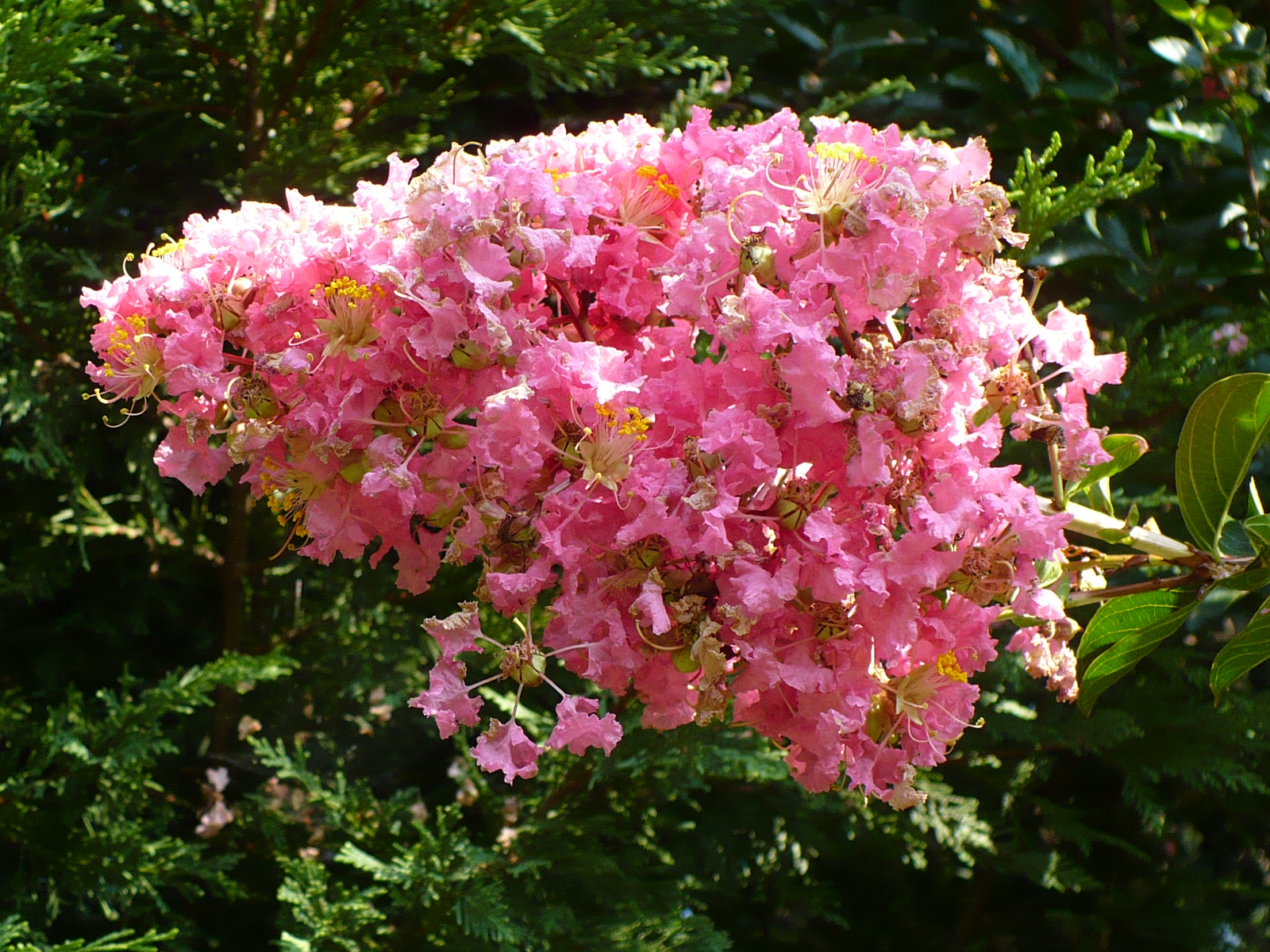
I knew about Crepe Myrtle and had one struggling near our mail box. When I put extra mulch, lawnmower droppings, leaves, or mushroom compost underneath, the soil food disappeared rapidly and the flowers began to change from boring to wow. I spent a lot of time removing lower branches to give it the Lyle Lovett look, so now we have pink fireworks on top for months. Pruning some of those flowers renewed the blooming all over. Bonus fact - Cardinals love CM seeds, and I now have a pair nesting there.

Squirrels Are Like Bears
Neat holes in the mulch are probably from squirrels digging for earthworms and grubs. Almost Eden told me - they are like bears, eating anything. Bonus fact - mama squirrel kicks the babies out of the nest rather early, so that is why I have baby squirrels eating sunflower seeds from the bird feeders.

Chaste Tree Forehead Slapper
I knew how great the Chaste Tree bush was for bees, but I grew one in a shady area and watered it diligently. The plant looked so bad I researched CT care on the Net. Errors:

  1. Never water a Chaste Tree.
  2. Always plant it in the sun.
  3. Prune it as much as desired.

I dug it up, planted it in the sun, pruned every branch somewhat, refused to water it, and saw it perk up and sprout healthy leaves.

Foundational Mistake - Jeff Lowenfels
In the olden days, every gardening book emphasized having a healthy supply of earthworms in the soil as the basis for fertile, lively plants. Wrong! The real foundation is microbial, with fungus doing a surprising amount of decomposition, movement of nutrition to plant hairs, and disease control. Therefore, moving the soil around unnecessarily is a big mistake.  Earthworms are the proof of a healthy microbial foundation - fungus, bacteria, protozoa, nematodes, all eating and being eaten - but with fungus feeding desired products to the root hairs in exchange for carbon from the plant.

Aphids love white and Peace roses.
Therefore, they attract beneficial insects and feed them.


KnockOut Roses Not Like Any Other
KnockOut roses are popular but treated badly. As disease resistant shrubs, KOs are packed with growth energy when mulched and watered. Based on several years experience - they respond with delight to heavy pruning - as much as 50% - and regain the lost height by growing and blooming all over again. Too much heat and wilted flower? - prune heavily. Too much rain  and droopy bushes - prune 50% and watch them sprout 50 blooms each.

Walliser Dictum - The Pests Are Food for Pest Predators - Backed by Sharon Lovejoy
Nothing makes us go crazier than aphids destroying rose blooms. No man-made cure works. Hosing them off? Haha. Pesticides? - sure, kill all the spiders too. The first attack will generate a response team that usually lays eggs that hatch into aphid eating monsters,  creatures which mature into egg-laying beneficials that... Jessica Walliser and Sharon Lovejoy write about this phenomenon. My white and Peace roses are trashed by aphids on the first bloom, then almost perfect the rest of the season.

One of the greatest rose hybridizers
gave us Chrysler Imperial and Queen Elizabeth roses.
A PhD, he was a Creationist.


Tiny Flowers Are Good Flowers
The beneficial insects that eat pests are tiny - not just the cute little Ladybugs. Because most of the adults need flower or pollen or both, any plant with tiny flowers will help the beneficial insect population. A constant bloom of tiny flowers will create a yard where the beneficials can wait for the cry of stricken plants. That may come from extra nectar being released, hormones, or maybe the sound of sipping and crunching from the pests. Therefore, I want:

  1. Mints
  2. Sunflowers
  3. Queen Ann's Lace
  4. Clover
  5. Carrot family plants, and
  6. Those little colorful plants that bloom in the grass for a short time.
 Mountain Mint - tiny flowers.
Many overlooked and unknown flowers are
the perfect medicine for gardening, attracting beneficial insects
and supporting other life in the garden.


Moles Are Good Soil Mixers
Every spring the gardeners share their hatred of moles with each other. I already knew they could not be killed. Secondly, I learned their annoying food tunnels, that alarm us in the spring, are difficult to trace later in the summer. Most importantly, since moles will never go away - they are superb soil mixers, like giant subway tunnel borers in comparison with earthworms, one of their favorite foods. The underground swimming of moles opens up the soil and creates room for new earthworms to take over. When moles establish storage places for earthworms - up to 1200 at a time - they are making sure more nitrogen is placed in that area.

 Queen Elizabeth Rose - developed by Lammaerts,
designed by the Creating Word.

Saturday, June 25, 2016

Heard from Three Gardening Gurus at Once -
Mulch Is Modular and Fun To Use.
Saving Planet Earth So You Don't Have To


Yesterday I heard from my favorite gardening gurus at the same time. The three are:

  • Jessica Walliser - Attracting Beneficial Bugs to Your Garden
  • Jeff Lowenfels - Teaming with Microbes - Soil
  • Sharon Lovejoy - A Blessing of Toads - The Big Picture

Sharon Lovejoy seemed surprised that I discovered her Blessing of Toads at  Cracker Barrel. All three chimed in with a like or a comment.

As I wrote before, these three books are essential for a Creation Garden, with far less work and cost, far more enjoyment and production. We had a brief spell where all the roses were waiting to bloom or just finished. 

For the KnockOuts, I pruned 50% of the bush. For the rest, I looked for dead wood, crossed canes, and unhealthy looking canes. The Jackson Rose Farm looked like a vast mulch display with little color. With some rain and watering, the roses took off again.The KOs are bursting with buds and blooms. The rest of the roses are either in full bloom, looking for some pruning, or ready to bloom he first time.

Strangely enough for some readers, the Maple Tree Rose Garden, which merged with the main rose area, is thriving with $5 roses in bloom - around 20 in all. Common sense says - 
  1. Do not plant among maple tree roots.
  2. Do not make roses compete with greedy maple roots.
  3. Do not plant roses where there is more shade.
  4. Do not even think about digging under a maple.
I made the case with Mrs. Ichabod and lost, but I am glad. Our helper and I actually dug roses in between lumps of roots. Those roses get plenty of sun in the morning, another sunbath in the afternoon. The ones most in the shade are slower, but they also bloom.

The key argument is - "I want to see the roses." The most visible flowers are going to  be enjoyed more - and our neighborhood loves them. The ones we pass every day will also get the most attention. Roses do not need a lot of work in the Creation Garden, but they need regular attention with their need for water and pruning.

Before I had any $5 roses to plant, I threw 10 bags of mushroom compost in the area where I hoped to plant something else. I covered the entire area with shredded mulch, added some garlic bulbs, and sprinkled red wiggler earthworms on top. That was in the autumn. At the worst, it was far better looking than what we inherited, an area packed with maple suckers, weeds, and broken toys.


Modular Mulch
The various weeds are pushing their way through the wood mulch. I can only blame the superfertile soil for that. Mulch builds the fungi network that Lowenfels describes so well. Earthworms and all soil creatures thrive with mulch. Besides those benefits, mulch conserves water and topsoil.

Weed seeds blow in and come up from below. Birds deposit them with fertilizer the natural way. Like any enemy, weeds find the weak spots and attack.

Mulch is modular. We do not need to re-mulch the entire garden. Instead, we:
  1. Look for weed patches.
  2. Cover them with cardboard or newspaper.
  3. Hold down the shade layer with shredded cyprus mulch - or water jugs in the back.
In the Wild Garden we used 60+ bags of autumn leaves to hold down the cardboard. That worked so well that hardly anything grew on top of the mulch. When I lifted the  cardboard, unmoved for six+ months, the former lawn was soft composted soil, easily dug, earthworm packed.

I have a new supply of cardboard and wood mulch for the areas that want to be weedy. The weeds are great ingredients for compost. Why pull them up and compost them? They are more useful when they rot there, feeding billions of soil creatures and feeding the plants I want to thrive.

Helianthus is a permanent sunflower plant,
which I want, because the squirrels eat every sunflower seed I plant.


Thursday, May 26, 2016

True Diversity in Planting the Creation Garden

Jessica Walliser writes about beetle banks,
where beetles are sheltered as an investment in pest control.

I write for the newer gardeners, because there are so many basics ignored in the colorful gardening books sold in stores. The foundational books for gardening are Lowenfels (soil), Walliser (beneficial bugs), and Lovejoy (observation and discovery).

As Jessica Walliser explains so well, planting diversity is the key to enjoying the support of beneficial bugs in the garden. Some of the efforts I have made include:

  • Letting grassy areas grow as shelter for beetles and web-less spiders.
  • Seeking out tiny-flowered plants for beneficial bugs.
  • Looking at the value of weeds, which often have unexplored virtues and benefits.
  • Emphasizing butterfly, bee, and hummingbird plants.

The umbrella flowers of he carrot family, like dill in this photo,
are appealing to beneficial insects.

Some are saying, "Thou hypocrite. Thy entire front yard is planted in roses." I like hearing from KJV fans, but they miss the mark here. I have also planted:

  1. Garlic, which repels insects and supposedly makes roses healthier.
  2. Mountain Mint, a plant that beneficial insects loves.
  3. Spirea, a low growing bush that favors butterflies and bees.
  4. Crepe Myrtle (inherited), a tall bush that currently harbors a cardinal nest.
  5. Bushes (inherited) near the house, which shelter toads and various creatures.
  6. Raspberries and Blackberries to feed the bees and birds.
Pokeweed has several virtues - deep taproots,
easy care, and berries for many birds,
which plant them for free.

Pokeweeds yield bright red poke berries,
and this native wildflower grows anywhere and everywhere.
Grandson Alex says, "Deal with it."

Birds plant Pokeweed and Wild Strawberries for me, but I leave those in the backyard.

Plant diversity means a constant flowering of weeds and flowers that feed the creatures we value so much. Many beneficial insects feed from flowers in the adult stage and set their babies upon the pests in their infant stage. Ladybugs are unusual in devouring pests at both stages.

Many plants have one bloom cycle. They display pollen, get pollinated by various creatures, and set seed. "Done. Bye. See you next year." We can see that in the low-growing weeds in the lawn. Arkansas has many wild flowers or weeds that garnish the monotonous lawn with color from time to time. They give the beneficials and bees a chance to feed all summer long, or in-between the big crops. Dandelions, a valued herb, is prominent and despised for no other reason than its ability to thrive in grass.

For example, by feeding and watering the birds, these creatures get into the habit of coming to our window feeders and nesting nearby. Likewise, the beneficial insects would rather set up housekeeping near sources of food and water.

Bombing the landscape with poisons is no way to foster diversity in insects. The effect of pesticides is to kill all insects and spiders, a bad result. The effect of fungicides is to kill bad fungus, good fungus, and other forms of life. I once had a lawn service that sprayed the yard with a weed-killer (contrary to my expressed wishes) that killed all the violets in the yard. long ago in Midland.

Almost Eden has a pile of topsoil he obtained for free from a construction site. They messed up orders in scraping and made the soil commercially unappealing. He had the low hill installed as a berm, and it began to grow with all the weeds and wildflowers dormant as seed in that soil. I said, "That is going to be wild with beneficial insects." We saw carrot family, possibly Angelica, common weeds, and some plants too exotic to try to name. I plan on visiting it with Sassy to look for insects.

My morning walks with Sassy often reveal piles of great gardening material set out as garbage. I often bring them home, so I have stumps (rescued by car), rotten wood, Gandalf staffs, and slices of trees. Almost Eden asked where I got my attractive rustic fence in the front yard. I said "Across the street. We went through the pile for the best examples."

The mint family (Mountain Mint here)
is appealing to all insects but can get away.
I told our helper, "Mulch your roses with your
mint scraps."

Monday, August 24, 2015

What I Learned Most This Year - Creation Gardening.
Chronological Order


I began the year with red wiggler earthworm populations all over the yard, and Jackson Mulch in place in future gardening areas.


I. The Microbes Were Working for Team Jackson All Along

My foundational lesson came from a serendipity discovery of Teaming with Microbes. Most gardening books are tiresome picture books that repeat the errors of the past - or they eagerly describe the cultivation of marijuana.

Teaming with Microbes opened my eyes to the recent research about the interface of plant roots, fungi, protozoa, nematodes, and bacteria. I always worked with organic/Creation principles, but here was a book that described the reasons why we should trust in God's design.


By necessity, this book is divided into two sections. The first is an explanation of soil and the soil food web. There is no getting around it. You have to know the science before you can apply it. At least in this instance, the science is fascinating, even astonishing, and we try not to make a textbook out of it. The second section is the explanation of how to work the soil food web to your soils’ advantage and to yours as a gardener. What makes this book different from other texts on soil is our strong emphasis on the biology and microbiology of soils— relationships between soil and organisms in the soil and their impact on plants. We are not abandoning soil chemistry, pH, cation exchange, porosity, texture, and other ways to describe soil. Classic soil science is covered, but from the premise that it is the stage where the biology acts out its many dramas.

Lewis, Wayne; Lowenfels, Jeff (2010-09-10). Teaming with Microbes: The Organic Gardener's Guide to the Soil Food Web, Revised Edition (Kindle Locations 129-135). Timber Press. Kindle Edition. 

This book showed me the process of complicated microbes trapping useful nutrition in the top layer of soil, with complicated swaps taking place between fungi and plant roots.


II. Sharon Lovejoy and Her Mini-Lessons with a Macro View

Sharon Lovejoy on Facebook

The princes of Serendip made accidental discoveries while looking for something else, and they applied their luck to their endeavors. We were at the Cracker Barrel looking at all the temptations for hungry diners in their gift shop. I spotted A Blessing of Toads by Sharon Lovejoy.

The genius of this author is her combination of little lessons (toads, chickadees, the absences of chemical poisons) in her larger view of gardening and bird-watching.

Sharon is on Facebook often and a lot of fun, enjoying the fruits of gardening and writing. Because of her books, I read one section at a time and plan new projects or enhance what I am doing for for the creatures in our yard.

Her books motivated me to make our yard as toad-friendly and bird-friendly as possible. Wherever water might fall, including under the soaker hoses, little ceramic pans hold water for toad hydration.


III. Jessica Walliser's Beneficial Bugs

Jessica Walliser on Facebook

Another serendipity find was Jessica Walliser's Attracting Beneficial Bugs to Your Garden.

It might surprise you to know that a mere 1 percent of the insects we come across in our lives are actually harmful. These are the creatures that consume our plants, introduce disease, bite our flesh, feed on our pets, and cause economic, aesthetic, or medical damage. These are the bugs that tend to attract our attention, and as a result they get all the press—most of it negative. 

The remaining 99 percent of insects are either benign or beneficial. Benign insects are very good at going about their business without harming our crops or us. And beneficial insects are, in fact, doing some type of good in the landscape. Insects can be beneficial for several reasons. First, they can be pollinators. We all know how important quality pollination is to a farm or garden. The world, after all, cannot function without it. Most of us can readily recognize common pollinators like honeybees and butterflies, but there are hundreds of thousands of other pollinator species in this world: beetles, moths, wasps, ants, flies, bats, and birds. Not to mention the more than thirty-five hundred species of native bees in the United States whose pollination work sadly and undeservedly plays second string to that of the imported European honeybee. Fifteen billion dollars worth of food needs to be pollinated by some little creature each and every year in the United States alone. The worth of pollinators is undeniable.

Walliser, Jessica (2014-02-26). Attracting Beneficial Bugs to Your Garden: A Natural Approach to Pest Control (Kindle Locations 184-193). Timber Press. Kindle Edition. 

Jessica Walliser's book was at the bookstore. I kept looking for a book on vines, and never found that, but I did discover Teaming and Attracting Beneficial Bugs in the process.

I always knew about the ratio between bad bugs (1%) and the good ones (99%). My mother had no fear of bugs and always liked to grab one and demonstrate its intricacies. She collected and grew butterflies and moths for photos that she published.

Jessica's work shows a vast knowledge of plants, far beyond anything I read about before, so I study her book for the relationship between plants and beneficial creatures. Suddenly the modest plants, weeds, and herbs took on new meaning.

I followed her advice and left the roses alone for the first invasion of aphids this year. My best hopes - Peace and John Paul II - were destroyed by aphids on the first round. The blooms were ugly, distorted, wilted, and loaded with aphids and other bugs. I even visited them at night, but did nothing. On the next boom cycle, the same roses were almost flawless and have remained so all summer.

If the pests are killed or picked off by hand (scratch that idea), then the pest eaters will have no food and go away. When the pests attack, the flowers send up a chemical signal that draws the beneficial bugs. The good bugs devour the pests or they lay eggs near/on the bad bugs. That explains the delay in solving the problem. The eggs need to be laid, hatched, and letting loose the hungry babies.


Tuesday, July 14, 2015

Cannot Wait To Dig Some Soil This Morning.
All My Book Finds Are Serendipitous


A WELS pastor tried to tell me I had a doctorate in agriculture. I said no, but he insisted. Finally, I said, "Don't you think I would remember if I did?" He finally conceded.

That extra degree may have been generated by the help I gave one seminary professor, who had no clue how to compost. Those who do not learn from gardening books are condemned to repeat this error.

Crepe myrtles are easy to prune,
but where is the mulch below to feed them?

Reading and observation go a long way in gardening. Initial problems generate disgust and a temptation to use an instant solution. Our crepe myrtle bush was too close to the mailbox, and it was way out of control. Our helper trimmed it back, about two wheelbarrows full. That summer it bloomed. Next we trimmed back the bottom part to show off the bark and give the bush a Lyle Lovett look. The blooms were even bigger because the bottom has been mulched, watered, and earthwormed for several years.

When the blooms are done, they can be cut off
for a second round of blooms
How many do this in the entire neighborhood? One.


When Sassy and I return from our walk, the crepe myrtle looks like floral fireworks, with enormous vibrant blooms shooting off  the top. Our single bush adds color and beauty to the entire cul-de-sac, and neighbors appreciate it. Our helper is proud of it because he did a lot of the pruning.

Today I cannot wait to dig into the watered soil and plant blueberry bushes. Almost Eden told me about things to do, and I read more on the Net when I woke up.

One big concern is birds eating the berries. I thought about netting - not a problem for the near future - and made a suggestion to Mrs. I. "Why not dedicate a bush or two to the birds. Give them all they want?" She thought that was a great idea.

God's creatures get their tithe, but they give far more than they take. I had a dozen ripe cherry tomatoes to bring in yesterday. They are just getting started and another dozen are green, ripening, enjoying the Jackson Aerial Aqueduct. Larger tomatoes get slug damage from those critters rasping away on the fruit. They rest on the ground and are easy pickings for slugs and squirrels. I find ripe ones half-eaten.

Tomato cages are against my religion. Besides, a slug can climb if it wants. A cage will not solve the slug problem. When I explored the slug beer party at night, I found a slug five feet up the tree.

Mrs. I hopes most of the basic work is done. Last year's labor made this year easy to accomplish, mulching large areas in advance. Yesterday I planted blackberries under the mulch that was placed a year ago. The size of the weeds suggested fertile, sun dappled land. The pigweed was hilariously large and branched with beautiful blossoms. I cut some to add to the mulch.


Gardening Lessons
First I learned a lot more about soil chemistry from Teaming with Microbes. The authors had been toxin addicts, but converted to organic methods when they learned more about soil life. Ditto Jessica Walliser, who had an arsenal of insecticides until she was converted by someone and eventually edited at Organic Gardening, a change of heart almost equal to St. Paul's on the road the Damascus.

That makes me inordinately proud of my upbringing, when I learned most insects were harmless and beneficial, keeping the bad ones in check. I recall my mother talking about this and showing us various insects. She even raised them for photography, read all about them, and gave slide shows on the topic.

I never went through the insecticide phase of gardening and liked the low cost of composting and mulching. I tried some weed killers but learned long ago that they promise more than they deliver. A trimmed lawn squeezes out weeds on its own, and many of our local weeds are attractive, blooming, insect-loving ground cover in the early spring. Why would wipe that out?

Facebook friend Jessical Walliser -
I am memorizing this book.

Beneficial Insects
Second, I learned about the relationship between plants and beneficial insects from Walliser's classic
Attracting Beneficial Bugs to Your Garden. I had a good attitude, which suffices for most gardening projects, but I wanted to be better informed.

Being informed makes me more trusting of the Creation solution. The key theme is wounded plants sending out signals to beneficial insects, which will only lay eggs on those plants, so their larvae will have food to consume when they hatch. Thus killing the bad bugs will kill the good ones and keep them from setting up generational controls on those pests - eggs, larvae, adults.

I see beneficial insects on my plants every day, and I see almost no insect damage now.

I own this one too.

Host Plants for Beneficial Bugs
I buy seeds and plants because they are havens for beneficial insects. Old and new favorites that contribute to this happy state are:

  • Coreopsis
  • Sunflower
  • Dill
  • Coneflower
  • Bee Balm
  • Borage
  • Lavender
  • Parsley
  • Lace Flower
  • Alyssum
  • Shasta Daisies.
Some hosting plants are free - dandelions, pigweed, Queen Ann's Lace, and such ground covers as clover and speedwell.

Another Facebook friend -
This is a fun, fact-filled, and inspirational book.
Many of my favorite books are serendipity finds, as Stan Hauerwas mentioned about his library research. He would go through the library stacks and look for something new and interesting, not off the required readings lists.

I go to book stores and book displays and look at new titles. I found

  • Teaming with Microbes
  • Attracting Beneficial Bugs
  • and A Blessing of Toads

amid the ten marijuana growing books at Barnes and Noble. Each one gave me a new perspective on gardening and a massive amount of fun, motivating information.


This is the best bird identification book,
so I can give away My Golden Book of Birds now.

Friday, July 3, 2015

Leaf Litter and Good Insects - Plan Ahead for a Healthy Garden in 2016

This graphic is for those who trust in machines and chemicals -
instead of God's Creation. They are paying big money to inflict damage.

Almost Eden Gardens and Nursery collects bags of leaves for their operation, about 1/2 block from us. The owner knows gardening, beneficial insects, and the value of organic (Creation) methods.

Another Facebook friend, Jessica Walliser, wrote:

Soldier beetles, leatherwings FAMILY Cantharidae NORTH AMERICAN SPECIES 470 
As adults, all species of solider (sic) beetles have soft, leathery wings; they fly well and serve to pollinate various flowering plants. Larval soldier beetles live in leaf litter and under rocks, logs, and debris. Larvae feed primarily at night and are fast movers with large, grasping jaws that capture insect eggs and prey insects, including grasshopper eggs, caterpillars, aphids, and mealybugs. Adults consume nectar, with many species also eating aphids and other insects. Both adult and larval soldier beetles can exude foul defensive chemicals to aid in protecting them from other predators. In the eastern United States, the orange and black Pennsylvania leatherwing is a common sight, while the brown leatherwing is more common in the West.

Walliser, Jessica (2014-02-26). Attracting Beneficial Bugs to Your Garden: A Natural Approach to Pest Control (Kindle Locations 1046-1051). Timber Press. Kindle Edition. 

---

http://www.ecosystemgardening.com/life-in-the-leaf-litter-dont-throw-a-good-thing-away.html


  • Leaf litter is also home to ladybugs, salamanders, toads, and other predators of pest insects. It is no wonder that pests like aphids thrive when we continue to destroy the habitat of the predators that would keep them under control.


Leaf litter is essential for the best bugs, but leaving it alone is also ideal for them to overwinter.

By divine design the insects settle down for the winter underneath the litter, serving as food for winter birds but also awaiting their adult stage in the spring (once again greeted by birds).

The beneficial insect sources insist that leaving areas alone is the best approach - not digging to make them neat, not  rototilling leaves into the soil. As I wrote before, most leaves will be pulled into the soil, especially where the soil is richly populated with soil creatures, especially earthworms.

The piles of dead leaves in the spring are havens for insect life and food for soil creatures. We scooped the excess into the compost bin and over the endzone of the backyard. Some dead leaves remain but most have composted into the soil or in the compost bin.

Dead leaves lying on the mulch of the main rose garden disappeared before our helper could remove them.

We treat chunks of wood and twigs the same way. We maintain a stick pile near the Jackson Bird Spa and move chunks of wood into the two rustic fence areas. Sometimes the larger wood pieces are used to frame bushes, to set them off and provide a toad shelter and bug generator. Bugs and slugs love decaying wood; toads love bugs and slugs. 

One Butterfly Bush has a large mulched area around it, logs setting it off to keep people from walking over the new plant. Around that I have planted dill, Bee Balm, and coreopsis - three beneficial insect plants.


This is my favorite bird identification book.
Sharon Lovejoy, another Facebook friend, has a wonderful, total look at gardening,
from the soil below to the air force above.

Friday, June 19, 2015

Bill Still Moving Through - Studying Ahead for Beneficial Insect Results

The Jackson Rose Farm has many places and levels to feed, many types of foods and seeds.
The squirrels do not monopolize the food or tear up the bird feeder.

Mrs. Ichabod had a routine test yesterday, so I brought the beneficial insects book in to the waiting room. I used to bring in Teaming with Microbes, but I gave the printed version to a our nursery owner neighbor, at Almost Eden.

Beneficial insects are endlessly fascinating because of their relationships to other creatures and various flowers.

Rain has prevented anything except feeding the birds, which made me very popular just before the storm broke. We had Bill on radar and saw the storm slowly circling and moving toward NW Arkansas. Sassy and I took a walk and she hurried inside to beat the rain. The drizzle - more of a misty - was already falling. I went to the backyard to scatter the combination bird seed I mixed in the pail. Bird sounds increased immediately while I was putting seed in various places to let everyone have some food before the storm.

I went inside and opened the window by the bird feeder. We watched the birds feeding and listened to their sounds as they fussed, chortled, and broadcast the meal being served. The little ones favor the finch feeder while the larger ones use the platform and the window ledge. Behind them the rain was starting to fall. The backyard looked like a very large shower room with the hot water left on.

Walliser and her book - essential for gardening and fun to read.


So I looked through the Jessica Walliser book to see what could be done to make our yard even friendlier to beneficial insects.

Part of my job as co-host of a radio program called The Organic Gardeners is to answer questions from callers about how to get rid of bugs. This never used to be a problem for me; I would tell the caller what organic product to spray to get rid of the perceived pest, and that would be that. But now that I am a confessed bug lover it’s a different story, and I struggle to find a balance. I want to go into a long, involved elucidation of how callers are gardening wrong and how they need to appreciate their bugs and how everything is connected, but if I did they would probably hang up on me. I hear the “just tell me what to spray” tone in their voice. So instead of giving a lecture, I tell them not to panic. Seldom does an insect actually kill a plant in a garden setting. Yes, the plant might not look so good for a while, but the chances of its survival are excellent.

Walliser, Jessica (2014-02-26). Attracting Beneficial Bugs to Your Garden: A Natural Approach to Pest Control (Kindle Locations 1712-1718). Timber Press. Kindle Edition. 

I never went through that phase of giving up chemical solutions, rototillers, and finding joy in organic gardening. Instead, I trusted in the beneficial bugs from the start. I grew up with my mother capturing bugs and showing us interesting features. I read every organic gardening book I could find and went through the children's library to read those gardening and nature books too.

When my future wife and I were dating in college, we often found moths in the fridge at home, or perhaps on the curtains if the newly hatched escaped. My mother photographed them for magazines and wrote about them. She knew moths and butterflies, too.

The trouble with an urban living (compared to the farm) is having all the experiences with insects indoors, where bugs are annoying vermin. Outside, insects and the other creatures keep each other controlled, so there is a constant dynamic that is fun to watch. The insects will do some harm, but they are limited by the creatures that prey upon them.

The landscape complexity Paula Shrewsbury champions is essential to encouraging your good bugs. You don’t have to rip up every inch of lawn (but if you really want to, go right ahead), nor do you have to change everything about your existing garden. “A lot of home landscapes already have some diversity as far as trees and shrubs are concerned, but when you add more, look to diversify those plant species,” she advises. She suggests these three steps to creating a beneficials-friendly landscape: first, choose plants that thrive in your climate; second, select plants known to support natural enemies....

Walliser, Jessica (2014-02-26). Attracting Beneficial Bugs to Your Garden: A Natural Approach to Pest Control (Kindle Locations 1760-1764). Timber Press. Kindle Edition. 


Queen Anne's Lace has a milder cousin, called Lace Flower, which Walliser likes more.
I looked for Lace Flower photos and got Queen Ann's Lace each time.
Erase the bug (or spot of blood) on this and you have - Lace Flower.
Beneficial insects are crazy for the tiny flowers of the carrot family.


Flowers and Weeds for Beneficial Insects 
Many common flowers and weeds are overlooked as favorite hang-outs for insects. The early blooming weeds provide initial pollen and nectar for bees and insects that prey upon pests. The pest eaters - or parasitizing egg-layers - often need nectar and pollen for themselves, if not as their main food, then at other times when fresh prey is not abundant.

I look at the low-lying, spreading weeds in the grass as early bee feeders. They are all quite attractive on their own. Other plants are simply not ready to bloom and provide harbors for the insects at the first sign of spring.

Roses were blooming and feeding bees very early, but Queen Ann's Lace and borage flowered much later.

My friends tell me the Chaste Tree, a new plant to me, is wildly popular with bees and insects.

Coreopsis - everyone has heard the name, but how many grow it?
Beneficial insects love coreopsis.


Easy to grow Coreopsis (tick-seed) is a great plant for beneficial insects.

Sunflowers are good for many insects and fun to watch grow.

Bee Balm or Horse Mint is also Oswego Tea and Beramot.
Nevertheless, insects, butterflies, and hummingbirds like it.


Bee Balm (horse mint) is a robust plant that many insects love and rumored to be a hummingbird favorite as well.

Queen Ann's Lace is one of many carrot family plants with tiny flowers for tiny insects. Not every insect can feed from every flower, and many of the best beneficial insects love this family of plants, including dill and parsley. I just bought Lace Flower, which is the genteel version of Queen Ann's Lace. Walliser impugned Queen Ann's Lace, associating it with highways and semis roaring by, so I told her I got my supply at the Lowe's empty lot, where the semis are parked. She responded favorably on Facebook.

This is the best overall gardening book, giving a great wholistic view of
the creatures and flowers working together in God's Creation.

Behind these fingers - Sharon Lovejoy.
Gardening is a dirty job but fun and relaxing.

This is the best bird identification book I have found.

Readers can FB friend and chat with my two favorite gardening writers on Facebook. They are:

Sharon Lovejoy

Jessical Walliser.

I often drop in a comment if their posts are related to what I am doing - and they usually are.

A kiddie pool with short sides is perfect for these clowns.
They splash, fuss, and have a great time.
They earn their food by eating insects and grubs.
Those beaks are perfect for grubbing.
Grackles are a larger version - not much for singing, but very smart.


Beneficial Birds
All birds are beneficial, especially those who never win popularity contests - crows, starlings, and grackles.

When I step into the backyard, a dozen or more birds launch into the air - every time. But often they feed a few feet from me, because I am no threat but a reliable food source.

The main benefit birds seek is a plenty of bathing space. When I opened the Community Pool for the birds, with a spare in the Wild Garden, birds were wary. Now the kiddie pool is filthy on the bottom, testimony to the crud washed off their feathers each day.

A rainstorm should bathe all the birds, right? They can perch on a limb, get a shower, shake it off and preen. But after every storm here I find birds in the street puddles, having joyous baths, even as cars drive by.

This morning the birds are interested in feeding, after using up so many calories staying warm. The platform feeder is seldom level, because the squirrels climb into it or land on it for food. The birds then feed at an absurd angle, but without complaint. Some seed gets dumped on the ground, so the ground feeders have a party in the garden.

All the birds feed from the mulch and lawn and garden. A large group of birds think of the Jackson Rose Farm as their favorite place to feed and bathe.

Grackles rock the metallic colors in sunlight, with those yellow eyes for contrast.
I swear the grackles have a special gleam in their eyes when they
snag a nut from the bird feeder and depart.


Lowenfels always poses with a clown nose on.

Converts
We were typical suburban gardeners. Each year, at the beginning of the growing season, we carpet bombed our lawns with a mega-dose of water-soluble, high-nitrogen fertilizer and watered like crazy; then we strafed their weeds with a popular broadleaf herbicide. Next, we attacked our vegetable gardens and flower beds with a bag or two of commercial fertilizer and leveled them with a rototiller until the soil, the color and texture of finely ground coffee, lay as smooth and level as the Bonneville Salt Flats. These things we did religiously, as did most of our neighbors. Once was never enough either. We continued to use chemical fertilizers throughout the season as if we were competing in the large-vegetable contest at the Alaska State Fair— and at the end of the season we rototilled again, for some inexplicable reason. 

When necessary (and it often was), we would suit up into protective clothing— complete with rubber gloves and a face mask— and paint our birches to protect them from invading aphids by using some god-awful smelling stuff that listed ingredients no normal person could pronounce, assuming he or she took the time to read the incredibly small print on the chemical’s label. Then we sprayed our spruce trees with something that smelled even worse— something so strong, one application lasted not one but two years. It was a good thing we did protect ourselves, as both spray products are now off the market, withdrawn as health hazards.

Lewis, Wayne;  Lowenfels, Jeff; (2010-09-10). Teaming with Microbes: The Organic Gardener's Guide to the Soil Food Web, Revised Edition (Kindle Locations 73-84). Timber Press. Kindle Edition. 


Wayne Lewis is a lifelong Alaskan gardener. He has worked with Jeff on many projects over the past 25 years, including the now national Plant a Row for the Hungry program (started in Anchorage by Jeff), which encourages gardeners to donate a portion of their harvest to charitable organizations in their community.

Thursday, May 7, 2015

All things bright and beautiful, all creatures great and small,
All things wise and wonderful: the Lord God made them all.

American toad
Every since I bought A Blessing of Toads, by Sharon Lovejoy, I have worked on ways to attract and keep toads in the yard.

Today was a great day for gardening. Our helper came over after the rain - soon after I found our rose romantic was visiting on Saturday. I wanted to finish the Creature Convention Center and move the logs.

As soon as we moved one log, a large toad appeared, looking bored and placid. I was delighted, learning tonight that toads love logs.

In general, logs left on the ground are great habitats for insects, birds, and toads. We had enough small ones to create circles around the back bushes.

My shallow pans of water are doubtless handy for the toads. They need to hydrate (not swim, not drink) each day. They sit in shallow water for that. I think of the shallow pans as bird friendly, but they also support the freeloading squirrels and the hard-working toads.

Last year a small toad appeared under the water pan I kept under the faucet, to make sure animals always had fresh water near the house. Sassy's outdoor activity is brief, but she does use that water from time to time. Another toad was in the front yard, where I keep another pan for catching faucet water.

Currently I have 12 shallow pans with clean water, and they need tending twice a day.

We finished the Creature Convention Center quickly. It is simply two large plastic sheets, 60 inches by 30 inches, separated by blocks from Mrs. Wright's yard. The birds and squirrels loved it from the start. The blocks and levels create extra nooks for food, shade, and mischief. The file cabinet drawer, with food in it, is often the scene of a squirrel popping out to scare a starling away from the grub. The file cabinet is falling apart in the rain, so we had to upgrade.

Articles Worth Reading
How to attract toads.

A complete tutorial about toad habitats.

Toads get rid of garden insects - at a prodigious rate.

An eccentric article on toads and toad houses.

Reversing the amphibian decline.


Toad of Toad Hall is one of the greatest characters in children's literature. The Wind in the Willows is a favorite of adults and children alike.

The window screen effect is from Amazon, where this castle for toads
can be purchased for $70 or more.

This link tells about building a toad house -
I did the same when I cracked a clay pot from Lowe's - 88 cents.
But I cracked six of them.

This looks like a fine place to live.
Logs, shallow pans of water, and clay pots will shelter and welcome toads, who can eat 10,000 insects each per summer. They also love slugs. They eat a few beneficials, even earthworms, but gardeners give these creations of God all the glory for maintaining their gardens.

Two other ways to welcome toads are:

  • Eliminate all pesticides.
  • Eliminate herbicides and fungicide.


As I mentioned before with the myth of hawks controlling the rabbit population - they have it upside down. Hawks can only grow in numbers if they have enough meat. Therefore, the rabbit population controls the numbers of hawks.

If the gardeners want to kill off all the insects with pesticides and systemic poisons, then the creatures eating them - like toads - will go elsewhere. And then the pests will return without beneficial creatures in large numbers to devour them before they take over.

Retaking Toad Hall