Showing posts with label butterflies. Show all posts

Friday, June 30, 2023

Bracing for Butterfly Season

Butterfly Weed has long-lasting orange flowers. Mine are bracing for the arrival of monarchs and related butterflies.


One reason to avoid news channels is the constant, vague statement that an area is bracing for an upcoming event. I am curious to find out how a region can brace.

I am bracing for the butterfly season - seriously. That was a Kardashian emphatic statement, reason enough to avoid them.

Butterflies are another matter. People notice them most of all, because they are relatively rare, perhaps because grass is not on their menu.

How do I brace for the butterfly season? 

The season starts a year or two early with planting butterfly loving vegetation in a sunny location. That starts slowly and builds steadily.

I have planted - for the butterflies:

Butterfly Weed - a reliable orange flower that attracts the monarch family.

Monarch butterfly plants - There are a number of them, closely related. I kept ordering them until they took over the entire width of the front patio.

Joe Pye Weed - lavender and musk fragrances, flowers with hundreds of tempting places to feed from the flowers. It may reach higher than 9 feet this summer.

Clethra - Summer Sweet, or Cinnabon Shrub - sugar and cinnamon fragrances, tiny little bottle brush flowers, very slow to grow. People brace for the aroma and light up - "What is that?." Butterflies, bees, and hummingbirds line up for sensory overload.

Various mints - bee balm, cat mint, mountain mint. Plants with tiny flowers attract delicate butterflies, bees, and hummingbirds.

Pokeweed - a real feeder - flowers and fruit for butterflies, birds, and bees. They do not need to be bought or planted. Birds plant them, with fertilizer, through God's air express facilities. The birds' favorite plant (no equal) is Poke, and they cheerfully enjoy the berry. They jettison the berries and add some fertilizer. 

 If God manages butterfly plants so well - like this Joe Pye Weed - how much more will He do for those who believe in Jesus Christ, the Lord of Creation?


Tuesday, July 20, 2021

Random Planting Works Sporadically


Ranger Bob came over to order some truck parts, so we took Christina out (to the porch) for coffee. 

Bob decided to tell me how he would have planted Joe Pye, since it grows so tall. I listened in astonishment. "This is the landscaper who found a collection of Hog Peanut Weed plants carefully cut and placed in a little pile in his yard." Bob jumped in to tell Christina, "I knew who did that the moment I saw it."

In defense of my plans and plants, I pointed out that I had no idea that Joe Pye could grow over eight feet tall and spread out as well. The beauty of this plant is that I can cut individual branches off - to give more sun to roses - and the rest of the plant will thrive.

The gardening industry seduced me with the Butterfly Plants genre and then expanded that to Pollinator and Hummingbird Plants. But now the dreams can be harvested daily. The late-blooming Joe Pye and Clethra are attracting butterflies and hummingbirds as surely as those ads caught my attention.

We had hummingbirds competing in the backyard for glads and in the front for the feeders.


Plant Insect Nostalgia 

Our rural romps as children led us to breaking open milkweed pods to scatter the seed, opening the stems to see the milky sap. They were easy to find and taken for granted. Now people buy milkweed plants (as I did) and hope the crop will last. We want Monarch butterflies to prosper.

I have been aiming for them since we moved to Springdale. I got Butterfly Weed going and added many butterfly plants, but no Milkweed grew. I forgot that I planted some along the tiny front porch fence and they finally grew up and formed buds. 

Yesterday, before anyone was around, I saw a Monarch stop at the row of plants along the porch fence. It settled down - making my day.


Saturday, August 17, 2019

Just When I Thought - "Rose Garden!" - A Butterfly Hummingbird Garden Appeared


We were at the Highlands Oncology Group (H.O.G.) yesterday, and saw a hand-made poster. "Just when a caterpillar thought the world was over, it became a butterfly."

This may be the original version - "What the caterpillar calls the end of the world, the master calls a butterfly."--Richard Bach. We see many three generation groups at HOG, not always sure if it is grandparent, child, or grandchild being treated.

As readers know, I have always used Creation or organic principles in growing gardens in Michigan, Minnesota, St. Louis, and Arkansas. Various attempts to use the sunniest part of our yard in Arkansas just started to succeed this summer. In that narrowly defined and very sunny area, I have great examples of -

  • Wild Ginger Hidden Lily
  • Joe Pye
  • Comfrey
  • Yarrow
  • Chaste Tree.

Recently I walked around the corner of this remote location (hardest to reach and to enjoy) - and it was alive with birds feeding, rabbits sheltering, and butterflies flying. The area is bathed in sunshine and boasts the richest soil in the yard, layers of organic matter (newspaper, wood mulch, hay bales) and plenty of earthworms.


Now we spend time on the porch, in the shade, overlooking the rose garden. Once Ranger Bob installed the hummingbird feeder, the hummingbird activity increased. Instead of catching a glimpse of them, they parade around the garden to sip the flowers and stop to feed and fight at the little feeder.

The result is not only the bird and rabbit population doing well, but the hummingbird and butterfly provide a constant source of peace, enjoyment, and surprises. Hummers are the only birds who hover and move closer to humans as they increase their trust. Two zoomed in so close that the audience started to duck. I sensed them laughing at us.


How Did This Happen?
I doubt whether the creatures are as geographical as we are, so our yard is a combination of convenient shelters and food sources for them. This took time to develop from an overgrown and seldom trimmed lot to one where the trees are pruned, the grass is cut, and a wide variety of plants are grown.


  1. The backyard Gardener fence has a row of blooming Crepe Myrtle and flowering Hosta at the moment.
  2. The backyard Wright fence is mostly wild, with some Butterfly Weed and raspberries. Mouse Ears are doing well, and they host a butterfly two.
  3. The bedroom windows are shaded by large Butterfly Bushes that always receive extra rain water and enjoyed a lot of extra organic feeding last fall. That helped when the rains fell, so we now have blooms above the roofline and butterflies tending them.
  4. The rose garden matured in many ways this summer -
  • Mountain Mints
  • Bee Balms
  • Cat Mints
  • Hosta
  • Joe Pye 
  • Fever Few
  • Wild Strawberry
  • Chaste Tree
  • Crepe Myrtle
  • Spirea Bush
  • Daisies
  • Trumpet Vine (also in the backyard)
  • Balloon Flowers
  • Butterfly Weed.
Beneficial insects, bees, butterflies, and hummingbirds love this combination of steady blooms, tiny flowers, and seasonal blooms, keeping them in food and shelter year around. I will transplant a lot of free Hostas, because they bloom heartily during the late summer and feed the hummers.

Fall planting seems to be viewed as food for the rabbits all winter, so the additions next spring will be:
  1. More roses - Veterans Honor
  2. More Joe Pye
  3. More Feverfew 
  4. Hibiscus for color
  5. Maybe some of highly touted ground covers
  6. Definitely Clethra where it can be the star of the show.


Thursday, December 13, 2018

Butterfly Lessons

Gladys Parker, co-ed, 1931.
She went to teacher's college, taught in country schools, and spent 10 years to graduate from Augustana during the Depression.


Mom grew up on an organic farm, which they just called "a farm" in those days. She became an expert on herbs, wild flowers, butterflies, and moths, photographing and publishing  her photographs in magazines.

My future wife Chris learned what it was like to be in that house on 18th Street A. Moths were in the fridge, and one escaped to rest and warm up on the drapes.

Did I listen and learn about butterflies, moths, and wild flowers? Composting? No.

So I had to start from zero when the gardening bug hit me. Chris says I was normal until we moved to Midland. All of the sudden, the farmer came out in me. I read every book on soil, plants, and animal life in the Grace Dow Library and bought many more from Rodale.

 The Monarch is sipping nectar from the sunflower, which is virtually an aircraft carrier for beneficial insects.


Butterfly Lessons

I have been trying to use the sunniest part of our yard, which once hosted $5 roses I got on sale. I moved them and tried straw-bail gardening, which ended as slug breeding. Those critters were so happy and well fed - rotting organic matter, regular soaking, no toxins. Paradise.

But now I am making the area a butterfly garden. I even moved most of the Wild Ginger Hidden Lilies to make a green fence in the back yard.

The first installation was a Chaste Tree, which we definitely killed by digging it up in the dry season, cutting its roots, and moving to the east edge of the Butterfly Garden. I dumped a bag of Stinky Peat (peat moss + manure) on its
 base and cut back all the branches, after the plant showed all signs of death - drooping with black withered leaves. Two weeks later, after I bought a replacement, the shrub leafed out and looked great. The new one was planed in the dry sunny area near the sidewalk.

Recipe for going crazy - My initial instructions for Chaste Tree were - pruning is fine but never water it. Later instructions were - water it frequently. I ended up with three Chaste Trees - now four - and the watered ones did very well. They are loved by bumble bees, which I find endlessly fun to watch.

Butterfly Hosting and Adult Butterfly Feeding
I decided to study butterfly plants more for the 2019 season. There are two kinds of plants for butterflies:

  1. Hosting plants for caterpillars.
  2. Nectar plants for adult butterflies.

In God's plan, butterflies are very particular about the where to hatch the children. The prime example is Milkweed for the Monarch caterpillars. Everyone should grow them and capture some caterpillars on Milkweed to watch them change over. Mom lived with us in New Ulm, so she taught me how. Reading about this is nothing compared to watching it happen.


Hosting the Children
So, besides the Milkweed family, what are the best hosting plants for a wide variety of butterflies? The top two are the Oak tree (shock) and Pussy Willows (need some). I have many different mints and cover crop flowers, so I am content about my gardens as nurseries for caterpillars.

Most butterflies specialize in one plant, so we can see how God has teamed a special butterfly for a particular plant, often an overlooked one like Buckwheat.

 Order Joe Pye early. Like Milkweed, it sells out before the other plants.

Nectar for the Adults - Start with Joe Pye
Everyone enjoys seeing butterflies, so I am building up the nectar side everywhere for them.

Joe Pye is the first choice for seeing butterflies all season. They bloom a bit late but normally have butterflies and beneficial insects feeding every day until the last bloom gives up. Joe Pye is a hardy perennial, so it is inexpensive and easy to grow and maintain.

If you can, buy a couple of Cinnabon Trees, aka Clethra, aka Summersweet aka... This shrub gives off a delicious sweet cinnamon scent from the plant all the time, and its flowers are a total delight to butterflies and beneficials.

 Butterfly puddling station constructed from a terra cotta saucer with gravel and a couple of rocks on which the butterflies can land to sip mineralized water. • Photo courtesy of The Wildlife Gardener.


Birdbaths Become Butterfly Puddles
I am not happy with my two small birdbaths, so I was happy to be reminded of the butterfly puddle. The pedestal birdbaths are the right size to have sand plus manure plus water for butterflies. Butterflies like to sip the salts and water, and they need a more secure place.


Saturday, June 16, 2018

Building a Butterfly Garden

 We took Monarchs for granted when milkweed was abundant.

Mosquito spraying is very effective against ladybugs and butterflies, but people can still build a butterfly garden and enjoy the results.

 Joe Pye Weed kept topping the lists for fun plants to grow,
so I started two and they were pollinator convention centers in bloom all summer. Butterflies love Joe Pye.


The first requirement is the sunniest place in the yard. That is also the least viewed area for us, so it was also ignored. I had a marvelous crop of crabgrass, actually a grain brought over by thoughtless Europeans. Then I tried a straw-bail garden, which proved to be a holiday resort for slugs, with this formula - start with straw and soak with water. That combination gives them all the food, water, and housing they need to conquer the area.

 Almost Eden sold me two Clethra bushes, and now they are well established.
Tiny flowers bring big results, and they are aromatic - songbirds like them as well.


So I turned over a new leaf and dedicated the area to butterflies. The following are great butterfly plants:

  • Joe Pye Weed, which can be six feet tall or the shorter variety, Little Joe. Butteflies always congregation around the blossoms.
  • Clethra - aka Summersweet aka Pepperbush - known for attracting all pollinators and butterflies.
  • Milkweed and Butterfly Weed are for Monarch butterflies.
  • Borage is unusually easy to grow, just scatter the seed. It grows flowers and drops seed all summer.
  • Hollyhocks are associated with old-fashioned gardens, perhaps because they stand out against a building and seed themselves.
  • Parsley brings Black Swallowtail butterflies.
  • And more - such as zinnias, lupine, etc.
I have a small sunny area, so I am going to fill it with Joe Pye - already established - and Clethra, mints, borage.

The rose garden is leavened with various pollinator plants - mints, Joe Pye, and daisies. I can add more in the future.

 Borage is the tiny version of its cousin Comfrey,
and so easy to grow. Tis another butterfly plant.

Saturday, May 12, 2018

Here Comes the Joe Pye Weed

 There are varieties of Joe Pye Weed.

I use the The Growers Exchange for herbs. The plants come wrapped and in perfect shape, still moist. They only sell herbs, but herbs are a good investment.

I kept hearing about this plant in connection with butterflies and started two plants last year. They grew and bloomed fast. The main selling point - butteflies crowded around this plant like crazy and it stayed in bloom, giving off a pleasant medicinal scent.

This spring both plants came up and look ready to bloom again, ahead of the roses.

Readers will notice that certain plants instantly attract specific insects. Sometimes the plants (like daisies) attract overlooked but heroic insects (Tachinid flies). Daisies have the additional benefit of growing in ever-growing mounds. The Tachinids attack aphids, so this all seems planned for the rose garden.

Mountain Mint is a large plant that grows well with no pampering. Its constant habit of blooming means that various insects will have a constant source of food.

 I have learned that tiny blooms are favored by tiny insects,
which are beneficial.


Garden Uses - Missouri Botanical Garden

Many people perceive Joe Pye weed to be nothing more than a roadside weed and have never seriously considered its outstanding ornamental attributes. It is a substantial plant which needs space, but when planted in groups or massed can provide spectacular flowering and architectural height. Border rears, cottage gardens, meadows, native plant gardens, wild/naturalized areas or water margins.

--


By Nikki Tilley (Author of The Bulb-o-licious Garden) 
Eupatorium purpureum, or Joe-pye weed as most people know it, is far from an unwanted weed to me. This attractive plant produces pale pink-purple flowers that last from mid-summer through fall. It’s a great addition to nearly any garden and a must have for wildlife lovers, attracting a multitude of butterflies with its sweet nectar. Growing Joe-pye weed flowers is a wonderful way to bring a little bit of nature to your backyard. What are Joe-Pye Weed Flowers? Joe-pye weed flowers were named after a New England man that used the plant medicinally for helping people with typhus fever. In addition to its medicinal properties, both the flowers and seeds have been used in producing pink or red dye for textiles. In their native environment, these plants can be found in thickets and woodlands throughout the eastern half of North America. The plants are hardy from USDA Zones 4-9. They reach heights of anywhere between 3 and 12 feet, offering great focal interest when using Joe-pye weeds in the garden. In addition, the flowers have a light vanilla fragrance that becomes more intense when crushed.

Read more at Gardening Know How: Joe-Pye Weed Care – Growing Joe-Pye Weed Flowers And When To Plant Joe-Pye
Weed https://www.gardeningknowhow.com/ornamental/flowers/joe-pye-weed/growing-joe-pye-weed.htm

--

Plant Care Today

Using Joe Pye Weed In The Landscape

These native perennials grow easily and well. It also makes a marvelous addition to a butterfly, hummingbird, and bee garden. The flowers smell sweet with a scent reminiscent of vanilla and extremely attractive to these beneficial pollinators.
Joe Pye Weed is especially recommended for those wishing to attract and support Monarch butterflies. Other butterflies, especially those that gets attracted to Joe Pye Weed flowers include black swallowtails and Tiger swallowtails.
Because these plants do grow tall (upwards of 6 feet) and thick, they also make an excellent spring and summertime privacy screen. Planting them in a hedge along property lines makes a smart use.
Also, this plant provides an excellent backdrop for a perennial garden consisting of shorter types of self seeding annuals and/or a bulb garden.
Because these plants blossom in the late summer and into the fall, they can take up where your early bloomers left off. In this way, you can make sure of having pretty flowers throughout the growing season.
If you struggle with damp, low spots in your yard, Joe Pye Weed serves as the perfect choice. It prefers average-to-rich soil and consistently moist, and it does quite well in areas of full sun to partial shade.
Full sun is definitely preferred because plants may grow excessively leggy and limp in light shade. With the right conditions, you can count on this sturdy survivor to grow well for you and provide both beauty and function.

Is It Really a Weed?

The term weed is open to interpretation. Joe Pye Weed comes from the wild and one can quickly consider it as a wildflower. It does grow natively, yet it submits to many positive uses and can make an excellent addition to a typical yard, a flower garden, and a butterfly garden.

Joe Pye Weed As Medicine

In natural medicine, you can use Joe Pye Weed in a number of different ways. The roots are considered especially beneficial and are gathered to be dried, ground and brewed as an herbal tea tonic.
The plant holds a long history of use in Native American and backwoods medicine. You can use the roots, leaves, and flowers of all varieties to create teas that are said to address problems as diverse as:
  • Respiratory Problems
  • Bladder Stones
  • Kidney Stones
  • Rheumatism
  • Impotence
  • Diarrhea
  • Fever
  • Gout
The plant contains immune boosting polysaccharides, and stimulating the immune system may help the body to overcome fevers and illnesses on its own.

Dry The Flowers, Leaves & Roots

Sweet Joe Pye Weed with its vanilla scented leaves is the best choice for making medicinal and relaxing teas.
To use the leaves and the stems as a medicinal tea, you should harvest them during the summer prior to the opening of the flower buds. Hang them or lay them out in an area that has good air circulation. When completely dry, you can store them for use as a medicinal tea.
To make a pleasant tasting herbal tea, harvest the flowers and dry them separately.
---

Medicinal[edit]

Joe Pye (Jopi in the Native tongue), an Indian healer from New England, used E. purpureum to treat a variety of ailments, which led to the name Joe-Pye weed for these plants.[10] Folklore says that Joe Pye used this plant to cure fevers. Folklore also states that American colonists used this plant to treat typhus outbreaks.[11] The author Hemmerly writes that the Indians used Joe Pye Weed in the treatment of kidney stones and other urinary tract ailments.[12] A peer-reviewed study suggests that Joe Pye of plant fame was a Mohican sachem named Schauquethqueat who lived in the mission town of Stockbridge, Massachusetts from ca. 1740 to ca. 1785 and who took as his Christian name, Joseph Pye.[13]

 Monarch Flower sounds more appealing than Butterfly Weed, a cousin of Milkweed. Monarch Butterflies need one or the other to attract them. And others like BW.

Saturday, August 20, 2016

Sunshower Yesterday - Planning the Butterfly Garden

This sunshower is from Wikipedia.

Yesterday I went to the car, long after an earlier burst of rain, so the sun was shining brightly. I wanted to get something from the Icha-boat.

Rain fell hard on me in the bright sunlight -  a sunshower. That confused my distracted mind. I looked at the roses - they were dripping with rain. The eaves were shedding rain too. And I was wet.

More rain may fall today, so the garden will be in good shape for yanking maple and oak trees, and for transplanting some Raspberries and Blackberries to the Wild Garden. I thought their rampant growth would be modified a bit in the shadier areas, but if not, the birds will get additional food and perches. Blackberries are growing like the latest Fuller Seminary fad - on the opposite side of the house, which is sunny and somewhat watered. I used the branch clippers to cut some Blackberry canes that were basking in the sunshine on driveway. No wonder they are so prevalent in the State of Washington.

I am re-setting the Sunny Garden:

  • Hot, dry, sunny, and grassy in its primitive state.
  • Soggy and sluggy last year as Straw Bale Garden and the Rose Garden for Mrs. Wright. I moved those roses to the main rose garden - the entire front yard.
  • Tomato and Raspberry garden this summer.
  • Butterfly Garden next year.
Coreopsis - Almost Eden
When I visited the Coreopsis Jungle at Almost Eden the other day, several types of butterflies, two types of bees, some wasps, and Flower Flies were feeding at once. Soon, perhaps today, I will take close-ups and a video of the activity. 

Fall and winter will give me a chance to decide on the best plants for the Butterfly Garden. As Jessica Walliser observed in a recent column, we should aim at the larvae and the adults at the same time. Like most beneficial bugs, Butterflies have different needs at the larval and adult stages. The famous Ladybug is voracious at both stages, but in many cases, the adults need pollen and nectar while their newly hatching babies dine on flesh of aphids and pest caterpillars.

Socrates was sentenced to drink Poison Hemlock tea,
portrayed by the French painter David.


I had a tribe of baby Ladybugs on my Poison Hemlock, but I chose to cut it down rather than explain to my wife and daughter-in-law that I was growing the last drink of Socrates in the garden. The plants were impressive, but so are Hogweeds, which were grown by the rich in England. 

Giant Hogweed - above - is in the same carrot family as Poison Hemlock and
Wild Parsnip. Hogweed also attracts beneficial insects, but
I prefer the less obnoxious Queen Ann's Lace.
The linked plants should be avoided, but Queen Ann's Lace
can be identified by her hairy legs (hairy stems).

I told a reader, "When we want to visit beautiful gardens, we go to the front yard, the backyard, or Almost Eden. Sassy loves to walk over, because she has so many places to explore with her nose while I admire the plants and insect life."

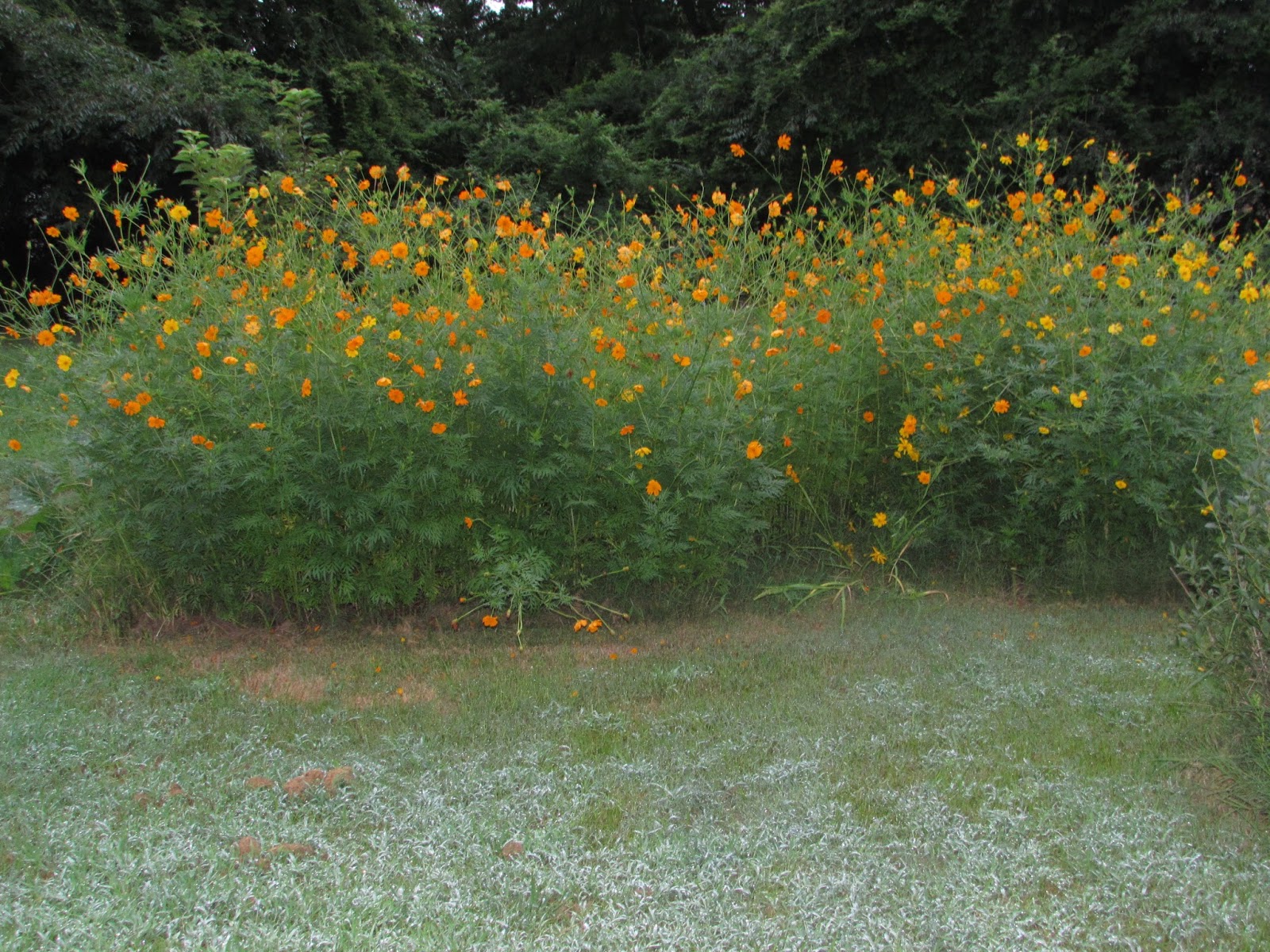
 A mass of Coreopsis flowers is irresistible
to bees, wasps, and butterflies. 

Friday, May 27, 2016

Moving the Butterfly Bush, Harvesting Asparagus from a Friend


Our Butterfly Bush - White Profusion if you forgot - has done so well near the bird feeders that I decided to move a tiny, struggling Butterfly Bush. It will help form a bird-perch, butterfly host, and natural screen around the windows.

Sassy wanted to go out with me until she detected a mist falling. She noped that and asked to go back in. So I pulled my hat down against the Sou-wester blowing in and fetched the distant Butterfly Bush. Last year, I hastily planted the bush on higher ground. The little bush probably had too little moisture. And the slugs ravaged the bush for a long time, giving me a chance to try out useless slug repellents and cures.
White Profusion Butterfly Bush.
A diversity of planting throughout the garden will
support the larvae of various butterflies.

White Profusion Butterfly Bush

I pruned another Butterfly Bush into extinction, so I decided to water the little tyke more, which began to grow a bit this year. The transfer was easy. The clay was soft but not waterlogged. Afterwards, I made a toad-friendly log fence around the new bush and watered it generously with rain-barrel water.

I also dumped a rain-barrel on the large White Profusion, which is now about 8 feet tall and not ready to start blooming. The little one, Bonnie, may get quite large in time.

Buddleia davidii 
'Bonnie' (Bonnie Butterfly Bush) This Mike Dirr selection was named after his wife, Bonnie, and if you know Mike, you know that it must be one fine Buddleia! This giant deer resistant butterfly bush reaches 10' tall and is covered in large grey-green leaves, then topped from June until frost with large 10" panicles (flowers)  of very fragrant, light blue-violet (RHS 94D) flowers. (Hardiness Zone 5-10) -
See more at: http://www.plantdelights.com/Article/Buddleia-Butterfly-Bush#sthash.iug1CBFw.dpuf
Rain was expected a 4 PM but should arrive later with some force.

The birds were anxious to feed, so I re-supplied them with sunflower seeds today and watched the lively feeding frenzy. When Junior Squirrel showed up again to keep the birds away, I opened and shut the window to watch his standing broad jump away. Very pleasing.

The male cardinal is feeding from the platform or the ground several times a day. I imagine the female is sitting on the eggs in the Crepe Myrtle bush.

Once the birds were feeding on the hanging feeder when the squirrels reach made it spin around. He took a swipe at them to shoo them away. They went to the platform and the Jackson EZ Bird Swing.
The creatures are fun to watch, constantly entertaining.

Lantana are grown to excess in Phoenix, because they are drought tolerant,
but they also bloom well and attract butterflies here.


Sunday, September 21, 2014

Feeding the Birds


I remember the days when I could buy some suet at the grocery store and get some citrus bags for free. When they began selling pre-cut meat, the suet had to come from the bird food supply companies, where one lump is $6 - and the minimal order is $20.

Dime's Meat Store sells suet because they actually cut their own meat. I ordered mesh bags from a supply house to hang the suet. I will put 10 bags around the yard today, hoping this does not make the yard Raccoon Central. The butcher and I exchanged raccoon stories when I got the suet.


Mine was pretty funny, except the varmits ate all the food I was leaving out for bluebirds and the pileated woodpeckers. In Bella Vista we had bird feeding stations all around the house, so pulling up to the house was something like visiting an airport for birds. They were everywhere. Since we lived above a creek, next to oak woods, and had a lawn and bushes, all the ingredients were there for a constant display of bird life. Blue jays built a nest outside our bedroom window, in the bushes, and we watched them hatch, flutter their wings, and learn to fly.

Our dogs were waking up in the wee hours from noise, so I kept a big flashlight near the bed. At 3 AM I saw dimly a raccoon on the window ledge outside, fiddling with the suet basket. I knew how to terrify him, as Sassy growled and moaned on the bed. I got right up to the window and shone the light in his diabolical eyes. He didn't flinch or look away. Instead, with one arm he reached back and unhitched the suet basket, letting the treasure drop to the ground. He followed it down and enjoyed his treat.

Nothing like a pound of suet to purge the system.

My only hope was that he got as sick on that square of suet as he did on the big lump from Dunhill, which he quickly recycled back onto the deck.


In short, suet-eating birds are insect eaters, so suet helps establish and fortify the best possible bird varieties:

  • Starlings
  • Cardinals
  • Woodpeckers
  • Blue jays
  • Chickadees
  • Blue birds
  • Juncos
  • Nuthatches

Downy Woodpecker - by Norma Boeckler.

These birds do well all winter because God decreed that insects would leave their larvae in bark and hidden in bushes. If there is a sleet storm, their food is hidden beneath ice, and they are really desperate. Otherwise, they enjoy the treats and use them as a small part of their diet.


As I wrote before, there are many gardening aspects to welcoming the birds. They enjoy a combination of trees, bushes, grass, and various plants - with plenty of bathing/drinking stations.
Since I am extending the elevated soaker-hose around the fence, I can have some herbs and tall plants growing in the distant back yard. Siberian sunflowers are an easy option, but I also want some other tall plants for bird cover and feeding, not to mention compost contributions.


A hedge of butterfly bushes will attract...butterflies.
Another interesting addition is the butterfly weed.

My winter garden is comprised of hardy bulbs, soon to arrive, garlic, and spinach. The corn patch is now mulched completely. Our helper asked, "Are we going to put soil on top?" I said, "No, we will pull some mulch aside, plant the corn, and mulch around the plants." In fact, pumpkin vines will mulch the bare spots and pole beans will grow up the corn stalks.


Grass loves sunlight, so a packet of newspapers will begin the rotting process fast. The grass turned black where we stored the mulch until we had time and weather to put in in the back. In some spots, where the grass poked out of the mulch and grew robustly from the rot nearby, I put down a wet layer of newspapers and saved a ton of time trimming.


When neighbors give me newspaper stacks to invest in gardening, I think, "You are giving me pounds of new soil." Their dividends are paid in roses for now. There will be corn and berries next year.

Congregations are increasingly confused about what they should be doing. I just finished an Old Testament survey class where I wrote to a large group of Evangelicals, "We should be singing hymns about God, not about us." A number of participants responded, "We are tired of singing about ourselves. All the modern music is about us, not about God."

God constantly displays the intricacies of His Creation, so we can see how He works, even while we are asleep. The clown princes of Church Growth tell their bedazzled followers, "You need to study statistics. You need to study management. You need to have contemporary worship, so Brunhilda sings her solo and all her relatives come to hear her."

They do not pay attention to the seed growing secretly because they ignore Creation and the Creator in favor of their own imagined cleverness.


Mark 4:26-29 King James Version  

26 And he said, So is the kingdom of God, as if a man should cast seed into the ground;

27 And should sleep, and rise night and day, and the seed should spring and grow up, he knoweth not how.

28 For the earth bringeth forth fruit of herself; first the blade, then the ear, after that the full corn in the ear.

29 But when the fruit is brought forth, immediately he putteth in the sickle, because the harvest is come.

In a rush to redeem the summer, I planted Malabar spinach, and now we eat the tender leaves. I grabbed some half-dead tomato plants from the display at Lowe's, and we have fresh tomatoes. I expertly dug holes for roses, expertly mulched them, and expertly pruned them. After doing almost nothing with roses, I harvest dozens of roses all the time.

Our helper says he worries about the garden - how are we going to deal with the weedy areas. I tell him, "Relax. We have already used bags of mushroom compost - old manure. The weeds are green manure. We will cover them to rot them into the soil - for the earthworms." His children now have a picture book on earthworms.

No, winter is for gardeners, when they dream about the perfect garden
and mentally buy all their supplies - no work, no cost -
the perfect season.