Showing posts with label Making Disciples: The Error of Modern Rationalistic Pietism. Show all posts

Tuesday, August 4, 2020

Most Popular New Post - About the Senescent ALPB Online Forum's Champion Writer's Arrest.
Stetzer Is Being Read - A 12 Year-Old Post


181
82
Dec 14, 2008, 1 comment
69
52
50

 Discipline in the LCMS-WELS-ELCA-ELS means applying the lash - in love.

It should be a major news item in a blog, when an ELCA pastor who has posted 10,000+ times is arrested. The ALPB+ Online Forum, the Sominex of Lutherdom discussion sites, has ignored their own story. Pride is not something to keep hidden, or celebrated only one month a year. Charles Austin is quick to snap at anyone who questions the isms of ELCA; he is always endorsing the cutting edge. He should be first to discuss the inevitable, given his synod's alphabet soup, which ends with a plus.
From Seminex to Sominex, the ALPB Online Forum is definitely non-habit-forming.

They could even hat-tip with a slight name change - ALPB+ Online Forum, elegant and subtle.

+1. Dicipleship! Spelling don't count!

The other popular post is about Ed Stetzer, who copyrighted this magnificent four-color chart. I am not stealing it, selling it, or licensing it to my readers at a special discount. Manufacturing disciples - or diciples - is a serious business where the rules must apply.

When I saw this post popping up as popular, I thought about the millions of dollars gathered by the denominational experts who paraded their skills in making congregations grow. The opposite happened, yet they are collecting their professorships, their executive directorships, and the lecture fees ad infinitum.

How in the world can they walk around - shamelessly - when their work has plunged their supposedly conservative denominations into apostasy and pussy-footing. There is hardly a pastor today who will even clear his throat when the denomination makes another leap into error or beatdown the faithful.

 John Deere's motto was that he would not put his name on a product unless it was the highest quality. Why do rationalistic-pietistic sects put Luther's name on their product? They are stetzier than Stetzer. At least he is honestly dumb.

Friday, December 6, 2019

Corruption of the Great Commission - Hallmark of Bad Translations

Kudzu  vine was planted until the feds realized it was a pest that could swallow up homes, telephone poles, anything. Thus Church Growth has devoured all the denominations, feeding itself and no others. Objective Justification is Calvinism, which always seeks to rule by the Law in the name of the Gospel. I remember the oleaginous Wally Oelhafen criticizing Calvinism while oozing Church Growth.

Nothing says Church Growth like "making disciples." The most obvious symptom of Fuller attendance is raving about making disciples, how every parish must make disciples, how only the discipling church can grow - with cell groups. Those foolish congregations with the ESV, NIV, or Extra High Voltage paraphrase are conditioning members to reject the Means of Grace, the Real Presence, baptism regeneration, and the efficacy of the Word.

Matthew 28:18-20 English Standard Version (ESV)

18 And Jesus came and said to them, “All authority in heaven and on earth has been given to me. 19 Go therefore and make disciples of all nationsbaptizing them in[a] the name of the Father and of the Son and of the Holy Spirit, 20 teaching them to observe all that I have commanded you. And behold, I am with you always, to the end of the age.”

Matthew 28:18-20 New International Version (NIV)

18 Then Jesus came to them and said, “All authority in heaven and on earth has been given to me. 19 Therefore go and make disciples of all nations, baptizing them in the name of the Father and of the Son and of the Holy Spirit, 20 and teaching them to obey everything I have commanded you. And surely I am with you always, to the very end of the age.”

Matthew 28:18-20 Evangelical Heritage Version (EHV)

18 Jesus approached and spoke to them saying, “All authority in heaven and on earth has been given to me. 19 Therefore go and gather disciples from all nations by baptizing them in[a] the name of the Father and of the Son and of the Holy Spirit, 20 and by teaching them to keep all the instructions I have given you. And surely I am with you always until the end of the age.”

Matthew 28:18-20 King James Version (KJV)

18 And Jesus came and spake unto them, saying, All power is given unto me in heaven and in earth.
19 Go ye therefore, and teach all nations, baptizing them in the name of the Father, and of the Son, and of the Holy Ghost:
20 Teaching them to observe all things whatsoever I have commanded you: and, lo, I am with you always, even unto the end of the world. Amen.

teach all nations - Î¼Î±Î¸Î·Ï„ευσατε παντα τα εθνη - The object of the imperative is not disciples, to make disciples, but to teach all nations."

The verb says nothing about making anything. Greek has a verb for that, but that verb is not used here. Doubtless WELS will help that along in the future - what Jesus would have said after a colloquy with their sect.

 Making Disciples: The Error of Modern Pietism

 Making Disciples is also a free PDF here, a 99 cent Kindle on Amazon.

Monday, November 11, 2019

Basics of Pietism - From 2008 - Your Synod Was Born in Pietism - Yep, All of Them - From 2008


Spener began Pietism, which was unionistic from the start. He baptized Zinsendorf, leader of the Moravians, who began world missions and profoundly influenced Wesley. See Knapp below.


Philipp Jakob Spener started Pietism with his Pia Desideria (Pious Wishes) in 1675. He wrote a long essay as an introduction to a popular orthodox book of sermons by Johann Arndt, so Arndt's book served inadvertently as a launching pad for Pietism. Spener had already started conventicles or cell groups in 1669. (Pia Desideria, ed. Tappert, p. 13)

Some hallmarks of Pietism are:
  1. A heart religion instead of a head religion. Pietists often mention that false distinction.
  2. Lay-led conventicles or cell groups, to develop piety through prayer and Bible study.
  3. Unionism - cooperation between Lutherans and the Reformed. Spener was the first union theologian (Heick, II, p. 23).
  4. An emphasis on good works and foreign missions. "Deeds, not creeds" is a popular motto.
  5. Denial of the Real Presence and baptismal regeneration, consequences of working with the Reformed. (Heick, II, p. 24)
  6. A better, higher, or deeper form of Christianity rather than the Sunday worshiping church. This often made the cell group the real church, the gathered church.


Spener influenced the ruler to found Halle University in 1694, to teach actual Biblical studies, which had been neglected in favor of ferocious dogmatic struggles between the Lutherans and Calvinists.


August Hermann Francke, (1663–1727)


Francke met with Spener, adopted his program, and got into a world of trouble over Pietism. Spener had Francke appointed to the newly established Halle University. Francke remained there as a professor and pastor of a congregation for the next 36 years. His energy spread the influence of Pietism, both in his charity work (Halle Orphanage) and his Biblical teaching.


Count Zinzendorf with Wesley


Count Zinzendorf (1700-1760) had a profound effect on the spread of Pietism, not only through his contact and friendship with Wesley, but also by being the father of world missions. Methodism is another form of Pietism. The English Methodist George Scott influenced Carl Olaf Rosenius, who founded Swedish Pietism together.

Zinzendorf is also known for his "Come Lord Jesus" prayer and his hymns. Pietistic hymns emphasize the blood of Jesus because of the influence of Johann Albrecht Bengel. (Heick, II, p. 25) Bengel's son-in-law, Burk, may be the inventor of Objective Justification.


The English Methodist George Scott (1804-1874) came to Sweden and worked with Carl Olaf Rosenius (1816-1868), who founded the newspaper Pietisten. The Swedish-American Augustana Synod looked to Rosenius as their patriarch. Augustana taught justification by faith, arguing against the Norwegian Pietists who promoted justification without faith. Two offshoots of Swedish Pietism in America are the Evangelical Covenant and Evangelical Free denominations, both deeply involved in the Church Growth Movement.


Jakob Boehme, radical Pietist


Boehme (1575-1624) illustrates what can happen when someone just starts making up all kinds of things. Today he is called creative. Another radical Pietist was Emanuel Swedenborg (1688-1772).


Johann Albrecht Bengel (1687—1752)


Bengel introduced weird ideas about the blood of Christ stored in heaven for justification. His work greatly influenced the Pietistic hymns (Jesus Thy Blood and Righteousness) and the theology of Zinzendorf.

Bengel is also famous for his Gnomon, used by John Wesley for his Expository Notes. Does this explain Methodist George Scott-->Rosenius-->Objective Justification? Note Burk below.

Bengel's son-in-law published an expanded edition of one of his works in 1763 - Philip David Burk (1714-1770).

Hoenecke (Dogmatik, III, p. 354-5) wrote this: And Ph. D. Burk (Rechtfertigung und Versicherung, p. 41) rightly said:
The difference between general justification and the more common usage of the term justification can be expressed as follows. The latter takes place precisely upon the appropriation of the former.


Hoenecke added a sentence used as a bromide by all UOJ fanatics: "An emphasis upon general justification is necessary in order to safeguard the material content of the Gospel."

In German, general justification means - each and every one is justified. General seems vague in English, so that is probably why moderns have used Objective Justification and Universal Justification and Universal Objective Justification. All three terms mean what the Brief Statement of 1932 imagines - God declared the whole world free of sin, without faith, without the Word, without the Means of Grace.
(1932 B.S. - Scripture teaches that God has already declared the whole world to be righteous in Christ, Rom. 5:19; 2 Cor. 5:18-21; Rom. 4:25; that therefore not for the sake of their good works, but without the works of the Law, by grace, for Christ's sake, He justifies, that is, accounts as righteous, all those who believe, accept, and rely on, the fact that for Christ's sake their sins are forgiven.)


Christian von Wolff (1679-1754)


Halle moved quickly from Pietism to Radical Pietism to Rationalism. Wolff, professor at Halle, exemplified the rationalism which spread to all other German universities from Halle. Frederick William I fired Wolff from Halle, so Marburg University immediately hired him. Wolff eventually returned to Halle, lionized by academics and a favorite of Frederick the Great.


Adolph Hoenecke (1835-1908) studied at Halle under Tholuck, who studied under Knapp. Hoenecke is the principal theologian, perhaps the only theologian, of the Wisconsin Synod.


George Christian Knapp (1753-1825) was a Pietist but very rationalistic. He taught two justifications, objective and subjective, in his Lectures on Theology, published in German in 1789. The Lectures were translated into English in 1831 by Leonard Wood, who was very influential at the time, published and used in many editions in America. The Lectures were still being used at Andover at the end of the 19th century, mirroring the enormous span of years Knapp spent teaching.


Knapp taught Objective and Subjective Justification, in form familiar to Missouri, WELS, and the Little Sect on the Prairie:

Here are some statements from the English edition, 8th, 1859, p. 397ff:

The Scripture doctrine of pardon or justification through Christ, as an universal and unmerited favour of God.

1. The Universality of this Benefit

It is universal as the atonement itself...If the atonement extends to the whole human race, justification must also be universal--i.e., all must be able to obtain the actual forgiveness of their sins and blessedness on account of the atonement of Christ. But in order to obviate mistakes, some points may require explanation.

*[Translator note - This is very conveniently expressed by the terms objective and subjective justification. Objective justification is the act of God, by which he profers pardon to all through Christ; subjective is the act of man, by which he accepts the pardon freely offered in the gospel. The former is universal, the latter not.]


The Register, quoted below:

"Dr. Knapp, late Professor at the University of Halle, was born at Glancha,in Halle, on the 17th of September, 1753, and received his early education in the Royal Paedagogium, one of the institutions of the pious Francke. At the age of 17, he entered the university at Halle, and attended the lectures of Semler, Noesselt and Gruner, with more than common success. The Bible was his great object of study, while the Latin and Greek classics still received a degree of attention which enabled him ever afterwards to adorn, enrich and illustrate from classical literature whatever he said or wrote in the department of Theological science. In 1774 he completed his course of study, and in 1775, after a short absence, he began to lecture, at Halle, with much success upon Cicero, the New Testament, and the more difficult portions of the Old Testament. He was appointed Prof. Extraordinary in 1777, and Prof. Ordinary in 1782. He then lectured in Exegesis, Church History, and in Jewish and Christian Antiquities.

On the death of Freylinghausen (1785), he and Niemeyer were appointed Directors of Francke's Institutes; and continued jointly to superintend these establishments for more than 40 years. In the division of duties, the Bible and Missionary establishment fell to Dr. Knapp, which brought him into near connection with the Moravians. The lectures, of which this volume forms a part, he commenced during the summer of the same year."


Tholuck mentored Hoenecke

From Henry Eyster Jacobs:

Only in George Christian Knapp a branch of the old Halle school remained, but reserved and timid, and without any extensive influence. At my [Tholuck's] entrance in Halle in 1826 I found still two citizens who traced their faith to this one deceased advocate of the old school among the clergy." This deterioration, however, was gradual.

Nevertheless, Knapp supported Unitarian-Universalist arguments.

Friedrich August Tholuck (1799‒1877) also taught two justifications, following the teaching of his own mentor George Christian Knapp.

From the Bethany Lectures:

Tholuck took a personal interest in Hoenecke, as he did with all of his students. He liked to take walks with his students, using the occasion as a time for peripatetic Seelsorge. Tholuck also gave Hoenecke quite a few free meals, which he had sorely needed.

Hoenecke traveled to America through the offices of a Pietistic missionary society. In Switzerland, his studies of the Confessions and later Lutheran orthodox fathers were doubtless pivotal in making him stronger in Lutheran doctrine.


C. F. W. Walther participated in Pietistic gatherings in Europe and came over with a Pietistic leader, Bishop Stephan.


J-564

"For God has already forgiven you your sins 1800 years ago when He in Christ absolved all men by raising Him after He first had gone into bitter death for them. Only one thing remains on your part so that you also possess the gift. This one thing is—faith. And this brings me to the second part of today's Easter message, in which I now would show you that every man who wants to be saved must accept by faith the general absolution, pronounced 1800 years ago, as an absolution spoken individually to him."
C. F. W. Walther, The Word of His Grace, Sermon Selections, "Christ's Resurrection—The World's Absolution" Lake Mills: Graphic Publishing Company, 1978, p. 233. Mark 16:1-8.


Wednesday, July 17, 2019

Pietism from Another Perspective - Swedish Pietism, the Augustana Synod


Bishop Hill, Illinois is not far from Moline and Rock Island, where many Swedes came to work for John Deere and organized congregations.

 Erin Jansson left Sweden and took many Swedes with him - to Bishop Hill, Illinois.

The rationalistic Church of Sweden and the plague of alcoholism combined to fuel many separatist movements that led to immigration to America.

Eric Jansson, a layman, used fiery preaching to call out the dissatisfied and start new in America. His group had many of the problems faced by the followers of Bishop Martin Stephan.

John Deere improved on the plow and moved his business to Moline to take advantage of river transportation and hydro to power his factories. Swedish Pietists were encouraged to come to Moline to work in the factories.

Anything but the Church of Sweden looked good to the Swedes as they left. In fact, many joined the Methodists and the Mormons when they arrived. However, the Swedish clergy who came over were shocked by the many extremes of American freedom, such as Bishop Hill, only 47 miles from Moline.

Tiny Augustana College moved around quite a bit until it settled in nearby Rock Island, adjacent to Moline, and began to attract faculty and students. They even had a prep school to get students ready for college. One layman has often remarked to me about the success and academic standards of the Augustana colleges and the low standards and dissolution of the WELS-LCMS schools.

The Pietists took on that new name - Augustana - for the Augsburg Confession, but they never denied their origins in Pietism. Various leaders and Passavant encouraged them to make the Book of Concord their standard rather than continue in the lax attitudes of Pietism.

 Taking Lutheran doctrine to the Perryville LCMS - donated books.


That Alien Walther Mythology
Many people wonder, lost in astonishment, about the worship of Walther in the LCMS. Others simply find it repulsive and blasphemous.

Clearly, the highest authority for many is not the Scriptures but Walther.

At first, I was impressed by the lies and evasions of the Walther myths, but a lot of details did not add up.


Not worthy! We stood beneath the shadow of the Pietist who organized a riot, stole all of Stephan's gold, land, books, and personal items - and kidnapped the bishop to Illinois. "Dream big!" their Church Growth leaders tell the LCMS today.


Walther is portrayed as the founder of the LCMS, the source of many tall tales. The Loehe pastors invited the Perryville cult to talk with them, where there was no agreement. Then Missouri changed their tactics and unity occurred.

They closed their eyes to pray. When they opened them, Perryville and St. Louis were the founders and Loehists were the disruptive hangers-on. Loehe is still a bad word for the Walther worshipers. Not all Missourians worship CFW, but it is better to pretend.

The Walther circle? - they were all Pietists. They formed around one abusive Pietist guru. When he died, they looked for another Pietist guru and found Martin Stephan - also abusive. The Walther circle identified with cell groups, as all Pietists did, and had them in America, too. Stephan was called to a Pietist congregation, which he turned into a Pietist fund-raising operation for himself.


Wednesday, February 15, 2017

Java Dude Helped Another Angel Obtain His Wings.
Making Disciples: The Error of Modern Pieitsm

Every time someone reviews a Martin Chemnitz Press book, another angel gets his wings.
Java Dude reviewed
Making Disciples: The Error of Modern Pieitism
.


Here is the review:

Top Customer Reviews

Format: Paperback
While reading this book, and this applies to all others I have read by the same author, you will have the treat of ready access to a deep and wide resource in the form of Dr. Jackson’s education, teaching, and preaching. With advanced degrees from Yale and Notre Dame, Jackson’s writing reflects a disciplined approach he honed in the process. He has a love for footnotes and quotations from sources. Jackson will bring into play tools from original languages of the Bible, history, geography, philosophy and of course theology, and use them to craft a narrative that is unusually comprehensive. Lucid and refreshingly succinct, Dr. Jackson carves with precision to his points.

Making Disciples is not merely a discussion of the venerable “Great Commission” found in the closing verses of Matthew 28. That subject is vivisected, to be sure, but an historical background of the English versions of the Bible is also presented, along with Luther’s German Bible and the Vulgate (Latin). All of this serves to add context and relevance to the discussion itself without distraction. Jackson writes with a density not to be found in many wordy so-called Christian books that flood the best seller lists. He’s not being paid by the word here, and he doesn’t profit a couple million dollars each time he takes to pen, as do the megachurch rock-stars so long in enthusiasm and short in academia. Dr. Jackson writes from mind and heart and the reader is a benefactor.
After reading Making Disciples, you will learn how Bible versions often contain agendas carefully inserted into the translation, along with footnotes that work to undermine the original Greek meaning, here and there again, to bend the Bible to suit the particular theology being advanced. Many examples are provided from both Testaments, laid bare and naked, and they can be startling to behold. A question is made to whether some new versions are actually new at all, or simply a profitable exercise in Bible merchandising.

A call to appreciate again (for some of us) and anew (for younger of us) the King James Version is made by Jackson, and solid argument provided to bolster its accuracy and beauty. To overcome some of the difficulties of the KJV, Jackson recommends the 21st Century translation, available on Amazon in book form, and also online at BibleGateway dot com. I have begun including KJV21, as it is also known, in my own studies and enjoy it.

I highly recommend this short book to anybody with respect and love for the inerrant Word.

 Many more angels are waiting for their wings.
Here is a list of books by Gregory L. Jackson
and
the books by Norma Boeckler, our award-winning artist.

Friday, December 2, 2016

Correction - ELDONUTs Ordered The Faith of Jesus Removed.
They Were Already Offended by The Faith of Jesus

 Making Disciples  is available on Kindle and Amazon
or from me at the author's price.

Rejection of the traditional text of the New Testament has been fruitful for the apostates. They have diluted the impact of having one, clear, precise English translation - the King James Version.

Once the radicals got their hands on the Greek New Testament, they convinced the academics that routine toying with the text could provide endless variations in the readings and slowly destroy the concept of the Word of God.

The KJV family - which includes many modernized versions - is alone in using the traditional Greek text. The rest -

  • NIV
  • ESV
  • RSV
  • New RSV

use the Nestle-Aland, which continues to change from the votes of the few who decide on the fate of each word.

Observe the invented rules about which Greek manuscript is best -

The New Testament in the Original Greek, the Text Revised by B.F. Westcott and F.J.A. Hort(Cambridge : MacMillan & Co., 1882):
  • There is a stronger presumption that the earlier date of a manuscript implies "greater purity of text" (p. 59)
  • A reading that is apparently an "improvement" of the text is less likely to be authentic (p. 27)
  • A more difficult reading is to be preferred as scribes tended to "smooth away difficulties" (p. 28) - from KJVToday
I was fascinated by Greek manuscripts when I was a young lad, but these rules struck me as ridiculous presumptions from the start. 
  1. How do we know that a manuscript is earlier than another? The real issue in transmission is care for accuracy. 
  2. Could something seen as an improvement actually be the better choice in the first place, the confused or confusing word a matter of inattention, bad eyesight, bad hearing?
  3. Who defines difficult? If an apostate calls it difficult for believers, then the apostate editor of the Greek New Testament is going to choose something harmonious with his many doubts. This rule is the most rewarding for turning the New Testament text into a set of Tinker Toys.
Once the concept of the "modern text" is accepted, with changes based on some arbitrary rules, all good things follow for the apostates. Radicalism is set in concrete and believers can be shamed into submission. "This is the best and most accurate text of the New Testament. The world Bible societies and the Pope agree. Who are you to disagree?"

In contrast, the traditional text is based on centuries of Christian tradition from the Greek-speaking, Christian, Byzantine Empire - the Eastern Roman Empire that lasted until 1453. The escape of scholars from Constantinople spawned the Renaissance in Europe - a flowering of literature, art, sculpture, the Greek language, and culture. Byzantine history is almost completely ignored, even by history scholars, and is usually overlooked entirely in the narrative of Western culture.

"We have thousands of those Byzantine manuscripts," so they have little value. One man found two manuscripts on his own - Sinaticus and Vaticanus - and pronounced them the best and purest. "Those manuscripts have no clear origin, so we liberal scholars like them the best." So rave the radicals, and the  so-called conservatives who parrot this nonsense.

Edited Greek New Testaments enabled Dynamic Equivalence, which is Anything Goes paraphrasing of the text.

Those two forces are the path to forcing "making disciples" into the Great Commission. The English alone is barbarous, because the real object of the verb is "all nations" - not disciples. So - teach all nations is converted to make disciples of all nations, completely unjustified by the text. That shows how the attitude toward changing the original text is upgraded into altering the meaning of Greek. 

These points made the ELDONUTs irritated and defensive, because one layman called them on their favoritism toward the modern translations, like the ESV, and their adopting the New KJV Babtist slant, which includes "making disciples." The New KJV could be called the Babtist KJV - that is their market and word selection shows it here and there.

The Faith of Jesus is available on Amazon and Kindle,or from me at the author's price.


ELDONUT priests received free copies of Making Disciples and the Lord, High Bishop became incensed at these gifts. But worse was the open, flagrant, and unashamed distribution of The Faith of Jesus at their last mini-conference.

One underling interrupted the meal of a layman to address a terrible crime. The Faith of Jesus and some other books were on the free books table, as if it were The Abomination of Desolation. "Make these disappear!" He was ordered. Thus generosity was turned into a grave sin.

ELDONUT priest Stefanski is zero for two in the fact department,
but that happens when listening in obedience to the Lord, High Bishop. Tis funny how Eric takes time from his mass excommunication of all LCMS pastoral friends to expectorate some unsupported charges against me. Was I an LCMS pastor?
Did I ever advocate UOJ, as Stefanski did? It is a miracle
that ELDONA has not yet imploded.
Breaking the SynCon tradition of being indirect, the layman went to the Lord, High Bishop, Jim Heiser, and asked directly what the problem was. The Right Reverend was too busy to be disturbed, so great is the burden of holding a mini-conference for a micro-sect. But the layman pressed on. Heiser was enraged that the notorious author, yours truly, wrote a post he did not like eight years ago. Tearing at his longish beard, he cried out, "Does this look like an Eastern Orthodox beard?"


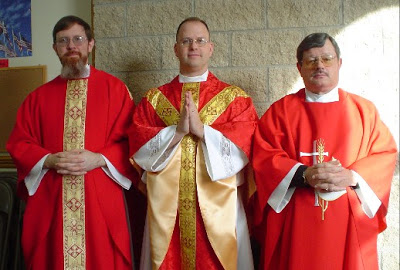
Heiser, in his purple bishop shirt,
is cleverly disguised as a UOJ advocate here,
with Rolf Preus and Steven Brockdorf, UOJ examplars,
proving a chameleon can turn every color - except white.

All the priests - except one - are from Concordia, Ft. Wayne, which has nursed a passion for Eastern Orthodoxy for years. A number of Ft. Wayners have joined Eastern Orthodoxy, as did one editor of the LCMS Lutheran Service Book - Fenton, who repudiated Lutheran doctrine afterwards.

Later, disciple Rydecki, when asked by me on IM, claimed, "The book was not vetted yet." That was in spite of Rydecki and Heiser having copies of the book eight months previously.

 "Do we look Eastern orthodox?"
Yes, you do.


Clearly, the ELDONUTs were fried, but they could not confine themselves to one topic. Fed by deliberate lies from another ELDONUT priest, ultimately from Heiser Hisself, Doug Handrich engaged in an age-old logical fallacy - poisoning the well, which in his case should be called "spitting into the wind."

ELDONUTs hide their information, just as Heiser hides behind his minions. But they have revealed a number of classic errors that come from Pietism.

Like Bishop Martin Stephan, STD, the tiny sect of ELDONA considers itself to be the only Church on earth. They told one layman, "It is unScriptural for Jackson to be apart from ELDONA." That declaration would also be true for 99.9999% of all Lutheran clergy. 


That declaration also defies the Augsburg Confesion, which they claim to uphold, just as the Pietistic sects LCMS, WELS, ELS, and CLC (sic) do. 

Pietists are obsessed with membership in the right sect, sometimes in the right district of the right sect, and even in graduating from the right seminary of the right sect. Ft. Wayne and St. Louis grads look down on each other. WELS and ELS pastors despise each other while "cherishing their fellowship." The CLC (sic) carps about everyone else while copying the worst doctrinal errors.

 "Anathema sit! Burn those books!
We alone are the Means of Grace on earth."

The book-burning attitude of ELDONA makes one wonder about the nature of their fears. If I give Augustine's City of God to a friend, am I expecting him to become Roman Catholic? If I give away a complete set of Pieper's Dogmatics, as I did to one seminarian, am I endorsing Pieper's UOJ and his Kalnis hobby? I give away books all the time, in the hopes of kindling interest in Reformation Lutheran doctrine.


Thursday, October 27, 2016

Review of Making Disciples - On Amazon.com


Top Customer Reviews

Format: Paperback
While reading this book, and this applies to all others I have read by the same author, you will have the treat of ready access to a deep and wide resource in the form of Dr. Jackson’s education, teaching, and preaching. With advanced degrees from Yale and Harvard (GJ - Notre Dame, rather than Harveard - but two of my ND professors now occupy endowed chairs at Harvard), Jackson’s writing reflects a disciplined approach he honed in the process. He has a love for footnotes and quotations from sources. Jackson will bring into play tools from original languages of the Bible, history, geography, philosophy and of course theology, and use them to craft a narrative that is unusually comprehensive. Lucid and refreshingly succinct, Dr. Jackson carves with precision to his points.

Making Disciples is not merely a discussion of the venerable “Great Commission” found in the closing verses of Matthew 28. That subject is vivisected, to be sure, but an historical background of the English versions of the Bible is also presented, along with Luther’s German Bible and the Vulgate Latin. All of this serves to add context and relevance to the discussion itself without distraction. Jackson writes with a density not to be found in many wordy so-called Christian books that flood the best seller lists. He’s not being paid by the word here, and he doesn’t profit a couple million dollars each time he takes to pen, as do the megachurch rockstars so long in enthusiasm and short in academia. Dr. Jackson writes from mind and heart and the reader is a benefactor.

After reading Making Disciples, you will learn how Bible versions often contain agendas carefully inserted into the translation, along with footnotes that work to undermine the original Greek meaning, here and there again, to bend the Bible to suit the particular theology being advanced. Many examples are provided from both Testaments, laid bare and naked, and they can be startling to behold. A question is made to whether some new versions are actually new at all, or simply a profitable exercise in Bible merchandising.

A call to appreciate again (for some of us) and anew (for younger of us) the King James Version is made by Jackson, and solid argument provided to bolster its accuracy and beauty. To overcome some of the difficulties of the KJV, Jackson recommends the 21st Century translation, available on Amazon in book form, and also online at BibleGateway dot com. I have begun including KJV21, as it is also known, in my own studies and enjoy it.

I highly recommend this short book to anybody with respect and love for the inerrant Word.


---

Format: Paperback
A thorough treatise on the error of "make disciples" by Lutheran Bishop Gregory L. Jackson. For more history information about the destructive philosophy of Pietism check out his blog: [...]

***

GJ - Reviews really help in the teaching office of the church. Many of the books I might want to study or buy begin with reading some book reviews. One does not have to be a professional book reviewer to post a review.

Thank you for everyone who wants to help. Thanks, Java Dude and Glen.

Start by going to the Pastor Gregory L. Jackson author page and picking a book to review.