Showing posts with label Luther's Sermons. Show all posts

Saturday, August 14, 2021

Luther's Sermon on the Pharisee and Tax Collector

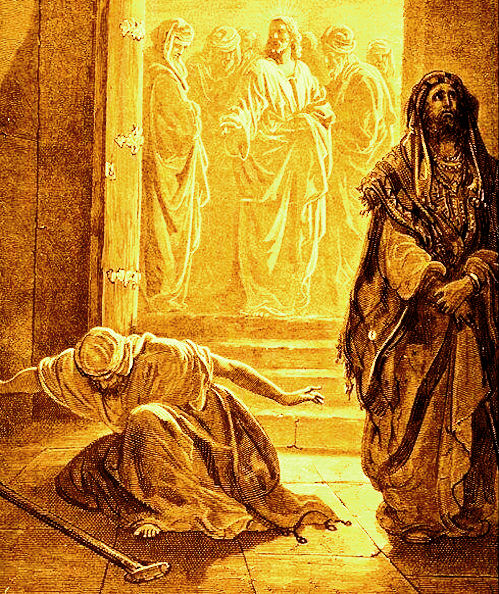
The Pharisee and the Tax Collector - by Dore.


ELEVENTH SUNDAY AFTER TRINITY


Text. Luke 18:9-14. And he spake also this parable unto certain who trusted in themselves that they were righteous, and set all others at nought: Two men went up into the temple to pray; the one a Pharisee, and the other a publican. The Pharisee stood and prayed thus with himself, God, I thank thee, that I am not as the rest of men, extortioners, unjust, adulterers, or even as this publican. I fast twice in the week; I give tithes of all that I get. But the publican, standing afar off, would not lift up so much as his eyes unto heaven, but smote his breast, saying, God, be thou merciful to me a sinner. I say unto you, This man went down to his house justified rather than the other: for every one that exalteth himself shall be humbled; but he that humbleth himself shall be exalted.


1. Here again we have a picture and an example of the divine judgment on saints and good people. Two extraordinary persons are presented to us in this Gospel; one thoroughly good and truly pious; and one hypocritically pious. But before we take up the example and consider the terrible sentence, we must first notice that Luke here makes the impression as though righteousness came by works. For Luke is most accustomed to do this, as when we at present preach that faith alone saves, he observes that people are led to desire only to believe, and to neglect the power and fruit of faith. This John also does in his Epistle and James, where they show that faith cannot exist without works.

Thus Luke, in the beginning of his introduction, would speak as follows: I see indeed that many have preached how faith alone saves, by which they have brought the people to strive for a fictitious faith; hence I must also speak of works by which they can be assured of their faith, and prove it to the people by their acts. Consequently it sounds as though Luke everywhere taught that righteousness came by works; as you have recently heard: Forgive, and ye shall be forgiven; and, make unto yourselves friends of the mammon of unrighteousness. And here it appears as though the publican had obtained his goodness by praying and smiting his breast. So this Gospel appears as though we should become good or pious by our works.

2. Now you have heard that a man, before he can do anything good, must by all means first be good. For the truth must always stand: “A good tree cannot bring forth evil fruit;” and again, “An evil tree cannot bring forth good fruit.” Thus a man must first be good, before he can do good. So he also firmly concludes that the publican smote his breast, which proves the conclusion, that he had been good.

3. This has taken place and has been written to the end that we should open our eyes and not judge the people according to their outward appearance. To do this in this instance it is necessary to examine the hearts of both, and not judge according to mere external works. For when the heart is good, the whole man is good. For if I judged the publican according to his works, my judgment would soon be false. For nothing appears in him but sin. Again, if I judge the hypocrite or Pharisee according to his works, I will also miss the mark. For he stands at the holy place, makes the best prayer imaginable, for he praises and thanks God with grand works, he fasts, gives the tenth of all his goods, harms no one; in short, everything, both outwardly and inwardly, appears well with him.

4. As he judges, all men judge; no one can condemn such an upright and virtuous life. Who dare say that fasting is not good; or that to praise God and give everyone what we owe them is evil? When I see a priest, monk, or nun with such apparent noble conduct, I regard them as pious. Who can say otherwise? Hence if I am to judge whether this one is good and the other evil, I must be able to look into the hearts of both. But I cannot see into the heart, and must make the proper distinction from their works, as Christ says: “By their fruits ye shall know them.” Matthew 7:20.

5. He speaks of the publican as though he must have previously heard a word from God that touched his heart so that he believed it and thus became pious, as St. Paul says, Romans 10:17: “So faith cometh by hearing, and hearing by the word of Christ.” When the Word falls into the heart, then man becomes pure and good. But the Evangelist does not indicate that he now first heard the Gospel here, but that he heard it somewhere, it matters not where. For he says: “God be merciful to me a sinner.” This knowledge is above the powers of reason. And yet it must previously have been known to him that God is merciful, gracious and friendly to all those who confess their sins, who call upon him and long for grace. As he heard that God is gracious by virtue of his very nature, to all those who humble themselves and seek comfort in him. But to preach thus is always the pure Gospel.

6. Hence the beginning of goodness or godliness is not in us, but in the Word of God. God must first let his Word sound in our hearts by which we learn to know and to believe him, and afterwards do good works. So we must believe from this that the publican had learned God’s Word. If not, it would certainly have been impossible for him to acknowledge himself to be a poor sinner, as this Gospel reports. Indeed, it has a different appearance here, because St. Luke seems to insist more strongly on external works and appearances than on faith, and lays the emphasis more on the outward character and conduct than on the root and on the faith of the heart within.

Nevertheless we must conclude that the publican had previously heard the Gospel. Otherwise his smiting his breast and his humble confession would not have occurred, had he not previously had faith in his heart.

7. This is also proper fruit, since it promotes God’s honor; as God desires nothing but the offering of praise, as Psalm 50:23, says: “Whoso offereth the sacrifice of thanksgiving glorifieth me, and to him that ordereth his way aright, will I show the salvation of God.” In this way the publican also proceeds, gives God the offering of thanksgiving and secures to himself the forgiveness of sin, and praises God, puts himself to shame and exalts the truth above himself.

Therefore we must praise and commend his work, because he gives God the highest honor and true worship. For he says: “God, be thou merciful to me a sinner.” As though he would say: I am a rogue, this I confess, as you yourself know. Here you see that he confesses the truth, and is willing that God should reprove and revile him; yea, he does this himself, and casts himself down the very lowest, and with God he again rises upward, gives glory to God that he is gracious, kind and merciful. But in himself he finds nothing but sin. Wherefore these are the true fruits of faith.

8. Thus we have learned from his fruits the publican’s faith. But how shall we understand what Christ says: “This man went down to his house justified,” as he had already been just through faith, before he smote his breast? He certainly must have been just before. Why then does Christ say here: “He went down to his house justified?” This is what I have often said, if faith be true, it will break forth and bear fruit. If the tree is green and good, it will not cease to blossom forth in leaves and fruit. It does this by nature. I need not first command it and say: Look here, tree, bear apples.

For if the tree is there and is good, the fruit will follow unbidden. If faith is present works must follow. If I confess that I am a sinner, it must follow that I will say: Alas God! I am a rogue, do thou cause me to be good. So this publican cares for nothing and speaks freely, though he puts himself to shame before all people, he does not care for that, as <19B610> Psalm 116:10 says: “I believe, for I will speak. I was greatly afflicted,” and says: “God, be thou merciful to me a sinner!” As though he would say: I now see that I am lost, for I am a bad man, and acknowledge my sins. Unless I believe and hold to God’s mercy, and take the cup of the Savior and call upon God’s grace, I will be ruined.

9. Thus faith casts itself on God, and breaks forth and becomes certain through its works. When this takes place a person becomes known to me and to other people. For when I thus break forth I spare neither man nor devil, I cast myself down, and will have nothing to do with lofty affairs, and will regard myself as the poorest sinner on earth. This assures me of my faith. For this is what it says: “This man went down to his house justified.” Thus we attribute salvation as the principal thing to faith, and works as the witnesses of faith. They make one so certain that he concludes from the outward life that the faith is genuine.

10. We find this also in Abraham when he offers his son Isaac. Then God said: “For now I know that thou fearest God,” Genesis 22:12. Surely, if he had not feared God, he would not have offered his son; and by this we know the fruit to be thoroughly good. Let us now heartily apply this to ourselves.

11. This is why St. Luke and St. James have so much to say about works, so that one says: Yes, I will now believe, and then he goes and fabricates for himself a fictitious delusion, which hovers only on the lips as the foam on the water. No, no; faith is a living and an essential thing, which makes a new creature of man, changes his spirit and wholly and completely converts him. It goes to the foundation and there accomplishes a renewal of the entire man; so, if I have previously seen a sinner, I now see in his changed conduct, manner and life, that he believes. So high and great a thing is faith.

For this reason the Holy Spirit urges works, that they may be witnesses of faith. In those therefore in whom we cannot realize good works, we can immediately say and conclude: they heard of faith, but it did not sink into good soil. For if you continue in pride and lewdness, in greed and anger, and yet talk much of faith, St. Paul will come and say, 1 Corinthians 4:20, look here my dear sir, “the kingdom of God is not in word but in power.” It requires life and action, and is not brought about by mere talk.

12. Thus we err on both sides in saying, a person must only believe, then he will neglect to do good works and bring forth good fruits. Again, if you preach works, the people immediately comfort themselves and trust in works. Therefore we must walk upon the common path. Faith alone must make us good and save us. But to know whether faith is right and true, you must show it by your works. God cannot endure your dissembling, for this reason he has appointed you a sermon which praises works, which are only witnesses that you believe, and must be performed not thereby to merit anything, but they should be done freely and gratuitously toward our neighbor.

13. This must be practiced until it becomes a second nature with us. For thus God has also introduced works, as though he would say: if you believe, then you have the kingdom of heaven; and yet, in order that you may not deceive yourselves, do the works. To this the Lord refers in John 15:17, when he says to his disciples: “These things I command you, that ye may love one another.” And previous to this at the supper he said, John 13:34-35: “A new commandment I give unto you, that ye love one another: even as I have loved you, that ye also love one another.

By this shall all men know that ye are my disciples, if ye have love one to another.” And shortly before this he said, 5:5: “For I have given you an example, that ye also should do as I have done to you.”

As though he would say: Ye are my friends, but this the people will not know by your faith, but when you show the fruits of faith, and break forth in love, then they will know you. The fruits will not save you nor make you any friends, but they must show and prove that you are saved and are my friends. Therefore mark this well, that faith alone makes us good; but as faith lies concealed within me, and is a great life, a great treasure, therefore the works must come forth and bear witness of the faith, to praise God’s grace and condemn the works of men. You must cast your eyes to the earth and humiliate yourself before everyone, that you may also win your neighbor by your services; for this reason God lets you live, otherwise nothing would be better for you than to die and go to heaven. This you now also observe clearly in the good publican.

14. So you find two judgments: one according to faith, the other according to outward works. The foundation you have in that faith is concealed; this he feels, who believes; but that is not enough, it must express itself as you see above in the publican, who breaks forth in humility, so much as not to lift his eyes to heaven, smites on his breast and praises God, by which he helps me to say when my sins oppress me: Behold, the publican also was a sinner and said: “God, be thou merciful to me a sinner;” thus too, I will do.

By this will I also be strengthened so that when I see my sins I will think of his example, and with it comfort and strengthen myself, so that I can say:

Oh God, I see in the publican that thou art gracious to poor sinners. Faith the believer keeps for himself, but externally he communicates its fruits to other people.

15. The publican is on the right road and is twice justified; once through faith before God, and again by his works to me. Here he gives unto God his glory, and by faith repays him with praise. Also toward me he performs the duty of love, and puts words into my mouth and teaches me how to pray. Now he has paid all his debts toward God and man. So faith urges him to do; without however requiring anything from God as a reward of faith.

16. This is one character of the publican, who, according to faith which is the spiritual judgment, is acknowledged justified, while according to the flesh he is unprofitable. For the Pharisee passes and does not notice him, sees not his faith, lets him stand way back, and sees him alone in his sins, and knows not that God has been gracious to him, and converted and reformed him. So when a carnally minded man would condemn a sinner according to his sins, it is otherwise impossible, he must fail.

17. Let us now consider the fool, the Pharisee. Here are most beautiful works. In the first place he thanks God, fasts twice in the week, and all this to honor God, not St. Nicholas or St. Barnabas, he gives the tenth of all his goods, nor has he at any time committed adultery, has never done any one violence or robbed him of his goods. Thus he has conducted himself in an exemplary manner. This is a beautiful honest life, and excites our wonder and surprise. Truly, after the fashion of the world no one could find fault with him, yea, one must praise him. Yes, to be sure he does this himself.

18. But God is the first to come and say, that all the work of the Pharisee is blasphemy. God help us, what an awful sentence this is! Priests and nuns may well be terrified by it, and all their bones quake, as you scarcely ever find one of them as pious as this Pharisee. Would to God we could have many such hypocrites and Pharisees; for then they could be taught better things.

19. Well, what is the matter with the good man? Only this, he does not know his own heart. Here you see that we are our own greatest enemies, who close our eyes and hearts, and think we are as we feel. For if I should ask any such hypocrite: Sir, do you mean just what you say? he would take an oath, that it is not otherwise. But behold, see how deep God’s sword cuts, and pierces through all the recesses of the soul, Hebrews 4:12.

Here everything must go to ruin, or fall to the earth in humiliation, otherwise nothing can stand before God. Thus a pious woman must here fall down and kiss the vilest harlot’s feet, yea, her footprints.

20. Now let us better see and hear what the Lord says to this. There stands the publican and humbles himself, says nothing of fasting, nothing of his good works, nor of anything. Yet the Lord says that his sins are not so great as the sins of the hypocrite; even in spite of anyone now exalting himself above the lowest sinner. If I exalt myself a finger’s breadth above my neighbor, or the vilest sinner, then am I cast down. For the publican during his whole life did not do as many and as great sins as this Pharisee does here when he says: I thank thee God that I am not as other men are; and lies enough to burst all heaven. From him you hear no word like: “God, be thou merciful to me a sinner?’ God’s mercy, sympathy, patience and love are all forgotten by him, while God is nothing but pure mercy, and he who does not know this, thinks there is no God, as in Psalm 14:1: “The fool hath said in his heart, There is no God.” So it is with an unbeliever who does not know himself. Therefore I say one thing more, if he had committed the vilest sin and deflowered virgins, it would not have been as bad as when he says: “I thank thee God, that I am not as the rest of men, extortioners, unjust, adulterers, or even as this publican.” Yes, yes, do I hear you have no need of God and despise his goodness, mercy, love and everything that God is? Behold, these are thy sins. Hence the public gross sins that break out are insignificant; but unbelief which is in the heart and we cannot see, this is the real sin in which monks and priests strut forth; these lost and corrupt ones are sunk head and ears in this sin, and pretend to be entirely free from it.

21. Further, since he has now blasphemed God and lied to him, because he is unwilling to confess his sins, he falls further and sins against love to his neighbor, in that he says: “Even as this publican.” He could not bear his presence without blaming and condemning him. Here all commandments are abolished and transgressed, for he denies God and does his neighbor no good. In this way he goes to ruin, because he has not obeyed a letter of the law. For if he had said: Oh God, we are all sinners, this poor sinner is also like myself and all the rest: and had he joined the congregation and said:

Oh God, be merciful unto us! then he would have fulfilled God’s commandment, namely, the first, in that he gave God the honor and the praise, and had he afterwards said: Oh God, I see this one is a sinner, in the jaws of the devil; dear Lord, help him. ‘ and had he thus brought him to God and prayed to God for him, he would then also have obeyed the other commandment of Christian love as Paul says, Galatians 6:2, and teaches: “Bear ye one another’s burdens, and so fulfill the law of Christ.”

22. Now he comes and praises himself that he is just. He has a poisonous, wicked heart, who praises himself most gloriously on account of his pretended good works, how he fasted and gave the tenth of all he had.

Hence he is so full of hatred to his neighbor, if God allowed him to judge, he would plunge the poor publican down into the deepest hell. Behold, is not this a wicked heart and terrible to hear, that I would all men should go to ruin, if only I be praised? Yet all this is so finely decorated and adorned by external conduct, that no one can censure it. Here we see how we are to know the tree from its fruits. For when I view his heart with spiritual eyes, I recognize it is full of blasphemy and hatred to his neighbor. From these fruits I know that the tree is evil. For works would not be evil in themselves, but the evil root in the heart makes them evil. This is set before us that we may beware and guard ourselves against it.

23. Again, on the other hand, examine the heart also of the publican. Here we find that he believes. Hence his works are good and of service to the whole world, for he teaches that a man should humble himself and praise God. On the contrary the other with his works makes saints who are puffed up and proud of heart; for he is entrapped in sins, his soul is condemned, and is fast in the jaws of the devil, and the high minded knave steps forth and praises himself, because his neighbor over there is a sinner. To sum up all, he misleads the whole world with his hypocritical life. Thus we must judge the fruits with spiritual eyes as we have now judged these two; then we will know the tree whether it be good or evil.

24. Now, where did I obtain this judgment? Here: God has given me his law like a mirror, in which I see what is good and evil. It says: Love the Lord thy God with all thy heart, and with all thy soul, and with all thy mind, and thy neighbor as thyself,” Deuteronomy 6:5, Matthew 22:37. ‘Now the works of the publican praise God and benefit the whole world, because they teach us to know, and show us the way of God our Savior. Therefore they are good because they praise God and benefit our neighbor. On the other hand, the hypocrite struts forth and blasphemes God, and with his corrupt life misleads the whole world.

25. I should also speak of the great and shameful vice of slander, when one belies another, exposes him and speaks evil of him; while we are all alike after all, and no one has a reason to exalt himself above another. But that the government judges and punishes crime, it does by virtue of its office.

For it wields the sword to make the transgressor fear. For God will not tolerate sin, and desires that the wicked have no rest, as the prophet Isaiah says, Isaiah48:22: “There is no peace, saith Jehovah, to the wicked.”

Therefore where God does not internally disturb sinners, he will wipe out sin by fire and water, that they can have no peace from without. When such sins are to be punished, the officers, judges and people should think thus:

Oh God! although I myself am a poor sinner and a much greater one than this person, and a much greater thief and adulterer than this one; still I will execute my office and leave him no rest in his sins and belabor him; for this is thy divine command. Concerning this I have said more on other occasions, especially in my book on the Civil Government, which you can road yourself; for the present let this suffice, and pray God for grace.

Saturday, May 4, 2019

Luther's Sermon on Shepherd Sunday, John 10


He shall feed His flock like a shepherd.
He shall carry the lambs in His arms,
and gently lead those with young.
Norma A. Boeckler

MISERICORDIAS DOMINI - SECOND SUNDAY AFTER EASTER


Psalm 51 (Misericordias. Also called “Shepherd Sunday”).

Text; John 10:11-16. I am the good shepherd: the good shepherd layeth down his life for the sheep. He that is a hireling, and not a shepherd, whose own the sheep are not, beholdeth the wolf coming, and leaveth the sheep, and fleeth, and the wolf snatcheth them, and scattereth them: he fleeth because he is a hireling, and careth not for the sheep. I am the good shepherd; and I know mine own, and mine own know me, even as the Father knoweth me, and I know the. Father; and I lay down my life for the sheep. And other sheep I have, which are not of this fold: them also I must bring, and they shall hear my voice; and they shall become one flock, one shepherd.


1. This is a comforting Gospel, which so beautifully portrays the Lord Jesus and teaches us what manner of person he is, what kind of works he does, and how he is disposed toward men. And there is no better way to understand it than to contrast light and darkness and day and night; that is, the good shepherd with the wicked one, as the Lord himself does.

2. Now, you have often heard that God has given the world two different proclamations. One is that which is declared in the Word of God when it says: Thou shalt not kill, not commit adultery, not steal ( Exodus 20:13-15), and when it adds the threat that all who do not keep these commandments shall die. But this declaration will make no one godly at heart. For though it may compel a man outwardly to appear godly before men, inwardly it leaves the heart at enmity with the Law, and wishing that there were no such Law.

3. The other proclamation is that of the Gospel. It tells where one may obtain that which will meet the demands of the Law. It does not drive or threaten, but tenderly invites us. It does not say, Do this and do that, but rather: Come, I will show you where you may find and obtain what you need to make you godly. See, here is the Lord Jesus; he will give it to you.

Therefore, the two are as contrary to each other as taking and giving, demanding and presenting; and this distinction must be well observed. Thus God ever has ruled and still rules the world today. To coarse and rude persons, who are not influenced by the Gospel, the Law must be declared, and they must be driven until they are humbled and acknowledge their imperfections. When this has been accomplished, the Gospel is to be applied.

4. These are the two divine proclamations, which come from heaven.

Besides these there are others that are not from heaven, but are human prattle, which the pope and our bishops have invented that they might terrify our consciences. Such men are not worthy of being called shepherds or hirelings, but they are here designated by the Lord Jesus as thieves, murderers and wolves. For if men are to be savingly governed, it must be done with the Word of God; and if it is not done by the Word of God, they are not properly governed.

I. THE NATURE OF THE OFFICE AND KINGDOM OF CHRIST EXPLAINED.

5. Now, here Jesus has in mind the second proclamation. He explains it and sets himself forth as the chief shepherd, yea, as the only shepherd; for that which he does not tend is not kept. This comforting and sweet proclamation we will now consider.

6. You have heard that after his sufferings and death Christ our Lord arose from the dead and entered upon, and was enthroned in, an immortal existence. Not that he might sit up there in heaven idly and find pleasure in himself, but that he might take charge of the kingdom of which the prophets and all the Scriptures have so fully spoken, and might rule as a king. Therefore, we should think of him as being present and reigning among us continually, and never think of him as sitting up there doing nothing, but rather that he from above fills and rules all things, as Paul says to the Ephesians 4:10, and especially that he is taking care of his kingdom, which is the Christian faith, and that therefore his kingdom among us here on earth must prosper. This kingdom, as we have said, is so constituted that we all must daily increase and grow in holiness, and it is not governed by any other power save the oral proclamation of the Gospel.

7. This proclamation is not of men, but Christ himself sent it forth, and then put it into the hearts of the apostles and their successors so that they understood it, and into their mouths so that they spoke and declared it.

This is his kingdom, and so does he rule that all of his power is comprehended in and connected with the Word of God. They who hear and believe it belong to this kingdom, and the Word then becomes so mighty that it provides all that man may need and bestows all the blessings that we may desire. For it is the power of God, and it can and will save all who believe it, as St. Paul declared to the Romans 1:16. If you believe that Christ died to save you from all evil, and will hold fast to that Word, you will find it so certain and sure that no creature can overthrow it; and as no one can overthrow the Word, neither can anyone harm you who believe it. Accordingly, with the Word you will overcome sin, death, devil and hell, and you will find a refuge in the Word and attain that which is found where the Word is, namely, everlasting peace, joy and life. In short, you will be participants in all the power that is in the Word. Therefore, it is a peculiar kingdom. The Word is present and is orally proclaimed to all the world, but its power is deeply hidden, so that none but they who believe realize that it is so effective and that it accomplishes such great things. It must be experienced and realized by the heart.

8. Hence, all that we preachers can do is to become the mouthpieces and instruments of Christ our Lord, through whom he proclaims the Word bodily. He sends forth the Word publicly so that all may hear it, but that the heart inwardly experiences it, that is effected through faith and is wrought by Christ in secret where he perceives that it can be done according to his divine knowledge and pleasure. That is why he says: “I am the good shepherd.” And what is a good shepherd? “The good shepherd,” says Christ, “layeth down his life for the sheep; and I lay down my life for the sheep.” In this one virtue the Lord comprehends and exemplifies all others in the beautiful parable of the sheep. Sheep, you know, are most foolish and stupid animals. When we want to speak of anybody’s stupidity we say, “He is a sheep.” Nevertheless, it has this trait above all other animals, that it soon learns to heed its shepherd’s voice and will follow no one but its shepherd, and though it cannot help and keep and heal itself, nor guard itself against the wolf, but is dependent upon others, yet it always knows enough to keep close to its shepherd and look to him for help.

9. Now, Christ uses this trait or nature of the animal as an illustration in explaining that he is the good shepherd. In this manner he plainly shows what his kingdom is, and wherein it consists, and would say: My kingdom is only to rule the sheep; that is poor, needy wretched men, who well see and realize that there is no other help or counsel for them.

10. But that we may make it the plainer, and may understand it the better, we will cite a passage from the prophet Ezekiel, where he speaks of the wicked shepherds that are against Christ, when he says (34:2ff): “Should not the Shepherds feed the sheep? Ye eat the fat, and ye clothe you with the wool, ye kill the fatlings; but ye feed not the sheep. The diseased have ye not strengthened, neither have ye healed that which was sick, neither have ye bound up that which was broken, neither have ye brought back that which was driven away, neither have ye sought that which was lost; but with force and with rigor have ye ruled over them. And they were scattered, because there was no shepherd; and they become food to all the beasts of the field and were scattered. My sheep wandered through all the mountains, and upon every high hill: yea, my sheep were scattered upon all the face of the earth; and there was none that did search or seek after them,” and so forth. Accordingly, God reproves the shepherds who do not keep the sheep. And now mark well what he has written. His earnest intent in this paragraph is that the weak, sick, broken, those who are driven away and the lost, are to be strengthened, bound up, healed, and sought again, and that they are not to be torn to pieces and scattered. This you should have done, says he to the shepherds, but you have not done it; therefore, I will do it myself. As he says further on, in verse 16: “I will seek that which was lost, I will bring back that which was driven away, and will bind up that which was broken, and will strengthen that which was sick.”

11. Here you see that Christ’s kingdom is to be concerned about the weak, the sick, the broken, that he may help them. That is, indeed, a comforting declaration. The only trouble is that we do not realize our needs and infirmities. If we realized them, we would soon flee to him. But how did those shepherds act? They ruled with rigor, and applied God’s Law with great severity; and, moreover, they added their own commandments, as they still do, and when these were not fulfilled, they raved and condemned, so that they were driving and driving and exhorting and exacting, continually. That is no proper way to tend and keep souls, says Christ. He is no such shepherd as that; for no one is benefited, but is rather wholly undone, by such a course, as we shall presently hear. Now let us consider this citation from the prophet in its order.

12. First, he says: The sheep that are weak are to be strengthened; that is, consciences weak in faith and troubled in spirit and of tender disposition are not to be driven and told: You must do this. You must be strong. If you are weak, you are lost. That is not strengthening the weak. St. Paul, speaking to the Romans ( Romans 14:1) says: “But him that is weak in faith receive ye, yet not for decision of scruples.” And shortly afterwards ( Romans 15:1) he says: “Now we that are strong ought to bear the infirmities of the weak.” Accordingly, they should not be driven with rigor, but should be comforted, even though they are weak, lest they be driven to despair; and in time they will grow stronger.

13. Isaiah, the prophet, speaks of Christ likewise ( Isaiah 42:3): “A bruised reed will he not break, and a dimly burning wick will he not quench.” The bruised reeds are poor, tender consciences, which are easily distracted so that they tremble and despair of God. He does not fly at them then, and trample them under foot; that is not his way. But he deals with them gently, lest he break them to pieces. Again, the dimly burning wick, which still burns at least, though there be more smoke than fire there, he does not wholly quench, but lights, and again and again trims it. That is a great consolation, indeed, to such as experience it; and, therefore, he who does not deal gently with tender consciences is no good shepherd.

14. Secondly, the prophet says: “Neither have ye healed the sick.” Who are the sick? They are those who are manifestly deficient in certain of their works. The first clause has reference to tender consciences; the second, to outward conduct. As, for instance, when one growls and sulks, and now and then lapses, and in anger and other foolish ways oversteps the bounds; even as the apostles, at times, grievously stumbled. But even those who in their outward works before men manifest their shortcomings, so that people are offended at them and say that they are rude and peculiar, he will not cast away; for his kingdom here below is not so constituted as to embrace only the strong and the whole, as it will be in the life to come.

Christ is sent here that he might receive and help just such people.

15. Therefore, even though we are weak and sick, we must not despair and say we are not in the kingdom of Christ. But the more we realize our sickness, all the more should we turn to him; for that is what he is here for, to heal and make us whole. Accordingly, if you are sick and a sinner, and realize your condition, you have all the more reason to go to him and say:

Dear Lord, I come just because I am a sinner; that thou mayest help me, and make me good. Thus, necessity drives you to him; for the greater your ailment, the more imperative it is that you seek relief. And that is what he wants; therefore, he tenderly bids us to be of good cheer, and to come unto him. They who are not good shepherds, however, expect to make people good by hatefully scolding and driving them, whereas they are thereby only making matters worse. And this may be seen when we look upon present conditions, brought about by this wrong method, when everything is so piteously scattered, even as the prophet has here said.

16. Thirdly: “Neither have ye bound up that which was broken.” To be broken is as though one had a bone fractured or were otherwise wounded.

As when a Christian is not only weak and infirm, so that he makes a misstep at times, but when he falls into such great temptation that he breaks his leg; for instance, if he should fall and deny the Gospel, as St.

Peter did, when he denied Christ. Well, even though one should make such a misstep as to be impeded or overthrown — even then you should not cast him away, as though he no more belonged to this kingdom. For you must not rob Christ of his characteristic, that in his kingdom abounding grace and mercy alone prevail, so that he helps those who realize their misery and wretchedness, and desire to be helped, and that his kingdom is wholly one of consolation, and that he is a comforting, friendly shepherd, who tenderly invites, and would induce, all men to come unto him.

17. Now, all this is effected through the Gospel alone, by means of which we are to strengthen all the weak and heal all the sick; for this Word will satisfy every want of those whose consciences are troubled, and will give full consolation to all, so that no one, no matter how great a sinner he has been, need despair. Hence, Christ alone is the good shepherd, who heals all our infirmities and raises up again those who have fallen. He who does not do that is no shepherd.

18. Fourthly, the prophet says: “Neither have ye brought back that which was driven away.” What is meant by “that which was driven away”? It is that despised soul that is fallen so low that all efforts to reclaim it seem to be in vain. Nevertheless, Christ would not have even such dealt with rigorously. He would not have his kingdom narrowed down so as to include only such as are strong and healthy and perfect. That will be the case in the future kingdom that follows this life, as has been said: Now, because he reigns, pure grace and bliss only shall prevail. Even as God promised the children of Israel ( Exodus 3:8) that the promised land would be a land flowing with milk and honey. Likewise St. Paul says that our uncomely parts shall have more abundant comeliness ( 1 Corinthians 12:23).

19. Fifthly, he concludes: “Neither have ye sought that which was lost.”

That which was lost is that which is given up as already condemned, so that there is no expectation that it ever will return; as the publicans and harlots mentioned in the Gospel, and as the dissolute and intractable in our day, were and are. And yet, even these he would not have us pass by, but would have everything possible done to reclaim them. This was done by St. Paul, on different occasions; as, for example, when he delivered two men unto Satan, as he said to Timothy ( 1 Timothy 1:20): “Whom I delivered unto Satan that they might be taught not to blaspheme.” And, again, to the Corinthians he said ( 1 Corinthians 5:5): “I have concluded to deliver such a one unto Satan for the destruction of the flesh, that the spirit may be saved in the day of the Lord Jesus.” He had cast these away as condemned, and yet he goes after them again.

20. Therefore, we should so preach Christ as one who will reject nobody, however weak he may be, but will gladly receive and comfort and strengthen everybody; that we may always picture him to ourselves as a good shepherd. Then hearts will turn to him of their own accord, and need not be forced and driven. The Gospel graciously invites and makes men willing, so that they desire to go, and do go, to him with all confidence.

And it begets a love for Christ in their hearts, so that they willingly do what they should, whereas formerly they had to be driven and forced. When we are driven, we do a thing with displeasure and against our will. That is not what God desires; therefore it is done in vain. But when I see that God deals with me graciously, he wins my heart, so that I am constrained to fly to him; consequently, my heart is filled with happiness and joy.

21. Now see what an evil it is when one person judges another. Christ’s kingdom, as we have heard, is calculated to heal and sanctify only such souls as are sick and needy; therefore all must err who look only upon those who are strong and holy. Consequently, the knowledge that rightly apprehends Christ is great and mighty. By our nature we are knaves to the very hide, and yet we expect everyone to be pious. With open mouth, we do not want to look at anybody but strong Christians. We ignore the sick and weak, and think that if they are not strong then they are not Christians at all. And others who are not perfectly holy we reckon among the wicked, and yet we, ourselves, are more wicked than they. That is what our evil nature does, and our blind reason, that wants to measure God’s kingdom by its own imagination, and thinks that whatever does not appear pure in its eyes is not pure in the sight of God.

22. Therefore we must get that idea out of our minds; for if we keep it before us too much, we will finally get into such a state of mind as to think:

Oh, what will become of me if only they are Christians who are strong and healthy and holy? When will I ever reach that state? And thus we, ourselves, will make it impossible. Therefore, we must eventually be driven to say: Dear Lord, I realize that I am very weak, very sick and despondent.

Nevertheless, I will not allow that to confound me, but I will come to thee, that thou mayest help me; for thou art ever the good and pious shepherd, which I also confess thee to be, and therefore will I despair of my own works.

23. Let us, therefore, ever be wise and learn to know Christ well, and to know that in his kingdom there are only weak and sickly people, and that it is nothing but a hospital, where the sick and infirm, who need care, are gathered. And yet there are so few who understand that! And this fact seems so obscured that even they who have the Gospel and the Spirit are lacking in the knowledge of it; for it is the most profound wisdom that man can attain. For even though they see that the Scriptures praise this kingdom and speak of its preciousness, yet they do not realize what the words mean, and do not understand that they contain that true wisdom which is far above the wisdom of men. For it is not our wisdom that we deal with, and that we speak of and preach to sensible, prudent and wise people; but it is this, that we go among fools and simpletons, and care for them, not because we find pleasure in so doing, but in order that we may help them to get rid of their sins and foolishness and to find righteousness and true knowledge.

24. So you see that Christian wisdom does not consist in raising our eyes to that which is lofty and wise, to see ourselves reflected there, but in lowering our eyes to that which is lowly and foolish. Let him who knows this, thank God; for such knowledge will fit him to accommodate himself to, and guide him under, all circumstances in this life. Therefore you will yet find many even among those who preach the Gospel, who have not yet attained it. They never taught us thus before, and we were accustomed to think we did not dare to come to Christ until we had first become perfectly pure. Now you must get out of that way of thinking and come to a proper understanding of Jesus, and learn to know him as a true shepherd. But we have heard enough on this point for the present.

II. CHRIST ILLUSTRATES HIS OFFICE AND KINGDOM BY COMPARING THE GOOD SHEPHERD WITH THE HIRELING.

25. Now, he contrasts the good shepherd with a wicked one, or a hireling, and says: “The good shepherd layeth down his life for the sheep. He that is a hireling, and not a shepherd, whose own the sheep are not, beholdeth the wolf coming, and leaveth the sheep, and fleeth, and the wolf snatcheth them and scattereth them: he fleeth because he is a hireling, and careth not for the sheep.”

26. In the strictest sense, he alone is the shepherd; and yet, as he alone is Christ but nevertheless calls us by the same name — Christians — even so, though he alone is the shepherd, he designates all those who exercise the office of the ministry among Christians by that name also. In like manner in Matthew 23:9 he forbids us to call any man on earth father, for one is our father, even he who is in heaven, yet Paul calls himself a father of the Corinthians when he says: “I begat you through the Gospel.” Corinthians 4:15. Thus God acts as though he alone would be our father, and yet he attributes the name to men also, so that they are called fathers.

But they have no right to this name in themselves; only in Christ is it theirs: even as we are called Christians though we have nothing of our own, but all we have has been given to us, in him. Now, “the hireling,” says he, “whose own the sheep are not, beholdeth the wolf coming, and leaveth the sheep, and fleeth,” etc. That is a hard saying, indeed, that some who truly preach and administer the Gospel and strengthen and heal the sheep, finally allow themselves to be carried away and leave the sheep when they are most in need of help. As long as no wolf is in sight, they are active and. tend the sheep; but when they see the wolf breaking in, they forsake the sheep. If the sheep have been well kept, till they are strong and healthy and fat, they will then be all the more acceptable to the wolf, for whom they have been kept.

27. How does that happen? Well, says Christ, in my kingdom, whose whole object is to strengthen the weak, heal the sick, comfort the sorrowing, and so forth, the holy cross will not be wanting. For, if we preach that Christ alone must receive, strengthen, heal and help us poor sheep, and that we cannot, by our own strength and works, help ourselves, and that, therefore, all works and whatever else the world pretends to offer in its many religious services are of no avail, the world cannot abide such preaching. Hence, it is but natural that the Gospel should bring with it the holy cross, and that they who confess it before the world should risk their necks in so doing.

28. Because this is so, the good shepherds are thus distinguished from the hirelings. Whoever is a hireling will preach the Gospel only so long as they say of him that he is a learned, pious and good man; but when he is attacked, and men begin to denounce him as a heretic and a knave, and challenge him to a dispute, he recants or runs away, and abandons the poor sheep in their distress, and things are in a worse state than they were before. For what advantage has it been to the poor sheep that they had once been well kept? Had the shepherds been faithful, they would have sacrificed their bodies and lives for the sake of the sheep, and would have given their necks to the executioner for the Gospel’s sake. Accordingly, they are never true shepherds who, in preaching, have their own popularity, profit and advantage in view. They are surely hirelings; for they seek their own advantage, even when they dispense the true doctrine and Word of God. Therefore they continue only as long as they are honored and praised.

Hence they retract, and deny the Word, when the wolf comes, or flee and leave the sheep in the lurch. The sheep bleat for pasture and for the shepherd to protect them from the wolves, but there is no one to succor them; thus they are deserted when they most need some one to help them.

29. Such will be the result when men once begin to lay hands on and persecute us in earnest. There will be preachers who will hold their tongues and flee, and the sheep will be pitiably scattered, the one running here and the other there. God grant that there may be at least some who will stand firm and risk their lives to rescue the sheep. Thus Christ has here portrayed the hireling. He then proceeds: “I am the good shepherd; and I know mine own.”

30. There is a great deal contained in these words, far too much to be exhaustively treated here. He speaks here of his own peculiar calling. “I know mine own,” he says, “and mine own know me.” How is this to be understood? That he explains further when he says: “Even as the Father knoweth me, and I know the Father.”

III. THE SPECIAL OFFICE CHRIST ADMINISTERS EXPLAINED.

31. How is he known of the Father? Not with an earthly, but with a heavenly, knowledge. Of that we have spoken more fully before, and the substance of it is this: Christ recognizes us as his sheep, and we recognize him as our shepherd. Now, we have heard what a good shepherd is, and also who the weak sheep are. He knows us to be such sheep as are weak, sick and broken. That is: It does not make any difference in his regard for them that they are weak and sickly, and he does not despise and reject them on that account; but he pities and heals them, even though they be so diseased that the whole world concludes they are not his sheep. Such is the world’s knowledge, but that is not the way that Christ distinguishes them.

He does not look upon their condition, but looks to see whether they are sheep, whether they may be designated sheep. He looks at the sheep, not at the wool.

32. Now, they are good shepherds who imitate Christ and know the sheep in the same way; who look at the person, not at the faults, and know how to distinguish between the sheep and the disease.

33. Even so the Father knows me also, says Christ, but the world does not know me. When the time comes for me to die a shameful death upon the cross, all the world will say: Well, is that the Son of God? That must be a malefactor, owned, body and soul, by the devil. And thus the world will look upon and know me; but my Father will say: This is my beloved Son, my King, my Savior. For he will not look upon my sorrows, nor upon my wounds, nor upon my cross and my death, but he will see the person that I am. Therefore, though I were in the midst of hell and in the jaws of the devil, I must again come forth, for the Father will not desert me. And thus I know my sheep and am known of them. They know that I am the good shepherd and know me; and therefore they come to me and abide with me, and they are not afraid because they are weak and sick, for they know that I will receive such sheep. He now concludes and says: “And other sheep I have, which are not of this fold; them also must I bring, and they shall hear my voice; and they shall become one flock, one shepherd.

34. Some have explained this passage in such a way as to make it appear that it will be fulfilled shortly before the last day, when the Antichrist appears, and Elias and Enoch. That is not true, and it is the devil himself who is responsible for this belief of some, that the whole world will become Christian. The devil did this that the true doctrine might be so obscured so that it might not be understood. Therefore be on your guard; for this passage was verified and fulfilled shortly after Christ ascended into heaven, and is still in process of fulfillment. When the Gospel was first proclaimed, it was preached to the Jews; that nation was the sheepfold.

And now he says here: “And other sheep I have, which are not of this fold: them also must I bring.” Here he declares that the Gospel is to be preached to the gentiles also, so that they also might believe in Christ, that there might be one Christian communion, composed of Jews and gentiles. This was afterwards brought about through the apostles, who preached to the gentiles and converted them to the faith. Accordingly there is now but one church or communion, one faith, one hope, one love, one baptism, etc.

And this continues to be so at the present day, and will continue until the day of judgment. Hence, you must not understand this to mean that the whole world, and all men, will believe in Christ; for this holy cross will always be with us. They are in the majority who persecute Christ, and therefore the Gospel must ever be preached, that some may be won for Christ. The kingdom of Christ is in process of growing and is not something that is completed. This is, in brief, the explanation of this Gospel.