Showing posts with label Jackson Mulch. Show all posts

Saturday, August 20, 2016

The Feeding of the Multitude after the Big Rain

The Feeding of the Multitude, by Norma Boeckler

Sassy and I had our morning walk and the sky was overcast. Mrs. Ichabod and I went out later in the Icha-boat, and we returned in a downpour. The rain has continued in the afternoon, often with such force that all the rain-barrels and buckets are full again.

One seed can, a zinc garbage can, was left open yesterday and filled with rain early. Yes, I was the one. I poured the seed over the platform feeder so the water would drain off a bit. Soon a baby squirrel was eating his sunflower seed soup with great energy. I did not warn him away this time.

Lenski or Luther pointed out that the fragments were gathered into baskets to show that nothing should be wasted or taken for granted when God gives in abundance.

Squirrels, doves, and sparrows will gladly work through the leftovers to take care of their needs. We can see that divine management system all the way down to the microbe level. I try to get that across to Creation gardeners and those wanting to abandon expensive and bad growing methods.

Norma Boeckler


Today our Army Ranger landscaper and his grandson dropped off four enormous bags of soggy leaves. Autumn has begun. Those leaves will cover the cardboard layer in the new gardening areas.

Before garbage trucks and green bags filled with organic treasure, God created a system to capture the useful chemicals in the top layer of the soil, normally the first foot of soil. In the Great Plains, that may be several feet of topsoil, created the same way but with prairie grass and millions of bison.

Fungi, bacteria, nematodes, and protozoa break apart the vegetation and decompose the dead animals. These carefully engineered microbes swap chemicals by their mutual balancing act, and higher level creatures continue the same.

 Norma Boeckler


As I was explaining to Mrs. Ichabod, the earthworms are giants compared to the microbes, and yet they cannot digest on their own. They take in food for bacteria to break down and help with a little gizzard to grind the food and hard stuff. The bacteria benefit the earthworms, which donate nitrogen products and Caltrate to the soil, in the form of kidney excretions, casts (manure), and calcium carbonate. The earthworms love  sweet, calcium carbonate fortified soil, and they manufacture it, which makes most crops more productive and helps break down chemicals more easily.

Rains and animal byproducts add to the nitrogen and other useful chemicals in the soil. Birds not only plant their favorite foods - they leave some fertilizer in the soil with the seed.

Those four bags of leaves are more than soggy masses to hold the cardboard down. They will suppress weeds (and also harbor some) but they will ultimately become part of the soil. Chemical gardeners say, "Their NPK rating is 1-1-1 at best. Leaves are mostly carbon. What a waste of time!"

The Creating Word determined - at the beginning - that the ocean of life in topsoil would not only gently mix those leaves into the soil, over time, but also increase in population with added food and hold those essential chemicals in the top foot of soil. The biomass in topsoil includes:

  1. Earthworms
  2. Animal excretions
  3. Dead plant materials
  4. Slugs
  5. Moles 
  6. Voles
  7. Mice
  8. Beetles and grubs
  9. Spiders
  10. Bacteria
  11. Protozoa
  12. Nematodes
  13. Fungi
  14. Centipedes
  15. Millipedes
  16. Sowbugs and pillbugs, and
  17. Many more living and dead creatures.
All these require water for life and store that water by living and dying. They eat food and become food, so the chemical exchanges never stop, and plants are nourished by fungi at the root hair level, the plant giving carbon in exchange for the moisture and chemicals needed.

 Norma Boeckler


So we will cart those four leaf bags to the cardboard carpeted areas, and let God's Creature enjoy the banquet set before them. 
  • Birds will flip and probe the leaves to find the creatures that move the leaves and pounce on them.
  • Earthworms and other creatures will reach up from below to pull down cardboard and recycle the leaves.
  • Fungi will pull apart the more complex chemicals and bacteria will work on the simpler formulae.
  • Beneficial insects will overwinter in the leaf little and reward our efforts next year.
  • Spiders will find interesting places to cast their nets for themselves and their young.
The Feeding of the Multitude takes place all the time, as determined by God's Word. Jesus the Son of God demonstrated this power of the Word in the Feeding of the 4,000 and the Feeding of the 5,000. In both cases, the fragments were gathered up, more than they began with, to show the abundance that comes with the Word. 

And nothing was wasted or thrown away carelessly.


 Norma Boeckler

Wednesday, August 3, 2016

Anticipating Fall - Preparation for 2017

Autumn Leaves - by Norma Boeckler.
They feed the soil creatures - for free.

Jessical Walliser wrote a column on the garden in autumn, which reminded me to mention a few ideas early. Some of us are already planning for next year.

The most important part of autumn is NOT cleaning up the garden. Everything should be left alone to let the beneficial insects over-winter in the debris. Hollow plant stems are good locations for wild bees and other insects. Some use the dead leaves for cover and warmth, too. When I used to have forests of sunflowers, I left all the stems intact for insects and birds. My mother wanted me to remove the mess. I said, "What will the birds perch on when the snow has fallen? They like to have an elevated place for safety and food spotting." She said, "I never thought of that."

Large annual plants like a sunflowers also have a large root system to rot into the ground over the winter. Rotting organic material is good for the soil, food for various creatures, and by creating a food magnet, also a good place for birds to harvest for their needs, in winter and early spring.

Apple Tree by Norma Boeckler.
Fruit trees increase their production when mulched with leaves all winter.


Autumn Leaves
We will finish the cardboard layer of three gardening areas before the leaves begin to fall:

  1. Hosta Garden - formerly The Three Sisters, which the squirrels treated as their main food source.
  2. The Bird Feeding and Butterfly Zone. Some see that as a contradiction, but we have bird feeders surrounded by Butterfly Bush with Bee Balms also planted. I want to subdue the weeds in-between
  3. The Wild Garden, which could use a little less wild. I know tall grass is good for many beneficial insects, but cardboard and leaves will tame the area

The Hosta Garden is now covered and the cardboard weighed down so we do not share our cardboard with the neighborhood during windstorms. Today is another cardboard delivery, which will modify the bird and butterfly area. There the red Bee Balms spread like crazy and also went quite wobbly, surrounded by tall grass weeds. I decided to stick to purple BeeBalms called Monarda.

Cardboard is free, easy to lay, and blocks weed growth
very well. The covering of leaves and pine needles will make it
a giant feeding zone and also more attractive.


Cardboard Plus Leaves
Newspapers work well for the first layer of mulching, but they do not cover much and want to fly away rather than stay in place while laying them down.

Wood mulch looks great, but the cost adds up. In the backyard gardens we are using only leaves now. They also look good and mat down well for the winter. In the late spring they are decomposed into the ground by rain, earthworms, mites, and other soil creatures.

The extensive leaf layer serves three purposes:

  1. The overwintering beneficial insects will burst into life in the spring and provide protection against pests, food for birds.
  2. Leaves piled around roses will insulate them from the cold and drying winter winds.
  3. The leaves and cardboard will become part of the soil over time and feed God's creatures. I see a pound of organic matter as a pound of organic fertilizer, whether the material is manure, grasses, weeds, leaves, cardboard, or newsprint.

Sharon Lovejoy says, "Let the birds eat the seeds
from the plants that bloomed" - like these coneflowers.

Wednesday, April 27, 2016

Under the Cardboard - News for Earthworm Fanciers


Last fall we began to cover half of the backyard with cardboard on the bottom and leaves on top. We used perhaps 80 bags of leaves.

Now that whole area has a soft waterbed feel to it, wherever I step. As I wrote not long ago, the grackles have stopped to feast on the food in the leaves, since moisture and organic matter produce a bumper crop of decomposers.

I had a couple of plants to start forming a screen, so I went to the western corner of the yard and began to dig, prying up some cardboard and pushing aside the leaves. The cardboard was still in one piece and the sod was blackened below. Earthworms were abundant in and below the cardboard, not one per shovel (the commonly cited proof of good soil) but dozens of them.

The sod was semi-decomposed after a warm winter, some snow, and rain. It was very easy to dig in the soil, and easy to place the new plants.

Jessica Walliser uses cardboard for her mulch too,
setting it up in the fall and punching through in the spring.


I once put all the sod from a dig into a compost pit I created in Midland for this purpose.. I was young and prone to use my construction sized wheelbarrow, donated. Large wheelbarrows tempt one into bigger projects.

Upside-down sod shrinks down as it decomposing. A large amount in a pit decomposes more quickly, with all the built-in nitrogen, soil animals, and various soil components pushed together in a mass. That sod compost pit became the parsley patch and produced well with black swallowtail butterflies enjoying their favorite food.

From that time on, the sod compost area remained bouncy like gelatin. That fascinated me. The original prairie soil that settlers found in the Great Plains, supercharged with centuries of deep prairie grass roots and buffalo dung, would create waves when people jumped off their wagons.

Mulch alone will normally feed the weed growth quickly, with the taller weeds like crabgrass shooting through the barrier, enhanced by having the punier growth shaded. For that reason I first began using layers of newspapers.

Larger areas are much easier to mulch with cardboard, and used boxes are everywhere for free. At first the cardboard plus mulch combination is odd, with that dry hollow underpinning sound. After some rains the mass settles down and continues its work of rotting the grass and empowering the soil creatures.

Mountain mint loves beneficial insects -
and butterflies.

Monday, April 4, 2016

Rose Fever - More Addicting Than Scarlet Fever.
The Benefits of Rainwater

Chrysler Imperial was developed by
Dr. Walter Lammerts, Creationist.
"This timeless classic is a perfect example of what a hybrid tea should be - high centered, velvety, strongly scented and with a great repeat. The large, shapely, dark red blooms are held on long stems clothed with dark matte-green leaves. While happiest in hot temperatures, it doesn't disappoint wherever it calls home. A proven performer with fragrance to die for. 1953" Edmunds Roses

Wikipedia:
This variety was bred and publicly debuted by Dr. Walter E. Lammerts of Descanso Gardens, La Cañada Flintridge, California, USA in 1952. Its stock parents 'Charlotte Armstrong' (cerise pink) and 'Mirandy' (dark oxblood red) are both 'All American Rose Selections'-roses (awarded in 1940 and 1945).
The elegantly tapered buds open into high-centered blossoms with a diameter of about 11 – 13 cm (5 inches) and can have up to 45-50 petals (which is a high number for a hybrid tea rose) with a rich, deep, velvety red color. The cultivar flushes in a chronological blooming pattern throughout its local season, starting in late spring until fall. The long-stemmed rose flowers are long lasting and showy and make excellent cut flowers.
The rose bush reaches 75 to 200 cm (30 to 72 inches) height, and a diameter of 60 to 120 cm (24 to 48 inches). The shrub has an upright form with very thorny canes and semi-glossy dark green foliage. It is not a cold hardy rose (USDA zone 6b through 9b) and needs good sun exposure. Without good air circulation it is susceptible to mildew and blackspot, particularly in cool climates.[1][2]
Shade-tolerant
Resistant to black spot
Resistant to mildew
Avoid chemical sprays
Stems are very thorny

Scarlet Fever is the nickname for clergy who are always running for bishop, District President, or Synod President. One ALC Lutheran moved to another district so he could be elected bishop - and he was, so pompous he seemed to come from a Hollywood satire movie.


Rose Fever is that healthy disorder that drives people to raise roses. I was enjoying the benefits today. I had eight transplants and two new roses that needed some attention, plus some pruning work to be done.

One fallacy is the idea of stirring stuff into the soil when the earthworm does that for us - with the help of many other creatures. I put mushroom compost or cow compost on top of the soil, around the new roses, so the creatures can pull it down and mix it with clay, the most productive soil of all. For several roses I also added newspapers on the bare soil and compost, plus shredded wood on top.

When all the new roses are done - some are arriving - they will all have Jackson Mulch - newspapers plus shredded wood. The tomato garden will have cardboard plus shredded wood.

We have had drying winds, which are deterred by Jackson Mulch and the added layer of autumn leaves. But I wanted to make sure the bushes were well watered and bathed. The main roses were watered and showered first. 

In the backyard I poured rainwater from the barrel on each rose bush. The task was pleasant, dipping out the water and pouring it on each bush.


Absence of Salt and Chemicals

The municipal water supply is treated with chemicals such as chlorine and fluoride in an attempt to control bacterial contamination. These chemicals are harmful to plants. Homeowners who have water softener systems are adding additional salts to their irrigation water. Rainwater is free of these chemicals.

Adding Nitrogen

Rainwater that falls during thunderstorms provides additional nitrogen to the soil, which helps high-nitrogen-consuming plants such as corn grow more rapidly. When lightning discharges during a storm, it converts nitrogen in the atmosphere into a form that is usable by plants.

Click here for -->The Magical Properties of Rainwater

Absent Stored Rainwater:
Water stored in a barrel will give up chlorine gas and other elements, make the water much friendlier to the plants. I would give stored tapwater several days to age before using it.

Queen Elizabeth, by Lammerts

Tomorrow, favorite plants will also get rainwater (backyard). Ultimately I will collect rainwater and keep it where it is closest to plants, backyard and front. And yes, I will dump out the rainwater before the mosquitoes turn it into a breeding ground.


Pruning Is No Chore
I enjoy pruning because it gives me the chance to look at each plant and search for dead wood and broken branches. Some get a little frost-bitten at this time of year. Water and nutrients do not pass through diseased and dead wood, so pruning cures that and wakes up the plant to grow more.

Cutting roses for neighbors, friends, and doctors is enjoyable, because everyone loves to have them. They also enjoy the fragrant varieties, which fill the home or office with perfume:

  • Mr. Lincoln
  • Double Delight
  • Chrysler Imperial
  • Falling in Love
  • Veterans Honor

Ways To Prune
Cutting flowers is good for the roses, because the bush wants to set seed and become dormant. Creating bouquets keeps the plants healthy.
  1. Pruning shapes the roses so that crowded canes are trimmed out.
  2. Fading flowers do not beautify the plant, so pruning them brings on new growth.
  3. KnockOut roses need to be pruned severely several times a season to take advantage of their abundant blooms and healthy growth.

Veterans Honor.

Wednesday, January 27, 2016

Getting Rose Fever as Spring Approaches.
Three Authors Featured Are My Facebook Friends

Veteran's Honor, above, and Mr. Lincoln
are two great, fragrant roses.

One reader asked about growing roses and what kind of food was good for them.

In general, roses love eastern sunlight, especially if the afternoons get too roasty in your part of the country. Roses on the south side will get the most sun and heat, which can be too much. But that depends on the setting, trees, and so forth.

Roses are very tolerant of cold, so bare root roses ordered on the Net will arrive in cold weather and thrive. They love rain and flourish in the cold, rain-soaked early spring that many flowers abhor. My roses stayed green into January, when many other plants were bare of leaves and taking a long nap.

Shrub roses grow very well - KnockOuts.

They were converted to organic gardening.
This book is essential for understanding the soil.


Food for Roses
The chemicals they sell as fertilizer for roses - or any other plant - are detrimental to soil microbes and larger creatures. Therefore, they are bad for roses and all other plants.

The goal is to have soil undisturbed and mulched with:

  • A newspaper layer and wood mulch. Jackson Mulch.
  • A cardboard layer and wood or leaves. Jackson Super Mulch.
  • A compost layer - for those who love to haul heavy loads all over the yard.
Last year I bought shredded cyprus mulch at Lowe's, to place on top of a thick layer of newspapers. Our torrential rains dissolved the newspaper and weeds burst through. Normally they do not. Weeds can be covered with more mulch, which we did, and that turns them into wonderful compost on the spot. The same thing happens when covering lawn with Jackson Mulch.

Do not rototill the lawn to put in roses, unless there is other way. They are the biggest hoax since the flu shot.


Earthworms
My other poorly kept secret is red wiggler earthworms. They are the ideal compost or mulch worm. They cannot turn sand into fertile soil, but they will mix organics ideally - in the root zone, the top 12 inches. Other earthworms help too.

I buy earthworms from Uncle Jim, who also offers a degree in earthworm farming.

My landscaper neighbor told me to cut back my shrub roses - the KnockOuts. I told him, in early spring, "I already cut them back 50%." They were back to chest height. 

I listened to his advice until he began asking for mine - summarized as no poisons, no herbicides, no pesticides, no insecticides. But earthworms and Jackson Mulch.

The flower fly, or hover fly, is your best friend.


How Plants Are Fed
The key rose feeders are the fungi, bacteria, and protozoa that achieve a balance in the soil. The rose root hairs offer carbon to fungi in exchange for the chemicals and water needed by the rose. The root hairs determine the swap. Fungi cannot produce carbon and must have carbon to grow.

That is why we leave the soil as undisturbed as possible. God will fix whatever you wreck with your 20 horsepower rototiller and Agent Orange fertilizer, but if you keep that up you will have weeds and pests and a big bill at Lowe's to pay.

Jessica was trained in insecticides,
but learned to use beneficial insects and their hosting plants.
Her book is excellent on this topic.

Beneficial Insects, Spiders, and Toads
When I walk Sassy, I look for rotten wood that has fallen from old trees. I try to look normal and casual as I walk home with lumps in my hand. Neighbors pretend not to notice.

The wood will shelter and help feed toads, who eat slugs and other pests, raising baby toads who stay around for the water (shallow pans) and the feasts. I create watering pans just for the toads. They were finding water anyway, but I want this to be a toad spa for the Jackson Rose Farm.

Spiders love to nest in roses, because flowers attract aphids and other pests. Let the aphids have their meals on the first flowering. Here they love white and light colored roses. My favorite Peace and John Paul roses were eaten alive on the first bloom, but I did not spray. I did not even try to flick aphids away. No, they were food traps for beneficial insects that feed on aphids. Kill the aphids, kill the beneficial insects and all the spiders. That also drives away all beneficials, like the toad and rove beetles. 

On the second bloom the roses will be almost 100% perfect. Some attacks may take place later, but that will be very much limited by the beneficial insects, spiders, and toads. I often pick the best white roses just above a very tough spider's web.

Sharon Lovejoy is a delightful author
with a lifetime of experience.

Saturday, June 20, 2015

Labor Saving Tip for Jessica Walliser from the Jackson Rose Farm.
Jackson Mulch on the Lawn

Jessica Walliser has plenty of labor-saving suggestions in this book,
so I am returning the favor.


My three favorite gardening writers are Jessical Walliser (bugs), Sharon Lovejoy (everything), and Jeff Lowenfels (soil). They are also Facebook friends with a wealth of knowledge and gardening joy to share.

installing and maintaining the insectary border 
Before planting your border, take the time to create good growing conditions. As many of the plants you’ll be growing there do indeed require half-decent soil, spend some time considering the conditions of your site. The large majority of insectary plants featured throughout this book do best in average garden soil. No matter your soil type, additions of compost or well-aged animal manure improve soil structure, amend drainage issues, and serve to add various nutrients. As many of the best plants for beneficials actually prefer leaner soils, there is generally no need to add supplemental granular fertilizers. A few inches of compost each year is adequate. 

Beginning your insectary border from scratch can be quite a challenge. If you have any reservations about your physical ability to create a new planting bed, you may want to consider hiring $omeone to do this part for you (and that is precisely what my husband and I have done ever since using a torturous sod-cutter to create a new planting bed at our farm). If you do decide to prepare the planting bed yourself, be aware that after any sod is stripped, the site should be tilled and a few inches of organic matter should be added before planting. There is also the “pile-it-on-and-wait” method, which involves placing 1 to 2 feet of well-aged animal manure, shredded leaves, grass clippings, compost, or even newspaper and unwaxed corrugated cardboard in layers over the bed to essentially smother the turf and, over time (you may have to wait six months to a year), amend the soil. 

Or build a raised bed—one method capable of generating your new insectary border with a single weekend’s effort. Plenty of do-it-yourself frame kits are available these days that snap together and don’t even require tools. Or if you are handy, you can build your own frame with rot-resistant locust, cedar, or redwood planks. Stacked rocks, blocks, and bricks are good options, too. Once the frame is built, fill the bed with a mixture of three-quarters garden soil (or carefully sourced topsoil if you don’t have any extra soil from your own property) and one-quarter screened compost. It’s ready to plant in just a few hours.

Walliser, Jessica (2014-02-26). Attracting Beneficial Bugs to Your Garden: A Natural Approach to Pest Control (Kindle Locations 3204-3211). Timber Press. Kindle Edition. 

Labor Saving Tip for Jessica Walliser
Notice the time and effort involved in cutting sod, removing it somewhere (for composting?) and laying down mulch and compost to rebuild the soil.

Decades ago I discovered the power of composting sod, when I took large amounts of it from a maintenance project and filled a small compost pit with sod alone. That composted area was like jelly, like a waterbed, undulating months later when I walked on it. That happened long ago on the prairie soil when settlers jumped off their wagons and landed on the ground. They felt the waves of rich prairie soil beneath them, not compacted hard-pan.

Previous to that, I composted sod upside down to prop up a downspout, observing how fast it decreased in size, a characteristic of good compost material.

I reasoned that the Jackson Rose Farm, with its first arrival of 8 bargain rose bushes, could be planted in the front lawn, directly into the grass. Before that, I experienced rapid weed growth through mulch alone. One site or book suggested a layer of newspapers first.

Note that Jessica mentions the use of newspapers or cardboard, but that is after cutting and removing the sod. Another labor-additive method is to build raised beds. That means buying lumber and knowing how to make raised beds that no one laughs at. Tain't easy. My landscaper neighbor had trouble with his, built on a slope.

Newspapers interfere with the weeds ability to germinate by shutting down the light and heat, absorbing the nitrogen needed by the nasty little weed seeds. Sure crab grass is a grain, but that does not make the plant any prettier.

Nota bene, as the Romans used to say. Weeds also make good compost, so I took many big patches of crabgrass and converted them to gardening spaces with Jackson Mulch.

Jeff Lowenfels is on the right.


Easy as 1-2-3
Regular readers know that Jackson Mulch is the solution for turning lawns into productive gardens, immediately or over the winter.

  1. Lay down the newpapers, overlapping edges to prevent grass and weed breakouts later
  2. Pour on the mulch. Rake. Smells good.
  3. Add red wigglers on top from Uncle Jim's Worm Farm.

That can be done after bushes are planted in the lawn - or in anticipation of a new gardening area.

I planted corn and pumpkins in mulch, so the weed problem was addressed last fall, 2014, and the soil creatures had plenty of time to enhance the soil in the months intervening. As Jessica has written in various places, the fall trashy area is a good place for beneficial insects to overwinter.

When it comes to preventing weeds in the first instance, nothing beats mulches. The nitrogen, phosphate, and sulfur weeds need to germinate and grow are tied up by the biology at the interface of the mulch and the soil. This makes it doubly hard for weeds to do well, as in addition to facing no light and a physical barrier to their growth, they are given a poor supply of nutrients. Really, when you think about it, why fuss around with the other tools, compost and compost teas? Put down 2 to 3 inches (5 to 7.5 centimeters) of a bacteria-supporting mulch before weeds appear, taking care to leave a bit of “bare” soil around the stems of your plants.

Lewis, Wayne;  ; Lowenfels, Jeff;   (2010-09-10). Teaming with Microbes: The Organic Gardener's Guide to the Soil Food Web, Revised Edition (Kindle Locations 2869-2873). Timber Press. Kindle Edition. 


The John Paul roses were hit hard by aphids,
but the beneficial bugs took over.


Why Is the Jackson-Mulched Lawn So Good for the Soil?
I am not a soil chemist, a bug specialist, or a trained horticulturalist. I have no science degrees, only the best and easiest to manage rose farm around.

Grass is rich in nitrogen material, crawling with soil creatures, and packed with miles of roots. I see no reason to remove sod, only to build soil up again.

Red wiggler earthworms are great for the soil, but only if they have plenty of food. Nothing is better for them - and the soil - than to have a layer of food on top, to hold the moisture, prevent wind erosion, and feed the soil creatures beneath.

Putting Jackson Mulch around the newly planted roses meant that each bush received a double blessing of earthworms ready to work and many inches of lawn, newspaper, and shredded wood to feed the worms, bacteria, protozoa, nematodes, and fungus.

My resident soil expert, Jeff Lowenfels (on Kindle) states that soil creatures trap nutrition in the top foot of soil. The growth of creatures will mean a constant exchange of usable elements for the plants. The nutrition is not lost and hauled away but fixed in the constantly moving, dying, reproducing, eating, and excreting ocean of life.

First, a fully active soil food web will have better nutrient retention in its soils. The bodies of all its members hold (immobilize) materials that will eventually be broken down into plant nutrients. Every time a fungus or bacterium is consumed and digested by a protozoan or nematode, nutrients are left behind in plant-available form. And since plants attract fungi and bacteria to their rhizospheres, the nutrients they provide are in the right location to be easily absorbed.

Lewis, Wayne; Lowenfels, Jeff;  (2010-09-10). Teaming with Microbes: The Organic Gardener's Guide to the Soil Food Web, Revised Edition (Kindle Locations 1532-1536). Timber Press. Kindle Edition. 


Mr. Lincoln

Monday, June 15, 2015

Creatures Are Always Fed, Watered, and Bathed at the Jackson Rose Farm

Early blooming roses attract bees, of course,
and their pests attract ichneumon wasps and flower flies.
I have seen both on my roses.

One well worn myth is, "You have to keep feeding the birds, or they will be dependent on you and starve when you go on vacation." Perhaps that means we should not feed them at all.

God feeds His creatures. As one UOP friend pointed out, He is always balancing His Creation. A plague of tree-destroying insects will attract a horde of parasitic wasps that feed on them. The plants send up a chemical signal that brings in the paratroopers, who land, breed, and go to work. There are interesting complications in this, such as the insect that will not lay eggs to parasitize the plant unless there is damage first. That may explain the delay in the rescue attempts.

We can only help feed the creatures. Birds only get about 15% of their needs from us, and many people feed them the equivalent of snack food, not enough to live on and not solid enough to raise the kids, who like their meat extra rare and often still wiggling.

If I neglect to feed the birds one day, they still have suet (kidney fat) and leftover seed scattered around. I found the peanut flavor suet is creating a feeding frenzy among the starlings. Four or more line up to have flavored suet - wouldn't you?

The finch bird feeder takes about a month to empty, used mainly by finches, chickadees and sparrows - ignored by the squirrels.

The sunflowers are starting to bloom, so they will have fresh seed available. Meanwhile, the beneficial insects will feed on the sunflowers and find a haven there. I have seen grasshoppers resting on sunflowers and roses alike, but less a threat to the plants as an offering to the birds.

They always have the two community pools in which to bathe and drink. One is already cut down to guarantee shallow walls, less of a threat, and easy cleaning. Popular? you ask. In 24 hours the water is loaded with dirt washed off the birds, so I dump it (recycling my birdfood) into the garden and refill with fresh water.

Besides that I have about 12 shallow dishes for bathing and drinking. The birds splash them and drink them empty in one day, often in the morning and afternoon. I water the dishes with the new plants.

And let us not forget - Jackson Mulch is one of the best bird feeders. Beneath a layer of newspapers and wood mulch, many creatures dine and multiply. The birds see their movement and pounce.

Cardinals feed near me now,
even though they are a shy bird.


Diversity Feeds
Even a change in bird food will bring new birds to the feeding areas. I combine nut and fruit blend with ordinary sunflower seeds. I get more species that way.

But that also applies to plants. Many plants provide food and shelter for insects, who also provide food for the birds. Still other insects, far more than I ever imagined, feed upon their fellow bugs.

I am working on increasing the variety of plants in the backyard.

When I grow potatoes in the backyard next year, I will sow buckwheat nearby because of buckwheat harboring insects that eat the potato bug.

I hear the crow more than I see him.
They are large, powerful pest destroyers.

Friday, May 29, 2015

Seize the Trash - This Branch Followed Me Home.
Building the Creation Garden from Trash


When I walked Sassy, the veteran's brother stopped me to ask about her. We talked about the weather and the downed branches. I saw a very large one and asked to have it. Once Sassy and I were done walking, I casually grabbed it and dragged it home.

Earlier this spring, I wheelbarrowed leaves home from the same house on the corner. I wanted to drag the branch anonymously, which is difficult on a cul-de-sac. My friendly neighbors drove by, stopped, waved, and laughed, probably thinking, "Crazy gringo." I thought, "But I have the roses and you have grass."

The veteran's brother agreed that dead branches are good for gardening. I am fashioning a wild area, using logs and heavy branches to provide a rustic border plus food and shelter for the creatures. We are going to have fun with leaves this fall. I am now keeping cardboard boxes, opening them up, and using them for the newspaper layer in Jackson Mulch.

I noticed some people were throwing away old wood they had used to border their garden. So far I have resisted the temptation to grab it. The wood is a few blocks away, so I would have to explain a bit.

Once I began gathering wood and making rough borders, the wild area took on a new look. The bushes each have logs around them. Now another set of logs and branches stretch across the area to serve as a low border, for toads, slugs, earthworms, spiders, arthropods, and birds. I sowed buckwheat just before a rain and now have that cover crop, bee friendly plant, growing in the back where only weeds and sparse grass grew before.

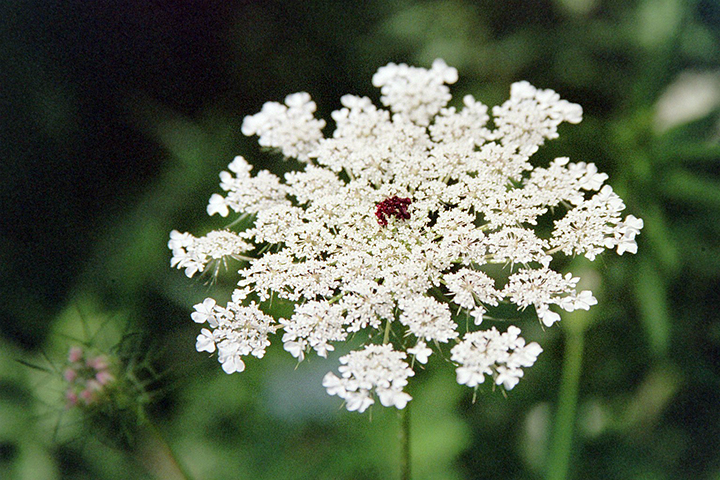
Queen Ann's Lace always has a spot of blood on it,
or a bug to draw more bugs.


When the seeds are maturing, a bird's nest seems to form.

Queen Ann's Lace is already blooming, so I have another bee and butterfly plant in the back. I found that at Lowe's, free, in a patch solid with the stuff. I gathered and sneezed at the same time. The flower is nicknamed Bird's Nest because the umbrella-like seedhead looks like a bird's nest as it matures.

We had mulch but not enough newspapers for the front rose garden touch-up, where some grass erupted through the mulch. That happens with a new row of plants, because the grass is even more vigorous and stages a breakout before composting. When the Friday paper came, my first thought was not the news but the mulch. "Saturday's paper will do it." The Sunday paper goes to the fours sisters for their mother's coupon collection.

Once a good use for trash is discovered, a shortage arises. In cleaning up one area we found an enameled pan, just right for a bird bath. That began my search for more shallow pans and bowls.

I knew I had toads from last year's surprises under the spigot bowls, which I used to capture extra water for Sassy and various creatures. Invariably dumping the bowl for clean water meant uncovering a toad.

When I moved an enormous log in the wild area, a large toad sat there royally. Looking at our minor insect damage, I wanted more toads and bought inexpensive clay pots to crack and deploy around the yard, front and back.

Currently - 
The potatoes are flowering and producing seed, something missed by many. They are in the straw bale garden, the sunniest part of the yard.

Cinco de Mayo floribunda rose.

The bargain roses bloomed before the fancy hybrid teas, perhaps because they were older bare root roses. They are worth far more than the $5 each I paid. One reader corrected me when I said Cinco de Mayo was not an attractive rose. "All God's roses are beautiful." Now in full bloom, Cinco is one of the best of all the roses in bloom.
Veteran's Honor is a vibrant red and fragrant.

Peace roses are blooming - vintage and Pink Peace. I am waiting for Chicago Peace to bloom. Veteran's Honor may be the best red rose ever, but Mr. Lincoln has many great qualities, fragrance, and turns purple as it ages when cut.


Falling in Love, hybrid tea, fragrant.


Forever in Love, which I thought died during winter, bloomed in its new location.

The vines are growing, from Honeysuckle (rapid) to Trumpet (leafing out) to Passion Flower (green and struggling).

Lessons Learned So Far 
The heat loving plants should be started after Memorial Day. Early planting means either poor germination or no growth for months.

  • Tomatoes.
  • Potatoes.
  • Corn.
  • Pumpkins.
  • Sweet potatoes.


Cold loving plants do well in the cool, damp, rainy days:"

  1. Roses.
  2. Strawberries.
  3. Sunflowers.
  4. Peas.
  5. Asparagus.
  6. Vines.
  7. Spinach.

 Let the weeds grow. They have many surprises and good things to offer. Exception - poison ivy, full of surprises with nothing good to offer.


Monday, May 18, 2015

Bindweed, Crab Grass, Nitrogen, and Mulch -
Jackson Mulch Works Wonders with Weeds

Liebig began the chemical experiments with soil and crops
that led to inorganic fertilizers.

Bindweed and Crab Grass are prodigal providers of seed. Bindweed is the evil cousin of Morning Glory, so it loves to hide in bushes and wrap itself around plants. Pulling it out can simply add more seeds to the collection in the soil.

Crab Grass came over as a grain and escaped with great success, like dandelion and day lilies.

Weed seeds survive in the soil as long as 40 years, so simply turning over the soil can expose them to sunlight and prompt them to grow.

The key to weed reduction is not herbicides, which are especially effective on bushes and flowers, but to use Jackson Mulch. I did not invent Jackson Mulch, but emulating the Roman Empire, adopted the technology to my growing and needy rose gardens.

Jackson Mulch is simply a complete layer of newspapers, weighed down by shredded wood mulch, leaves, or compost. I favor wood mulch for keeping the newspapers in place. Leaves are not reliable in keeping down the newspaper, if the wind picks up and dries them out. Sticks and branches can also be used. Compost is great because it combines the ingredients and soil creatures, even earthworm egg capsules. that the soil requires.

Newspaper style mulch works because the cellulose will break down in time, unlike plastics and "landscaper's cloth." The first effect of the newspaper layer is to block the sun. If you think that does not kill everything below, leave a big sack of seed or mulch on the lawn for a week or two.

The vitality of the weed is rendered null and void with no sunshine to sprout the seeds. In fact, the mass of weeds will quickly turn into the best compost, including their roots below. The greens decompose very fast and the roots leave spaces in the soil when they die. All this feeds the soil creatures, which simply love darkness, damp, and rot.

The sun baked weeds turn into dark enclosed compost, especially because the moisture previously dried up by sun and wind is held down below to feed the process of decomposition.

The gardening industry wants people to believe that inorganic fertilizers help plants, when the chemicals only do their job when available to the plant roots. Most of the inorganic fertilizer will pass down into the water table, as proven by one rose grower who had terrible results with fertilizer while his friends were having great results with organics.

The clue is simple - soluble, that is, available chemicals. The atmosphere is 80% nitrogen, so why would plants lack nitrogen?

The lightning makes nitrogen compounds in the rain that give
seed for the sower and bread for the eater.
'Isaiah 55


Classroom - Nitrogen
But nitrogen compounds, such as ammonium and nitrates, do mix with water. If those nitrogen compounds exist in the air, they can mix with water and come down with rainwater. The question then is, how can stable nitrogen molecules convert to nitrogen compounds? The answer is that it takes energy. For example, lightning provides enough energy to split nitrogen molecules and stimulate the formation of nitrates -- molecules with nitrogen and oxygen molecules. Bacteria decomposing animal manure and internal combustion engines are also sources of energy that produce nitrogen compounds that can end up in the atmosphere.

Green, leafy plant material is high in nitrogen compounds, so smothering the weeds with mulch will give those compounds to the good plants. We mulched large areas of lawn months in advance, to have a garden area ready - without tilling or back-breaking digging. We also mulched after the roses were planted, so the lawn decomposed around the plants to feed them as they grew.

Having mulch around the entire fence perimeter meant that we had plenty of easy digging to plant 30 asparagus, 16 roses, beans, peas, and other plants.

Long-term, the soil creatures are moving bags of usable nitrogen. I have neglected the earthworm, which we take for granted, in favor of the soil microbes. Next is a post on the earthworm's role.

Crabgrass can be mowed or mulched.
Pre-emergent toxins can be used, but do not let
children play in the grass.

Thursday, April 9, 2015

Gardening Makes People Eager To Get Up

Let's roll!
Winter continues in other parts of the country.
We have a severe thunderstorm watch.


Gardening changes our morning outlook.

The first thing I want to see every morning is the Jackson Bird Spa, soon to be expanded to the Jackson Animal Resort and Spa. Two neighbors have concrete blocks, the mother's milk of all construction. Then I can mulch the rest of the area near our bedroom window and bring the food and fun closer all day.

I can see birds on the Jackson EZ Bird Swing before I get out of bed, and they drop over to the feeder just below the swing. Sometimes they eat on the swing afterwards.

Activity on the suet slowed down when I began using large wire baskets to hold chunks from the meat market. The birds are suspicious of something new, so they will be cautious for weeks. Fabric bags get rather messy so they will be retired.

Since I usually wake before birds, I hear the growing chorus as they greet the dawn. A crow caws loudly each day, breaking off when he knows I am around. The largest bird is the most cautious, while the hummingbird will buzz friendly gardeners with a water hose (free bath). Chickadees are likewise just as friend and daring.

When fed and watered, animals have more time for games.


The woodpecker I fed all winter is ratta-tat-tatting on the trees each day. The grackles have established a home in my yard, and the starlings visit with them. Mourning doves and a charm of finches arrive daily.

I look over the needs of various plants and opportunities to transplant. I realized the wild strawberries are natural for easy growing, shade tolerance, and critter feeding. They also make an attractive ground cover around trees. The dead tree had ragweed ground cover last summer. We covered that with Jackson Mulch in the fall. Now we have honeysuckle vine and wild strawberries growing the in the wood mulch, a more attractive alternative.

Gardeners have more birds because the best growing habits foster bird feeding and bathing. A bush dripping water is also a safe shower stall for small birds. The aerial aqueduct is handy for larger birds above and below the soaker hose on the fence. I have eight or more dishes of various depths for their drinking and bathing. They get clean refills almost daily.

Robins look at me while I water roses the way Sassy looks at me while grilling. They expect to be fed soon, and they often feed a few feet away, grabbing a fat worm while I watch. Should I be taking notes? More worms? More water?

Trumpet vine - nectar and insects.


Mrs. Ichabod began laughing when I said I was moving the mulch closer to the bedroom window. She pictured a rug pulled by the corners. I said, "No," glaring for even more amusement, "I will put down a bigger layer over all the grass in the area. The birds will feed and bathe closer." She was still laughing so I added, "They do most of the insect work in the garden."

She objected, "But they poop all over."

I rebutted the objection - "At least they give the food back."

This morning we had two baby squirrels on the ledge feeding. They do not mind us watching from a few inches away. When they left, the finches arrived since that feeder caters to them with thistle (niger) and hulled sunflower seeds. Suet hangs from the feeder, so starlings are bound to come by at various times.