Showing posts with label Teaming with Microbes. Show all posts

Wednesday, October 27, 2021

You Are Not in Charge - Let Living Roots Grow in the Creation Garden


Procrastinating storms are typical here. Sunday was supposed to let loose on our dry landscape. When only a short mist appeared, hopes were raised about the Wednesday forecast of rain starting at 5 am. That has been delayed for several hours, but the payday already signaled its arrival yesterday. I could smell the first hints of a major storm, and the wind kicked up, cold rather than cool. A major storm always pushes a front of colder air before it, as if to warn all creatures to get fed and get warm.

Roses are still blooming because our water prices are especially low. We have many stunted plants (Bee Balm, Joe Pye) clipped low but putting out new leaves. That reminded me of the Carbon Cowboys' dictum - "Let plant roots grow as long as possible."

The argument is simple - roots cause 75% of the fertility of the soil. If we give credit to the Creating Word - the Son of God - and His superb engineering skills, the reasons are clear. Growing plants have thousands of miles of roots and root hairs to feed the diversity of plants. 

Some plants are bought from a nursery. Others begin as seed in the garden. Still others seem to make a surprise appearance; bird bombing provides a clue. Yesterday Comfrey made an appearance far from the original plant. Yarrow has various locations after one summer of blooms and seeds. 

 Armillaria mushrooms feed from wood sources. We have clusters of them. Ranger Bob thought Dog Vomit mushrooms were the real thing and blamed Sassy for a moment.


Every plant has its own system connecting to others via fungus strands. They provide water and nutrition for the plants while the plants provide carbon for fungus growth. Mushrooms are the fruiting bodies of particular fungi, such as "dog vomit" which appears on top of wood mulch.

 Dog Vomit fungus appears on wood mulch.


I used to think of plant nutrition as something we add to the lawn and garden, but Teaming with Microbes taught me that the ideal - the Divine Plan - is holding water and nutrition in the top 12 inches of soil. Every living creature and cell performs its assigned task and dies to feed and water the next creature and cell. Moving creatures aerate the soil and loosen it for more growth. Bacteria in earthworms need to be bussed to new locations, and bacteria in earthworms reduce the raw materials (dead leaves, etc) into worm manure (politely called castings) that gently feed roots, hold moisture, and add usable calcium to the garden.

Teaming with Microbes is essential for gardening.


John 1:3 allows for no exceptions, a rhetorical device used in the Scriptures (by no other name is anyone saved, Acts 4:12). 

KJV John 1:3 All things were made by Him; and without him was not any thing made that was made.


Rationalism is king in science and modern Biblical studies, but that philosophy is devoid when it comes to purpose. Random events, even over billions of years, cannot exhibit purpose. The soil scientists did not even know or appreciate the work of fungi until recently.

By Norma A. Boeckler


 Growing up on a farm - more people need that kind of education.

Tuesday, February 14, 2017

Gardeners Dream of Long, Slow Rains Like This.
The Garden Is a Local Area Netgwork (LAN)

 Gardening is contagious. 
Here are some KnockOut roses.
My neighbor has a wonderful nursery - Almost Eden.


Last night began a long, slow rain that should last all day. A large front is moving up from the Gulf of Mexico, through Texas, and traveling onto the Midwest, ending on the East Coast.

These weather systems help us realize how water gathered by a single dam can become a threat to hundreds of thousands of people - like the crisis at the Oroville Dam in California. In 2005, various groups filed petitions to have the earthen spillways made into concrete because of the danger of erosion, now happening as predicted.
Meanwhile, the rain is slowly soaking into our clay soil, which turns whiter as it dries out. Our rose canes are greening up and leafing out for Valentine's Day, a February to remember.

I love these rainy days because God is doing so much work with billions of creatures in the soil. Microscopic, beneficial fungal strands are connecting the most elaborate Local Area Network (LAN) anyone can imagine. In fact, no human expected anything so complicated a few years ago. There it was, under our feet.


Fungus tunnels through the soil, finer than human hair, seeking whom it may devour - wood chips, decaying animals, anything organic. The tip of the fungus has enormous power to penetrate wood and chemicals to dissolve and absorb the nutrition. What really astonishes me are the proteins used by the fungus to move chemicals through its skin. No moving parts - this fungus is not even certified as a plant. Nevertheless, the Creating Word designed fungus to use proteins specific for each kind of chemical transport.

 The leaves, mulch, and dead wood clumps
are now a much larger pyramid of fungus, earthworm,
and soil food.
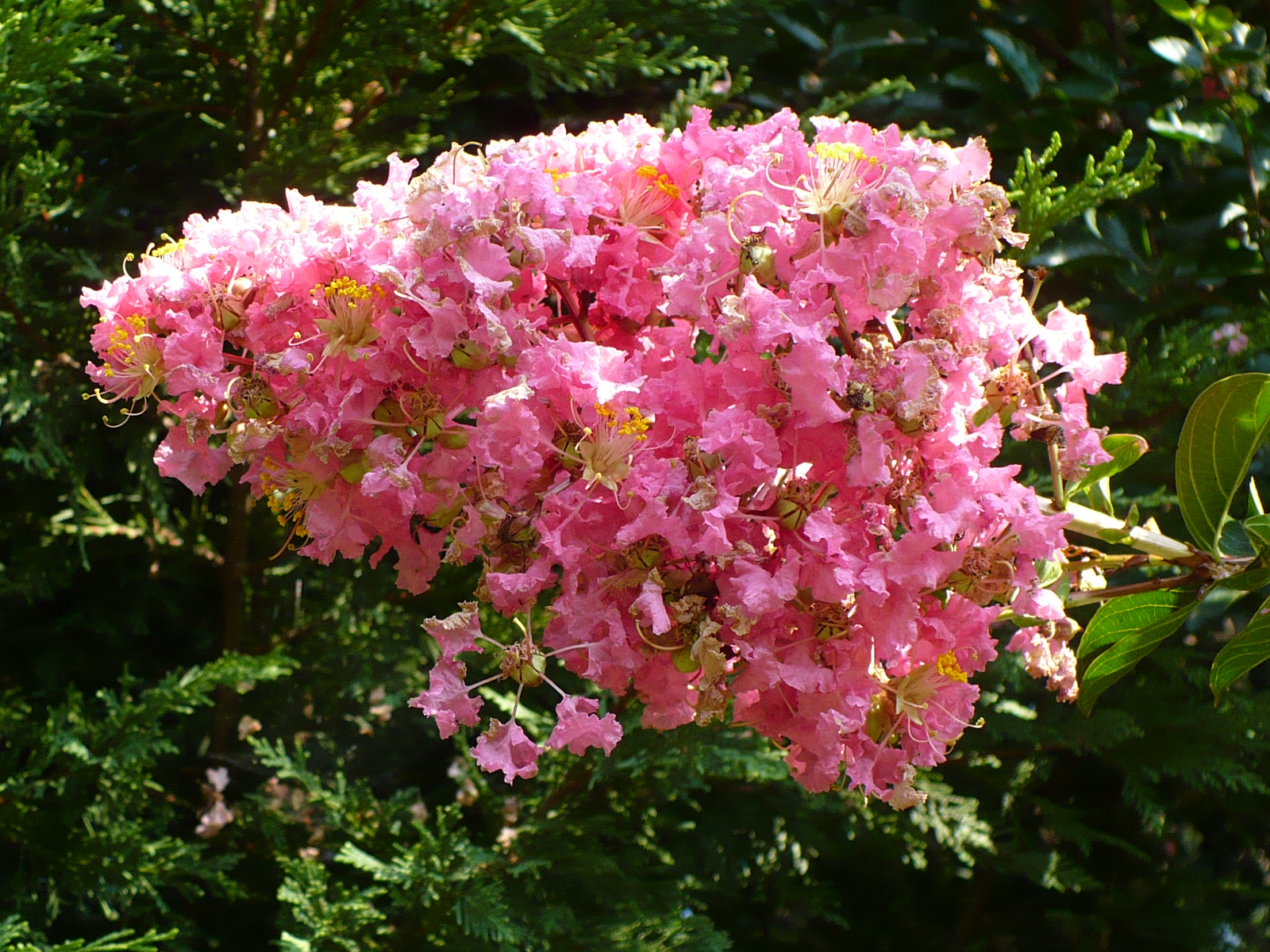
Their work feeds the Crepe Myrtle bush above.


The fungus is worried and anxious about many things, taking from various organic sources and serving multiple plants at once in this elaborate, microscopic, self-regulating LAN. If roots need more water, the fungus can deliver. When the plants demand prepared, ready-to-use nutrition, the fungus acts upon the chemical request. But one thing is needful - carbon. The fungus cannot manufactures its own carbon, so it must beg from the plant roots.

 Months of showy Crepe Myrtle blooms
come from an autumn and winter of feeding the soil
through organic materials processed by God's creatures.


The roots are devious, because they must have what the fungus can deliver, so they give up spare carbon to keep the fungus alive and growing. Some plants can live without this fungal support around them and in them, but most achieve their best results teaming with fungus, as Jeff Lowenfels has described in a series of books.

Who created and engineered these teams to work together so well? When like-minded and cooperative humans decide to build a church or add onto their building, experts assume that this task will take two years and end up with mistakes, conflicts, finger-pointing, and regrets - even on dedication day. But these microscopic parts of God's Creation build and maintain this living LAN, which repairs itself when needed.

If Mr. Gardener gets a rototiller for Father's Day, conveniently in June, he cannot wait to tear through his future garden, flinging fungal strands everywhere, destroying earthworms, disturbing the layers of soil. As soon as he retires inside to clean up and congratulate himself, the fungal strands begin rebuilding the LAN and supporting all life, above and beneath. With luck, the belt will break on the rototiller and life will be peaceful for several weeks.

The rain is essential for this building of the soil, since all life requires hydration. But rain is the best kind, feeding all life at once and adding a gentle and natural fertilizer in the form of nitrogen compounds. Soil life goes into overdrive, because the microscopic networks expand to recycle the population explosion around them - bugs hatching, earthworms moving and dying, plant debris decaying on top of the soil, roots tunneling and dying.


The melting snow and falling rain always have an effect. The Spirit teaches this in the Word and Creation illustrates this truth from the beginning of time - God spoke the Word - Let there be light - and there was light.


Saturday, June 25, 2016

Heard from Three Gardening Gurus at Once -
Mulch Is Modular and Fun To Use.
Saving Planet Earth So You Don't Have To


Yesterday I heard from my favorite gardening gurus at the same time. The three are:

  • Jessica Walliser - Attracting Beneficial Bugs to Your Garden
  • Jeff Lowenfels - Teaming with Microbes - Soil
  • Sharon Lovejoy - A Blessing of Toads - The Big Picture

Sharon Lovejoy seemed surprised that I discovered her Blessing of Toads at  Cracker Barrel. All three chimed in with a like or a comment.

As I wrote before, these three books are essential for a Creation Garden, with far less work and cost, far more enjoyment and production. We had a brief spell where all the roses were waiting to bloom or just finished. 

For the KnockOuts, I pruned 50% of the bush. For the rest, I looked for dead wood, crossed canes, and unhealthy looking canes. The Jackson Rose Farm looked like a vast mulch display with little color. With some rain and watering, the roses took off again.The KOs are bursting with buds and blooms. The rest of the roses are either in full bloom, looking for some pruning, or ready to bloom he first time.

Strangely enough for some readers, the Maple Tree Rose Garden, which merged with the main rose area, is thriving with $5 roses in bloom - around 20 in all. Common sense says - 
  1. Do not plant among maple tree roots.
  2. Do not make roses compete with greedy maple roots.
  3. Do not plant roses where there is more shade.
  4. Do not even think about digging under a maple.
I made the case with Mrs. Ichabod and lost, but I am glad. Our helper and I actually dug roses in between lumps of roots. Those roses get plenty of sun in the morning, another sunbath in the afternoon. The ones most in the shade are slower, but they also bloom.

The key argument is - "I want to see the roses." The most visible flowers are going to  be enjoyed more - and our neighborhood loves them. The ones we pass every day will also get the most attention. Roses do not need a lot of work in the Creation Garden, but they need regular attention with their need for water and pruning.

Before I had any $5 roses to plant, I threw 10 bags of mushroom compost in the area where I hoped to plant something else. I covered the entire area with shredded mulch, added some garlic bulbs, and sprinkled red wiggler earthworms on top. That was in the autumn. At the worst, it was far better looking than what we inherited, an area packed with maple suckers, weeds, and broken toys.


Modular Mulch
The various weeds are pushing their way through the wood mulch. I can only blame the superfertile soil for that. Mulch builds the fungi network that Lowenfels describes so well. Earthworms and all soil creatures thrive with mulch. Besides those benefits, mulch conserves water and topsoil.

Weed seeds blow in and come up from below. Birds deposit them with fertilizer the natural way. Like any enemy, weeds find the weak spots and attack.

Mulch is modular. We do not need to re-mulch the entire garden. Instead, we:
  1. Look for weed patches.
  2. Cover them with cardboard or newspaper.
  3. Hold down the shade layer with shredded cyprus mulch - or water jugs in the back.
In the Wild Garden we used 60+ bags of autumn leaves to hold down the cardboard. That worked so well that hardly anything grew on top of the mulch. When I lifted the  cardboard, unmoved for six+ months, the former lawn was soft composted soil, easily dug, earthworm packed.

I have a new supply of cardboard and wood mulch for the areas that want to be weedy. The weeds are great ingredients for compost. Why pull them up and compost them? They are more useful when they rot there, feeding billions of soil creatures and feeding the plants I want to thrive.

Helianthus is a permanent sunflower plant,
which I want, because the squirrels eat every sunflower seed I plant.


Thursday, May 26, 2016

True Diversity in Planting the Creation Garden

Jessica Walliser writes about beetle banks,
where beetles are sheltered as an investment in pest control.

I write for the newer gardeners, because there are so many basics ignored in the colorful gardening books sold in stores. The foundational books for gardening are Lowenfels (soil), Walliser (beneficial bugs), and Lovejoy (observation and discovery).

As Jessica Walliser explains so well, planting diversity is the key to enjoying the support of beneficial bugs in the garden. Some of the efforts I have made include:

  • Letting grassy areas grow as shelter for beetles and web-less spiders.
  • Seeking out tiny-flowered plants for beneficial bugs.
  • Looking at the value of weeds, which often have unexplored virtues and benefits.
  • Emphasizing butterfly, bee, and hummingbird plants.

The umbrella flowers of he carrot family, like dill in this photo,
are appealing to beneficial insects.

Some are saying, "Thou hypocrite. Thy entire front yard is planted in roses." I like hearing from KJV fans, but they miss the mark here. I have also planted:

  1. Garlic, which repels insects and supposedly makes roses healthier.
  2. Mountain Mint, a plant that beneficial insects loves.
  3. Spirea, a low growing bush that favors butterflies and bees.
  4. Crepe Myrtle (inherited), a tall bush that currently harbors a cardinal nest.
  5. Bushes (inherited) near the house, which shelter toads and various creatures.
  6. Raspberries and Blackberries to feed the bees and birds.
Pokeweed has several virtues - deep taproots,
easy care, and berries for many birds,
which plant them for free.

Pokeweeds yield bright red poke berries,
and this native wildflower grows anywhere and everywhere.
Grandson Alex says, "Deal with it."

Birds plant Pokeweed and Wild Strawberries for me, but I leave those in the backyard.

Plant diversity means a constant flowering of weeds and flowers that feed the creatures we value so much. Many beneficial insects feed from flowers in the adult stage and set their babies upon the pests in their infant stage. Ladybugs are unusual in devouring pests at both stages.

Many plants have one bloom cycle. They display pollen, get pollinated by various creatures, and set seed. "Done. Bye. See you next year." We can see that in the low-growing weeds in the lawn. Arkansas has many wild flowers or weeds that garnish the monotonous lawn with color from time to time. They give the beneficials and bees a chance to feed all summer long, or in-between the big crops. Dandelions, a valued herb, is prominent and despised for no other reason than its ability to thrive in grass.

For example, by feeding and watering the birds, these creatures get into the habit of coming to our window feeders and nesting nearby. Likewise, the beneficial insects would rather set up housekeeping near sources of food and water.

Bombing the landscape with poisons is no way to foster diversity in insects. The effect of pesticides is to kill all insects and spiders, a bad result. The effect of fungicides is to kill bad fungus, good fungus, and other forms of life. I once had a lawn service that sprayed the yard with a weed-killer (contrary to my expressed wishes) that killed all the violets in the yard. long ago in Midland.

Almost Eden has a pile of topsoil he obtained for free from a construction site. They messed up orders in scraping and made the soil commercially unappealing. He had the low hill installed as a berm, and it began to grow with all the weeds and wildflowers dormant as seed in that soil. I said, "That is going to be wild with beneficial insects." We saw carrot family, possibly Angelica, common weeds, and some plants too exotic to try to name. I plan on visiting it with Sassy to look for insects.

My morning walks with Sassy often reveal piles of great gardening material set out as garbage. I often bring them home, so I have stumps (rescued by car), rotten wood, Gandalf staffs, and slices of trees. Almost Eden asked where I got my attractive rustic fence in the front yard. I said "Across the street. We went through the pile for the best examples."

The mint family (Mountain Mint here)
is appealing to all insects but can get away.
I told our helper, "Mulch your roses with your
mint scraps."

Sunday, May 22, 2016

Rose Consultations - Avoiding the Big Mistakes in Gardening.
In Short - Don't Do It!


Creation Gardening means avoiding the big mistakes. In roses, that means

  1. Failing to prune consistently, which is not much work.
  2. Imagining that fungicides will stop black spot.
  3. Ignoring the complex dependencies of Creation, which work on their own, given a chance.
  4. Trusting in man-made fertilizers when God does a much better job.

1. Don't Let Roses Get Ragged - They Love Prunes
One rose fancier laughed with me about KnockOut roses "pruning themselves." Their robust growth means they need steady pruning, which can be accomplished two ways. One is by cutting roses and snipping off spent roses during the enjoyable time. The other is by having a take-no-prisoners pruning session, which includes taking off all spent roses, all roses trying to go to seed and without petals, and all dead wood. The biggest pruning I do with KnockOuts is a 50% cut, which happens at the beginning and several times later. 

Pruning is the opposite of hurting the rose. Cutting energizes the plant. If 20 buds are forming, clipping 10 of them will make the remaining ones bloom faster and better - and more will form. A rose about to peak is best in color, so a bush full of peaking roses will be glowing red or pink. 


2. Don't Spray for Black Spot - It Is Part of Colored Roses
Black spot was introduced with the Persian Yellow rose, so we have to deal with it among most rose varieties - except KnockOuts. Black Spot is a fungus that lives in the soil and eats at the leaves. I normally cut the hybrid teas and clip off the leaves in the grass (not in the mulch). A healthy rose in my gardens will have Black Spot and still do well. If the rose is weak, the Black Spot seems to be killing it. The solution is to strengthen the rose, not douse the Black Spot with poison.

Man-made toxins kill the beneficial organisms so the intended good effect has long-term bad consequences.

But he lost the Best Dressed Rosarian award.


3. Don't Ignore the Complex Dependencies of Creation
God created soil as a living ocean of creatures dependent upon each other, plus some sand and clay and stuff like that - mostly rocks in some areas. The creatures we cannot see are the most important, because they are the foundation for the soil-plant-microbe relationships.

I encouraged one rose grower to do more to grow plants harboring beneficial insects. She had holes eaten into her roses. I have wasps or hornets in the front and back, and they have to be eating something. Research - "Wasps eat a wide range of invertebrates including spiders, caterpillars, ants, bees, and flies." I had a few holes eaten in the roses, perhaps by earwigs, but it is not a big problem. A concentration of roses should increase the pests, but they also increase the supply of food for the pest eaters. When I was pruning, a flower fly got in my way - he looked like a little bee. 

I let the white and Peace flowers take the pest attacks, which brings the beneficial insects (flower flies, ichneumon wasps, etc) to the roses. The good insects may attack the pests on their own or lay eggs on or near the pests. Thus the solution takes a little time, as it does with me. The second blooming had greatly reduced damage, and the rest of the summer the roses were damage free.

A ye who get out the insecticide and poison the ground with systemic poisons - are the spiders missing in thy garden? As I was looking at the roses in the front yard, I saw a silken thread above them, perhaps a traveling thread used to come down from the maple tree and feast among the rose pests. As the season develops I often cut flawless roses that enjoy a thick spider web around the stem, a wall built against illegal intruders without any cost to me.

God not only creates these magnificent examples of plant and animal life, but engineers them to perfection in their individual roles and manages their work. The parisitoid wasps see pests as "food for my children" and destroy the pests for us while guaranteeing a new generation of helpers. The spider sees wood mulch and says, "There I will stretch my net, because the food supply around and beneath wood mulch is endless." Birds think the same way, yet birds and spiders feast together. Each creature is fitted for the tools and skills it needs to prosper, which is engineering at its best, but it is also managed by unseen forces to carry out its tasks relentlessly and to move on when the work is done.


Side Bar
Did Jesus command His disciples to cast a vision for the future? Did the Holy Spirit descend upon them so that people saw images of soft-drinks and snacks, making the prospects hungry for the Christian Faith? St. Paul wrote, "Preach the Word at the right time and at the wrong time." (Jackson Relevant Relational Living Surfer-Dude Paraphrase) 2 Timothy 4:2

The Word created in the beginning, entirely through the Son, the Creating Word. Nothing was created apart from Him - John 1:3.

When so many turn away from divine solutions for man-made answers derived from business, we should shake our heads and direct the young seminary students to the garden, since their school's name  - seminary - really means seed-bed. Try working the garden with ordinary tools and labor, and plant the living seed that was created to grow and reproduce.

I still sow seed in the yard, those tiny seeds that easily fall into the rough surface of soil and mulch, germinating and growing to self-sow in the future. In the olden days, that was called broadcasting. Now we say that about digital media, where we can broadcast the Word via blogs, websites, and live-streaming video. The results are similar though global, since the Word can reach anywhere. We get responses from all over the 50 states and around the world. The Word never returns void, always accomplishes His purpose, and always prospers His purpose. 


4. Don't Trust in Man-Made Fertilizers When God Does a Much Better Job

Jeff Lowenfels, who wrote Teaming with Microbes, recently wrote a column where he dissed anyone who tossed around the soil just to place a few potted plants in the garden. Of course, there is no better way to disrupt good fungus, kill earthworms, and exposed weed seeds to sunlight for instant germination and growth.

Man-made fertilizers are detrimental to soil microbe growth. Their reputed power - compared to the gentleness of earthworm castings or animal manure - is an argument against factory fertilizer. The combination of fungus-bacterial-protozoa-nematode interactions keep the usable chemicals of decomposition in a convenient place for the fungus to funnel the food to the roots. Factory fertilizer is like that TV game where dollars descend or blow around in a cage. The contestant can keep what he catches, but most of it floats to the floor.

God's fertilizer adds up rather than passing into the water table. God's plan is to add the organic matter generated by plant and tree growth - leaves and other debris - to the soil, so the soil can hold more nutrition and support more life to grow plants that add more organic matter.

The self-serving and opportunistic maple tree would like to have the front yard for itself, shading out all rivals, using its greedy surface roots to absorb the rain and elbow out other roots. But that tree can live in peace with a rose garden if the lower branches are pruned to let in the sunlight.

God's fertilizer is hand-crafted (by His own Hand) from:
  • Fallen leaves, dying seeds, pollen, dead insects.
  • Mushroom compost and the excretions of billions of soil creature.
  • Mown grass left in place.
  • Rain fertilized by lightning.
  • Animals large and small that die in the soil - moles, voles, earthworms, and springtails, to name a few.
  • Bacteria and protozoa fighting a war over which will dominate.
  • Fungus.

I made way for the new roses for the altar flowers,
disposing of this Veterans Honor rose in the garden,
but the bloom still remained full and brilliant red for days.

Monday, April 18, 2016

Mr. and Mrs. Cardinal at the Feeder. Grackles in the Wild Garden.
O great rose farmer, your Chrysler Imperial roses have arrived.
Beetle Banks

No bird is quite so welcome as the cardinal in the winter.
It made my day when Grandson Alex saw one eating at our feeder,
from a few feet away in the bedroom.


This morning I woke up to a baby squirrel sitting and eating in the sunflower seed platform, a favorite hang-out for the juvenile squirrels. A male and female cardinal were eating from hanging bird feeder (Lowe's), and two other birds were also on that circular feeder.

The birds are less likely to fly away when I approach the window. Everything is bunched up close to the window, so we have activity all day long. When the sun sets in the West, I have shadows flitting around on the wall that I face when working on the computer.


Management by the Creator
Gentle rains have built up the new roses and energized the earthworms. This is how the Creator helps the soil through the engineering of the earthworm:

Vermicastings 
Vermicastings (the name given to worm poop) are 50% higher in organic matter than soil that has not moved through worms. This is an astonishing increase and radically changes the composition of the soil, increasing CEC because of the greater amount of charge-holding organic surfaces. Other nutrients, therefore, have the ability to attach to the organic matter that has passed through a worm. 

The benefits don’t stop there. The worm’s digestive enzymes (or, properly, those produced by bacteria in the worm’s intestines) unlock many of the chemical bonds that otherwise tie up nutrients and prevent their being plant-available. Thus, vermicastings are as much as seven times richer in phosphate than soil that has not been through an earthworm. They have ten times the available potash; five times the nitrogen; three times the usable magnesium; and they are one and a half times higher in calcium (thanks to the calcium carbonate added during digestion). All these nutrients bind onto organic matter in the fecal pellets. 

Worms can deposit a staggering 10 to 15 tons of castings per acre on the surface annually. This almost unbelievable number is clearly significant to gardeners: the ability to increase the availability of nutrients without carting in and adding tons of fertilizer is about as close to alchemy as one can get.

Master shredders 
Earthworms are classified as shredders. As they search for food, they break down the leaf litter in the garden and on the lawn, greatly speeding up the decomposition of plant material, directly and indirectly. They open up leaves and other organic matter, giving bacteria and fungi better access to the cellulose (and other carbohydrates) and lignin (a noncarbohydrate) in the organic matter. Earthworms, then, obviously facilitate the recycling of nutrients back to the plants.


Lewis, Wayne; Lowenfels, Jeff (2010-09-10). Teaming with Microbes: The Organic Gardener's Guide to the Soil Food Web, Revised Edition (Kindle Locations 1400-1409). Timber Press. Kindle Edition. 

The Wild Garden proved its worth when a flock of grackles landed and began flicking leaves away to eat the insects and worms beneath. More about that below.

"O great rose farmer, your Chrysler Imperial roses have arrived."

The people at Gurney are so respectful. That was the email message I received today. Of course, I wrote that into the program when I got the initial order shipped. Unfortunately, this only meant the roses were being passed from FedEx to the Post Office. I have two more days of waiting. That is why bare root roses seem a bit dry when they arrive.

When I had a DOS computer, it booted up saying, "What is your wish, O Great Publisher?"

One day the computer rebooted and said, "What is your wish, Rex Flipperorum?" That was Little Ichabod's version of King of the Seals. He had his cousins call me Uncle Flippers, which they loved to do. My granddaughter even said this about my short legs, "They look like they belong to another person, Grampy."

So I plan on having fun with little programs that let me input a personal message, which is perhaps a way to make people sure of the message coming from a legitimate source. After all, I get offers of $25 millions or more from various sources each day.


Beetle Banks
ORGANIC FARMERS ARE mandated by the rules of the USDA’s National Organic Program to work to conserve biodiversity on their farms. Gwendolyn Ellen’s job is to work with both organic and conventional farmers and with researchers to find ways to make this happen. In the early 2000s, Ellen and other scientists at Oregon State University began to develop a program to establish and study beetle banks. A regular practice of farmers in Great Britain and Australia, beetle banking involves creating elongated, semi-permanent raised berms throughout crop fields and planting them with grasses. 

Beetle banks are a great example of how habitat creation and companion planting can encourage populations of a very important predator. Ellen explains that the predaceous ground beetles these banks are meant to encourage instinctively climb upward to stay high and dry, away from moisture. To encourage this natural behavior, beetle banks are raised a foot higher than ground level. The native bunch grasses planted on the banks provide a drier, warmer habitat for these insects during the winter. The beetles especially like the organic matter that naturally accumulates around the base of these grasses. In the spring and summer, the beetles move out into the fields to forage for prey. 

“You have to think like an insect,” Ellen says. “Create a refuge from soil and pesticide disturbance. Our research shows that providing an undisturbed area, no matter what the size, increases the diversity of predaceous ground beetles on farms.” Ellen’s team encourages farmers to put in banks sized to fit with their farm’s production practices and suggests incorporating a minimum of three different species of native bunch grasses (grass species that grow into a clump or tuft rather than spreading horizontally to form a sodlike mat) into a given beetle bank.

Walliser, Jessica (2014-02-26). Attracting Beneficial Bugs to Your Garden: A Natural Approach to Pest Control (Kindle Locations 3395-3409). Timber Press. Kindle Edition. 


The Wild Garden was this wild before we applied about 80 bags of leaves.
The extra newspapers piled up are now in the driveway to
help in mulching the rose garden and tomatoes.

The back part of the yard is higher ground, and it is left alone. That is the jumpin' jivin' part of the yard, not a place for shorts and sandals.

Weeds and tall grass are welcome. I planted dill and Queen Ann's Lace. I let pokeweed grow 8 feet tall.

Besides that, I have shallow pans for toads and other creatures, careful to clean them various ways and empty them out every few days. Bees too like water and take it back to the hive to create evaporative cooling.

Evaps are popular in Phoenix. Big fans and their water puddles are used to cool the air when the temps are high and the humidity is low. They are also called swamp coolers because they add humidity to the dry air.

So here are bees making their own swamp coolers to protect the hive. And we admire our own engineering.


I never realized that one kind of spider worked without webs - the cursorial spiders. I knew that beetles were so populous in the world that one etymologist concluded, "God was inordinately fond of beetles" when he summarized his career.

Those beetles can track slugs by their odious slime trails and remove them permanently. They do most of their work at night and appreciate a safe place by day, a welcoming place for the winter. Given these facts, do you want to rototill the Wild Garden and destroy an army of beneficial creatures, which doubles as a full-time cafeteria for birds?

That is why we expanded the Wild Garden from a slice of the backyard to 50% of the backyard.


Thursday, October 1, 2015

Thirty Years To Grow - Tree Down in One Hour.
Teaming with Wood Mulch


We heard an unusual, persistent sound on this quiet block. I went outside - the Gardeners' tree was coming down. He was outside watching, so I joined him.

I appreciate trees, but not when they grow crowded and in the wrong place. This one was also raining debris on his collectible cars.

The crew took down the branches fast, cut the trunk into pieces, chipped the branches into a large truck, and loaded the loads into the owner's pickup. The son-in-law was getting the logs, and I coveted the mulch.

Summary - organic matter is good for the soil, great for the plants.


The boss heard I liked wood mulch so we discussed a way to get a load into my yard without it being a mountain. Midland Michigan would dump a load for free, so I once got a tuck-load of aromatic cedar, making one neighbor child say, "It smells like Christmas here."

I will get a small load of chips later, which will be great for the winter. Wood is knocked for soaking up nitrogen, which is a half-truth. Wood uses nitrogen as it starts to rot and then releases it into the soil. Long ago I read that adding wood products to the soil would make it more bacterial laden than any other process. I do not have chapter and verse on that, but I trust it is true. Bacteria is part of the process of capturing organic chemicals in the first foot of soil.

Commit to memory - earthworms are cows that graze on bacteria. Build the foundation for a large herd of earthworms and they will tunnel, aerate, mix, fertilize, and sweeten the soil. Earthworms will be fruitful and multiply to the extent they are fed.

Based on Lowenfels epic work, I would call wood products the ultimate fungus feeder. Bacteria are good but they are tiny and immobile compared to fungus. The fungal strands can simply dissolve wood and bark. Fungus travels great lengths to dissolve organic matter and deliver the needed chemicals - via their tubes - and moisture to plant roots. The plant roots offer up carbon credits, which fungus must have to grow, to get the materials they need to grow.

Bacterial alone can rot organic matter, but not as fast or effectively as fungus. When grass is piled up, fungus will attack at once to soften the cells. Bacteria will join the fun and build up heat, but that white covering is the first attack of fungus.

This fungus, trapping a nematode, shocked the Teaming authors.
The fungus engineered a spring trap to stop, kill, and - yuk - digest the nematode.
Dare we say - Creation?

While some fungi prefer the “softer,” easier-to-digest sugars characteristic of the foods that feed bacteria, most go for tougher-to-digest foods (mainly because bacteria are better and faster at grabbing and taking up the simple sugars). Fungi, however, win in the competition for more complex foods: they produce phenol oxidase, a strong enzyme that dissolves even lignin, the woody compound that binds and protects cellulose. Another characteristic of fungi is their ability to penetrate hard surfaces. Fungi have perfected apical growth— that is, growth at their hyphal tip. Apical or tip growth is an incredibly complex process, an engineering job akin to building a tunnel under a river and requiring great coordination of events. Even before electron microscopes, scientists identified a dark spot, the Spitzenkörper, in the tip of actively growing hyphae; when hyphal growth stopped, the Spitzenkörper disappeared. It seems this mysterious region has something to do with controlling or perhaps directing apical growth. 

During apical growth, new cells are constantly being pushed into the tip and along the sidewalls, elongating the hyphal tube. Materials for the growth of fungal hyphae are supplied to the advancing tip by the cytoplasm, which transports vesicles loaded with all necessary “construction” supplies. Of course, it is important to keep extraneous material from flowing into the hypha as well as out while this growth is happening. All the while, powerful enzymes capable of dissolving all but the most recalcitrant carbon compounds are released as the new cells are put into place. Think about it: these enzymes are powerful enough to convert lignin, cellulose, and other tough organic matter into simple sugars and amino acids, yet they do not decay the chitin cell walls of the fungi. 

Fungi can grow up to 40 micrometers a minute. Discount for the moment the speed, which is incredibly fast for such tiny organisms, and compare the distance covered to the movement of a typical soil bacterium, which may travel only 6 micrometers in its entire life. 

As with the death of any organism in the soil, the death of fungi means the nutrients contained within them become available to other members of the soil food web. But when fungi die, their hyphae leave a subway system of microscopic tunnels, up to 10 micrometers in diameter, through which air and water can flow. These “tubes” are also important safety zones for bacteria trying to elude protozoa: protozoa are considerably bigger than the tunnels.

Lewis, Wayne; Lowenfels, Jeff (2010-09-10). Teaming with Microbes: The Organic Gardener's Guide to the Soil Food Web, Revised Edition (Kindle Locations 867-885). Timber Press. Kindle Edition. 

Nematodes can be bad, like weeds, but the badness of the nematode, when dissolved, becomes a little dose of organic nitrogen to feed the roses, carrots, and beans. The weed when alive can create nitrogen compounds and mine calcium from the deeper layers of soil. When dead and rotting, that weed will feed the soil creatures that feed the roots.

The effort to fertilize the plant takes place at Vanity Fair, the marketplace where the root hairs meet the fungus strands for swaps. If the carbon-moisture-organic swaps do not happen there, they pass through to the water table. Thus the inorganic chemical salts make enough difference to get people hooked on them, but most of the chemicals go right through to the water table to pollute it, as the fertilizer bags concede with the big ZERO in the numbers. 10-0-10.

Insecticides and herbicides will kill and drive away the soil creatures that work together to form Vanity Fair, so - Vanity of Vanities - all is vanity when using toxins. They are also addicting, because gardeners must continue to kill when the previous toxins only make a temporary dent in the population of pests.

Sure - go crazy when roses get Blackspot. Soak them with fungicide because Blackspot is a fungus. That will clobber the fungus doing the real work and the microbes as a bonus.

"Let go and let God," according to the Twelve Step program for inorganic chemical addicts.

--


All things bright and beautiful, 
all creatures great and small, 
all things wise and wonderful: 
the Lord God made them all. 

1. Each little flower that opens, 
each little bird that sings, 
God made their glowing colors, 
and made their tiny wings. 
(Refrain) 

2. The purple-headed mountains, 
the river running by, 
the sunset and the morning 
that brightens up the sky. 
(Refrain) 

3. The cold wind in the winter, 
the pleasant summer sun, 
the ripe fruits in the garden: 
God made them every one. 
(Refrain) 

4. God gave us eyes to see them, 
and lips that we might tell 
how great is God Almighty, 
who has made all things well. 
(Refrain) 

---

Monday, August 24, 2015

What I Learned Most This Year - Creation Gardening.
Chronological Order


I began the year with red wiggler earthworm populations all over the yard, and Jackson Mulch in place in future gardening areas.


I. The Microbes Were Working for Team Jackson All Along

My foundational lesson came from a serendipity discovery of Teaming with Microbes. Most gardening books are tiresome picture books that repeat the errors of the past - or they eagerly describe the cultivation of marijuana.

Teaming with Microbes opened my eyes to the recent research about the interface of plant roots, fungi, protozoa, nematodes, and bacteria. I always worked with organic/Creation principles, but here was a book that described the reasons why we should trust in God's design.


By necessity, this book is divided into two sections. The first is an explanation of soil and the soil food web. There is no getting around it. You have to know the science before you can apply it. At least in this instance, the science is fascinating, even astonishing, and we try not to make a textbook out of it. The second section is the explanation of how to work the soil food web to your soils’ advantage and to yours as a gardener. What makes this book different from other texts on soil is our strong emphasis on the biology and microbiology of soils— relationships between soil and organisms in the soil and their impact on plants. We are not abandoning soil chemistry, pH, cation exchange, porosity, texture, and other ways to describe soil. Classic soil science is covered, but from the premise that it is the stage where the biology acts out its many dramas.

Lewis, Wayne; Lowenfels, Jeff (2010-09-10). Teaming with Microbes: The Organic Gardener's Guide to the Soil Food Web, Revised Edition (Kindle Locations 129-135). Timber Press. Kindle Edition. 

This book showed me the process of complicated microbes trapping useful nutrition in the top layer of soil, with complicated swaps taking place between fungi and plant roots.


II. Sharon Lovejoy and Her Mini-Lessons with a Macro View

Sharon Lovejoy on Facebook

The princes of Serendip made accidental discoveries while looking for something else, and they applied their luck to their endeavors. We were at the Cracker Barrel looking at all the temptations for hungry diners in their gift shop. I spotted A Blessing of Toads by Sharon Lovejoy.

The genius of this author is her combination of little lessons (toads, chickadees, the absences of chemical poisons) in her larger view of gardening and bird-watching.

Sharon is on Facebook often and a lot of fun, enjoying the fruits of gardening and writing. Because of her books, I read one section at a time and plan new projects or enhance what I am doing for for the creatures in our yard.

Her books motivated me to make our yard as toad-friendly and bird-friendly as possible. Wherever water might fall, including under the soaker hoses, little ceramic pans hold water for toad hydration.


III. Jessica Walliser's Beneficial Bugs

Jessica Walliser on Facebook

Another serendipity find was Jessica Walliser's Attracting Beneficial Bugs to Your Garden.

It might surprise you to know that a mere 1 percent of the insects we come across in our lives are actually harmful. These are the creatures that consume our plants, introduce disease, bite our flesh, feed on our pets, and cause economic, aesthetic, or medical damage. These are the bugs that tend to attract our attention, and as a result they get all the press—most of it negative. 

The remaining 99 percent of insects are either benign or beneficial. Benign insects are very good at going about their business without harming our crops or us. And beneficial insects are, in fact, doing some type of good in the landscape. Insects can be beneficial for several reasons. First, they can be pollinators. We all know how important quality pollination is to a farm or garden. The world, after all, cannot function without it. Most of us can readily recognize common pollinators like honeybees and butterflies, but there are hundreds of thousands of other pollinator species in this world: beetles, moths, wasps, ants, flies, bats, and birds. Not to mention the more than thirty-five hundred species of native bees in the United States whose pollination work sadly and undeservedly plays second string to that of the imported European honeybee. Fifteen billion dollars worth of food needs to be pollinated by some little creature each and every year in the United States alone. The worth of pollinators is undeniable.

Walliser, Jessica (2014-02-26). Attracting Beneficial Bugs to Your Garden: A Natural Approach to Pest Control (Kindle Locations 184-193). Timber Press. Kindle Edition. 

Jessica Walliser's book was at the bookstore. I kept looking for a book on vines, and never found that, but I did discover Teaming and Attracting Beneficial Bugs in the process.

I always knew about the ratio between bad bugs (1%) and the good ones (99%). My mother had no fear of bugs and always liked to grab one and demonstrate its intricacies. She collected and grew butterflies and moths for photos that she published.

Jessica's work shows a vast knowledge of plants, far beyond anything I read about before, so I study her book for the relationship between plants and beneficial creatures. Suddenly the modest plants, weeds, and herbs took on new meaning.

I followed her advice and left the roses alone for the first invasion of aphids this year. My best hopes - Peace and John Paul II - were destroyed by aphids on the first round. The blooms were ugly, distorted, wilted, and loaded with aphids and other bugs. I even visited them at night, but did nothing. On the next boom cycle, the same roses were almost flawless and have remained so all summer.

If the pests are killed or picked off by hand (scratch that idea), then the pest eaters will have no food and go away. When the pests attack, the flowers send up a chemical signal that draws the beneficial bugs. The good bugs devour the pests or they lay eggs near/on the bad bugs. That explains the delay in solving the problem. The eggs need to be laid, hatched, and letting loose the hungry babies.


Tuesday, July 14, 2015

Cannot Wait To Dig Some Soil This Morning.
All My Book Finds Are Serendipitous


A WELS pastor tried to tell me I had a doctorate in agriculture. I said no, but he insisted. Finally, I said, "Don't you think I would remember if I did?" He finally conceded.

That extra degree may have been generated by the help I gave one seminary professor, who had no clue how to compost. Those who do not learn from gardening books are condemned to repeat this error.

Crepe myrtles are easy to prune,
but where is the mulch below to feed them?

Reading and observation go a long way in gardening. Initial problems generate disgust and a temptation to use an instant solution. Our crepe myrtle bush was too close to the mailbox, and it was way out of control. Our helper trimmed it back, about two wheelbarrows full. That summer it bloomed. Next we trimmed back the bottom part to show off the bark and give the bush a Lyle Lovett look. The blooms were even bigger because the bottom has been mulched, watered, and earthwormed for several years.

When the blooms are done, they can be cut off
for a second round of blooms
How many do this in the entire neighborhood? One.


When Sassy and I return from our walk, the crepe myrtle looks like floral fireworks, with enormous vibrant blooms shooting off  the top. Our single bush adds color and beauty to the entire cul-de-sac, and neighbors appreciate it. Our helper is proud of it because he did a lot of the pruning.

Today I cannot wait to dig into the watered soil and plant blueberry bushes. Almost Eden told me about things to do, and I read more on the Net when I woke up.

One big concern is birds eating the berries. I thought about netting - not a problem for the near future - and made a suggestion to Mrs. I. "Why not dedicate a bush or two to the birds. Give them all they want?" She thought that was a great idea.

God's creatures get their tithe, but they give far more than they take. I had a dozen ripe cherry tomatoes to bring in yesterday. They are just getting started and another dozen are green, ripening, enjoying the Jackson Aerial Aqueduct. Larger tomatoes get slug damage from those critters rasping away on the fruit. They rest on the ground and are easy pickings for slugs and squirrels. I find ripe ones half-eaten.

Tomato cages are against my religion. Besides, a slug can climb if it wants. A cage will not solve the slug problem. When I explored the slug beer party at night, I found a slug five feet up the tree.

Mrs. I hopes most of the basic work is done. Last year's labor made this year easy to accomplish, mulching large areas in advance. Yesterday I planted blackberries under the mulch that was placed a year ago. The size of the weeds suggested fertile, sun dappled land. The pigweed was hilariously large and branched with beautiful blossoms. I cut some to add to the mulch.


Gardening Lessons
First I learned a lot more about soil chemistry from Teaming with Microbes. The authors had been toxin addicts, but converted to organic methods when they learned more about soil life. Ditto Jessica Walliser, who had an arsenal of insecticides until she was converted by someone and eventually edited at Organic Gardening, a change of heart almost equal to St. Paul's on the road the Damascus.

That makes me inordinately proud of my upbringing, when I learned most insects were harmless and beneficial, keeping the bad ones in check. I recall my mother talking about this and showing us various insects. She even raised them for photography, read all about them, and gave slide shows on the topic.

I never went through the insecticide phase of gardening and liked the low cost of composting and mulching. I tried some weed killers but learned long ago that they promise more than they deliver. A trimmed lawn squeezes out weeds on its own, and many of our local weeds are attractive, blooming, insect-loving ground cover in the early spring. Why would wipe that out?

Facebook friend Jessical Walliser -
I am memorizing this book.

Beneficial Insects
Second, I learned about the relationship between plants and beneficial insects from Walliser's classic
Attracting Beneficial Bugs to Your Garden. I had a good attitude, which suffices for most gardening projects, but I wanted to be better informed.

Being informed makes me more trusting of the Creation solution. The key theme is wounded plants sending out signals to beneficial insects, which will only lay eggs on those plants, so their larvae will have food to consume when they hatch. Thus killing the bad bugs will kill the good ones and keep them from setting up generational controls on those pests - eggs, larvae, adults.

I see beneficial insects on my plants every day, and I see almost no insect damage now.

I own this one too.

Host Plants for Beneficial Bugs
I buy seeds and plants because they are havens for beneficial insects. Old and new favorites that contribute to this happy state are:

  • Coreopsis
  • Sunflower
  • Dill
  • Coneflower
  • Bee Balm
  • Borage
  • Lavender
  • Parsley
  • Lace Flower
  • Alyssum
  • Shasta Daisies.
Some hosting plants are free - dandelions, pigweed, Queen Ann's Lace, and such ground covers as clover and speedwell.

Another Facebook friend -
This is a fun, fact-filled, and inspirational book.
Many of my favorite books are serendipity finds, as Stan Hauerwas mentioned about his library research. He would go through the library stacks and look for something new and interesting, not off the required readings lists.

I go to book stores and book displays and look at new titles. I found

  • Teaming with Microbes
  • Attracting Beneficial Bugs
  • and A Blessing of Toads

amid the ten marijuana growing books at Barnes and Noble. Each one gave me a new perspective on gardening and a massive amount of fun, motivating information.


This is the best bird identification book,
so I can give away My Golden Book of Birds now.