So many have run to the windows lately that the weather-bureau has almost given up. Today began with tiny drips and now we have very steady rain. The local farmers are very happy already.
Fresh-scrubbed, Sassy enjoyed walking over to Bob's, wet, and sneaking up on him. He thought some mangy coyote was behind him. He just finished waxing his truck, which definitely contributed to the thunderstorm today.
Instead of washing and waxing the car, a surefire rain generator, I washed Sassy yesterday. I am sure that precipitated the precipitation we are enjoying now.
Earlier today, the Schwan rep told me he did not get stung when he drove up with the Bee Balm hanging out over the driveway and sidewalk. He also appeared to be soliciting an apology, but I was thinking how he bruised my pollinators. Bees foraging are as dangerous as Golden Retrievers. Bees are so busy getting their work done that they pay no attention to humans hovering over them or brushing into them.
Bee Balms of various types are like fright wigs, and they attract bees and hummingbirds.
Jumping up and down, screaming, and waving arms may get the swarm interested in driving away the intruder. I have never been stung by bees while gardening and often brush them away gently with the back of my hand.
The mailman cut some of the Bee Balm down from around the mailbox. I kept moving the buzzing blooms away, but they had an affinity for the box. Once he did some cutting, I cut more away. Only 500 stems are left to bloom now. The cut ones bloomed right away, but much lower to the ground.
Shasta Daisies grow in big clumps, but they need cutting to keep them budding and blooming. Fresh as a daisy soon looks like a dying weed. This is the mulch I use, but grassy weeds easily burst through it, even with a cardboard base underneath.
In fact, I will be cutting off blooms in the earliest Bee Balm group to let them rebloom. Daisies and roses need and enjoy the same kind of regular pruning. Shasta Daisies become dark buttons quickly after blooming, and I planted them specifically for their hosting of beneficial insects.
Cutting promotes growth above and below. Likewise, many congregations go to seed because lazy clergy want to live off the endowment fund instead of tending to their work. The unrighteous servant took care of business, shrewdly, but the drones of the synods fail to see how their own children will have few educational opportunities and very few church occupations. Moreover, they have let the weeds take over, prolific growth in false doctrine, anti-Biblical approaches to everything - rank but sterile growth.
Not so long ago, I worried about too much rain. Yesterday's prediction did not yield a drop. Sassy's afternoon walk gave me a chance to look around.
The thirstiest plants have a lot of leaves exposed to the sun. Corn, pumpkins, sunflowers, and Joe Pye wilt first. The leaves start to sag and then droop alarmingly. Most of the garden looked fine, but one Joe Pye Weed, in the sunniest zone, looked as tired as the damage control units of the LCMS-WELS-ELS.
I had to thrash around in the vegetation to find the kinked up hose and broken sprinkler head. Hosing a few buckets worth of water on the worst looking plant gave it a chance to spring up an hour later.
Plants Are Like People - a great gardening book - describes the value of rinsing plants, giving them a shower when Creation is holding back. The best shower is from the sky, and we all love to sit on the front porch during a gentle rain, the plants getting immediate hydration and nitrogen, a cooling wash after hot days and demanding growth. Everything is greener and cleaner. In the soil, billions more creatures generate more life, more food, more storage of water and nutrition.
The topic always reminds me of Holy Baptism, the most basic symbol of life wrapped in the efficacious Gospel Word. Graduate students always want to be eggheads, using philosophical concepts and big words. I tell them - "Use concrete illustrations, emotions, colors, graphics. Speak to the eight year-old in all of us."
The sacrament of Baptism has those qualities - washing, rebirth, new life, and renewal. The Word makes us new creatures - new creations. I wonder if those who make Baptism nothing see the connection between the Word creating (Genesis 1, John 1:3) and Word converting hardened sinners into new creations.
17 Therefore if any man be in Christ, he is a new creature: old things are passed away; behold, all things are become new.
Like the Word of God, the effect of rain is inevitable. The weather prediction is four days of rain, and it started today.
More mulch was going to be applied, but that was delayed. I had three mature tomato plants, two good for one pound tomatoes, the third one cherry tomatoes. Blooms are on the big tomato plants, and the cherry tomatoes are hanging in a green cluster on the third plant.
I dug the tomatoes into the front of the sunny garden. If all goes well, they will get some companions and mulch. Digging was fun because the soil has been softened with a thick layer of earlier mulch - newspapers, wood mulch, and straw. The soil was packed with red wigglers and only a few thick maple roots blocked my shovel. The solution for maple roots is to expose them with the shovel and use large tree pruning shears to cut them.
We have experienced days of drying wind, a good reason to mulch, which holds onto water, prevents wind erosion, and hinders water evaporation. My rain barrels were evaporated to a low level by the winds alone, so I emptied them to keep them skeeter free and ready for fresh supplies of rain. Four barrels should be already full by tomorrow.
I told one reader that I expected to sow some seed between rains, and she responded as if I would be caught like the Reformer in a violent storm. Instead, when the cold wind kicked up (usually the sign of an approaching storm front), I found a packet of borage and scattered that in various places. The borage (also called bee bread) will grow and seed itself all summer, feeding bees and other beneficial insects.
I have also decided to let banks of clover grow without mowing, so they can flower and seed themselves all summer. I have learned that beneficial insects often have juvenile stages where they feast on pests and adult stages where they depend on nectar and pollen. The clover is already blooming.
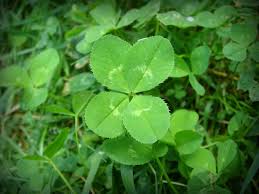
That is also the place to discover a four-leaf clover. They are easy to find in a stand of tall clovers.
I'm looking over a four leaf clover
I overlooked before
One leaf is sunshine, the second is rain
Third is the roses that grow in the lane.
No need explaining
The one remaining is somebody I adore
I'm looking over a four leaf clover
I overlooked before.
--
The falling rain is certainly a blessing for everything growing. Dissolved nitrogen in the rain, and dusty minerals from the newly cleansed air renew the face of the earth. Trees, bushes, and plants are washed off in soft water, adding more to the soil. Soil creatures come alive and pull down the debris caused by the rain. Fungi ask for carbon from plant roots and grow out toward objects of decomposition, supplying nutrition to the roots.
The nitrogen compounds immediately green up the grass and plants. Nitrogen is building block for protein in plants and animals. The red wiggler earthworm is all muscle, in essence, all nitrogen. He concentrates useful nitrogen in his ceaseless tunneling and excretes nitrogen compounds two ways - through its castings and also through its tiny kidneys.
One earthworm is nothing, as the chemical gardeners like to point out, but the mass of earthworms in good soil provides massive earth movement and creation of new soil (castings) every day. No matter what I put around the crepe myrtle bush, the pile of organic mulch is drawn into the soil, feeding the creatures that ultimately feed the plant.
The earthworm gathers organic matter in its effective tunneling esophagus, transporting bacteria and letting them digest the organics to feed the his rippling muscles and gripping movement bristles. No, he is not lazy. He has a crop where he grinds up this mix with little pieces of stone. Bacteria like their food pre-chewed, and they finish the job as much as they can. Each creature benefits the other.
Saturday brought the delivery of bare root roses from Edmunds'. The weather map looked ominous or optimistic, depending on one's point of view. I expected some rain on Saturday, maybe a big storm and definite rain on Sunday. The system developed but little rain fell until Monday morning. Some rain is still dripping off the eaves, where I have four barrels and one little trash can stationed. More is on the way.
The effect of rain and snow is unquestioned. God's Word does not speak of water having these results, but rain and snow. As one farmer said, "Water keeps my crops alive. Rain makes them grow and produce."
Like the rain and snow, God's Word
Never returns void.
Always accomplishes God's purpose, and
Always prospers His will.
A rainstorm has a powerful and unique influence on all life because it also brings down dissolved nitrogen compounds that are the basis for all life, the building block of proteins. Nitrogen in the air is useless for plants, but the vast supplies in the atmosphere are rendered useful by lightning. The lightning and thunder people often fear is the basis for their lawns and gardens greening up. I am sure statistics exist for how many tons of fertilizer fall from the sky during a rainstorm. One only has to look at a straw colored lawn turn green in August to realize its value.
In the soil, this fertilizer-rain wakes up all the microbes and miniature creatures. Although gardeners give due credit to the earthworms hatching and wiggling to life in the rain, the larger creatures really depend on the microbes. Bacteria travel on water and suspend life in drought. Protozoa and earthworms need bacterial and moisture, so everything is jumping and jiving at once.
All life depends on this water, and the increase of all living things (biomass) holds that water and the nutritious elements in the soil at the root zone. Last fall we made a pyramid of maple leaves under the crepe myrtle bush. Whenever more raking involved those leaves, which interlock and stay in place, the pile was supplemented. Now the leaves are all gone from under the bush, some doubtless blown away, but most of them turned into soil food by springtails, mites, and earthworms.
The root hairs of the roses - and all plants - barter for nutrition from the fungi, which grow fast in the rain. The plants offer the carbon the fungi cannot make for themselves. The fungi provide water and nutrition for the plants in exchange for the carbon credits, as demanded by the plants. All soil life engages in this Vanity Fair of swapping one thing for another, sometimes by barter, often by ingestion.
The bare root roses move from dormancy, truly asleep, to growing on its own, red-green leaves popping out of the stems and soon buds beginning to form. Then they are no longer wobbly in the soil but rooted and grounded.
I enjoy digging in the roses. More people should engage in gardening and see how God's Creation is designed, engineered to take care of itself (in a manner of speaking). All the creatures of the soil work together without a local supervisor and yet they thrive because of divine management, which we take for granted. The ancients begged their idols to give them fertility, because crops meant life or death for them. We trust smelly bags of NPK and forget the origin and the supervisor of this vast wealth in Creation.
Nothing is quite so satisfying as having a powerful rain finish off a day or two of planting roses, raspberry canes, seeds, and tomato plants.
Some gardeners use inorganic fertilizers before it rains, but this article warns about washing a lot of pollution into the water table. In Midland, before a rain, I used Rabbit-Gro on the lawn, a product of Wormhaven.1. We had quite a few rabbits. Their hard pellets are easy to spread and dissolve in the rain, adding long-lasting nutrition and bacteria to the soil.
Inorganic fertilizers do not stay in the soil but move down into the water table. That supports the industry since everyone needs more. Massive farms have also added to pollution by having too much organic fertilizer for the ground to absorb.
Rain and lightning bring down usable nitrogen compounds for the plants to use, and the chlorine free water increases the growth of all soil creatures.
Seeds and plants are thirsty for water, so hours of rain are ideal to hydrate the plants and germinate the seeds.
The straw bale garden is showing signs of life, so I was pleased to have it soaked in nitrogen-rich rain. The websites and books tell me to add nitrogen to straw bales. Obeying the Maynard G. Krebs and Scrooge Prime Directives, I fertilize with rain, easily furnished in this area. No work and no cost!
Last year's roses are bursting with life, leaves sprouting on every cane, newly pruned. The new roses are just settling in. I water them heavily in the soil because I consider pre-soaking to be foolish and a waste of time. Pre-soaking produces those pale little leaves that may even appear in a new shipment. However, the only leaves that matter are the green ones created by the roots taking hold, growing root hairs, and sending nutrition into the plant.
Class - listen up. Almost everything in the garden happens at the root hairs, which consist of miles and miles of cells receiving usable chemicals from the fungi and giving up carbon to those marvels of decomposition. If we enhance the health of the soil by feeding its creatures, the soil will feed the plants.
Root Hairs Specialized epidermal cells on roots, known as root hairs, are extremely important to the uptake of nutrients. Root hairs dramatically increase the surface area of the root that is exposed to soil. Root hairs form because epidermal cells along the outer surface of a root have the ability to change from their normal shape and placement on the surface of a root into an extension of the root that grows out into the soil. Each root hair is a single cell, and these cells can grow to amazing lengths of up to 1500 microns (0.06 inch) and can be as thick as 15 microns (0.0006 inch). Only a small zone located just below a growing root tip contains meristematic cells coded to become root hair cells. These cells live only from a few days to a couple of weeks, depending on the plant and conditions. Root hairs are constantly being replaced as the growing tip moves into new territory. Still, an astonishing number of these cells can grow at one time. Some plants produce tens of thousands of them in an area no bigger than an inch or two around. For example, studies have shown that a single rye plant can have miles of root hairs growing in 2 cubic feet (0.06 cubic meters) of soil. Lowenfels, Jeff; Lowenfels, Jeff (2013-05-07). Teaming with Nutrients: The Organic Gardener’s Guide to Optimizing Plant Nutrition (Kindle Locations 1306-1316). Timber Press. Kindle Edition. Eyes of the Roots Root hairs act as the eyes of a plant root. Calcium, one of the essential plant nutrients, moves into the root hair through the plasmalemma. The presence of calcium is necessary to complete the process that causes root hair cells to grow downward. As long as there is calcium coming into the root hair from the soil, the root hair cell elongates in the same direction. When an obstacle, say a small rock, is encountered, then that surface of the root hair cell can no longer take up calcium. Elongation in that direction stops, but it starts in another area of the cell where calcium does come through the membrane. Once the obstacle has been passed by the root hair, it reorients itself and travels in the original direction. Consider that this goes on all over those miles of hairs. Calcium shortages have obvious consequences here.
Lowenfels, Jeff; Lowenfels, Jeff (2013-05-07). Teaming with Nutrients: The Organic Gardener’s Guide to Optimizing Plant Nutrition (Kindle Locations 1318-1324). Timber Press. Kindle Edition.
Sassy canceled her afternoon walk yesterday, when the rain started. so she wants her morning walk now.