Showing posts with label Knapp. Show all posts

Wednesday, October 31, 2018

The False Teachers' Subjective Justification Sows as Much Deception as Their Objective Justification

 The ELDONUTs are mostly Ft. Wayne graduates who congratulate each other on their superb training. How long does it take to read Genesis 15 and Romans 4?

Various writers on this blog have exposed Objective Justification for what it is. Rolf Preus seems to be using the equally toxic Subjective Justification to bridge the gap between his dogma and Christianity. True to Walther - though I have not stolen millions in gold, books, chalices, and land - I will post Walther's timeless twaddle on the topic.

 The OJ and SJ terms are found in the American Calvinist's translation of the Halle dogmatics professor, below. The terms caught on, were used in Germany, and came back to America with CFW's blessing.

Here I Misunderstand Lectures - by Rolfie One-Note, Ft. Wayne MDiv

"While the terms “objective justification” and “subjective justification” may have arisen in the 19th century, the objective/subjective distinction in the topic of justification has always been made. (sic, no proof) This distinction is inherent in the gospel itself. (sic, where?) The doctrine of objective justification teaches that God, freely by his grace, without reference to any merit or worthiness in sinners, for the sake of the vicarious obedience and suffering of Jesus, has forgiven this whole world of sinners all their sins and declared them to be righteous." (sic, The Adventists agree with Rolf.)

Now let us step into his attempt to spray some gold paint on his Dreck:

"The doctrine of subjective justification is that we receive this forgiveness and righteousness only through faith in the gospel of Christ.  There are not two justifications: one objective and one subjective.  There is only one justification.  We view it from the side of its acquisition for us by Christ and we view it from the side of its reception by us through faith.  In either case, it is the same Jesus, the same verdict from God, the same forgiveness of sins, the same justification."

I would not like this mechanic to work on my Lincoln Town Car limo. An air filter is not a gas filter, and an engine is not a transmission.

Rolf just defined his precious OJ as God's declaration of universal forgiveness (and salvation, by inference) - true to Pietism, Knapp, Bishop Stephan, and Karl Barth. That word "declaration" is what converts the Atonement into World Absolution, where gasoline becomes oil and the exhaust pipe is really a searchlight. The OJists have lost their courage, so they do not name Hindoo and Eskimeaux and Hottentotts as absolved, as they did in the days of his great uncle Edward Preuss, an Enthusiast who became a  distinguished Roman Catholic leader. A Concordia Seminary St. Louis professor became a Roman Catholic leader? - they have been jumping ship ever since - Wilken, Neuhaus, etc.

Justification is a good and noble term but it is perverted by the perverted leaders who turn Justification by Faith into Justification of the Entire World. That is why we see the same family of words in the perverted, twisted language of the OJists:

  • General Justification - meaning every single one in German.
  • Justification of the World - John Sparky Brenner's fave.
  • Universal Objective Justification - see Valleskey, below, for that honker.

In the second quotation, Rolfie One-Note is trying to bridge the gap by combining faith with OJ. Oh no you don't, Walther fan. You can lie about the kidnapping, about making Stephan a bishop, about the young girls getting the clap from Stephan, about stealing all the gold, land, books, and chalices, but not about the second part of OJ/SJ.

Subjective Justification means accepting God's absolution of the entire world, without the Word, grace without the Means of Grace, without faith, Enthusiasm at its lowest ebb. Walther was a Pietist, as most people realize by now. All his training, apart from rationalism at home and in the educational system, was Pietistic.

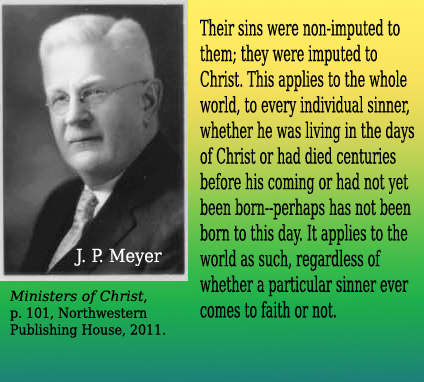
JP Meyer was true to ravings of Walther. Note, this is the new improved edition of Meyer! The editor Panning taught Romans and yet approved this nonsense.

And what is the fruit of UOJ? As Otten told me, Sig Becker was disgusted with all the adultery and alcoholism of the WELS pastors.

 As far as can be determined, the Calvinist translator of the Pietist Knapp used the OJ and SJ terms first. The new terms caught on, as Rolfie One-Note proves in his historic lectures. 


Monday, September 25, 2017

Twin Stone Warden: Objective & Subjective Justification -- Pastors Todd Wilken & Rolf Preus

 Sure - we heard the terms Objective Justification
and Subjective Justification from the Calvinist Woods
who translated the rationalistic Pietist Knapp into English:
best seller ever since, still in print.


Twin Stone Warden: Objective & Subjective Justification -- Pastors Todd Wilken & Rolf Preus:


"Have you heard the terms "objective justification" and "subjective justification"? Have you had questions about them? Have you been confounded by them?

Be of good cheer!

Pastor Todd Wilken interviews Pastor Rolf Preus on Issues, Etc., on "Objective & Subjective Justification." Listen to this clarifying and faith-strengthening broadcast on demand."


'via Blog this'

 Quistorp the Pietist also agrees.
Could it be the Calvinistic influence?

UOJists used to cite Romans 4:25!!!
until I began quoting the verse that goes with Romans 4:25!!!

Monday, April 10, 2017

The ad Knapp Defense of Universal Objective Justification

 The Calvinist translator used ambiguous language -
as WELS loves to say - "It caaaaan be understood correctly."
"Error loves ambiguities."
Now Lutherans top-dog each other with their extreme statements,
revealing the inherent weakness of the initial error:
guilt-free saints in Hell, etc.

One long-time family (and FB) friend thought this graphic was misleading. His fellow pastors are always asking him (but not me) what I am trying to say when I write about Universal Objective Justification, which is the Helen of Troy for the WELS-ELS-LCMS and ELCA leaders. I am emphasizing leaders because the historical documents show just the opposite, even in those synods.

We should have some kind of award for 100% of the Lutheran leaders endorsing the opposite of what Luther taught, just in time for the 500th anniversary of the Reformation.

Following is the issue with the graphic above - The words are not Knapp's but the translator's, explaining what Knapp was trying to say. I have probably explained that a few dozen times. I have posted about UOJ over a thousand times.

Actually, the critic makes my point for me, because the translator (clearly identified as Protestant rock star Leonard Woods Junior was a Calvinist. Thus we have the hybrid formula embraced by the ELS-WELS-LCMS, from a Calvinist translating a Halle Pietist:

  1. God has forgiven the entire world its sins - Objective Justification.
  2. Man must agree with this state of affairs - Subjective Justification.
According to what I have read, these two terms made their way to Germany, became part of the literature, and delighted Walther. Most of the Missourians would have their German copies of Knapp, but perhaps also came upon the English translation. The English version of Knapp dominated Protestant theology for 90 years, finding a place in all libraries. During that era, Pietism was highly praised by all Protestants during - including the Lutherans. Spener, Halle, and Pietism were as untouchable then as Fuller Seminary is now.


From what I have read, Halle emphasized its Easter absolution of the entire world, backed by their false exegesis of 1 Timothy 3:16, which Jay Webber prefers over Martin Chemnitz' exegesis. Litmus test? I think so.


Agreeing with the Halle Pietist Rambach, Walther also taught the Easter absolution of the world, which he learned from Bishop Martin Stephan. 


Oddly enough, WELS and the Little Sect on the Prairie have adopted the OJ and SJ of the Calvinist Woods. He may not have invented the terms, but that book certainly popularized the concept and the terms in 19th century American Protestantism. The English translation was already in print before Walther swore life-long allegiance to Bishop Stephan, on the muddy shores of New Orleans. I wonder if Stephan's mistress, who came along on Stephan's ship, attended the enthronement.

As I explained to the pastor, I have been meticulous in reporting how all this developed. In fact, since the Calvinist translation of Knapp is the English version, there is little to distinguish Knapp the theologian from Woods the theological translator. What made Knapp so important to a Calvinist leader that the book had to be translated? I find no difference between the two men. Are there letters extant where Knapp called Woods a fool for introducing Objective and Subjective Justification?

The anti-UOJ quotations in Justification and Rome
make me think these theologians were arguing against
the UOJ rationalism of Halle University.

Calvinism is the unspoken secret of the Synodical Conference. LCMS pastors from the Bronze Age were fond of citing their favorite Calvinist sources for the inerrancy of the Scriptures. The rationalist approach of Calvinist is a greater threat to the Christian Faith than the depredations of outspoken atheist groups. Pietism and Calvinism had Lutheran pastors looking up the wrong sources, the wrong doctrine, enhancing the wrong attitude toward the Holy Spirit's efficacy in the Word.

For example, Professor John Brug's Ministry of the Word, which Otten loved, is unLutheran enough to appeal to any Protestant.


Some days, gardeners pull weeds. On other days they water and prune for growth. One Lutheran wrote to thank me for exposing UOJ but also to say it brought great disturbance into her thinking. Now she is aware of the falsehood in WELS/ELS.

Luther wrote about the sign spoken against in Volume 1 of his sermons:


44. From this we learn to be assured that we may comfort ourselves and cheerfully bear up when many people stumble at our Word and speak against our faith, especially the great, the learned, and the priests. This is a sign that our message and faith is right, for it receives the treatment foretold by Simeon and all the prophets. They must take offense at it, stumble over it, rise by it, and speak against it; it cannot be otherwise. He who would have it otherwise must look for another Christ. Christ is set for the falling and rising of many in Israel, and for a sign which is spoken against; consequently his members, or every Christian, must be like him on account of his faith and his message. He is called “antilegumenous,” he who is spoken against. 

His doctrine must be rejected, condemned and execrated as the worst heresy, error and foolishness. It is treated rightly when this is done; but when this does not take place, then we have neither Christ, nor his mother, nor Simeon, nor the prophets, nor faith, nor the Gospel nor any Christians. For what does speaking against mean but to deny, blaspheme, curse, condemn, reject, prohibit and persecute with all disgrace and ignominy as the worst heresy?


Friday, August 26, 2011

Universalism Everywhere:
ELCA, Rome, Syn Conference.
Let Us Disbelieve Together in Love


Herman Otten was bewailing Universalism in the Church of Rome but not in the LCMS. I saw an editorial that sound Universalistic, by Scott Murray, LCMS, another UOJ friend of Paul McCain and Otten, the odd couple who elected Al Barry and Matt Harrison. 

Scott asked, "What must I do to be saved?" He answered himself, not from the Scriptures, but from his UOJ talking points. The answer is "literally. Nothing. It is done."
Christian News, 8-22-2011, "Nothing To Conquer," p. 4.

Acts of the Apostles
KJV Acts 2:37 Now when they heard this, they were pricked in their heart, and said unto Peter and to the rest of the apostles, Men and brethren, what shall we do?

Acts 2:38 Then Peter said unto them, Repent, and be baptized every one of you in the name of Jesus Christ for the remission of sins, and ye shall receive the gift of the Holy Ghost.

The Gospel of John
KJV John 6:26 Jesus answered them and said, Verily, verily, I say unto you, Ye seek me, not because ye saw the miracles, but because ye did eat of the loaves, and were filled. 27 Labour not for the meat which perisheth, but for that meat which endureth unto everlasting life, which the Son of man shall give unto you: for him hath God the Father sealed.

28 Then said they unto him, What shall we do, that we might work the works of God?

John 6:29 Jesus answered and said unto them, This is the work of God, that ye believe on Him whom He hath sent.

The Apostle Paul
KJV Romans 4:24 But for us also, to whom it shall be imputed, if we believe on him that raised up Jesus our Lord from the dead; 25 Who was delivered for our offences, and was raised again for our justification.

KJV Romans 10:8 But what saith it? The word is nigh thee, even in thy mouth, and in thy heart: that is, the word of faith, which we preach; 9 That if thou shalt confess with thy mouth the Lord Jesus, and shalt believe in thine heart that God hath raised him from the dead, thou shalt be saved.

The Holy Spirit moves us to faith through the Means of Grace
The UOJ fanatics want to say they are devoted to grace, but they obliterate faith and the Means of Grace. They have to eliminate the Holy Spirit's work in the Word because their foundation is Halle Pietism - not Biblical, Lutheran doctrine.

I know something about modern theology because my professors studied under Barth, Tillich, Bultmann, and Moltmann. Stan Hauerwas, on my dissertation committee, is the best known theologian in America. Martin Marty recommended the publication of my dissertation, and so forth. Marty was good enough to lecture at Wisconsin Lutheran College, so he must be kosher for WELS.

The names are relevant because my studies meant reading hundreds of books of modern theology, not to mention writing essays based on those studies and lectures.

UOJ, mainline theology, ELCA, and modern Romanism all share the same basics of Universalism, expressed with a little variety. As someone said about gardens, "Each one is unique, but few are original."


When Team Ichabod was discussing What Happened To Knapp, the Founder of Double-Justification?, I found the clue. Knapp is largely forgotten, overshadowed by men like Schleiermacher, but the old Halle Pietist is still in print. My English copy is dated from 1830, and Knapp's Halle lectures began long before that. But people are still printing and buying his lectures from 180 years ago.

More importantly, Knapp became the gold standard for mainline theology.

Knapp's double-justification scheme, starting with the justification of the entire world, turned easily into Step One as a solo. Schleiermacher, considered the father of modern theology, studied at Halle and taught at Halle, specializing in Step One Universalism.

I remember many a mainline theology book warning. "We must not make this contingent upon faith." Similarly, Syn Conference types glare and say, "Do not make faith a work of man." Those who are giddy with UOJ love to emphasize unbelief as a virtue.

God creates and nurtures faith through the Gospel in the Means of Grace. Since faith is the foundation for the Christian life, unbelief is the basis for all sin and evil.

Many are in deep pain as they realize their synods teach against Luther's doctrine, contrary to the Book of Concord. The results are everywhere. One friend went to  a WELS service where the congregation was involved in worshiping with the help of their volunteer kazoo band. 


Monday, May 23, 2011

Knapp, Halle University - Promoted Double Justification


"This is very conveniently expressed by the terms objective and subjective justification. Objective justification is the act of God, by which he proffers pardon to all through Christ; subjective, is the act of man, by which he accepts the pardon freely offered in the Gospel. The former is universal, the latter not."

“His [Woods'] translation of Georg Christian Knapp's Christian Theology (1831-1833) was long used as a text-book in American theological seminaries.” http://www.1911encyclopedia.org/Leonard_Woods

Wednesday, April 27, 2011

Zorro Has Uncovered a Significant Factoid about UOJ,
So Listen Up


I happened upon this reference in G.C. Knapp in working through Heick's "A History of Christian Thought." It occurs in Book Four, The Disintegration of Confessional Theology; chapter seven, German Rationalism; section head, The Theologians of Rationalism. The page reference is 128.


"Frequently all the theologians of this period have been thought of being as one stripe. This is not quite correct. Two main schools of thought can be distinguished among them: the Supernaturalists and the Rationalists proper. The former exerted a kind of restraining influence in the earlier period of the Enlightenment; they marked the transition from Orthodoxy and pietism to rationalism...Relying on Kant's axiom that pure reason cannot establish religious truth, the second group of Supernaturalists emphasized that reason cannot deny the claims of Christianity. Among the proponents of this view were F.V. Reinhard at Wittemberg and Dresden (d. 1812) and G.C. Knapp at Halle (d. 1825). They labored to prove by rational means the possibility, necessity, and reality of the content of supernatural revelation. Truth was to be proved by Scripture. The idea was that Scripture, not reason, was to decide in matter of religion; but reason establishes what the teaching of Scripture is."

The rationalizing tendency sticks close to pietistic outbreaks, most notably in the argument that we can hinder the divine operation of the Holy Spirit working through the Word by our human foibles. From there, it is a quick jump to we are responsible for relative success or failure in the empirical growth of church organizations. Very rational.

Z

Monday, February 21, 2011

WELS Layman Makes a Helpful Suggestion

Looking too far might end up spotting Knapp, the founding father of Universal Objective Justification.


raklatt (http://raklatt.myopenid.com/) has left a new comment on your post "Jeski Change or Die! Inspirations: Rock MusicAnd T...":

This stuff really needs to be looked into. A thorough investigation. A Sigmoid Oscopy.

Tuesday, November 25, 2008

Knapp and the Lutheran Confessions


The Symbolical Books are another name for the Confessions gathered in the Book of Concord. Martin Chemnitz' work was not thrown out by the Pietists- just ignored, like today.


The Confessional History of the Lutheran Church, 1909,

By James William Richard

But that the Symbolical Books did not exert much influence on Bretschneider, either as a theologian or as an ecclesiastical official, is evident from his Handbuch; and that they had in general lost very much of their influence under the rationalistic thought of the age is shown by the fact that they scarcely ever emerge high enough to be seen either in the best representative of the Halle Biblical School (George Christian Knapp, 1753-1825), or in the best representatives of the supranaturalistic school of Tubingen, Storr and Flatt, who in their Handbook of Dogmatic seem to have been more influenced by Immanuel Kant than by the Symbolical Books. Though there were those who still defended the Symbolical Books, and who did not bow the knee to the Moloch of Rationalism.

***

Knapp denied the Real Presence and baptismal regeneration in his Lectures. He was exactly like the Church and Change, Church Growth leaders of today - denying essential doctrines of the Word while promoting emotionalism and rationalism.


Spener also denied the Real Presence and baptismal regeneration (Heick, History of Christian Doctrine, my professor and a bit of a Pietist himself.)

Two Justifications from Pietism


UOJ dog singing da blues, da St. Lewie blues.


Some of us are just starting to pursue some leads about the origin of two justifications. I first mentioned the Pietistic seedbed of UOJ in Thy Strong Word, citing Hoenecke (who studied at Halle under Tholuck).

I suggest Googling terms and names but also going to Google Documents for the same kind of search. GD will find the names in obscure books and highlight them. For example, I found a reference to George Christian Knapp (Mr. Two Justifications) in The Education of Philips Brooks, about a well known New England divine.

Here is the citation.

The point made is that Knapp (Halle University) was a Pietist and a very dull writer. Amen to both! He was not in harmony with Luther. Yes, I hear you brother.

And Knapp was used at Andover Seminary until 1898. That means the two justification book was being used as a text while the Synodical Conference was building a fence around their precious UOJ.

Dates to consider:
Woods (very prominent Protestant leader) translated Knapp into English, 1833.
C. F. W. Walther took credit for founding the LCMS 1847.
Knapp was still being used at Andover Seminary, 1898.
UOJ made canonical in the Brief Statement of the LCMS, 1930.

Here is material on Tholuck the Universalist.

This paragraph establishes how influential Knapp was in America, at least in the view of one author:

"Now, to the bold assertion of Mr. Lecky, we shall oppose the assertion of Dr. George Christian Knapp; whose great, calm, judicial mind, as well as great learning and piety, has gained for him an enviable reputation in both the Old and the New Worlds, and from all sections of the Christian Church. Indeed, although a decided Arminian himself, his Theological Lectures have, for the benefit of theological students, been translated from the German by an eminent and learned Calvanistic divine ; an act which reflects equal honor on both the translator and the original author."

Here is an 1832 notice of the Knapp book being made available in English. Figures and institutions of Pietism are reverently highlighted in red - by me. Knapp was thoroughly trained in Pietism:

NOTICES OF NEW PUBLICATIONS.

"Lectures on Christian Theology, by
GEORGE CHRISTIAN KNAPP. Translated by
LEONARD WOODS, Jan., Abbot Resid. at the
Theol. Seminary in Andover, Mast., in two vol-
umei, vol. I. New York : published by G. & C.
& H. Carvill, 108, Broadway. Andover: printed
at the Codman Fress, by Flagg & Gould, 1831.
pp. 539.


Dr. Knapp, late Professor at the University of Halle, was born at Glancha,in Halle, on the 17th of September, 1753, and received his early education in the Royal Paedagogium, one of the institutions of the pious Francke. At the age of 17, he entered the university at Halle, and attended the lectures of Semler, Noesselt and Gruner, with more than common success. The Bible was his great object of study, while the Latin and Greek classics still received a degree of attention which enabled him ever afterwards to adorn, enrich and illustrate from classical literature whatever he said or wrote in the department of Theological science. In 1774 he completed his course of study, and in 1775, after a short absence, he began to lecture, at Halle, with much success upon Cicero, the New Testament, and the more difficult portions of the Old Testament. He was appointed Prof. Extraordinary in 1777, and Prof. Ordinary in 1782. He then lectured in Exegesis, Church History, and in Jewish and Christian Antiquities.

On the death of Freylinghausen (1785), he and Niemeyer were appointed Directors of Francke's Institutes ; and continued jointly to superintend these establishments for more than 40 years. In the division of duties, the Bible and Missionary establishment fell to Dr. Knapp, which brought him into near connection with the Moravians. The lectures, of which this volume forms a part, he commenced during the summer of the same year. In consequence of illness, and the variety and extent of his other duties, he did not complete them, however, until 1789, when they were first read before a class of 186 students. He continued to lecture on Theology, until his death, to auditories no less numerous. Such was his popularity (notwithstanding his orthodox sentiments !) that when in 1825 he closed the 50th year of his connection with the theological faculty of the university, and the accustomed jubilee was held in his honor, the most flattering marks of affection and respect were poured upon him from every side. He died the 14th day of October, 1825, in the 73d year of his laborious life. At his request he was interred privately in his family tomb ; and in the public notices of his decease, nothing was to be said in his honor, except that he lived in the faith of these words, I know that my Redeemer liveth. The volume before us is an important addition to our helps in the department of Theology."

In another notice:

The Author of these Lectures appeared on the stage at the time when the theologians of Halle began to be " divided into different schools, according as they adhered more closely to the principles of Spener and Franke" (the founders of the University) " or fell in, either with the more ascetic, or the more free and liberal principles then prevailing."

In a history book by the great Henry Eyster Jacobs:

But as historical truth demands it, we let the story be told by a later Halle professor, the eminent Professor Tholuck, whom no one can charge with prejudice against the school of Spener and Francke. "Pietism in Halle," says Professor Tholuck, " reached the summit of its power under Frederick William I. [1 713-40], the soldier king with the Christian soldier's heart, the particular patron of the Halle theological faculty. Under him was issued in 1729 the edict which was promulgated anew in 1736, according to which no Lutheran theologian should hold a position in the Prussian state who had not studied at least two years in Halle, and received a testimonial from the Halle faculty of being in a state of grace.

Gradually the nursery of piety was transformed into a nursery of rationalism. ' God's gifts descend not by inheritance;' this is proved also in the history of the Halle institutions. Every director had the right to chose his own successor; and yet with Ludwig Schultze and Niemeyer the direction passed gradually into the hands of rationalism. Under Baumgarten the interests of piety yielded to those of learning ; and through Semler, Gruner, Nosselt, and Niemeyer, rationalism became the prevalent theology. Only in George Christian Knapp a branch of the old Halle school remained, but reserved and timid, and without any extensive influence. At my [Tholuck's] entrance in Halle in 1826 I found still two citizens who traced their faith to this one deceased advocate of the old school among the clergy." This deterioration, however, was gradual.


Once again, the Unitarian-Universalists have donated a book to Harvard about Knapp, who agreed with them! Your precious advocate of Objective and Subjective Justification provided a historical argument for Unitarianism.

To this effect I will quote the authority of George Christian Knapp an eminent Trinitarian writer, whose " Lectures on Christian Theology," as translated by Leonard Woods, Jr., are a standard work with Trinitarian believers. After a full and learned discussion of the whole subject, he distinctly admits that it is " impossible to prove the agreement of the earliest Christian writers with the common Orthodox doctrine as established in the fourth century." Vol. I. pp. 294, 299, &c.


---

Tholuck was A. Hoenecke's mentor at Halle University, a school founded for Pietism by the leader of Pietism. That does not make Hoenecke a Universalist, but it helps illustrate why UOJ is just one step away from Universalism. Note what Jacobs said above about Pietism degenerating into rationalism.

About Tholuck:

Tholuck, though only in his twenty- first year, was commanded to fill the chasm, by delivering Lectures in the Exegesis of the Old Testament. In 1823, he was appointed to succeed the venerable George Christian Knapp, in the University of Halle, where " he maintains his standing with growing honour and usefulness."

One WELS DP claims that the UOJ leaders are not Universalists, but WELS ran a so-called evangelism campaign with this slogan: "I am saved, just like you." Grace without the Means of Grace = Enthusiasm, which leads to Universalism. That is a Universalist slogan, but WELS swallowed that lump of toxic leaven, too.

I have a church for the UOJ Universalists - right near my house.

Here it is.

"Love is the doctrine of our church;
The quest for truth is our holy rite;
And service is our prayer.
To dwell together in peace;
To seek knowledge in freedom;
To serve humankind in friendship;
Thus do we covenant."

Saturday, November 22, 2008

UOJ Breaking News: Knapp and Tholuck


The Universalist Historical Society gave their copy of the Knapp UOJ lectures to Harvard, the source of the Google book.

"I thought you might get a kick out of this. If you go to page 2 of Volume II on Knapp's Lectures on Christian Theology, you'll notice the copy belonged to the Universalist Historical Society... maybe they saw something of use in UOJ?"

Tholuck, mentor to Adolph Hoenecke, wrote in his Romans commentary, 1844, that God justified the entire human race. Tholuck opposed Lutheran orthodoxy, just as Knapp did.

So there we have it, UOJ Stormtroopers. Your precious doctrine originated just before the Synodical Conference formed. It was anti-Lutheran, anti-Means of Grace in origin, and it came from the Pietists at Halle University.

Tonight various scholars have been tossing me information. I want to acknowledge them, but not by name.

A WELS district president said to me, "You know things that I don't. You have a lot of sources."

My arms haven't been so tired since my grandchildren introduced me to Wii and clobbered me in Wii bowling. I thought, "I am getting tendonitis from throwing a fake bowling ball in a fake bowling game, and my granddaughter is humiliating me at the same time."

Better to get carpal tunnel fighting against false doctrine.

Thursday, November 20, 2008

George Christian Knapp, UOJ Inventor, Was Translated into English by an Influential Protestant, L. Woods


Leonard Woods was quite famous as an American Protestant leader.

WOODS, Leonard, clergyman, born in Princeton, Massachusetts, 19 June, 1774; died in Andover, Massachusetts, 24 August, 1854. His father, Samuel, possessed "Puritanic piety," and his habits of serious thought on metaphysical subjects obtained for him the title of "Philosopher Woods." The son was brought up strictly, and while very young was conversant with the works of John Locke and Jonathan Edwards. He was graduated at Harvard in 1796, taught, studied theology at Somers, Connecticut, and in 1798 was ordained pastor at Newbury, Massachusetts When the Andover theological seminary was founded in 1808 he became professor of Christian theology there, holding that chair for thirty-eight years, and becoming professor emeritus in 1846. Dartmouth gave him the degree of D. D. in 1810. Dr. Woods was active in the establishment of the American tract society, the Temperance society, and the board of commissioners of foreign missions, of whose prudential committee he was a member for twenty-five years. He ably defended orthodox Calvinism against Unitarian theology, and while he admitted improvements in theologians and theological science, thought theological truths were fixed and unalterable. His literary reputation dates from his contribution in 1805 of a series of papers in the " Panoplist," a religious periodical, in which he defended Calvinism against Joseph Buckminster, William Channing, and other Unitarian divines. Dr. Henry B. Smith says of him : "He is emphatically the' judicious ' divine of the later New England theology. He educated more than 1,000 preachers, who had neither crotchets nor airy aims." He left in manuscript a "History of Andover Seminary." His publications in-chide " Letters to Unitarians" (Andover, 1820) ; "Lectures on the Inspiration of the Scriptures" (1829); " Memoirs of American Missionaries" (1833); " Examination of the Doctrine of Perfection" (1841); "Lectures on Church Government" (New York, 1843);" Lectures on Swedenborgianism" (1846); and his collected works, containing lectures, essays, sermons, and reviews (5 vols., Andover, 1849-'50).
His son, Leonard, scholar, born in Newbury, Massachusetts, 24 November, 1807; died in Boston, Massachusetts, 24 December, 1878, was graduated at Union college in 1827 and at Andover theological seminary in 1830. In 1831-'3 he was resident graduate scholar at Andover, and in 1833 he was licensed to preach. His private pupil, Richard Henry Dana, says of him: " At the age of twenty-four years he had been the first scholar in the Phillips academy, the first in every branch at Union, had been graduated at the Theological seminary the acknowledged foremost man of his period, and had published a translation of Knapp's 'Christian Theology, ' enriched with a long and fully thought-out preface, with original notes showing profound scholarship. He was assisting Professor Stuart in his commentary on the Epistle to the Romans, ' and aiding Professor Robinson in editing the ' Biblical Repository, ' then the most scholastic periodical in America, and was assistant instructor of Hebrew in the seminary." He edited the " Literary and Theological Review" in New York city in 18"34-'7, and although that periodical was the organ of the Presbyterian and Congregational churches, he directly opposed the opinions of many of its supporters, objecting to the proposals of temperance and anti-slavery societies and popular revivalists, and to the German Reformation, and defending the few and simple conditions of admission into the Anglican communion, as compared with the minute requirements of doctrine in his own church. He was professor of sacred literature in Bangor theological seminary in 1836-'9, and from 1839 till 1866 president of Bowdoin. He never accepted a pastoral charge, but occasionally delivered sermons and addresses. He went abroad in 1833, and contracted friendships with eminent theologians in Rome and in Oxford. His familiarity with the classics caused him to be congratulated by Gregory XVI. for his "excellent Latin and the richness of his discourse," and the Oxford theology having won his approval, he was the theological champion and personal friend of Dr. Edward B. Pusey. "He was even more remarkable, perhaps, for his conversations than for his public addresses," says his biographer, Professor Edwards A. Park. Having resigned the presidency of Bowdoin in 1866 (see the accompanying vignette), he accepted from the legislature of Maine a commission to visit Europe to obtain materials for the early history of the state. "He engaged the assistance of Dr. John G. Kohl in the work, which subsequently assumed shape in his "Discovery of Maine" (Portland, Maine, 1868), and procured the Hakluyt manuscript of the "Westerne Planting." Dr. Woods was preparing this document for the press when his health declined, and the papers were completed and published by Charles Deane, in the "Proceedings of the Maine Historical Society" (Portland, 1877). Dr. Woods furnished other valuable matter, which appeared in the 1st and 2d volumes of the publications of that society, and was engaged in further work when his materials were destroyed by a fire that consumed his entire library. Harvard gave him the degree of D. D. in 1846, and Bowdoin that of LL. D. in 1866. Besides the works already referred to, including his translation of George Christian Knapp's "Christian Theology" (2 vols., New York, 1831-'3), Dr. Woods published an "Address on the Life and Character of Parker Cleveland (Portland, Maine, 1859), and "Address on the Opening of the New Medical Hall of the Medical School of Maine" {1862). See a "Memorial " of him. by Edwards A. Park (Andover, 1880), and an article by Richard H. Dana in the "Century Magazine" for June, 1881.

Edited Appletons Encyclopedia, Copyright © 2001 VirtualologyTM

---

Leonard Woods (1807-78) was the fourth president of Bowdoin College.

Life and career

"Born in Newbury, Massachusetts, Woods attended Phillips Andover Academy before graduating from Union College in 1827. After having graduated from Andover Theological Seminary, he made a translation of George Christian Knapp's Christian Theology, which became long used as a textbook in American theological seminaries. "


---
From the Net

(7.) George Christian Knapp, Lectures on Christian Theology, trans. Leonard Woods Jr. (Philadelphia: J. W. Moore, 1851). According to Woods's biographer Edwards Amasa Park, the Lectures on Christian Theology was first published at Andover Theological Seminary in 1831. Park, The Life and Character of Leonard Woods (Andover, Mass.: Warren F. Draper, 1880), 8.

(8.) For a discussion of Knapp, see John Ker, Lectures on the History of Preaching (London: Hodder and Stoughton, 1888), 224-25; and B. B. Edwards and E. A. Park, Selections from German Literature (Andover, Mass.: Gould, Newman, and Saxton, 1839), 204-5.

(9.) Woods's private papers show that as early as 1832 he was exchanging books in German by both Tholuck and Neander with John Yates, a professor at Union College. John A. Yates to Leonard Woods Jr., Nov. 6, 1832, and Yates to Woods, Dec. 5, 1832. In the first-named letter, Yates asked Woods, "when you visit Germany I wish you would bring back another copy [of Neander's Church History] in manuscript or (it maybe published) in print for which I will pay you the cost." Leonard Woods Papers, Bowdoin College Archives, Brunswick, Me. For the influence of the German mediating theology on American Congregationalism, see Robert T. Hardy, A History of Union Theological Seminary in New York (New York: Columbia University Press, 1987), 2-25.

---

Where did Knapp teach? Halle University - the warm womb of Pietism.

---

Tholuck taught at Halle. He is far better known today than Knapp. Here is Wikipedia on Tholuck.

Here he made it his aim to combine in a higher unity the learning and to some extent the rationalism of Johann Salomo Semler with the devout and active pietism of A H Francke; and, in spite of the opposition of the theological faculty of the university, he succeeded in changing the character of its theology.

This he achieved partly by his lectures, but above all by his personal influence on the students, and, after 1833, by his preaching. His theological position was orthodox, but laid more stress upon Christian experience than upon rigid dogmatic belief.


Hoenecke was Tholuck's pupil, maybe even his star pupil.
So we have Knapp's book used all over America as a doctrinal book. The advantage it had for the Synodical Conference was its printing both in German and English.
Knapp's book was available in time for the Synodical Conference to form.
So the next question is - what did Knapp teach and did other influential (non-Lutheran) theologians teach the same thing?