Thursday, January 6, 2022

Tomorrow - Friday at 7 PM - Day of Epiphany Vespers


Tomorrow - Friday - I will be working on the chapel hardware set-up. I know today is the Day of Epiphany, celebrating the Wise Men seeing the baby Jesus, but tomorrow will work better - 7 PM Central Standard Time.

I want to see how much difference one change (the camera) will make.

Mike Pompeo, Former Trump Secretary, Lost 100 Pounds


 "Does my fur make me look fat?"

NY Post has an interesting article on Mike Pompeo losing 100 pounds through daily exercise and nutritious eating. 

He might modestly call it the Ichabod diet, because this was my lunch - sweet potatoes microwaved with a pat of butter on them. They were delicious, and I was hungry. 

I once had a slice of Walmart's sweet potato pie - poison. 

Look at the nutrition in sweet potatoes.

One cup (200 grams) of baked sweet potato with skin provides (2Trusted Source):

  • Calories: 180
  • Carbs: 41.4 grams
  • Protein: 4 grams
  • Fat: 0.3 grams
  • Fiber: 6.6 grams
  • Vitamin A: 769% of the
    Daily Value (DV)
  • Vitamin C: 65% of the DV
  • Manganese: 50% of the DV
  • Vitamin B6: 29% of the DV
  • Potassium: 27% of the DV
  • Pantothenic acid: 18% of the DV
  • Copper: 16% of the DV
  • Niacin: 15% of the DV
Another example to consider - Compare the price of one large package of meat versus the same amount spent on frozen or canned vegetables. That would probably be one package in one hand and one large sack in the other.

Questions To Ask While Reading The Bible Book: The KJV Reborn for Those Who Love the Word of God


Questions To Be Asked While Reading The Bible Book


1.      Since manuscripts do not have a date, how can scholars like Tischendorf promote a very early date that enhances their careers?

2.      Why did Tischendorf, a German Lutheran, have an audience with the Pope, an arrangement with a Roman Catholic king, and a deal with a Russian Orthodox Tzar?

3.      How can anyone claim, as Tischendorf did, that monks devoted to ancient manuscripts were burning up pages from a 1500 year-old bound volume (codex) with leather pages that could not burn?

4.      How does anyone explain Sinaiticus having white, supple pages after resting unknown for 15 centuries? Two witnesses attest to the whiteness, and yet the codex later looked very much darkened, not so much by age but by special treatments.

5.      Since Tischendorf lied so many times about Codex Sinaiticus, what does that suggest about his earlier work with Codex Ephraim Rescriptus[1] – and his later work embracing Codex Vaticanus – “so much like Sinaiticus?” They disagree at a 40% level, not exactly a match, except for the sketchy origins.

6.      Why did the mysterious Codex Sinaiticus suddenly appear at St. Catherine’s Monastery, having no previous history, and was later stolen by Tischendorf – but never returned – so the Russians “could set Sinaiticus in print for the whole world.”

7.      How did Tischendorf happen upon a codex with no history and get away with his garbage to be burned excuse for spiriting pages away for the Catholic king?

8.      Biblical apostates in England and America were burning to have the earliest and best possible New Testament Greek text, but why did they accept the least trustworthy and most heretical Sinaiticus and Vaticanus?

9.      Indeed, why did the Lutheran Church Missouri Synod use Vaticanus as the main source for the Gospel of Mark commentary, 1000 pages long?

10.  Since Westcott and Hort were honored clergy and scholars in England, why were they allowed to secretly push their Greek New Testament on the KJV Revision Committee?

11.  Why did the Westcott-Hort Greek New Testament stay hidden until the horrible KJV Revision came out?

12.  The wild bragging of Tischendorf and the absurd theories of Westcott-Hort are an embarrassment to text scholars, so why are they still locked into loyalty to these Til Eulenspiegels but opposed to the clear, well-documented, apostolic sources of the Byzantine Majority Text?

13.  Which is more likely to be the true apostolic heritage? – 5,000 or more individual examples of the Byzantine Text from a Christian empire 1100 years old – or a handful of dubious and heretical exceptions with no history and no children proving they were never used for anything other than supporting papal supremacy over the Word of God.

14.  When will the New King James Version and any other KJV copycats stop referring to the Nestle-Aland-Nida texts as genuine alternatives? Do we join the apostates in saying a Virgin - or young woman - will bear a son?[2] Are we so frightened by these hucksters that we whisper the Biblical truths softly in Mequon/Mankato/St.Louis/FtWayne lest we be heard on the streets of Gath?


[1] Tischendorf claimed to have superb eyesight, enabling him to detect what others could not, since the pages were erased and overwritten.

[2] The RSV first used young woman instead of virgin in Isaiah 7:10. After the firestorm, they used virgin in the text and footnoted young woman. Now the RSV has young woman in the text and footnotes virgin. A con artist always rigs the game against the suckers.


Wednesday, January 5, 2022

Those Married to the Wretched NIV and ESV in This Age Will Find Themselves Widowers in the Age To Come


A Case for Byzantine Priority

The New Testament In The Original Greek According To The Byzantine / Majority Textform

(Maurice A. Robinson and William G. Pierpont)

The "Byzantine" Textform (otherwise called the "Majority" or "Traditional Text") predominated throughout the greatest period of manual copying of Greek New Testament manuscripts -- a span of over 1000 years (ca. AD 350 to AD 1516). It was without question the dominant text used both liturgically and popularly by the Greek-speaking Christian community. Most Greek manuscripts in existence today reflect this Byzantine Textform, whether appearing in normal continuous-text style or specially arranged in lectionary format for liturgical use. Of over 5000 total continuous-text and lectionary manuscripts, 90% or more contain a basically Byzantine Textform.

This statistical fact has led some simply to refer to this Textform as the "Majority Text." This misnomer, however, gives a false impression regarding the amount of agreement to be found among Byzantine manuscripts where places of variation occur. No two Byzantine-era manuscripts are exactly alike, and there are a good number of places where the testimony of the Byzantine-era manuscripts is substantially divided. In such places, the archetypical "Byzantine Textform" must be established from principles other than that of "number" alone.

An important consideration is that, except for a few small "family" relationships which have been established, the bulk of the Byzantine-era documents are not closely-related in any genealogical sense. A presumption, therefore, is toward their relative independence from each other rather than their dependence upon one another. This makes the Byzantine majority of manuscripts highly individualistic witnesses which cannot be summarily lumped together as one "mere" text type, to be played off against other competing text types. This relative autonomy has great significance, as will be explained.

The Byzantine/Majority Textform is not the text found in most modern critical editions, such as those published by the United Bible Societies or the various Nestle editions.[12] Byzantine readings, however, are often cited in the apparatus notes to those editions. The critical Greek editions favor a predominantly "Alexandrian" text, deriving primarily from early vellum and papyrus documents having an Egyptian origin -- a clear minority of manuscripts in any case. It should be remembered that most of the variant readings pertaining to one or another text type are trivial or non-translatable, and are not readily apparent in English translation (significant translatable differences are discussed above).

Not all early manuscripts, however, favor the Alexandrian text, and few are purely Alexandrian in character. Many early papyri reflect mixture with a more "Western" type of text, but few (if any) scholars today favor the "Western" readings found in such manuscripts. Such rejection, although well-founded, is basically subjective. On a similar basis, the early date and certain "preferred" readings currently cause the minority Alexandrian manuscripts to be favored by critics over against those comprising the Byzantine/Majority Textform.

Many scholars, particularly those from within the "Evangelical" camp, have begun to re-evaluate and give credence to the authenticity-claims for the Byzantine Textform, as opposed to the textual preferences of the past century and a half. The Alexandrian-based critical texts reflect the diverse textual theories held by various critics: a preference for early witnesses (as espoused by Lachmann, Tregelles or Aland); a partiality for a favorite document (as demonstrated by Tischendorf or Westcott and Hort); a "reasoned" eclectic approach (as advocated by Metzger and Fee); and a "rigorous" eclectic approach (as argued for by Kilpatrick and Elliott). The weakness of each of these positions is the subjective preference for either a specific manuscript and its textual allies, for a small group of early manuscripts, and/or for certain types of "internal evidence" regarding a reading's length, difficulty, style, or contextual considerations.


Going Off the Water Bottle Addiction

 Tired of cat selfies?

We used the kitchen water filter for a long time, plus a water cooler where we put 5 gallons of filtered water in for steaming hot and ice cold water. However, plastic water bottles are handy and portable. The kitchen filter blew up from being pushed too far - they have feelings too.

I reinstated the kitchen faucet filter because I am tired of lugging water home and filling trashcans with bottles full of air. I am going to keep cases of water bottle just in case. Get it? A stack of them is good in case public water is contaminated and the population empties the stores from the rumors or the facts. Rumors work as well or better than the facts.

I am already thinking about food tomorrow, not that I am hungry. I have a breakfast worth of vegetables (Normandy blend, Schwan, so I can conquer England). How are those kings named now? Harold the Usurper lost, and William the Conqueror won. It is great to be a historian on the winning side.

I cut back to two eggs in the morning. I may reduce that even more, only a few per week. Probably the best goal would be to get more leafy greens in the meals, because they are filling, loaded with nutrition, and almost devoid of calories. 

Here is an Internet search for Vitamin E

Vitamin E is a common nutrient found in most foods. A few foods, including cooking oils, seeds and nuts, are exceptionally rich sources.

1. Wheat Germ Oil — 135% DV per serving

1 tablespoon: 20 mg (135% DV)

100 grams: 149 mg (996% DV)

2. Sunflower Seeds — 66% DV per serving

1 ounce: 10 mg (66% DV)

100 grams: 35 mg (234% DV)

3. Almonds — 48% DV per serving

1 ounce: 7.3 mg (48% DV)

100 grams: 26 mg (171% DV)

4. Hazelnut Oil — 43% DV per serving

1 tablespoon: 6.4 mg (43% DV)

100 grams: 47 mg (315% DV)

5. Mamey Sapote — 39% DV per serving

Half a fruit: 5.9 mg (39% DV)

100 grams: 2.1 mg (14% DV)

6. Sunflower Oil — 37% DV per serving

1 tablespoon: 5.6 mg (37% DV)

100 grams: 41 mg (274% DV)

7. Almond Oil — 36% DV per serving

1 tablespoon: 5.3 mg (36% DV)

100 grams: 39 mg (261% DV)

8. Hazelnuts — 28% DV per serving

1 ounce: 4.3 mg (28% DV)

100 grams: 15 mg (100% DV)

9. Abalone — 23% DV per serving

3 ounces: 3.4 mg (23% DV)

100 grams: 4.0 mg (27% DV)

10. Pine Nuts — 18% DV per serving

1 ounce: 2.7 mg (18% DV)

100 grams: 9.3 mg (62% DV)

11. Goose Meat — 16% DV per serving

1 cup: 2.4 mg (16% DV)

100 grams: 1.7 mg (12% DV)

12. Peanuts — 16% DV per serving

1 ounce: 2.4 mg (16% DV)

100 grams: 8.3 mg (56% DV)

13. Atlantic Salmon — 14% DV per serving

Half a fillet: 2.0 mg (14% DV)

100 grams: 1.1 mg (8% DV)

14. Avocado — 14% DV per serving

Half a fruit: 2.1 mg (14% DV)

100 grams: 2.1 mg (14% DV)

15. Rainbow Trout — 13% DV per serving

1 fillet: 2.0 mg (13% DV)

100 grams: 2.8 mg (19% DV)

16. Red Sweet Pepper (raw) — 13% DV per serving

1 medium pepper: 1.9 mg (13% DV)

100 grams: 1.6 mg (11% DV)

17. Brazil Nuts — 11% DV per serving

1 ounce: 1.6 mg (11% DV)

100 grams: 5.7 mg (38% DV)

18. Mango — 10% DV per serving

Half a fruit: 1.5 mg (10% DV)

100 grams: 0.9 mg (6% DV)

19. Turnip Greens (raw) — 10% DV per serving

1 cup: 1.6 mg (10% DV)

100 grams: 2.9 mg (19% DV)

20. Kiwifruit — 7% DV per serving

1 medium fruit: 1.0 mg (7% DV)

100 grams: 1.5 mg (10% DV)

Princess cat does not approve.


A Little Night Music - Getting BB Done


  A married couple, Mr. and Mrs. Cardinal, stopped to eat at the kitchen window, in the hanging bun basket and window sill.

Tomorrow I will work on the chapel set-up. God-willing, I will have something for the Day of Epiphany, 7 PM tomorrow.

Today I worked on The Bible Book, Second Edition.

I am very happy about creating a second edition. I kept ordering KJV and Greek text books after the first edition came out, which linked me to other books, all in great condition and inexpensive. That expanded my knowledge of the battle for the KJV and Majority Text. 

When I post some information on the blog, views go up.  Some sections are clarifications with more photos. It helps to have a photo of modern authors. The more information I pursue, the more I learn. I am shocked at how gullible the 1880-1930 scholars were, but the truth was kept from them. Sinaiticus is a fake and so is Vaticanus, yet Metzger referred to the "latest discoveries" as the "earliest and best manuscripts." 

If the Majority (Byzantine) Text is so late, then why are Byzantine readings found in the earliest manuscripts.

Confidential to scholars - when manuscripts are so valuable, could some be forgeries to make money, prove a point, or both? 


The Glory That Was Hort - Is Of Another Day


 William Grover Pierpont, Byzantine Text


See and hear the Byzantine Text here.

https://byzantinetext.com/

William Grover Pierpont

26 January 1915 - 20 February 2003


 Maurice Robinson and William Grover Pierpont worked together on the Byzantine text.


1. William Grover Pierpont, co-editor of The Greek New Testament: Byzantine Textform, died in Wichita, Kansas, at age 88, following a lengthy bout with cancer. He is survived by his widow, a daughter, and a brother. Addendum: He was survived by his widow for just under six months; she also has passed on as of 10 August 2003 - mar.

2. William was the son of Grover and Helen Pierpont. He was born in Wichita in 1915. His father originally was from West Virginia, but he served for 25 years in Wichita as a prominent state district court jurist, known for never having had a judgment reversed in a criminal case. His mother had graduated as a music major from Washburn College, Topeka, Kansas.

3. In high school, William Pierpont was deeply interested in math, chemistry, and physics, as well as Latin, German, and Spanish. Although he attended Friends University in Wichita for two years, he had to withdraw due to medical problems. These were so severe that doctors had suggested he might not live beyond age 30; yet, as his brother notes, "with his 88th birthday just recently, his many years of active life are a testimony that our Lord had other plans." After that time, William Pierpont was mostly self-taught. He learned ancient, biblical, and modern Greek from his father's old textbooks (his law-trained father had mastered Greek as an undergraduate). William also learned Biblical and Rabbinic Hebrew and Aramaic from a local Rabbi. As time passed, he extended his language acquisition expertise to include many European and Asiatic languages. Because of his language skills, at various times he served as an interpreter for foreign visitors to Wichita.

4. As a hobbyist, he was an early pioneer in wireless ham radio (mostly Morse code). He was licensed in 1930 at age 15 as W9BLK and W9HPU Portable, although he actually had begun radio experimentation several years prior. In 1932 he served as a primary ham communicator with the Byrd Antarctic Expedition and was commended by Franklin Roosevelt for his work in this area. Although he had allowed his license to lapse after World War II (during which all hams were suspended), in 1986 he reactivated his license, obtaining the call sign N0HFF. During that time, he authored a training manual for aspiring hams, The Art and Skill of Radio-Telegraphy, now in the 6th printing of its 3rd edition. This book has been acclaimed worldwide as what his brother accurately terms "the finest and most comprehensive treatise ever written on Morse code, its history, and its use." It has been translated into various languages; is published in English, French, and Japanese; and is also available for free download from various internet sites. As an illustration of his code and language skills during his retirement years, his brother mentions an ability to interpret and translate Morse Code in the Polish language as it emanated from two separate stations at 35 words per minute. His last Morse code transmission before health problems intervened was to his brother on 7 February 2002.

5. William was married to Enid Feese on 11 March 1939 and was then employed in the Federal Land Bank of Wichita. Around 1940 he began work at Beech Aircraft as a Weight Analyst in their Weights and Balance department, and shortly thereafter he began self-study of technical works regarding aircraft structure, dynamics, and vibration. This was possible because of a special innate ability to read and absorb highly technical theoretical and mathematical material in a rapid manner. He was soon raised to the status of Engineer in the Structures department, where his technical expertise allowed him to create and head a Structural Dynamics Group. He eventually became recognized--even within NASA--as an expert in aircraft structural dynamics, particularly vibration and wing flutter. He often served as an expert witness regarding the causes of small plane crashes. He retired as Chief Scientist at Beech in 1982 after approximately 41 years of service.

6. William was raised in a Christian home, with a Baptist denominational background. The family had belonged to an unaffiliated Baptist church in downtown Wichita that in 1932 affiliated with the Southern Baptist Convention. Over the years, his local church affiliation changed several times, involving several Baptist congregations, as well as the Christian Church. During the 1970s, he and his wife became permanent members of the Evangelical Free Church. William and Enid remained active Sunday School and Bible Fellowship teachers within their various local church affiliations. William and Enid had three children, of whom one daughter is still living.

7. William Pierpont began his Greek New Testament study in 1933 while a freshman at Friends University. He was taught from the Westcott-Hort text by Professor J. H. Langenwalter, and at that time he fully accepted the general theory and underlying principles of that edition. From that point, he became an ardent student of New Testament Greek for the remainder of his life, and his curiosity and interest regarding the theory, principles, and methodology of New Testament textual criticism began to develop. He devoted thousands of hours of reading and study to this particular field, even while favoring the Westcott-Hort type of critical text and gravitating toward a reasoned eclectic methodology of text-critical praxis.

8. In the mid-1960s his views regarding textual criticism begin to change. After exploring many issues regarding the underlying theory and praxis of modern eclectic methodology and its resultant critical text, he began to examine the entire matter more deeply. As a result of this intense inquiry, he began to abandon certain aspects of the theory and operative principles under which he had functioned during the previous thirty years. His shift in text-critical opinion derived primarily from this independent questioning and detailed analysis of individual variant units. Only later did he become acquainted with those 19th and 20th century writers who had questioned various aspects of the Westcott-Hort theory or the current eclectic critical text.

9. In his quest for knowledge he obtained and carefully studied various works covering many aspects of New Testament textual criticism. He was as familiar with Tregelles, Alford, Westcott and Hort, Vincent, Nestle, Gregory, Souter, Kenyon, Metzger, and Colwell as he was with Scrivener, Burgon, Miller, Cook, Salmon, Whitney, and Hoskier, along with many other writers in the field. He carefully sifted all materials, retaining what was helpful while questioning anything that was weakly-supported, polemical, circular, or anti-intellectual, including various special pleadings urged in behalf of particular printed editions and translations.

10. Pierpont's intention was always to inquire fully into the leading aspects of text-critical theory and to investigate all textual units of variation. His method of research did not anticipate any acceptance or promotion of the Byzantine Textform as a whole., although he was led to accept many Byzantine readings as superior to that which had appeared in various critical editions. In that era, the Nestle-Aland 25th edition and the UBS 1st edition were in common use, and the UBS edition in particular presented a substantial array of evidence regarding the variant units considered significant for translators. Pierpont prepared extensive personal notes regarding these variant units, and he detailed his rationale for any departures from the modern critical text. The formation of these notes began his movement toward what would become the "Byzantine-priority" position, even though at this time he had not entered into a specific examination of the Byzantine Textform itself.

11. During this mid-1960s era, Pierpont purchased a microfilm of von Soden's 4-volume Prolegomena and Text (replaced during the 1970s by the last available copy of the printed edition from the original publishers). He carefully examined von Soden's discussion and presentation of evidence and meticulously worked through all variant units cited in that edition. Each variant was categorized and analyzed on the basis of external and internal evidence within Pierpont's then-current reasoned eclectic framework. As his eclectic decisions began to demonstrate a preference for a large number of Byzantine readings, he became involved in a decade-long inquiry regarding the entire concept of New Testament Greek manuscript transmission, along with various aspect of text-critical theory and praxis, in the hope of understanding and explaining the observed phenomena.

12. By 1975, William Pierpont had thoroughly researched all these factors and had prepared an outline of a plausible underlying theory of transmission that could explain the textual variations and text-type alignments of the existing documents. This theory suggested that a single text-type (or "Textform") would be more likely to reflect the autograph text than the various eclectic or documentary alternatives. As part of this process, Pierpont was able to evaluate and establish the basic pattern of readings which are considered to comprise the Byzantine Textform. He also examined the various transmissional factors that might account for the rise and relative dominance of the various remaining text-types and subtypes according to their particular textual patterns and levels of agreement. Such was the unplanned beginning of what became the theory and praxis now known as the Byzantine-priority hypothesis.

13. In 1976 Maurice Robinson become a research partner with William Pierpont as the unplanned result of a letter written by Pierpont to a Bible publisher; that letter of inquiry regarding certain aspects of New Testament textual criticism was passed for reply to Robinson. This initial contact occurred providentially at the most appropriate time, since Robinson and Pierpont were each beginning an independent detailed study of Hoskier's massive collation data in his Concerning the Text of the Apocalypse in an attempt to discern the various alignments and degrees of support among the textually-divided Byzantine manuscripts of that New Testament book. This initial contact developed into a joint partnership, friendship, and association that extended for more than a quarter-century (1976-2003), from which results still continue to issue.

14. Pierpont and Robinson thus began an extensive series of correspondence by regular postal mail (in the days before computers). In the process they discussed various aspects of theological and textual concern and gave particular attention to the question of the form of the Greek text that might best represent the autograph form of the canonical New Testament scriptures.

15. Pierpont's initial set of privately typed notes--developed prior to Robinson's association with him--were organized more formally as part of their joint reexamination of the data. The revised notes were supported by worksheets containing various internal and external comments that related the examination of variants on internal and external grounds to the underlying transmissional theory regarding the basic text. Thus began the formal development of the "Byzantine-priority theory" of New Testament textual criticism.

16. As a result of the joint correspondence between Pierpont and Robinson, every text-critical decision was rechecked and reevaluated; thus, the privately-circulated notes steadily were refined and improved. Eventually these revised notes were published as an appendix to the New Testament volume of an Interlinear Bible in 1979 in their then-current form. The research and evaluation continued to progress from that point, however, and subsequent improvements regarding theory and praxis continued to be made by the joint editors.

17. With the advent of office computer technology in the 1980s, the original notes were converted into a complete electronic Greek New Testament text. By 1986, this running Byzantine text had become available as a module in the Online Bible computer program. In 1991, the printed edition of The Greek New Testament according to the Byzantine/Majority Textform was published (copies of that edition are no longer obtainable). The electronic form of the Robinson-Pierpont Greek New Testament is openly available in many software packages, including programs such as the Online Bible, BibleWorks, Sword, OliveTree, and Logos; its electronic text remains freely downloadable in ASCII form at numerous internet sites worldwide. A revised edition of the Robinson-Pierpont Byzantine Greek New Testament is currently in preparation and should become available in printed and electronic form sometime during 2003. Even during his last months, William Pierpont continued to work with interest on this forthcoming new edition; his last written communication with Robinson occurred about a month before his death.

18. One can only guess as to how many people may be familiar with the Byzantine Textform Greek New Testament that resulted from William Pierpont's initial typewritten notes prepared so many years ago. His name has become familiar to many, and we all owe him sincere thanks for his labor of love regarding the word of God and his selfless service to his Lord and Savior Jesus Christ.

19. The 2003 edition of the Byzantine Greek New Testament will be a fitting memorial to the spiritual life and work of William G. Pierpont. In all aspects of this text and edition, William Pierpont's contribution remains primary--the order of the editors' names (Robinson-Pierpont) was that chosen by Pierpont, arranged more for euphony than for any other factor. Over 95% of the Byzantine Textform edition remains that which Pierpont had initially prepared in note form, long before Robinson's association with him. The Byzantine Textform Greek New Testament abides as William Pierpont's tangible legacy, prepared by a committed, loving, and sincere Christian gentleman, to whom all owe a debt of thanks.

Maurice A. Robinson
with assistance from Kenneth Pierpont

© TC: A Journal of Biblical Textual Criticism, 2003.

The original version of the obituary without the Addendum in par. 1 is also available (ed.).

The Giant Killer - Contributed by Steven Quick


The Giant Killer


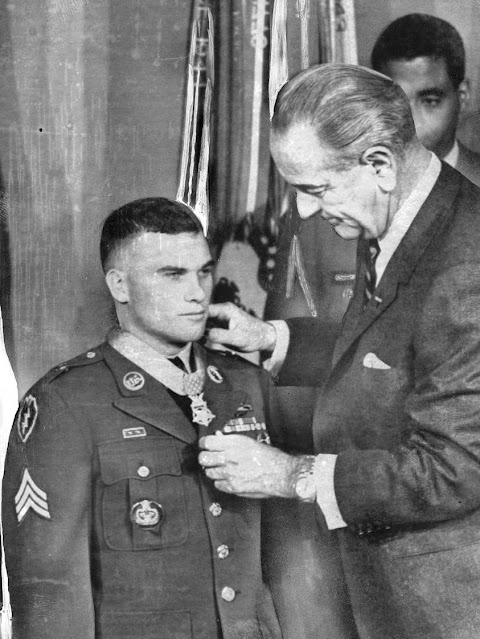
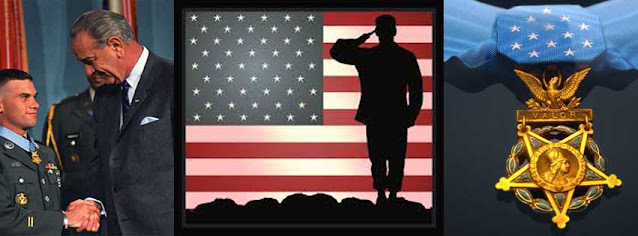
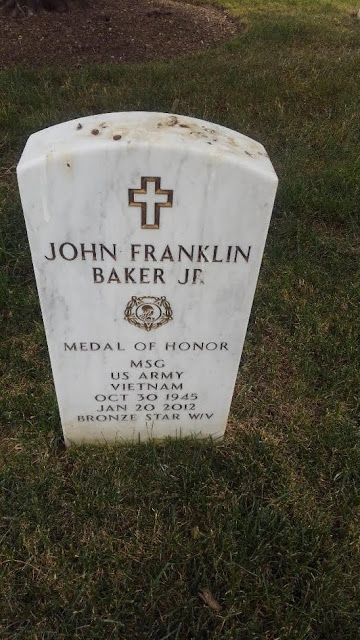
At 5' 2" 105 lbs, Medal of Honor recipient, Sgt. John F. Baker Jr. certainly qualifies as a Giant Killer. He was also the recipient of the Silver Star, Bronze Star, and Purple Heart.

Sgt. Baker made up for his diminutive stature by building up his physique. Inspired by his father’s work as a circus trapeze artist, he joined a gymnastics squad in high school and trained on the rings, learning to execute a perfect iron cross.

Accepted by the Army during the Vietnam War — the Marine Corps said he was an inch too short — Sgt. Baker’s impressive strength helped him save the lives of his fellow soldiers.

On Nov. 5, 1966, Sgt. Baker’s unit was tasked with reinforcing a group of American soldiers pinned down near Dau Tieng, close to the Cambodian border. About 3,000 Vietnamese had taken positions in the surrounding jungle, hiding in underground bunkers and roping themselves to tree branches.

As the U.S. soldiers advanced, the lead scout was shot in the face.

The jungle erupted in enemy fire. Camouflaged machine gun positions spit bullets that whizzed by Sgt. Baker’s head. Mortar rounds thumped the ground. Snipers in the trees picked off Americans hiding on the ground.

Sgt. Baker ran toward the front with another soldier and helped destroy two enemy bunkers. During the attack, the other soldier was mortally wounded. Sgt. Baker killed four enemy snipers before carrying his comrade away from the ambush.

Returning to the battle, Sgt. Baker was blown off his feet by an enemy grenade but recovered to make repeated trips through withering fire to evacuate wounded American soldiers much larger than himself. By the end of the two-hour conflict, Sgt. Baker’s uniform was soaked in the blood of his comrades.

In all, Sgt. Baker was credited with recovering eight fallen U.S. soldiers, destroying six bunkers and killing at least 10 enemies.

As his Medal of Honor nomination was considered, Sgt. Baker spent the rest of his tour as a “tunnel rat.” Armed with a flashlight and pistol, he explored the spider- and scorpion-infested subterranean network used by Viet Cong guerillas. During one mission, he discovered a full-scale hospital complete with surgical suites buried three stories below ground.

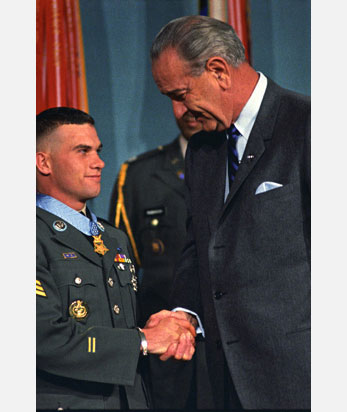
Returning home in August 1967, Sgt. Baker served as a drill instructor. One day, he was told he had an urgent phone call. It was President Lyndon B. Johnson on the line, inviting him to the White House to be awarded the Medal of Honor, the military’s highest decoration for valor.

According to his citation, “Sgt. Baker’s selfless heroism, indomitable fighting spirit, and extraordinary gallantry were directly responsible for saving the lives of several of his comrades, and inflicting serious damage on the enemy.”

Joining Sgt. Baker at the ceremony in the East Room was his company commander, then-Capt. Robert F. Foley, who also was awarded the Medal of Honor for bravery during the same battle that November day in 1966.

Foley, who retired from the Army as a lieutenant general in 2000, stood 6-foot-7 and played basketball at the U.S. Military Academy at West Point.

Noticing the soldiers’ disparate heights, Johnson told Sgt. Baker and Foley that they reminded him of the cartoon characters Mutt and Jeff.

John Franklin Baker Jr. was born Oct. 30, 1945, in Davenport, Iowa, and was raised in Moline, Ill.

After being awarded the Medal of Honor, Sgt. Baker traveled the country as a recruiter. His repeated requests to be sent back to Vietnam for combat duty were denied. He retired from the military in 1989 and later worked at a Department of Veterans Affairs hospital in Columbia, S.C.

The Giant Killer book & page honors these incredible war heroes making sure their stories of valor and sacrifice are never forgotten. The Giant Killer book is available now on Amazon & Walmart websites. God Bless our Vets!


In 2010 the Interstate 2-80 bridge was named the Sgt. John F. Baker Jr. Bridge. Initiating the successful process through all its steps and organizing the dedication ceremony was the Quad Cities Vietnam Veterans of America Chapter 299. Spearheaded by Ray Hamilton and William Albracht.


Awash in KJV Books

Because some people come here for the cat photos. That's why.

It took me a few months to acquire the main books needed for the KJV

Many books for and against the KJV are here.

I would start with Edward Freer Hills - The King James Version Defended. That book is comprehensive yet written for those of us who have not bowed down at the Tischendorf-Westcott-Hort shrine. Put the author's name in the search line at Alibris.com, to find Hills' book.

The other top book is Wilbur N. Pickering, The Identity of the New Testament Text, 2014.

David W. Daniels has a lot of books at Chick Publications and can also be found with an author search on Alibris.com

Finally, the Trinitarian Bible Society has many publications, often aimed at one issue at a time, such as the ending of Mark. The US Store is here.


Tuesday, January 4, 2022

Readers Are Enjoying the Nutrition Posts.
I Am Enjoying the Inexpensive Food.

 As others have pointed out, my father on the far left and his customers, are slender by today's standards. 

I am a bit hungry now, so I am going to have an orange or two. My mother pumped us full of skim milk (which I loathed) - lots of calcium. Skim milk causes more weight problems than whole milk - long term studies.

Oranges have calcium too.

Here are top vegetables with calcium, a gentle hint that this was designed by the Logos, John 1:3.

KJV John 1:3 All things were made by Him; and without Him was not any thing made that was made. 

Some veggies loaded with calcium

  • Collard greens
  • Edamane
  • Turnip Greens
  • Kale
  • Mustard Greens
  • Bok choy
  • Dandelion greens - no herbicide please. They are herbs, not weeds. I had two blossoms during Christmas.
  • Snow peas
  • Brocolli
  • Sweet potatoes
  • Squash
Now I look in the freezer and wonder, "What is this good for in nutrition?" I never knew this about sweet potatoes:
  1. Anti-oxidants
  2. Potassium for energy, nervous system
  3. Vitamin C - almost a daily dose in one serving
  4. Vitamin A and E - good for the eyes
  5. Magnesium for blood pressure and blood sugar
  6. Low glycemic (the opposite of popcorn and donuts)
  7. Beta-carotene, which converts to A
  8. Fat-free, fibrous, and folate
  9. Good for the skin
I can easily cook frozen sweet potatoes, and I often did for Christina. I have tilted away from Schwan's now and gone back to supermarket frozen and canned food. I even bought a can opener. Schwan's has many good frozen vegetable selections, but the big money is in the prepared foods and desserts, two categories I am nixing.

I wrote to one member that people should not get into extremes that make them toss the whole idea out. Opti-fast is a good example (lose 20 pounds, gain 30). "Never eat anything that tastes good" is another. A never-never diet usually ends in binge candy dessert eating. The trouble is not using satisfying good food, including some meats.

One sign of high blood sugar is eating an unusual amount of sweets, whether ice cream or candies. That spikes blood sugar, which then makes us sluggish, so we want instant relief - high sugar content. In contrast, a combination of vegetables and greens will end the sugar craving and provide real energy.

I pulled out a bag of frozen raw vegetables today (Schwan, Normandy Blend) and microwaved a bowl 3 minutes, with one pat of butter - delicious.

I went over the Fuhrman material on butter and decided to reduce that quite a bit. All oils have the most calories per ounce, compared to anything else, so cutting back there is just as smart and reducing white sugar, white flour, and junk food.

For your own amusement and edification, google "nutritional benefits of _____" and name a food. Or go the other way and ask for "foods with the most vitamin C". Cauliflower? Number 4? You must be kidding! Kale too?

In general, more processing of the food means more salt, more sugar, more fat. Low fat processed food often means a lot more sugar. More processing also means more money - let that sink in. Go to McDonalds and get two chicken sandwiches, no fries, no drinks. $8.50. Next go to the grocery store and spend $8.50 on vegetables, fresh and frozen and canned. Which purchase is more difficult to carry and has more food value?

Look them up for nutrition - eat them for satisfaction and health. They taste great.

Here Is a Book List for your New Testament Studies


Authors and Books - Good and Bad – On the Greek New Testament

            This list is very important, necessary for a better grasp of these issues concerning the Bible and its accurate translation. They are in order of importance, so the top ones are best to start. I buy used copies most of the time, from Alibris. Other used sources are Amazon used books, Biblio, and eBay. Watch and wait, because some very expensive books are offered for a fraction of the price later. I got a $300+ book for $25 later.

Greek New Testaments

Stephanos – Majority Text – Good, also on Biblegateway.com

Westcott and Hort – Horrible, with no explanations at all

United Bible Societies – Horrible but lots of critical apparatus below

Bad Text Criticism – Acolytes of Tischendorf and Westcott and Hort

Bruce Metzger – The Text of the New Testament, Its Transmission, Corruption, and Restoration, 1964. Note – “corruption” refers to the Majority Text.

Metzger, Reminiscences of an Octogenarian, 1997

J. Harold Greenlee, Introduction to New Testament Textual Criticism, 1995. Traditionalists are wrong because they disagree with to bogus and fantastical Westcott-Hort theories! - circular reasoning.

Kurt and Barbara Aland, The Text of the New Testament, 1981. He continued the Westcott-Hort argumentation, via Nestle, his mentor. The Nestle-Aland United Bible Society edition has become the favorite of liberals, apostates, and Lutherans. The New KJV constantly references NU in footnotes – for this Nestle-Aland-UBS edition – and M for the Majority Text. Is this citing of NU any different from the RSV footnoting Isaiah 7:10 – “or virgin?” RSV Isaiah 7:10 now reads – “a young woman will conceive and bear a son.”

Good Text Criticism

Edward Freer Hills – The King James Version Defended, 1988. Hills was a top Latin student at Yale, studied for a doctorate at Chicago and was blocked by Metzger, then finished his doctorate at Harvard. He tutored Theodore Letis, who is best appreciated through his videos.

Wilbur N. Pickering, The Identity of the New Testament Text, 2014. A layman pointed out Pickering to me. As one person wrote, Pickering destroyed the entire modern argument against the modernist, eclectic (invented) Greek text.

About Tischendorf

James Bentley, Secrets of Mt. Sinai. The Story of the World’s Oldest Bible – Codex Sinaiticus, 1986. This is so hilariously worshipful that its thesis self-destructs. “Tischendorf was obsessed…” Yes.

J. A. Moorman, Was Codex Sinaiticus Written in 1840? 2018. Moorman is a KJV defender and the author of many comparison books on the KJV.

Dr. Constantine Tischendorf, Codex Sinaiticus. 1934.

YouTube - History Education for KJB Believers - lecture by Chris Pinto, https://www.youtube.com/watch?v=f4sx2WM-nsM

David W. Daniels, Who Faked the “World’s Oldest Bible”? 2021. This book goes over the details of Tischendorf’s life and travels, with an emphasis on explaining how a gift book was turned into the oldest Bible, even though there are no traces of it, no record of Sinaiticus until the mid-19th century.


Apologetic Books – In Defense of the Christian Faith

David Otis Fuller – He has at least three good books that address key issues:

Which Bible? – Essays on the KJV translators – learned men; Dean Burdon – by Edward F. Hills, Modern criticism, Codex Vaticanus, the problems of Westcott-Hort theories.

True or False? – Various Greek texts explained (Stephens, Tischendorf, etc), Burdon on The Revision Revised. Pickering (above) on the contributions of Dean Burgon.

Counterfeit or Genuine? - The Ending of Mark by Dean Burdon, Woman Caught in Adultery – Burdon, Preservation of the Scriptures.

Gregory Jackson – Liberalism, Its Cause and Cure.The Poisoning of American Christianity and Its Cure. This is a review of how the 20th century Christian Church became apostate, fallen from faith.

Liberalism