Monday, February 21, 2022

References for the KJV Book - Cleaned Up with Notes about Important Books, Good and Bad


 Tischendorf


The King James Version:

Apostolic Texts, Precise Translation versus Fraudulent Texts and Heretical Translations


References with Notes

Aland, Kurt and Barbara Aland. (1995). The Text of the New Testament. Eerdsman. GJ – The Nestle-Aland Greek New Testament dominates the academic world. Kurt Aland repudiated the Christian Faith early in his career.

Alter, Robert and Frank Kermode. (1987). The Literary Guide to the Bible. Harvard University Press. GJ - The editors based their book on the KJV, a precaution for those rushing to buy the newest hip, soon to be forgotten (or erased) Bible paraphrase.

Burke, David G. et al. (2013). The King James Version at 400. Assessing Its Genius as Bible Translation and Its Literary Influence. Society of Biblical Literature.

Bainton, Roland. (1969) Erasmus of Christendom. Scribner’s Sons.

Beck. (1976). The Holy Bible (An American Translation, AAT). Holman. Quoting Beck - “The two oldest manuscripts [Vaticanus, Sinaiticus] lack Mark 16:9-20…but end at verse 8.” See the brobdingnagian Voelz commentary on Mark, CPH.

Bentley, James. (1986). Secrets of Mt. Sinai. Doubleday. GJ - See Tischendorf’s lavish self-praise and deceptions, below. See also Moorman’s work on the validity of Sinaiticus being the “world’s oldest Bible”.

Bloom, Harold. (2011) The Shadow of a Great Rock. A Literary Appreciation of the King James Bible. Yale University Press. GJ – Depreciation would be a better word to use.

Daniels, David W. (2005). Did the Catholic Church Give Us the Bible? Chick Publications. GJ – Daniels has a detailed history of the Roman Catholic attempt to set aside the true Scriptures in favor of their corruptions.

Daniels, David W. (2009). Look What’s Missing. Chick Publications. 2009.

Daniels, David W. (2013). Did the Catholic Church Give Us the Bible? Chick Publications.

Daniels, David W. (2018). Fifty-One Reasons Why the King James. Chick Publications.

Daniels, David W. (2020). The Bridge Bible. A Path from Faith to Doubt. New King James. Chick Publications.

Daniels, David W. (2021). Who Faked the “World’s Oldest Bible”? Chick Publications. GJ – This example of detailed research, with sources, shows how Tischendorf’s Sinaiticus is a complete hoax, truly the world’s newest Bible!

De Hamel, Christopher. (2001). The Book. A History of the Bible. Phaidon Press. 2001.

Fuller. David Otis. (1973). True or False? GJ- This includes Dean Burgon’s Revision Revised and Pickering’s essay about Burgon.

Fuller, David Otis. Which Bible?

Fuller, David Otis. (1984). Counterfeit or Genuine? GJ – This includes articles by and about Dean Burgon, who was almost alone arguing against the deceptions of Sinaiticus and Vaticanus. This deals with the ending of Mark, the woman caught in adultery, and the preservation of the Scriptures.

Greenlee, J. Harold. (1995). Introduction to New Testament Criticism. Hendrickson Press.

Gutjahr, Paul C. (20  ). An American Bible. A History of the Good Book in the United States, 1777-1880.

Hallihan, C.P. (2010). The Authorised Version. A Wonderful and Unfinished History. Trinitarian Bible Society. 2010.

Hills, Edward F. (1988). The King James Version Defended. Christian Research Press. 1988. GJ – This is one of the top three best books on the text of the KJV. Hills was a top student at Yale, studied at Chicago, and earned his PhD at Harvard. He tutored Theodore Letis.

Kenyon, Frederic G. (1949). The Text of the Greek Bible. A Student’s Handbook. Duckworth Press.

Letis, Theodore P. (2000). The Ecclesiastical Text. Just and Sinner Publications. GJ - He studied with Edward Freer Hills, above.

Letis, Theodore P. (    )The Majority Text: Essays and Reviews in the Continuing Debate.

Luther. Reading the Psalms with Luther. Concordia Publishing House. 2007. GJ - CPH’s NIV Self-Study Bible is rationalistic and denies the Messianic nature of the Psalms.

McClure, Alexander. (1853-2000). The Translators Revived. Biographies of the Authors of the King James Version of the Holy Bible. Charles Scribner. LutheranLibrary.org.

McAfee, Cleland Boyd. (    ). Study of the King James Bible. 1912. GJ - This is a superb appreciation of the KJV, its genius, and influence on our society.

McGrath, Allister. (2001). In the Beginning. The Story of the King James Bible and How It Changed a Nation, a Language, and a Culture. Random House. GJ – This is one of the best books on the KJV.

Metzger. Bruce M. (2001). The Bible in Translation. Ancient and English Versions. Baker Academic. 2001.

Metzger, Bruce M. (    ) Reminisces of an Octogenarian. Hendrickson Press.

Metzger, Bruce M. The Text of the New Testament: Its Transmission, Corruption, and Restoration. Oxford University Press. 1964. GJ - By corruption, he meant the Majority Text and by restoration, he meant the Nestle-Aland-Metzger text.

Moorman, J. A. (2006). 8000 Differences Between the N.T. Greek Words of the King James Bible and the Modern Versions. The Bible for Today.

Moorman, J. A. (2018). Was Codex Sinaiticus Written in 1840! Old Paths Publications. GJ – This is another revealing book about the falsehoods of Count Tischendorf, though the Count is his own worst perjury suspect.

Moorman, J. A. Early Manuscripts, Church Fathers, and the Authorized Version. The Bible for Today Press, 2005.

Paine, Gustavus S. (1977). The Men Behind the KJV. Baker Book House. GJ – Appreciating the team of translators is a good way to understand the remarkable results of their work. This may be the same as Learned Men.

Pickering, Wilbur N. (1977). The Identity of the New Testament Text. Thomas Nelson. GJ – Pickering shares honors with Edward Freer Hills in his scholarship, eviscerating the claims of the modernist Bible disasters.

Pickering, Wilbur N. (2014). The Identity of the New Testament Text IV. GJ – The best and most readable KJV books are Pickering, Edward F. Hills, and David Daniels.

Pickering, Wilbur N., Marcello Freitas. (2021). Family 35. Original Text of the New Testament, Exposition of Evidence.

Robinson, Maurice A., William Pierpont. (2020). The Case for the Byzantine Priority. 2020. GJ – The evidence has grown remarkably to show the earliest good texts were from the Apostles while the error infested early texts came from the Egyptian heretics.

Sightler, James. (1999). A Testimony Founded Forever. GJ – This is unusually detailed about the dishonest KJV “revision” and the unchristian Hindu-Christian fusion promoted by Westcott.

Tischendorf, Dr. Constantin. (   ) Codex Sinaiticus. The Discovery of the World’s Oldest Bible. The Book Tree. 2016. See also James Bentley’s work above. GJ – Tischendorf baptized the fake Sinaiticus as the World’s Oldest Bible and promoted Vaticanus as being just as old. Neither Bible has a genuine history or children. Why did no one copy them or wear them out through copying and use?

Trinitarian Bible Society booklets are very well written, precise, and reliable in defending the value, fidelity, and authority of the King James Version. The author is a member of this group. See a list of some of the titles at the end of the sources.

Voelz, James W. (2013). Mark Commentary, 2 vols! 1320 pages. Concordia Publishing House. GJ - Note how the Beck Bible footnote error on the ending of Mark 16 is now trumpeted by a “conservative” seminary professor and CPH. This gigantic collection of errors is based upon the Church of Rome’s dubious Codex Vaticanus, mysteriously promoted with Sinaiticus as the world’s oldest, but in reality falsification’s boldest. Christian News laid the foundation for Voelz by promoting and selling the Beck Bible.

Waite, D. A., Jr. (2003) The “Doctored” New Testament. The Bible for Today Press.

Vance, Laurence M. (1993). A Brief History of English Bible Translations. 1993. GJ – Far more English translations have been published than most could imagine. The KJV remains dominant among those who read the Bible.

Vance, Laurence M. (1999). The Other Side of Calvinism. GJ – Vance collected and compared the many contradictions among the leading Calvinists, showing that TULIP falls apart upon close examination.


Greek New Testaments

H KAINH DIATHHKH – The New Testament, Textus Receptus, Trinitarian Bible Society. 1976.

The Greek New Testament. Fifth Revised Edition. (2020). Barbara Aland, Kurt Aland, Bruce Metzger, et al. 2020. GJ - This features the minority texts of Sinaiticus and Vaticanus, its fantasies almost the same as the Westcott-Hort, which was kept hidden in the 19th century KJV revision. The Revision of was a disaster as an improved KJV, but the Westcott-Hort Greek text, which they conjured up from their theories, is now the Nestle-Aland, with few exceptions.

Stephanus edition, Majority Text. Greek New Testament. GJ – This is the text preserved in 5,000 or more examples from the Byzantine, Greek Christian Empire, also known as the Eastern Roman Empire, which continued after the Fall of Rome in 400 AD and continued until its doom in 1453, when the Ottoman Turks captured Constantinople. The overwhelming majority of all Greek New Testament texts is from the Apostolic Age, quite different from the handful of “oldest” examples from the self-promoting careers of Tischendorf, Westcott, and Hort.

Westcott Brook Foss, and Fenton John Anthony Hort. (1953). The New Testament in the Original Greek. Macmillan. GJ - These two frauds secretly printed a thousand Greek copies early for the KJV revisers, using their status to get the vast changes made based on Vaticanus, Sinaiticus, and their now-debunked text theories. Today’s Nestle-Aland is very much the Westcott-Hort but with a critical apparatus attached. The Westcott-Hort, which I own, has no justification below for their falsehoods, such as omitting “the Son of God” from Mark 1:1.


Trinitarian Bible Society Booklets, London

God Was Manifest in the Flesh, 1 Timothy 3:16

The Divine Inspiration of the Holy Scriptures

Dr. Kurt Aland, Textual Critic

The Greek New Testament

The Excellence of the Authorised Version

Why 1 John 5:7-8 Is in the Bible

Which Bible Version? Does It Really Matter?

A Textual Key to the New Testament – Omissions and Corrections

The Learned Men – The Translators of the KJV

The Authenticity of the Last Twelve Verses of St. Mark’s Gospel

How We Got the Bible

The Authorised Version – What Today’s Christian Needs To Know


More on Nutrition - The Panoply of Beans and Greens


I do not miss the old pattern of 10 pounds down, 15 pounds up. I can recall various comments from doctors over the years, but they did not move me in the right direction. Blood sugar and blood pressure encouraged me to change immediately, and we had a pristine copy of Fuhrman in our home library. 

I also owned a book from one of my MA students in education - on diabetes, plus additional diabetes books. The student's son almost died of type 1 diabetes and is now a healthy strong young man. Diabetes is more than a disorder - it is a constellation of many bad outcomes from high blood sugar. 

Fuhrman staggered me with the facts of greens and vegetables being so much better than sugar, white flour, high fat foods, and high salt snacks. In addition, nuts and fruits are a return to Eden. Instead of apple pie from Schwan, I have fresh crunchy apples from the store. I still eat some meat, but far less than before.

I like the Fuhrman emphasis on rare eating:

Fish - I already noped that.

Cheese - maybe once a week, too much salt. It is basically a fat product, but can be enjoyed in small amounts.

Milk products are fat products I never liked, except for ice and whipped cream, which are fatal temptations. 

I like the joke that tomatoes are the fourth stage of water, because I used to raise delicious tomatoes and eat them warm from the sun. Store tomatoes are little more than water, but tomato paste delivers flavor and super-nutrition at the same time but with a low cost.

Beans are satisfying but I do not like them alone. However, many canned varieties are tasty with a lot of vegetables. I often open a can of vegetable soup, add favorite vegetables (mushrooms, peas, mixed vegetables) plus nuts and flaxseed. 

A fellow bean convert suggested lima beans, which I have always loved. They also have to have super nutrition benefits. I will list them.

"One cup (170 grams) of cooked lima beans contains (1Trusted Source):

  • Calories: 209
  • Protein: 12 grams
  • Fat: 0.5 grams
  • Carbs: 40 grams
  • Fiber: 9 grams
  • Manganese: 92% of the daily value (DV)
  • Copper: 58% of the DV
  • Magnesium: 30% of the DV
  • Iron: 23% of the DV
  • Potassium: 21% of the DV
  • Thiamin: 20% of the DV
  • Vitamin C: 19% of the DV
  • Vitamin B6: 19% of the DV
  • Phosphorus: 18% of the DV

Lima beans are especially high in manganese, which acts as an antioxidant and plays a key role in metabolism (2Trusted Source).

They also provide a good amount of copper in each serving, which supports immune health and promotes brain function (3Trusted Source).

Plus, lima beans are rich in magnesium, a mineral your body needs for energy production and DNA synthesis (4Trusted Source)."

As others have said, multi-vitamins are good for supplementing food, but these simple, inexpensive foods are loaded with nutrition that lowers blood pressure, blood sugar, and increases the body's fight against various disorders - like cancer.

Someone can get a shopping basket worth of nutritional medicine simply from 

  1. mounds of greens (like spinach), 
  2. a variety of beans, 
  3. walnuts and almonds, and
  4. a number of fruits.

The miracle compounds sold at a high price and promising everything - they are derived rather selectively from vegetation. Instead, the beans and greens, nuts and fruits fill in more of our needs than we can get from fast food, snack food, and donuts.

Sunday, February 20, 2022

New Covers for the New KJV Book. Thank You Norma A. Boeckler


The King James Version: 

Apostolic Texts, Precise Translation versus Fraudulent Texts and Heretical Translations

The entire book has been worked over, from start to finish, so it earned a new title - more information, fewer typos. 

There are two major divisions. Part One is all about the KJV, an appreciation of its grandeur, precision, and dominance in a field of squawking fakes, notably the Little Three - ESV, RSV, NIV - the first two owned (leased) by the radical National Council of Churches. "May God bless and keep the NCC far away from us."

Part Two reviews the information showing that Vaticanus and Sinaiticus were both hoaxes, not at all the "Oldest Bibles in the World." I have put together research showing that the Majority Text (KJV) is from the Apostles and the Nestle-Aland Greek New Testament is from Tischendorf, the Vatican, and Westcott-Hort - based on a handful of sources without a history and without "children."

Pastors and laity, if you do not know the seriousness of the modern Bible hoaxes, you are feeding poison to yourself and to others. The seminary professors are too busy drinking their booze and feeding their fat tummies to stand up for the truth.

Norma A. Boeckler was kind enough to design the covers today. She really enjoys fashioning book covers, which she has done for her own and others besides me. They are unique and beautiful.

 Norma A. Boeckler, Christian Artist and Writer


Sexagesima Sunday, 2022. Luke 8:4-15


Bethany Lutheran Church 

Sexagesima Sunday, 2022

Pastor Gregory L. Jackson
10 AM Central Standard Time


The Hymn #350               Jesus the Very Thought                      
The Confession of Sins
The Absolution
The Introit p. 16


Awake, why sleepest Thou, O Lord? 
Arise, cast us not off forever.
Wherefore hidest Thou Thy face: 
and forgettest our affliction?
Our soul is bowed down to the dust: 
arise for our help and redeem us.
Psalm. We have heard with our ears, O God: 
our fathers have told us what work 
Thou didst in their days.

The Gloria Patri
The Kyrie p. 17
The Gloria in Excelsis
The Salutation and Collect p. 19

O God, who seest that we put not our trust in anything that we do, mercifully grant that by Thy power we may be defended against all adversity; through Jesus Christ, Thy Son, our Lord, 
who liveth, etc.

The Epistle and Gradual    

Let the nations know that Thy name is Jehovah: Thou alone art the Most High over all the earth.
V. O my God, make them like a wheel 
and like chaff before the wind.
Tract. Thou, O Lord, hast made the earth 
to tremble and hast broken it.
V. Heal the breaches thereof, for it shaketh.
V. That Thy beloved may be delivered, save with Thy right hand.

The Gospel              
Glory be to Thee, O Lord!
Praise be to Thee, O Christ!
The Nicene Creed p. 22
The Sermon Hymn # 339          All Hail the Power
 
The Seed Is the Word of God

The Hymn # 308                    Invited Lord                          
The Preface p. 24
The Sanctus p. 26
The Lord's Prayer p. 27
The Words of Institution
The Agnus Dei p. 28
The Nunc Dimittis p. 29
The Benediction p. 31
The Hymn #46       On What Has Now Been Sown

Prayers and Announcements
  • Medical care - Norma Boeckler, Randy Anderson, Pastor Jim Shrader, Chris Shrader, Lito Cruz and Pastor K - diabetes.
  • Children - Callie, seizures; C. therapy.
  • Pastor Jackson's eyes: 20/20; 20/25.
  • RESI training will finish this week, starting early.
Finishing the New Book - The King James Version: Apostolic Text, Precise Translation versus Fraudulent Text and Heretical Translations


 Norma A. Boeckler

2 Corinthians 11:19 For ye suffer fools gladly, seeing ye yourselves are wise.
20 For ye suffer, if a man bring you into bondage, if a man devour you, if a man take of you, if a man exalt himself, if a man smite you on the face.  21 I speak as concerning reproach, as though we had been weak. Howbeit whereinsoever any is bold, (I speak foolishly,) I am bold also.  22 Are they Hebrews? so am I. Are they Israelites? so am I. Are they the seed of Abraham? so am I.  23 Are they ministers of Christ? (I speak as a fool ) I am more; in labours more abundant, in stripes above measure, in prisons more frequent, in deaths oft.  24 Of the Jews five times received I forty stripes save one.  25 Thrice was I beaten with rods, once was I stoned, thrice I suffered shipwreck, a night and a day I have been in the deep;  26 In journeyings often, in perils of waters, in perils of robbers, in perils by mine own countrymen,in perils by the heathen, in perils in the city, in perils in the wilderness, in perils in the sea, in perils among false brethren;  27 In weariness and painfulness, in watchings often, in hunger and thirst, in fastings often, in cold and nakedness.  28 Beside those things that are without, that which cometh upon me daily, the care of all the churches.  29 Who is weak, and I am not weak? who is offended, and I burn not?  30 If I must needs glory, I will glory of the things which concern mine infirmities.  31 The God and Father of our Lord Jesus Christ, which is blessed for evermore, knoweth that I lie not.  32 In Damascus the governor under Aretas the king kept the city of the Damascenes with a garrison, desirous to apprehend me:  33 And through a window in a basket was I let down by the wall, and escaped his hands. 12:1 It is not expedient for me doubtless to glory. I will come to visions and revelations of the Lord.  2 I knew a man in Christ above fourteen years ago, (whether in the body, I cannot tell; or whether out of the body, I cannot tell: God knoweth;) such an one caught up to the third heaven.  3 And I knew such a man, (whether in the body, or out of the body, I cannot tell: God knoweth;)  4 How that he was caught up into paradise, and heard unspeakable words, which it is not lawful for a man to utter.  5 Of such an one will I glory: yet of myself I will not glory, but in mine infirmities.  6 For though I would desire to glory, I shall not be a fool; for I will say the truth: but now I forbear, lest any man should think of me above that which he seeth me to be, or that he heareth of me.  7 And lest I should be exalted above measure through the abundance of the revelations, there was given to me a thorn in the flesh, the messenger of Satan to buffet me, lest I should be exalted above measure. 8 For this thing I besought the Lord thrice, that it might depart from me.  9 And he said unto me, My grace is sufficient for thee: for my strength is made perfect in weakness. Most gladly therefore will I rather glory in my infirmities, that the power of Christ may rest upon me.

By Norma Boeckler

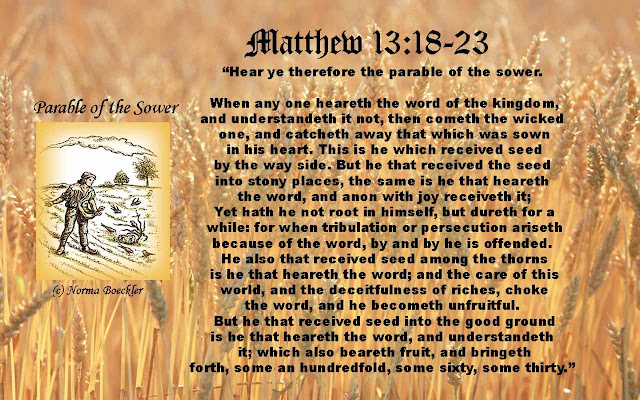
KJV Luke 8:4 And when much people were gathered together, and were come to him out of every city, he spake by a parable:  5 A sower went out to sow his seed: and as he sowed, some fell by the way side; and it was trodden down, and the fowls of the air devoured it.  6 And some fell upon a rock; and as soon as it was sprung up, it withered away, because it lacked moisture.  7 And some fell among thorns; and the thorns sprang up with it, and choked it.  8 And other fell on good ground, and sprang up, and bare fruit an hundredfold. And when he had said these things, he cried, He that hath ears to hear, let him hear. 9 And his disciples asked him, saying, What might this parable be?  10 And he said, Unto you it is given to know the mysteries of the kingdom of God: but to others in parables; that seeing they might not see, and hearing they might not understand. 11 Now the parable is this: The seed is the word of God. 12 Those by the way side are they that hear; then cometh the devil, and taketh away the word out of their hearts, lest they should believe and be saved. 13 They on the rock are they, which, when they hear, receive the word with joy; and these have no root, which for a while believe, and in time of temptation fall away. 14 And that which fell among thorns are they, which, when they have heard, go forth, and are choked with cares and riches and pleasures of this life, and bring no fruit to perfection. 15 But that on the good ground are they, which in an honest and good heart, having heard the word, keep it, and bring forth fruit with patience.

 Norma A. Boeckler designed the Bethany altar
and created this photograph of it.


The Seed Is the Word of God
Introductory

One of the most important lessons from Luther is the concise nature of the Spirit at work in the Word. That means that every phrase and nearly every Word has meaning, because God works efficaciously through His Word.

So people (or maybe pastors) grew bored with a one-year cycle of readings and followed the Vatican's example of a three- year cycle. No one thought Rome was an enemy of the Gospel - they have their people in all the top positions in Bible societies.

Repetition means we should examine these lessons closely, because that was intended, especially with the parables. One example is Luther's point that the seed is the Gospel alone - from Christ - because there are no weeds that grow in this parable. That has greater and greater meaning as we study this short parable. 

I can say with great confidence that hardly anyone understands or teaches this parable as intended, because we see all kinds of salesmen running around selling Unstuck programs, or phone programs, or fun-and-games-and-popcorn instead of worship. It is good that fools spend all their money on foolishness and end up with nothing of value. They are precisely and remorselessly described in this parable.

KJV Luke 8:4 And when much people were gathered together, and were come to him out of every city, he spake by a parable:

Vast throngs came to Jesus because of His healing miracles. They might have heard of other miracles (the wedding at Cana) but healing was clearly an attraction for everyone. Jesus spoke through parables, as Matthew and Mark say, because His Word was not for superficial people looking for the fad of the moment. 

It is so true today - "to see and not perceive, to hear and not understand," 

KJV Mark 4:10 And when he was alone, they that were about him with the twelve asked of him the parable. 11 And he said unto them, Unto you it is given to know the mystery of the kingdom of God: but unto them that are without, all these things are done in parables: 12 That seeing they may see, and not perceive; and hearing they may hear, and not understand; lest at any time they should be converted, and their sins should be forgiven them.13 And he said unto them, Know ye not this parable? and how then will ye know all parables?

The central point of this parable - the Seed is the Word of God. As Luther points out, this Seed is Gospel only because the parable only speaks of seed fruiting. Weeds do not grow useful fruit, only more of the same weed - ragweed, poke weed, hemlock, poison ivy, etc.

The Bible teaches us that the Seed is the Word of Christ, accompanied by the Holy Spirit. That means it is is good, useful, powerful, and effective all by itself. Man does not add to the Word or improve it. The purer the teaching, the more power it has. However, because the Word belongs to God alone, the Word is not our plaything, tool, or device needing ideas and false teachings from other religions and from destructive, false Christian teachers, who are more destructive than outsiders. 

Why hide His truths in parables? Because we also keep power tools, motors, and high voltage lines under lock and key. More than one child has caused harm from playing with them. I found a way to engage the clutch in my mother's car when I was alone in the front seat. I watched as a man ran along the downhill slope to get inside and stop it. 

Parables are so compelling because we can learn from them all the time. They are short enough to remember and mysterious enough that we have to be serious to understand them.

No one who gives away soft drinks, coffee, and popcorn before a worship service comprehends this parable. The very act of using food and entertainment is a repudiation of the Word. Why so ashamed of the Gospel and so enamored of food. 

All those using sociology to explain the Church today are blind to this parable. They bemoan empty churches but fail to see their Internet writings never touch on faith in Christ. No, they love demographics (an aging population), sociology (who still likes to go to church?), history (blaming people of the past and getting rid of traditional books and the Apostolic Majority Text (KJV). Sometimes, when tempted by one forum, I want to post something and realize they cannot deal with the Gospel. One group of Ovaltine drinkers ran like scalded dogs - away from my endorsement of the KJV.

5 A sower went out to sow his seed: and as he sowed, some fell by the way side; and it was trodden down, and the fowls of the air devoured it. 

This is living seed. The Word is imbued with life, just as plant seeds are. Even more today, food seeds are valuable and expensive because they are practical and ready to burst into germination.

The seed of the parable is the Gospel Word.

Luther:

2. The first class of disciples are those who hear the Word but neither understand nor esteem it. And these are not the mean people in the world, but the greatest, wisest and the most saintly, in short they are the greatest part of mankind; for Christ does not speak here of those who persecute the Word nor of those who fail to give their ear to it, but of those who hear it and are students of it, who also wish to be called true Christians and to live in Christian fellowship with Christians and are partakers of baptism and the Lord’s Supper. But they are of a carnal heart, and remain so, failing to appropriate the Word of God to themselves, it goes in one ear and out the other. Just like the seed along the wayside did not fall into the earth, but remained lying on the ground in the wayside, because the road was tramped hard by the feet of man and beast and it could not take root.

When people were looking at the Church Growth numbers, and denouncing others for not making membership charts, they were playing the role of the outwardly Christian leaders who had no faith. They can have a vast knowledge of Christianity and not believe. In fact, that makes them more attractive and college and seminary teachers and especially world religion professors in state schools (all ardent atheists, but very knowledgeable).

When I emphasize the efficacy of the Word (last chapter of Liberalism: Its Cause and Cure) using the concepts of this parable, two leaders in missions stood up to denounce me with all their might. They were joined by a future missionary to the Ukraine, who swore and flung my paper across several pews. That is when I decided it would be the last chapter of the book. When Liberalism was published by WELS, a meeting was organized to get rid of me in a surprise attack meeting.

So the parable is a perfect example of those who have an outward expression of Christianity but really hate the Gospel and can never be productive of the Gospel. When birds come across seed on shallow or packed soil, they quickly snatch it up and devour.

Satan attacks the Word through these skirmishes, which are artfully designed to uphold the impression of the Faith while undermining it. The use of modern "translations" based upon fraudulent texts (Sinaiticus, Vaticanus) is a good example of something outwardly good to most people but loaded with falsehoods from the anti-Christian Christian leaders of the 19th century KJV "revision." Hort loved "Mary religion" in his own words and partner Bishop Westcott combined Hinduism with Christianity. One day the entire world would be Christ incarnate in every person (Westcott).

6 And some fell upon a rock; and as soon as it was sprung up, it withered away, because it lacked moisture.

This emphasizes the superficiality of making people excited over the Gospel without any depth to their knowledge or any suggestion of bearing the cross. If they are exuberant on a special positive, inspiring day and run into terrible difficulties soon after, joy fades and they turn to other amusements. 

People often give in because of opposition. Clergy get very discouraged because they try to do the right things and get hatred for it. In God's Creation, opposition is good for trees and plants. They even flourish because of storms and freezes. 

We have to remember this is God's Gospel Word, so it is always good and powerful, but it will meet opposition and outright persecution. 

7 And some fell among thorns; and the thorns sprang up with it, and choked it. 

I planted honeysuckle, which is loved in the South and often considered obnoxious in growth. I was warned. I said, "I hope so in the back yard." But another weed-like plant said, "This water is mine." and engulfed the supposedly fast growing honeysuckle and choked it with leaves surrounding and absorbing the sun's energy.

One could easily say (and be shouted down) that the pastor's job is only the Word, not serving the synod or organizing baseball or building a new, even larger chapel. All the seemingly worthwhile activities engulf the entire congregation so the least important area is the Means of Grace while imitations of secular fun take over.

8 And other fell on good ground, and sprang up, and bare fruit an hundredfold. And when he had said these things, he cried, He that hath ears to hear, let him hear.

The nature of sowing means that the seeds, equal in life, take hold best in fertile soil and can even overwhelm other plants with their growth. (Buckwheat did that when I scattered them through the rose garden.)

So the briefest part of the descriptions is the plain truth. The Gospel Word will fall on good ground and increase beyond anyone's imagination. Although there are many ways in which the Word is opposed, hindered, and suffocated by bad alternatives, the power of the Gospel Word is shown in more than making up for the difficulties....

15 But that on the good ground are they, which in an honest and good heart, having heard the word, keep it, and bring forth fruit with patience.

Luther writes about hatred, opposition, and persecution. Wycliffe's body was burned after he died and his ashes thrown into the river in 1415. 

Tyndale was murdered, then burned in 1536. Luther knew of many Christians killed by the papacy - and the Word only grew faster, especially because few had heard of Justification by Faith - just as few hear it today.


The Mysteries
10 And he said, Unto you it is given to know the mysteries of the kingdom of God: but to others in parables; that seeing they might not see, and hearing they might not understand.

The term mystery is used here (and with Paul) to describe those spiritual truths which are only given to us through the Spirit in the Word. That encourages all kind of mockery because those blind to the mysteries will make fun of them and wonder about the intelligence and understanding of the believer. The mysteries include:
  • The Holy Trinity 
  • Creation
  • God's grace
  • The inerrancy of the Word and its perseverance
  • The divinity, Virgin Birth, miracles, atoning death, resurrection and ascension of Christ.
  • Forgiveness of sin through faith in Jesus Christ.
  • Eternal life
Ministers are (1 Corinthians 4:1) "stewards [caretakers] of the mysteries of God" so they are obliged to teach the truth of the Scriptures, no matter what others may say, no matter how the supposed great men of the visible Church react against it. 


Saturday, February 19, 2022

Luther's Sermon on the Sower and the Seed. Luke 8. Sexagesima


SEXAGESIMA SUNDAY.


TEXT:

Luke 8:4-15. And when a great multitude came together, and they of every city resorted unto him, he spake by a parable:

The sower went forth to sow his seed: and as he sowed, some fell by the way side; and it was trodden under foot, and the birds of the heaven devoured it. And other fell amidst the thorns; and the thorns grew with it, and choked it. And other fell into the good ground, and grew, and brought forth fruit a hundredfold. As he said these things, he cried, He that hath ears to hear, let him hear.

And his disciples asked him what this parable might be. And he said, Unto you it is given to know the mysteries of the kingdom of God: but to the rest in parables; that seeing they may not see, and hearing they may not understand. Now the parable is this: The seed is the Word of God. And those by the way side are they that have heard; then cometh the devil, and taketh away the Word from their heart, that they may not believe and be saved. And those on the rock are they who, when they have heard, receive the Word with joy; and these have no root, who for a while believe, and in the time of temptation fall away. And that which fell among the thorns, these are they that have heard, and as they go on their way they are choked with cares and riches and pleasures of this life, and bring no fruit to perfection. And that in the good ground, these are such as in an honest and good heart, having heard the Word, hold it fast, and bring forth fruit with patience.


I. THE NATURE OF THE WORD SPOKEN HERE.

1. This Gospel treats of the disciples and the fruits, which the Word of God develops in the world. It does not speak of the law nor of human institutions; but, as Christ himself says, of the Word of God, which he himself the sower preaches, for the law bears no fruit, just as little as do the institutions of men. Christ however sets forth here four kinds of disciples of the divine Word.

II. THE DISCIPLES OF THIS WORD.

2. The first class of disciples are those who hear the Word but neither understand nor esteem it. And these are not the mean people in the world, but the greatest, wisest and the most saintly, in short they are the greatest part of mankind; for Christ does not speak here of those who persecute the Word nor of those who fail to give their ear to it, but of those who hear it and are students of it, who also wish to be called true Christians and to live in Christian fellowship with Christians and are partakers of baptism and the Lord’s Supper. But they are of a carnal heart, and remain so, failing to appropriate the Word of God to themselves, it goes in one ear and out the other. Just like the seed along the wayside did not fall into the earth, but remained lying on the ground in the wayside, because the road was tramped hard by the feet of man and beast and it could not take root.

3. Therefore Christ says the devil cometh and taketh away the Word from their heart, that they may not believe and be saved. What power of Satan this alone reveals, that hearts, hardened through a worldly mind and life, lose the Word and let it go, so that they never understand or confess it; but instead of the Word of God Satan sends false teachers to tread it under foot by the doctrines of men. For it stands here written both that it was trodden under foot, and the birds of the heaven devoured it. The birds Christ himself interprets as the messengers of the devil, who snatch away the Word and devour it, which is done when he turns and blinds their hearts so that they neither understand nor esteem it, as St. Paul says in 2 Timothy 4:4: “They will turn away their ears from the truth, and turn aside unto fables.” By the treading under foot of men Christ means the teachings of men, that rule in our hearts, as he says in Matthew 5:13 also of the salt that has lost its savor, it is cast out and trodden under foot of men; that is, as St. Paul says in 2 Thessalonians 2:11, they must believe a lie because they have not been obedient to the truth.

4. Thus all heretics, fanatics and sects belong to this number, who understand the Gospel in a carnal way and explain it as they please, to suit their own ideas, all of whom hear the Gospel and yet they bear no fruit, yea, more, they are governed by Satan and are harder oppressed by human institutions than they were before they heard the Word. For it is a dreadful utterance that Christ here gives that the devil taketh away the Word from their hearts, by which he clearly proves that the devil rules mightily in their hearts, notwithstanding they are called Christians and hear the Word.

Likewise it sounds terribly that they are to be trodden under foot, and must be subject unto men and to their ruinous teachings, by which under the appearance and name of the Gospel the devil takes the Word from them, so that they may never believe and be saved, but must be lost forever; as the fanatical spirits of our day do in all lands. For where this Word is not, there is no salvation, and great works or holy lives avail nothing, for with this, that he says: “They shall not be saved,” since they have not the Word, he shows forcibly enough, that not their works but their faith in the Word alone saves, as Paul says to the Romans: “It is the power of God unto salvation to every one that believeth.” Romans 1:16.

5. The second class of hearers are those who receive the Word with joy, but they do not persevere. These are also a large multitude who understand the Word correctly and lay hold of it in its purity without any spirit of sect, division or fanaticism, they rejoice also in that they know the real truth, and are able to know how they may be saved without works through faith.

They also know that they are free from the bondage of the law, of their conscience and of human teachings; but when it comes to the test that they must suffer harm, disgrace and loss of life or property, then they fall and deny it; for they have not root enough, and are not planted deep enough in the soil. Hence they are like the growth on a rock, which springs forth fresh and green, that it is a pleasure to behold it and it awakens bright hopes. But when the sun shines hot it withers, because it has no soil and moisture, and only rock is there. So these do; in times of persecution they deny or keep silence about the Word, and work, speak and suffer all that their persecutors mention or wish, who formerly went forth and spoke, and confessed with a fresh and joyful spirit the same, while there was still peace and no heat, so that there was hope they would bear much fruit and serve the people. For these fruits are not only the works, but more the confession, preaching and spreading of the Word, so that many others may thereby be converted and the kingdom of God be developed.

6. The third class are those who hear and understand the Word, but still it falls on the other side of the road, among the pleasures and cares of this life, so that they also do nothing with the Word. And there is quite a large multitude of these; for although they do not start heresies, like the first, but always possess the absolutely pure Word, they are also not attacked on the left as the others with opposition and persecution; yet they fall on the right side, and it is their ruin that they enjoy peace and good days. Therefore they do not earnestly give themselves to the Word, but become indifferent and sink in the cares, riches and pleasures of this life, so that they are of no benefit to any one. Therefore they are like the seed that fell among the thorns. Although it is not rocky but good soil; not wayside but deeply plowed soil; yet, the thorns will not let it spring up, they choke it. Thus these have all in the Word that is needed for their salvation, but they do not make any use of it, and they rot in this life in carnal pleasures. To these belong those who hear the Word but do not bring under subjection their flesh. They know their duty but do it not, they teach but do not practice what they teach, and are this year as they were last.

7. The fourth class are those who lay hold of and keep the Word in a good and honest heart, and bring forth fruit with patience, those who hear the Word and steadfastly retain it, meditate upon it and act in harmony with it.

The devil does not snatch it away, nor are they thereby led astray, moreover the heat of persecution does not rob them of it, and the thorns of pleasure and the avarice of the times do not hinder its growth; but they bear fruit by teaching others and by developing the kingdom of God, hence they also do good to their neighbor in love; and therefore Christ adds, “they bring forth fruit with patience.” For these must suffer much on account of the Word, shame and disgrace from fanatics and heretics, hatred and jealousy with injury to body and property from their persecutors, not to mention what the thorns and the temptations of their own flesh do, so that it may well be called the Word of the cross; for he who would keep it must bear the cross and misfortune, and triumph.

8. He says: “In honest and good hearts.” Like a field, that is without a thorn or brush, cleared and spacious, as a beautiful clean place: so a heart is also cleared and clean, broad and spacious, that is without cares and avarice as to temporal needs, so that the Word of God truly finds lodgment there. But the field is good, not only when it lies there cleared and level, but when it is also rich and fruitful, possesses soil and is productive, and not like a stony and gravelly field. Just so is the heart that has good soil and with a full spirit is strong, fertile and good to keep the Word and bring forth fruit with patience.

9. Here we see why it is no wonder there are so few true Christians, for all the seed does not fall into good ground, but only the fourth and small part; and that they are not to be trusted who boast they are Christians and praise the teaching of the Gospel; like Demas, a disciple of St. Paul, who forsook him at last, 2 Timothy 4:10; like the disciples of Jesus, who turned their backs to him. John 6:66. For Christ himself cries out here: “He that hath ears to hear, let him hear,” as if he should say: O, how few true Christians there are; one dare not believe all to be Christians who are called Christians and hear the Gospel, more is required than that.

10. All this is spoken for our instruction, that we may not go astray, since so many misuse the Gospel and few lay hold of it aright. True it is unpleasant to preach to those who treat the Gospel so shamefully and even oppose it. For preaching is to become so universal that the Gospel is to be proclaimed to all creatures, as Christ says in Mark 16:15: “Preach the Gospel to the whole creation;” and Psalm 19:4: “Their line is gone out through all the earth, and their words to the end of the world.” What business is it of mine that many do not esteem it? It must be that many are called but few are chosen. For the sake of the good ground that brings forth fruit with patience, the seed must also fall fruitless by the wayside, on the rock and among the thorns; inasmuch as we are assured that the Word of God does not go forth without bearing some fruit, but it always finds also good ground; as Christ says here, some seed of the sower falls also into good ground, and not only by the wayside, among the thorns and on stony ground. For where-ever the Gospel goes you will find Christians. “My word shall not return unto me void.” Isaiah 55:11.

III. THE FRUIT OF THIS WORD.

11. Here observe that Mark 4:8 and Matthew 13:8 say the seed yielded fruit some thirty, some sixty and some a hundredfold, which according to all interpretations is understood of three kinds of chastity, that of virgins, married persons and widows; and virgins are credited with a hundredfold of fruit, wedded persons with thirtyfold, the least of all, and widows with sixtyfold. But this is such coarse and corrupt talk that it is a sin and a shame that this interpretation has continued so long in Christendom and has been advocated by so many noted teachers, and criticized by none of them. In this one perceives how many wide-awake, well-armed and faithful teachers the church has had heretofore, and how one blindly believed another, and how God allowed many noted saints and people to play the fool so completely in these important matters pertaining to the soul that he warned us to believe no teacher, however saintly and great he may be, unless he comes with the pure Word of God.

12. First, it would be doing the Word of God injustice to hold that it brings forth no other fruit than chastity, since St. Paul boasts quite differently in Galatians 5:22. In brief, the Word of God accomplishes all good, it makes us wise, sensible, prudent, cautious, pious, kind, patient, faithful, discreet, chaste, etc. Hence this comment referring only to three kinds of chastity is wholly unchristian. The heathen and wicked people, who neither possess the Gospel nor persecute it, have also virgins, widows and married persons. Doubtless Anna and Caiaphas had been properly married. Thus there were virgins, widows and consorts before the Word of God; for virgins were born, and when the Gospel comes it finds virgins, widows and wives; the Gospel did not first make them virgins, widows or wives.

13. Secondly, thus marriage, virginity and widowhood are not fruits, nor virtues, nor good works; but three stations or states in life created and ordained by God, and are not creatures of our power. They are divine works and creations like all other creatures. For if it should be valid to interpret a station or state in life as good fruit, one would have to say the state of a lord, a servant, a man, a child and of officers was only fruit of the Gospel; in this way there would be no fruit at all left for the Gospel, since such states or callings are found everywhere regardless of the Gospel. But the chastity of virgins is paraded thus for the sake of a show, to the great danger and injury of immortal souls; just as if no virtue adorns a Christian but virginity.

14. I will say further, that chastity is a different and a far higher thing than virginity, and is nothing more than that a woman has never been under any obligation to a man. Besides, however, it is possible that a virgin has not only a desire and a passion for man, in harmony with the character and nature of her female body; but she must also be full of blood and life in order to bear children and multiply the race, for which God created her, and that creation is not her work but God’s alone. Therefore that woman may not hinder God’s work, nature as created by God must take its course, whether children be born or not. But chastity must indeed be a state of a woman’s mind that has no or little desire for man, and has in her body also little or no seed to bear fruit or children.

15. Now it is generally the case that a married woman does not so often experience such desire and lust, such a flow of love or life; for she will be relieved of the same by or through her husband; and besides, where a virgin has only passion in the thoughts of her heart and in the seed of her body, a married woman has much displeasure mingled with the pleasure of her husband, so that to speak in common terms, the high and best chastity is in the married state, because in it is the least lust and passion, while the least chastity is in the state of virgins, because in it there is much more lust and passion. Therefore chastity is a virtue far above virginity; for we call a bride still a virgin, although she is indeed full of desire, passion and love for her bridegroom. Chastity waves high over all three states, over marriage, over widowhood and over virginity. But when God does not work wonders it sinks low and exists most in the married state and least in the state of virgins, and there are not three kinds of chastity, but three states of chastity.

16. True, when we consider virginity according to its outward appearance, it seems great that a woman restrains herself and never satisfies her desires with a man. But what does it help if persons restrain their passions longer without a man or a woman and then satisfy them more than with a man or woman? Is there not more unchastity where there is greater lust, love, lewdness and sensation than where there is less? Therefore to calculate according to the amount of lust and sensation, as unchastity should be considered, virginity is more unchaste than the state of marriage. This is very apparent among prostitutes, who are virgins and yet are very forward and obscene, and cherish greater thoughts of the sin than the sin itself is. In short, I wonder if there is a virgin twenty years of age, who has a healthy, perfect female body.

17. This is enough concerning chastity, that we know how the fruits of the Word must be understood differently and in a wider sense than pertaining to chastity, and be applied especially to the fruits, by which many are converted and come to the knowledge of the truth. For although works are also called fruits, yet Christ speaks here especially of the fruits the seed of the Word brings forth in hearts that become enlightened, believing, happy and wise in Christ, as St. Paul says in Romans 1:13: “That I might have some fruit in you also, even as in the rest of the Gentiles;” and Colossians 1:6: “Even as the Gospel is also in all the world bearing fruit and increasing, as it doth in you also;” that is, many will be made alive through the Gospel, delivered from their sins and be saved; for it is the characteristic work of the Gospel, as the Word of life, grace and salvation to release from sin, death and Satan. In harmony with this fruit follow the fruits of the Spirit, the good works of patience, love, faithfulness, etc.

18. Now that some seed brings forth thirty, some sixty, and some a hundred fold, means that more people will be converted in some places than in others, and one apostle and minister may preach farther and more than another; for the people are not everywhere alike numerous and do not report the same number of Christians, and one minister may not preach as many sermons or cover as great a territory as another, which God foresaw and ordained. To the words of St. Paul, who preached the farthest and the most, we may indeed ascribe the hundredfold of fruit; although he was not a virgin.

IV. WHY CHRIST CALLS THE DOCTRINE CONCERNING THE DISCIPLES AND THE FRUITS OF THE WORD A MYSTERY.

19. But what does it mean when he says: “Unto you it is given to know the mysteries of the kingdom of Gad”, etc.? What are the mysteries? Shall one not know them, why then are .they preached? A “mystery” is a hidden secret, that is not known: and the “mysteries of the kingdom of God” are the things in the kingdom of God, as for example Christ with all his grace, which he manifests to us, as Paul describes him; for he who knows Christ aright understands what God’s kingdom is and what is in it. And it is called a mystery because it is spiritual and secret, and indeed it remains so, where the spirit does not reveal it. For although there are many who see and hear it, yet they do not understand it. Just as there are many who preach and hear Christ, how he offered himself for us; but all that is only upon their tongue and not in their heart; for they themselves do not believe it, they do not experience it, as Paul in 1 Corinthians 2:14 says: “The natural man receiveth not the things of the Spirit of God.” Therefore Christ says here: “Unto you it is given”, the Spirit gives it to you that you not only hear and see it, but acknowledge and believe it with your heart. Therefore it is now no longer a mystery to you. But to the others who hear it as well as you, and have no faith in their heart, they see and understand it not; to them it is a mystery and it will continue unknown to them, and all that they hear is only like one hearing a parable or a dark saying. This is also proved by the fanatics of our day, who know so much to preach about Christ; but as they themselves do not experience it in their heart, they rush ahead and pass by the true foundation of the mystery and tramp around with questions and rare foundlings, and when it comes to the test they do not know the least thing about trusting in God and finding in Christ the forgiveness of their sins.

20. But Mark says, Mark 4:33, Christ spake therefore to the people with parables, that they might understand, each according to his ability.

How does that agree with what Matthew says, Matthew 13:13-14: He spake therefore unto them in parables, because they did not understand? It must surely be that Mark wishes to say that parables serve to the end that they may get a hold of coarse, rough people, although they do not indeed understand them, yet later, they may be taught and then they know: for parables are naturally pleasing to the common people, and they easily remember them since they are taken from common every day affairs, in the midst of which the people live. But Matthew means to say that these parables are of the nature that no one can understand them, they may grasp and hear them as often as they will, unless the Spirit makes them known and reveals them. Not that they should preach that we shall not understand them; but it naturally follows that wherever the Spirit does not reveal them, no one understands them. However, Christ took these words from Isaiah 6:9-10, where the high meaning of the divine foreknowledge is referred to, that God conceals and reveals to whom he will and whom he had in mind from eternity.