Monday, April 2, 2012

Missing the Love, Appleton Heroes

We laugh at dogma like this,
not at the sound doctrine of the Book of Concord.


Tim Glende:
On his blog the past several weeks, Dr. Gregory L. Jackson and his cronies Brett Meyer, Joe Krohn, Bruce Church and others have been mocking and laughing at the central Biblical teaching of universal objective justification.

---


Article V: Of the Ministry.

1] That we may obtain this faith, the Ministry of Teaching the Gospel and administering the Sacraments was instituted. For through the Word and Sacraments, as through instruments, 2] the Holy Ghost is given, who works faith; where and when it pleases God, in them that hear 3] the Gospel, to wit, that God, not for our own merits, but for Christ's sake, justifies those who believe that they are received into grace for Christ's sake.

4] They condemn the Anabaptists [like Andy Stanley] and others who think that the Holy Ghost comes to men without the external Word, through their own preparations and works.


---

Febreze has left a new comment on your post "Missing the Love, Appleton Heroes":

I just wish they'd post my comments. My most recent one was in response to their claim that they can't count "Jackson's followers on one hand". I tried to comment in this simple way:

"That's because they'll be excommunicated or forced to resign faster than you can say to an openly impenitent parishioner, "You're already forgiven!"

***

GJ - I have heard from people who are attacked because they know me. Glende knows me - they should attack him.

Shunning is a Pietistic characteristic. It is also necessary to attack the person who does not go along with the shunning.

LCMS Changes Their Logo Color.
They Even Call It Branding

Missouri just spent a zillion dollars changing their logo to royal blue.


bruce-church (https://bruce-church.myopenid.com/) has left a new comment on your post "Reprise - Zion Mourns in Fear and Anguish. I Heard...":

Hmmm. Let's see. A LCMS member calls you to commiserate, AND you post a bio of hymnist who lost all his worldly possessions. I'd say there's a good possibility that this is a seminary student who was told after his vicar year that he won't be receiving a call, and he up to his eyeballs in student loans from Concordia U and seminary. I refer to the reader back to this Icha-post:

SP Harrison welcomes news student to debtors'  prison:

http://ichabodthegloryhasdeparted.blogspot.com/2012/03/welcome-to-debtors-prison-many-arrive.html

See also:
http://ichabodthegloryhasdeparted.blogspot.com/2012/02/walther-became-pastor-after-four-year.html


***


GJ - Wrong on all counts, BC, but you gave me a chance to post the new LCMS logo.

The layman I mentioned has always stood up for sound doctrine. He is deeply disappointed in the clergy.


Reprise - Zion Mourns in Fear and Anguish.
I Heard from a Missouri Synod Layman Today.


GJ - This hymn came to mind after I read a long, anguished message from a Missouri Synod layman. Details? The usual assaults from the usual clergy suspects.

"Zion Mourns in Fear and Anguish"
By Johann Heermann, 1585-1647

1. Zion mourns in fear and anguish,
Zion, city of our God.
"Ah," she says, "how sore I languish,
Bowed beneath the chastening rod!
For my God forsook me quite
And forgot my sorry plight
Mid these troubles now distressing,
Countless woes my soul oppressing.

2. "Once," she mourns, "He promised plainly
That His help should e'er be near;
Yet I now must seek Him vainly
In my days of woe and fear.
Will His anger never cease?
Will He not renew His peace?
Will He not show forth compassion
And again forgive transgression?"

3. "Zion, surely I do love thee,"
Thus to her the Savior saith,
"Though with many woes I prove thee
And thy soul is sad to death.
For My troth is pledged to thee;
Zion, thou art dear to Me.
Deep within My heart I've set thee,
That I never can forget thee.

4. "Let not Satan make thee craven;
He can threaten, but not harm.
On My hands thy name is graven,
And thy shield is My strong arm.
How, then, could it ever be
I should not remember thee,
Fail to build thy wall, My city,
And look down on thee with pity?

5. "Ever shall Mine eyes behold thee;
On My bosom thou art laid.
Ever shall My love enfold thee;
Never shalt thou lack Mine aid.
Neither Satan, war, nor stress
Then shall mar thy happiness:
With this blessed consolation
Be thou firm in tribulation."

Hymn #268
The Lutheran Hymnal
Text: Is. 49: 14-17
Author: Johann Heermann, 1636, ab.
Translated by: Catherine Winkworth, 1869, alt.
Titled: "Zion klagt mit Angst und Schmerzen"
Composer: J. Hermann Schein, 1623
Tune: "Zion klagt"


Johann Hermann lost all his possessions, many times, when Catholic forces repeatedly sacked his city during the Thirty Years War, one of the worst times for faithful Lutherans. He also wrote "Ah Holy Jesus, What Law Hast Thou Broken," #143, and "O God Thou Faithful God" #395.


"O Dearest Jesus, What Law Hast Thou Broken"
By Johann Heermann, 1585-1647

1. O dearest Jesus, what law hast thou broken
That such sharp sentence should on Thee be spoken?
Of what great crime hast Thou to make confession, --
What dark transgression?

2. They crown Thy head with thorns, they smite, they scourge Thee;
With cruel mockings to the cross they urge Thee;
They give Thee gall to drink, they still decry Thee;
They crucify Thee.

3. Whence come these sorrows, whence this mortal anguish?
It is my sins for which Thou, Lord, must languish;
Yea, all the wrath, the woe, Thou dost inherit,
This I do merit.

4. What punishment so strange is suffered yonder!
The Shepherd dies for sheep that loved to wander;
The Master pays the debt His servants owe Him,
Who would not know Him.

5. The sinless Son of God must die in sadness;
The sinful child of man may live in gladness;
Man forfeited his life and is acquitted, --
God is committed.

6. There was no spot in me by sin untainted;
Sick with sin's poison, all my heart had fainted;
My heavy guilt to hell had well-nigh brought me,
Such woe it wrought me.

7. O wondrous love, whose depth no heart hath sounded,
That brought Thee here, by foes and thieves surrounded!
All worldly pleasures, heedless, I was trying
While Thou wert dying.

8. O mighty King, no time can dim Thy glory!
How shall I spread abroad Thy wondrous story?
How shall I find some worthy gifts to proffer?
What dare I offer?

9. For vainly doth our human wisdom ponder, --
Thy woes, Thy mercy, still transcend our wonder.
Oh, how should I do aught that could delight Thee!
Can I requite Thee?

10. Yet unrequited, Lord, I would not leave Thee;
I will renounce whate'er doth vex or grieve Thee
And quench with thoughts of Thee and prayers most lowly
All fires unholy.

11. But since my strength will nevermore suffice me
To crucify desires that still entice me,
To all good deeds, oh, let Thy Spirit win me
And reign within me!

12. I'll think upon Thy mercy without ceasing,
That earth's vain joys to me no more be pleasing;
To do Thy will shall be my sole endeavor
Henceforth forever.

13. Whate'er of earthly good this life may grant me,
I'll risk for Thee; no shame, no cross, shall daunt me;
I shall not fear what man can do to harm me
Nor death alarm me.

14. But worthless is my sacrifice, I own it;
Yet, Lord, for love's sake Thou wilt not disown it;
Thou wilt accept my gift in Thy great meekness
Nor shame my weakness.

15. And when, dear Lord, before Thy throne in heaven
To me the crown of joy at last is given,
Where sweetest hymns Thy saints forever raise Thee,
I, too, shall praise Thee.

The Lutheran Hymnal
Hymn #143
Text: Luke 23: 20-24
Author: Johann Heermann, 1630
Translated by: Catherine Winkworth, 1863, alt.
Titled: "Herzliebster Jesu"
Composer: Johann Crueger, 1640
Tune: "Herzlebster Jesu"

Icha-flogging:
Join the Synodical Sport.
Much Easier Than Facing the Truth

Faithful laity need to be flogged regularly,
to keep them in the right frame of mind.


Whenever someone shows signs of thinking outside the synodical cesspool, the accusations start flying.

Various people have found this blog because they came to their own conclusions about UOJ. For instance, Brett Meyer must have doing some searching on the topic of UOJ, which I covered on a regular basis. Brett is the one who encouraged me to move up to video services. We had used phone teleconference before.

Rather than address the doctrinal issues, the UOJ wolves get out their flails and begin accusing, always in the most derogatory and nasty manner possible. I have heard it all before, from the same pack of wolves. I was a disciple of Larry Darby, or he was my disciple. I was a disciple of Walter Maier, although I did not read his material until recently.

Beating people up because they have posted on Ichabod should be called Icha-flogging. It will be entered into the official lexicon soon.

Many people have been chased away from this blog by a stern phone call or message from SP Mark Schroeder. The silenced ones are sworn to secrecy. And yet Mark is helpless to do anything about Jeske, Gunn, Glende, Ski, or Parlow. Church and Change has no better friend than Mark Schroeder, no better defender than the SP.

Most of the Visible Churches Teach UOJ.
Most of the World Is Pagan.
That Puts UOJ/CGM on the Winning Side?


Brett Meyer has left a new comment on your post "Fake-o-Blog Stepping Up the Pace":

Anti-Ichabod is confirming that the denizens of Sodom and Gomorrah are by their central doctrine of Universal Objective Justification, declared by God to be sinless, justified and righteous. UOJ teaches that they are now sinless saints in Hell. (W)ELS' Siegbert W. Becker confirmed this in his foundational essay on Justification.

In response to Kokomo #1

1) Objectively speaking, without any reference to an individual sinner’s attitude toward Christ’s sacrifice, purely on the basis of God’s verdict, every sinner, whether he knows it or not, whether he believes it or not, has received the status of a saint.

S.W. Becker states, "The first statement can easily be misunderstood and has caused confusion. The Bible never uses the word saint, when applied to human beings, in any other sense than a converted Christian. Those who have read those words in the context of John Meyer’s Ministers of Christ know what Prof. Meyer wanted to say in that sentence. The key words are “objectively speaking” and “status.” Meyer simply wanted to say that the sins of all men are forgiven. “Status of a saint” to him meant “the legal state of a forgiven sinner.” While we may disagree with his use of English, we cannot as biblical theologians surrender what he wanted to say. Nevertheless it would have been better if he had not used the word saint in that connection, especially since the word “received” is also a word that is often used in describing the function of faith in justification. We receive the status of saint for ourselves or accept forgiveness through faith.

The same criticism can be directed against the second statement. One really becomes a guilt-free saint only through faith, if we limit ourselves to the biblical usage of the word. However, since our holiness, as Augustine says, consists in sin’s remission rather than in life’s perfection, we could say that when God forgave the sins of the whole world he regarded all sinners as guilt-free, but if they are guilt-free we might also say that they are considered sinless in the sight of God. But a sinless person is a holy person, a saint. The fact that 15 unbelievers do not consider themselves to be forgiven does not change the truth of God’s Word that tells us that God does not impute the sins of all men to them, or that through one man justification has come upon all men.

Even the fourth statement can be defended even though it leaves much to be desired. As we have said, the statement is not drawn from a WELS source. If it is true that God has forgiven the sins of the world then it is also true that he forgave the sin of Judas. When Jesus called Judas “friend” in the garden, he was in effect treating him as a forgiven sinner. If Jesus took away the sins of the world he also took away the sins of the people who died in the flood. It is surely no more difficult to believe that God forgave sins that were already being punished than to believe that at the time of the resurrection he forgave sins that had not yet been committed. How that is possible I do not know. It very likely finds its explanation in the divine attribute of eternity. But while the statement can be defended as expressing a biblical reality, yet it would be best not to speak in such terms. In Scandinavia it is customary on the part of some to ridicule universal justification with the remark, “The damned lie in hell with their forgiven sins.” So this fourth statement is a caricature which has a tendency to make universal justification look ridiculous.


Enjoy your central doctrine of UOJ Anti-Ichabod it is an abomination.

Fake-o-Blog Stepping Up the Pace

Condescending Wonka is condescending.

Sensitive Tim Glende:
As we expected, Jackson responded to this last post of ours with a picture of Willy Wonka, as he bragged about how many posts he's made recently compared to our site. Dr. Jackson may have lots of time to post, and he may have plenty of viewers who check on his blog for their daily laugh, but we can count his followers on one hand.

Lulu.com Has A Mystery Sale - Any Book - No Code Required - Through April 6


Lulu has a mystery discount program going for this week. Click here for MCP books. This time you do not need to use a code. The discount will be applied as you add books.

All the books are also available as free PDF downloads. See the link on the left.

The fake blogger must write a lot of books and poems and songs, because there are thousands listed on the Net - all by Anonymous.

Finding Another Piece of the UOJ Puzzle

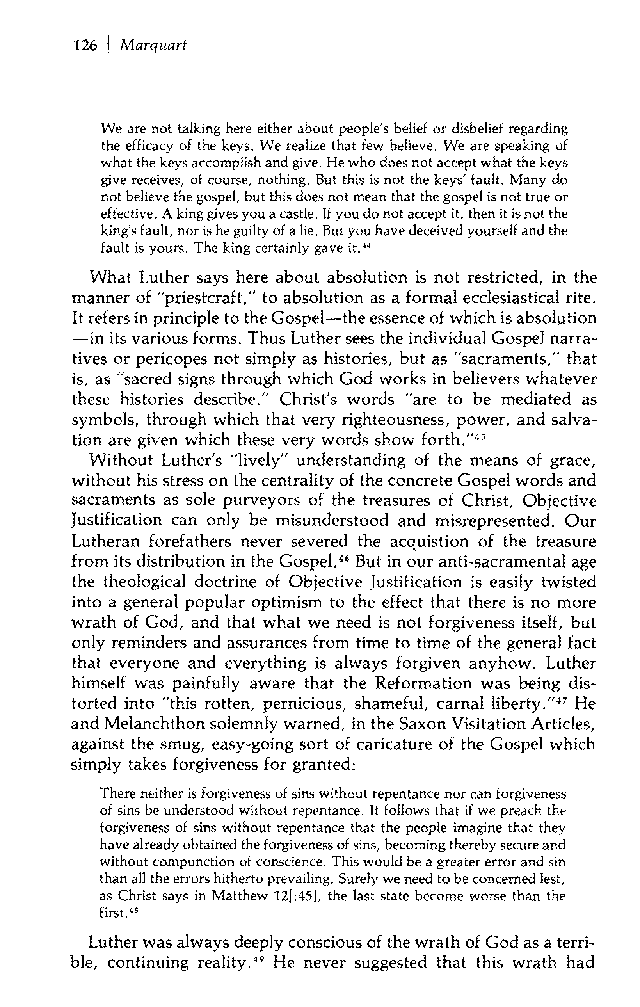
Professor Kurt Marquart

When people mentioned "the Marquart essay," I thought they meant the one given at Trinity LCMS in Bridgeton, Missouri.

Apparently they meant the one in the Preus festschrift, which I have reproduced as PNGs (pings).

Strangely, he went farther than Deutschlander in ascribing UOJ to the Book of Concord, so I can see what his MDiv graduates are so fond of the same absurdities.

Some time ago, LaughQuest tried the Ambrose quotation on their skunk-patch audience. I quoted the passage immediately afterwards, to show how they were deliberately deceiving their readers.

 This is their precious UOJ, copied from the Marquart essay:

Book of Concord, Formula of Concord, Solid Declaration, The Righteousness of Faith:


103] Here and there among the Fathers similar testimonies are extant. For Ambrose says in his letter to a certain Irenaeus: Moreover, the world was subject to Him by the Law for the reason that, according to the command of the Law, all are indicted, and yet, by the works of the Law, no one is justified, i.e., because, by the Law, sin is perceived, but guilt is not discharged. The Law, which made all sinners, seemed to have done injury, but when the Lord Jesus Christ came, He forgave to all sin which no one could avoid, and, by the shedding of His own blood, blotted out the handwriting which was against us. This is what he says in Rom. 5:20: "The Law entered that the offense might abound. But where sin abounded, grace did much more abound." Because after the whole world became subject, He took away the sin of the whole world, as he [John] testified, saying John 1:29: "Behold the Lamb of God, which taketh away the sin of the world."

But they omit, as Marquart did, the section following immediately afterwards.

---


"And on this account let no one boast of works, because no one is justified by his deeds. But he who is righteous has it given him because he was justified after the laver [of Baptism]. Faith, therefore, is that which frees through the blood of Christ, because he is blessed "whose transgression is forgiven, whose sin is covered," Ps. 32:1,104] These are the words of Ambrose, which clearly favor our doctrine; he denies justification to works, and ascribes to faith that it sets us free 105] through the blood of Christ. Let all the Sententiarists, who are adorned with magnificent titles, be collected into one heap. For some are called angelic; others, subtile, and others irrefragable [that is, doctors who cannot err.] When all these have been read and reread, they will not be of as much aid for understanding Paul as is this one passage of Ambrose.

106] To the same effect, Augustine writes many things against the Pelagians. In Of the Spirit and Letter he says: The righteousness of the Law, namely, that he who has fulfilled it shall live in it, is set forth for this reason that when any one has recognized his infirmity he may attain and work the same and live in it, conciliating the Justifier not by his own strength nor by the letter of the Law itself (which cannot be done), but by faith."

Besides this crime of ripping a quotation out of context, they follow the assumptions of Marquart, which contradict the Scripture and baffle anyone not inducted into UOJ thinking.

I kelmed this from Brett Meyer, who kelmed it from the essay. 

“Logically there is here at least the suggestion of a circle: On the one hand forgiveness is the result of faith, and thus comes after faith, and on the other hand it is the object of faith and therefore goes before faith.
One way of resolving the paradox would be to say that by forgiveness as object of faith here is meant not anything actually existing before faith, but simply the principle of how sin is or will be forgiven, namely by grace through faith. Forgiveness then would not in any sense exist before faith. It would occur as soon as faith accepted the principle that forgiveness occurs in this way. Thus, forgiveness as the object of faith would not be anything past or completed, but something essentially future or present. This line of reasoning, however, suggests another "feedback circuit": "I am forgiven when I believe that I am forgiven when I believe that I am forgiven, etc." page 3

Here is another false UOJ statement:
It is very dear here that forgiveness, in the form of the absolution, exists before and independently of faith, and creates or gives birth to it. Forgiveness or absolution (that is, the Gospel itself) creates faith; faith merely receives or accepts forgiveness. Absolution can exist without faith (although its benefits of course go to waste unless faith receives them), but faith cannot exist without absolution. Page 4.


Those statements are apparently the LQ source for saying, "Your faith is in faith." If anyone can follow the twists and turns in those statements, send me a telegram.

The Formula of Concord is lucid. This Marquart essay is opaque, a transparent effort to promote a dogma that gets lamer as time goes by, doubtless because the current crop of Enthusiasts are repeaters of class notes.

Ironically, the festschrift tried so hard to promote UOJ in honor of Robert Preus, but Hardt and Marquart simply revealed how shallow the argumentation is.


They go beyond the clear meaning of Scripture. Marquart definitely gives "forgiveness" the meaning of absolution, the declaration of forgiveness.

The Scriptures and the Confessions can use "forgiveness" in the sense of the atonement, but nowhere is the atonement confused with justification by faith. The two are separate. (The UOJ Enthusiasts scream "Limited Atonement" without a shred of evidence.)

So we have the same word - forgiveness- taken two different ways. One way is the Scriptural and Confessional use - Christ is our righteousness. He has paid for the sins of the world with His death on the cross. That is the Gospel, the reconciliation, the message by which the Holy Spirit plants and sustains faith.

The false and misleading use of forgiveness is a merger of two terms - atonement and justification, making them the same thing - that God declared the entire world forgiven of sin the moment Christ died on the cross, or the moment He rose from the dead.

The Enthusiasts have not decided which Moment of Absolution is true, although they consider themselves to be great experts on the Word.

The current crop of MDivs have no trouble complaining about Luther and Lenski, but they cannot handle their professors being wrong about anything. Watch them go ballistic on their blogs, which prove they can type - but not write.

Finding the furtive UOJ gets increasingly absurd.
Walther has many statements in Law and Gospel that
puncture the extremes of UOJ today.
General Justification - invented.
Objective Justification - invented.
UOJ - invented.


Sodom, Hitler, Stalin, Mao, and everyone who died in the Genesis Flood?
Only in the NNIV, which WELS is still promoting.

---

AC V has left a new comment on your post "Marquart's UOJ Essay in the Robert Preus Festschri...":

Right out of the gate, first paragraph, first sentence, first footnote, I think he's on to something:

The term "objective justification" has only recently come into standard Lutheran usage.1

Footnote:

1. The terminology "objective" and "subjective" here is not altogether happy since "subjective justification...is every whit as objective as objective justification"

Can we agree to consign the terms to a footnote in church history or to the circular file of unfortunate and misleading, if not erroneous theological terminology?

---

AC V has left a new comment on your post "Finding Another Piece of the UOJ Puzzle":

In case you don't understand it, "is not altogether happy" is a euphemism for:

"is a bad idea!"


***


GJ - I caught that, Acey, but we must take into account the lack of reading comprehension among UOJ fanatics. They are so unhappy with the Bible that they need the NNIV porno-mytho-mainline version to certify their false doctrine.

---

Brett Meyer has left a new comment on your post "Finding Another Piece of the UOJ Puzzle":

While reading the Marquart & Co. essay last night it struck me what the UOJ doctrine's object of faith is. It is not Christ and His payment for the sins of the world. It is forgiveness. UOJ's faith is created by and focused on the person's forgiveness, justification and declaration of being righteous. Buchholz and Becker say the same thing, that faith can't be created by a promise but must have something that is already a reality for it to cling to. They reject the promise of the forgiveness of sins in Christ as being a reality. For UOJists it must be the already divinely pronounced absolution that faith can cling to. Marquart speaks of this as forgiveness or justification as the object of faith. This is wrong and leads people to reject the Holy Spirit's faith which does so much, works contrition over sin, causes the individual to die to sin and through faith in Christ rise to life under God's grace - quickening the spirit.

UOJ is a false gospel and the more these guys talk about it the more they expose their errors.

Maybe the Jesuit contingent in the (W)ELS and LCMS will be bold enough to write the official UOJ confession that every layman can read - but they are too afraid to talk about this heinous doctrine openly in their churches.

***

GJ - Brett, they use the straw man fallacy to build their straw palaces, all dedicated to UOJ.


KJV 1 Corinthians 3:12 Now if any man build upon this foundation gold, silver, precious stones, wood, hay,
stubble; 13 Every man's work shall be made manifest: for the day shall declare it, because it shall be
revealed by fire; and the fire shall try every man's work of what sort it is.

Their work will turn to ashes - and much of it has already.


Marquart's UOJ Essay in the Robert Preus Festschrift


AC V has left a new comment on your post "Marquart's UOJ Essay in the Robert Preus Festschri...":

Right out of the gate, first paragraph, first sentence, first footnote, I think he's on to something:

The term "objective justification" has only recently come into standard Lutheran usage.1

Footnote:

1. The terminology "objective" and "subjective" here is not altogether happy since "subjective justification...is every whit as objective as objective justification"

Can we agree to consign the terms to a footnote in church history or to the circular file of unfortunate and misleading, if not erroneous theological terminology?

---

AC V has left a new comment on your post "Finding Another Piece of the UOJ Puzzle":

In case you don't understand it, "is not altogether happy" is a euphemism for:

"is a bad idea!"

Sunday, April 1, 2012

Transferring the Sexually Abusive Church Workers.
LCMS, WELS, ELS, ELCA, CLC (sic)

Lutherans need to clean up their own habits.


bruce-church (https://bruce-church.myopenid.com/) has left a new comment on your post "Lake George pastor’s bail set at $1 million in sex...":

LCMS hierarchy pretends its Catholic, and transfers around pedophile:

http://steadfastlutherans.org/?p=18016 

---
Steadfast

Recently in the same circuit as my first call there has been a horrible set of news.  One of the men who shepherded congregations (he is a lay minister only but was allowed to and acted fully as a pastor) was brought up on charges for felony criminal sexual conduct with a minor.  In a small town, and in a rural community this sends ripples across the whole region.
But this is not just a story about a man who has fallen into great sin right now because this is not the first time this man has been in this situation.  The news story linked below reports that this man, who is still on the LCMS roster, had first been convicted of sex crimes against a minor in 1983 when he as a Lutheran principal had a three year sexual relationship that began with a 10 year old child at the school he oversaw.  He was convicted for this.
Here is the story (or at least half of it, the second half will be coming out on Wednesday).
Now some questions -
How did this man become a “lay minister”? His record shows that in 1989 he graduated from Mequon.  How was this even possible to go through the lay ministry program there with such a past?
Did the various District Presidents (1983 Minnesota South; 1989 South Wisconsin; 1989 Minnesota North) know this?  If so, how did the various District Presidents allow this to happen?  Were none of those men concerned with this man having access to children again and again in ministry situations (a position of trust)?  If they did not know, how could this happen, what level in the certification/placement/call process needs to be changed to make sure that men that are not above reproach are not put into congregations?
What sort of things can be done SYNODWIDE to find out if there are more of these men (and women in the case of teachers) serving in situations where sheep are vulnerable to their abusive behavior?  What would need to happen for a SYNODWIDE background check for each worker?
As we saw the Roman Catholics suffer dearly for their cover-ups of these kind of situations, is there a way in which we can SYNODWIDE show due diligence to correct this situation, make those who are responsible take their responsibility, and prevent future occurrences?

There is something horribly wrong with the lack of oversight (or perhaps willful negligence) in this case which allowed a man who had raped a ten year old for three years and was convicted to become in all functional reality a pastor serving congregations.
We will have to wait for the second half of the article to come out on Wednesday, but my hope is that those people who may be guilty of such negligence would be considering their role in this horrific act and now crippling blow to congregations that this man served (not to mention the victim and family).

Now here is my suggestion:
Pray for the people involved in this: the victim and family of the victim; for Mr. Schauer and his family; for Trinity Lutheran, Lake George; for Immanuel Lutheran, Cass Lake; for Immanuel Lutheran, Courtland; for the Minnesota North District and the Bemidji Circuit; for the pastors involved in caring for wounded and wronged sheep; for Synodical officials who have to deal with this with integrity and compassion.

***

GJ - Nicollet County. I know of another case like that. People should ask Steve Kurtzahn about how the CLC (sic) handled incest.

WELS members and pastors have told me about numerous homosexuals ordained and moved around the synod. The Michigan District of WELS only had problems with clergy adultery when people knew the truth - then the praesidium took their revenge against the innocent while protecting the guilty.

What did WELS do when Joel Hochmuth confessed earlier to dealing in heinous homosexual man-boy porn? They did nothing, then professed shock that the FBI showed up at The Love Shack, shock that their Director of Communications was a multiple-felon. But they immediately pronounced his forgiveness, just before he pleaded innocent. UOJ.

Missouri and ELCA have long histories of doing the same.

Why is so little done? When I mentioned the $40 million lawsuit that ELCA lost, because they ordained a known homosexual predator, Paul McCain's expert theologian began yelping that he knew nothing of it, etc etc.

That is a typical reaction, which is used to keep anything from happening, even when it is known and recorded in the official magazine of ELCA.

PS - The solution is to contact an attorney and SNAP and sue the synod leaders until they wise up. They did not even begin to weed out the criminals until the lawsuit costs piled up.

Lutheran Theological Southern Seminary // News.
Merger, the First of Many More

Merger Signing Ceremony - March 26, 2012

Lutheran Theological Southern Seminary // News:


United We Stand
March 26, 2012
The Win-Win Merger of a South Carolina Seminary and a North Carolina University
Hickory, N.C. – This is the story of two great institutions building a partnership that is being watched around the country. One is a surprisingly ecumenical seminary preparing mostly Lutheran – but also Baptist, Methodist, AME and Episcopal – ministers on its Main Street campus in Columbia, SC. The other, 140 miles north, is a rising university in Hickory, North Carolina.

Come July 1, Lutheran Theological Southern Seminary (LTSS) will officially join forces with Lenoir-Rhyne University in what some say is a "game-changing" merger between the two. Both are affiliated with the Evangelical Lutheran Church in America (ELCA), and both have deep roots in the Carolinas.

Through this merger, LTSS will become part of the School of Theology of Lenoir-Rhyne University, but will maintain its historical identity and location in Columbia, SC.  This is the first such marriage among the 26 colleges/universities and eight seminaries of the ELCA.

Of the two institutions, LTSS is the elder sibling. Established in 1830, the seminary is a survivor. It has outlasted the Civil War, the Depression, two world wars, and countless sink-or-swim moments. Lenoir-Rhyne, by comparison, is the youthful upstart. It was founded in 1891 as Highland College, soon became Lenoir College, then Lenoir-Rhyne College and finally in 2008 rose up to become a full-fledged university.

This summer, the two will unite to create an unparalleled force in Carolina higher education. "This merger shows the kind of trust that developed among the leaders of each institution," explains the Rev. Dr. Marcus J. Miller, President of LTSS. "Before, we had compatible missions. Going forward, we have the promise of a vibrant, singular mission. That's powerful."

L-R President Wayne Powell calls the merger "a win-win for both institutions. As one university, we will be both broader and deeper, and that makes it a win for students, faculty, and alumni as well."

Broader and deeper, yes, and also potentially bigger. For the current year, LTSS enrolls some 150 students compared to L-R's 1,861 undergraduates and graduate students.  Add additional students from the new Center for Graduate Studies of Asheville that Lenoir-Rhyne is set to launch this fall, and university enrollment is poised to rise significantly. Altogether, the three campuses of Lenoir-Rhyne University will yield an enrollment over 2,000, with plenty of growth potential in coming years.

The LTSS and L-R merger is expected to be a key driver. "LTSS and Lenoir-Rhyne have similar missions but unique strengths," Dr. Powell explains. "For the university, the seminary expands our offerings in theological education and extends our geographic reach. For the seminary, Lenoir-Rhyne offers economies of scale in everything from IT costs to student support services. Plus, our undergraduate population provides a natural pipeline of students for the seminary."

Powell expects synergies between the two components of the expanded university to fuel not only growth, but innovation. "What can the seminary offer to help undergraduates explore vocations in ministry?" he asks. "How can our business programs prepare future ministers for the managerial roles they will hold in churches?"

L-R Provost Dr. Larry Hall and LTSS Academic Dean Rev. Dr. Ginger Barfield are working on the answers. "We live in a world where the traditional boundaries that separate things are blurring," Dr. Hall notes. "Today, preparing for ministry isn't just about theology. It's also about psychology, economics, and world history. And take business majors – where do they develop the ethical and spiritual dimensions so desperately needed in business leaders?"

"That," Dr. Barfield adds, "is where the synergy, the opportunity, comes in. I expect to see the seminary and the university develop new, cross-disciplinary ways of educating students – one that works in Hickory, in Columbia, and around the world. As a liberal arts university, this is exactly the way we should be thinking and how we should be preparing students.

Church leaders also see the merger as a win-win for the denomination. The Rev. Mark T. Hanson, Presiding Bishop of the ELCA, points out that "both institutions will be enriched with a greater diversity and an increased capacity to serve both church and society."

The Rev. Dr. William B. Trexler, LTSS Board Chair, agrees, pointing out that "Lenoir-Rhyne and Southern already share core Lutheran values, which the merger will simply reinforce. Significant financial savings are already resulting from sharing administrative costs and consolidating redundant services."

"The merger is just more evidence that Lenoir-Rhyne isn't a place that makes empty promises, says Rachel Nichols, L-R Vice President of Enrollment Management. "Five years ago, this North Carolina college began talking about itself as a "rising university" and challenging its students, faculty, and staff to 'rise up.'"

"Well, we're doing it. We're rising up. We've added academic programs and athletic programs. We're building a new chapel and a science center. We're starting the graduate center in Asheville," she enumerates. "Now, with this merger, we're adding a School of Theology and a seminary in Columbia."

As for the future? Charles Snipes, Chair L-R Board of Trustees, is optimistic. "As we continue to rise up, Lenoir-Rhyne will be one of the great success stories for higher education – and theological education – in the 21st century."

'via Blog this'

The Quest for the Historical UOJ


Rolf Preus:
You are not at liberty to change the meaning of terms to suit yourself. The correct understanding of objective justification is what we all have been saying.

***

GJ - I love reading the encyclicals from the Pontifical Institute (aka LaughQuest).

General Justification, Objective Justification, Subjective Justification, and Universal Objective Justification are all non-Biblical terms - invented long after the Book of Concord and foreign to Lutheran Orthodoxy.

In fact, the first bloop of UOJ--from Samuel Huber--was repudiated by Polykarp Leyser, an editor of the Book of Concord and the biographer of Martin Chemnitz.

The next citation I have, using the term General Justification is from the Pietist Burk. Hoenecke, who graduated from Halle University (under Tholuck) quoted Burk in his Dogmatik.

After that, I have a quotation from the Calvinist translation of George Christian Knapp, the Halle University Pietist, famous as the last of the old Pietists. That quotation uses the double justification so dear to Synodical Conference hearts.

The UOJ Stormtroopers contradict themselves so often that I have not figured out their definition or their dogma.

Was everyone absolved the moment Christ died or the moment He rose from the dead? Something so important should be noted somewhere in the Bible.

Is everyone in the world forgiven before birth, as several authors claim? For all time?

Are Hitler, Stalin, and the Sodomites all guilt-free saints?

Does LaughQuest agree with Leyser or label him a false teacher?

Please Read the Formula of Concord and Get Back To Us.
Formula of Concord - The Righteousness of Faith.


AC V has left a new comment on your post "David Jay Webber, MDiv, Misleading the LaughQuest ...":

DJ Webber on LaughQuest: "The theological truth of objective justification is implicit in the phrase "justification by faith." If humanity's justification in Christ were not in some sense an objective fact that is offered in the means of grace, so as to be an object of faith, then the most that we could say is that Christians are justified in faith. Those who deny the objective side of justification turn justification in its entirety into something that is brought into existence in the act of faith, rather than seeing justification as something that is received by faith."

The problem, Rev. Webber, is that because of the "OJ/SJ" division of categories, you are forced to put faith into the "subjective" category and thereby make faith not something God does to and for me (objective), but something "I" do of and by myself.

Everything about Justification is objective, even faith. I don't work faith from within myself, God gives it from outside of and for me.

See again the Formula of Concord Solid Declaration III:25 for Confessional support that faith is necessary to the definition of Justification. When you take faith out of "Objective Justification" and put it into the so-called "Subjective Justification" category you thereby create two Justifications, a concept foreign to the Scriptures and the Confessions.

---
Book of Concord, Formula of Concord,
III, The Righteousness of Faith

25] For not everything that belongs to conversion belongs likewise to the article of justification, in and to which belong and are necessary only the grace of God, the merit of Christ, and faith, which receives this in the promise of the Gospel, whereby the righteousness of Christ is imputed to us, whence we receive and have forgiveness of sins, reconciliation with God, sonship, and heirship of eternal life.

26] Therefore true, saving faith is not in those who are without contrition and sorrow, and have a wicked purpose to remain and persevere in sins; but true contrition precedes, and genuine faith is in or with true repentance [justifying faith is in those who repent truly, not feignedly].

---

AC V has left a new comment on your post "Please Read the Formula of Concord and Get Back To...":

Cf. also Knapp's definition of OJ/SJ, namely: "subjective is the act of man"


How can Jay Webber criticize Church Growth
when he advocates the same false doctrine as Knapp and Valleskey?

I endorse this statement.
But how many millions of dollars have been drained
from synod offerings to fund Fuller foolishness?

---

LPC has left a new comment on your post "Please Read the Formula of Concord and Get Back To...":

His statement rather than seeing justification as something that is received by faith."

says that he does not agree with Luther who said that faith itself is justification. The statement also says he does not accept that man is justified by faith alone.

Also the statement then the most that we could say is that Christians are justified in faith is a fallacy, tertium non datur; the favorite fallacy of UOJers.

JBFA is clearly taught in John 3:16, the one who believes in Christ (present tense) does not perish but has everlasting life. Or to put it another sense, man has eternal life (salvation) through faith in Christ.

---

Brett Meyer has left a new comment on your post "Please Read the Formula of Concord and Get Back To...":

It's also important to see how (W)ELS Pastor David Jay Webber exposes the true object of UOJ's withered hand of faith - it is man's justification. Buchholz, Zarling, Becker and the rest of the UOJists teach this also.

Webber states, "If humanity's justification in Christ were not in some sense an objective fact that is offered in the means of grace, so as to be an object of faith"

The object of the Holy Spirit's faith, Christ's righteousness, worked graciously and solely in men through the Means of Grace is in Christ and Him crucified for the payment of sins. UOJ declares anathema on this and states their faith can only be created and can only cling to forgiveness declared and distributed prior to faith. The nail in their coffin is that they say faith cannot cling to or be created by something that hasn't already happened - asserting again that UOJ's faith is in their justification and righteousness already being delcared by God before they believed and not in Christ.

Oh, the contradictions and blasphemies the spew forth from the unholy birth and nurture of UOJ!

Keep the UOJists talking and they skewer themselves on Scripture and the Lutheran Confessions.

Palm Sunday, 2012


Palm Sunday, The Sixth Sunday in Lent, 2012


Pastor Gregory L. Jackson


Bethany Lutheran Church, 10 AM Central Time


The Hymn #160       All Glory, Laud                      4:49 
The Confession of Sins
The Absolution
The Introit p. 16
The Gloria Patri
The Kyrie p. 17
The Gloria in Excelsis
The Salutation and Collect p. 19
The Epistle and Gradual        
The Gospel              
Glory be to Thee, O Lord!
Praise be to Thee, O Christ!
The Nicene Creed p. 22
The Sermon Hymn # 162               Ride On                     4:80 

Messianic Hymn


The Communion Hymn # 42        O Thou Love             4:93
The Preface p. 24
The Sanctus p. 26
The Lord's Prayer p. 27
The Words of Institution
The Agnus Dei p. 28
The Nunc Dimittis p. 29
The Benediction p. 31
The Hymn # 388                  Just As I Am                          4:91

KJV Philippians 2:5 Let this mind be in you, which was also in Christ Jesus: 6 Who, being in the form of God, thought it not robbery to be equal with God: 7 But made himself of no reputation, and took upon him the form of a servant, and was made in the likeness of men: 8 And being found in fashion as a man, he humbled himself, and became obedient unto death, even the death of the cross. 9 Wherefore God also hath highly exalted him, and given him a name which is above every name: 10 That at the name of Jesus every knee should bow, of things in heaven, and things in earth, and things under the earth; 11 And that every tongue should confess that Jesus Christ is Lord, to the glory of God the Father.

KJV Matthew 21:1 And when they drew nigh unto Jerusalem, and were come to Bethphage, unto the mount of Olives, then sent Jesus two disciples, 2 Saying unto them, Go into the village over against you, and straightway ye shall find an ass tied, and a colt with her: loose them, and bring them unto me. 3 And if any man say ought unto you, ye shall say, The Lord hath need of them; and straightway he will send them. 4 All this was done, that it might be fulfilled which was spoken by the prophet, saying, 5 Tell ye the daughter of Sion, Behold, thy King cometh unto thee, meek, and sitting upon an ass, and a colt the foal of an ass. 6 And the disciples went, and did as Jesus commanded them, 7 And brought the ass, and the colt, and put on them their clothes, and they set him thereon. 8 And a very great multitude spread their garments in the way; others cut down branches from the trees, and strawed them in the way. 9 And the multitudes that went before, and that followed, cried, saying, Hosanna to the Son of David: Blessed is he that cometh in the name of the Lord; Hosanna in the highest.

Palm Sunday

Almighty and everlasting God, who hast caused Thy beloved Son to take our nature upon Himself, that He might give all mankind the example of humility and suffer death upon the cross for our sins: Mercifully grant us a believing knowledge of this, and that, following the example of His patience, we may be made partakers of the benefits of His sacred passion and death, through the same, Thy beloved Son, Jesus Christ, our Lord, who liveth and reigneth with Thee and the Holy Ghost, one true God, world without end. Amen.


Messianic Hymn

Christ Jesus Who, being in the form of God,
thought it not robbery to be equal with God:
7 But made himself of no reputation,
and took upon him the form of a servant,
and was made in the likeness of men:
8 And being found in fashion as a man,
he humbled himself,
and became obedient unto death,
even the death of the cross.

9 Wherefore God also hath highly exalted him,
and given him a name which is above every name:
10 That at the name of Jesus every knee should bow,
of things in heaven, and things in earth, and things under the earth;
11 And that every tongue should confess
that Jesus Christ is Lord, to the glory of God the Father.

The Epistle matches the Gospel, reflecting the lesson of Holy Week.

Philippians 2:6 Christ Jesus Who, being in the form of God,
thought it not robbery to be equal with God:

The episode at Bethany is crucial to the events of Holy Week. Jesus learned that His good friend was mortally ill, but He delayed His trip to Bethany on purpose. The sisters of Lazarus sent a message to Him that Lazarus was sick. Jesus knew that His good friend was not merely sick, but dead. He delayed His trip so that Lazarus was dead for four days when they arrived.

The tensions were so great, after three years of public ministry, that doubting Thomas thought they would all die in traveling so close to Jerusalem.

KJV John 11:16 Then said Thomas, which is called Didymus, unto his fellowdisciples, Let us also go, that we may die with him (Lazarus.)

At Bethany Jesus raised Lazarus from the dead by calling Him from the tomb. Lazarus emerged covered in his burial cloths.

This caused a sensation in the whole region for many reasons. Lazarus was wealthy, which we know from his carved tomb. He was necessarily prominent, so his extended family and friends were witnesses to his rising from the dead. They were still at the funeral.

Assuming travel between Bethany and Jerusalem, and the normal exchange of news, the people of Jerusalem would also have found out about this miracle. First a prominent man was known to be dead and buried for days. Then he was raised from the dead by Jesus.

That means the crowd from the funeral of Lazarus followed Jesus to Jerusalem, with Lazarus prominent in the company.

Those who found out about the rising of Lazarus came out of the city to meet him and Jesus. Therefore crowds followed Jesus and came out of the city, forming an enormous circle of shouting, Hosanna crying people.

Only God could raise someone from the dead. Some might say, “But there were two others.” And there were. One was a widow’s son, so that must have been well known or rumored at least. The other was the little girl, whose funeral was interrupted by Jesus bringing her back to life. “Little girl, I say, arise.”

Notice in both cases that Jesus overcame death with His Word. God always works with His Word. One might speculate about God acting otherwise, which is possible, but Jesus chose to do His work through the Word, just as God bound His Word to His Spirit.

That is an important corrective against all false religion. They identify this and that as coming from God, but always without His Word and against His Word.

So Jesus displayed Himself as the Son of God, beyond all doubting, before He entered Jerusalem. The crowds and the opponents knew it. The children caught the excitement and hope of the moment and joined in praising God, because children have faith too. They have child-like faith, the kind Jesus commended to the frowning and rationalistic adults.

"Learn then from this Gospel what takes place when God begins to make us godly, and what the first step is in becoming godly.  There is no other beginning than that your king comes to you and begins to work in you.  It is done in this way:  The Gospel must be the first, this must be preached and heard.  In it you hear and learn how all your works count for nothing before God and that everything is sinful that you work and do.  Your king must first be in you and rule you.  Behold, here is the beginning of your salvation; you relinquish your works and despair of yourself, because you hear and see that all you do is sin and amounts to nothing, as the Gospel tells you, and you receive your king in faith, cling to him, implore his grace and find consolation in his mercy alone."
            Sermons of Martin Luther, 8 vols., ed., John Nicholas Lenker, Grand Rapids:  Baker Book House, 1983, I,  p. 26.   


Lenski:

Yet, although so much is involved, the fact remains that the Scriptures freely name the person, at one time only as a person, at another according to his office, at another according to one, again according to the other and even according to both natures and, no matter how it is named, predicate of this person something that is native to the one or to the other or also to both of his natures. Knowing this, we might pass on without further concern when Paul writes “Christ Jesus” (office, person), for this name certainly befits all that is predicated of him. The issue is raised by the Kenoticists and by those related to them. They empty out more or less of the logos, of his divine nature, plus also every divine gift bestowed on Christ’s human nature. Their first statement is that here “Christ Jesus” = the logos before he became flesh. The confessional church emphatically rejects this demand because this demand would contradict all that Paul here says of “Jesus Christ.”
The subject of all that follows in v. 6–11 is “Jesus Christ.” This whole section is one connected sentence. This is Paul’s great passage on the humiliation and the exaltation of Christ, on these two states. Both deal with Christ’s human nature, here and everywhere in Scripture where either the humiliation or the exaltation or both are mentioned. The divine nature can undergo neither humiliation nor exaltation, it is immutable.
                Lenski, R. C. H.: The Interpretation of St. Paul's Epistles to the Galatians, to the Ephesians and to the Philippians. Columbus, O. : Lutheran Book Concern, 1937, S. 773.

7 But made himself of no reputation,
and took upon him the form of a servant,
and was made in the likeness of men:

When Jesus entered Jersalem as the Messiah, the Son of God, He deliberately kept His divine nature from being prominent. Except for healing the servant’s ear (at His arrest) and cursing the fig tree, He did not show His divine nature.

Instead, He allowed Himself to be treated as an ordinary human. The Roman and Jewish opponents hated and feared Him, but they also delighted in capturing, torturing, and destroying Him – exalting in their victory.

He should have shown His divine majesty, but He did not. His opponent were overjoyed that all those reports were wrong. They were the powerful ones. They took away everything with guile, deceit, and power.

Almost all of Jesus public ministry was in the form of a lowly servant. He traveled by foot, ate food, became thirsty, was angry and happy, sorrowful, and grieving.

He told them He could use His divine majesty to summon legions of angels, but He did not. Therefore, He allowed Himself to be seen in the form of a servant.

Luther’s point about Holy Week is that Jesus gave up everything to become our Savior. He left the heavenly abode to live among men, to teach them and perform miracles, to show them true righteousness, through faith in Him. For this He was scorned, mocked, beaten, and given the worst form of execution devised by man.

8 And being found in fashion as a man,
he humbled himself,
and became obedient unto death,
even the death of the cross.


Jesus became poor to make the wealth of the Gospel available to the entire world, training apostles that would take the saving Word to the corners of the Roman Empire. America was discovered by the Chinese 600 years ago (http://www.1421.tv) and by Columbus 500 years ago. And yet it only took 300 years for the Gospel to travel from the dregs of Roman society to Constantine, one of the great politicians and military heroes of Roman history. (He was not the best family man.)

Ministers like to complain about this and that, about various hardships and bad treatment. Some of it comes from human institutions. A lot of it comes from resistance to the Word of God. The greatest resistance met the Word of God Incarnate, because He truly bore the cross as the Suffering Servant, executed with criminals, almost alone. The rest of us see some form of bearing the cross, which wakes up the Old Adam to complain, worry, and fret. Why do the apostates do so well? Because their time of pleasure is short, the penalty phase endless.

The ultimate battle was fought and won by Christ. The forces against the Gospel have never rested. They give the Gospel no peace. There is endless hatred poured out against the Christian faith today. I see it on atheist forums and Internet posts. Any unbeliever is condemned by the Holy Spirit and feels the wrath of God against that unbelief. For some, the constant agitation is good, because it awakens them to study the Word, often to prove it wrong, and they are converted to faith in the Gospel. For others, this agitation makes them angrier all the time, and they become progressively more hardened and blind.

As someone said recently, when we discussed justification by faith, we are always in danger of falling into apathy and sins that remove us from the Gospel. The Means of Grace remove the power of sin, even though temptations remain, and give us the energy to remain in the fold as followers of the Good Shepherd. His loving and gathering Spirit is expressed in the Word, in hundreds of ways.


9 Wherefore God also hath highly exalted him,
and given him a name which is above every name:
10 That at the name of Jesus every knee should bow,
of things in heaven, and things in earth, and things under the earth;
11 And that every tongue should confess
that Jesus Christ is Lord, to the glory of God the Father.

Because Jesus was willing to be abased and humiliated for the sake of salvation, God has exalted Him about all others. No one is compared to Jesus because He did all to rescue us from Satan’s grasp.

When the final revelation is given, every single creature will bow to His Name – the heavenly beings, all human races, and the devils of Hell. Those without faith will still acknowledge what they rejected, because Jesus will be shown to them also as the King of King and Lord of Lords. For them it will be too late.

I read about and know about famous ministers who have started in some form of the Gospel – all denominations included – and became atheists over time. How do we know? By their public proclamation, by bragging about their newfound unbelief. One was the founder of the Jesus Seminar, which was famous for rejecting the Gospel. Another was a co-worker of Billy Graham and a fellow evangelist to boot. Others were Lutheran ministers I knew, ministers whose work as radicals was highly praised by synodical leaders. One day they will know again what they rejected – that Jesus in the Savior and that faith in Him receives forgiveness and everlasting life.

"For you do not find Him; He finds you.  For the preachers come from Him, not from you.  Your faith comes from Him, not from you.  And everything that works faith within you comes from Him, not from you."
            What Luther Says, An Anthology, 3 vols., ed., Ewald Plass, St. Louis:  Concordia Publishing House, 1959, I, p. 345. Matthew 21:1‑9.