Showing posts with label starlings. Show all posts

Friday, February 28, 2020

For the Birds - In the Creation Garden

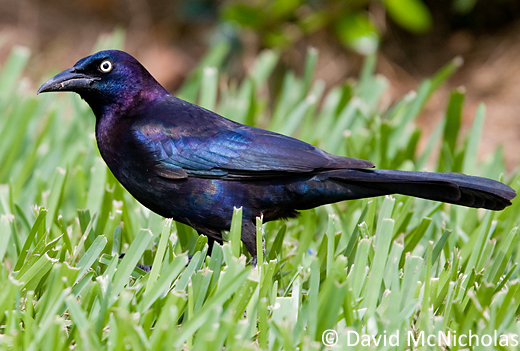
 Grackles are great at poking their beaks down for grubs in the soil. 

Sassy and I have an agreement. She loves fresh Moist and Meaty food, which is individually packed, and I like cheap birdfood. She wants it fresh each day and not mixed with the older stuff. Just as kids judge ice cream by the color, dogs judge their food by the stink.

So I took a page from Lynda R.'s bird rescue book and put old dogfood out each day, to start fresh for Sassy. She is not subtle. She sits down with one paw on each side of the dish. If she is not in that position, I ask what she wants. She offers me a long, slow, dramatic licking of her chops.

The stale dogfood is now a regular part of the decoration on the two garbage barrels. One is for recycling, the other for typical garbage. The lids are convenient for birds and squirrels, and two separate mealsites.

My most dramatic sight was a bunch of crows (maybe ravens) on the barrels, only a few feet from the kitchen window. They were majestic in size, solid black. I have never seen that branch of the smart, wiley corvid clan so close to me. (They were eating leftover panera bread.) Grackles, yes. Starlings, always. In Midland the crows would leave the ground in the backyard the moment I turned on water in the kitchen.

Needless to say, I was impressed. Likely the cold morning frost made fresh bread seem especially appealing to the crows.

Normally I am seeing squirrels, robins, starlings, cardinals, and snowbirds on the barrels. Starlings own the neighborhood trees, so they are most frequent and fun. One will be eating and his friend will walk over and shoulder him away. So he flies up and lands on the other barrel and stalks some food. They are a riot bathing.

 Starlings really live it up when bathing. I keep two children's pools for all the critters, who add their dust and manure to pour into the back garden.

Monday, October 31, 2016

The Starlings Are Back


The weather seemed to be turning wintry some time ago, so I put six pounds of suet in two baskets, for the birds that thrive on bugs - especially the Starlings. Chickadees and the Woodpecker family also like suet. The suet remains.

Yesterday I heard and saw a flock of Starlings high in the trees during the morning walk with Sassy. I have not seen them in the yard. They were making the rounds, since they took off as a group. Today I will put fresh water in all the birdbaths, because the dry weather has to make them relatively short of bathing and drinking water. Starlings really make a fuss in the water, which attracts more creatures to the scene.

People hate Starlings for what the Creator designed them to be - smart, social, and voracious eaters. But we discount whatever is plentiful, until we notice a shortage of what we once took for granted. Starlings arrive in flocks and seem to dominate, but I wonder about the claim that they "drive out native species." That is like saying, "The squirrels eat all the bird-food." On a given day, many bird species eat, and the squirrels take their turn. A squirrel will bat the birds away, just as we swat at flies, but the birds wait in the trees and bushes for their turn.

The Starlings decide to eat from someone's lawn, and they gather in the normal pattern. One scout bird lands. Next a few more join the scout. Soon the entire flock is on the ground, engaged in eating. But if the scout bird rises to the air in alarm, the entire flock takes off.

Starlings never seem to stop foraging. When I first discovered mulch, I noticed how they marched through the garden, flipping grass-leaf mulch over to expose the bugs enjoying the shade or feeding from decomposition.

Their larger cousins, the Grackles, are often around Starlings. The Grackles are even better at spearing the ground for grubs.


Monday, July 28, 2014

Exotics Can Be Found in Our Own Backyards - But We Take Them for Granted

Have you seen a murmuration of starlings,
where they weave patterns in the sky by constantly changing group flight patterns?
We watched during a church picnic, transfixed by the ever-changing shapes created.


I lost track of the Facebook page on jeweled spiders from Australia, with some remarkable photos in the article.

I decided to Google the images and could not find anything close to the article, so I wondered if it was a hoax. I could find the category and examples, but they did not look like walking stained glass windows - except for the one photo of a jewelry case in the shape of a spider.

Nothing would surprise me about exotic animals, especially those in Australia, where they seem to be larger, more colorful, and more dangerous than anywhere else except Africa. They even have giant earthworms in Australia.

Everyone loves the Sassy grin.


Sassy is learning her Australian culture, since she is half Australian Cattle Dog, bred from the tough little dingo wild dog of that continent. We sing Waltzing Matilda and the Cattle Dog Blues in the car. That proved useful when we were waiting for tires at Goodyear. Two customers became very interested in her behavior and three legs, so we sang the Cattle Dog Blues, with Sassy howling the chorus. They loved it so much that Sassy pawed my leg to get the second verse going, where she howled again. She loves attention. The customers wrote down the Sassy blog's name so they could look it up later.

When she begins yipping in a high-pitched voice, we chide her about "going full Kelpie." That is another name for the Cattle Dog - Kelpie. When she hears that Kelpie name, she really sounds off.

She used that call to get the Helper family out of their house. Mrs. Helper asks for the happy bark when we stop by. Sassy responds with her German Shepherd voice, a very loud but lower pitched bark, sent left and right for full coverage. "There's that happy bark!" And she barks some more. In contrast, the Kelpie yip is high pitched and penetrating, one sharp warning or alert.

She yips if anyone tries to pick her up or comes close to stepping on her. She is especially sensitive because of her amputation and recuperation, but she is also quite the drama queen.

She is one of those homegrown exotics that people often overlook. Sassy is unusually smart and independent, cleverly working on us to understand her way of doing things. I asked her to move over on the bed, so she rolled over for loveys. If Mrs. Ichabod does not join in pettting her, Sassy looks back to get a second person petting her at the same time. She grins about this because her independent actions make us laugh each time.

Butterfly Weed is related to Milkweed, named Asclepias for the healing properties of this family.

I am hoping that Butterfly Weed will grow in my yard. I planted some along the fence. In time they should show themselves. The attracts butterflies in general but also helps other plants - a companion plant.

Once upon a time Milkweed was common, and so were Monarch butterflies. Now people are wishing for more butterflies and worry about the loss of the Monarch.

I think I spotted some local Milkweed on my walk. A stand of them would support some Monarch caterpillars, but I doubt one plant in the sidewalk crack will do it.


Here the Monarch, in his jade coffin with golden nails. The wing markings are visible. Shortly before he was a fat caterpillar with none of this coloring - no gold frills. I am not going to get jeweled spiders in my yard, but I can raise these and even hatch them in a glass jar, as I did years ago in New Ulm.

No one is sure if the golden nails have a function. I consider it showboating by the Creator. If you ever doubt the power of the Creating Word, look at what He does with with a homely caterpillar that dines on milkweed sap.