Showing posts with label earthworms. Show all posts

Wednesday, October 25, 2017

Australian woman captures picture of enormous 2ft earthworm driven above ground by heavy rains


Australian woman captures picture of enormous 2ft earthworm driven above ground by heavy rains:


This is a mechanical earthworm,
very expensive and not easy to re-cycle.

"An Australian woman discovered a gigantic 2ft earthworm after it was driven above ground by torrential rains.

Kelli Mace posted a photo on Facebook of her holding the huge creature with two sticks after it emerged from the earth around Tamborine Mountain, Queensland, and it was soon picked up by Australian news outlets.

The area, which is covered in rain forest, is known for the massive species of worm, known as Digaster longmani, and which can grow up to 3ft long.

Paid content"

Supposedly they can grow to four feet,
the largest earthworm known.


'via Blog this'

Monday, August 22, 2016

Holy Moly - Creation Distribution and Recycling

 "Holy Moly, what a savings account.
I have 1,200 earthworms tucked away!"
The Michigander reported that a man was digging in his front yard to find a water turn-off valve. The owner asked, "Did you find any earthworms?"

The man answered, "Millions."

The Michigander followed my advice to buy red wiggler earthworms from Uncle Jim's and scatter them on the surface of the soil, last year and this spring. He attributes lush growth in the yard to the work of the earthworms, who never stop, multiply on their own - all for a small, one-time fee.

My neighbor thinks it is too cold for red wigglers and we have hardly any winter. Michigan has real winters and the red wigglers are thriving there. The genius of earthworm engineering allows the egg capsules to wait out bad weather, cold or dry, and hatch later. If all the adults died, which is unlikely, the eggs will hatch when the time is right. Four to six baby worms emerge and reach adulthood in about two months.

I found this quotation intriguing:
Insects are undoubtedly mole nutritive staples, but they're not actually their first priority. Large earthworms are actually what moles generally like to eat the most. Moles consider earthworms to be so valuable they regularly stash them away for later consumption. If they have an earthworm surplus, they tuck them away inside designated safekeeping units. One researcher found a unit consisting of more than 1,200 earthworms. The unit also housed several grubs.

The mole who stores a vast collection of earthworms and grubs is also distributing a large collection of useful nitrogen and other organic chemicals for plants. If he eats them all, they become part of the soil eventually. Otherwise, the earthworms are going to give off some egg capsules before they become food or fertilizer.

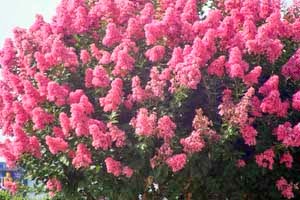
The base of the Crepe Myrtle show off its
dried, pruned flowers (John 15).
When I find rotten wood on our Sassy-walks,
the new additions go on to
p.


The places cleansed of earthworms will repopulate quickly enough. Depending on how rich and well watered the soil is, the earthworm population can only reach a certain population density. Our mole cleaned the entire area under the Crepe Myrtle bush - an object of awe and wonder in our neighborhood. I keep renewing the organic food under the plant and doubtless a hearty earthworm population has returned in force.

I cut all the blooms from the lower half
and placed them underneath for added mulch.
The lower half has already re-bloomed completely.


We had soil, rabbit manure, and earthworms under rabbit cages, and that meant teeming balls of earthworms, all well fed on high nitrogen waste. That population was much denser because of the food, moisture, and soil. We kept some in each kiddie pool when we emptied the container of earthworm packed soil. At some point the worms could not keep up with the rabbits' output, so thousands of packed wiggling earthworms were put into the garden. With new fresh soil, the population exploded again and again. The garden in Midland was quite rich from Rabbit-Gro (TM). The Silver Queen corn patch, started on top of a deep compost pit, was especially productive and healthy.

Our helper planted these red and white Calladiums in the shade of the maple.
Roses also bloom under the heavily pruned maple tree.
We try to keep up with trash trees and bushes that spring up,
but the Hog Weed (upper right) is tolerated
for its ability to fix nitrogen.


Saturday, June 11, 2016

Next Best - Stored Water. Plus Bacteria and Fixing Nitrogen


I knew my mother's secret for having the best houseplants at Garfield Elementary School. She filled her watering container early, let it evaporate out the chlorine, and then used it. No other teacher had so many flowers in their classroom.

She told me about it with a big smile - "Give it at least 24 hours. Flowers do not like chlorine." Later, when I bought her bare-root roses to grow in St. Louis, she ended up with the best ones in the condo area, and people asked her how she did it. She said, "I grew up on a farm."

Now that regular rains have departed, and the rain-barrels are empty, I have done the same to build up a supply of stored water. When I was done with some routine watering, I filled one barrel almost to the top. Some replacement roses are coming, so they will be soaked in stored water before planting. The $2 rugosa roses will get daily watering from the same supply.

What seems like a lot of water is soon gone when gallons are used here and there. I have four large rain-barrels and four 5-gallon painting buckets (clean).

People gasp at Big Bertha,
which is an expensive copy of the earthworm
they take for granted.

Avoiding chlorine in the water is short-hand for favoring the bacteria cycle. As readers know, earthworms graze on bacteria. The earthworm's rings of muscle and bristle propel them through the soil. They are like the giant tunnel-boring equipment used to create space for subways and underground pipes. From the mouth to the disposal area, the earthworm is one straight digestive track, with little grinding stones to pulverize the intake.

When man tries to imitate Creation, a much more elaborate device is needed, and it can choke on a pipe found in the wrong place.

But earthworms patiently continue the work assigned them, which brings us back to bacteria. The earthworm does not digest the food taken in through its mouth. The bacteria digest the food for the earthworm and get a free ride.

Since most bacteria are not dangerous and help keep disease organisms at bay, they are good and useful.

Nitrogen fixing bacteria are the foundation for improving the soil. I visited the office of a company that drew nitrogen from the atmosphere in Midland, Michigan and sold it to Dow Chemical. Nitrogen gas is handy for preventing fires and explosions in chemical reactions.


Pulling nitrogen from the atmosphere without changing it is an elaborate and noisy operation, but the bacteria do the same and make a compound at the same time. I am no chemist, just a chemnitz, so here is the explanation -

Wiki:

Legume family[edit]

Plants that contribute to nitrogen fixation include the legume family – Fabaceae – with taxa such as kudzucloverssoybeansalfalfalupinespeanuts, and rooibos. They contain symbiotic bacteria called rhizobia within nodules in their root systems, producing nitrogen compounds that help the plant to grow and compete with other plants. When the plant dies, the fixed nitrogen is released, making it available to other plants; this helps to fertilize the soil.[1][12] The great majority of legumes have this association, but a few genera (e.g., Styphnolobium) do not. In many traditional and organic farming practices, fields are rotated through various types of crops, which usually include one consisting mainly or entirely of clover or buckwheat (non-legume family Polygonaceae), often referred to as "green manure".
Inga alley farming relies on the leguminous genus Inga, a small tropical, tough-leaved, nitrogen-fixing tree.[13]

Cow Vetch is a legume that produces
seed loved by budgies and other birds.

Vetches are not glamorous because they grow on their own,
but Cow Vetch has a delicate flower that would be prized if rare.

Friday, April 29, 2016

More Earthworm and Compost Questions


One question came in from Facebook - what about a large supply of coffee grounds, pounds and pounds from Starbucks? Aren't earthworms crazy about coffee grounds?

Earthworms love just about anything organic, but they do not actually digest the material. They graze on bacteria that digest what goes into the earthworm's tubular system. The earthworm breaks down organic matter, with a crop or grinder filled with little stones, to make it easier for bacteria to attack the food they both need.

The earthworm is a series of rings of muscles with bristles. These bristles on the muscular rings move the earthworm smoothly through soil and resist being pulled out of the soil by birds or humans.

The earthworms produce Caltrate (TM) with their calciferous glands. OK, it is calcium carbonate, but I remember Caltrate more easily. The tiny kidneys excrete nitrogen compounds into the soil, and the castings leaving the earthworm form an ideal soil.

Big-eyed bugs are beneficial insects easily overlooked.

I have mold under my cardboard. Is that bad?
The idea behind the mulch, which God builds naturally under every plant and tree, is to:

  1. Provide organic products for the needs of the plant.
  2. Conserve moisture in the soil.
  3. Reduce weed competition.
  4. Attract beneficial bugs and birds to help the plant grow.

That mold is part of the decomposing process that can be enhanced with waste products, like:

  • Cardboard, newspapers.
  • Leaves and sawdust.
  • Wood mulch.
  • Animal manure, but not cat or dog manure.
  • Kitchen waste, minus meat and grease.

Mold attracts mold-eaters that digest it. Once digested, the mold-eaters are devoured. Every creature of decomposition is food for another, even the lowly slug. I once read that only ducks eat slugs, but that is not so. Various beetles eat slugs. Otherwise, slugs would overcome the world, just as bacteria would without the protozoa to keeps its numbers down.

Fungus is the champion decomposer, using its microscopic tube system to deliver the dissolved ingredients to plant roots. In turn, the plant roots offer carbon that the fungus must have to grow. God has not only engineered a fascinating system for building soil, but also manages it without our intervention. Sometimes God manages His improvements in spite of our meddling.

My favorite rose grower in a magazine wrote, "I keep putting chemical fertilizer on my roses, but they keep getting worse and do not produce. Should I go organic like my friends? They have lots of roses and never use chemicals at all."

Neither does Queen Elizabeth II, and her private gardens are a mecca for all wildlife.

So we try to balance the earthworm feast a bit, simply because its effect mixing and improving gets better with a tiny bit of help from us. For example, if we have access to rabbit, cow, or horse manure, that means addition ingredients - and lots of bacteria - for the earthworms to process.

As I told the person who IMed me, the wonderful thing about earthworms in clay is their ability to release even more nutrition from the clay to plants. Adding a load of organic matter will make the earthworms multiply and pull down the ingredients while making soil more amenable to digging, tunneling, and soil roots.

Organic matter holds water, sponge-like, and contains a wealth of compounds for the plants. A mix of organic additions will increase the array of these compounds, but one can go far simply with leaves, paper, and cardboard.

My unscientific formula is - one pound of organics (newspaper, cardboard, wood mulch, leaves) = one pound of excellent soil, due to earthworm digging and excretion. Therefore, I am always adding rather than taking away.

God adds to the soil over time by building up plants and trees that rain down material on the soil. The bio-mass increases as plants grow, penetrate the soil with their roots, rot back into the soil, and feed the creatures that helped give them nutrition in the first place.

Dill flowers and its cousins benefit
the insects that protect our favorite flowers.


Midland Experiment
I began organic gardening in Midland, Michigan, so I decided to make one small piece of land my earthworm paradise. I put all the kitchen trash in a small patch near the kitchen entrance. I kept putting grass, kitchen trash, everything, into that soil.

Two things happened. The first - the soil seemed to be almost all earthworms as they multiplied to process all the food. The second - the birds gathered in a tree overlooking that spot whenever I went out to dig. They chortled among themselves contently, looking forward to the extra food I was disturbing for their enjoyment. It became a favorite spot for them to eat, but they always left gifts behind to feed the survivors of their snacking routine.

This was repeated when we put children's swimming pools under the rabbit cages. We put soil and earthworms in each pool. The soil became a mass of well-fed earthworms, and this Rabbit-Gro was put in the gardens and replaced with less potent soil and an initial lump of earthworms to tend it.

The worms kept the area beneath the rabbits sanitary, and the worms were promoted to compost duties and garden chores.

Birds plant pokeberry for me,
and I grow it because so many birds enjoy the fruit.

Wednesday, April 13, 2016

Red Wiggler's Frequently Asked Questions


Where did you grow up?
Uncle Jim's Worm Farm. I was still young when I was mailed to the Jackson Rose Farm, where I have been working ever since.

How would you describe yourself?
I am all muscle, just one long tube of muscle, devoted to tunneling through soil. Bristles on each segment of muscle allows us to pull through the earth.

What do you do for the soil.
My cousins and I contribute in many ways. We are part of the soil food web. We tunnel through the soil and deposit our casts - we are always eating.

That sounds rather me-centered, or worm-centered. How is that good?
The effect of what we must do is good for all the creatures.

A grand statement - explain.
To live and reproduce, we have to tunnel through soil. These are our talking points:

  • Tunneling loosens the soil, so roots can grow more easily.
  • Our movement also allows more air to reach the soil and lighten it. 
  • Our digging means rain and tap-water can penetrate the lower levels better instead of running off.
  • We are good for clay because we mix organic matter with it and loosen it.
  • We are good for sandy soil, because we add organic matter to it, to hold more water.
  • We concentrate the nutrition plants need in our casts, which are effective but gentle on plants.
  • Our casts make the soil hold together better.
  • We also excrete nitrogen products through our custom kidneys.
  • We multiply rapidly and spread our eggs throughout the soil.
  • We like sweet soil, but we also sweeten it more by adding Caltrate (TM) to the soil with our calcium carbonate glands. Most plants like sweet soil.
It is said by Lowenfels that you "graze on bacteria." Can you justify this behavior?
We survive that way. The bacterial we consume work on all that organic matter we swallow and pass through our digestive system. The bacteria break down the materials, releasing the nutrition for everyone to use. When it comes to eating bacteria, blame the protozoa for that, but they let bacteria thrive and also keep them in check by eating them. It's a complicated relationship.

Indeed. You sound like a harmless and yet beneficial creature. Do you have any enemies?
We have many, due to our astonishing fertility and muscular build:
  1. Robins hunt us all the time, and yet people cheer for the robins.
  2. Moles consume us as they tunnel through the soil, but they like grubs too.
  3. Beetles and lizards eat earthworms.
  4. Centipedes hunt us.
  5. Ants bury our departed. So they say. They dine on us, to be frank.
  6. And fisherman dote on us, then dangle us in the water for fish to grab.

So how do you fit into the soil food web you mentioned?
We are the obvious sign of soil fertility. You cannot see the bacteria and protozoa, which are very important. Fungi are also microscopic. Fungi do the heavy lifting in breaking down organic matter like wood and bark. Compared to all the microbes, we are giant freight trains, moving bacteria and other microscopic life around. We are individually small, but we add up to monstrous size and weight per garden, always working and fertilizing. You dig a hole and call it heroic. We turn over all the soil - routinely.

What are your turn-ons?
We like organic matter on top of the soil. That gives us darkness for working it into the soil - we react against sunlight. We also like the moisture held in the soil, so mulch does both for us. We also like fallen leaves, plant material, and grass clippings.

What are your turn-off?
We hate all poisons. They kill us and they slaughter our food sources. Rototillers are sick, babaric imitations of what we do. They osterize the soil and kill us.

What is the latest book you have read?
The Wormhaven Gardening Book. There is a sequel coming out later - Creation Gardening.


Monday, May 18, 2015

Earthworms - The Prize Won for Creation Gardening Methods

Fungi can trap and kill nematodes, dissolving their
compounds to swap for the root's carbon credits.

Living the Fungal Jungle
All gardeners missed the real message of soil microbes until recently, when investigations of fungi, protozoa, and bacteria revealed the crucial role they play in delivering usable chemicals to plant roots. Fungi are decomposing champions that create tubes (hyphae) to dissolve organic matter on one end and deliver nutrition to roots (sometimes several plants) on the other end.

The long hyphae of mycorrhizal fungi help plants obtain nutrients and water. In return, the fungus receives exudates from the plant. These all-important root-fungi partnerships are known as mycorrhizae. (The fungi are mycorrhizal fungi; mycorrhiza refers to the relationship.) Somewhere between 90 and 96 percent of all plants enter into mycorrhizae. These are not trivial associations. Fungi produce powerful acids and enzymes that break down organic material, freeing tied-up nutrients, many of which are then moved to the host plant root. The plant, in turn, expends valuable energy and uses limited resources to make and deliver exudates to support the association.

Lowenfels, Jeff;   (2013-05-07). Teaming with Nutrients: The Organic Gardener’s Guide to Optimizing Plant Nutrition (Kindle Locations 2165-2170). Timber Press. Kindle Edition. 


Basics of the Earthworm
Creation (organic) gardeners, aimed at having the most earthworms per shovel. Some say that one earthworm per shovel is the standard, when digging. I find them tumbling out like acrobats at a circus, each time I dig, often on my hands and knees with a trowel.

Earthworms share this with other assets of God's Creation. They do not like:
  • Pesticides.
  • Herbicides.
  • Fungicides.
Diversity of Life - more earthworm biology.

Darwin studied worms for 40 years,  but missed their importance. He saw earth-movers, but we know earthworms are  earth-moving soil improvers.

Many people are familiar with dew worms, which dig deep and do not cotton to earthworm farms. The main product of earthworm farms is the red wiggler, which is very active in the top foot of soil, where almost all roots - even tree roots - feed. I add red wigglers to every place where we live.

The earthworm is all muscle, with bristles to move it through soil in harmony with the muscle contractions. Its hard nose makes it easier to penetrate tough soil and has been known to burrow through asphalt.

Earthworms eat little pebbles that stay in the gizzard to grind soil. One benefit of earthworms is the creation of fine soil.

As many gardeners know, most plants like sweet soil, but there are some that like acid soil. Earthworms are unique in having calciferous glands that produce calcite from the calcium found in the soil. This sweetens the soil, which helps plant growth. Worms like sweet soil and make it sweeter.
This sweet (non-acid) soil makes chemical exchanges work better. Most plants love sweet soil.

Earthworms are shredders and mixers. One author called them "cows that graze on bacteria." In doing so they move bacteria around and concentrate beneficial organisms in their castings (manure). They multiply usable nitrogen and other compounds in their castings, and they excrete nitrogen compounds from their kidneys.

Worms can deposit a staggering 10 to 15 tons of castings per acre on the surface annually. This almost unbelievable number is clearly significant to gardeners: the ability to increase the availability of nutrients without carting in and adding tons of fertilizer is about as close to alchemy as one can get.

Lewis, Wayne; Lowenfels, Jeff; (2010-09-10). Teaming with Microbes: The Organic Gardener's Guide to the Soil Food Web, Revised Edition (Kindle Locations 1407-1410). Timber Press. Kindle Edition. 

Earthworms move in when compost is done, so moving compost around distributes them and their egg capsules while providing food on the spot for their progeny. Darkness, moisture, and food will make them even more prone to reproduce.

Earthworms also love mulch. They cannot tolerate sunlight, so new worm purchases will dig down into the soil at once. Under mulch - or in compost - they will feed on bacteria and burrow through rotting organic matter. They like dead trees, logs on the ground, sawdust, shredded wood mulch, and newspaper.

Earthworms benefit soil, compost, and mulch by their constant tunneling, which aerates its surroundings and allows water to penetrate more deeply rather than run off. Earthworms work against soil compaction.


For example, worms pull mulch material into underground dens for shredding; the results are nutrient-rich worm castings, more worms, worm tunnels and dens, better water retention, and improved aeration. All manner of micro- and macro-arthropods are able to live in mulches, speeding decay, adding to the soil’s organic content, and attracting other members of the soil food web. 

Lewis, Wayne;  Lowenfels, Jeff;  (2010-09-10). Teaming with Microbes: The Organic Gardener's Guide to the Soil Food Web, Revised Edition (Kindle Locations 2077-2080). Timber Press. Kindle Edition. 

An earthworm will move its body-weight in soil every day, so its constant work will improve the soil in many ways, On one acre of pasture, earthworms will easily move one ton of soil per day. Why did when they do this so well? My mulched areas are always light, airy, and easy to dig.

The ancient Egyptians realized that earthworms did most of the work in working the soil after each of the annual floods of the Nile River. Thus - harming an earthworm was a capital offense - as it should be today.

Additional details about gardening with earthworms can be found in The Wormhaven Gardening Book - free PDF.

God turns newspapers and wood mulch into roses.

Monday, April 20, 2015

Dealing with Hardened Unproductive Soil


One reader asked a series of questions about hardened, unproductive soil in the yard.

Sand does not lighten clay, in case anyone had the misfortune of reading and taking that advice seriously.

Soil tends to maintain its state. When it is productive and full of life, the soil creatures trade nutrients back and forth and preserve moisture and health.

When soil is trampled down, dry, compacted, and hard as a rock, it stays that way. Even the opportunistic weeds may have trouble with establishing a grip on the soil.

The answer is - organic matter:

  • Newspapers
  • Wood mulch
  • Grass clippings
  • Manure
  • Pulled up weeds
  • Leaves
  • Banana peels
  • Citrus - and 
  • Red wiggler earthworms.
  • Add water to aid decomposition.


Newspapers have to be weighed down, so they should go on the bottom layer. If the area is even slightly breezy, soak them first. They really work well when topped by organic matter, because newsprint breathes, soaks up water and lets it go, and slowly rots into the soil.

Earthworms will not to do the job unless they have food. Otherwise a gardener could put earthworms into a sandbox and have a flower garden. Red wigglers are the most active when given plenty of organic matter to shred and concentrate for the soil.

Food on top of the soil will become an ocean of life - and food - below the surface.

As determined by God's Creation, the soil creatures will lighten up the soil with tunneling, moving about, feasting on each other, and making complex chemicals (cellulose and lignin in newsprint and wood mulch) soluble and useful for plant roots.

When there is some softening up, sunflowers will dig deep into the soil and help break up the soil.
When I mulch first and plant later, I pull aside the mulch a bit and plant the new seeds. The mulch will hold onto rain and extra water while preserving the improved soil. Hardened soil without a mulch or plant cover will blow away, the best leaving through wind erosion.

God created earthworms to improve the soil.
They are all muscle, so nothing can stop their burrowing.
They sweeten the soil and concentrate useful plant nutrition in their manure (castings).


How To Handle Red Wiggler Earthworms
Earthworms are easy to distribute. They arrive in sawdust, a bit dried from their journey. They double in size in a few days. They are not slimy.

A package of 2,000 is surprisingly small. I pull out a few at a time and drop them on the surface in the sunshine. Shade will work too. They immediately dig into the soil. Originally I placed them where I was gardening and where I planned to garden, with a few extra in and near the compost. They do not like hot compost but know when to travel in and finish it up.

I placed them along the house, along the fence, in the rose garden, and under the crepe myrtle. The combination of mulch, earthworms, and pruning gave the crepe myrtle bush a spectacular show of flowers, followed by a second flowering from pruning. I steadily add to the mulch pile under the crepe myrtle and it keeps reducing.

The rose garden last year was free of pests (except cutworms on the borage) and produced flowers constantly.

I come up with red wigglers no matter where I dig now,and I can easily share them with neighbors. A few will inoculate a yard, but that can happen much faster with a a few thousand for starters.


Sunday, July 20, 2014

Do All the Earthworms Die in the Winter?

Dandelion is the tap-rooted herb no one can eradicate,
so why not include it in compost?

The Michigander asked about the survival of red wiggler earthworms during the cold winters up north. In a search of the literature, I found a number of experienced vermiculturists on the Net. They said that the red wiggler does not like the cold and will probably die in the winter, but will survive in compost, where the temperature is warmer. Egg cases survive cold and drought, throughout the yard.

We can only speculate about the depth of the next winter. We had a very mild winter followed by last year's harsh winter for NW Arkansas.

Some organic gardeners consider the best contribution of compost is the distribution of egg cases, which survive cold and drought. I have hauled wheelbarrows of compost and distributed earthworms the hard way - I would rather handle the little sack from Uncle Jim's Worm Farm.

I like composting on the spot, with mulch from newspapers, wood, and grass clippings. Weeds also make good mulch. If you think that will spread weeds in your yard, look again - they are already there. Make them pay the ultimate price while shaming them. Weeds have high nitrogen content plus minerals, so they might as well give back what they stole from the garden and borrowed from the sun.

I often put used coffee grounds in the wood mulch, especially if the kitchen trash is ready to overflow and spill it on the floor.

Small gestures do not seem to mean much at first, but over time the recycling of organic matter does add up, and the soil creatures thrive. The soil improvements that are started now will continue during the winter, under a blanket of snow.

Instead of scratching all the stuff from under the bushes, spread cypress mulch around the base to suppress weeds and feed the soil. Bare soil around the bushes will only grow up with weeds, evaporate water faster, and let topsoil blow away in the wind.

This is from Dave's Garden.
Ours is a single bush to be shaped like a vase with a narrow bottom.

Pruning bushes will make the roots start growing again. Some gardeners will jab a spade into the soil to cut the roots, which is another jump-starter for bushes. Our crepe myrtle bush continues to be in full bloom, with full pink flowers covering it. The top continues to reach upward while forming new flowers.

Fall Anticipated
I have pile of branches in the back of the lot, thanks to another round of trimming. When the leaves fall this autumn, the mulching lawnmower will combine grass and leaves in fragments to feed the soil. Raking leaves was more fun when we burned them along the curb. The backyard leaves will be raked over the garden areas and held down by the branches. Most of the leaves will be consumed by spring and the branches will be hauled away.

Our grandson had a great time again with the roses. He got the rose shears and cut off all the spent blooms. We spent a little time explaining why that helped the roses bloom even more. He learned to distinguish the ones about to bud and those on the way out. A little bump on an old bloom will scatter the petals. I saw him doing that to test some iffy roses. At the end he said, "I learn a lot from you, Grampy."

Queen Elizabeth Rose -
the ultimate bud transforms into the perfect bloom.