Showing posts with label Krauth. Show all posts

Saturday, June 8, 2024

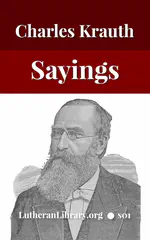
Lutheran Library - Alec Satin - Sayings of Charles Porterfield Krauth


The Big Five sYNODS - ELCA-LCMS-WELS-ELS-CLC (sic) haVE not grasped the importance of Krauth and probably never will.

Saturday, November 7, 2020

Steal These Quotations


Quotations


Preaching of the Gospel – Stone in a Pond

"The preaching of this message may be likened to a stone thrown into the water, producing ripples which circle outward from it, the waves rolling always on and on, one driving the other, till they come to the shore. Although the center becomes quiet, the waves do not rest, but move forward. So it is with the preaching of the Word. It was begun by the apostles, and it constantly goes forward, is pushed on farther and farther by the preachers, driven hither and thither into the world, yet always being made known to those who never heard it before, although it be arrested in the midst of its course and is condemned as heresy." 
Sermons of Martin Luther, 8 vols., ed., John Nicholas Lenker, Grand Rapids: Baker Book House, 1983, III, p. 202. Ascension Day Mark 16:14-20. 

"Shall we permit this to be done! in the name of Christian unity! and by a latitudinarianism that is our own heritage, which rises ever anew from the embers of the past to find such veiled support and strength in the citadel of Zion that Confessionalism is told to whisper low in Jerusalem lest she be heard on the streets of Gath." 
Theodore E. Schmauk and C. Theodore Benze, The Confessional Principle and the Confessions, as Embodying the Evangelical Confession of the Christian Church, Philadelphia: 1911, p. 941. 

"Is the Lord's Supper the place to display my toleration, my Christian sympathy, or my fellowship with another Christian, when that is the very point in which most of all we differ; and in which the difference means for me everything--means for me, the reception of the Savior's atonement? Is this the point to be selected for the display of Christian union, when in fact it is the very point in which Christian union does not exist?" 
Theodore E. Schmauk and C. Theodore Benze, The Confessional Principle and the Confessions, as Embodying the Evangelical Confession of the Christian Church, Philadelphia: 1911, p. 905f. 


"The modern radical spirit which would sweep away the Formula of Concord as a Confession of the Church, will not, in the end, be curbed, until it has swept away the Augsburg Confession, and the ancient Confessions of the Church--yea, not until it has crossed the borders of Scripture itself, and swept out of the Word whatsoever is not in accord with its own critical mode of thinking. The far-sighted rationalist theologian and Dresden court preacher, Ammon, grasped the logic of a mere spirit of progress, when he said: 'Experience teaches us that those who reject a Creed, will speedily reject the Scriptures themselves.'" 
Theodore E. Schmauk and C. Theodore Benze, The Confessional Principle and the Confessions, as Embodying the Evangelical Confession of the Christian Church, Philadelphia: General Council Publication Board, 1911, p. 685. Trinity 

"The real question is not what do you subscribe, but what do you believe and publicly teach, and what are you transmitting to those who come after? If it is the complete Lutheran faith and practice, the name and number of the standards is less important. If it is not, the burden of proof rests upon you to show that your more incomplete standard does not indicate an incomplete Lutheran faith." 
Theodore E. Schmauk and C. Theodore Benze, The Confessional Principle and the Confessions, as Embodying the Evangelical Confession of the Christian Church, Philadelphia: 1911, p. 890. 


[Selnecker, who wrote "Ach bleib bei uns" (TLH #292) was bitterly attacked and severely persecuted by the Reformed, deposed when Augustus died, reduced to poverty, and not allowed to remain in Leipzig as a private citizen.] GJ – Imagine that! 
Theodore E. Schmauk and C. Theodore Benze, The Confessional Principle and the Confessions, as Embodying the Evangelical Confession of the Christian Church, Philadelphia: General Council Publication Board, 1911, p. 310ff. 

"It is not the devil's aim to plague us physically; he is a spirit who is always thirsting for the tears and the drops of blood that come from our hearts. He wants us to despair and to perish from sadness. This would be his joy and delight. But he will not succeed."
Martin Luther, What Luther Says, An Anthology, 3 vols., ed., Ewald Plass, St. Louis: Concordia Publishing House, 1959, III, p. 1244. John 15:19.


"Hence the Pope is the true Antichrist, and his high schools are the devil's own taverns and brothels. What does Christ signify if by effort of my own human nature I can obtain God's grace? Or, having grace, what more will I desire?" Martin Luther, Sermons of Martin Luther, 8 vols., ed., John Nicholaus Lenker, Grand Rapids: Baker Book House, 1983, VI, p. 284. New Year's Day, Galatians 3:23-29 

"So when we see a bishop assuming more than this text gives him warrant for, we may safely regard him as a wolf, and an apostle of the devil, and avoid him as such. Unquestionably he must be Antichrist who in ecclesiastical government exceeds the authority here prescribed." Martin Luther, Sermons of Martin Luther, 8 vols., ed., John Nicholaus Lenker, Grand Rapids: Baker Book House, 1983, VI, p. 65 Third Sunday in Advent, 1 Corinthians 4:1-5 

"Observe, however, what the devil has accomplished through the Papists. It was not enough for them to throw the Bible under the table, to make it so rare that few doctors of the holy Scriptures possessed a copy, much less read it; but lest it be brought to public notice they have branded it with infamy. For they blasphemously say it is obscure; we must follow the interpretations of men and not the pure Scriptures. What else is their proceeding but giving Paul the lie here where he says the Bible is our manual of instruction? They say it is obscure and calculated to mislead." Martin Luther, Sermons of Martin Luther, 8 vols., ed., John Nicholas Lenker, Grand Rapids: Baker Book House, 1983, VI, p. 41 Second Sunday in Advent Romans 15:4-13 

"THE DEVIL'S DIRTY DOZEN: TWELVE WAYS (AND MORE) TO KEEP YOUR CHURCH FROM GROWING..."Limit worship experience only to pages 5 and 15...Bulletin should be 'worship service' oriented rather than 'announcement oriented'...Expect unchurched to accept traditions as though they were doctrine." School of Outreach IV, Notebook, WELS Evangelism Commission p. O-1. 

"Let us, then, prepare ourselves to be patient and learn to bear the furious attacks and the blows of Satan, who is trying to tear the church of Christ to pieces and to establish his own church. We are not any better than the fathers. At the cost of much sweat and labor they, too, scarcely succeeded in their effort to preserve the Word and to snatch a few souls from the jaws of Satan." Martin Luther, What Luther Says, An Anthology, 3 vols., ed., Ewald Plass, St. Louis: Concordia Publishing House, 1959, I, p. 280. W 42, 425. Genesis 11:10ff. 

"Therefore nothing but a satanic, seductive, and sinister strategy is involved when we are called upon to yield a bit and to connive at an error for the sake of unity. In this way the devil is trying cunningly to lead us away from the Word. For if we adopt this course and get together in this matter he has already gained ground; and if we were to yield him a fingerbreadth, he would soon have an ell." Martin Luther, What Luther Says, An Anthology, 3 vols., ed., Ewald Plass, St. Louis: Concordia Publishing House, 1959, III, p. 1411f. Ephesians 6:10-17. 

"The devil has the advantage of being able to find pupils for a doctrine or a dream no matter how absurd the doctrine or the dream may be. The more absurd it is the sooner he finds pupils." Martin Luther, What Luther Says, An Anthology, 3 vols., ed., Ewald Plass, St. Louis: Concordia Publishing House, 1959, II, p. 632. WLS #1940 Mark 7:31-37. 

"If the devil were to identify himself and show himself as black as he is, who would want to follow him? But now he peddles his poison and false doctrine under the cover of God's name and does so with an impressiveness greater than that with which the true doctrine is presented." Martin Luther, What Luther Says, An Anthology, 3 vols., ed., Ewald Plass, St. Louis: Concordia Publishing House, 1959, II, p. 633. 2 Corinthians 11:14. 


Tuesday, October 22, 2019

From Krauth - About Justification by Faith


Alec Satin, the Lutheran Librarian - "Guess the OJ scholars have not read Herder. See below from Krauth’s Conservative Reformation."

The doctrine of justification is so closely associated with, that of faith, that one must stand or fall with the other. On this, also, the cornerstone of Lutheranism, preeminently hold fast, I beg you, by Luther’s writings. I think it was Spener who had felt, with reference to this system, a doubt which, it seemed to him, nothing could overthrow; he read Luther’s writings and his doubts vanished. But, as I have said, Luther already mourned that not all comprehended him, and whilst every one was crying out about faith, justification, and good works, few had really grasped his meaning and his spirit; the consequences, both, immediate and long after his death, were melancholy enough. When in this matter you need instruction, or long to have difficulties resolved, go to this living man of faith himself, this legitimate son of Paul. In his writing is so much sound sense, with such strength of spirit and fervor of an honest heart, that often, when worn out with the frigid refinings and speculations of a more recent date, I have found that I was revived by him alone.”
 The Lutheran Librarian is working on Krauth now.

Tuesday, April 23, 2019

Jacobs Book of Concord Now Available - from Alec Satin's Lutheran Library Publishing Ministry


The Book of Concord: The Symbolical Books of the Evangelical Lutheran Church by Henry Eyster Jacobs and Charles Krauth

Here is a clear, trustworthy and easy-to-search and navigate version of the Lutheran Confessions. This edition was prepared by Henry Eyster Jacobs for the use of all the Lutheran Churches in America.

Table of Contents

About the Translation

“The translation of the Augsburg Confession adopted in this volume is the well-known one of Dr. Charles P. Krauth, which he has kindly revised as the proof-sheets passed through his hands.
“In the Small Catechism, the translation prepared by Dr, Charles F. Schaeffer with the co-operation of a committee of the Ministerium of Pennsylvania, and in universal use in the English churches of the General Council, is reprinted, with the addition of the formula for confession contained in the Book of Concord.
“The Large Catechism was translated for this work by Rev. A. Martin, Professor of the German Language and Literature in Pennsylvania College, to whom the Editor is greatly indebted for assistance and advice also in other directions.
“The Apology of the Augsburg Confession, the Smalcald Articles and the Formula of Concord were translated by Henry Eyster Jacobs. The rendering of the Apology is from the Latin, the German translation of Justus Jonas of the Concordienbuch being more of a paraphrase than a translation, differing sometimes from the original by the omission, introduction and transposition of entire paragraphs, and therefore inducing the editors of some of the best German editions of the Symbolical Books to prepare fresh translations. We have, accordingly, carefully revised our translation from the Latin, by comparing it with the German translations of Schöpf, Köthe, Spieker and Bodemann.

Summary of the Contents

  • I. The General Creeds: The Apostles’ Creed. The Nicene Creed. The Athanasian Creed.
  • II. The Augsburg Confession
  • III. Apology Of The Augsburg Confession.
  • IV. The Smalcald Articles.
  • V. The Small Catechism of Martin Luther
  • VI. The Large Catechism of Dr. Martin Luther.
  • VII. The Formula Of Concord.
  • Appendix: The Saxon Visitation Articles

Download the eBook 


Publication Information

  • Lutheran Library edition first published: 2019-04-23
  • Version 4 update: 2019-04-23
  • CopyrightCC BY 4.0

Friday, October 26, 2018

Krauth - Not Ashamed of the Chief Article

 No, they are Jesuiterans, the UOJ/CG faction that lusts for union with ELCA and Rome.
I long to be like ELCA,
because they have the loot;
I long to be like ELCA,
they bear such lively fruit;
I long to be with ELCA,
amid the Thrivent thugs,
to sing the pothead praises,
to take the ELCA's drugs.
Sing to Aurelia

She claims a historical right to exist. Her history proves her divine origin and necessity; and as our Church has been needed in the past, so is she needed in the present. She is needed not only for her motherhood to her own children, but for the great wants of Christendom and of the world. She is needed as a witness to that doctrine which is conceded in terms by the whole Protestant world, but which is invaded primarily or by necessary inference by every system which is at war with ours — the doctrine of Justification by Faith. Inadequate views of the person and work of Christ; false views of election and reprobation; of the means of grace, the Word and Sacraments; the mode and subjects of Baptism; the nature of the validity and efficacy of the ministry, — all are in conflict, covertly it may be, but really, with the true doctrine of Justification by Faith. Romanism and Ritualism directly assail it; Rationalism destroys it; Fanaticism, sometimes with an affectation of zealotry for it, confounds justification by faith with justification by sensation, and leads the penitent to rest, not on the old, eternal promise, but on a new personal revelation. No Church holds the doctrine of Justification by Faith in that consistent integrity and harmonious relation within itself and with all other doctrines, in which it is held and confessed in the Lutheran Church.
From Charles Krauth. “The Relations Of The Lutheran Church To The Denominations Around Us.” paper given at the First Free Lutheran Diet, 1877. Lutheran Library Publishing Ministry, Alec Satin.
 "I will sell you the Truth about Luther, which will tear down the Reformer and prepare you for the final steps into ELCA and union with Rome. You will be incensed."

Tuesday, May 22, 2018

The Importance of Henry Eyster Jacobs


CFW Walther had to be the big dog, the bishop of all Lutherans. It is easy for the bully to take over and imagine he is infallible. If one can start a small enough sect, anyone can be a bishop today, but that is not the Chief Article. Walther cleverly excommunicated the American Lutherans who came from the same Halle traditions as Pope Walther and Bishop Stephan.

Jacobs explored his options in Christian doctrine, because he came from the ecumenical General Synod, which sought to unify the Calvinists and Lutherans in a watered-down version of the Scriptures, where the Biblical doctrines of efficacy, the Means of Grace, baptismal regeneration, and the Real Presence were faded away.

Jacobs was no different from Walther in starting out in rationalism and ecumenism. But Jacobs saw the importance of Lutheran doctrine, which is actually just Biblical doctrine. We can see the difference in style. Walther taught:

  1. The Glories of Walther.
  2. The Glories of His Synod.
No one was more Calvinistic in expression than Walther. His puffed-up theses are full of Calvinistic pomp and puffery. He started the fissure in American Lutheranism with his Easter Absolution, but made a complete split with his patented election without faith, so Calvinistic that most people will not touch it. Notice that false teachers like Valleskey, Wayne Mueller, and Jay Webber carry on the same way.


Jacobs began at Gettysburg but ended up a leader at Philadelphia's seminary, sometimes called Mt. Airy. That history is lost to most Lutherans. But that came from the Book of Concord Lutherans breaking from the revivalistic Church Growth General Synod to form the General Council. They needed a seminary and built one in Philadelphia, where great professors taught and published. 

ELCA will not admit to that era; naturally the Walther-worshiping Synodical Conference also ignores the General Council. It was handy for Walther to stick with German-only churches and be treated as infallible in his own sect.

I published one account of Walther trying to push his view, being horribly offended, and withdrawing his opinion in a huff. That is how he related to the Ohio Synod.

  1. Krauth was the early, central figure of the Philadelphia Seminary
  2. Jacobs came later, and 
  3. Schmuak last of all.
 WELS pastor - "First they took away the Small Catechism, and I said nothing. Then they took away the Augsburg Confession, and I said nothing. Then they pushed the NIV and took away the KJV, and there was no one to join my cries of despair."

No one needs to believe my account. One can chase rabbits down their hidey-holes all day long. Krauth supplied a Dutch Reformed Church for three months! Oh no!

Can anyone name the Four Open Questions? Not one of them is The Chief Article.


The Chief Article of the Christian Faith
But this issue remains, and it can be checked with a good translation of the Bible - which excludes the NIV, ESV. I suggest any Bible with KJV on its title page, like "after Luther" on a German page. Actually, that is almost the same.

In that research, find out which one is the Chief Article, regardless of what I write. 
  1. Is it UOJ, world absolution and salvation without faith? - Zarling and Bivens, WELS genius professors. Sig Becker too.
  2. Or is it Justification by Faith - Luther, Melanchthon, Chemnitz?


Thursday, May 3, 2018

Sayings of Charles Porterfield Krauth - Lutheran Library Publishing Ministry – "Faithful to the Reformation"


Download the E-book


Sayings of Charles Porterfield Krauth - Lutheran Library Publishing Ministry – 


"Faithful to the Reformation": "This Lutheran Library “short” is taken from the two volume biography of Charles Krauth published by Adolph Spaeth. Spaeth includes in his Preface to that work the following:

“The Motto chosen for this Memoir is Dr. Krauth’s description of Martin Luther, in the biography of the great Reformer which he undertook shortly before his death – “Faithful to the Truth, and true to the Faith.” It may be properly applied to Dr. Krauth himself. It represents his own religious and theological development. Faithful to the truth of God’s everlasting Word, he became ever more true to the Faith of the Church of his Fathers, and in the end its most consistent, learned, and eloquent witness in the English language. If we mistake not, there are not a few in our American Lutheran Church who, under the influence of their early training, still have their difficulties with that faith of the fathers, but are earnestly endeavoring to overcome them. We trust that this Memoir may be of special service to all such honest inquirers.”1"

About the Author

Krauth, Charles Porterfield, D.D., LL. D., was born March 17, 1823, at Martinsburg, Va., son of Charles Philip K. and his wife, Catharine Susan Heiskell, of Staunton, Va. He was educated at Pennsylvania College and the theological seminary in Gettysburg. Having been licensed by the Synod of Maryland, in 1841, he took charge of the mission station at Canton, near Baltimore. In 1842 he became pastor of the Lombard Str. Church in Baltimore; 1847, at Shepherdstown and Martinsburg; 1848, in Winchester. On account of the ill-health of his wife he spent the winter 1852 to 1853 i n the West Indies, serving the Dutch Reformed congregation at St. Thomas’, during the absence of its pastor. In 1855 he became pastor of the first English Lutheran Church in Pittsburgh, Pa., and in 1859 pastor of St. Mark’s, Philadelphia. Later on he served the mission churches of St. Peter’s and St. Stephen’s, in Philadelphia. In 1861 he resigned the pastorate of St. Mark’s in order to devote his whole strength to the editorship of The Lutheran, which in his hands became the strongest weapon in the conflict against the shallow, unprincipled “ American Lutheranism “ which ruled our English Lutheran Church of that time. He was pre-eminently fitted to transplant the spirit of true, historical, conservative Lutheranism into the sphere of the English language, and there to reproduce and establish it on such a basis, that its future should be secure. When the theological seminary at Philadelphia was founded, in 1864, he was appointed Norton professor of dogmatic theology, and at the installation of the first faculty he delivered the inaugural address, defining the theological position represented by that institution.
In the establishment of the General Council he took an active and prominent part, being the author of the Fundamental Articles of Faith and Church Polity, adopted by the preliminary convention at Reading, 1866; of the constitution for congregations, adopted in 1880, and of the theses on pulpit and altar fellowship, presented in 1877. He was also actively engaged in the liturgical work of the Church, resulting in the publication of the Church Book. From 1870 to 1880 he was president of the General Council. In 1868 he was appointed professor of mental and moral philosophy at the University of Pennsylvania. From 1873 he held the position of vice-provost, and after the resignation of Provost Stills he carried the burden of this office for many months. After a journey to Europe which was undertaken, in 1880, not only for his own recuperation but chiefly in the interest of the Luther Biography with which the Ministerium of Pennsylvania had charged him, the chair of history at the University of Pennsylvania was given him in addition to all his other duties. But the burden proved too heavy. In the winter 1881-82, his work in the seminary was frequently interrupted through bodily weakness. He died January 2, 1883.
He was one of the most prolific and brilliant writers of our English Lutheran Church.2

Download the E-book


'via Blog this'