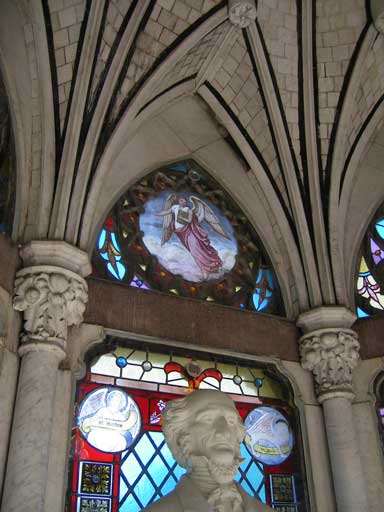
Showing posts with label Bishop Stephan. Show all posts

Saturday, August 26, 2023

LCMS and WELS Cults Fading Fast - ELS and CLC (sic) Sinking Even Faster.
Micro-Minies...Forgotten But Not Gone


Martin Stephan was a Pietist who attended Halle University, gathered Pietists and the Walther Pietist circle to him, pursued young women, and gave them syphilis. He left Europe with his cult because he was convicted in court of various crimes.


Walther organized the riot that stole Stephan's land, gold, books, and personal belongings, forcing the bishop over to Illinois at gunpoint. Walther took over the leadership as pastor, seminary leader, and publisher. The Walther cults - LCMS, WELS, ELS, CLC (sic) - are imbued with Pietism and Calvinism, and no one dare question the infallibility of CFW Walther, even though he supported the slave trade.

Like Zwingli, CFW had very little training in the Biblical languages (only a B.A.) and a tremendous and undeserved ego. Walther's Objective Faithless Justification slowly became the standard dogma for his groupies, canonized in 1932 by the Brief Statement, F. Pieper's swan song.

+++

More later - consider the facts when enrolling students in an abusive and anti-Biblical prep/college/seminary. Anyone who objects to physical, emotional, and sexual abuse is considered a loser and not fit for the barbaric school. As one CLC (sic) leader said to a group, "We used to line up the students and slap them in the face, one after another, until one of them confessed."

Monday, September 12, 2022

Bishops Jim Heiser and Matt the Fatt Display Their Roman Glam Gowns

 This C. H. Almy cope costs $2531.


The bishop in the Philippines. Where are all the Finland photos?


The late Randy DeJaynes - Lutheran Church in America - made himself a bishop and created the Lutheran Confessional Synod. The ELS and WELS joined in fellowship with the LCS. Heiser began his Repristination Press there, which morphed into ELDONA after he took his LCMS parish - Salem, now Salem Cathedral, Malone, Texas - out of that synod.


Matt the Fatt wore the superfluous cope or chasable in Europe. No crosier or miter so far. His cassock was probably $371.


Like Stephan and DeJaynes, Heiser (on the far right) made himself a bishop. Here he has an alb, stole, pectoral cross, and ill-fitting cope. On the left is a chasuble costing about $700 for each of the colors in the church calendar, which now include sky blue and rosy pink.

Heiser wore a bishop's miter for his enthronement and carried a crosier.

An Almy miter costs $700, but various colors are needed to match the paraments and associates' stoles.

 
Heiser modeled the Almy Roman bishop's cassock and sash with a pectoral cross. The first two items cost $450 total. Long beards, like hay bales, seem to be spiritually significant, but scholars remain divided about their true purpose.


Saturday, March 12, 2022

Waltherite Cult - Still Teaching Universal Absolution without Faith - Like ELCA


“The Waltherites claim that their fight is a fight for divine truth and for God’s Word… [but] where is it expressly said in the Bible, that faith comes from election, that the Holy Ghost in conversion also overcomes and removes willful resistancethat God could convert all men, but from some unknown reason chooses not to do it—that the reason why some men are converted, and others not, is simply because God removes willful resistance in some and in others He does not—that He bestows larger measures of grace upon some than upon others, etc.? Where are these and other similar things which New Missourians now hold, set forth? Not a shadow of proof has been furnished for any of them. And yet they are all boldly declared to be Bible truths and parts of the “reine Lehre,” just as the Papists claim their tenets to be contained in the Bible, being slow, however, to adduce the evidence."

From “The Lutheran Doctrine Of Election: Its Scriptural Evidence And Proof. By Rev. P. Eirich, Hoboken, N. J.” in The Columbus Theological Magazine, Vol 1, 1881, Matthias Loy, editor. LutheranLibrary.org


 Walther lied about Stephan's many affairs with young women, until an opportune time came to talk about the bishop's syphilis and that of his young girlfriends. He insisted on his false doctrine and controlled everything as a cult - seminary, publications, synod, calls. So Missouri built him a shrine or two.


Friday, July 23, 2021

LutherQueasies Explode Erratically - Like Cheap Chinese Fireworks

LutherQueasies convinced me that they have never smiled, not once.


Jojakim Dettmann (Random_layman)
Senior Member
Username: Random_layman

Post Number: 3952
Registered: 5-2006
Posted on Thursday, July 22, 2021 - 9:25 pm:   Edit Post Delete Post Print Post

Rev. Jackson's blog binds your conscience with catch-22s especially when you don't understand the secular and philosophical origins of his disagreement with most other American Lutheran clergy in the former Synodical Conference bodies.

When a disagreement is secular and philosophical, but the parties involved mistakenly think it is sacred, they can argue on-and-on for eternity on sacred things without coming to any resolution.

Are you willing to research things like I suggested above? For this question in particular you'd also want to teach yourself about the different political theories involving authority--the theories present in Germany during the 1700s and 1800s.

++

Simon Reynolds (Simon)
Intermediate Member
Username: Simon

Post Number: 357
Registered: 1-2005
Posted on Thursday, July 22, 2021 - 8:00 pm:   Edit Post Delete Post Print Post

For the record, it wasn't during the worship service. It was after the service had concluded.

I don't really know how to respond to what else you have written. In my opinion, you are wide-of-the-mark. To use the photoshopped photos of Mr. Gregory Jackson as evidence of anything except mischief-making and nastiness on his part reveals a decided lack of good judgment on your part.

You are using the Augsburg Confession like a rule book in a way which is completely at odds with what was accomplished at Augsburg. May I respectfully ask you to take to heart the words of Lord Jesus, "I desire mercy, not sacrifice..." and all that that Scripture implies.


Juan Jeanniton (Casusconscientiae)
Intermediate Member
Username: Casusconscientiae

Post Number: 299
Registered: 2-2021
Posted on Thursday, July 22, 2021 - 11:00 am:   Edit Post Delete Post Print Post

Rev. Herzberger:

quote:

There is but one limitation—imposed by the Lord of the harvest Himself—they are not to preach the Gospel in public worship [I Cor. 14:34-35 and I Timothy 2:11-14]...


Daniel Gorman:

quote:

...the office of deacon is clearly an all male authoritative office forbidden to all women:

"Let each deacon be the husband of only one wife, managing his children and his own household well." 1 Tim 3:12, EHV


So, precisely WHERE does the AUTHORITY of the deacon lie, if not to PREACH and TEACH in church, or administer the Sacraments, or exercise government over the congregation in Church?

It is now a mathematical, theological, and theonomical CERTAINTY that if the occupation or activity which defines the very concept of a deaconess is to be a lawful occupation, well then such an occupation or activity cannot be quite the same as the MALE OFFICE of a DEACON.

http://cyclopedia.lcms.org/display.asp?t1=d&word=D EACONESSES:

quote:

1. Female servants in the ch., formerly unmarried or widowed (some contemporary diaconates permit married women to serve as deaconesses); a special ministry in the ch.; “Phoebe, a deaconess.” (Ro 16:1 RSV)

2. Custom and usage of the ancient world forbade intimate assoc. of the sexes in pub. assemblies. Functions of deaconesses in the early ch. were to instruct female catechumens, assist at the baptism of women, care for sick or impoverished women, minister to women martyrs and confessors in prison, and act as ushers for women in chs.

3. The 4th c. was the Golden Age of the female diaconate. Forty deaconesses served in the cong. of J. Chrysostom* in Constantinople. Among the deaconesses of that time was Olympias.

4. When the diaconate came to be regarded as a meritorious work, its deterioration began. Escape sought from a corrupt world resulted in monastic life. By the 12th c. deaconesses had nearly disappeared.

5. The modern career woman in ch. work looks back to 1833 for the beginnings of her work. T. Fliedner,* planning ways to meet the needs of people in distress, opened a door for women who wanted to use their talents for the ch. He est. the first motherhouse 1836 at Kaiserswerth, Ger., where he trained ca. 425 deaconesses. J. K. W. Löhe* est. a motherhouse at Neuendettelsau 1854. Among others in Eur. were those at Bielefeld, Basel, Paris, and St. Petersburg. The diaconate was introd. also in Eng. and Scand.

6. Among chs. that have deaconesses are the Ch. of Eng., the Ch. of Scot., the Episc., Presb., Ref., Meth., Mennonite, and Bap. chs. Many deaconesses are active throughout the world.

7. W. A. Passavant* introd. the diaconate in Am. He est. a Luth. hosp. in Pittsburgh, Pennsylvania, 1849, and on his request Fliedner brought 4 deaconesses from Ger. to be nurses in this “Pittsburgh Infirmary,” later called Passavant Hosp. One of the 4 deaconesses was Maria Elizabeth Hess, later wife of Philipp Wambsganss, Sr. (December 19, 1823–October 1, 1901).

8. Motherhouses were est. at Philadelphia 1884 and Baltimore 1895. In Omaha, E. A. Fogelström organized the Ev. Immanuel Assoc. for Works of Mercy 1889; a hospital opened 1890; home for deaconesses built 1891; Immanuel Deaconess Assoc. formed 1892. The Milwaukee motherhouse, later connected with the ALC, was est. ca. 1893. Other deaconess homes include those est. in Chicago, Minneapolis, Brooklyn, Brush (Colorado), and Axtell Nebraska). See also Wenner, George Unangst.

9. F. W. Herzberger* helped est. the deaconess movement in the Syn. Conf. He was ably supported by P. Wambsganss, Jr., pres. of the Ev.-Luth. Wohltütigkeitskonferenz.

10. The Luth. ;Deaconess Assoc. of the Ev. Luth. Syn. Conf. of N. Am. (LDA) was organized in August 1919 at Fort Wayne, Indiana Deaconess training was given in connection with the Luth. Hosp., Fort Wayne. First grad.: Ina Kempff 1922. First deaconess sent to a for. field: Louise Rathke, to India 1926.

11. LDA Pres.: P. Wambsganss, Jr., 1919–33; Walter Klausing 1933–55; Edgar H. Albers 1955– Supts. (called Ex. Dir. beginning in 1957): Bruno Poch 1923–32; Herman B. Kohlmeier 1932–41; Arnold F. Krentz 1941–61; Walter C. Gerken 1961–67; Arne P. Kristo 1968–71;. Lucille Wassman 1971–. Dir. of Training: Arne P. Kristo 1961–71. Dir. of Deaconess Educ.: Lucille Wassman 1971–. Over 300 deaconesses have been trained since 1920.


So, if the Church should, in its official capacity, appoint women to such a position as described above in the Christian Cyclopedia, namely, a position of active service in the church like that of Olympias, and 39 other so-called "deaconesses", in Chrysostom's own 4th century Church, and ceremonially inaugurate them, in ecclesiastical and liturgical ceremonies, to the position, would that be ipso facto an act of allowing these women to teach and exercise authority over MEN in the Church????

Daniel Gorman: "Rev. Herzberger: "There is but one limitation—imposed by the Lord of the harvest Himself—they are not to preach the Gospel in public worship [I Cor. 14:34-35 and I Timothy 2:11-14)..."

Did the LCMS celebrate its hundredth year of feminist apostacy?"

Celebrating precisely this sort of "feminist" apostasy of allowing women to publicly perform functions belonging ONLY to the pastoral office is PRECISELY what one local WELS congregation already did a few years ago!

See also: https://3.bp.blogspot.com/-E0OmGDoK0s4/VvxWdyVpnWI /AAAAAAABpcw/bR2uxCx91dk98YgSalhEGuKe3N1KN14Rg/s16 00/wels_woman.jpg:

COME TO THE WELS

WHERE THE WOMAN AT THE WELL COULD PREACH TOO!

http://3.bp.blogspot.com/-t051WTw27PA/UgxVBugDFDI/ AAAAAAABLEw/0bN20K58Tf8/s1600/wels_women_pulpit.pn g:

THEN THEY SAID WELS DOESN'T LET WOMEN IN THE PULPIT!

Those nominal WELS local congregations in which these things happen ARE NO LONGER CONFESSIONAL LUTHERAN!


***

GJ - I have mailed coupons to these scribblers, so they can obtain the pharmaceutical help they need. I would untangle their lack of substance and research, if it mattered. I think some are enraged they they have no legitimate heritage while I am part of the Apostolic Succession, which - like a real education - is missed most by those lacking it.

The descendants of the Perryville Sex Cult call themselves orthodox or confessional or conservative when they praise themselves for covering up the felonies of the Walther Crime Family, who aided and abetted the promiscuity of Bishop Stephan. They solved their problems by using the outbreak of high church syphilis to rob Stephan of his gold, land, books, and everything else. They threatened their bishop's life and kidnapped him to Illinois.

But that is piddling compared to their rejection of the Chief Article of Christianity - Justification by Faith.

Their biggest deception is not the Stephan cover-up, but the claim that Missouri began with Objective Justification - it is pure baloney. Missouri was Justification by Faith in the beginning, just as WELS was. 

Note the first three presidencies of the LCMS - Walther - Schwan - Pieper. Schwan's catechism is devoid of OJ. Bonus fact - he was not brain-washed at Concordia Seminary, St. Louis. Walther and Pieper had the advantage of promoting Stephan's OJ dogma among generations of pliable students. The weed seed of OJ was sown and the Chief Article neatly buried by combining OJ, SJ, and "Justification by Faith" in the Dogmatics, a stew of Enthusiasm from Walther's most pliable student (and hand-picked via Walther's political gimmicks).

Where are LCMS-WELS now? 
  1. They adore the Calvinism of Church Growth and NIV/ESV.
  2. Their abandonment of the KJV and Luther are all too apparent.
  3. They are shining examples of servility to ELCA - reviving Seminex "Biblical scholarship" and promoting the love that dares not speak its name.
 Jungkuntz chaired the board of Seminex and became the official seminary of the Metropolitan Community Church.


Friday, September 11, 2020

Draft - More Details on Threatening, Robbing, and Kidnapping the Bishop


May 28, 300 Roared Off the Steamship

Walther organized the mob that arrived in Perryville and surrounded the bishop’s cabin. Only those against the bishop were allowed to take the trip. They threatened his life, held him at gunpoint, forced him out of his home, stole all his money, took all his books and personal possessions, and forced him across the river to Illinois. They even disrobed him to make sure he was not hiding any money.[1]

This action has been called “deposing the bishop,” but it was a series of crimes and completely unscriptural. This mob activity led by Walther set the precedent in the LCMS-WELS-ELS for ignoring due process and Matthew 18, assuming dictatorial powers, and abusing people with the theme of might makes right.

First of all, only the people already in agreement with Walther were allowed to travel from St. Louis to Perryville. Those with a different opinion were left behind, not a voters’ assembly but a kangaroo court. They were fired up for execution, not for pastoral admonition and discipline. To compound the deceit of the times, the LCMS guides in Peryville today tell the innocent that the bishop was given three options. But only one option is needed at the end of a gun barrel – obey! Bishop Stephan had no advance notice of this angry horde and refused to acknowledge their authority. The former clergy arranged to have the real estate agent (!) read the charges to Stephan.

The bishop was charged with misuse of the funds, fornication, and adultery, the same charges brought against him in a court of law in Dresden, ending his career there. Since the same lawyers, Vehse and Marbach, were there in the Dresden court, people should only marvel that these were suddenly charges never before proven. Mrs. Stephan and the primary mistress Louise Guenther both testified.

The mob outside Stephan’s cabin whipped the walls to terrify him, and he felt afraid for his life. He signed the document of accusation, though obtaining a guilty plea through death threats is hardly legal or Biblical.

The next anti-Scriptural step was searching him bodily for any money on him and the cabin for the rest of the money. At the Walther site, the guide showed me the chest where Stephan’s gold was kept. “That would be worth millions today.” The man showed no remorse over stealing a vast amount of money, which was perhaps a mix of the society’s money and the bishop’s. The implication of the tour was – he had it coming to him. Never mentioned – the society was financially strapped from foolish spending, not all of it the bishop’s fault. The former pastors also took money from the fund and that was not consistently recorded or paid back. (Zion)

Stephan was forced to sleep overnight on the ground, another strange concept not addressed in Walther’s Pastoral Theology. He was forced across the river at gunpoint, with only 100 dollars, a few clothes, and a shovel. The mob took all his personal possessions and library. Stealing a library was replayed when Seminex stole the books from Concordia Seminary, St. Louis, for their own school, claiming, as one did, “They were our books.” Antinomianism reigns with legalism where Objective Justification is taught.

The trip across the river was probably on a ferry, not in a rowboat. The bishop was dumped in Illinois, sick, with not enough to survive. Future pleas to provide some food were refused. He sued for the return of his property and received almost nothing. The beautiful chalice given to him was kept by Walther and used at every communion service. Thieves often keep trophies to admire.

The lawyer Marbach, on behalf of the Society, interrogated Louise Guenther - after the fact, so the verdict and punishment were first and the facts second. The issue had already been settled in Germany and verified by her cozy position on the ship near Stephan’s cabin, living above him in the same building in St. Louis. Could Marbach and Vehse have traveled for weeks on the same ship and not seen anything amiss, with the bishop’s wife and his children (except one) left behind?

Louise joined the bishop in Illinois about two weeks later. He became the first bishop in Illinois and served as the pastor of a congregation that still exists in the LCMS. He died in Illinois, seven years after Walther’s mob threatened, robbed, and kidnapped him. A rumor lived on that Stephan had gold coins in his cane when he was expelled. The author of Servant of His Word examined the cane and found nothing there. The irony of thinking the bishop escaped with some money – but without his land, cabin, books, and savings – is too rich to ignore.

Not satisfied with this, Walther talked Stephan’s son into giving away the 80 acres in Perryville belonging legally to his father.

The Ninth Commandment.

Thou shalt not covet thy neighbor's house.
What does this mean?--Answer.
We should fear and love God that we may not craftily seek to get our neighbor's inheritance or house, and obtain it by a show of [justice and] right, etc., but help and be of service to him in keeping it.


[1] Servant of the Word, cane story.

 Red Bud, Illinois


Thursday, May 24, 2012

Given to Stephan's Group - Or to Bishop Stephan?


One chalice was a personal gift to Bishop Stephan. This is the one Walther used at the congregation that his brother vacated (by death).


Things happened fast. Walther organized the mob against Stephan. Next came the Altenburg Debate. Then C.F.W. accepted the call extended by his late brother's congregation.


Some photos of Historic Trinity in St. Louis are here.

Tuesday, March 6, 2012

Walther's Criminal Behavior - No Secret To Historians

The keepers of the Walther shrine have hidden the syphilis story,
but the rest is well known.
Part I
One of the UOJ lapdogs claimed I was writing about a secret LCMS history, smirking as if I were making up details or digging up legends known only to a few. The material below is from Zion on the Mississippi, Walter O. Forster, 1953. The book is older than the UOJ Enthusiasts Paul McCain, Jay Webber, Preus Inc, and Jumpin' Jack Kilcrease (who jumps synods and confessions with the greatest of ease). Concordia Publishing House printed the book, which was a doctoral dissertation that employed the resources of the Concordia Hagiography Institute, where McCain had a sinecure.

My copy was owned given to Arthur Stellhorn Welch, whose mother wrote this in 1984:
"This is the authoritative soruce of the history of the Saxon Pilrims who came to America for religious as well as other freedoms. My father's parents, Stellhorn and Buenger, are of this company. I see in your nature and life that cultural and genetic strain." (Emphasis in original)

Zion has been required reading for seniors. Vehse has another account. Now the Stephan records are available in the book above, whose title I modified somewhat.

As I wrote before, Stephan was investigated many times for his obvious immoral behavior with young women. Louise Guenther was the main mistress, but there were others investigated by the police and church officials. The groupies were jealous of each other and vied for Stephan's attention. Two of the lawyers were participants in the court action just before the Saxon departure, which led to Stephan's house arrest. His long-suffering wife gave detailed testimony about Stephan's infidelities, which his lawyers knew about, although they were happy to go to America with him. Vehse and Marbach were brothers-in-law.

Note that Suelflow solemnly recorded Walther blaming Mrs. Stephan for the bishop's adultery!

All the historians know that C.F.W. Walther's future mother-in-law was jailed for her part in kidnapping and hiding the niece and nephew of Ferdinand and his brother. According to the Stephan book, police issued warrants for the arrest of Walther, who left his port early, like Jonah, on a fast ship West, regardless of the fare.

Download it here.

Landing in New Orleans, Walther swore allegiance to Bishop-for-Life Stephan, known adulterer. A few months later, Stephan was suddenly revealed to be an adulterer and a false teacher, for calling himself bishop. Actually, the pastors elected him bishop, so that made them false teachers as well.  As for the lying, let me get started.

Stephan and his group were being dissed in America and Europe for their lawlessness. That is no secret - Zion, p. 345. Stephan's pastors defended their effort and their bishop - in print.

Money was loosely handled, but the laity had control of that, even though they obeyed the directives of Stephan. The bishop showed the signs of third stage syphilis, with many strange delusions and impractical, improvident plans. The unemployed pastors also paid themselves out of the common fund. Ferdinand's brother did not even account for the huge sum, $400, he requested and received. Zion, p. 364.

"The Bishop always had a number of women staying with him at his St. Louis residence." Zion, p. 355. The women included - "Louise Voelker, Louise Guenther, Mrs. Schneider, Pauline Weidlich, and the youthful Marie Schubert, niece of the Walthers." (ibid) He resumed the evening strolls with women, the practice in Germany that attracted police attention. It is no secret that he left his wife behind in Dresden, to fend for herself, and abandoned all his children except his healthy son, who came over and established his own LCMS dynasty.

The clergy were loyal to the hierarchical order, even after the removal of Stephan. Zion, p. 357.

Walther was happy to carry out Stephan's abusive orders. Zion, p. 358.

The Saxons were offered a good deal on land, right in St. Louis, (p. 376) but Stephan wanted to be in the wilderness, so they bought in Perry County. They were running out of money. Zion, p. 373. Stephan the Bohemian had no problem with human slavery. They could have purchased better land for less in Illinois or in another territory. Perry County had spas good for additional syphilis treatment and the advantage of obscurity, away from prying eyes and urban newspapers.


The stories of Stephan's "stupid vanity and gross incompetence" suggests syphilitic dementia rather than the effects of the bishop's title. Zion, p. 387.

On April 24, 1839, five of the pastors (Loeber, Keyl, Oertel, Buerger, Walther) replied to an attack by the St. Louis newspaper, Zion, p. 388. They defended their enterprise and their bishop, but the paper said they were all under a cloud, both in Europe and America. The five pastors reversed themselves a few days later - in print!

The Rogate Sunday sermon (May 5, 1839) and confession story is recorded on p. 392 of Zion. Loerber (a great friend of Walther) preached a sermon. Two women confessed adultery, and Loerber told Walther. But they already knew, and Forster does not seem to believe the story he repeated about the shocking discovery.

"In Germany they did not want to believe ill of Stephan because of their high regard for him and their close association with him. Hence they closed their eyes to all evidence and their ears to all 'slander' against him and pronounced him an innocent martyr." Zion, p. 394

The facts are known to those who investigated them. Stephan became more contagious (third stage syphilis) and shared his disease with his mistresses. The community suddenly became aware that the overlooked adultery had bequeathed a slow, shameful death sentence on their young women, thanks to their bishop. His children and wife were already suffering from syphilis, abandoned in Dresden.

On May 15, Walther and a layman traveled from St. Louis to Perry County. Zion, p. 403. Forgetting Matthew 18, Walther did not confront Stephan but instead defrauded him of the land given by the Saxons (80 acres).  That behavior shows the common understanding in the group, that Stephan had his female groupies and no one really saw anything. After years of ignoring all the girlfriends and the bishop's wife being left behind in Dresden, Walther could not act suddenly outraged over adultery.


Part II

Something else was brewing. The only explanation is an outbreak of syphilis. To defend themselves against the charge of Loerber and Walther revealing a confidential confession (the cover story), Missourians have said, "But everyone already knew." That shows the cover story to be a lie - and not a well crafted lie at that.

Above on May 15, Walther and a layman traveled to Perry County, but not to confront Bishop Stephan. Walther needed to organize the Perry County residents, since the St. Louis Saxons were already united. Recall that Stephan was with his groupies in St. Louis before he moved down to Perry County. The entire Saxon group was in the public spotlight because their sordid reputations followed them. The kidnapping, immoral behavior, and money issues were reported in Germany and in America, although the apologists make it sound like persecution, remaining vague about why two newspapers were so antagonistic about this Holy Spirit anointed immigration.

In Perry County, Walther openly defied Bishop Stephan. The New York group came to Perry County at that time. Zion, p. 408. That included three of the Buengers, "who had been separated from the rest of the family by the performance of the Walther brothers in the incident involving the Schubert children." Zion, p. 404f. Incident? Incident? I wonder if Forster was a little more direct and found his prose edited by the LCMS public relations experts.

The Saxons consisted of three groups at this point: the St. Louis residents, the Perry County pioneers, and the newly arrived New York contingent. The New Yorkers were still loyal and obedient to Stephan. So were the Perry County residents, although they chafed at Stephan's spending and spirochete-fueled delusions.

Walther stayed with the Buengers in Perry County and got them on his side. They were already Waltherians via the kidnapping. J. F. Buenger was one of Walther's closest friends. Zion, p. 408.

"Walther, of course, immediately instructed J. F. Buenger on the state of affairs but did so in the sleeping quarters of a group of about twenty-five to thirty men, and the fact that it was done in Latin did not prevent others, such as Ernst Buenger, from understanding it. This episode is typical of Walther's methods on his mission. He did not make the mistake of immediately mounting a stump and denouncing Stephan, but gave his information to hand-picked individuals, always with the caution that they were to keep it to themselves for the time-being." Zion, p. 409.

By May 19th the "entire colony was seething." Zion, p. 409. Stephan took note, telling Ernst Buenger, "Beware of that Ferd. Walther, that fellow is a fox." p. 409.

That Sunday, May 19th, Pentecost, Walther had everyone listen to him preach, although they had been directed to hear Stephan at a different location. Walther said after his sermon: "Many of you will have been surprised this morning that I preached in spite of the invitation and against the orders of the man who until now has been beloved and respected by us all, but terrible things have happened, which I shall now communicate to you." Everyone believed Walther, so all three groups were united against Stephan. No one went to Stephan in obedience to Matthew 18. Walther began with "tell it to the church," but not until he had most of the people on his side by his crafty spread of the story. Zion, p. 410.

Walther went back to St. Louis to bring those residents to Perry County for the climax of his excellent adventure.

The tacky Walther shrine has been refurbished.

Walther did a superb job in organizing the mob against Stephan
and serving as spin-doctor about his own history.


Part III 
In Pursuit of Religious Freedom describes the arrival of the St. Louis mob and the many criminal acts against their leader:

  1. Invading his home.
  2. Threatening his life.
  3. Strip-searching him for money.
  4. Stealing all his money, a large sum of gold.
  5. Taking away his books and personal possessions.
  6. Making him leave his house and sleep outside.
  7. Kidnapping him at gunpoint and forcing him to live in Illinois.
Not one act against Stephan was justified by his adultery. But everything is understandable in light of the spread of syphilis. Daughters and families were humiliated. The Saxon group was shown to be a degenerate cult carrying the most dreaded plague of the time. No real cure was available. A young woman with syphilis would give it to her husband and to her future children. Severe rashes would give away the disease until it went into latency, only to emerge again later with final, deadly results.

The clergy were all in trouble for their published support of Stephan, just before the expulsion. They were just as quick to accuse the bishop in print was they were to defend him in print. Both actions were only a few days apart. This reversal did not come from a dramatic confession or two, but from a much darker source and their justified fears of facing a mob in St. Louis.

I went over the Forster account in Zion to find who was organizing and leading the mob action against Stephan. No other name appears in leadership. Walther acted on behalf of the St. Louis Saxons, coming down to Perry County to steal the bishop's 80 acres and organize the colony. He used the Buenger family to convert the newly arrived New York group to his side. Then he returned to St. Louis to bring those people down to Perry County in the dramatic purge, robbery, and expulsion.

Walther never wanted an early history of the Missouri Synod written down, because he was so much a part of the story. (Suelflow) O. H. Walther married one Buenger daughter and died, so Ottomar Fuerbringer married the widow. C. F. W. Walther married another Buenger daughter and took over his brother's congregation in St. Louis when O. H. died.

Ludwig Fuerbringer was the son of Ottomar, so he was a double-Buenger (mother and aunt) and the nephew of C.F.W. Ludwig also skipped over the early years of the Saxon adventure in his two little books about the Missouri Synod. I find much to admire in Ludwig's life, ministry, and teaching. His books prove the saying that always comes to mind when dealing with historical accounts, "The unspoken word is the most important."

This Walther statue is at the Purple Palace, the LCMS Vatican.
The original is at the Concordia Hagiography Institute.
Another copy is inside the Walther shrine.
Three idols are erected to the same kidnapper and thief in the same city.
CFW is the ruling norm of the Olde Synodical Conference.

Friday, March 2, 2012

Historic Old Zion Lutheran Church Has the Same Origin as the Missouri Synod - Halle University

Historic Old Zion Lutheran Church:


It proved to be very difficult at first to find a German pastor who would stay to serve the congregation for any length of time.  Therefore these German Lutherans depended on the Swedish Lutheran pastors of the former New Sweden (Nya Sverige) colony to minister to them.  Thus the still existing Swedish Gloria Dei church (Old Swedes’ church), built in 1699-1700, served also as “our” first church building.

A dramatic change occurred in 1742, when at long last there was found a German pastor willing to serve the German Lutherans in Philadelphia on a permanent basis.  He was Heinrich Melchior Muehlenberg, sent out from Halle/Saale, at that time a center for Lutheran outreach and missionary activity.  Pastor Muehlenberg turned out to be the right man in the right place at the right time.  Under his energetic and capable leadership, the congregation flourished.

Zion's history and its pipe organ.


'via Blog this'

***


GJ - The LCMS cannot admit that its founder was really Bishop Martin Stephan, STD, not C. F. W. Walther.

Stephan--also from Halle University--brought his cult to America. It remained a cult when Walther, who had no call and no job, usurped the bishop's position through subterfuge. Walther was called to his dead brother's congregation and reigned supreme.


Monday, January 16, 2012

Walther and Slavery - Another Inconvenient Fact

Stephan's hat probably represents Herrnhut.


bruce-church (https://bruce-church.myopenid.com/) has left a new comment on your post "Complete Rough Draft of Chapter Four - Luther vers...":

About Walther and slavery, a topic that  some are studying. The Moravian mission sites that Herrnhut set up around the world, especially in the Caribbean, used slaves to make a profit and set up more Moravian mission sites.

With Stephan being a former Hernnhuter, he had no problem setting up shop in southern Missouri. Sparsely populated Perry Co. had 150 slaves, I recall reading, when the Saxons arrived there. The census information is online, but I think one can find that info on Perry Co history pages. By contrast, the Scandinavian immigrants to America were specifically warned not to settle in the South or anywhere there was slavery. Hence, Norwegians are found in northern tier states mainly.

***

GJ - Perry County also had mineral springs, so Stephan could continue treatment for his syphilis.

The Swedish Augustana Synod loathed slavery and voted Republican.

Here is Cascione's amen corner for everything Walther ever thought, including slavery.

More Walther and slavery.

---

Norman Teigen, Walther, Slavery:


Norman Teigen says:
September 30, 2011 at 6:02 pm
Thank you for posting this very interesting discussion. I had no technical problems.

I have always admired Walther but in the past year or so I have become quite troubled with Walther and the issue of slavery. I believe that the historical record shows that Walther was a southern partisan. I think that the evidence is pretty solid on this point.

There were lots of southern partisans, of course, and one shouldn’t be too hard on these followers of the cause that was lost. What is troubling to me is how Walther justified slavery on an argument based on his interpretation of Scripture, an argument which I feel does not stand so much on Lutheranism as it does on culture.

Walther’s argument on slavery closely follows the standard Southern defense of the institution. Walther’s argument that he only cares about Scripture and not about civil matters seems to cloud the picture rather than clarify.

Walther’s influence on other Lutherans was profound as the professors discuss. I am of the Norwegian branch of Lutheranism and my spiritual ancestors sought advice from Walther on the topic of slavery. Unfortunately, in my opinion, the Norwegians accepted Walther’s views on the subject rather than the better advice which they received from theologians in Oslo. The Waltherian view caused, I think the historical record will show, great sorrow within the Norwegian branch of the faith.

The theological battles of the Civil War, as Professor Mark Noll has written, were settled by the two eminent theologians Ulysses Simpson Grant and William Tecumseh Sherman. What has prevailed, I think, is that Walther’s explanation of the slavery question is the biblically based, solidly Lutheran explanation.

I think that that question is open to serious discussion and I would like to hear from the professors about this over-all issue of the slavery problem and Walther’s explanation. I won’t ask the professors to resolve our Norwegian interpretations of these historical events but would like a clarification of the slavery problem.

Incidentally, the Missouri Synod is still getting beaten up on slavery in recent days as a writer demonstrated earlier this summer in a local paper, The Metro Lutheran.

Thank you,

Norman Teigen
Hopkins MN

---

Norman Teigen has left a new comment on your post "Walther and Slavery - Another Inconvenient Fact":

Thanks, GJ, for posting this. This comes from the Concordia Seminary site. I was pleased in this exchange to have a seminary professor there acknowledge that Walther was wrong on slavery. This admission was encouraging to me because it was the first time that a reliable source had admitted that. I think that one can admire Walther's contribution to the faith and admit that he was once wrong about something.

My interest is in the ideas involved. I have not been able to further my Walther studies this Fall because I ran a campaign for election to the Hopkins MN City Council. I was unsuccessful - no Boss Teigen here, just Ten Percent Teigen-and now I can renew my studies.

I will concentrate on Walther's assertion that slavery is a civil matter and has nothing to do with spiritual matters. This is the essence of the Walther slavery problem and I am reasonably sure that my explanation will be on target.

I will submit it to you and your readers for review and comment. I had a blog once but it was officially shut down. Now the ban was been lifted but I am slow to get the blog going again.

---

bruce-church (https://bruce-church.myopenid.com/) has left a new comment on your post "Walther and Slavery - Another Inconvenient Fact":

Cascione wrote: "Walther shows that the American slave masters could hardly claim they were following the Bible."

Ha! That's a bunch of historical revisionism. Walther claimed that slavery was biblical, and that abolitionists were wrong when they condemned slavery. Walther clearly taught that only the abuses associated with slavery ought to be condemned, not slavery itself.

People argued against Walther's assertion by saying the abuses were intrinsically bound up with slavery itself, so even if Walther were right, he still ought to condemn slavery itself. Walther, however, chose to believe that abuses of slaves were not widespread, a total myth that abolitionists tried to dispel.

Besides that, almost as soon as Christianity took over the Roman empire, at least widespread slavery was a dead institution, so other Christians were 1300 years ahead of the caveman Walther on that point.

---

bruce-church (https://bruce-church.myopenid.com/) has left a new comment on your post "Walther and Slavery - Another Inconvenient Fact":

Norm Tiegen, If you really want to know why Walther was pro-slavery, it all comes down the inherent antinomianism of UOJ. Walther thought, "So what if there are widespread abuses inherent in slavery, since all that is forgiven." It's similar to how Stephan's abuses of his office were no no concern since they figured he was forgiven before his was born for those sins, and what's all-important is he's carrying out his duties as cleric:

In Forster's Zion of the Mississippi one can read:

...anything which promised to discredit him before the people or even to rid them of him was accepted without further scrutiny. Their attitude in Germany had been typified by Keyl's remark noted above, that he did not believe in the assertions against Stephan to be true, but that if they were, he was certain Stephan had repented, and all was well (pp. 394-5).

---

LPC has left a new comment on your post "Walther and Slavery - Another Inconvenient Fact":

Walther's theological contribution? The promotion of quasi universalism?
I began being cynical of Walther when I read his essays on Lutheranism. Like a typical cult leader he believed his own propaganda. It is high time that he gets put on the scale and out of the pedestal. It is time to see how he weighs.

LPC

***

GJ - Walther created many needless splits by making his own opinions the ruling norm for all Lutherans. He won in this sense - at first the General Council taught justification by faith and the Means of Grace. Now ELCA is just as UOJ as the Olde Synodical Conference.

The Lutheran Reformers would have laughed at a bachelor's degree from Leipzig qualifying Walther to judge and condemn everyone else. Herrnhut cell groupies are not exactly the Concordists brought back to life, even if the terminology was borrowed for every LCMS institution.

Wednesday, January 4, 2012

The Walther Chapter, Rough Draft of Part One

Cell group leader, adulterer, syphilitic - Martin Stephan.


Chapter 4 – Stephan’s Halle Pietism Became Walther’s UOJ


            The official history of the Lutheran Church Missouri Synod is full of deliberate, bald-faced lies about its origin. Central to the deception is the C. F. W. Walther mythology, tales and claims that portray him as the American Luther, when he was really the American Pope, a treacherous and criminal usurper, a divisive figure who forced his imprint upon the Synodical Conference. The often-told story is familiar to most conservative Lutherans. The Saxon immigrants came over to America with Bishop Stephan leading them. They suddenly discovered he was an adulterer and forced him out, with the brave and noble Walther taking over and leading them until his death. Although Stephan is always called a false teacher and Walther a champion of Lutheran orthodoxy, with details too murky to decipher, the truth is unsettling.
            Many will portray the facts about Walther as a personal attack, but the truth needs to come out, to set the so-called conservative Lutherans free from the yoke of synod worship and Walther mythology. For too long the statements of Walther have been used to define Scriptural interpretation. His writings have usurped the Book of Concord in the same way that he usurped the position of the bishop he swore to support, the documents he swore to follow in case of a dispute. Walther also set up minions who would repeat his opinions post-mortem until they were established as canon law, best exemplified in the position of UOJ in the Synodical Conference today.[1]

Martin Stephan Saga, Pietism and Syphilis


            Martin Stephan had a difficult early life, which prepared him for future hardships and the leadership of a Pietistic congregation. He was born in Moravia in 1777, and Moravia was a center of Pietism. His pastoral sponsor was a Pietist, and so were his parents. He had to get by on his own for years, but he enrolled at Halle University for two years, 1802-04 and finished at Leipzig in 1809. The disruption was caused by the Napoleonic wars. He served one congregation for a year and began his ministry at St. John’s in Dresden in 1810.
            St. John’s was a Pietistic congregation with a special charter to continue cell groups or conventicles when they had become suspect. The land for the church came from Count Zinzendorf, one of the superstars of Lutheran Pietism.[2] Stephan gloried in his cell groups, which are the essence of Pietism.[3]
Stephan was not a rationist. At the time, the two major parties were the rationalists and Pietists. Since the Pietists emphasized Bible study and prayer, they attracted those who found no solace in human reason. Thus anyone who mentioned faith was accused of being a Pietist or a mystic.
Unfortunately, cell group leaders often become bewitched by their power over others. Stephan was unusually successful and well known. In court, testimony from his main mistress, Louis Guenther, a daughter of his friend, stated that he felt he had control over the souls of the people in his charge - and also over their bodies. Although some of his troubles came from his position as a successful Pietist, his other trials came from his immoral behavior. Accusations came at an early date in his ministry.
The book about Martin Stephan is honest about his problems with adultery, providing a considerable amount of evidence, which was known long before Stephan led 700 people to America “in pursuit of religious freedom.” He obviously wanted more than religious freedom, because he took his mistress, Louise Guenther,  and his healthy son to America and left his wife at home – with all the sick children.
Even in this age of hedonism, Stephan’s liberties were outrageous and well known. He was often caught taking evening walks with various women. He was investigated by the justice system numerous times. He installed a young woman in the parsonage attic and told his long-suffering wife it was none of her business – he was the master of the house.[4] When he took the cure at the spa, his mistress Louise lived with him. When his wife came to help, she was sent away and walked 20 miles home. The spa and the walks were excused because of his health, but why did he suffer so many chronic complaints?
Martin Stephan suffered from syphilis. He gave it to his wife, and passed it on to some of his children. Syphilis is the great pretender, mimicking one disorder and then another. A sore may appear at the first outbreak, but it goes away, giving false hopes of a cure. The carrier is still contagious even if his symptoms are difficult to discern at any given moment. Anyone with questions about this disorder should consult a physician and read the extensive information (with photos) on the Net. Reading the Stephan book and the Web sources will lead readers to an obvious conclusion.
Previous researchers have come to the same conclusion, but no one wants to admit that Walther and the other pioneers of Missouri Synod followed an obvious adulterer and covert syphilitic to America. The evidence demands this conclusion:
  • Primary syphilis erupts with a single lesion, painless and non-itchy, which goes away in about three months. Stephan could have contracted the disorder and passed it to his wife while thinking (or hoping) it was nothing.
  • Secondary syphilis shows itself with rashes, a major problem for Stephan. The rashes made him go for long evening walks and visit the spa for its comforting waters. Syphilitic rashes are very ugly indeed.  The disease may become latent, with the rashes going away.
  • Tertiary syphilis means obvious neurological and cardiac problems, possible open sores in various parts of the body and on the skin. These lesions are hideous.
  • Congenital syphilis is passed from the pregnant mother to the unborn child. Stephan’s wife was sickly and died before he did. Three of their daughters were deaf and had to be institutionalized. Deafness is one symptom of congenital syphilis. Newborns have many obvious symptoms, perhaps another reason for Stephan to leave his innocent children behind – their deformed bodies were a tragic testimony to his misdeeds.[5]
  • The violence of the upheaval against Stephan is not explained by a sudden revelation of adultery by two women, one of them his long-standing mistress, Louise. Historians concede that the colonists did not need to violate the confessional. Instead, it was likely the spread of syphilis in the colony that enraged the men and justified everyone in their violence and criminal actions. [6]
  • Stephan’s subsequent decline after sleeping outside one night is another indication of his STD. Exposure would have lowered his fragile immune system and brought on the symptoms with new force. Louise Guenther, moved to Illinois to live with him and help him recover. He did not live much longer.

C. F. W. Walther the Pietist

The spooky, kitschy Walther shrine needs more cowbell.


[1] The Synodical Conference officially broke up, but the three synods work together with the ELCA through Thrivent. Their dramatic loss of members and the decline of their schools will soon force some type of merger, although it may be dressed up in different clothes.
[2] Zinzendorf’s furtive trip to America (under a false name) caused Lutherans to send Henry M. Muhlenberg to America (from Halle) to serve them. Zinzendorf, who gave us the “Come Lord Jesus” table grace and two hymns, was controversial but also extremely influential. He was the bridge to Wesley and Methodism, a major influence on the pioneers of the Swedish Augustana Synod.
[3] Cell groups are Pietism, just as yoga exercises are Hinduism. The cell group is the real church, according to Pietists, a rejection of the Means of Grace. “There is also a family oral tradition about the hat drawn in the seal. It was believed that the hat represented the hat that Martin used when he preached. This preaching hat may have represented Herrnhut, which translated into English means ‘the hat of the Lord.’ Herrnhut was always an important place in the Pietist tradition. It was in Herrnhut where two families of Moravian Brethren came to live on the estate of Nicholas Ludwig, called Count von Zinzendorf. The count donated the land for their community that grew and then they built a church on the donated property that was near Dresden…Zinzendorf was born in 1790 only seventy miles from Dresden. He had a profound influence on the ‘awakening’ movement, on Pastor Stephan, and on the Bohemian founds of St. John’s Church in Dresden.”
#31, IPRF. p. 64.
[4] His wife kicked the girl out and locked the attic, keeping the key. Stephan broke the lock and re-installed the girl. Sad to say, many church officials imagine they also have the same rights and duties today, and their clergy pals look the other way.
[5] Hutchinson's triad
Hutchinson's triad is a common pattern of presentation for congenital syphilis. It consists of:
1. Interstitial keratitis, 2. Hutchinson incisors, 3. Eighth nerve deafness. Hutchinson's triad is named after Sir Jonathan Hutchinson (1828-1913). http://classictriads.com/hutchinsons-triad
[6] The neurological damage might have made Stephan less capable of dealing with the incredible tensions around him. At least one writer seemed puzzled that someone once so aware found himself uninformed and unaware.