
"In the light of church growth principles as they are promulgated in many mission schools these days, the question naturally arises as to whether or not our approach to world mission work is in need of reassessment or improvement."
Ernst H. Wendland, "Church Growth Theology," Wisconsin Lutheran Quarterly,
April, 1981, 78, p. 108.
"Recently we had opportunity to read a book written by Dr. George W. Peters, Professor of World Missions at Dallas Theological Seminary, who is also a leading spokesman for the Evangelicals."
[Note: Peters is Who's Who in Church Growth]
Ernst H. Wendland, "Missiology--and the Two Billion," Wisconsin Lutheran Quarterly,
January, 1974, 71, p. 14.
"THIS QUESTIONNAIRE WAS ORIGINALLY DESIGNED AS A RESEARCH INSTRUMENT, PART OF REV. DAVID LUECKE'S INVESTIGATION INTO THE NEED FOR PASTOR DEVELOPMENT. HIS HYPOTHESIS, WHICH WAS CONFIRMED BY THE RESEARCH FINDINGS, WAS THAT PASTORAL EFFECTIVENESS RELATIVE TO CONGREGATIONAL GROWTH WAS PREDICTABLE FROM THE
ATTITUDES OF THE MINISTERS...THIS TOOL HAS BEEN PREPARED AS A CONSCIOUSNESS-RAISING DEVICE TO HELP MINISTERS ASSESS THEIR OWN NEEDS FOR CONTINUED TRAINING IN CHURCH GROWTH AND OTHER ADMINISTRATIVELY FOCUSED AREAS.
Fuller Evangelistic Association, Copyright, 1981, MINISTERIAL ATTITUDES DESCRIPTION QUESTIONNAIRE, Sent to congregations using the Spiritual Renewal Consultant program, headed by Rev. Paul Kelm, 1990, p. 1.
(The consultants were trained at Fuller Seminary, which may surprise no one. David Luecke was the LCMS pastor who was a dean at Fuller Seminary, then took a CG congregation in the Cleveland area.)
"Marketing churches to reach people is consistent with biblical principles and doesn't mean the message needs to be watered down or compromised, according to researcher George Barna...Church growth is primarily accomplished by word of mouth. Barna advised clergy to see themselves as cheerleaders rather than leaders, as laypeople carry out the practical marketing of the church."
News From Around the World, The Northwestern Lutheran, November 15, 1991, p. 395. (George Barna is a favorite of CG types.)
"Types of Groups...This table relies on information from Eddie Gibbs. I Believe in Church Growth, Grand Rapids: Eerdmans, 1982, pp. 275-279."
School of Outreach IV, Notebook, WELS Evangelism Commission, p. 51.
Eddie Gibbs is Who's Who in Church Growth
"How do we get there (Resources)...1. Book (3 ring binder): Facing the Facts for Church Growth by Diane Barber and Kent R. Hunter, a step by step manual for understanding 'all you ever wanted to know and more' about the nature of graphs...This is a very good resource...Order from the Church Growth Center."
School of Outreach IV, Notebook, WELS Evangelism Commission p. B-5.
Kent Hunter is (Who's Who in Church Growth
"PRINCIPLES OF GROWING CHURCHES - APPLIED TO THE LARGE CHURCH. 1. Church growth begins with a desire, commitment, and expectation for growth on the part of the pastor and lay leadership. The pastor and congregation must want to grow and be willing to sacrifice for growth. The congregation has a mission statement."
School of Outreach IV, Notebook, The Large Church, WELS Evangelism Commission
p. 45.
"Every congregation of the WELS was provided a TRACT CATALOG reviewing tracts from CTM, ATS, ACTS and IBS at the 'Getting Everyone Involved' District Evangelism Worships held in '89." [Note: George Barna, Who's Who in Church Growth, is on the board of ACTS. Faith, Prayer and Tract League, recommended on
the same page, offers decision theology: Grand Rapids, 1-616-453-7695]
WELS, Notebook, School of Outreach IV, p. 223.
"RESOURCES AVAILABLE...CALLING IN LOVE; A HANDBOOK FOR THE TELEPHONE OUTREACH. Order from Church Growth, Inc...Monrovia, CA, 1-800-423-4844...Evaluation: It offers almost everything you will need to know when it comes to using the telephone for outreach."
WELS Evangelism Workshop IV, LOCATING THE LOST, p. 53.
"THE EXPANDED PHONE'S FOR YOU! by Norman W. Whan. Order from Church Growth Development International...Cost $229."
[The original version, which was copied verbatim by WELS mission congregations,
had a deceptive dialogue script for phoning and brochures which suggested joining the church "to meet new friends, develop self-confidence..."]
WELS Evangelism Workshop IV, LOCATING THE LOST, p. 55.
"The role of worship seen by the Church Growth movement is not the same role of worship understood by the Lutheran Confessions. This must be said from the beginning in order to be fair to both the Lutheran Confessions and the modern Church Growth movement. My paper is indebted to Dr. David Leucke on this point and I am confident that his Evangelical Style and Lutheran Substance will be an invaluable aid to this discussion. Leucke has offered an indepth review of what principles can be identified in the newer, faster growing churches which have been studied by the Church Growth movement."
WELS Evangelism Workshop IV, LOCATING THE LOST, Larry A. Peters, "Lutheran Worship and Church Growth," LCMS Commission on Worship, p. E-1.
"Some in the Church Growth movement have challenged Lutherans to give up their 'style' while keeping their 'substance.'...How can we utilize the Church Growth movement to help us reach out with the Gospel without changing the basic definition of what it means to be Lutheran?"
WELS Evangelism Workshop IV, LOCATING THE LOST, Larry A. Peters, "Lutheran Worship and Church Growth," LCMS Commission on Worship, p. E-2.
"Neither things I shared with you nor any of my writings, published or not, substantiate the implications that I am an advocate of Church Growth theology. I did attend a Pasadena forum on Church Growth featuring Win Arn and others...I therefore request a public apology from you for making an unfounded accusation against me based on the fact that I attended a Church Growth conference. My attendance is no greater proof (by association) of my alleged Church Growth advocacy than your attendace at and degree from Notre Dame is proof of your acceptance of Roman Catholic heresy!"
Rev. Norman W. Berg, WELS, former mission board chairman, Letter to Gregory L. Jackson, 3-27-96. GJ - So why was Berg promoting Felt Needs and associating with TELL, which was started specifically to promote the Church Growth Movement?
"What do people mean when they talk about effective church growth principles? Do we make God's kingdom come? 'God's kingdom certainly comes by itself,' Luther wrote. Ours is to sow the seed. We hamper the kingdom if we sow carelessly or if we do not sow at all. But we do not make it grow."
Mark Braun, The Growing Seed, What Do People Mean When They Talk about Effective Church Growth Principles? The Northwestern Lutheran, September 1, 1991, p. 300. Mark 4:26-29. GJ - Braun's article repudiated Biblical doctrine, especially the parable he pretended to teach.
"Types of Home Groups, by Karen Hurston (Church Growth Assoc.), from material by Bob Fulton."
WELS Campus Pastors, Small Group Training Conference, Jan. 7-9, 1991, Madison. p. 10.
GJ - Yes, they were promoting Pietistic Cell Groups.
"Incidentally, during my mission counselor days in California during the 80's, I did take a course at Fuller from Carl George and Peter Wagner. I am grateful for the opportunity to have done so because it helped me to see through the lousy theology espoused by David Luecke in "Evangelical Style and Lutheran Substance" a book, by the way, which has been roundly criticized in WELS circles as your own columns have noted." no date
Rev. Joel C. Gerlach (WELS) to Pastor Herman Otten. GJ - Gerlach hated Fuller theology so much that he constantly promoted Manufacturing Disciples Who Manufacture Disciples Who Manufacture Disciples. .
[Gerlach taught at Wisconsin Lutheran Seminary. Like Wayne Mueller, he left the faculty.]
"TELL has served the church faithfully for 15 years. Three editors have served; Ronald Roth (1977-84), Paul Kelm (1985-88), and the undersigned since 1989...The lead article in the first issue of TELL was titled 'Church Growth - Worthwhile for WELS.'...The author of this article in April 1988 issue of TELL concludes, 'It's obvious by now that I believe we in WELS can profit greatly from the writings of the church-growth leaders.' ... TELL as a separate publication ends with this issue. Nevertheless, the focus of The Evangelism Life Line will continue for years to come as an integral part of the new Board for Parish Services journal - PARISH LEADERSHIP.
Rev. Robert Hartman, TELL (WELS Evangelism) Summer, 1992.
"'Church growth.' I've seen people cringe when they hear those words. I think I know why. They react negatively because they feel 'church growth' implies an obsessive fixation with numbers and statistics."
Pastor James Huebner, Spiritual Renewal Consultant, Notebook, School of Outreach IV,
Seventeen Ways to Keep Your Church from Growing, p. 178.
GJ - #18. Hire a CG consultant trained at Fuller. Hey, that one really worked well!
Huebner's Reformed Doctrine - Now He's a WELS VP
"We can't do a thing to make his Word more effective. But surely we can detract from its effectiveness by careless errors and poor judgment. It just makes good sense to utilize all of our God-given talents, to scour the field for
appropriate ideas, concepts, and material (sic), to implement programs, methods,
and techniques so that we do not detract from the effectiveness of the gospel we
proclaim. Church growth articles, books, seminars, and conferences can offer
such ideas and programs."
Pastor James Huebner, Spiritual Renewal Consultant, Notebook, School of Outreach IV,
Seventeen Ways to Keep Your Church from Growing, p. 178.
"Church growth theory suggests the need for seven fellowship groups for every 100 members."
Pastor Paul E. Kelm, The Evangelism Life Line (WELS), Winter, 1985, p. 4.
"Non-Christians usually become good prospects for personal reasons or as I like to say: 'They come for sociological reasons and stay for theological reasons.'"
[Note: this is the felt needs approach of Fuller, also endorsed by Pastor
Forrest Bivens, now a professor at Wisconsin Lutheran Seminary: "I went to
Fuller Seminary and I happen to believe we can use sociological methods to bring
people to church so we can apply the Means of Grace." Midland circuit get together, attended by Pastor - now DP - John Seifert.]
Rev. Paul Kelm, "How to Make Sound Doctrine Sound Good to Mission Prospects,"
p. 4.
"In an article on the small group movement, J. A. Gorman notes that 'both the Church Growth Institute of Fuller Seminary and the American Institute of Church Growth became centers for influencing the use of this means for evangelizing." (Christian Education, Moody Press, 1991, pp. 509, 510)
Prof. David Kuske, "Home Bible Study Groups in the 1990s," Wisconsin Lutheran Quarterly, Spring, 1994. p. 126.
"Several of our brothers have been warning us to be careful about the leaven of The Church Growth Movement and the insidious Reformed doctrine contained within. Not a few of us have heard their warning and have thought to counter the danger by saying we will weed out the erroneous material and use only that which is proper and beneficial to the Lord's work in our congregations. Fellow-shepherds, there is some evidence to show that that is exactly what the devils wants us to think. That seems to be used to lull us and our members into sleep, and without our intending it, the soul-harming false doctrines creep in undetected, under the guise of religious printed materials and programs."
Michigan District President Robert Mueller, (WELS),
"President's Report to the Conferences, Spring, 1991, p. 2.
"There is no Church Growth Movement Program in our synod. Our church body is opposed to the false theology of the Church Growth Movement. We have no programs inside or outside the budget with that name. Nor do we have any programs with a different name which utilize Church Growth theology."
Wayne D. Mueller, Administrator for the BPS, WELS, "A Response to 'Saving Souls vs. New Programs,'"
The Northwestern Lutheran, November 1, 1991, February 1, 1992 p. 50.
"There may be pastors or congregations which use methodology which church growth people use. This does not mean they have adopted the theology of the Church Growth Movement. Our Lutheran Confessions allow complete freedom among our churches in methodology that does not conflict with the gospel."
Wayne D. Mueller, Administrator, Parish Services, "A Response to 'Saving Souls' vs.'New Programs,'" The Northwestern Lutheran, February 1, 1992, p. 50.
"...and in the process we got a look at the inside of his study. [WELS pastor David Reichel, Mandan, ND] He's got all the standard reference works you'd expect to find in a confessional Lutheran pastor's office. But the handiest shelf, right at chest level, was reserved for a long row of binders from annual seminars at Fuller."
Source: Pastor Paul Naumann, CLC. April 1, 1996, e-mail.
"Please stop exaggerating the amount of study that I have done at Fuller. After four years of study at Wisconsin Lutheran Seminary, which involved sixty-two different courses and a year of vicarage, I graduated in 1983. From 1987 to 1989 I took four courses where I was in a classroom with a Fuller instructor. That is the extent of my Fuller coursework...In addition, I have taken two courses at Trinity Evangelical Divinity School and one at the University of Wisconsin--Madison. Because of Fuller's liberal (would you expect anything else?) policy on transfer of credit, and because of two independent studies I undertook, I could complete the degree by simply writing a dissertation."
Lawrence Otto Olson, D. Min., Fuller Seminary, "A Response to Gregory L. Jackson, Ph.D.," Christian News, 3-28-94, p. 23
"You may reply that by 'Fuller-trained' you mean anyone who has attended a worshop presented by the Charles E. Fuller Institute of Evangelism and Church Growth, an agency which is independent of the Seminary. If that is the case, your attribution of 'Fuller-trained' is still simply not true. It would surprise me if even half of the two dozen people on your 'WELS/ELS Who's Who' list have attended a Fuller workshop; I personally know of only five who have."
Lawrence Otto Olson, D. Min., Fuller Seminary, "A Response to Gregory L. Jackson, Ph.D.," Christian News, 3-28-94, p. 23.
"Donald C. McGavran died at home home in Altadena, California, on July 10, 1990. He was 92 years old. Dr. McGavran is widely recognized as the founder of the church growth movement, a movement which has sought to put the social sciences at the service of theology in order to foster the growth of the church. In August of 1989 I borrowed a bicycle and pedaled several miles uphill up from Pasadena to Altadena. I found Dr. McGavran in his front yard with a hose in hand, watering flowers."
Lawrence Otto Olson, D. Min., Fuller Seminary, "See How It Grows: Perspectives on Growthand the Church,"
EVANGELISM, February, 1991, Professor, Martin Luther College (WELS), p. 1.
This Explains WELS and Missouri BMs
"The church growth movement has made inroads into nearly every denomination in America. Once considered only the turf of conservative evangelicals, you will now find church growth practioners in the United Methodist Church, in the Presbyterian Church in the USA, and among the Episcopalians. The LCMS has more pastors enrolled in the Doctor of Ministry program at Fuller Theological Seminary, the seedbed of the movement, than are enrolled in the graduate programs at their Fort Wayne and St. Louis seminaries combined, and most of them include church growth as part of their studies."
Lawrence Otto Olson, D. Min., Fuller Seminary, "See How It Grows: Perspectives on Growth and the Church," EVANGELISM, February, 1991, Parish Consultant for the WELS Board of Parish Services and his district's Coordinator of Evangelism. p. 1.
"When Frederick Horn faced that situation, the Holy Spirit moved him to accept the call, and for the last few years he has served as the [lay] Minister of Discipleship for Grace Lutheran in downtown Milwaukee." (Pastor James Huebner Fuller alumnus)
Lawrence Otto Olson, D. Min., Fuller Seminary,, "Another Kind of Minister, There's a lot to do in a church, and a staff minister can do a lot of it,"
The Northwestern Lutheran, March, 1994, p. 9. Olson is director of staff ministry at MLC.
"In the autumn of 1985 and the winter of 1985-1986, a truly momentous step was taken by the five Wisconsin Evangelical Lutheran Synod (WELS) congregations in the metropolitan area of Columbus, Ohio. The five pastors and lay representatives of those churches organized and incorporated Lutheran Parish Resources, Inc., the first Church Growth institute in the WELS."
David G. Peters, "Lutheran Parish Resources: Pilot Program in Church Growth,"
Mequon: Wisconsin Lutheran Seminary, April 27, 1987, p. 1.
"Lutheran Parish Resources, Inc. (LPR) is dedicated to the concepts of the Church Growth movement only insofar as they agree with the Scriptures and as taught by the WELS--that is, Church Growth with Lutheran theology rather than Evangelical, and without the typical Church Growth emphasis on quantitative measurement of growth. Kent R. Hunter's definition of 'Church Growth' justifies the use of this term in describing LPR: 'Church Growth: That science which investigates the nature, function and health of Christian churches as they relate specifically to the effective implementation of God's commission to make disciples of all peoples (Matt.
28:19). Church Growth is simultaneously a theological conviction and an applied
science,....' Foundations for Church Growth, p. 187.
David G. Peters, "Lutheran Parish Resources: Pilot Program in Church Growth,"
Mequon: Wisconsin Lutheran Seminary, April 27, 1987 p. 1.
"Please display this [Team Evangelism, Church Growth] prominently. The WELS is more committed to the church growth movement than LCMS."
Note from Robert Preus to Herman Otten, Church Growth Institute, P. O. Box 4404, Lynchburg, VA 24502, 1-800-553-GROW
"Resources mentioned in this 'Bulletin' are available from CHURCH GROWTH,
709 E. Colorado Blvd. #150, Pasadena, CA 91101. Or call 1-800-423-4844."
Pastor Jim Radloff, Mission Counsellor Newsletter, Austin, Texas, May, 1988
"Types of Home Groups, by Karen Hurston (Church Growth Assoc.), from material by Bob Fulton. Copied with the permission of Charles Arn."
Pastor Jim Radloff, editor, WELS Mission Counselors' Newsletter, Oct., '91,
2929 Mayfair Road, Milwaukee, WI 53222, p. 11.
"The dynamics of assimilation into active church membership have very little to do with theological issues. Rather, a new members' class should focus primarily on relational issues of involvement and belonging." (Defining an Assimilated Member, by Charles Arn, copied with permission from EVANGELISM, 12800 North Lake Shore Drive, Mequon, WI, 53092. Annual subscription rate for EVANGELISM is $12...Charles Arn is Vice President of Church Growth, Inc. in Monrovia, Ca.)
Pastor Jim Radloff, editor, WELS Mission Counselors' Newsletter, Oct., '91, 2929 Mayfair Road, Milwaukee, WI 53222, p. 150.
Mocking Word and Sacrament, the Means of Grace
"Not that Word and Sacrament are ineffective in incorporating new souls into our fellowship. Not at all! But according to some serious Church Growth studies, as many as one-third of the people gained for protestant church
membership today do not feel they really belong."
David N. Rutschow, The Evangelism Life Line (WELS), Winter, 1985, p. 3.
"A number of experts on church growth principles added muscle to the conference. Among the experts were George Barna, George Gallup Jr., Lyle Schaller, and Tom Sine--icons in the church growth movement...Of the four church growth experts mentioned above, I have heard three of them speak at some length." [On opposing page, letter about Church Growth which Wayne Mueller answered]
James P. Schaefer, The Northwestern Lutheran, October 15, 1991, p. 363. GJ - Why do these things happen on my birthday?
"I share the judgment of Prof. David Valleskey that one 'can probably pick up a few helpful hints' from the church growth folks."
[On opposing page, letter which Wayne Mueller answered]
James P. Schaefer, The Northwestern Lutheran, October 15, 1991, p. 363.
e May 15, 1991 NWL Valleskey article
"For several years I've been a Pete Wagner fan. Although I don't see eye to eye with him on many important theological points (he approves of faith healing and speaking in tongues as long as it promotes church growth and he comes from a Billy Graham decision for conversion doctrinal background), he is the most eloquent spokesman of the Church Growth Movement. A prolific author on mission/evangelism/church growth subjects, Wagner is also an excellent teacher and a crystal clear writer."
Reuel J. Schulz, The Evangelism Life Line (WELS) Winter, 1980,
"We have discovered that the Early Church was an institution that unknowingly saw its world through Church Growth eyes. We have some benefits they did not have in that we can look back today and analyze their successes and failures."
Floyd L. Stolzenburg, "Church Growth - the Acts of the Apostles,"
Taught at St. Paul's Lutheran Church, Columbus, Ohio
"As you read, pick out the principles of Church Growth in this "FOCUS ON
A GREAT CHURCH" (Acts 11:19-30)...11:26 tells us this studies the Word 'in great
numbers.' How can we improve our numbers?"
Floyd L. Stolzenburg, "Church Growth - the Acts of the Apostles," Taught at St. Paul's Lutheran Church, Columbus, Ohio, January, 1986
"CHURCH GROWTH. This program was basically the beginning of L.P.R. at St. Paul's. Certainly a church growth consciousness exists in all of the congregations which was not there four years ago. It is also evident that most of the congregations are not really willing to make church growth a major priority of their ministry. Some new people who visit our churches are turned off by the comments of church members. It would seem that many members will 'tolerate' growth if it does not upset the church's traditions."
Floyd Stolzenburg, Consultant's Annual Report, 1-12-89.
Lutheran Parish Resources
"This downplaying of the importance of the means of grace on the part of many in the Church Growth Movement would seem to stem from several factors."
[That is like saying that many Lutherans downplay the infallibility of the
pope.]
David J. Valleskey, "The Church Growth Movement: An (Enthusiastic) Evaluation," Wisconsin Lutheran Quarterly, Spring, 1991 88, p. 105. Holidaysburg, 10-15-90.
"Yet this writer is confident we won't go astray in adopting a 'spoiling the Egyptians' approach to the various Church Growth Movement sociological principles and the research that produced them."
David J. Valleskey, "The Church Growth Movement: An Evaluation," Wisconsin Lutheran Quarterly, Spring, 1991, 88, p. 116. Exodus 12:36.
"Useful Ideas for My Ministry from the Church Growth Movement...The Church Growth Movement--Strengths and Weaknesses...The Church Growth Movement--An Evaluation...Church Growth Sounds Good, But...Dangers of the Church Growth Movement...Friendship Evangelism...Rationale for Friendship Evangelism..."
Prof. David J. Valleskey, Class Notes, The Theology and Practice of Evangelism, PT 358A.
"Assignments:...2. Prepare a term paper on the subject of evangelism and/or church growth."
Prof. David J. Valleskey, Class Notes, The Theology and Practice of Evangelism, PT 358A, p. 3.
"David Hubbard, president Fuller Seminary: 'Not all of us have the gift of evangelism. I admire people who can lead others to Jesus Christ right on the spot...."
Prof. David J. Valleskey, Class Notes, The Theology and Practice of Evangelism, PT 358A, p. 52.
"Introduction to the Church Growth Movement by Lutheran authors, Hunter, Kent R., Foundations for Church Growth (New Haven, MO: Leader Publishing Co.,
1983) - the author, an LC-MS clergyman who has now set up his own church growth
consulting service, performs the valuable service in this 204 page book of
presenting an introduction to church growth goals and terminology. Werning,
Waldo, Vision and Strategy for Church Growth, (Chicago: Moody Press, 1977) - Werning, active for years in LC-MS stewardship work, explains the foundations, presuppositions and principles of church growth and then shows how a
congregation can benefit from making use of certain church growth principles -
of the two books listed in this category, Werning's is the more practical."
Prof. David J. Valleskey, Class Notes, The Theology and Practice of Evangelism, PT 358A, p. 6.
Bob: "..I'd like to share with you a book I came across the other day. It's interesting, easy to read, and may be the answer to our problem..." [Could this be the Bible, The Book of Concord, What Luther Says?] "Its title is Your Church Can Grow, and it's filled with all sorts of practical hints that could help us turn things around here."
Author: "Bob didn't realize it at the time, but in his browsing he had stumbled upon one of many similar books written from the perspective of the church growth movement, books with such titles as How to Grow a Church, Ten Steps for Church Growth, Church Growth: Strategies that Work, and Leading Your Church to Growth."
Prof. David Valleskey, "The Church Growth Movement, Just Gathering People or Building the Church?" The Northwestern Lutheran, May 5, 1991, p. 184.
Lutheran members of the North American Society for Church Growth: Harold S. Drageger, Grace Lutheran, Visalia, CA; Bradley Hoefs, King of Kings Lutheran,
Omaha, NE; Kent Hunter, Church Growth Center, Corunna, IN; Elmer Matthias,
Emeritus Concordia St. Louis, MO; Dale Olson, Cross of Hope Lutheran, Ramsey,
MN; Waldo J. Werning, Stewardship Growth Center, Ft. Wayne, IN; Gregory L.
Jackson, Columbus, OH.
Doris M. Wagner, Fuller Theological Seminary, December 10, 1991. GJ - I joined to get the list. Otherwise it was TOP SECRET!
"A half-hour film entitled 'See You Sunday' shows the problem and solution in a credible case history. Anguish and humor accompany the efforts of Church and Diane Bradley to keep their newly-won friends from dropping out of the church. This is one film in a series of six available from:
Church Growth
709 E. Colorado Blvd. #150
Pasadena, CA 91101.
It rents for $42.00.
"On the Subject of Incorporating Members,"
The Evangelism Life Line (WELS), Winter, 1985, p. 8.
"For the Love of Pete is an excellent overview of the entire friendship witnessing process and is recommended for use with the workshop or as a follow-up too...from Church Growth, Pasadena, California."
School of Outreach IV,
Notebook, WELS Evangelism Commission, p. B-5.
Lutheran Worship a Downer
"Some active in the Church Growth movement have allowed that Lutheran worship is at best a neutral factor; and more often, a hindrance to the growth and outreach of a Lutheran congregation."
WELS Evangelism Workshop IV, LOCATING THE LOST, Larry A. Peters, "Lutheran Worship and Church Growth," LCMS Commission on Worship, p. E-4.
"The publication TELL ('The Evangelism Life Line') has been inaugurated to promote the cause of church growth."
Ernst H. Wendland, "Church Growth Theology," Wisconsin Lutheran Quarterly, April, 1981, 78, p. 105.
"There are other church growth programs which have been developed along more conservative lines. Here we are thinking of adaptations of McGavran's principles such as developed by Waldo J. Werning of The Lutheran Church-Missouri Synod. In his study entitled "Vision and Strategy for Church Growth" Werning has modified some of McGavran's extreme positions. Using some of his own adaptations Werning has conducted many seminars and workshops in applying church growth principles to a local congregational setting in America."
[Werning is Who's Who in Church Growth]
Ernst H. Wendland, "Church Growth Theology," Wisconsin Lutheran Quarterly, April, 1981, 78, p. 117.
"Dr. Donald McGavran, Dean Emeritus and Senior Professor of Mission at the Institute of Church Growth, Pasadena, California, is very much concerned about the Two Billion. He severely censures the leaders of the World Council of Churches as having 'betrayed the Two Billion.'
Ernst H. Wendland, "Missiology--and the Two Billion," Wisconsin Lutheran Quarterly,
January, 1974, 71, p. 9.
"I would not say this publicly, but I will tell privately that I received a phone call from a WELS pastor who said that some claim that there are several WELS pastors in your Circuit who are into church management and some kind of church growth (and possibly even funded by some agencies) and that some believe that you are trying to get at them and a few others in WELS, and that is why you are writing the articles. Whatever the facts are, your entering into this fray, it seems to me, will not open up channels for God to use your very good talents in WELS in profitable ways."
Waldo J. Werning, Letter to Gregory Jackson, August 23, 1989, (Letter stamped in red: CONFIDENTIAL CONFIDENTIAL)
"In the light of church growth principles as they are promulgated in many mission schools these days, the question naturally arises as to whether or not our approach to world mission work is in need of reassessment or improvement."
Ernst H. Wendland, "Church Growth Theology," Wisconsin Lutheran Quarterly, April, 1981, 78, p. 108.
"The publication TELL ('The Evangelism Life Line') has been inaugurated to promote the cause of church growth."
Ernst H. Wendland, "Church Growth Theology," Wisconsin Lutheran Quarterly, April, 1981, 78, p. 105.
***
A. Nony Mouse has left a new comment on your post "McGavran Influence on the Synodical Conference":
Greg, this is the same kind of crap you plastered the pages of Christian News with. Look at the dates--this is all old news. What are you trying to prove? Some of these quotes go back to the 70's. So what? The CGM was just getting started, and guys like Wendland were simply trying to figure out what it was all about. And the way you write about Valleskey is simply absurd. For those who really know him (obviously you don't) he is not some sort of CG demon with horns. He is an Evangelical Lutheran confessional pastor and professor who wants to share the gospel with others. All I see you do is tear down, criticize, mock, and slander. I would much rather emulate Valleskey as my role model than you.
GJ - Don't you emulate Valleskey already? - striking in stealth mode? Here's a clue, Mouse. Church and Change just got done meeting. Remember, the group that was dissolved, over, finished? All the quotations posted show how it was beginning 30 years ago. Your mentor, Paul Kelm, is an example of your kind of Lutheran leadership.
Mouse, you have established your low level of reading comprehension. This is the only blog with a vast collection of orthodox Lutheran quotations. You may recall from seminary classes--or was that you sleeping?--that one must have rejection statements as well as positive statements. Read the post below. He signs his name.
***
rlschultz has left a new comment on your post "McGavran Influence on the Synodical Conference":
My response to Wayne Mueller's official denial of CG programs in the WELS: Liar, liar, pants on fire, nose as long as a telephone wire. The nose length reference in this childhood limerick may be a reference to Pinnochio, whose nose increased in length with every lie told.
To paraphrase the Great Oz: "Pay no attention to that Church Growth Guru behing the curtain".
It seems like many of the apologies for CG in the WELS are always those conditional statements - the "yeah, buts". Their meanings come through like, "yeah we know the Word is effective, but we can hinder the Word with improper methods". Another one could be translated as, "yeah we know that the CG comes from the heterodox Reformed, but we can Lutheranize it".
***
Greg Jackson = Space Waster has left a new comment on your post "McGavran Influence on the Synodical Conference":
If that isn't the biggest waste of space, filled with out of context quotes, I don't know what is. For a professor and pastor, you sure have a lot of time on your hands.
***
GJ - Another way of expressing yourself, Pixel Waster, would be, "Greg, you sure have worked hard to get information past the synod minders and into the hands of laity and pastors." Perhaps I make enough money to give me free time to post and publish books. Maybe I stay up late and get up early.
I get appreciative emails (signed) from laity every day. They know how the CG gurus have destroyed WELS and Missouri. If the facts are so unpleasant, go back to your BMs (Becoming Missional).
Leonard Sweet-hearts are a nasty bunch, repetitive too.
***
Greg Jackson's a Liar has left a new comment on your post "McGavran Influence on the Synodical Conference":
GJ wrote:
"Perhaps I make enough money to give me free time to post and publish books. Maybe I stay up late and get up early. I get appreciative emails (signed) from laity every day."
Please, don't make me laugh.

ICHABOD, THE GLORY HAS DEPARTED - explores the Age of Apostasy, predicted in 2 Thessalonians 2:3, to attack Objective Faithless Justification, Church Growth Clowns, and their ringmasters. The antidote is trusting the efficacious Word in the Means of Grace. John 16:8. Isaiah 55:8ff. Romans 10. Most readers are WELS, LCMS, ELS, or ELCA. This blog also covers the Roman Catholic Church, Eastern Orthodoxy, and the National Council of Churches.
Thursday, October 18, 2007
McGavran Influence on the Synodical Conference


Donald McGavran, Theologian of the Synodical Conference

Donald McGavran, liberal Disciples of Christ minister, sociologist, founder of the Church Growth Movement
From MEGATRON, the Database
Pastor Gregory L. Jackson
"Donald A. McGavran, who has been called the father of the modern church growth movement, states in Understanding Church Growth, 'Men and women do like to become Christians without crossing barriers' (p. 227). This experienced scholar and missionary states many examples of the homogeneous principle working in his research throughout the world."
Dr. Paul Y. Cho (with R. Whitney Manzano), More Than Numbers, Waco: Word Books, 1984, p. 46.
"There is no doubt the Body rightly understood, reverently discerned, and scientifically described assists Christian leaders in being better stewards of the grace of God and effective communicators of the gospel of Christ."
Donald A. McGavran and Winfield C. Arn, Ten Steps for Church Growth, New York: Harper and Row, 1977, p. 110. 1 Corinthians 10.
"To acquire more expertise in Church Growth thinking, I visited the School of World Mission and Church Growth at Fuller Theological Seminary. When I inquired concering resources and materials for American Church Growth, I found that Dr. Donald McGavran and C. Peter Wagner were team-teaching a course applying world principles of Church Growth to the American scene. I immediately became a part of that group. As I listened and learned, I realized here was the effective approach to evangelism for which I had been searching. In those hours, I experienced my third birth--'conversion' to Church Growth thinking." [Winfield C. Arn]
Donald A. McGavran and Winfield C. Arn, Ten Steps for Church Growth, New York: Harper and Row, 1977, p. 12.
"For the Love of Pete,"...presents "The Master's Plan for Making Disciples"...."Planned Parenthood for Churches"...Church growth principles are communicated with warmth and humor.
Donald A. McGavran and Winfield C. Arn, Ten Steps for Church Growth, New York: Harper and Row, 1977, p. 132.
"A Church Growth principle is a universal truth which, when properly interpreted and applied, contributes significantly to the growth of churches and denominations. It is a truth of God which leads his church to spread his Good News, plant church after church, and increase his Body."
Donald A. McGavran and Winfield C. Arn, Ten Steps for Church Growth, New York: Harper and Row, 1977, p. 15.
"Discover new ways of thinking about your church and community, develop Church Growth eyes that see more accurately the various parts, the homogeneous units, the responsive segments of the community which can be won."
Donald A. McGavran and Winfield C. Arn, Ten Steps for Church Growth, New York: Harper and Row, 1977, p. 17.

Church Growth Eyes Blinded Me with Science
"As we begin developing Church Growth eyes and see the possibilities, as we discover methods that prove effective and discard methods that are clearly ineffective, we will find ourselves in a new age."
Donald A. McGavran and Winfield C. Arn, Ten Steps for Church Growth, New York: Harper and Row, 1977, p. 19.
"As Christians refine their methods, develop Church Growth eyes, feel church growth responsibility, communicate the Gospel, and educate those who are won until they become responsible Christians, the church as a whole will receive the abundant blessing God wants to give."
Donald A. McGavran and Winfield C. Arn, Ten Steps for Church Growth, New York: Harper and Row, 1977, p. 21f.
"God wants his church to grow!"
Donald A. McGavran and Winfield C. Arn, Ten Steps for Church Growth, New York: Harper and Row, 1977, p. 22.
"They must not only believe in Jesus Christ but must become responsible members of his church The Bible requires that. If we take the Bible seriously, we cannot hold any other viewpoint."
Donald A. McGavran and Winfield C. Arn, Ten Steps for Church Growth, New York: Harper and Row, 1977, p. 30.
"If a person claiming to be Spirit-filled is not evangelizing, one must doubt how full he or she is and wonder what kind of spirit he or she is full of."
Donald A. McGavran and Winfield C. Arn, Ten Steps for Church Growth, New York: Harper and Row, 1977, p. 58.
"As we consider various factors and principles relating to Church Growth we need abundant, accurate information about the members of our churches. This basic principle of Church Growth is called Discerning the Body [in italics]. Pastors and lay people need to discern the Body in the congregation in which they are serving. For this, Church Growth eyes are essential."
Donald A. McGavran and Winfield C. Arn, Ten Steps for Church Growth, New York: Harper and Row, 1977, p. 61. 1 Corinthians 10.
Fuller Will Give Y'all CG Eyes
"Discerning the Body begins with Church Growth eyes. Unfortunately, this is what many leaders, many Christians, do not have."
Donald A. McGavran and Winfield C. Arn, Ten Steps for Church Growth, New York: Harper and Row, 1977, p. 63. 1 Corinthians 10.
"I was thinking some hard thoughts about my Presbyterian friends when the Lord said to me, 'Donald, you sat on the executive committee of the Indian Mission of the Disciples of Christ for twenty-five years, didn't you?' I said, 'Yes, Sir.' He said, 'How much time did you spend describing the growth or nongrowth of your church?'"
Donald A. McGavran and Winfield C. Arn, Ten Steps for Church Growth, New York: Harper and Row, 1977, p. 65.
"How can my congregation develop Church Growth eyes?"
Donald A. McGavran and Winfield C. Arn, Ten Steps for Church Growth, New York: Harper and Row, 1977, p. 72. 1 Corinthians 10.
"Churches grow as they reproduce themselves through planned parenthood." [Title of chapter 8]
Donald A. McGavran and Winfield C. Arn, Ten Steps for Church Growth, New York: Harper and Row, 1977, p. 93.
"Winning the winnable while they are winnable seems sound procedure."
Donald A. McGavran, Understanding Church Growth, Grand Rapids: William B. Eerdmans, 1980, p. 291.
[McGavran became a professor of missions in Indianapolis in 1957, at the College of Missions, where he got his M.A. in 1923. He began teaching at Northwest Christian College in Oregon in 1961. McGavran was invited to move his Institute of Church Growth to Fuller and become the founding dean of Fuller's School of World Mission.]
Delos Miles, Church Growth, A Mighty River, Nashville: Broadman Press, 1981, p. 10f.
"The bulletin to which I refer is the Global Church Growth Bulletin, which McGavran began in 1964...One should not confuse McGavran's Global Church Growth Bulletin with Church Growth: America, a magazine edited by W Charles Arn and published by the Institute for American Church Growth."
Delos Miles, Church Growth, A Mighty River, Nashville: Broadman Press, 1981, p. 11.
"Church Growth Eyes Sometimes the term is used in conjunction with the phrase, 'discerning the body.' Professor McGavran uses the terms almost synonymously. Both phrases are examples of how church growth science appropriates the medical model to express itself. Church growth eyes are 'a characteristic of Christians who have achieved an ability to see the possibilities for growth, and to apply appropriate strategies to gain maximum results for Christ and His Church.'" [McGavran and Arn, Ten Steps for Church Growth, p. 127.]
Delos Miles, Church Growth, A Mighty River, Nashville: Broadman Press, 1981, p. 51.
Where WELS/LCMS Got MBO
"Church growth theorists are not opposed to applying Management by Objectives (MBO) in their work. McGavran is bold to advocate planning as much as fifty years in advance."
Delos Miles, Church Growth, A Mighty River, Nashville: Broadman Press, 1981, p. 79.
Cloaca Magna of CG
"The fountainhead and headwaters of the church growth river are to be found in a man, an institute, a bulletin, a school, and a book." [But see C. Peter Wagner, "Church Growth, More Than a Man, a Magazine, a School, a Book," Christianity Today, December 7, 1973, pp. 11ff.]
"The man is Donald Anderson McGavran, the son of missionary parents, born in India on December 15, 1897, who was himself a third-generation missionary in India for more than thirty years under appointment of the United Christian Missionary Society (Disciples of Christ). He has a Ph. D. in education from Columbia University."
Delos Miles, Church Growth, A Mighty River, Nashville: Broadman Press, 1981, p. 9f.
Olson (WELS): Our Hearts Beat as One
"Donald C. McGavran died at home home in Altadena, California, on July 10, 1990. He was 92 years old. Dr. McGavran is widely recognized as the founder of the church growth movement, a movement which has sought to put the social sciences at the service of theology in order to foster the growth of the church. In August of 1989 I borrowed a bicycle and pedaled several miles uphill up from Pasadena to Altadena. I found Dr. McGavran in his front yard with a hose in hand, watering flowers."
Lawrence Otto Olson, D. Min., Fuller Seminary, "See How It Grows: Perspectives on Growth and the Church," EVANGELISM, February, 1991, Professor, Martin Luther College (WELS), p. 1.
"McGavran leaned toward me and said, 'The fields are white unto harvest. But you can't harvest a field of wheat with a penknife--you need a sickle, you need a scythe. Harvest intelligently."
Lawrence Otto Olson, D. Min., Fuller Seminary, "See How It Grows: Perspectives on Growth and the Church," EVANGELISM, February, 1991, Parish Consultant for the WELS Board of Parish Services and his district's Coordinator of Evangelism. p. 2.
"But perhaps church growth's greatest challenge in North America comes from research that shows that more than 80 per cent of all the growth taking place comes through transfer, not conversion. The statistic strikes at the heart of McGavran's brainchild, now come of age. Whether by computer or spiritual power, the church growth movement must improve on those numbers. For if it does not, it will stand to lose the credibility and acceptance it has worked so long to gain."
Ken Sidey, "Church Growth Fine Tunes Its Formulas," Christianity Today, June 24, 1991, p. 47.
"In 1963 he [McGavran] planned to add to the Institute of Church Growth at Eugene an American Division headed by an American minister of church growth convictions, but the plan did not mature. In 1967 the annual Church Growth Seminar at Winona Lake, Indiana, drew in about 20 American ministers and heads of Home Missions Departments."
C. Peter Wagner (study questions by Rev. John Wimber), Your Church Can Grow, Glendale: G/L Regal Books, 1976, p. 14.
How Norm Berg Got Fullerized
"The conscious attempt to apply church growth philosophy to America was stimulated in the fall of 1972 by Pastor Charles Miller, then a staff member of Pasadena's Lake Avenue Congregational Church. At Miller's urging, I organized and asked McGavran to team-teach with me a pilot course in church growth designed specifically for American church leaders. We did it only as an experiment, but the results were remarkable: One of the students, Win Arn, left his position with the Evangelical Covenant Church and founded the influential Institute for American Church Growth."
C. Peter Wagner (study questions by Rev. John Wimber), Your Church Can Grow, Glendale: G/L Regal Books 1976, p. 15.
"The basic responsibility for the seminar is mine, but I am also assisted by Donald McGavran, Win Arn and John Wimber of the Fuller Evangelistic Association." [Two week Doctor of Ministry seminar every winter at Fuller School of Theology, on church growth]
C. Peter Wagner (study questions by Rev. John Wimber), Your Church Can Grow, Glendale: G/L Regal Books, 1976, p. 15.
"I know these questions are real because I was asking them myself when I first came, during my second missionary furlough from Bolivia, to study at Fuller under McGavran. Frankly, I entered his program in 1967 as a skeptic. But I emerged an enlightened person."
C. Peter Wagner (study questions by Rev. John Wimber), Your Church Can Grow, Glendale: G/L Regal Books, 1976, p. 35.
Kuske's Agenda for CG Institute in Columbus
"Church growth is that science which investigates the planting, multiplication, function and health of Christian churches as they relate specifically to the effective implementation of God's-commission to 'make disciples of all nations' (Matt. 28:19-20 RSV). Church growth strives to combine the eternal theological principles of God's Word concerning the expansion of the church with the best insights of contemporary social and behavioral sciences, employing as its initial frame of reference, the foundational work done by Donald McGavran." [Constitution, Academy for American Church Growth]
C. Peter Wagner, Church Growth and the Whole Gospel, New York: Harper and Row, 1981, p. 75.
"In 1980 the Church Growth Movement celebrated its twenty-fifth anniversary. The historical even now regarded as the beginning of the movement was Donald McGavran's publication of The Bridges of God in 1955."
C. Peter Wagner, Church Growth and the Whole Gospel, New York: Harper and Row, 1981, p. x.
WELS/ELCA Both Loved Lyle Schaller, not John Schaller
"Lyle Schaller, for example, now characterizes the emergence of the Church Growth Movement as 'the most influential development of the 1970's on the American religious scene." [In the Foreword to Donald McGavran and George G. Hunter III, Church Growth Strategies that Work (Nashville: Abingdon, 1980) p. 7.]
C. Peter Wagner, Church Growth and the Whole Gospel, New York: Harper and Row, 1981, p. xi.
"Donald McGavran is the founder of the Church Growth Movement. See chapter 1, 'A Tribute to the Founder.'"
C. Peter Wagner, ed., with Win Arn and Elmer Towns, Church Growth: The State of the Art, Wheaton: Tyndale House, 1986, p. 248.

"C. Peter Wagner is the Donald A. McGavran Professor of Church Growth at the Fuller Theological Seminary School of World Missions in Pasadena, California. The School of World Mission became a part of Fuller Seminary in 1965 when Donald McGavran, father of the Church Growth Movement, moved his nonacademinc Institute of Church Growth to Pasadena from Northwest Christian College in Eugene, Oregon. Since that time, Fuller Seminary has been the institutional base for the Church Growth Movement, first in its global expression and later in its North American expression."
C. Peter Wagner, ed., with Win Arn and Elmer Towns, Church Growth: The State of the Art, Wheaton: Tyndale House, 1986, p. 271.
"C. Peter Wagner is the Donald A. McGavran Professor of Church Growth at the Fuller Theological Seminary School of World Missions in Pasadena, California. The School of World Mission became a part of Fuller Seminary in 1965 when Donald McGavran, father of the Church Growth Movement, moved his nonacademinc Institute of Church Growth to Pasadena from Northwest Christian College in Eugene, Oregon. Since that time, Fuller Seminary has been the institutional base for the Church Growth Movement, first in its global expression and later in its North American expression."
C. Peter Wagner, ed., with Win Arn and Elmer Towns, Church Growth: The State of the Art, Wheaton: Tyndale House, 1986, p. 271.
"Wagner invited McGavran to team teach with him, and the course was a success. Among its students was Win Arn, who almost immediately stepped out in faith and established the Institute for American Church Grwoth, also located in Pasadena. Both Wagner and McGavran were members of the founding board of directors. Arn has given brilliant leadership to the Institute for American Church Growth and ranks as the premier communicator of the Church Growth Movement in North America."
C. Peter Wagner, ed., with Win Arn and Elmer Towns, Church Growth: The State of the Art, Wheaton: Tyndale House, 1986, p. 271f.

"Wagner was instrumental in the organization of the North American Society for Church Growth, and became its founding president in 1984. In the same year he was honored by Fuller Seminary with the Donald A. McGavran Chair of Church Growth."
C. Peter Wagner, ed., with Win Arn and Elmer Towns, Church Growth: The State of the Art, Wheaton: Tyndale House, 1986, p. 273.
Acknowledgments to: Donald McGavran, Win Arn, John Wimber, Paul Benjamin, Dennis Oliver, Harold Lindsell...Jack Hyles...Robert Schuller....
C. Peter Wagner, Study Questions by John Wimber, Your Church Can Grow, Glendale: Regal Books, 1976, p. 9.
"There are other church growth programs which have been developed along more conservative lines. Here we are thinking of adaptations of McGavran's principles such as developed by Waldo J. Werning of The Lutheran Church-Missouri Synod. In his study entitled "Vision and Strategy for Church Growth" Werning has modified some of McGavran's extreme positions. Using some of his own adaptations Werning has conducted many seminars and workshops in applying church growth principles to a local congregational setting in America." [Werning is Who's Who in Church Growth]
Ernst H. Wendland, "Church Growth Theology," Wisconsin Lutheran Quarterly, April, 1981, 78, p. 117.
Wendland (WELS) Helped Soften Resistance to CG
"Dr. Donald McGavran, Dean Emeritus and Senior Professor of Mission at the Institute of Church Growth, Pasadena, California, is very much concerned about the Two Billion. He severely censures the leaders of the World Council of Churches as having 'betrayed the Two Billion.'
Ernst H. Wendland, "Missiology--and the Two Billion," Wisconsin Lutheran Quarterly, Wisconsin Lutheran Quarterly, January, 1974 71, p. 9.
CG Eyes Werning Worked with WELS/ELS/LCMS
"Donald McGavran offered us the following essay on 'The Unique and Radical Nature of the Church Growth Movement.'"
Waldo J. Werning, The Radical Nature of Christianity, Church Growth Eyes Look at the Supernatural Mission of the Christian and the Church, South Pasadena: William Carey Library, 1975, p. 159.
"Dr. McGavran offers the following 'Ten Prominent Emphases in the Church Growth School of Thought.'" [Six and one half pages of direct quotes from McGavran follow.]
Waldo J. Werning, The Radical Nature of Christianity, Church Growth Eyes Look at the Supernatural Mission of the Christian and the Church, South Pasadena: William Carey Library, 1975, p. 160.
"Dr. McGavran offers the following 'Ten Prominent Emphases in the Church Growth School of Thought.'" [Six and one half pages of direct quotes from McGavran follow.]
Waldo J. Werning, The Radical Nature of Christianity, Church Growth Eyes Look at the Supernatural Mission of the Christian and the Church, South Pasadena: William Carey Library, 1975, p. 160.
"Waldo Werning has made an outstanding contribution to the church growth movement in America with Vision and Strategy for Church Growth...Working out of the models established by Donald McGavran and the School of World Mission at Fuller Seminary, Waldo Werning breaks new ground in developing ways that church growth principles can be applied directly to American churches." [Foreword by C. Peter Wagner]
Waldo J. Werning, Vision and Strategy for Church Growth, Second Edition, Grand Rapids: Baker Book House, 1983, p. 5.

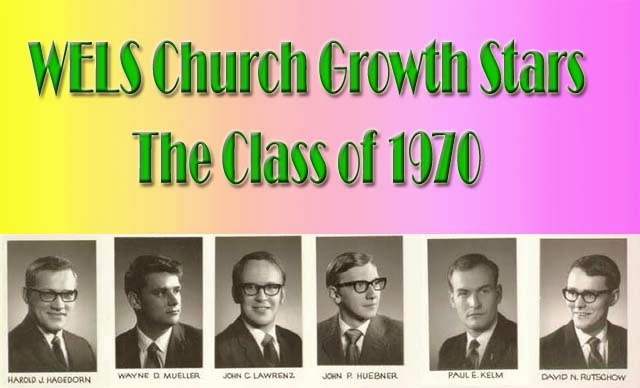
More Bilge from WELS Church Growth Stars
The following is a verbatim quotation from Motley Magpie. Wisconsin Synod gave the Left Foot of Fellowship to the the Berg brothers, sons of Fuller veteran Norm Berg:
In businessman-like fashion, businessman Eberle predictably gets to the bottom line - the bottom line, “our outflow is greater than our inflow” (p. 8). While giving the Spirit his due he argues, “but numerous verses in Scripture can be quoted showing that the Lord expects results” (p. 10) that is, net growth. Given that he states, “I submit that any WELS congregation can grow as fast, or faster, than the fastest growing congregation in its community” (p. 9). He then adds the sweeping appraisal of an unidentified (and evidently well informed) WELS pastor,
Most [WELS pastors] are loathe (sic) to even consider that mega-churches in our area grow because they are well-led, high-performance, high-expectation, high-quality organizations. The fact that these [mega-churches] are theologically more conservative than us and more demanding of their members is conveniently ignored (p. 9)
- to which Mr. Eberle adds, “Since this is the case, it begs the question - Why aren’t there any WELS mega-churches?”
To state it syllogistically: conservative churches grow; the WELS is conservative; therefore, WELS churches should grow, and their “conservatism” should not be used as an excuse for “failure” (p. 11). Mr. Eberle is not the first to make this argument in the Wisconsin Synod. It was made in an 1985 essay with the admittedly improbable title “How to Make Sound Doctrine Sound Good to Mission Prospects” by the Rev. Paul Kelm and in a 1987 essay, “The Call into the Discipling (sic) Ministry” by the Rev. Joel Gerlach who cites, then WELS executive secretary of evangelism,
Kelm, who noted that it requires 103 WELS communicants to enlist one new adult confirmand per year… [for] the Lutheran Church-Missouri Synod… 73 communicants for each new confirmand, [and] the figure for the Assemblies of God (currently the fastest growing Protestant denomination in the USA) is 20 for each new member2 (see the footnote examination of this “statistic”).
Rev. Gerlach concludes,
Thereby hangs the tale. Apparently WELS Lutherans (sic) are not as determined as members of other denominations to become involved personally in sharing their faith with others.
For himself Kelm dismisses the heterodoxy-is-why-the-heterodox-grow factor this way,
True, [fast-growing conservative, biblical churches] may not be fully orthodox; but I fail to see where baptism by immersion and assorted other Protestant departures are any drawing card. In fact, growing churches are typically those whose doctrines and expectations of members are strict” (p. 2).
As if reading from the same script, Mr. Eberle dismisses the “rationalization” that only the apostate grow,
Churches identified as fundamentalist or orthodox have grown, often at an amazing pace. For these churches, orthodoxy seems to be an asset that assists growth, rather than hinders it. Surely you and I don’t believe that the pure Gospel, as taught within the WELS, is an impediment to growth (p. 9)?
So - this naïve definition of “orthodox” aside - a commonality of conservatism (strictness!), a few “assorted Protestant departures” aside, shows that conservative WELS ought to grow, “citius, altius, fortius” - contingent, I suspect, on whether it ingests new church growth hormones, the methods of growing churches.
***
GJ - I know a WELS pastor who dared take issue with Eberle. Soon District Pope Jahnke fired him this way. "I can fire you on the spot or you can voluntarily resign and get three months pay."
Let us consider the solemn declarations of Mr. Eberle, an expert on all churches due to his experience in mass mailings. Kelm is now at the mega-church of Eberle's dreams. Is it Lutheran? No. Is it conservative? No. The congregation appears to be a clone of Robert Schuller's generic, liberal pan-Protestant congregation in California.
Studies have shown...I love to use that phrase. Studies have shown that mega-churches simply take people from other congregations, the way mega-stores take people from Mom and Pop stores. The Church Growth Movement has done nothing to increase the total number of Christians in America. The four-letter synods (ELCA, LCMS, WELS) have slavishly followed Church Growth for decades and they have failed. Once healthy denominations are strangled by high costs, membership decline, low clergy morale, and lawsuits from adulterous Church Growth pastors.
Wednesday, October 17, 2007
Fall, 1985 - Do You Know Where Your Doctrine Is?

Now Becoming Missional
Reading old issues of TELL is like finding the archives of the KGB. Do you know the difference between a KGB agent and a CG guru? ... You can negotiate with the KGB.
The old gang was certainly populating the pathetic little hand-out called TELL (The Evangelism Life-Line). The newsletter was started specifically to promote the Church Growth Movement of Fuller Seminary.
"The publication TELL ('The Evangelism Life Line') has been inaugurated to promote the cause of church growth."
Ernst H. Wendland, "Church Growth Theology," Wisconsin Lutheran Quarterly, April, 1981, 78, p. 105.
"TELL has served the church faithfully for 15 years. Three editors have served; Ronald Roth (1977-84), Paul Kelm (1985-88), and the undersigned since 1989...The lead article in the first issue of TELL was titled 'Church Growth - Worthwhile for WELS.'...The author of this article in April 1988 issue of TELL concludes, 'It's obvious by now that I believe we in WELS can profit greatly from the writings of the church-growth leaders.' ... TELL as a separate publication ends with this issue. Nevertheless, the focus of The Evangelism Life Line will continue for years to come as an integral part of the new Board for Parish Services journal - PARISH LEADERSHIP.
Rev. Robert Hartman, TELL (WELS Evangelism) Summer, 1992.
The future of WELS (and Missouri) is foreshadowed in each issue. As noted just before, Reuel Schulz was promoting Fuller Pentecostal C. Peter Wagner 27 years ago. Valleskey was writing for the newsletter. So was Paul Kelm, who edited some years, including this one.
Let me run through the Fall, 1985 issue of TELL. Readers will see why WELS is in such deep yogurt today.
- Paul Kelm published his classic "Evangelism Upside Down" article. He quoted Valleskey, argued for the Felt Needs approach of Fuller Seminary, and solemnly declared, "What must I do to be saved? is not the burning question of the masses" Listen to this howler, the conclusion: "Upside-down evangelism follows the path of least resistance to the God of gracious acceptance."
- Joel Gerlach wrote for this issue. No one promoted Church Growth more than Gerlach. He especially favored "making disciples." Yes, he went to Fuller Seminary.
- Paul Kelm, as editor of TELL, wrote about Friendship Evangelism, as suggested by another Fuller Seminary student, Norm Berg.
- Norm Berg deserves his own bullet. Berg championed Felt Needs, which proved to be a major belly flop for WELS. My favorite Berg enthusiasm was, "The pastor in New York City is trained to give classes in stress relief." Berg was sure that would bring the prospects in the door. They closed that mission too, after spending tons of money.
- Daniel Schmelzer wrote his own article on Felt Needs. He enthused about the New Mode missions, which Norm Berg loved so dearly. Schmelzer wrote with the authority of the Scribes and the Pharisees, "Put your confessional six-shooter in its holster for the time being and be willing to listen." And... "Don't brush aside felt needs simply because statements contrary to Scripture are made." [GJ - Maybe this has dawned on most TELL readers - the newsletter was consistently contrary to the Word of God and the Confessions. Doggedly contrary.]
Cheer Up - They Gave Kelm a Job, One of Several in Promoting Reformed Doctrine
Ron Roth (who has been taking stewardship down the drain for years) cheerfully reported in the Winter, 1985 issue that WELS made Kelm the fulltime executive secretary for evangelism.
Roth wrote these prophetic words: "Only God knows what will be the effcts of a fulltime secretary for evangelism in WELS. This much I know. The effects will be related directly to how much, how wisely and how enthusiastically you and I make use of this new God-given resource. Welcome to the team Paul!"
Kelm saw the tremendous growth of The Love Shack employees. That was the only thing growing in WELS during the Kelm years. Membership tumbled, perhaps because the true Church is built on the Word, not Enthusiasm. Kelm got himself into serious trouble, but his Fuller friends bailed him out many times. He seemed to be so far gone that everyone thought he was going toward the light. But wait, WELS made him Spiritual Renewal Project director. And he taught a required course at Wisconsin Lutheran College. Everyone had to read Reformed literature to graduate from a WELS college. No, WLC is not WELS unless they are raising funds for it.
Sidebar: brother Dan Kelm became famous for his Willow Creek-like service in Indianapolis. I admit helping his fame by printing the newspaper article in Christian News. Soon Dan was in the LCMS, which is a little bolder about its false doctrine.
Paul Kelm serving as the Pastor of Discipleship at the WELS CG congregation, DePere in Wisconsin. Someone else is the Life Coach. Do those titles ever get confused?
Kelm earned a D.Min. from Concordia Seminary, so he is being called Dr. now.
C. Peter Wagner, Pentecostal Baptist - Early Guru for WELS Church Growth

C. Peter Wagner was an early guru for Church Growth - among the WELS leaders. The very first issues of TELL were praising Wagner. That was more than 27 years ago.
On my lap is a copy of TELL from 1980. In the issue is a book review of a C. Peter Wagner book. Reuel Schulz, a WELS pastor, began his review with these chilling words:
"For several years I've been a Peter Wagner fan." Several years! That means Wagner was sowing his Pentecostal weed seeds in WELS 30 years ago. Three decades. "Game over, man. Game over!" as Bill Paxton once said.
Schulz also recommended more Wagner books, ending his review with "Read these books and you might become a Wagner fan too."
Another fan of Wagner - David Valleskey. What did Valleskey and Schulz have in common? Oh yes, both went to Fuller Seminary. Both wrote for TELL. Valleskey recommended Wagner books in his article in The Northwestern Lutheran (before it became FIC).
WELS has had a number of Pentecostal outbreaks among its clergy, especially those in world and American missions (Valleskey territory). Randy Cutter is healing the sick Pentecostally in Florida right now.
Ft. Wayne Seminary produces Eastern Orthodox clergy, while Mequon makes disciples of Wagner. Could the seminary professors be responsible?
Where is the doctrinal discipline? A Missouri DP hands out free copies of Reggie McNeal. Can anyone imagine a Lutheran DP handing out copies of Luther and saying, "You really need to read this."
BM - Painful at Times, Says WELS Leader

By Dr. John E. Bauer, Editor
Reggie McNeal, not a Lutheran, pictured above.
A Singular Lack of Repentance
By now, readers may be aware that the 3rd annual Church Door Symposium was cancelled after WELS district presidents actively discouraged pastors in their districts from attending. Not one, but three guest speakers were to have shared their insights and the results of their research and experience. One was a Baptist and two were from the LCMS. The 2005 Symposium hosted Dr. Reggie McNeal, a nationally known Baptist author. At the fall 2005 Church and Change Conference, Dr. Leonard Sweet, a Methodist, was the keynote speaker. In the spring of 2005 a Baptist author spoke at Wisconsin Lutheran Seminary as part of the Home Mission Seminar.
In those events that were held, the parameters for the presentations were clearly outside the “framework of fellowship.” In all cases, the expertise of the outside speakers was of great value and they were warmly received. In no case was there a misunderstanding about the doctrinal differences between the hosts and the speakers. As the COP report indicated, these speakers were properly used.
To say that these speakers were “not well received” is not accurate. In fact, representative district presidents and seminary professors were at all of these events. They spoke well of the events and the insights that were gained from listening to the speakers.
But to say that they were well received would not support the conclusion of the COP argument, namely, that the “continuation and increase of such outside speakers is leading to making it unhealthy for the synod.” One has to wonder what is unhealthy about having speakers share their expertise in matters outside the framework of fellowship, especially when they were all received with high praise and appreciation. What appears to actually be the case is that certain parties who
have never attended such symposia or conferences have prejudged the presence of such speakers as being in and of itself a violation of the doctrinal principles of fellowship. Without taking the time to think through such things as audience, topic,context, purpose, setting, etc., reactions often seem to be based on personal and individual impressions. Rather than engage in brotherly discussion, emails and letters fly about that label individuals “and their ilk” as “heretics,” even when the purpose of the presentation is of a non-doctrinal nature. Is this the “sensitivity” that is spoken of in the report—a sensitivity that is based on an inadequate understanding of the doctrine of church fellowship and a narrow interpretation of how it should be applied?
Much of the confusion comes from the fact that it is a matter of judgment as to which speakers might be acceptable and which are not. However, it is never clear whose judgment should prevail. The correspondence from some pastors and district presidents urging that the Church Door Symposium be cancelled was more than outweighed by the outrage expressed by other pastors following the Symposium’s cancellation.
Can this report really be saying that the COP can’t find fault with the practice itself on doctrinal grounds, but finds it unhealthy because a number of individuals have their sensitivities offended? Readers are again urged to read the article in the Christmas 2005 issue of CHARIS entitled “What the Scriptures Say About Christian Liberty.”
But consider the nature of the symposia and conferences that have come under attack and which seem to be goading church leaders into becoming more and more prohibitive. These events are offered on the well-founded assumption that attendees are spiritually mature and biblically literate. The audiences are comprised largely of pastors and lay leaders in the WELS fellowship. These are not impressionable undergraduates or theologically naïve laypeople. These audiences are comprised of the very people who are in the best position to discern truth from error, to take what is wholesome and beneficial, and to recognize if something said doesn’t jibe with WELS doctrine and to challenge it.
The context for such symposia is clearly academic in nature. Analyzing and evaluating ideas about ministry is consistent with what think tanks, institutes, colleges, and seminaries are supposed to do. The topics are carefully chosen to avoid direct instruction in doctrine, but are rather selected to explore issues and challenges that face the church. The audience is comprised of theologically trained pastors and teachers, along with spiritually mature lay leaders. The expectation is that they are capable of discernment and good judgment. The purpose of such events is to help churches carry out their ministries, not to alter doctrine. To that end, church leaders participate with the expectation that they are getting from the event what they paid for. If they are disappointed, or offended, then they don’t attend. How sad that we have devolved to such a level of mistrust, that brothers in the ministry don’t have confidence in each other to exercise appropriate discernment. How sad that the WELS has been reduced to factional mistrust instead of collegial respect. How odd it is that some of the “strongest” voices in the Synod are making the greatest appeal to their “weakness.” And how sad it is that we can’t trust pastors and professors to properly engage with the authors of the very books that are sold to untrained laypeople at Northwestern Publishing House.
College Qua College
These distortions of the church fellowship principle raise a larger issue regarding the nature and qualities of a college that identifies itself as distinctively Lutheran. What are the attributes of a Lutheran institution of higher education? What are the means and methods by which it educates its students and extends its educational mission into programs and services for its larger constituencies? A college is a place in which students explore and examine ideas, develop reasoning skills, cultivate the ability to communicate ideas, reason scientifically, think critically, argue logically, and grow in appreciation for the arts and humanities. In a Christian college, this is done in the context of the Bible as the ultimate source of truth, but not the only source of all truth. In a Lutheran college, this is conducted within the parameters set by the Lutheran confessional writings. Wisconsin Lutheran College in particular expresses this commitment by saying that “education is inseparable from religion, that all knowledge in all areas of human thought and endeavor is worthy of inquiry when viewed in the light of human sin and divine grace.”
***
The whining in 2005 worked well. Church and Change had their conference October 15th.
LCMS BMs


From John Whaley:
Mt. Olive Lutheran Ministries hosted Circuit 18's Convocation Sunday, January 22nd. A good number of churches from the Silicon Valley came to hear President Newton share his vision of the ministry for the CNH District. He continued to speak on the theme from Jeremiah 29. In addition, the group spent time in discussion around the six realities facing the church today as identified by Reggie McNeal in his book, The Present Future. As experienced in other convocations this year, lively discussions ensued.
Try Not To Gag
Present Future: A Book a Lot of People are Reading
Why is President Newton giving away copies of Present Future to everyone he meets? Perhaps it's because Reggie McNeal has touched on the jugular when it comes to where the church needs to be as it attempts to minister in our world.
Reggie McNeal identifies the six most important realities that church leaders must address including: recapturing the spirit of Christianity and replacing "church growth" with a wider vision of kingdom growth; developing disciples instead of church members; fostering the rise of a new apostolic leadership; focusing on spiritual formation rather than church programs; and shifting from prediction and planning to preparation for the challenges of an uncertain world. McNeal contends that by changing the questions church leaders ask themselves about their congregations and their plans, they can frame the core issues and approach the future with new eyes, new purpose, and new ideas. Written for congregational leaders, pastors, and staff leaders, The Present Future captures the urgency of a future that is literally now upon us, in a thoughtful, vigorous way. It is filled with examples of leaders and churches who are emerging into a new identity and purpose, and rediscovering the focus of their mission within new spiritual dimensions.
Get your copy. . .
Your Daily BM

Becoming Missional Logo
House Church Blog:
From Reggie McNeal’s book (The Present Future: Six Tough Questions for the Church):
The Pharisees' evangelism strategy sounds eerily familar. Their approach to sharing God was, "Come and get it!"...Jesus' evangelism strategy directly challenged the Pharisees' approach. Instead of "Come and get it!" it was "Go get'em!" p. 28
Jesus' strategy was to go where people were already hanging out. This is why he went to weddings, parties, and religious feast day celebrations...Taking the gospel to the streets means we need church where people are already hanging out. We need a church in every mall, every Wal-Mart supercenter, every Barnes and Noble. p. 35
Bottom line: we've got to take the gospel to the streets. This is the only appropriate missional response to the collapse of the church culture. I am not talking about short forays into port off of the cruise ship. I am speaking of an intentional 24/7 church presence in the community, not tied to church real estate: (rather) office building, malls, school campuses, sports complexes, storefronts, homes, apartment buildings, and community centers. We need to go where people are already hanging out and be prepared to have conversations with them about the great love of our lives. This will require our shifting our efforts from growing churches into transforming communities.
They're not coming to us. We've got to go to them.
***
WELS Official apostate lobbyists, Church and Change, are huge fans of Reggie McNeal and Becoming Missional. Huge.
Episcopal House of Bishops

Dr. Katharine Jefferts Schori, Presiding Bishop
Posted by David Virtue on 2007/10/6 5:40:00 (3554 reads)
NO SHAME IN EPISCOPAL CHURCH HOUSE OF BISHOPS
Commentary
By David W. Virtue
www.virtueonline.org
10/6/2007
While observing the Episcopal House of Bishops in action from the bleachers at the Intercontinental Hotel in New Orleans recently, I was struck by the fact that before me were a group of mostly white males playing out the moral delusions of the 60's as they head towards retirement in the early decades of the 21st century.
What struck me most was that, in the absence of any notion of personal sin (except perhaps child and female abuse), the idea of sin, and therefore shame, was entirely absent. Sin is now cast mostly in terms of racism and homophobia and Global South Primates who can't quite get with the program that the Episcopal Church and Mother Schori know best about how the whole Anglican Communion should be run, if only it could be let loose to run (read ruin) it.
Mercifully, that is not now going to happen. The Global South has awakened to the truth that North American bishops, like the proverbial emperors, have no ecclesiastical clothes, and what they wear has been tainted by so much sin that Joseph's coat of many colors would make better vestments, even after they have been dry cleaned a few times.
One could not help but notice the over bearing presence of Jo Mo Doss, the former worthless Bishop of New Jersey, striding around like he owned the place. He was tossed out of the diocese for, among other things, being a racist according to the Black Caucus of priests in the diocese. Compounding the outrage was a $1.5 million payout engineered by former Presiding Bishop Frank Griswold and the promise that the diocese would not hire a new bishop until the retirement date of Doss kicked in.
In the back pews of the HOB sat former Utah bishop Otis Charles looking hollow and gaunt, much like his morality. He and his male partner have five former marriages between them...and now they have each other. No shame there.
In the middle of the episcopal circus sits Vickie Gene Robinson dressed in Hawaiian shirt grinning at everyone, ready and waiting to pounce on anyone who even dares to suggest that his sexual behavior is bringing the Anglican Communion down around its ears. Naturally, he took a swipe at Rowan Williams, the titular head of the whole communion, accusing him of "dehumanizing" gays and lesbians, telling him in no uncertain terms exactly what was on his mind and heart. Never mind that in the entire history of Canterbury archbishops no one has cut sodomites more slack to engage in anal sex, presuming it is being done in a committed relationship. No point in letting an opportunity slip by without whacking your only solid friend in Lambeth Palace, now is there.
Then of course there is Charles Bennison, the idiot, sociopathic Bishop of Pennsylvania, who faces civil and ecclesiastical charges ranging from fraud to financial mismanagement of the diocese. He was the ONLY bishop to vote against the final resolution because he just had to be honest with himself about letting sodomite priests practice their behavior without fear of Episcopal inhibition and sexual curtailment. I never saw the giant bear hug Vickie must have given him, but I'm sure there must have been one. A missed photo op for sure.
Then there is Tom Shaw, Bishop of Massachusetts dressed appropriately in black monkish robes. His chaplain, a younger look-alike version of himself, is appropriately following his "master" around with a funny grin on his face, while Shaw engages his former female suffragan Bishop Barbara Harris in "deep" conversation about whatever.
There are other sodomite bishops of course, but they won't come out of the closet to support Gene. Why should they, Gene is doing all the heavy lifting for them. No need to spoil a good thing. Stay under the radar screen, Gene is doing great PR for the cause. They can cheer him along from the sidelines collecting huge pensions when they come to retire with their lovers to Mexico or wherever the dollar is still worth something.
And then of course there is Mother Schori who treats them all like a schoolmistress dealing with a bunch of recalcitrant schoolboys. The only thing missing is a large primeval (British-made) cane she can wield to whack those who get out of line about MDG's or for daring to suggest that the Great Commission might have something to do with saving souls, which might be necessary if there is to be an Episcopal Church a decade from now.
In the meantime, there are lots of papers to be written, more communiques to be handed out, more shuffle to be done, more spin to be spun, more bribes to African bishops to be made, more "mission" gabfests to attend at expensive hotels courtesy of the Episcopal Church's proxy sister, Trinity Church Wall Street, and dead men's money to be spent to keep the church afloat and law firms to pay.
After all the show must go on (and there is no shame in that) even if there is only the HOB in attendance and the lights have gone up to reveal an empty auditorium.
Willow Creek Effect

Bill Hybels, Willow Creek Community Church aka Lutheran Training Academy
wantingthemountainstofallonme has left a new comment on your post "Willow Creek Story and Parody":
I was not only alarmed and confused when my former WELS pastor and leaders of that church were attending Willow Creek for seminars and sessions. Why would they want to sit at the feet of mockers and even subject themselves to false teachers I wondered? Even that pastor said if you went to a Willow Creek Service you would say (quote to the best of my memory) "these people are devoid of the Gospel, there is no solid teaching there. But the zeal these people have is amazing." I just remember him saying "their zeal, their zeal!" as if he were bitten by the AMWAY bug. (if youv'e ever met someone smitten with the AMWAY eyes you'll know what I mean. It was truely frieghtening fo rme to see. My stomach was really starting to tweek and twitter. The internal alarm in me (my conscience, discernment?) was really convicting me. I left the chruch shortly after.
***
GJ - Ditto. Wally Oelhaven, trained at Fuller Seminary, head of the Michigan WELS mission board, wanted Lutherans to be as enthusiastic as the Reformed.
I know the Michigan District board paid pastors to attend Willow Creek seminars. They never asked me. I attended a Seeker Service there anyway.
WELS pastors really thought that imitating Willow Creek would create Willow Creek clones. I suppose the Parlow/Kelm congregation is a clone, but is it Lutheran?
A Church Growth expert has said that Willow Creek is the most influential church in America. That is certainly true about WELS and Missouri. Willow Creek has influenced ELCA as well. Even some of the mini-micro sects have their tongues hanging out for Willow Creek.
Why do Lutheran congregations do well when they become liberal Reformed?
1. Lutherans have a long history with Pietism, which is unionism with the Reformed and based on good works, not the Word and faith.
2. The Wisconsin Synod began with union Reformed-Lutheran congregations. The old spirit has not gone away.
3. The high profile congregations in America are anti-Confessional.
4. Synodical leaders are pragmatists, not idealists. They want to promote what works.
5. Many synodical leaders are also apostates. They hate orthodox Lutheran doctrine and those who love the Triglotta, Luther, Chemnitz, and J. Gerhard. (It's official, everyone loves Paul Gerhardt the hymn-writer. They just hate his doctrine.)
6. Healthy, orthodox Lutheran congregations are an embarrassment to Lutheran leaders, so they never give those parishes any credit for doing anything right.
7. Apostate pastors who chase women and girls (boys, too) must be protected, because they give synodical leaders a bad reputation.
One WELS mission pastor actually gave Hybels sermons, verbatim, complete with the same vocal nuances. On Ichabod I have recorded two WELS pastors copying Reformed sermons almost verbatim and posting them as their own work. That is against the law.
***
rlschultz has left a new comment on your post "Willow Creek Effect":
A former member of our WELS congregation was obsessed with the zeal that those in the Reformed camp exhibited. He even tried to lead by example. When he wasn't working or going to board and Council meetings, he would be watching some TV circus tent huckster or going to a "prophecy conference". Whenever we had a vacancy on a board, he would start whining about the lack of enthusiasm (pun intended) among our members. He would then point to the Oneness Pentecostal sect about a mile away as proof that their zeal produced results. The claim was made that they never had any money problems as everyone tithed. There was always a packed house as members came from as far as 30 miles away. The implication being that they did things right.
Those who lack discernment will always be impressed with apparent success. I used to work with a fellow who belonged to a big LCMS congregation. He had the same complaints about lack of zeal. He used to point to the door knocking of the Jehovah's Witnesses as evidence that even the JW's were better than those dull Lutherans.
The Amway analogy is fitting. The Amway stakeholders are expected to leave , eat and breathe Amway. My wife was involved in a similar direct sales scheme many years ago. Their monthly meetings were no more than circus tent revivals. Their product was expected to be the center of your universe.
It reminds me of a little comedy routine from Cheech & Chong. A guy is talking about how his life changed when he got religion. He says, "Before, I was all messed up on drugs. But since I found Jesus, I'm all messed up on the Lord".
Along with this, the keynote speaker at the C&C conference is motivational speaker John Di Frances. Read about him at http://www.superbspeakers.com/speaker_listing.asp?sid=56.
To paraphrase a credit card commercial - Motivational speaker fee: $15,000 to $20,000. Cost of enthusiasm: priceless.
***
Greg Jackson Is Da Man! has left a new comment on your post "Willow Creek Effect":
******"On Ichabod I have recorded two WELS pastors copying Reformed sermons almost verbatim and posting them as their own work. That is against the law."*****
You are the man Greg, you da man! Continue your back patting. I'm sure it feels good. You sure stuck it to them! If you keep it up surely WELS will soon bow down to you! You go Greg!
***
GJ - The poster directly above should wonder why ordained ministers are stealing the words of others and portraying them as their own. I did not find the plagiarism. Various WELS pastors/laity found the examples and relayed them, signing their emails, not hiding like A. Nony Mouse. I asked for a direct link to prove where one came from.
***
Bruce Church has left a new comment on your post "Willow Creek Effect":
You're wise for copying comments on your blog into the main body of your posts (i.e., updating your posts) because otherwise, the commenters might come back and delete and revise their comments unbeknownst to you.
***
GJ - Thank you. I learned how quickly the Ichabod effect hits. Crown of Life, Corona, California, removed the Leonard Sweet rhapsody plus its gushing-red-ink offering figures, finding it a horrible sin that I mentioned their offerings.
A typical WELS response to violations of the Ten Commandments is to make the objection itself a sin and to make snide personal remarks. Nevertheless, stealing someone els'e words remains a sin and a civil crime. My experience with classroom plagiarists is that they act very offended, deny the most obvious facts, hide the evidence (if possible), and accuse the instructor of vile crimes against education.
In confirmation, the daughter of a woman who committed adultery explained the Sixth Commandment this way, "You should not steal away someone who belongs to another person." I thought this was an insightful blending of two commandments. Infidelity and thievery go together.
Holy Communion Practices

The old Receptionist views of the Synodical Conference have adversely affected the thinking of many. Receptionism means the elements of Holy Communion are not the Body and Blood of Christ until they are received. Many were trained this way and still think along these lines.
There are three ways of dealing with elements remaining after the Holy Communion service is over, if the congregation rejects Receptionism. (I hate to use the term Consecrationist, because the word is a label for orthodox Christian teaching.)
1. One way is to consume the remaining elements.
2. Another way is to respectfully pour the remaining wine, which is the Blood of Christ, onto the earth. I vicared at a church where a sink was installed in the sacristy for that purpose.
3. A third way is to have an accurate count of the communicants. That is fairly easy with closed communion and a smaller congregation.
I know that one WELS member thought a Missouri congregation was throwing away the remaining elements. The reasoning behind these actions listed above is to show that the Words of Institution mean what they say. Congregational actions are not always consistent. It is good to ask what is being done and why it is being done. I think the LCMS congregation throwing away the remaining elements was saying: We do not mix consecrated elements with the unconsecrated, because the Words of Institution mean what they say." I am also guessing the congregation treats the remaining elements with reverence, even if the words chosen (or impressions given) are bad.
If a congregation short-changes the elements for a large communion service and ushers bring in new supplies (to be used right away), it is saying, "The Words of Institution mean nothing." New elements should be consecrated or adequate amounts should be provided in the first place.
I am writing about this because several laymen had questions. The best preparation for Holy Communionn is a believing heart. If the pastor is an orthodox Lutheran in his teaching, the individual should have no problems communing.
Perhaps others share my frustration. Many ELCA and LCMS pastors insist on every Sunday service being a Holy Communion service. I am not opposed to this. It is my practice. I am opposed to the Law attitude of the advocates. I also wonder about those who are Patristic Fundamentalists but care nothing about Lutheran doctrine.
KJV 1 Timothy 4:1 Now the Spirit speaketh expressly, that in the latter times some shall depart from the faith, giving heed to seducing spirits, and doctrines of devils; 2 Speaking lies in hypocrisy; having their conscience seared with a hot iron; 3 Forbidding to marry, and commanding to abstain from meats, which
God hath created to be received with thanksgiving of them which believe and know the truth. 4 For every creature of God is good, and nothing to be refused, if it be received with thanksgiving: 5 For it is sanctified by the word of God and prayer.
KJV 2 Timothy 3:1 This know also, that in the last days perilous times shall come. 2 For men shall be lovers of their own selves, covetous, boasters, proud, blasphemers, disobedient to parents, unthankful, unholy, 3 Without natural affection, trucebreakers, false accusers, incontinent, fierce, despisers of those that are good, 4 Traitors, heady, highminded, lovers of pleasures more than lovers of God; 5 Having a form of godliness, but denying the power thereof: from such turn away. 6 For of this sort are they which creep into houses, and lead captive silly women laden with sins, led away with divers lusts, 7 Ever learning, and never able to come to the knowledge of the truth.
Chemnitz Post on The Plucked Chicken
The Plucked Chicken is an ELS blog with fairly regular posts, worth reading. Here is PC quoting B. W. Teigen:
In giving Chemnitz's stance with regard to the Scriptures and his hermeneutical principles, it is necessary to consider his view of reason and the use of Aristotelian terms and conceptual usages. Chemnitz is a sharp thinker who recognizes the necessity of precise definitions and nice distinctions. He will draw valid conclusions from clear propositions of Scripture. But he follows Luther in holding that there is no place in theology for reason corrupted by natural man. In spiritual matters reason must take its premises from the Word. While at times it may be harmless to borrow Aristotelian terminology (such as causa efficiens, causa instrumentalis, causa finalis, rem sacramenti, etc.), it can become dangerous and limit the Word of God because these terms of Aristotle are designed for the secular world. There is a vast difference between the earthly kingdom and the spiritual or heavenly kingdom, where we deal with things which eye has not seen nor ear heard nor entered into the mind of man.
-- Bjarne Wollan Teigen, The Lord's Supper in the Theology of Martin Chemnitz p. 21.
The Lord's Supper controversy in the ELS is significant because the ELS ambiguously denied the efficacy of the Word, following the lead of WELS, where the efficacy of the Word is strenuously denied as often as possible.
The old bromide of "We don't know the moment of consecration" is another way of saying, "We reject Isaiah 55, with the Calvinists." The true Calvinists are never sure when the Holy Spirit accompanies the Word.
KJV Isaiah 55:8
For my thoughts are not your thoughts,
neither are your ways my ways, saith the LORD.
9 For as the heavens are higher than the earth,
so are my ways higher than your ways,
and my thoughts than your thoughts.
10 For as the rain cometh down,
and the snow from heaven, and returneth not thither,
but watereth the earth,
and maketh it bring forth and bud,
that it may give seed to the sower,
and bread to the eater:
11 So shall my word be
that goeth forth out of my mouth:
it shall not return unto me void,
but it shall accomplish that which I please,
and it shall prosper in the thing whereto I sent it.
12 For ye shall go out with joy,
and be led forth with peace:
the mountains and the hills
shall break forth before you into
singing, and all the trees of the field
shall clap their hands.
When--in the Isaiah 55 passage or any other Biblical passage--is the Holy Spirit absent from the Word?
Willow Creek Story and Parody

At Willow Creek Community Church outside Chicago, Sunday morning generally features eight worship services at four locations with 15,000 people attending.
On Christmas Sunday this year, their doors will be closed.
As quoted in USA Today:
Cally Parkinson, a spokeswoman for Willow Creek Community Church in South Barrington, Ill., said church leaders decided that organizing services on a Christmas Sunday would not be the most effective use of staff and volunteer resources. The last time Christmas fell on a Sunday was 1994, and only a small number of people showed up to pray, she said.
"If our target and our mission is to reach the unchurched, basically the people who don't go to church, how likely is it that they'll be going to church on Christmas morning?" she said.
According to Willow Creek the only reason to worship God on Sunday is to reach the unchurched? I thought that Christians worshipped God on Sunday in order to......uh.....worship God!?
Sure Christmas is a busy day....for families in particular. There are stockings to poke through. Bicycles to assemble. Presents to unwrap. Food to cook. Guests to accommodate. Trips to make. When Christmas falls on a Sunday, like it does this year, how can people be expected to squeeze in a morning worship service in the middle of all that?
Christmas, after all, is about families, isn't it? Or is it about God....and Jesus....the Incarnation...the Word become flesh....the advent of the Son of God....Immanuel....the Prince of Peace.
On that first Christmas,
-Angels took the time to form a choir, and;
-Shepherds took time off in order to find the baby Jesus and worship him.
It seems to me that the Christmas story provides a clear guide to what should be a Christian's priority on a Christmas Sunday morning.
After all, the only present really worth celebrating on Christmas Day is the gift of Jesus himself.
Come to think of it, Easter morning is a busy time for families, too. All those egg hunts and Easter baskets and family gatherings and travel plans and cooking big Easter meals.
Perhaps Willow Creek should close down on Easter, too. It's a real bother that Easter has to land on a Sunday every year.
Note: It's almost enough to make this parody seem like the real thing!
[GJ- The parody is below. Warning. Warning. It is a parody. That means the story is making fun of Willow Creek trends. The story above is serious. One must have great discernment to detect the difference between the news story and the parody.]
Shutdown Season:
Willow Creek Community Church Will Close its Doors for the Summer
SOUTH BARRINGTON, IL – In perhaps the most extreme example to date of churches halting ministries during the traditionally slower summer months, Willow Creek Community Church – one of America's prototypical mega-churches – has decided to close its doors until after Labor Day.
"The church leadership took a look at where attendance and giving were last summer, and when you look at the numbers, the case for closing shop just makes a lot of sense," said Willow Creek Senior Pastor Bill Hybels. "For years we've been trying to justify the expense of operating throughout the summer when schools are closed and people are on vacation. We just couldn't do it any more. If people are going to put their spiritual growth on hold until September anyway, why should the church fight it?"
While weekly services and other regular ministries have all been canceled, some special, summer-specific programs like summer camps will still go on as scheduled.
"It's not like the church will be disappearing off the face of the earth," said Church Administrator David Widener. "We're still having the big Third Day concert, along with any other events that traditionally bring in a good amount of money. Plus we'll still have a pastor on call at all times just in case anyone has a spiritual need that absolutely can't wait until September."
While many churches have been putting Bible studies, choirs and other portions of regular church life on the back burner during the summer for years, this may be the first example of a church scheduling a complete shutdown.
"I see this as part of a trend of church attendance as we know it taking a serious dip around the world, and not just during the summer months," said Robert Holmes, president of the Center for the Study of World Religion – a London-based religion think tank. "With so many media options out there for people to get their spiritual enlightenment, the practice of church attendance is in real trouble. Mark my words. This is a harbinger."
Not surprisingly, Hybels doesn't see it that way.
Hybels is planning on 4 weeks in Tahiti
"Willow Creek has been setting trends for the rest of the evangelical community for decades," he said. "When we started changing the way we do worship and outreach, you had people acting like it was the end of the world. Now they're all doing the same things. This is going to strengthen our church. The money we save by shutting down over the summer will go toward reaching people for Christ during the rest of the year. When other churches see how this benefits us, shutting down for the summer will soon become as common as church names that have nothing to do with God or Christianity."
Josh Allen - a 13-year-old who regularly attends Willow Creek with his parents - is on Hybels' side.
"No more hymnals. No more pews. No more sermons to make me snooze," Allen rhymed with glee. "I'll see you at the pool!"
But not all Willow Creekers share Allen's enthusiasm.
"We had skits rehearsed and ready to go for every Sunday in the summer," said Willow Creek Drama Team Leader Leah Cress. "Now all that work is completely worthless. It's not gonna make much sense to perform a theatrical representation of the importance of beach evangelism in the dead of winter, now is it?"
Despite the detractors, Widener is almost giddy about the concept of saying a fond farewell to summer services.
"No more bloated air conditioning bills for a room that's only half full," he said, eyes gleaming. "All that money being saved for God's kingdom and not being wasted on a scant congregation that would rather be on vacation anyway. It's a beautiful thing."
LCMS Winning Poll

There is only one day left to vote in the poll on which synod is the most pastor-friendly.
The Missouri Synod is clearly winning. ELCA pastors leave Sodom for the LCMS. ELS pastors leave their tiny kingdom for their big sister, following the example of the sainted Preus brothers (Jack and Robert).
ELCA probably won some votes because they accept men, women, and the undecided. In the language of the Lavender Mafia: LBGTQ. The Q is for Questioning. That category probably fits most of the straight, male clergy. "I really like the design of the new hymnal. Omigosh. Am I gay?"
I cannot fathom why anyone would vote the Little Sect on the Prairie as the most pastor-friendly. Maybe some read the question as the most pasture-friendly.
Anyone who voted for WELS must have Stockholm Syndrome, which is rife in the Wisconsin Synod. Stockholm Syndrome is that disorder where people are kept captive and abused and yet sympathize with their captors. Mark Twain described it in Tom Sawyer, when the boys planned to kidnap women, who would fall in love with them.
Stockhold Syndrome is obvious when pastors say, "Every time I read Christian News I thank God I'm in the Wisconsin Synod." One WELS pastor sent me a book on abusive churches. I said, "This fits WELS perfectly."
WELS is united doctrinally. The old leadership is trained 100% at Fuller Seminary and Willow Creek Community Church. The same can be said for the LCMS. Kieschnick has a Fuller-trained administration and he is ecumenical to a fault.
Link Fixed
Souces Menu
Practial Applications of the Word (Chapter 10 from Thy Strong Word) was not working, one of my advisors said. I repaired the link, so it should work now.