Sunday, August 18, 2019

The Ninth Sunday after Trinity, Luke 16:1-9.
Jesus Taught His Disciples


The Ninth Sunday after Trinity, 2019

Pastor Gregory L. Jackson


The melodies are linked in the hymn title. 
The lyrics are linked in the hymn number.
The Confession of Sins
The Absolution
The Introit p. 16
The Gloria Patri
The Kyrie p. 17
The Gloria in Excelsis
The Salutation and Collect p. 19
The Epistle and Gradual       
The Gospel              
Glory be to Thee, O Lord!
Praise be to Thee, O Christ!
The Nicene Creed             p. 22
        
Jesus Taught His Disciples

The Preface p. 24
The Sanctus p. 26
The Lord's Prayer p. 27
The Words of Institution
The Agnus Dei p. 28
The Nunc Dimittis p. 29
The Benediction p. 31
The Hymn # 649     Jesus Savior Pilot Me 

In Our Prayers
  • Andrea, whose eyes will need careful, patient help.
  • Carl Roper, who is being treated for more occurrences.
  • Christina Jackson, being treated for infection.
  • Elizabeth Mior - has cancer. She is the mother of two small children.
  • Those looking for work and a better income.
  • Glen Kotten is doing well and appreciates your prayers.
  • Our country's leaders as justice is served to the criminals and traitors. Over 60,000 indictments.
            

KJV 1 Corinthians 10:1 Moreover, brethren, I would not that ye should be ignorant, how that all our fathers were under the cloud, and all passed through the sea; 2 And were all baptized unto Moses in the cloud and in the sea; 3 And did all eat the same spiritual meat; 4 And did all drink the same spiritual drink: for they drank of that spiritual Rock that followed them: and that Rock was Christ. 5 But with many of them God was not well pleased: for they were overthrown in the wilderness. 6 Now these things were our examples, to the intent we should not lust after evil things, as they also lusted.

KJV Luke 16:1 And he said also unto his disciples, There was a certain rich man, which had a steward; and the same was accused unto him that he had wasted his goods. 2 And he called him, and said unto him, How is it that I hear this of thee? give an account of thy stewardship; for thou mayest be no longer steward. 3 Then the steward said within himself, What shall I do? for my lord taketh away from me the stewardship: I cannot dig; to beg I am ashamed. 4 I am resolved what to do, that, when I am put out of the stewardship, they may receive me into their houses. 5 So he called every one of his lord's debtors unto him, and said unto the first, How much owest thou unto my lord? 6 And he said, An hundred measures of oil. And he said unto him, Take thy bill, and sit down quickly, and write fifty. 7 Then said he to another, And how much owest thou? And he said, An hundred measures of wheat. And he said unto him, Take thy bill, and write fourscore. 8 And the lord commended the unjust steward, because he had done wisely: for the children of this world are in their generation wiser than the children of light. 9 And I say unto you, Make to yourselves friends of the mammon of unrighteousness; that, when ye fail, they may receive you into everlasting habitations.


Ninth Sunday After Trinity

Lord God, heavenly Father, who hast bountifully given us Thy blessing and our daily bread: We beseech Thee, preserve us from covetousness, and so quicken our hearts that we willingly share Thy blessed gifts with our needy brethren; that we may be found faithful stewards of Thy gifts, and abide in Thy grace when we shall be removed from our stewardship, and shall come before Thy judgment, through our Lord Jesus Christ, Thy Son, who liveth and reigneth with Thee and the Holy Ghost, one true God, world without end. Amen.


Background for the Sermon, Luke 16:1-9, The Unrighteous Steward
This is the most debated parable of all, and the most perplexing. First we should consider that the best lessons from Jesus arise from those teachings that escape us the first time, even the first 20 times, the ones very few of the experts can grasp. Sometimes they are called "hard sayings of Jesus" and therefore are avoided. But the longer they are studied, phrase by phrase, the more we gain from them. The Holy Spirit is stingy with words, so the words of the Bible  are extremely valuable, especially down to those details which are often overlooked.

For practice, simply begin with the opening. This is a parable taught to the disciples, not to large or small crowds. The second frame reference is verses 9. Our Greek students will notice something unusual in this one verse conclusion about the lesson to the disciples.

Luke 16:9 καγω υμιν λεγω ποιησατε εαυτοις φιλους εκ του μαμωνα της αδικιας

Most of the teachings of Jesus use the pronoun in the verb (lego) which is sufficient for clarity. But this begins with and-I myself, which serves a double purpose. And is punctuation - the story is over, here is the lesson. I myself means - this is My lesson to you, the disciples, and it is exceptionally important.

Consider this - is this parable difficult or do we make it difficult by running back and forth between 12 interpretations of it? Is the Word of God clear and plain - or is it so difficult and challenging that we need a hierarchy to declare the truth for us? 

The difficult passages are that way because so much sand has been thrown in our eyes by inventive, creative dunces. Apart from that, they serve as a way to challenge us to read more Scripture, to pay attention to its clear teaching. No passage contradicts another, so if we cannot discover meaning at one point, we can find out how another passage explains it better for us. Every verse is part of one unified Truth.


Jesus Taught His Disciples

KJV Luke 16:1 And he said also unto his disciples, There was a certain rich man, which had a steward; and the same was accused unto him that he had wasted his goods.

Many sayings of Jesus are plain and simple to grasp, but others require more thought and consideration. Stories have a framework, and a parable is a short story with a definite major point and sometimes additional points. There is a beginning and an ending. Some parables are explained by Jesus and others are not. So our best chance at understanding this debated parable is to see how Jesus Himself explained it. 

Major overlooked phrase - And He said to His disciples - so obvious and so easy to pass by without thinking. This parable is aimed at the disciples only. That does not mean  - only for the bishops (district presidents), cardinals (parachurch businesses) and pope (synod presidents). No, if it was so important for the disciples, we should give it special consideration and keep the lesson  vivid in our minds. Jesus and Paul made some lessons paradoxical in order to make us study them and learn them better.

This time around should be better and clearer for us, which is why we have the same lessons year after year. 

There was a certain rich man, which had a steward; and the same was accused unto him that he had wasted his goods.

The wording tells us this is a parable, a short story. There are no names, no places, but key characters. One is a rich man who owns and sells large quantities of farm produce. Another is his manager (steward) who handles this complicated business. Someone told on the steward, revealing he was not doing his job honestly.

We should not overlook this term "steward," which transliterates to "economist" (house-law), and therefore manager. Paul called himself a steward of the mysteries of God - a manager, not the owner, of the Spirit revealed truths of God's revelation. 1 Corinthians 4:1ff.

2 And he called him, and said unto him, How is it that I hear this of thee? give an account of thy stewardship; for thou mayest be no longer steward.

At this point, the rich man believed the charges and fired the manager. The steward's last work was to gather the the accounting books and hand them over to the owner.

There was no debate, no trial. The manager was guilty.

3 Then the steward said within himself, What shall I do? for my lord taketh away from me the stewardship: I cannot dig; to beg I am ashamed. 

This Hamlet-like soliloquy is a bit funny. Two options were bad - he was an accountant, not a laborer who would dig in the hot sun. He was too ashamed to beg. Another option had to be considered.

4 I am resolved what to do, that, when I am put out of the stewardship, they may receive me into their houses. 

This verse gives us a key point and some word-play in Greek. He was getting booted from his house-law in Greek, so he had a plan for the customers to welcome him into their houses.

"Receive" has the meaning of welcome and is used for believing, receiving Christ. The obstinate reject Christ. Those converted by the Gospel welcome Christ into their lives.

5 So he called every one of his lord's debtors unto him, and said unto the first, How much owest thou unto my lord? 6 And he said, An hundred measures of oil. And he said unto him, Take thy bill, and sit down quickly, and write fifty. 7 Then said he to another, And how much owest thou? And he said, An hundred measures of wheat. And he said unto him, Take thy bill, and write fourscore.

This is the crux of the parable, but not actually the lesson. Small children think - "This steward is a crooked. He is going to be punished." Like any good story, this has a plot twist.

It reminds me of a way business gets a quick and easy cash flow - by a clearance sale. Sure, the products are worth so much retail, but the storage of those items will cost some money and not pay any bills. Mark them as CLEARANCE! and they will be gone in a flash. I saw a huge pile of 50 pound bags of dogfood in the aisle at one store half-price. I asked, "Who wants them?" They were gone in hours.

But of course no one gave the steward permission to discount the money owed to the rich man.

8 And the lord commended the unjust steward, because he had done wisely: for the children of this world are in their generation wiser than the children of light.

This is where the parable gets its title, and a title will always change perception of the story. For example, what does "The Gift of the Magi" suggest to people, even though it involved a husband and wife giving up what they thought was precious, nullifying the gift of the other? (She sold her hair to buy a chain for his watch; he sold his watch to buy combs for her hair.) The title suggests Christmas and selfless giving to another.

But is this about  the unjust steward? The "for" explanation begins the explanation of the parable with an observation. The unbelievers are more active, clever, and unrelenting in clinging to their material things than the believers (children of light) are in staying with the Faith.

Since the rich man is also called the lord, we see him as representing God. But does God commend greedy dishonesty? That is where the parable turns itself around. The way it is stated makes us wonder, but my version would not have -

My simpler version - And God wondered why the unbelievers work so hard at keeping the things that never last, but the Christians are lax and careless about the forgiveness of sin, salvation, and everlasting life - the treasures of the Gospel. If only the believers loved the Gospel as much as the steward loved his comforts on a rich man's estate!

9 And I say unto you, Make to yourselves friends of the mammon of unrighteousness; that, when ye fail, they may receive you into everlasting habitations.

26. But it is especially before God an unrighteous mammon because man does not serve his neighbor with it; for where my neighbor is in need and I do not help him when I have the means to do so, I unjustly keep what is his, as I am indebted to give to him according to the law of nature: “Whatsoever you would that men should do to you, do you even so to them.” Matthew 7:12. And Christ says in Matthew 5:42: “Give to him that asketh thee.” And John in his first Epistle,1 John 3:17: “But whoso hath the world’s goods, and beholdeth his brother in need, and shutteth up his compassion from him, how doth the love of God abide in him?” And few see this unrighteousness in mammon because it is spiritual, and is found also in those possessions which are obtained by the fairest means, which deceive them that they think they do no one any harm, because they do no coarse outward injustice, by robbing, stealing and usury.
27. In the third place it has been a matter of very great concern to many to know who the unjust steward is whom Christ so highly recommends? This, in short, is the simple answer: Christ does not commend unto us the steward on account of his unrighteousness, but on account of his wisdom and his shrewdness, that with all his unrighteousness, he so wisely helps himself. As though I would urge some one to watch, pray and study, and would say: Look here, murderers and thieves wake at night to rob and steal, why then do you not wake to pray and study? By this I do not praise murderers and thieves for their crimes, but for their wisdom and foresight, that they so wisely obtain the goods of unrighteousness.

Since the mammon of unrighteousness is such a strange term, it needs explanation. Mammon means worldly goods, and they come everyday life, working, getting paid, so they are not the spiritual treasures of the Faith.

The Church of Rome tried to elevate poverty and make all the monks beg for a living. This feigned poverty as a sign of holiness only led to debauchery and laziness. The system made people feel obligated to the good works (and saving benefits) of providing for these monks.

So Jesus charged His disciples with being as diligent and trusting in God as the unrighteous manager was in keeping a comfortable living. One is for eternal life, and the other is for this life alone.

Luther trusted the efficacy of the Word. He did not seek an organization or a bishop's hat and staff. He did not hide what he taught but passed it over to the printers and translators who established fortunes from his books. His work spread the Gospel - and that was clever for a man with almost nothing, no power except the word, and no elevated title. 

Strangely, many congregations view their worth in terms of a full calendar, a full mammon treasury, etc. The richest denominations believe the least, and wealthy clergy climb into marble pulpits to tell people the Gospel reading really did not mean that. It was symbolic, poetic. They need to make the world a better place.

Increasing the spread of the Word is the primary work of the Church, strengthening faith and creating faith in the Gospel of forgiveness. As I told my OT class, faith does not just come from hearing, but from hearing the Report of Isaiah 53, that Jesus'  love is shown in His atoning death on the cross. The victory over sin is faith in Him.


Luther's Sermon about the Unjust Steward. Luke 16:1-9


NINTH SUNDAY AFTER TRINITY.

SECOND SERMON — LUKE 16:1-9.

KJV Luke 16:1 And he said also unto his disciples, There was a certain rich man, which had a steward; and the same was accused unto him that he had wasted his goods. 2 And he called him, and said unto him, How is it that I hear this of thee? give an account of thy stewardship; for thou mayest be no longer steward. 3 Then the steward said within himself, What shall I do? for my lord taketh away from me the stewardship: I cannot dig; to beg I am ashamed. 4 I am resolved what to do, that, when I am put out of the stewardship, they may receive me into their houses. 5 So he called every one of his lord's debtors unto him, and said unto the first, How much owest thou unto my lord? 6 And he said, An hundred measures of oil. And he said unto him, Take thy bill, and sit down quickly, and write fifty. 7 Then said he to another, And how much owest thou? And he said, An hundred measures of wheat. And he said unto him, Take thy bill, and write fourscore. 8 And the lord commended the unjust steward, because he had done wisely: for the children of this world are in their generation wiser than the children of light. 9 And I say unto you, Make to yourselves friends of the mammon of unrighteousness; that, when ye fail, they may receive you into everlasting habitations.


1. Although in my Postils hitherto, and in my little book, Christian Liberty and Good Works, I have taught very extensively, how faith alone without works justifies, and good works are done first after we believe, that it seems I should henceforth politely keep quiet, and give every mind and heart an opportunity to understand and explain all the gospel lessons for themselves; yet I perceive that the Gospel abides and prospers only among the few; the people are constantly dispirited and terrified by the passages that treat of good works; so that I see plainly how necessary it is, either to write Postils on each gospel lesson, or to appoint sensible ministers in all places who can orally explain and teach these things.

2. If this Gospel be considered without the Spirit by mere reason, it truly favors the priests and monks, and could be made to serve covetousness and to establish one’s own works. For when Christ says: “Make to yourselves friends by means of the mammon of unrighteousness; that, when it shall fail, they may receive you into the eternal tabernacles;” they force from it three points against our doctrine of faith, namely: first, against that we teach faith alone justifies and saves from sin; second, that all good works ought to be gratuitously done to our neighbors out of free love; third, that we should not put any value in the merits of saints or of others.

3. Against our first proposition they claim the Lord says here: “Make to yourselves friends by means of the mammon of unrighteousness,” just as though works should make us friends, who previously were enemies.

Against the second is what he says: “That they may receive you into the eternal tabernacles;” just as though we should do the work for our own sakes and benefit. And against the third they quote: “The friends may receive us into the eternal tabernacles;” just as though we should serve the saints and trust in them to get to heaven.

For the sake of the weak we reply to these:

I. FAITH ALONE MAKES US GOOD, AND FRIENDS OF GOD.

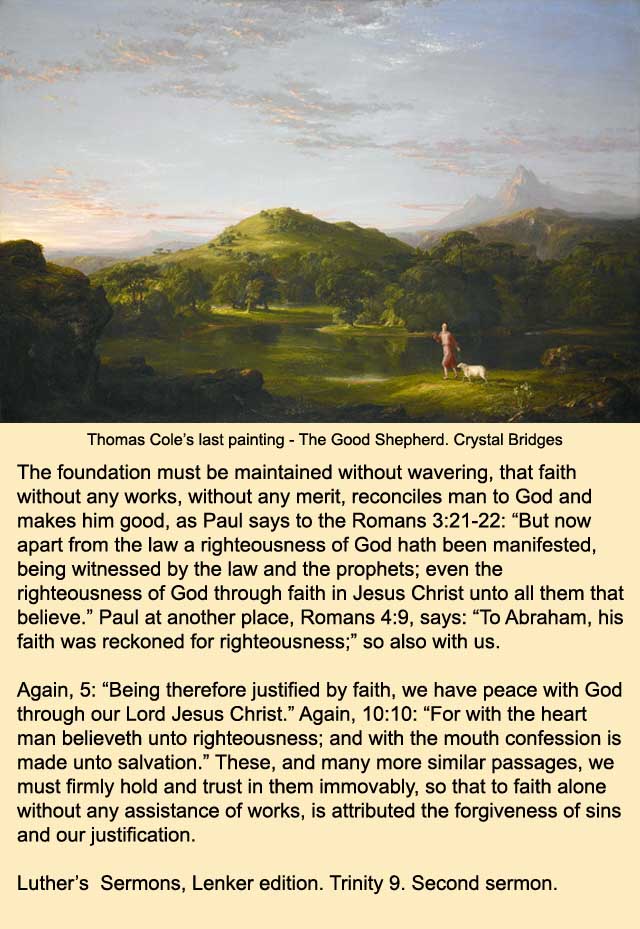
4. The foundation must be maintained without wavering, that faith without any works, without any merit, reconciles man to God and makes him good, as Paul says to the Romans 3:21-22: “But now apart from the law a righteousness of God hath been manifested, being witnessed by the law and the prophets; even the righteousness of God through faith in Jesus Christ unto all them that believe.” Paul at another place, Romans 4:9, says: “To Abraham, his faith was reckoned for righteousness;” so also with us.

Again, 5: “Being therefore justified by faith, we have peace with God through our Lord Jesus Christ.” Again, 10:10: “For with the heart man believeth unto righteousness; and with the mouth confession is made unto salvation.” These, and many more similar passages, we must firmly hold and trust in them immovably, so that to faith alone without any assistance of works, is attributed the forgiveness of sins and our justification.

5. Take for an illustration the parable of Christ in Matthew 7:17: “Even so every good tree bringeth forth good fruit; but the corrupt tree bringeth forth evil fruit.” Here you see that the fruit does not make the tree good, but without any fruit and before any fruit the tree must be first good, or made good, before it can bear good fruit. As he also says, Matthew 12:33-34: “Either make the tree good, and its fruit good; or make the tree corrupt, and its fruit corrupt: for the tree is known by its fruit. Ye offspring of vipers, how can ye, being evil, speak good things?”

Thus it is the naked truth, that a man must be good without good works, and before he does any good works. And it is clear how impossible it is that a man should become good by works, when he is not good before he does the good works. For Christ stands firm when he says: “How can ye, being evil, speak good things?” And hence follows: How can ye, being evil, do good things?


6. Therefore the powerful conclusion follows, there must be something far greater and more precious than all good works, by which a man becomes pious and good, before he does good; just as he must first be in bodily health before he can labor and do hard work. This great and precious something is the noble Word of God, which offers us in the Gospel the grace of God in Christ. He who hears and believes this, thereby becomes good and righteous. Wherefore it is called the Word of life, a Word of grace, a Word of forgiveness. But he who neither hears nor believes it, can in no way become good. For St. Peter says in the Acts 15:9: “And he made no distinction between us and them, cleansing their hearts by faith.”

For as the Word is, so will the heart be, which believes and cleaves firmly to it. The Word is a living, righteous, truthful, pure and good Word, so also the heart which cleaves to it, must be living, just, truthful, pure and good.

7. What now shall we say of those passages which so strongly insist on good works, as when the Lord says: “Make to yourselves friends by means of the mammon of unrighteousness?” And in Matthew 25:42: “For I was hungry, and ye did not give me to eat.” And many other similar passages, which sound altogether as though we had to become good by works. We answer thus:

8. There are some who hear and read the Gospel and what is said by faith, and immediately conclude they have formed a correct notion of what faith is. They do not think that faith is anything else than something which is altogether in their own power to have or not to have, as any other natural human work. Hence, when in their hearts they begin to think and say: “Verily, the doctrine is right, and I believe it is true,” then they immediately think faith is present. But as soon as they see and feel in themselves and others that no change has taken place, and that the works do not follow and they remain as before in their old ways, then they conclude that faith is not sufficient, that they must have something more and greater than faith.

Behold, how they then seize the opportunity, and cry and say: Oh, faith alone does not do it. Why? Oh, because there are so many who believe, and are no better than before, and have not changed their minds at all. Such people are those whom Jude in his Epistle calls dreamers, 5:8, who deceive themselves with their own dreams. For what are such thoughts of theirs which they call faith, but a dream, a dark shadow of faith, which they themselves have created in their own thoughts, by their own strength without the grace of God? They become worse than they were before. For it happens with them as the Lord says in Matthew 9:17 “Neither do men put new wine into old wine-skins; else the skins burst, and the wine is spilled.” That is, they hear God’s Word and do not lay hold of it, therefore they burst and become worse.

9. But true faith, of which we speak, cannot be manufactured by our own thoughts, for it is solely a work of God in us, without any assistance on our part. As Paul says to the Romans 5:15, it is God’s gift and grace, obtained by one man, Christ. Therefore, faith is something very powerful, active, restless, effective, which at once renews a person and again regenerates him, and leads him altogether into a new manner and character of life, so that it is impossible not to do good without ceasing.


For just as natural as it is for the tree to produce fruit, so natural is it for faith to produce good works. And just as it is quite unnecessary to command the tree to bear fruit, so there is no command given to the believer, as Paul says, nor is urging necessary for him to do good, for he does it of himself, freely and unconstrained; just as he of himself without command sleeps, eats, drinks, puts on his clothes, hears, speaks, goes and comes.

Whoever has not this faith talks but vainly about faith and works, and does not himself know what he says or whither it tends. For he has not received it; he juggles with lies and applies the Scriptures where they speak of faith and works to his own dreams and false thoughts, which is purely a human work. Whereas the Scriptures attribute both faith and good works not to ourselves, but to God alone.

10. Is not this a perverted and blind people? They teach we cannot do a good deed of ourselves, and then in their presumption go to work and arrogate to themselves the highest of all the works of God, namely faith, to manufacture it themselves out of their own perverted thoughts. Wherefore I have said that we should despair of ourselves and pray to God for faith as the Apostle did. Luke 17:5. When we have faith we need nothing more, for it brings with it the Holy Spirit, who then teaches us not only all things, but also establishes us firmly in it, and leads us through death and hell to heaven.

11. Now observe, we have given these answers, that the Scriptures have such passages concerning works, on account of such dreamers and selfinvented faith; not that man should become good by works, but that man should thereby prove and see the difference between false and true faith.

For wherever faith is right it does good. If it does no good, it is then certainly a dream and a false idea of faith. So, just as the fruit on the tree does not make the tree good, but nevertheless outwardly proves and testifies that the tree is good, as Christ says, Matthew 7:16: “By their fruits ye shall know them”--thus we should also learn to know faith by its fruits.

12. From this you see, there is a great difference between being good, and to be known as good; or to become good and to prove and show that you are good. Faith makes good, but works prove the faith and goodness to be right. Thus the Scriptures speak in the plain way, which prevails among the common people, as when a father says unto his son: “Go and be merciful, good and friendly to this or to that poor person.” By which he does not command him to be merciful, good and friendly, but because he is already good and merciful, he requires that he should also show and prove it outwardly toward the poor by his act, in order that the goodness which he has in himself may also be known to others and be helpful to them. 13 So you should explain all passages of Scripture referring to works, that God thereby desires to let the goodness received in faith express and prove itself, and become a benefit to others, so that false faith may become known and rooted out of the heart. For God gives no one his grace that it may remain inactive and accomplish nothing good, but in order that it may bear interest, and by being publicly known and proved externally draw every one to God; as Christ says, Matthew 5:16: “Even so let your light shine before men, that they may see your good works, and glorify your Father who is in heaven.” Otherwise it would be but a buried treasure and a hidden light. But what profit is there in either? Yea, goodness does not only thereby. become known to others, but we ourselves also become certain that we are honest, as St. Peter in 2 Peter 1:10 says: “Wherefore, brethren, give the more diligence to make your calling and election sure.” For where works do not follow a man cannot know whether his faith is right; yea, he may be certain that his faith is a dream, and not right as it should be. Thus Abraham became certain of his faith and that he feared God, when he offered up his son. As God by the angel said to Abraham, Genesis 22:12: “Now I know, that is, it is manifest, that thou fearest God, seeing thou hast not withheld thy son, thine only son from me.”

14. Then abide by the truth, that man is internally, in spirit before God, justified by faith alone without works, but externally and publicly before men and himself, he is justified by works, that he is at heart an honest believer and pious. The one you may call a public or outward justification, the other an inner justification, yet in the sense that the public or external justification is only the fruit, the result and proof of the justification in the heart, that a man does not become just thereby before God, but must previously be just before him. So you may call the fruit of the tree the public or outward good of the tree, which is only the result and proof of its inner and natural goodness.

This is what St. James means when he says in his Epistle, James 2:26: “Faith without works is dead.” That is, as the works do not follow, it is a sure sign that there is no faith there; but only an empty thought and dream, which they falsely call faith. Now we understand the word of Christ: “Make to yourselves friends by means of the mammon of unrighteousness.” That is, prove your faith publicly by your outward gifts, by which you win friends, that the poor may be witnesses of your public work, that your faith is genuine. For mere external giving in itself can never make friends, unless it proceed from faith, as Christ rejects the alms of the Pharisees in Matthew 6:2, that they thereby make no friends because their heart is false. Thus no heart can ever be right without faith, so that even nature forces the confession that no work makes one good, but that the heart must first be good and upright.

II. ALL WORKS MUST BE DONE FREELY AND GRATUITOUSLY, WITHOUT SEEKING GAIN BY THEM.

15. Christ means this when, in Matthew 10:8, he says: “Freely ye receive, freely give.” For just as Christ with all his works did not merit heaven for himself, because it was his before; but he served us thereby, not regarding or seeking his own, but these two things, namely, our benefit and the glory of God his Father; so also should we never seek our own in our good works, either temporal or eternal, but glorify God by freely and gratuitously doing good to our neighbor. This St. Paul teaches the Philippians 2:5: “Have this mind in you which was also in Christ Jesus: who, existing in the form of God, counted not the being on an equality with God a thing to be grasped, but emptied himself, taking the form of a servant, being made in the likeness of men; and being found in fashion as a man, he humbled himself, becoming obedient even unto death, yea, the death of the cross.” That is, for himself he had enough, since in him dwelt all the fullness of the Godhead bodily; and yet he served us and became our servant.

16. And this is the cause; for since faith justifies and destroys sin before God, so it gives life and salvation. And now it would be a lasting shame and disgrace, and injurious to faith, if any one by his life and works would desire to obtain what faith already possesses and brings with it. Just as Christ would have only disgraced himself had he done good in order to become the Son of God and Lord over all things, which he already was before. So faith makes us God’s children as John 1:12 says: “But as many as received him, to them gave he the right to become the children of God, even to them thai: believe on his name.” But if they are children, then they are heirs, as St. Paul says, Romans 8:17, and Galatians 4:7.

How then can we do anything to obtain the inheritance, which we already have by faith?

17. But what shall we say of passages that insist on a good life for the sake of an external reward as this one does: “Make to yourselves friends by means of the mammon of unrighteousness?” And in Matthew 19:17: “But if thou wouldst enter into life, keep the commandments.” And Matthew 6:20: “But lay up for yourselves treasures in heaven.” We will say this: that those who do not know faith, only speak and think of the reward, as of works. For they think that the same rule obtains here as in human affairs, that they must earn the Kingdom of heaven by their works.

These, too, are dreams and false views, of which Malachi 1:10, speaks: “Oh, that there were one among you that would shut the doors, that ye might not kindle fire on mine altar in vain!” They are slaves and greedy self-enjoying hirelings and day laborers, who receive their reward here on earth, like the Pharisees with their praying and fasting, as Christ says, Matthew 6:2.

However, in regard to the eternal reward it is thus: inasmuch as works naturally follow faith, as I said, it is not necessary to command them, for it is impossible for faith not to do them without being commanded, in order that we may learn to distinguish the false from the true faith. Hence the eternal reward also follows true faith, naturally, without any seeking, so that it is impossible that it should not, although it may never be desired or sought, yet it is appropriated and promised in order that true and false believers may be known, and that every one may understand that a good life follows naturally of itself.

18. As an illustration of this take a rude comparison: behold, hell and death are also threatened to the sinner, and naturally follow sin without any seeking; for no one does wickedly because he wants to be damned, but would much rather escape it. Yet, the result is there, and it is not necessary to declare it, for it will come of itself. Yet, it is declared that man might know what follows a wicked life. So here, a wicked life has its own reward without seeking it. Hence a good life will find its reward without any seeking it. When you drink good or poor wine, although you do not drink it for the taste, yet the taste naturally follows of itself.

19. Now when Christ says: make to yourselves friends, lay up for yourselves treasures, and the like, you see that he means: do good, and it will follow of itself without your seeking, that you will have friends, find treasures in heaven, and receive a reward. But your eyes must simply be directed to a good life, and care nothing about the reward, but be satisfied to know and be assured that it will follow, and let God see to that. For those who look for a reward, become lazy and unwilling laborers, and love the reward; more than the work, yea, they become enemies of work. In this way God’s will also becomes hateful, who has commanded us to work, and hence God’s command and will must finally become burdensome to such a heart.

III. IT IS NOT THE SAINTS, BUT GOD ONLY WHO RECEIVES US INTO THE ETERNAL TABERNACLES, AND BESTOWS THE REWARD.

20. This is so clear that it needs no proof. For how can the saints receive us into heaven, as every one himself must depend on God alone to receive him into heaven, and every saint scarcely has enough for himself? This the wise virgins prove, who did not wish to give of their oil to the foolish virgins, Matthew 25:9, and St. Peter, 1 Peter 4:18, says: “The righteous is scarcely saved.” And Christ in John 3:13: “And no one hath ascended into heaven, but he that descended out of heaven, even the Son of Man, who is in heaven.”

21. What then shall we reply to: “Make to yourselves friends out of the mammon of unrighteousness; that, when it shall fail, they may receive you into the eternal tabernacles ?” We say this: that this passage says nothing about the saints in heaven, but of the poor and needy on earth, who live among us. As though he would say: why do you build churches, make saints and serve my mother, St. Peter, St. Paul and other departed saints?

They do not need this or any other service of yours, they are not your friends, but friends of those who lived in their days and to whom they did good; but do service to your friends, that is, the poor who live in your time and among you, your nearest neighbors who need your help, make them your friends with your mammon.

22. Again, we must not understand this reception into the eternal tabernacles as being done by man; however, men will be an instrument and witness to our faith, exercised and shown in their behalf, on account of which God receives us into the eternal tabernacles. For thus the Scriptures are accustomed to speak when they say: sin condemns, faith saves, that means, sin is the cause why God condemns, and faith is the cause why he saves. As man also is at all times accustomed to say: your wickedness will bring you misfortune, which means, your wickedness is the cause and source of your misfortune. Thus our friends receive us into heaven, when they are the cause, through our faith shown to them, of entering heaven.

This is enough on these three points.

23. In this connection we will explain three questions, that we may better understand this Gospel. What is mammon? Why is it unrighteous? And why Christ commands us to imitate the unjust steward, who worked for his own gain at his master’s expense, which without doubt is unjust and a sin?

24. First, mammon is a Hebrew word meaning riches or temporal goods, namely, whatever any one owns over and above what his needs require, and with which he can benefit others without injuring himself. For Hamon in Hebrew means multitude, or a great crowd or many, from which Mahamon or Mammon, that is, multitude of riches or goods, is derived.

25. Second, it is called unrighteous, not because obtained by injustice and usury, for with unrighteous possessions no good can be done, for it must be returned as Isaiah 61:8, says: “For I, Jehovah, love justice, I hate robbery with iniquity.” And Solomon, Proverbs 3:27, says: “Withhold not good from them to whom it is due, when it is in the power of thy hand to do it.” But it is called unrighteous because it stands in the service of unrighteousness, as St. Paul says to the Ephesians 5:16, that the days are evil, although God made them and they are good, but they are evil because wicked men misuse them, in which they do many sins, offend and endanger souls. Therefore, riches are unrighteous, because the people misuse and abuse them. For we know that wherever riches are the saying holds good: money rules the world, men creep for it, they lie for it, they act the hypocrite for it, and do all manner of wickedness against their neighbor to obtain it, to keep it, and increase it to possess the friendship of the rich.

26. But it is especially before God an unrighteous mammon because man does not serve his neighbor with it; for where my neighbor is in need and I do not help him when I have the means to do so, I unjustly keep what is his, as I am indebted to give to him according to the law of nature: “Whatsoever you would that men should do to you, do you even so to them.” Matthew 7:12. And Christ says in Matthew 5:42: “Give to him that asketh thee.” And John in his first Epistle,1 John 3:17: “But whoso hath the world’s goods, and beholdeth his brother in need, and shutteth up his compassion from him, how doth the love of God abide in him?” And few see this unrighteousness in mammon because it is spiritual, and is found also in those possessions which are obtained by the fairest means, which deceive them that they think they do no one any harm, because they do no coarse outward injustice, by robbing, stealing and usury.

27. In the third place it has been a matter of very great concern to many to know who the unjust steward is whom Christ so highly recommends? This, in short, is the simple answer: Christ does not commend unto us the steward on account of his unrighteousness, but on account of his wisdom and his shrewdness, that with all his unrighteousness, he so wisely helps himself. As though I would urge some one to watch, pray and study, and would say: Look here, murderers and thieves wake at night to rob and steal, why then do you not wake to pray and study? By this I do not praise murderers and thieves for their crimes, but for their wisdom and foresight, that they so wisely obtain the goods of unrighteousness. Again. as though I would say: An unchaste woman adorns herself with gold and silk to tempt young boys; why will you not also adorn yourself with faith to please Christ? By this I do not praise fornication, but the diligence employed.

28. In this way Paul compares Adam and Christ saying: “Adam was a figure of him that was to come.” Romans 5:14. Although from Adam we have nothing but sin, and from Christ nothing but grace, yet these are greatly opposed to each other. But the comparison and type consist only in the consequence or birth, not in virtue or vice. As to birth, Adam is the father of all sinners, so Christ is the father of all the righteous. And as all sinners come from one Adam, so all the righteous come from one Christ.

Thus the unjust steward is here typified to us only in his cunning and wisdom, who knows so well how to help himself, that we should also consider in the right way the welfare of our souls as he did in the wrong way that of his body and life. With this we will let it suffice, and pray God for grace.

Saturday, August 17, 2019

Just When I Thought - "Rose Garden!" - A Butterfly Hummingbird Garden Appeared


We were at the Highlands Oncology Group (H.O.G.) yesterday, and saw a hand-made poster. "Just when a caterpillar thought the world was over, it became a butterfly."

This may be the original version - "What the caterpillar calls the end of the world, the master calls a butterfly."--Richard Bach. We see many three generation groups at HOG, not always sure if it is grandparent, child, or grandchild being treated.

As readers know, I have always used Creation or organic principles in growing gardens in Michigan, Minnesota, St. Louis, and Arkansas. Various attempts to use the sunniest part of our yard in Arkansas just started to succeed this summer. In that narrowly defined and very sunny area, I have great examples of -

  • Wild Ginger Hidden Lily
  • Joe Pye
  • Comfrey
  • Yarrow
  • Chaste Tree.

Recently I walked around the corner of this remote location (hardest to reach and to enjoy) - and it was alive with birds feeding, rabbits sheltering, and butterflies flying. The area is bathed in sunshine and boasts the richest soil in the yard, layers of organic matter (newspaper, wood mulch, hay bales) and plenty of earthworms.


Now we spend time on the porch, in the shade, overlooking the rose garden. Once Ranger Bob installed the hummingbird feeder, the hummingbird activity increased. Instead of catching a glimpse of them, they parade around the garden to sip the flowers and stop to feed and fight at the little feeder.

The result is not only the bird and rabbit population doing well, but the hummingbird and butterfly provide a constant source of peace, enjoyment, and surprises. Hummers are the only birds who hover and move closer to humans as they increase their trust. Two zoomed in so close that the audience started to duck. I sensed them laughing at us.


How Did This Happen?
I doubt whether the creatures are as geographical as we are, so our yard is a combination of convenient shelters and food sources for them. This took time to develop from an overgrown and seldom trimmed lot to one where the trees are pruned, the grass is cut, and a wide variety of plants are grown.


  1. The backyard Gardener fence has a row of blooming Crepe Myrtle and flowering Hosta at the moment.
  2. The backyard Wright fence is mostly wild, with some Butterfly Weed and raspberries. Mouse Ears are doing well, and they host a butterfly two.
  3. The bedroom windows are shaded by large Butterfly Bushes that always receive extra rain water and enjoyed a lot of extra organic feeding last fall. That helped when the rains fell, so we now have blooms above the roofline and butterflies tending them.
  4. The rose garden matured in many ways this summer -
  • Mountain Mints
  • Bee Balms
  • Cat Mints
  • Hosta
  • Joe Pye 
  • Fever Few
  • Wild Strawberry
  • Chaste Tree
  • Crepe Myrtle
  • Spirea Bush
  • Daisies
  • Trumpet Vine (also in the backyard)
  • Balloon Flowers
  • Butterfly Weed.
Beneficial insects, bees, butterflies, and hummingbirds love this combination of steady blooms, tiny flowers, and seasonal blooms, keeping them in food and shelter year around. I will transplant a lot of free Hostas, because they bloom heartily during the late summer and feed the hummers.

Fall planting seems to be viewed as food for the rabbits all winter, so the additions next spring will be:
  1. More roses - Veterans Honor
  2. More Joe Pye
  3. More Feverfew 
  4. Hibiscus for color
  5. Maybe some of highly touted ground covers
  6. Definitely Clethra where it can be the star of the show.


Q Updates - Rome as the Antichrist and All the Little Antichrists


Some say the D5 avalanche will start soon, but I think it has already started.

One segment of world corruption is child trafficking (and worse) - now being exposed in the grisly news about J. Epstein, Nxium, and Rachel Chandler.

When we were in Columbus, Ohio, the news often mentioned Les Wexner and his Limited conglomeration of clothing stores, including Victoria's Secret.

In Columbus wee heard about Senator McCain, whose second wife was rich from her dad's liquor business - more like their mob business in connection with Bronfman, another mobster. Thanks to Prohibition, Bronfman's Seagram whiskey was sold at premium prices to people like Joe Kennedy. And Bronfman money protected Nxium from prosecution for decades.

 Ghislane Maxwell, procurer of young girls for Epstein's schemes, posed with Murdoch, godfather of the NIV Bible. WELS and LCMS should be proud of this connection.

 Only a few attended the exclusive wedding of Chelsea Hubbell Clinton, and that included Ghislane Maxwell.  

Today I would like to emphasize the Church of Rome's participation in global corruption. Some like to think it is rather recent, but Rome has at least 500 years of tradition in that area, and the architecture of the Vatican proves how this is out in the open, slap-in-the-face real today.

The best way to get some grasp of the enormity of Rome's current corruption is to read articles by George Neumayr of the American Spectator. Clearly, the entire structure of Cardinals in Roman Catholicism is dominated by their homosexual princes:

  • Spellman
  • Bernadin
  • Pell
  • McCarrick
  • Wuelr
  • Many more.

The power of the Cardinals is so great that all the chatter about reform - for the last 30 years - has been an organized distraction. The noisy reform campaigns are like Werning and Kelm teaming up to get rid of Church Growth in the Missouri and Wisconsin sects.

Does anyone wonder how the WELS Wisconsin Lutheran College managed to invite Archbishop Weakland and his priests to give lectures to the public from the WLC campus? Yes, he was notorious for his boyfriend and his embezzlement of church funds to pay off the boyfriend. Such invitations do not happen by accident. The Lavender Mafia in WELS had to be involved, because colleges of any kind do not just happen to invite an archbishop and a bunch of his priest toadies to give public lectures.

Naturally, WELS lied about their scandalous involvement. They usually condemn anyone who tells the truth about their cover story, which was something like - it was only a private dinner. Sure, Roman archbishops go to private dinners at Lutheran colleges. Does anyone wonder why the Reformation's 500th was so weak in LCMS-WELS?

Pope Francis, SJ, is at the top of this global, organized crime family, known as the Roman Catholic Church.

Disgraced Archbishop Weakland, Wisconsin Lutheran College lecturer.

Thursday, August 15, 2019

The Mother of a Quadriplegic Wrote


To Dr. Greg Jackson,  you taught both me and my daughter online with Grand Canyon University many years ago.  I don't know if you would remember her.. L.D. and she was a quadriplegic.  You were kind enough to send each of us one of your beautiful books Angel Joy.  thank you.
M.D.

 Erin Joy had many seizures so we got her distracted with jokes about everything, including falling, messes, and someone (not her) in trouble.


I wanted to let you know that my daughter passed away in 2013.  She had earned her bachelors degree with honors.  She is free and flying high with our Lord and nothing could make me happier.  I will be joining her in the not too distant future as I am fighting COPD and lung cancer.  I just wanted you to know how much we both appreciated you when you were our teacher.  M.D.

 Bethany and her nurse Ida - they loved each other so much, which is one of many reasons we admire and respect nurses.

Staggering Dishonesty in WELS Biblical Fraud

The EHV is currently doing well in WELS.


The navigation for Defeat the New NIV Translation can be found here. 

The post links to many other informational articles and remains one of the most read, in spite of the 2011 date.

Supposedly their new Extra High Voltage is surging to 50,000 copies. They call it Evangelical Heritage Version, which is not hip enough for me.

I came across some documents used to foist the New NIV on WELS. They show the poverty of Biblical knowledge in WELS, the abundance of deception use to get their way - and they did.

The Translation Evaluation Committee (Supplemental Report, 2011 Convention) was a farce.

"Why would anyone want to revise a translation as popular as the NIV?" - they ask with feigned innocence.

The NIV was planned for future improvements. WELS decided not to do its own translation, at first, but went ahead with the EHV.

They used a public domain base to get the work done, so it was not really "their" translation. The EHV tendency overall is to repair the idiocy of the old NIV and the worse idiocy of the New NIV. But the EHV fouls up the Great Commission, so the CG force is stronger than translation precision. Jesus taught His disciples to "teach all nations" - not to "make disciples" (Fuller Seminary) or "gather disciples" (EHV).

 The Southern Baptists rejected the New NIV and ordered it not put on the shelves of their bookstores. The WELS wolves sheepishly posing by the sign did not listen to the Baptists. The New NIV is official, baked in, love it or enjoy the Left Foot of Fellowship from WELS.


WELS Staggering Dishonesty
The Translation Evaluation Committee 2011 gives away the plot and reveals why the seminary was slavering to make the New NIV official - Romans 3:22-24!

The bad old NIV translated it as "all have sinned and fallen short...and are justified freely by his grace..."

But the wonderful New NIV has - "all have sinned and fallen short...and all are justified freely by his grace..." [GJ - all is bolded and underlined in the printed copy I have.]

The Greek text did not change, but the mainline apostates (which include WELS, LCMS, and ELCA) clamored for the extra all.


The dogma of Universalism is far more important to them, even in the guise of Objective Justification, than Biblical truth is.

The section means simply, as Luther explained - all have sinned and those who are justified are only justified through faith in Jesus.

For the pinheads in WELS, grace means universal forgiveness and opposes faith. However, St. Paul clearly stated -
Romans 4:16 Therefore it is of faith, that it might be by grace...

Their denial and rejection of faith is obnoxious and wrong, but now they have their New NIV to comfort them in their apostasy.

Quoting the WELS false teachers in battle array against the Gospel -

"The addition of the little word "all" is significant, since it clarifies Paul's intended meaning: God has declared all guilty sinners not guilty by his gracious, saving work in Christ Jesus." [bold and underlining in the original printed copy]

 Note the WELS language in large print above the graphic, clearly a case of the sect "building and correcting" by adding an all that is not in Romans 3 or anywhere else in the Scriptures. Paul really intended to teach universal absolution, WELS is saying, and now they can make him say it.

The Justification by Faith Deniers Had Their Summer Camp Experience

They deny the Chief Article - Justification by Faith - what makes them Lutheran? Or even Christian?


 Heiser is wearing his purple bishop shirt. Rolf seems fine with that. Preus was/is a constant Objective Justification advocate, as Heiser knew, and Bishop Jim is not bothered at all.

Happy Campers came together at Camp Trinity, to celebrate their common bond. Calvinism. As one publication of Northwestern Publishing House (WELS) said, "The Calvinists are not crypto anymore." Thanks to Otten's business zig-zagging between Walter Maier and Walther, the path has been smoothed to complete apostasy.

 St. John is the church and endowment WELS stole, after kicking it out years ago. More importantly, here is Wayne pontificating about "not being restricted" to doctrines (sic). There is only one doctrine. Note the item in question - Election - which Walther abused to turn his drones toward Geneva, to back up his Halle OJ. Cited is fellow dunce Harold Wicks. If someone else wrote it in WELS, it is the ruling norm, unless the man's name is Gausewitz. Who he? they all say now.

The genius of Pietism is the blend of Lutheran identify and Calvinistic rejection of the Confessions. Even today, WELS struts about the Book of Concord outwardly but inwardly despises the Confessions and Luther.

Pietism concentrates on appearances. "Are you a WELS member? Good! Are you from Wisconsin? Even better?"

Long ago when WELS was not collapsing, they had the seminarians saying, "We will not sit down with Missouri until they are straight about the ministry!" That was said to me verbatim, with some venom, many times at Mordor. It was like pushing a button on a display at a DC museum, only the button was self-activating.

Both synods are equally OJ, equally anti-Luther, equally terrified of the judgment facing them as members and seminaries flee.

Wayne Mueller's Church Growth and Rolf Preus' OJ are the twin devils of this catastrophe. Both Boomers pranced around as experts while they were dipping the silver and gold of Biblical doctrine in toxic mercury - to make it better, clearer, more relevant and effective.

 Read the Calvinists to yak people into WELS. That worked like a charm. When will the Boomers meet to apologize to everyone.

Wednesday, August 14, 2019

The Bible Was Not Written By...


Greek Lesson - Mark 9:39ff


Parser - tells us the I.D. of the word

Lenski's Mark Commentary - download as a PDF


38 απεκριθη δε αυτω ο ιωαννης λεγων διδασκαλε ειδομεν τινα τω ονοματι σου εκβαλλοντα δαιμονια ος ουκ ακολουθει ημιν και εκωλυσαμεν αυτον οτι ουκ ακολουθει ημιν

Notice how important κωλυο is.


39 ο δε ιησους ειπεν μη κωλυετε αυτον, ουδεις γαρ εστιν ος ποιησει δυναμιν επι τω ονοματι μου και δυνησεται ταχυ κακολογησαι με


40 ος γαρ ουκ εστιν καθ υμων υπερ υμων εστιν

41 ος γαρ αν ποτιση υμας ποτηριον υδατος εν τω ονοματι μου οτι χριστου εστε, αμην λεγω υμιν, ου μη απολεση τον μισθον αυτου


42 και ος αν σκανδαλιση ενα των μικρων των πιστευοντων εις εμε, καλον εστιν αυτω μαλλον ει περικειται λιθος μυλικος περι τον τραχηλον αυτου και βεβληται εις την θαλασσαν


43 και εαν σκανδαλιζη σε η χειρ σου, αποκοψον αυτην; καλον σοι εστιν κυλλον εις την ζωην εισελθειν η τας δυο χειρας εχοντα απελθειν εις την γεενναν εις το πυρ το ασβεστον


44 οπου ο σκωληξ αυτων ου τελευτα και το πυρ ου σβεννυται


45 και εαν ο πους σου σκανδαλιζη σε, αποκοψον αυτον; καλον εστιν σοι εισελθειν εις την ζωην χωλον η τους δυο ποδας εχοντα βληθηναι εις την γεενναν εις το πυρ το ασβεστον

46 οπου ο σκωληξ αυτων ου τελευτα και το πυρ ου σβεννυται

47 και εαν ο οφθαλμος σου σκανδαλιζη σε εκβαλε αυτον καλον σοι εστιν μονοφθαλμον εισελθειν εις την βασιλειαν του θεου η δυο οφθαλμους εχοντα βληθηναι εις την γεενναν του πυρος

48 οπου ο σκωληξ αυτων ου τελευτα και το πυρ ου σβεννυται

49 πας γαρ πυρι αλισθησεται, και πασα θυσια αλι αλισθησεται

salt, saline, salary


50 καλον το αλας εαν δε το αλας αναλον γενηται εν τινι αυτο αρτυσετε εχετε εν εαυτοις αλας και ειρηνευετε εν αλληλοις

Alec Satin Found This Quotation on Heretics


Heretics
The heretics were never dishonest men; they were mistaken men. They should not be thought of as men who were deliberately setting out to go wrong and to teach something that is wrong; they have been some of the most sincere men that the Church has ever known. What was the matter with them? Their trouble was this: they evolved a theory and they were rather pleased with it; then they went back with this theory to the Bible, and they seemed to find it everywhere.

D. Martyn Lloyd-Jones, Studies in the Sermon on the Mount

Lutheran versus Calvinist (Reformed)


There is a big difference:

"To the Lutheran the sermon, as the preached Word, is a means of grace. Through it the Holy Spirit calls, gathers, enlightens, and sanctifies the whole Christian church on earth. It is a constant offer of pardon; a giving of life, as well as a nourishing and strengthening of life. In the Reformed churches the sermon is apt to be more hortatory and ethical. It partakes more of the sacrificial than of the sacramental character. The individuality of the preacher, the subjective choice of a text, the using of it merely for a motto, the discussion of secular subjects, the unrestrained platform style, lack of reverence, lack of dignity, and many other faults are common, and are not regarded as unbecoming the messenger of God in His temple. Where there is a properly trained Lutheran consciousness such things repel, shock, and are not tolerated."

G. H. Gerberding, The Lutheran Pastor, Minneapolis: Augsburg Publishing House, 1915, p. 278.

 Mordor graduates, like Ski, take pride in copying the Calvinists word for word, calling it "spoiling the Egyptians." His peers love the sound of Calvinistic prancing.