Friday, May 10, 2019

Demonstration - The Fallacy of Emphasis.
Book of Concord, Smalcald Articles, UOJ Salescritters

 And this is Buchholz' critique of J. P. Meier? Bwa-ha-ha.
Luther seems to support this dogma, if we have no reading comprehension at all - and no integrity.


THE SECOND PART
Treats of the Articles which Refer to the Office and Work of Jesus Christ, or Our Redemption.

Part II, Article I: The first and chief article.
1] That Jesus Christ, our God and Lord, died for our sins, and was raised again for our justification, Rom. 4:25.

Oh Jay - Agrees with Brief Statement on Justification, no?

2] And He alone is the Lamb of God which taketh away the sins of the world, John 1:29; and God has laid upon Him the iniquities of us all, Is. 53:6.

Oh Jay  - More agreement with the UOJ Enthusiasts!

3] Likewise: All have sinned and are justified without merit [freely, and without their own works or merits] by His grace, through the redemption that is in Christ Jesus, in His blood, Rom. 3:23f

Oh Jay  - So close to the blessed New NIV. This only needs another all.

4] Now, since it is necessary to believe this, and it cannot be otherwise acquired or apprehended by any work, law, or merit, it is clear and certain that this faith alone justifies us as St. Paul says, Rom. 3:28: For we conclude that a man is justified by faith, without the deeds of the Law. Likewise 3:26: That He might be just, and the Justifier of him which believeth in Christ.

Oh Jay  - Necessary to believe. Yes, yes. Go on.


it cannot be otherwise acquired or apprehended by any work, law, or merit, it is clear and certain that this faith alone justifies us as St. Paul says, Rom. 3:28: For we conclude that a man is justified by faith, without the deeds of the Law. Likewise 3:26: That He might be just, and the Justifier of him which believeth in Christ.

PS - So the Chief Article is Justification by Faith!

Oh Jay  - Ruined, ruined!

5] Of this article nothing can be yielded or surrendered [nor can anything be granted or permitted contrary to the same], even though heaven and earth, and whatever will not abide, should sink to ruin. For there is none other name under heaven, given among men whereby we must be saved, says Peter, Acts 4:12. And with His stripes we are healed, Is. 53:5. And upon this article all things depend which we teach and practice in opposition to the Pope, the devil, and the [whole] world. Therefore, we must be sure concerning this doctrine, and not doubt; for otherwise all is lost, and the Pope and devil and all things gain the victory and suit over us.

***
GJ - I did a copy and paste from the Smalcald Articles, written by Luther himself, to show how many lies Buchholz and Webber told to get people assured of the genius of Halle rationalistic Pietism rather than Luther's faithful Biblical teaching.

All it takes is an emphasis upon one part of this confession and silence on the rest. That is the fallacy of emphasis, used all the time. 

Question to Bill Clinton - "You denied an affair with Gennifer Flowers?"

Bill Clinton - "That's right, I denied it."

The affirmation of the denial was portrayed as an exoneration.

To Barth - "Is the Bible the Word of God?"

Barth - "The Bible contains the Word of God but is not the Word of God."

What seems like a blatant repudiation of the Scriptures is left murky (to the murky-brained) and the issue left unanswered. A conservative Evangelical professor at a conservative Evangelical college beat me like a rented mule for saying the obvious about Barth.

Are "conservative" Lutherans better. They have done the same thing - with impunity - attacking and excommunicating those who teach Justification by Faith.

The upper part may seem confusing, and I have left it that way. Many times an argument by false teachers is won by leaving the audience confused, especially with an emphasis on "what our church has always believed" or "what you were taught in seminary."

If someone can cling to Holy Mother Sect and forget Romans 5:1-2, the lesson from the Holy Spirit is not deeply embedded.

 "The ELS-WELS-LCMS are peaceful again, Jon-Boy."
"That's General Buchholz to you, Probie Rolf."

ChurchMouse = Extensive Coverage of Notre Dame Plans

Notre Dame, Paris

Virtual Tours of Paris

Not knowing the circumstances surrounding the inferno at Notre-Dame in Paris is bad enough.
Now lovers of the mediaeval cathedral, the French capital’s monumental house of worship, wonder what is meant by the words ‘restoration’ and ‘rebuilding’.
Does the French government consider the two words to be the same as the average person who treasures what was lost? What about expert architects? What about building contractors?

The entire ChurchMouse article about Notre Dame is here.


 Follow ChurchMouse for future Notre Dame developments.
He is a campanologist.


Yale Gothic - Harkness Tower - Downtown Campus


Thursday, May 9, 2019

Where Are the Quia Subscribers to the Book of Concord?


“Of this article nothing can be yielded or surrendered [nor can anything be granted or permitted contrary to the same], even though heaven and earth, and whatever will not abide, should sink to ruin. For there is none other name under heaven, given among men whereby we must be saved, says Peter, Acts 4:12. And with His stripes we are healed, Is. 53:5. And upon this article all things depend which we teach and practice in opposition to the Pope, the devil, and the [whole] world. Therefore, we must be sure concerning this doctrine, and not doubt; for otherwise all is lost, and the Pope and devil and all things gain the victory and suit over us.”
           Martin Luther, The Smalcald Articles, II, THE SECOND PART. Treats of the Articles which Refer to the Office and Work of Jesus Christ, or Our Redemption. Part II, Article I: The first and chief article. The Book of Concord.


 The "conservative" Lutherans chase these chuckleheads around the country, aping their silliness, such as screaming in a sermon - for emphasis.
The WELSian Papists are no different from the ones they copy.
"What we have approved is the truth. The rest - Be gone!"

Two Lists of Resources - For and Against Justification by Faith


Books for Understanding Justification by Faith


Augsburg Confession, Article 4 and 5

Apology of the Augsburg Confession, Justification by Faith

Chemnitz (senior editor of the Book of Concord) – his works

Formula of Concord, Article III, The Righteousness of Faith

Gausewitz, Small Catechism, original edition

Jackson, The Lost Dutchman’s Goldmine

Jackson, Thy Strong Word

Jacobs, Henry Eyster 
KJV Small Catechism, Concordia Publishing House

Krauth, The Conservative Reformation

Lenski, New Testament Commentaries

Luther’s Sermons, Lenker Edition

Luther’s Galatians Lectures, Recommended in the Formula of Concord

Preus, Robert, Justification and Rome

Schmauk, The Confessional Principle


Books Promoting Objective Justification


Preuss, Edward, The Justification of the Sinner

Pieper, Francis, Christian Dogmatics

Kuske, David, WELS Small Catechism

Knapp, Georg Christian, Halle Theology Lectures, English and German

Meier, JP, Ministers of Christ, WELS

Mueller, J. T., Dogmatics

Confessing the Gospel – CPH

LCMS New Small Catechism – CPH


Plus - anything by David Scaer

Go Back to the Source - Says Martin Chemnitz


When I work on Scriptural studies - more are planned - I am struck by the utter lack of Biblical knowledge in the "conservative" clergy and their professors.

When I studied Genesis in Hebrew at Yale, Mark and Thessalonians in Greek, the professors knew the theories and studied under the famous scholars who are often cited in the textbooks. But all three professors emphasized the text rather than the theories. Nils Dahl and Abraham Malherbe knew the scholars from their own graduate work - they did not need students to rehash the theories.

 Nils A. Dahl


Dahl asked, as I have written before, "What do we know for certain?"

His answer was simply, "The text! The text!"

But all I read from the Synodical Conference is Walther, Pieper, Mueller, Meier (but not Maier), Valleskey, etc. Fortunately, I have been warned against Lenski, so I know he is worth some study.

And - all the histories of clerical garb, who wrote what, who wore what, and how fastidious these crypto-Romanists are who do not comprehend the Gospel. They really should join Rome or Byzantium, because those alternatives stress worship style and give enormous leeway within their dogmas and justification by faith plus works.

David Scaer, like Paul McCain, Matt the Fatt, Jack B. Simple Cascione, Wayne Mueller, the Preus Doctrinal Crime Family, and many others have no coherent grasp of the Gospel as elucidated by the Scriptures, from Genesis 15:6 to Romans 3 - 5.

That is - if they read a few passages and took a reading comprehension test from ACT or SAT, they would fail. Why? Because they cannot see what is clearly revealed and  - they substitute a conflicted fantasy that claims God absolved the world when Jesus rose from the dead.

The more I read over the dogmatics literature, the more I see how they have promoted three (3) justifications:

  1. Objective Justification
  2. Subjective Justification
  3. Justification by Faith.
These great and wise men do not teach Justification by Faith (Pieper, Mueller, Scaer) but they toss it into the mix to let people falsely assume that OJ is the Atonement and SJ is Justification by Faith.

Lenski denies Objective Justification!


Read the gibberish of Scaer and check whether he connects any of his free associations with Scripture. 

"Lenski’s denial of objective justification [GJ - teaching Justification by Faith] was found in his commentary on Romans. Opponents of seeing justification only as subjective see it as nothing other than synergism (sic), the issue which was at the heart of the Lutheran Reformation protest against Rome. Since God justifies all humanity by raising Christ from the dead (sic), justification is universal (sic) and, as an act of God and not of man, is objective. By faith justification becomes a reality for the believer and is called subjective (sic - read your Walther, lol, SJ is making a decision for OJ).   
Lenski, R. C. H., The Interpretation of the New Testament (Columbus, OH: Wartburg Press, 1934–1966).

Scaer, David P.. Surviving the Storms: Memoirs of David P. Scaer (Kindle Locations 5562-5567). Luther Academy. Kindle Edition. " David Scaer, ThD, Concordia Seminary, St. Louis.

Scaer, David P.. Surviving the Storms: Memoirs of David P. Scaer (Kindle Locations 5562-5566). Luther Academy. Kindle Edition. 

Tonight I was reading Carl Braaten, an exercise in self-torture. Though he was graced with endless academic opportunities, he also writes with the random pretensions of a junior in seminary. The fault does not lie in their educations but in the vast gulf between the Bible and their pet dogmas, conclusions, and warnings.

LutheranLibrary.org gives people a chance to compare and contrast the old Lutheran books for themselves.


J-016 
"Wherever the place has been determined, let us see to it that the canonical codices are on hand and if any proofs can be produced on either side, let us set  everything else aside and bring so important a matter to a conclusion." [Augustine, Letter no. 163, about private disputations about religion]             
Martin Chemnitz, Examination of the Council of Trent, trans., Fred Kramer, St. Louis: Concordia Publishing House, 1971, I, p. 154.   

J-017 
"And Cusanus writes that the custom of the ancient ecumenical synods was to place the holy Gospels in their midst."              Martin Chemnitz, Examination of the Council of Trent, trans., Fred Kramer, St. Louis: Concordia Publishing House, 1971, I, p. 154.   

J-018 
"For the book of the evangelist and apostles and the oracles of the ancient prophets plainly teach us what we are to think concerning divine matters. Therefore let us cease our hostile discord and take the solutions of the questions out of the divinely inspired sayings." [Constantine at Nicea]              
Martin Chemnitz, Examination of the Council of Trent, trans., Fred Kramer, St. Louis: Concordia Publishing House, 1971, I, p. 154.   

J-019 "If anything is said without Scripture, the thinking of the hearers limps. But where the testimony proceeds from the divinely given Scripture, it confirms both the speech of the preacher and the soul of the hearer." [Chrysostom, commenting on Psalm 95]      Martin Chemnitz, Examination of the Council of Trent, trans., Fred Kramer, St. Louis: Concordia Publishing House, 1971, I, p. 156. 
 
J-020 
"Whatever is required for salvation is already completely fulfilled in the Scriptures." [Chrysostom, commenting on Matthew 22]              Martin Chemnitz, Examination of the Council of Trent, trans., Fred Kramer, St. Louis: Concordia Publishing House, 1971, I, p. 157.   

J-021 "There is a short way for pious minds both to dethrone error and to find and bring out the truth. For when we return to the source and origin of the divine tradition, human error ceases." [Cyprian, Ad Pompejum]  
Martin Chemnitz, Examination of the Council of Trent, trans., Fred Kramer, St. Louis: Concordia Publishing House, 1971, I, p. 158. 

J-026 "Beautiful is the statement of Cyprian, which Augustine declares to be the best without any doubt, showing what ought to be done when examples and customs are held up to us which do not have the authority of the canonical Scripture. 'If,' says he, 'we return to the head and origin of the divine tradition, human error will cease. For if the channel of water, which before flowed copiously and purely, either fails or brings muddy water, then certainly one goes to the source in order to find out whether there is something wrong in the veins or in the source, or whether something got in midway.' So also it is rightly, necessarily, and indeed safely done when things that happened in later times in matters of religion must be examined." 
Martin Chemnitz, Examination of the Council of Trent, trans., Fred Kramer, St. Louis: Concordia Publishing House, 1986, III, p. 237.   

J-027 
"Don't let the world paint us into a corner of antiquarianism on subjects like a six-day creation or verbal inspiration."  
Rev. Paul Kelm, WELS, "How to Make Sound Doctrine Sound Good to Mission Prospects," p. 13.72 

Synodical Conference - "Lenski is not good on justification."
They mean - He teaches Justification by Faith.


Wednesday, May 8, 2019

Greek Lesson - Mark 3:1ff - Healings, Disciples

 By Duccio di Buoninsegna - Web Gallery of Art:   Image  Info about artwork, Public Domain, https://commons.wikimedia.org/w/index.php?curid=7922656


Parser - tells us the I.D. of the word

Lenski's Mark Commentary - download as a PDF


ΚΑΤΑ ΜΑΡΚΟΝ 3 1550 Stephanus New Testament (TR1550)

3 και εισηλθεν παλιν εις την συναγωγην και ην εκει ανθρωπος εξηραμμενην εχων την χειρα
Xerox is what? Then you have the word.
2 και παρετηρουν αυτον - ει τοις σαββασιν θεραπευσει αυτον ινα κατηγορησωσιν αυτου
guard guardedly suspiciously? category - accuse
3 και λεγει τω ανθρωπω τω εξηραμμενην εχοντι την χειρα "εγειραι εις το μεσον"
4 και λεγει αυτοις εξεστιν τοις σαββασιν αγαθοποιησαι η κακοποιησαι ψυχην σωσαι η αποκτειναι οι δε εσιωπων
Greek and German - beautiful compound words
5 και περιβλεψαμενος αυτους μετ οργης συλλυπουμενος επι τη πωρωσει της καρδιας αυτων λεγει τω ανθρωπω εκτεινον την χειρα σου και εξετεινεν και αποκατεσταθη η χειρ αυτου υγιης ως η αλλη
osteoporosis, cardiogram, anthropology, chiropractor, hygiene, 
6 και εξελθοντες οι φαρισαιοι ευθεως - μετα των ηρωδιανων - συμβουλιον εποιουν κατ αυτου οπως αυτον απολεσωσιν
plan-together
7 και ο ιησους ανεχωρησεν μετα των μαθητων αυτου προς την θαλασσαν και πολυ πληθος απο της γαλιλαιας ηκολουθησαν αυτω και απο της ιουδαιας
plethora
8 και απο ιεροσολυμων και απο της ιδουμαιας και περαν του ιορδανου και οι περι τυρον και σιδωνα; πληθος πολυ, ακουσαντες οσα εποιει ηλθον προς αυτον
9 και ειπεν τοις μαθηταις αυτου, ινα πλοιαριον προσκαρτερη αυτω, δια τον οχλον ινα μη θλιβωσιν αυτον
10 πολλους γαρ εθεραπευσεν ωστε επιπιπτειν αυτω ινα αυτου αψωνται οσοι ειχον μαστιγας
11 και τα πνευματα τα ακαθαρτα οταν αυτον εθεωρει προσεπιπτεν αυτω και εκραζεν λεγοντα οτι συ ει ο υιος του θεου
12 και πολλα επετιμα αυτοις ινα μη αυτον φανερον ποιησωσιν
13 και αναβαινει εις το ορος και προσκαλειται ους ηθελεν αυτος και απηλθον προς αυτον
14 και εποιησεν δωδεκα ινα ωσιν μετ αυτου και ινα αποστελλη αυτους κηρυσσειν
15 και εχειν εξουσιαν θεραπευειν τας νοσους και εκβαλλειν τα δαιμονια
16 και επεθηκεν τω σιμωνι ονομα πετρον
17 και ιακωβον τον του ζεβεδαιου και ιωαννην τον αδελφον του ιακωβου και επεθηκεν αυτοις ονοματα βοανεργες ο εστιν υιοι βροντης
brontosaurus
18 και ανδρεαν και φιλιππον και βαρθολομαιον και ματθαιον και θωμαν και ιακωβον τον του αλφαιου και θαδδαιον και σιμωνα τον κανανιτην
19 και ιουδαν ισκαριωτην ος και παρεδωκεν αυτον και ερχονται εις οικον

Matt the Fatt in Rock n Roll Black


 Pick the future ELDONA pastor.

Matt the Fatt, not funny, not talented, not in good taste.
Send in the clowns, don't worry...they're here.

The lyrics were copied down and posted as a pdf.
Desperate demagogues like to call the opposition insane - ask Bishop Heiser for tips on this method. Or LutherQuest.
Matt the Fatt trekked to Otten's to sing "The Ballad of Herman Otten," doubtless urged by Paul McCain. Matt ended his career with this, which is slander and libel, since he did not have any supervisory role over the excommunicated editor. But ELCA Bishopettes? - they are cool.

 Was this a magic trick or a demonstration of how Objective Justification works?
Honey, I shrunk the synod!

Even with Continuing Rain, BBQing Is Still Fun in Springdale


Oceans 1 Suggested This - A Quotation List of Objective Justification, Included in The Path to Understanding Justification


Look at the influence of Pietism and the Easter absolution of the world. A short history of this distortion and false proclamation follows:
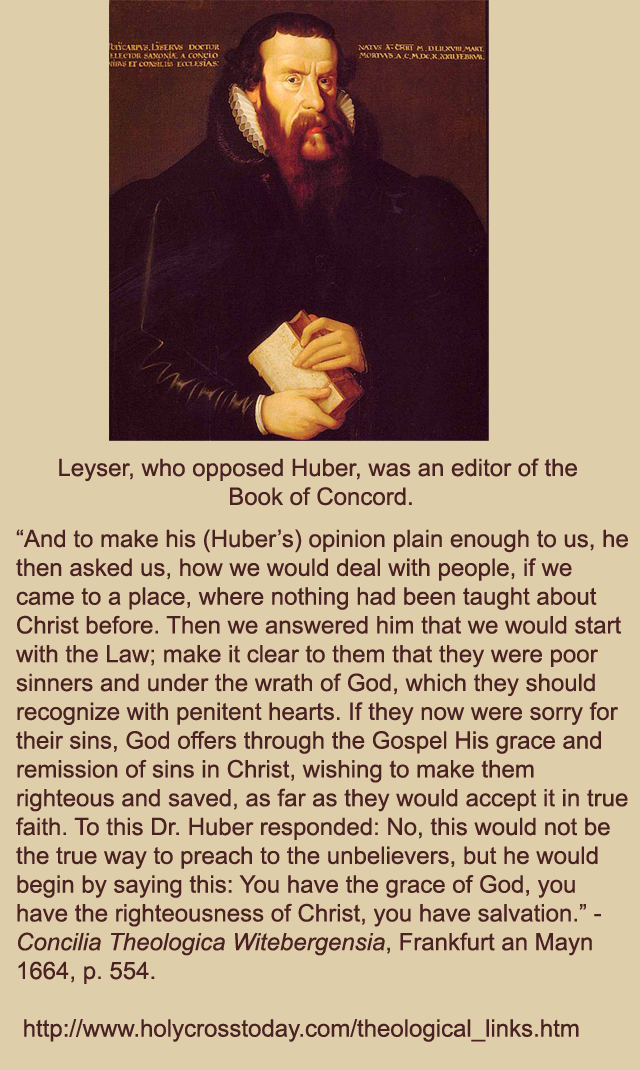
1.     Samuel Huber (1547-1624) was a former Calvinist who joined the faculty of Wittenberg University, but turned against the Biblical doctrine of the Reformation to claim this should be said to someone who has no knowledge of Christ:
“You have the grace of God, you have the righteousness of Christ, you have salvation.” Concilia Theologica Witenbergensia, 1664, p. 654.[1]
2.     J. J. Rambach (1693-1795) was a well-known, prominent figure in Halle, at the height of Pietism. He wrote:
“In His Person, all mankind was justified and absolved from all sin and curse.” Tom Hardt, Robert Preus Festschrift, “Easter and Absolution.”
3.     The Pietistic, rationalistic theology of Halle’s Georg Christian Knapp (1753-1825) became a major doctrinal book in German and also in English, the translation found in every American theological library in the 19th century. It remains in print. The Calvinist translator, explained Knapp’s theology this way, and those italicized justification terms became normative within the Synodical Conference:
“This is very conveniently expressed by the terms objective and subjective justification. Objective justification is the act of God, by which he proffers pardon to all through Christ; subjective, is the act of man, by which he accepts the pardon freely offered in the Gospel. The former is universal, the latter not.” (Italics in the original)
Lectures on Christian Theology, by Georg Christian Knapp, Professor of Theology in the University of Halle. Translated by Leonard Woods, Jr., D.D., President of Bowdoin College, Brunswick, Maine, later at Andover Seminary, which later became Andover-Newton, which merged into Yale Divinity School in 2018.[2]
4.     Schleiermacher’s Christian Dogmatics - “According to Schleiermacher, the decree of redemption already means that human beings are agreeable to God in his Son; an individual act of justification in time is not first needed in each individual person. It is only necessary that each individual person become aware that in God’s decree of redemption in Christ he is already justified and made agreeable to God.”
Hoenecke, Dogmatics, III, p. 339.

5.     C.F.W. Walther - "For God has already forgiven you your sins 1800 years ago when He in Christ absolved all men by raising Him after He first had gone into bitter death for them. Only one thing remains on your part so that you also possess the gift. This one thing is--faith. And this brings me to the second part of today's Easter message, in which I now would show you that every man who wants to be saved must accept by faith the general absolution, pronounced 1800 years ago, as an absolution spoken individually to him."
The Word of His Grace, Sermon Selections, "Christ's Resurrection--The World's Absolution" Lake Mills: Graphic Publishing Company, 1978 p. 233. Brosamen, p. 138. Mark 16:1-8.  

6.     Barth and Kirschbaum’s Church Dogmatics, IV, 1, p. 638
“There is not one for whose sin and death he did not die, whose sin and death he did not remove and obliterate on the cross...There is not one who is not adequately and perfectly and finally justified in Him. There is not one whose sin is not forgiven sin in Him, whose death is not a death which has been put to death in Him...There is not one for whom he has not done everything in His death and received everything in His resurrection from the dead.” Barth, Church Dogmatics, IV, 1, 638

7.     Pieper’s Christian Dogmatics, II, Concordia Publishing House, 1951, p. 321.
"Now, then, if the Father raised Christ from the dead, He, by this glorious resurrection act, declared that the sins of the whole world are fully expiated, or atoned for, and that all mankind is now regarded as righteous before His divine tribunal. This gracious reconciliation and justification is clearly taught in Romans 4:25: 'Who was delivered for our offenses and was raised again for our justification.' The term dikaiosis here means the act of divine justification executed through God's act of raising Christ from the dead, and it is for this reason called the objective justification of all mankind. This truth Dr. Walther stressed anew in America. He taught that the resurrection of Christ from the dead is the actual absolution pronounced upon all sinners. (Evangelienpostille, p. 160ff.)…

8.     LCA Professor Carl Braaten, who felt ELCA was too radical for him –
“We cannot hold a universalism of the unitarian kind. People are not too good to be damned. There is no necessity for God to save everybody nor to reject anyone. God is not bound by anything outside of himself. He is not bound to give the devil his due. If we take into account God's love, he would have all to be saved. If we reckon with his freedom, he has the power to save whomsoever he pleases. This does not lead to a dogmatic universalism. But it does mean that we leave open the possibility that within the power of God's freedom and love, all people may indeed be saved in the end. This follows as a possibility from the fact that God is free from all external factors in making up his mind.”
Justification, The Article by Which the Church Stands or Falls, Fortress Press, 2001.


9.     The LCMS new two-volume dogmatics set, $90.
“To understand the role of faith in the justification of the sinner, one must first recall the significance of objective justification or universal reconciliation, namely, the divine proclamation that God has accepted the sacrifice of his Son for the sins of the whole world, that his wrath has been appeased, that he is reconciled to the whole world, and that as a result he has issued a full pardon for all humanity. Since this pardon is unconditional, it is clear that faith cannot be a cause of one's justification.” Confessing the Gospel, volume 1, p. 573.

10. The LCMS 428 page Small Catechism[3]
“By ‘objective’ or ‘universal’ justification one means that God has declared the whole world to be righteous for Christ’s sake and that righteousness has thus been procured for all people. It is objective because this was God’s unilateral act prior to and in no way dependent upon man’s response to it, and universal because all human beings are embraced by this verdict. God has acquired the forgiveness of sins for all people by declaring that the world for Christ’s sake has been forgiven. The acquiring of forgiveness is the pronouncement of forgiveness.”

11. J. P. Meyer, a president of Mequon (WELS), wrote even more extreme statements, three of which became part of the Kokomo Statements - such as:
I. "Objectively speaking, without any reference to an individual sinner's attitude toward Christ's sacrifice, purely on the basis of God's verdict, every sinner, whether he knows about it or not, whether he believes it or not, has received the status of a saint. What will be his reaction when he is informed about this turn of events? Will he accept, or will he decline?"  J. P. Meyer, Ministers of Christ, A Commentary on the Second Epistle of Paul to the Corinthians, Milwaukee: Northwestern Publishing House, 1963, p. 103f. 2 Corinthians 5:18-21.  

II. "Before Christ's intervention took place God regarded him as a guilt-laden, condemned culprit. After Christ's intervention and through Christ's intervention He regards him as a guilt-free saint." J. P. Meyer, Ministers of Christ, A Commentary on the Second Epistle of Paul to the Corinthians, Milwaukee: Northwestern Publishing House, 1963, p. 107. 2 Corinthians 5:18-21.

III. "This applies to the whole world, to every individual sinner, whether he was living in the days of Christ, or had died centuries before His coming, or had not yet been born, perhaps has not been born to this day. It applies to the world as such, regardless of whether a particular sinner ever comes to faith or not."
J. P. Meyer, Ministers of Christ, A Commentary on the Second Epistle of Paul to the Corinthians, Milwaukee: Northwestern Publishing House, 1963, p. 109. 2 Corinthians 5:18-21.

12. David Valleskey, “In Christ God has effected a universal justification a universal reconciliation, a universal ransom, a universal atonement. Different terms, but all conveying the same message: God in Christ has declared the whole world to be not guilty. We Believe, Therefore We Speak, Northwestern Publishing House, 1995, p. 71.[4]
At this, the beginning of the End Times, the LCMS has defined Justification as world absolution without faith, both in its new dogmatics and its prolix Small Catechism. Yet, no one is blushing. Praising Luther and Dr. Walter A. Maier in one breath, they promote Rambach and Knapp in another.


[1] This is roughly what Rev. Wayne Mueller said to the Columbus WELS Youth Rally, showing them how easy evangelism is. Pastor Paul Rydecki (formerly WELS) has translated Hunnius, who with P. Leyser, refuted Huber’s early form of Objective Justification, which explains its Calvinist DNA from Huber. Calvinism also entered the Lutheran Church through the unionistic style of Spener and the Pietism that grew from his efforts.
[2] It is said, which is worthy of a dissertation, that the Objective and Subjective Justification terms were adopted in Germany and influenced Walther, who approved them. At first Knapp’s actual words seem to be Biblical, but he clearly speaks of universal justification, which combines the universal nature of the Atonement with Justification by Faith.
[4] Valleskey has expressed fully the common error of Objective Justification – merging the Atonement with Justification by Faith, thus rejecting the Scriptural foundation of Luther’s Reformation, instead - embracing rationalistic Pietism and its bedmate, religious unionism.