Showing posts with label The Parables of Jesus. Show all posts

Monday, February 27, 2023

The Parables of Jesus - The Sower and the Seed


The Sower and the Seed – Matthew 13:1-13


KJV 13 The same day went Jesus out of the house, and sat by the sea side. 2 And great multitudes were gathered together unto him, so that he went into a ship, and sat; and the whole multitude stood on the shore. 3 And he spake many things unto them in parables, saying, Behold, a sower went forth to sow; 4 And when he sowed, some seeds fell by the way side, and the fowls came and devoured them up: 5 Some fell upon stony places, where they had not much earth: and forthwith they sprung up, because they had no deepness of earth: 6 And when the sun was up, they were scorched; and because they had no root, they withered away. 7 And some fell among thorns; and the thorns sprung up, and choked them: 8 But other fell into good ground, and brought forth fruit, some an hundredfold, some sixtyfold, some thirtyfold. 9 Who hath ears to hear, let him hear.


            This parable is about the efficacy of God’s Word, the Holy Spirit always at work in the Word, but also about the ways this activity is impeded. Sowing seed today is not as unusual as the easy chair gardeners imagine. Many seeds, like dill and buckwheat, easily take root from being sown and prosper beyond our dreams. I bought a large bag of buckwheat seed and scattered it by hand in the Rose Garden, because that would improve the rich soil even more. That worked so well that the plants grew unexpectantly beyond knee-high and made it difficult even to see the rose bushes. My yard crew came to the rescue by carefully wee-whacking the buckwheat without hurting the roses. The ground covered with greens, which enriched the soil and prevented weed growth. However, the buckwheat plants were mown after their seeds had matured, so I soon had another crop of buckwheat, more lush, more shading the roses than ever before. My Laotian neighbors across the street pointed at my garden and laughed! Such is the power of God’s Creation – and the Word.

            Jesus taught this parable, sitting in the ship, near the shore. This allowed Him to speak clearly to the large crowd along the shore, His voice carried clearly over the water to be clearly heard. After teaching many parables, He taught about the sower and the seed.

The work of sowing means the seeds will necessarily land in various places rather than being planted individually or dropped into rows already dug. As everyone knows, every seed is imbued with the power of life. Though some seed many not germinate, most will start to grow.

4 And when he sowed, some seeds fell by the way side, and the fowls came and devoured them up:

Growing areas are bound to have worn, trampled, hard soil for pathways, and those areas invite birds to get a quick meal. They will sit above the planting area, wise about their next meal, clucking and chortling about the easy feast coming.

5 Some fell upon stony places, where they had not much earth: and forthwith they sprung up, because they had no deepness of earth: 6 And when the sun was up, they were scorched; and because they had no root, they withered away.

Rocky soil seldom nurtures seed, especially when its life depends on depth, moisture, and sunlight. Initial growth is soon thwarted by frost or lack of rain.

            7 And some fell among thorns; and the thorns sprung up, and choked them:

            One classic measurement of soil fertility is to look at the thorns. If they are strong and healthy, then useful plants will also do well there.

            8 But other fell into good ground, and brought forth fruit, some an hundredfold, some sixtyfold, some thirtyfold. 9 Who hath ears to hear, let him hear.

            The joy of every gardener and farmer is to plant living seed and watch it grow, flower, and provide food. This parable teaches about the power of God’s Creation and the magnificent growth engineered by the Son of God, the Lord of Creation, the Word that executed the commands of God the Father.


10 And the disciples came, and said unto him, Why speakest thou unto them in parables? 11 He answered and said unto them, Because it is given unto you to know the mysteries of the kingdom of heaven, but to them it is not given. 12 For whosoever hath, to him shall be given, and he shall have more abundance: but whosoever hath not, from him shall be taken away even that he hath. 13 Therefore speak I to them in parables: because they seeing see not; and hearing they hear not, neither do they understand. 14 And in them is fulfilled the prophecy of Esaias, which saith, By hearing ye shall hear, and shall not understand; and seeing ye shall see, and shall not perceive: 15 For this people's heart is waxed gross, and their ears are dull of hearing, and their eyes they have closed; lest at any time they should see with their eyes and hear with their ears, and should understand with their heart, and should be converted, and I should heal them. 16 But blessed are your eyes, for they see: and your ears, for they hear. 17 For verily I say unto you, That many prophets and righteous men have desired to see those things which ye see, and have not seen them; and to hear those things which ye hear, and have not heard them.


            10 And the disciples came, and said unto him, Why speakest thou unto them in parables? 11 He answered and said unto them, Because it is given unto you to know the mysteries of the kingdom of heaven, but to them it is not given.

            The parables are not intended for those who want a quick answer and a clever quip to go with it. Although the Word of God is simple and plain, the text is designed to make us study it, compare it to other similar concepts in the Bible, and challenge each other to believe and understand God’s meaning.

12 For whosoever hath, to him shall be given, and he shall have more abundance: but whosoever hath not, from him shall be taken away even that he hath. 13 Therefore speak I to them in parables: because they seeing see not; and hearing they hear not, neither do they understand. 14 And in them is fulfilled the prophecy of Esaias, which saith, By hearing ye shall hear, and shall not understand; and seeing ye shall see, and shall not perceive: 15 For this people's heart is waxed gross, and their ears are dull of hearing, and their eyes they have closed; lest at any time they should see with their eyes and hear with their ears, and should understand with their heart, and should be converted, and I should heal them.

I had the difficult but eventual good experience of learning New Testament studies from ordained unbelievers. Both men earned Ivy League doctorates and both denied the truth of Jesus’ resurrection, using the same lame excuse, confused by two angels at the tomb but only one speaking. Both men could recite what they were told yet they did not concentrate on the Biblical text itself and its clear meaning. Although these two professors spent years in study, they did not comprehend the Scriptures. In contrast, Nils Dahl, Abraham Malherbe, and Robert Wilson concentrated on the meaning of the text. Dahl said, “The text! The text! That is all we really know!”[1]

Those who fall into the rationalistic view of the Bible often know the obvious facts but none of the meaning. In fact, when ordained but rationalistic scholars teach, they cannot avoid being shallow and sarcastic about the Biblical narrative. The Isaiah predictive is eerily prophetic about our age of apostasy, and it also fits previous times of doctrinal darkness and denial.

16 But blessed are your eyes, for they see: and your ears, for they hear. 17 For verily I say unto you, That many prophets and righteous men have desired to see those things which ye see, and have not seen them; and to hear those things which ye hear, and have not heard them.

            Jesus encouraged the audience, people listening and seeing Him, filled with trust that the promised Messiah was before them. These early witnesses and believers were the foundation for the Christian Faith when the Savior died on the cross, rose from the dead, and ascended into heaven.


18 Hear ye therefore the parable of the sower. 19 When any one heareth the word of the kingdom, and understandeth it not, then cometh the wicked one, and catcheth away that which was sown in his heart. This is he which received seed by the way side. 20 But he that received the seed into stony places, the same is he that heareth the word, and anon with joy receiveth it; 21 Yet hath he not root in himself, but dureth for a while: for when tribulation or persecution ariseth because of the word, by and by he is offended. 22 He also that received seed among the thorns is he that heareth the word; and the care of this world, and the deceitfulness of riches, choke the word, and he becometh unfruitful. 23 But he that received seed into the good ground is he that heareth the word, and understandeth it; which also beareth fruit, and bringeth forth, some an hundredfold, some sixty, some thirty.

            The explanation of the parable contrasts faith with indifference and rejection.

1.      The seed on hardened ground, snatched by birds, is like the interested but wavering souls who have no trust and are easily made victims of Satan, not growing in the person’s heart but snatched away for the Opposer.

2.      The seed falling on stony areas is like the person who hears the Word, rejoices, but soon falls away because he is not rooted or grounded in the Faith.

3.      The seed falling among thorns is like so many who hear the Word but let it be choked by the weight of this world and the deceptive lure of riches.

4.      But seed that falls on good soil includes those who hear and understand the Word, bear fruit 100, 60, and 30 times over.

This parable is cautionary and also promising, because the sower must accept the many losses as well an enormous harvest. The promises are an abundance of grace and forgiveness through faith in Jesus Christ, an eternity won by Him in the worst of circumstances, and the fruits of the Spirit in our daily lives.


[1] The Dean of Yale Divinity School said he would not hire any more Lutherans because they were too conservative. Serving at the time were Nils Dahl, Paul Holmer, George Lindbeck, and Jaroslav Pelikan: giants in their field. 

Tuesday, February 21, 2023

The Parables of Jesus, Luke 7 -
The Sinful Woman, Simon's Answer, And Jesus


This parable follows a well-known event, although the woman’s name is not given and the sinful state is not described at all. Leave it to the busy scholars to apply her name and describe the sinfulness, even though the sinfulness and the parable following are general, much more applicable to all people. In contrast, giving the woman’s name and sin would make it easy for many to say, “I thank God I am not like her.” The Pharisee who invited Jesus to dinner served that role well. Centuries have passed, offering many ways to look down on her life, making the details and parable far more significant.

KJV Luke 7: 36 And one of the Pharisees desired him that he would eat with him. And he went into the Pharisee's house, and sat down to meat. 37 And, behold, a woman in the city, which was a sinner, when she knew that Jesus sat at meat in the Pharisee's house, brought an alabaster box of ointment, 38 And stood at his feet behind him weeping, and began to wash his feet with tears, and did wipe them with the hairs of her head, and kissed his feet, and anointed them with the ointment. 39 Now when the Pharisee which had bidden him saw it, he spake within himself, saying, This man, if he were a prophet, would have known who and what manner of woman this is that toucheth him: for she is a sinner.

The Pharisee’s inward response was known to Jesus since nothing escapes God. The disdainful reaction is with us today, whether responding to known sinners, or the disabled, or those excluded for not belonging to the correct social class, race, denomination, or grandparents.

            The parable following the event becomes one about Simon, or us. The Scriptures do not honor gifts to pay for past sins, current continuous sins erased by the gratitude of synod officials, or other distortions of the Gospel. Simon would go on to commit the greatest sin, denying Jesus Christ at the worst of times, when his Teacher was on trial for his life, even though the disciple said he would never desert Jesus. So Jesus asked Simon, if a money-lender loaned 500 coins to one man and only 50 to another, which penniless debtor would be most thankful for loan forgiveness?

KJV Luke 7:43 Simon answered and said, I suppose that he, to whom he forgave most. And he said unto him, Thou hast rightly judged.

The disciple answered correctly, but more details were included, so that the woman judged by the righteous Pharisee is far more thankful than Simon. “Look at her, Simon!”

KJV Luke 7: 44 And he turned to the woman, and said unto Simon, Seest thou this woman? I entered into thine house, thou gavest me no water for my feet: but she hath washed my feet with tears, and wiped them with the hairs of her head. 45 Thou gavest me no kiss: but this woman since the time I came in hath not ceased to kiss my feet. 46 My head with oil thou didst not anoint: but this woman hath anointed my feet with ointment. 47 Wherefore I say unto thee, Her sins, which are many, are forgiven; for she loved much: but to whom little is forgiven, the same loveth little. 48 And he said unto her, Thy sins are forgiven. 49 And they that sat at meat with him began to say within themselves, Who is this that forgiveth sins also? 50 And he said to the woman, Thy faith hath saved thee; go in peace.

(This is not the final draft.)

Tuesday, January 31, 2023

Parables - The New Cloth on an Old Garment, New Wine in Old Wineskins


New Cloth on an Old Garment, New Wine into Old Bottles

KJV Matthew 9:16 No man putteth a piece of new cloth unto an old garment, for that which is put in to fill it up taketh from the garment, and the rent is made worse.

            People scratch their heads over this parable, but the comparison is simpler than it appears at first. The parables are for the studious, not for the superficial who guess at and even make up their inventive and creative solutions. This is made worse by a popular assumption that the Old Testament is all law and condemnation, the New Testament all grace and forgiveness. True Judaism is also true Christianity, but many have tried to patch Pharisaic legalism with Christian words and phrases. Judaism declined into the perfection of the Pharisees in works. Many modern Christian denominations are inclined to deny the Scriptures, miracles, and divinity of Christ, replacing the Gospel of the Savior with man redeeming society with new laws. This Social Gospel, as they called it, only differs in kind from the old cloth of works righteousness. The National Council of Churches is an example of the bitter fruit of Christian socialism.


17 Neither do men put new wine into old bottles: else the bottles break, and the wine runneth out, and the bottles perish: but they put new wine into new bottles, and both are preserved.

            The second comparison is clearer because skins were used then and even in modern times to hold wine or water. As Lenski observed himself, the goat skin was removed in on piece, with the feet and tail openings sewn shut. The neck opening was used for filling the skin. Since leather is fragile, new wine in old wineskins could split the skin and splash the wine onto the ground, both wine and wineskin ruined.

            This wrongful improvement, causing destruction, is easily found many quasi-Christian sects today. The Bible is praised, the New Testament is emphasized, but the effort to pour alien ideas into the container has ruined the Christian Faith mixed with the cults’ or sects’ dogma.

Parables - The House on the Rock


The House on the Rock

KJV Luke 6: 47 Whosoever cometh to me, and heareth my sayings, and doeth them, I will shew you to whom he is like:

48 He is like a man which built an house, and digged deep, and laid the foundation on a rock: and when the flood arose, the stream beat vehemently upon that house, and could not shake it: for it was founded upon a rock.

49 But he that heareth, and doeth not, is like a man that without a foundation built an house upon the earth; against which the stream did beat vehemently, and immediately it fell; and the ruin of that house was great.


            Jesus performed many miracles, even stating that if people did not listen to Him, they should at least believe on Him because of those wonders.[1] Many were drawn to Him and yet fell away when they heard hard words – as in John 6. This parable compares the outcome of those who hear and do the sayings of Jesus. It is also the closing of the Sermon on the Mount, KJV Matthew 7:24-29.

            The Lukan version starts with hearing and doing the Words of Jesus. Jesus began with the positive description of a well-built house weathering a storm.

 Therefore, Jesus first portrayed a home built correctly –

·         A man built a house and began by digging it deeply.

·         He laid the foundation on a rock.

·         The flood arose and the stream beat against it vehemently.

·         The storm could not shake it because it was founded on a rock.

Our news is filled with photos, videos, and descriptions of storms, floods, and tornados, and hurricanes. The power of Creation is so great that poorly built homes are washed or blown away in a moment. They float away like cardboard models.

KJV Luke 6: 49 But he that heareth, and doeth not, is like a man that without a foundation built an house upon the earth; against which the stream did beat vehemently, and immediately it fell; and the ruin of that house was great.

The second part of the parable compares the gulf between a house built but only upon soil. Immediately the swollen stream sweeps it away.


[1] KJV John 10:37 If I do not the works of my Father, believe me not. 38 But if I do, though ye believe not me, believe the works: that ye may know, and believe, that the Father is in me, and I in him.


Parables - The Light of the World


The Light of the World

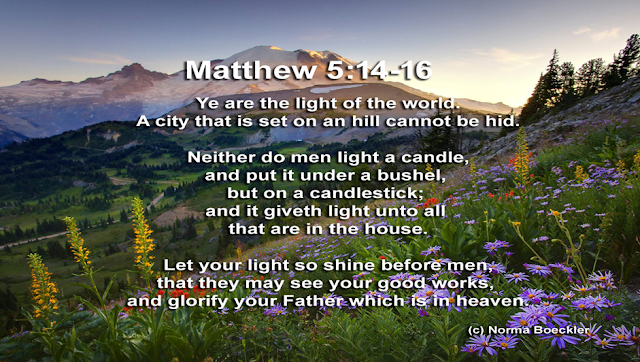
KJV Matthew 5: 14 Ye are the light of the world. A city that is set on an hill cannot be hid. 15 Neither do men light a candle, and put it under a bushel, but on a candlestick; and it giveth light unto all that are in the house. 16 Let your light so shine before men, that they may see your good works, and glorify your Father which is in heaven.

            Luther used the sun and the moon to compare the Gospel with the Law, since the energy of the sun is needed for the moon to illuminate the night sky. In the same way, the light of Christ is in those who believe in Him and absent in those who do not. Even the smallest light can be seen in complete darkness. In fact, utter darkness makes light especially important for believers and unbelievers alike.

            President Ronald Reagan’s farewell speech included this Biblical reference, a great contrast when compared to the deliberate darkness of dystopia today:

In my mind it was a tall, proud city built on rocks stronger than oceans, windswept, God-blessed, and teeming with people of all kinds living in harmony and peace; a city with free ports that hummed with commerce and creativity. And if there had to be city walls, the walls had doors and the doors were open to anyone with the will and the heart to get here.[1]

            No one can hide a city built up high on a hill or mountain. The light of that city penetrates the darkness and draws people to it. In contrast, darkness makes people afraid, and they stumble from the smallest obstacle. When my brother lost his shoe in a sheep pen at night, we were playing with the farmer’s children. No one knew how to find it in the muck – until the farmer brought out his flashlight, laughing. The farmer did not hide the light but shone it until the shoe was found and extracted with the expected jokes.

            Matthew 5:16 “Let your light so shine before men, that they may see your good works, and glorify your Father which is in heaven.”

The secondary light from the Light of the World shines in us as we practice the forgiveness which bears fruit in love. Most importantly, that begins with our own households, where faith, forgiveness, and grace dissolve the darkness of our natural selves and selfishness. The early Christian martyrs witnessed to their faith by dying instead of silencing themselves and hiding the truth. They were honored to model the Savior in their deaths - and in doing so - to spread the Gospel. John Hus’ death as a martyr paved the way for Luther, who stated, “We are all Hussites,” and the Reformation which changed Europe and the world.

PS - Note that these are first drafts, with more details later.

Wednesday, January 25, 2023

The Light of the World


The Light of the World

KJV Matthew 5: 14 Ye are the light of the world. A city that is set on an hill cannot be hid. 15 Neither do men light a candle, and put it under a bushel, but on a candlestick; and it giveth light unto all that are in the house. 16 Let your light so shine before men, that they may see your good works, and glorify your Father which is in heaven.

            Luther used the sun and the moon to compare the Gospel with the Law, since the energy of the sun is needed for the moon to illuminate the night sky. In the same way, the light of Christ is in those who believe in Him and absent in those who do not. Even the smallest light can be seen in complete darkness. In fact, utter darkness makes light especially important for believers and unbelievers alike.

            President Ronald Reagan’s farewell speech included this Biblical reference:

“In my mind it was a tall, proud city built on rocks stronger than oceans, windswept, God-blessed, and teeming with people of all kinds living in harmony and peace; a city with free ports that hummed with commerce and creativity. And if there had to be city walls, the walls had doors and the doors were open to anyone with the will and the heart to get here.”[1]

            No one can hide a city built up high on a hill or mountain. The light of that city penetrates the darkness and draws people to it. In contrast, darkness makes people afraid, and they stumble from the smallest obstacle. When my brother lost his shoe in a sheep pen at night, we were playing with the farmer’s children. No one knew how to find it in the muck – until the farmer brought out his flashlight, laughing. The farmer did not hide the light but shone it until the shoe was found and extracted with the expected jokes.


            The secondary light from the Light of the World shines in us as we practice the forgiveness which bears fruit in love. Most importantly, that begins with our own households, where faith, forgiveness, and grace dissolve the darkness of our natural selves and selfishness. The early Christian martyrs witnessed to their faith by dying instead of silencing themselves and hiding the truth. They were honored to model the Savior and in doing so spread the Gospel. John Hus’ death as a martyr paved the way for Luther stating “We are all Hussites” and the Reformation changing Europe and the world.

            The light does not remain within the household but spreads so that all people will have the chance to see the meaning of the true Christ, the Savior of the World.

Monday, January 16, 2023

The Salt Parable - The Parables of Jesus


The salt verse follows the Beatitudes, Matthew 5:3-12, which can seem so overwhelming in their nine-fold blessings. The salt statement can be overlooked. However, the two themes together create an even more powerful statement. Each beatitude is a blessing for the Christian believer to understand, climaxing with persecution, the way of the cross. The vitality of the sincere believer, blessed by Jesus Christ, in verse 13 is expressed by salt in verse 13, a tiny amount of mineral in comparison with most other elements of Creation but essential in life. In the Old Testament, salt was used for preserving food, for seasoning, and for healing wounds. A salt covenant could not be broken.

When people drift away from the Faith, especially clergy and teachers, they become consumed by the cares and riches of this life. They often pursue the luxuries and honors of this life, losing their vitality and turning the Gospel into a convenience. The energy of the Word of God is set aside and becomes a burden enhancing apostasy. Salt becomes a form without its essence, just as a lukewarm faith becomes a show without real meaning.

The Mark 9:50 salt verse urges followers to remain on the Way of the Cross and display the forgiveness – peace – that comes from faith in Jesus Christ, the Son of God.

Adding to the Parables Introduction - More Today, A Little Later


 The Prodigal Son

    The Parables are used correctly only when the Scriptures are studied and remembered as one unified source, the Bible - the Book of the Holy Spirit, all verses in harmony and not contradicting themselves as the professional professors often do. The purpose of the entire Bible is not to eliminate faith in the Savior, but to explain and believe what is clearly the mission and purpose of the Son of God.

            Some Parables, like the Good Samaritan, are so obvious that an entire era of church political activism is used to make the Savior the founder of political activism in the visible church, the conclusion always being, “What can’t we do even more to make the world a better place?”

            The divine nature of the Parables is clear to anyone who has been asked to write a very short story in fulfillment of English or journalism credits. The short story task is very difficult and suffers badly in comparison with the Parables of Jesus.

            The Parables deserve special consideration for us all, for one reason. They are the very Word of Jesus. We need the Biblical narratives which explain the birth and public ministry of Jesus, but the Parables are the concentrated wisdom of the Savior Himself. Because His Word is always effective, reading a parable is like going to class and listening to the Son of God explain aspects of the Gospel to us. We can go back to these divine stories time after time, because the power of each story is so great and so vast in its implications, always expanding our appreciation. 

Thursday, December 29, 2022

Introduction to the Next Book - The Parables of Jesus


  Titles fluctuate from day to day.


Table of Contents

Introduction. 2


Introduction

            Scholars, endlessly divided, have lengthy introductions explaining the concept and meaning of Jesus’ Parables. My New Testament professor, at Waterloo Lutheran Seminary, wrote a book on the Parables and concluded that no one really knew what they meant. He had been dropped from the faculty of the Lutheran School of Theology in Chicago, a merger of six or more seminaries, dwindling in size even then, and now orphaned and selling its property to the University of Chicago.

            The New Testament Parables mean nothing unless they are read in the context of faith in Jesus Christ, the Son of God, born of the Virgin Mary, unique teacher and miracle maker, dying on the cross for our sins, rising from the dead, and ascending to Heaven. When the work of the Savior is shrunken down to “popular teacher,” the Parables lose their meaning. The apostates, who have abandoned their faith, are limited to mumbling about the many opinions published since the Age of Rationalism.

            The Bible itself is simply the book which teaches faith in Jesus, from Genesis 1 until the end of Revelation. The Holy Trinity is clearly taught in Genesis 1, as long as people read a little further and see the mysteries of the Christian Faith unfolding as the centuries progressed – and sometimes regressed.

KJV Genesis 1: 1 In the beginning God created the heaven and the earth.

2 And the earth was without form, and void; and darkness was upon the face of the deep. And the Spirit of God moved upon the face of the waters.

3 And God said, Let there be light: and there was light.

4 And God saw the light, that it was good: and God divided the light from the darkness.

5 And God called the light Day, and the darkness he called Night. And the evening and the morning were the first day.

God the Father commanded that the entire universe be fashioned, God the Son executing His orders. God the Holy Spirit witnessed this and revealed God’s Word. John 1:3 reveals additional details to us –

KJV John 1: 1 In the beginning was the Word, and the Word was with God, and the Word was God.

2 The same was in the beginning with God.

3 All things were made by him; and without him was not any thing made that was made.

4 In him was life; and the life was the light of men.

The New Testament specifies what was suggested in the Old Testament – the Holy Trinity, the pre-existence of the Son of God, the creation of all things animate and inanimate, and light – before the sun and stars were commanded into existence.

            The Parables are used correctly only when the Scriptures are studied and remembered as one unified source, the Book of the Holy Spirit, all verses in harmony and not contradicting themselves as the Biblical professors so often do. The purpose of the entire Bible is not to eliminate faith in the Savior, but to explain and believe what is clearly the mission and purpose of the Son of God.

            Some Parables, like the Good Samaritan, are so obvious that an entire era of church political activism is used to make the Savior the founder of political activism in the visible church, the conclusion always being, “What can’t we do even more to make the world a better place?”

            The divine nature of the Parables is clear to anyone who has been asked to write a very short story in fulfillment of English or journalism credits. The task is very difficult and suffers badly in comparison with the Parables of Jesus.