Showing posts with label crepe myrtle. Show all posts

Tuesday, July 3, 2018

"Why Did You Water the Crepe Myrtles Before the Rain?" Mrs. Ichabod asked.

"Fill these bowls and put down the camera."

Mike stopped by to warn of the storm, which I did not suspect. It was just another hot and humid July day, as far as we knew. The weather sites acknowledged the coming storm, and the clouds looked promising. I went out to water the young Crepe Myrtle bushes in the backyard.

"Why did you water them before the rain?" Mrs. Ichabod asked.

I explained:

  • First the five-gallon buckets will fill from a short rain, so why not empty them before the storm?
  • Second, if it is another short rain, the bushes will get the benefit before the rain starts - and then get a little more rain or even a long soaker.
Her final question was, "You didn't get wet?" She and Sassy consider raindrops to be fatal. Sassy will go out in snow and ice, but she nopes a slight rainfall.

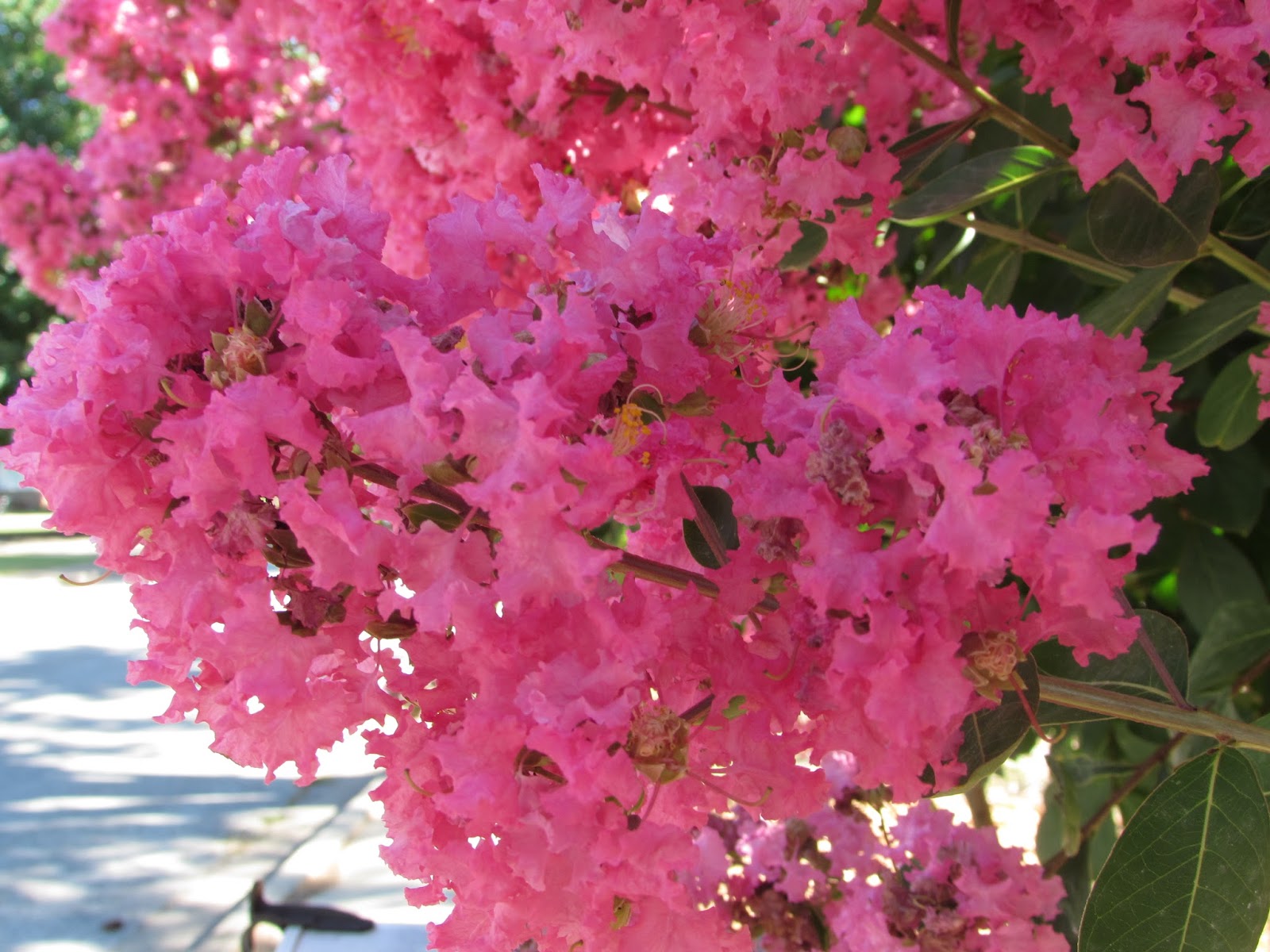
Crepe Myrtle Picotee - red and white blooms blend into a colorful pink.

Recently I showed Mrs. Ichabod what doting on the Crepe Myrtle by the kitchen window accomplished. Last year I watered it often and it doubled the size of its mates in the front yard. Now we are looking straight out the window at the brilliant flowers.

Next year we should be looking out the window at a strong Crepe Myrtle perch for the birds as they feed. The squirrels are so obnoxious on the Jackson EZ Bird Swings that I am going to move one to an empty window - no food - and put more perches on it. Bushes will serve as self-repairing perches for the two bird-feeder windows.

The squirrels like to sit on the bird swing to eat.
This is the kitchen window view, before the Picotee Crepe Myrtle bush began growing.


The recent vandalism from squirrels came from running out of thistle seeds, which they avoid, and using a songbird mix, which smelled good enough to eat - peanuts, etc. Now they can munch their songbird mix at the solo squirrel-proof feeder that they raid with ease. In Bella Vista, I stopped filling it, because they dominated it completely and laughed their little rodent laughs at the obstacles I added to the built-in squirrel proof measures.

My favorite moment with them was watching the squirrel stand on the baffle that was supposed to keep him off the pole. From that position he could wiggle the contraption that closed the food off from any creature heavier than a bird. That allowed him to jiggle endless amounts of food into his mouth, which he did with a saucy look on his face. I said, "I give up," and left it empty afterward. However, I moved it to Springdale, to use as a stand-by feeder.


Tuesday, June 26, 2018

Another Chance for Rain - Crepe Myrtle Blooms Pruned.
Sudden Sleep Suggests Tornado Near


I continue to spoil the big Crepe Myrtle, and it blooms gloriously as a result. The fertile base soil may be a major factor in its rapid transformation to seedheads. But do not fear - another bloom will take place this summer, when the other bushes have faded away.

 I planted the Cardinal Caladiums under the Crepe Myrtle.
I grew the white ones too. I plant the bulbs rather than the expensive plants from the store.


First, I trimmed the grassy weeds coming up through the mulch. I put down newspaper, then mulch on the newspaper for looks and keeping the news in place. Sassy guarded me from the front sidewalk. Her interest in gardening has grown, perhaps because she can find rabbits strolling through the garden at all hours.

I was going to cut the bottom row of blooms off, to use as additional mulch on the base. I found more seedheads, so I took off all blooms except the top row. The vivid pink top became the vivid pink base, especially since petals scattered all over.

These CM trimmings will dry up fast and highlight the Caladiums under the Crepe Myrtle - about 16 bright red and green leaves.

Accused of spoiling the big Crepe Myrtle, I confessed to spoiling the other nine, which I got on sale. I mulched them all with coffee diapers, the grounds and paper left from pour-over coffee. I use rose collars to protect them from rabbits and weed-eaters. I give them rainwater stored in the barrels. Even a slight rain will give me five-gallon paint buckets that are mostly full of water.

Borage, often called Bee Bread, is now blooming, a safe landing zone for beneficial insects.

Misunderstanding the Soil
Many people think they plant in the dirt, so they love to whip the dirt with tillers, which will

  • tear up weeds, 
  • destroy soil structure, and 
  • disrupt the fungal networks that provide for all the plants.
They have little roto-tillers, which some would like to use instead of weeding. I enjoy pulling or trimming the weeds, then using the weeds as mulch. Ruth Stout considered that the last insult for weeds! But I think of weeds as feeding the soil unless they get in the way of flowers and useful plants.

Clethra is known for fragrance and butterflies,
starting to bud
.
And It Rained with a Torcan of 3

We had tornado warnings, but the heat, humidity, and empty radar images left me doubting. I cannot stay awake when a tornado is near, so my dropping off to sleep concerned Mrs. Ichabod. Twice I stopped driving, extremely drowsy, unable to drive, only to learn a tornado was nearby. I could be a storm-chaser, fitted out in a comfortable van driven by someone else. "He's asleep and snoring. F5! Call the alert!"

The sky darkened and the solar lights went on outside. The system passed quickly and headed toward Perryville and St. Louis.

Chaste Tree is another southern favorite.

Sassy reluctantly came outside with me to view the gardens. Chaste Tree is in full bloom and attracting bees; some consider it the ultimate bee plant. It can be a shrub by itself, about six feet tall, a row of shrubs like the Crepe Myrtles. I learned with this one - I had it in partial shade and watered it. The tree needed plenty of sun and no water at all. In fact, organic mulch is discouraged. I have three, thanks to Almost Eden's nursery nearby, so I might move one or two up front in the fall.

Autumn may be my time of moving plants around, with an abundance needing more room, more variety desired in the rose garden.

The roses are getting their second wind, after being plundered of their flowers and suffering drought and heat. The rain will go a long way toward a lot of blooms for Sunday. I will prune with that in mind.

The divided Shasta Daisies have forgiven my haste and are already blooming. If someone had gardening anxiety, daisies would be a good starting point - rapidly clumping, easily divided, and good for beneficial insects. Besides that, they are great for filling out a bouquet of roses. I have roughly 12 Shasta Daisy clumps growing now.

 Joe Pye Weed can be found growing in the wild, but it remains one of the first sold out in the spring.
Our first Joe Pye Weed is now six feet tall and still reaching up with buds. Today I confided in Mrs. Ichabod, "I know why they sell Little Joe Pye bushes. Look at that monster." I am picturing a rose garden full of six-foot-tall Joe Pyes, which could be more leverage for our Laotian neighbors.

They snickered about the Buckwheat plants taking over the rose garde - twice - last year. This year I have a few Buckwheats six feet tall. What does that suggest? The soil is incredibly fertlie, and the cover crop contributed by growing abundantly there last year.

Joe Pye and roses have similar needs. Joe Pye harbors beneficial insects, so it is a great companion plant, easy to grow, happy to be watered. Our new plants are already budding, so we will have a fun display for butterfly experts aka lepidopterists.

 Hosta blooms make them the best hummingbird feeders.

 Blue Hawaii is an example of Hostas grown for color and variety. They tolerate shade better than most but enjoy sun as much as roses.

Hostas grow in two classes in the rose garden. The veterans came from Mr. Gardener, and they developed several years in the back. I moved them to the rose garden this spring. I also had a few new ones planted last fall. Every plant is doing well, some a bit insect-chewed. I plan to divide the veteran hostas this fall. They are easy care plants and usually do not grow to gargantuan size.

Hidden Lily

I got Hidden Lily Wild Ginger for almost nothing. The flowers stay colorful, pushing up out of the ground. The sunny butterfly garden made them bloom first there, but two are also working their way up along the driveway. The Elephant Ears, which never grew, are gone to compost every one.

Every Plant Has Its Own Nature - 
Another Blow To Evolution

The people who claim they cannot garden remind me of the ones who go nuts at the mention of spiders. Additional discussion is not possible.

But for those who do garden and might garden - knowing the nature of a plant is the Creation key. Those plants with similar likes grow well together as companions. They feed bees and beneficial insects at alternate times, keep concentrations of pests away, and look attractive. The aphid hunters enjoy food as adults, but they also like neonatal units nearby for their young. Therefore, roses provide the aphids for the young to eat as they hatch. Nearby aisies provide nectar and pollen for the adults.

We can push some plants to perform against their nature, such as having Hostas in the deep shade, but they flourish when allowed the warmth, water, or sunshine they need.

The Chaste Tree did not like the shade and excess water I gave it and almost died of my indulgence. The same plant flourished after being pruned and placed in a dry, sunny spot - no watering.

That is why I return to Biblical principles all the time and make fun of clergy/laity looking for results. In the garden, results follow respect for the engineering and management of the Creator:

  1. Insecticides cause more pests in the garden, not fewer.
  2. Man-made fertilizers hurt the soil.
  3. Soil creatures and microbes do far more than a tiller, which hurts them, and cost nothing to deploy.


Monday, July 3, 2017

Let Myrtles Be Myrtle

 The Crepe Myrtle is a bit soggy and heavy with rain,
with more blooms to open.
The plants around its base are Buckwheat, living mulch.
Photo by 29A.

 This is the original view of the yard, with the Ichaboat parked
in the driveway. The neglected Crepe Myrtle is next to the mailbox.
The maple tree suckers on the left almost squeezed out the
weeds and junk around its base.

 My first steps in feeding the Crepe Myrtle involved putting the
trimmings, grass clippings, wood mulch,
and mushroom compost around the base.
I also piled a pyramid of leaves under it for the winter,
and left it there to be absorbed in the early spring.

The Crepe Myrtle is now so glorious that strangers stop on their walks to grab the blossoms and smell them, to marvel at the density of the flowers. Bees work the flowers and birds are nesting there once again.

This is how God's Creation works together. I did not put much labor into this project, but I do a little all the time, week by week.

  • I studied Crepe Myrtles because I had them in Bella Vista and they were not impressive. They had potential, I thought.
  • I removed all the branches below, which looked silly at first, but emphasized the bloom that summer. Similar to pour-over coffee, the bloom is crucial.
  • Previous years of study showed that the way to feed the plant was simply to put organic matter around the base, to be consumed by red wiggler earthworms that I added, supplemented by all the other soil creatures, included our hard-working mole. You be hatin', he be mixin' the soil.
  • New studies showed that the fungus network that feeds, protects, and hydrates plants would be helped by wood products (done), and leaving everything alone (no roto-tilling).
People still need to recognize the value of pruning all the time - not a massive effort but a little bit each day. Most plants that we value will grow better with pruning. Pick some peas, beans, or tomatoes - more flowers will sprout and more fruit will grow. The same is true of Crepe Myrtle, roses, and other plants.

Sunday  morning, I cut the best roses for the altar. I was a bit short of roses, so I also cut some Chaste Tree to add purple blossoms to the mix, next to John Paul II white roses - no irony intended. Sunday afternoon, we had an explosion of Easy Does It orange roses. The display on that one rose bush was so brilliant that our guest walked into the garden to photograph it. 

Yes, I welcomed the photography. A gardener with a camera is nowhere near as dangerous as a newbie with a roto-tiller and a jug of insecticide.

Joel Salatin, who is a Christian, writes about honoring the life on the farm or garden - the plants, the soil, and the animals. He is speaking of Creation. His best work that I have read is The Sheer Ecstasy of Being a Lunatic Farmer. He is all over YouTube as well.

Food
The Crepe Myrtle blooms easily, loves the sun, and tolerates a lack of water. That does not excuse neglect, which is the typical reaction. Plant it and forget it. A flowering bush has to have food, which will come from the sun and the soil. I simply put the food around the base, year around, and let the soil creatures carry out their divinely engineered functions. 

Water
When other plants are drooping from the sun and lack of rain, I water them and the Crepe Myrtle. In return, its deep roots and extensive root system direct rain into the subsoil rather than letting the top soil run off onto the sidewalk. 

 We see this around town. The bushes still grow and bloom,
but they do not achieve their real glory,
which was embedded in Creation.


Pruning To Grow
The Crepe Myrtle has more horsepower than a supercharged Ford 150. New branches come out and droop over the mailbox. I cut them off and place them around the base. Some sprouts come from the lower branches. They are cut or pulled away. The first bloom is pruned away later, which means a complete second bloom to round out the summer. Then I let the seeds form. Early spring means pruning and shaping the top, not "crepe murder" where the flowering section is lopped off.


Pruning means spurring growth, above and below ground. Every snip of the shears will encourage more branches and bigger flowers. Below ground, the roots reach out deeper and wider.


Saturday, September 3, 2016

Crepe Myrtle Photographs Elicit a Plea - "Sell Me a Cutting!"
Four Months of Sp[ectacular Blooms, A Southern Beauty


Our attorney in Phoenix said, "You are moving TO Arkansas? I can see moving FROM Arkansas."

I said nothing, which means, "You are too dense for a response." Since then I have attended about 80 Walmart Saturday Morning Meetings, met three CEOs and the surviving children of Sam Walton, founder of Walmart. Little Ichabod and I have listened to movie stars, politicians, and real heroes like Sully, who landed his passenger jet in a river and saved all their lives. Famous Medal of Honor winners? - they have been honored only 15 feet from us, since we get the front seats by getting there early. We saw the notorious Senator McCain at one meeting, and I never saw him (or tried) in Phoenix.

Yesterday, I posted a video and these pictures on Facebook, from the photography session with Sassy. A classmate wrote right away, "Greg, would you please sell me a cutting?" I was willing to give her some, but she soon learned her location was too cold for Crepe Myrtle.

And "that's what I like about the South."


This odd photo, above, demonstrates how a Crepe Myrtle will re-bloom after being pruned in the summer, if it has enough time. I pruned the lower half and put the cuttings below for mulch. I left the upper portion alone, since Cardinals are nesting there. Now the upper portion is going through its cycle of pollination and seed production. Birds love the seeds, so the plant first feeds the pollinating insects, then the birds for winter.

Adult beneficial insects usually need pollen and nectar for their meals, letting the babies eat the pests. Having early, persistent, and late blooms will keep that population around, generation after generation.

The stumps in the front yard are not from cutting down our trees, but from numerous rescue operations, grabbing them from the curb before they are hauled to the dump. They serve as perches for birds looking for food among the roses, and they feed the soil by creating a zone for the creatures that live from darkness and decomposition.

Our rustic fence is made from the limbs of a tree cut down across the street. They were also on sale at an antique market. I did not ask the price, since I had plenty.


The seeds framed by the blue sky are a small indication of what a fine bird-feeder this Crepe Myrtle is, only costing a little labor from time to time. Most of the energy comes from its position in the sun, watering when it was ready to bloom, and constant mulching year around. Every organic tepee underneath has flattened out from decomposition.

New rose growers often think that pruning means taking blooms away, but veteran growers know that every prune (dead wood or green branch) spurs growth above and below.

One British gardening book taught me that organic matter on top of the soil will be pulled down until the soil is enriched as much as possible. The remaining mulch on top serves to protect the treasure below. Red wiggler earthworms are the best for decomposition and thrive in this environment. Our yard was heavily sown with red wigglers from the beginning, including the place beneath the Crepe Myrtle.

Good gardening methods take advantage of

  1. God's Creation, 
  2. Engineering, and
  3. Management - whether the gardener acknowledges this truth or not. 

Bad gardeners thwart the Creation and supplant it with man's ideas about

  • Chemical fertilizers, 
  • Pesticides, 
  • Fungicides, and
  • Herbicides - four ways to poison the soil and limit plant growth. 
If I were wrong - and I depend on many studies for these ideas - I would not have the most spectacular Crepe Myrtle in town. I am not boasting about what I have done, but about God's work in Creation. What I do is minor - piling up organic matter below, pruning twice a year, and watering every so often.

 Sassy supervises all my gardening efforts.


Autumn Warning
Do not clean up the garden, rake away the leaves, or do anything else to disturb the expert engineering on display in the yard. Hordes of beneficial creatures depend on leaf litter, dormant or dead plants, logs, branches, and other ornaments of organic gardening to survive the winter and protect their young.

I have a green jungle along Mrs. Wright's fence, a tangle of many plants and weeds. We could mow or weed eat it down to a green porridge, but the density of this growth is unlike the density of the attorney quoted above - good for something.

Every spring our helper wants to rake up the remaining leaves. I stop him with stern warnings and helpful encouragement. "Soon the leaves will be pulled under the soil." The piles in the back were deep but they are a fine mat now, no longer knee deep. Where did they go? Earthworms and mites reduced them for the microbes in the soil, the foundation for the root hairs of all the plants.

During that time, bugs good and bad matured, some eaten, others moving about to do their assigned tasks. Many beetles prey upon the worst pests. The work of spiders is impossible to calculate. They want the trashy style of the so-called lazy gardener, who knows more is done from not cleaning up than can every happen with the tidy, monoculture look of green grass and nothing else.

I knew a pastor who rototilled his autumn leaves into the garden, when leaves are frosting on the cake, a blanket of warmth and food for God's Creation. He did not trust God to use the leaves in the best way possible, like ministers who do not trust the Word to do God's will.

Sassy is always listening and watching.
Here she is looking toward her home
from Almost Eden Gardens and Nursery.

Friday, September 2, 2016

Sassy Supervises the Crepe Myrtle Photography Session

 Sassy loves to be around us when visiting.
She first sat a safe distance from Mr. Gardener watering,
then joined us for a conversation about Springdale and the Clintons.


This is the new bloom on the Crepe Myrtle,
caused  by pruning the lower half some time ago.


 This shows how the lower half of the Crepe Myrtle bloomed
while the upper half began going to seed.
The resident Cardinals love the food provided on the spot.
Earlier in August, the lower half
was newly pruned and starting to bloom again.


 Crepe Myrtle seeds form slowly and last
through the winter. I encourage new growth by
pruning them in the spring and feeding the soil
with multiple layers of mulch at the base.

Friday, March 20, 2015

Jackson Bird Spa Expansion - Stolen Leaves Are Sweeter


The Jackson Bird Spa is party central in our neighborhood -

nine feedings stations and seven places to drink or bath,
twigs, sticks, string, and lint for their nests.


When I came home from Walmart today, Mrs. Ichabod asked about the two huge garbage pails I had in the car. "They aren't garbage pails. They are rain barrels with birdbaths on top."

In the trunk I had some mulch for the Jackson Bird Spa expansion. I left newspapers out in the rain, which finally stopped. They are far easier to spread when soaking wet, and breezes do not blow them away. I expanded the area to be covered and mulched on top.

I put the garbage-can-lid birdbaths upside-down in the mulch and filled all the baths. These Rubber Maid lids were especially shallow and very large, which birds appreciate. They are not going to step into deep water, and I want toads to have a pleasant area with plenty of water.

I never looked for toads before, but I had one under the faucet last summer. I also saw baby toads here and there, without thinking much about them being such a blessing - eating slugs and insects.


Rain Barrels
I thought of capturing rain from altering the down spouts, but I had second thoughts after wrestling with one of the spouts today. Reworking the spout means additional work, which is a violation of the Maynard G. Krebs Prime Directive - Do not create extra jobs in the garden.

Instead I will leave the downspouts alone and capture rain from the roof runoff in the backyard (no downspouts or gutters there).

There are two ways to have great water for special treatment of plants. One is to fill a barrel and let it evaporate the chlorine out of it for at least 24 hours. The other is to collect the rainwater and use it before it generates a population of mosquitoes.

My mother always stored water before using it in the classroom. All the teachers wanted to know why her flowers were so bountiful and theirs were so poor. She just smiled. Moline water was so bleachy we did not need whiteners for our teeth.


The Crown Imperials are beginning to show.
Giant aliums are next.

Stolen Leaves
I watered the straw bale garden, which is going to produce gushy soil around it. The benefit of straw bales is that watering them will motivate the roots to go down deep. The disadvantage is the need to water often and stay out of the mud.

We began with a good base - heavy ragweed growth, pumpkin vines, and tomato vines mulched into the soil, which had plenty of wood mulch. Newspapers were on top of this, and straw bales on the newspapers.

Lacking was an area to dress up the sloppy look of leaning bales and newspapers under them like old nappies.

I know our veteran on the corner wanted his leaves gone, and his brother was taking several more months to finish the job. Sassy and I went down with the wheel-barrel and nicked them in  two trips. If no one saw the trips, the brothers will wonder how the leaves disappeared after abiding so long on the corner of the lot, killing the grass.

Autumn leaves, piled up, rained and snowed and sleeted on, are dark, wet, and somewhat slimy. They are pure food for the soil. Leaves harbor beneficial insects, soil creatures, and earthworms. Microbes and larger soil creatures (yea, even slugs) will shred, digest, and fix all that food in the root zone.

Yes, I smile at at Lowe's customers carting bags of inorganic fertilizer out to their cars. They probably bag their leaves and have the city pick them up. Endless withdrawals from the soil cannot be made up with inorganic salts.

So I piled my treasure along the base of the straw bales. Overflow of water will facilitate additional decomposition. The leaves will settle down in a few days, so I will add a bag or two of wood mulch,  on top - as I did at the base of the crepe myrtle bush.

I mulched the crepe myrtle all last year, and the mulch kept going down. What does this mean, class?
Answer - the soil creatures below consumed the trees leaves, bush leaves, mower grass clumps, and wood mulch, feeding the roots of the bush and giving us the most glorious crepe myrtle in the area.

We pruned the top of the crepe myrtle and got a second bloom when all others stopped. Why? They did not prune for a second bloom. The seed pods formed and lasted all winter and fed the birds. We mulched all the pruned branches by cutting them up into twigs. They decomposed into the soil.


Sunlight Plus + Organic Additions = Soil Health
The renewal of the soil comes from a combination of solar power and organic additions.

Solar power makes the plants grow, create complex compounds above and below the surface, and build the soil by turning energy into useful nutrition.

Organic additions build the soil by adding a wide variety of food for soil creatures to turn into food for plant roots. Just as the birds show up for suet, peanuts, corn, and sunflower seeds, the soil creatures arrive to consume manure, plant leftover, mulch, leaves, and grass clippings.
Great blooms, but this crepe myrtle could use a lot of pruning.

The Lyle Lovett pruning of the crepe myrtle bush
puts all the flowers on top, the branches below bare.
Little Ichabod laughed.

Monday, August 18, 2014

Pruning Roses - Divided Joy, Doubled Joy


Our neighbor's daughter came over with newspapers. We give them the Sunday paper for coupons; they send it back with interest. I said, "Thanks. I will turn these into roses and vegetables. Do you want some roses now?"

No one turns down roses.

Although I cut about 10 roses for the altar, I still had four perfect roses left with long stems. She decided to hold them for the walk across the street.

The Germans have a saying, which is literally "A cut joy is a doubled joy." People translate it as "A shared joy is a doubled joy." The Jackson Literal Translation fits rose gardening the best.

When roses are cut just above a five-leaf cluster, they produce more blooms. That is where I normally prune. Dead wood (brown and dry) is always pruned. Spent flowers are trimmed away and so are thefurtive attempts at going to seed.

Knock-Out roses bloom profusely and open quickly, but I can get those roses to open slowly if I cut them early in the blooming stage. The whites, pinks, and magentas have delicate little buds that are perfectly formed when pruned early.

These sepals need a little more time before cutting the rose for the vase.


The best rose in a vase is not the fully opened bloom, but the bud where the five sepals around it have opened. Then the bud will open completely, slowly. If one of the sepals is still tightly bound to the bud, the cut bud will not open. I wait until the sepals are at the equator (my term) or below it.

Given adequate moisture and nutrition below, heavily pruned roses will bloom profusely. I do not add rose food after a bloom cycle because I have the earthworms and mulch for that. Besides, inorganic fertilizers are like steroids. They can promote immediate change but long-term damage. I water extra because these roses are on a slope and it is difficult to over-water them.


The crepe myrtle bush got a Lyle Lovett haircut.

I wanted to shape the crepe myrtle bush so the horizontal branches were pruned away. The bush was engulfing the mailbox, and neither object could be moved. Although the bush  can take on a graceful umbrella shape, I wanted a tall vase with a narrow base - like my distant neighbor's, which is now 20 feet tall.

When we were done, I thought of Lyle Lovett. All the lower branches are bare and only the top is leafy. All flower heads are trimmed away in hopes of a second bloom this year. As my mother used to say after cutting our hair with her electric trimmers, "It will grow out."

Our timing was good. A storm front moved over the region and dumped rain on all my projects, with more to come. The bush is mulched by cypress and cut up fragments of the pruning. I placed solar faerie lights in the top. I set them to flicker on every so often instead of blinking steadily and making the neighbors go crazy.

Gardeners realize that one effect of pruning is waking up the roots. If the plant is pruned, the roots start growing more - the secret to healthy, robust, drought-resistant plants. Gardeners will spade into the roots of an old bush to cut them, to promote new growth.

I have no qualms about trimming the roots of bare root roses to fit the hole I have dug for them. I know the roses will not accomplish much until the roots grow out and form their extremely delicate root hairs. Until that happens, the rose will be fragile. The rose will wobble in the soil and not take in much moisture or nutrition. The root hairs vastly increase the surface area and the efficiency of the plant.

Digging up a rose bush means damaging the root hairs. That is why transplanting can be difficult and will always result in a delay after replanting.

God created entire plant groups with specific characteristics. If we know how they relate to their surroundings, we can have great results with relatively little labor.


Has anyone improved on Mr. Lincoln?
Velvety petals, rich perfume, beautiful foliage.

Thursday, August 14, 2014

Sunflowers Are So Much Fun in the Garden

This dwarf sunflower is called Sunny Smile.
I have grown many kinds of sunflowers, but my favorite is the Russian Mammoth or striped seed sunflower. The larger the plant, the greater the diameter of the seedhead, the larger the seeds.

Two rows of sunflowers of growing now, chiefly for to feed the birds and squirrels. Sunflowers have a honey-like aroma. Bees are working the flowers right now.I let the plants go to  seed - if the squirrels allow it. Sometimes they chew off the bloom and eat that. We have seen squirrels bounce on sunflower plants as they pull seeds from finished disk.

A sunflower is like a cheap motel, with all kinds of residents. Grasshoppers will stay on a leaf and chew away, doing nothing to slow down the plant. Spiders set up shop to trap some food. Bees arrive for pollen, birds and squirrels for seed.

I leave the stalks up for the winter, so birds can perch safely on them above the snow, looking for food.

The seed companies like to market all kinds of sunflowers, all colors and sizes, almost like car models. "Have you grown Sunset sunflowers, yellow and brown?" They cost more and produce fewer seeds, tiny seeds.

Mammoth sunflowers are ideal for birds and for human snacks.
They are loaded with minerals and protein and oil.
I plan to use mammoth sunflowers to screen the back fence, where No-Man's Land separates us from the homes on Joye street. The sun may be limited, but the sunflowers will spread out and grab whatever they can. I have soaker hose out to that location so I can easily add one link. They are heavy feeders and demand plenty of water to grow.

Buying pounds of sunflower seeds is a great way to do some interesting things. like create a living screen. Or they can form a square around children's equipment, so a green fort grows up around their slide or climber. Dig shallow trenches and sow in abundance. Water daily. The results are spectacular. The little bit of work is worthwhile when a child disappears inside the fort and pops out to surprise his parents.

Crepe myrtle may bloom again.

I was studying my gardening in the South book when I discovered that pruning the crepe myrtle may result in a new set of blooms. I was interested in the soft branches for the compost; I also wanted to shape the plant, which threatens to engulf the mailbox. No one ever figures out how big a plant will be in the future. Proof - we have two trees in the backyard, growing into each other.

If we prune now, the bush will send down more roots, create new growth, and possibly bloom again for the fall. The full blooms lasted for weeks and have not completely finished going to seed. Crepe myrtles in our neighborhood grow with pink, raspberry, or purple blooms.

This crepe myrtle should be shaped like a vase,
the form used for most hybrid tea roses.