Showing posts with label Eastern Othodoxy. Show all posts

Saturday, September 17, 2011

WELS Pastor in Wasilla, Alaska Becomes Russian Orthodox.
Roger Kovaciny Now LCC, Eh?


Rev. Tim A Kolb  -    King of Kings   -   Wasilla, Alaska  -  4/21/2011   -      Resigned from WELS.

---


Greek studies challenge seminary students in Ukraine


by Oleg Schewtschenko  


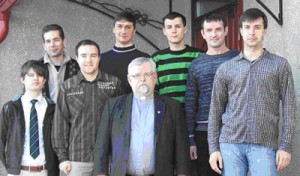
Pastor Roger Kovaciny and seminary students


For more than six-and-a-half weeks Pastor Roger Kovaciny taught biblical Greek at Concordia Seminary in Odessa. The students were  challenged by the totally new language, hard and intensive work, and the short period of time to learn it. Pastor Kovaciny is from the Wisconsin Evangelical Lutheran Synod (WELS) and has lived more than 15 years in Ukraine serving as a professor and president of the Ukrainian Lutheran Church’s seminary in Ternopol. 
This is first time our seminary has taught Greek to the students. Thanks to this class, students could see the New Testament in the new light. They enjoyed reading John´s writings, learning the Greek grammar and they worked on their own translation of the Gospel of St. John.  
We hope this will be a great gift to the church and the pastors making them able to look up some difficult passages in the original Greek Bible and giving them new tools to work with the original language for the benefit of themselves and of their congregations.  

New teacher arrives

The cold February session began with the arrival of a new instructor, Pastor Albert Schmidt from Edmonton, an old friend of our seminary. He has instructed most, if not all of the ordained pastors in the Synod of Evangelical Lutheran Churches in Ukraine. The first time he came to teach was in August 1998.  
Pastor Schmidt is teaching two classes:  Christ in the Synoptic Gospels (Matthew, Mark and Luke) and Pastoral Theology. Our students are enjoying very much his pastoral experience. “I just really love to listen to the stories from his ministry” one of the students shared with me about the stories he heard that day.  
“There is so much we can learn from his teaching and examples,” commented another student.  
Please continuing to pray for the students and their teachers that God would give them unity and a good working atmosphere.  
Rev. Oleg Schewtschenko is pastor of LCC’s partner Lutheran congregation in Odessa, Ukraine, and also assists the seminary program with translating and other arrangements. Support for the educational program comes from Concordia Lutheran Mission Society and Lutheran Church–Canada.

 Guilt by association scan.

Saturday, May 30, 2009

The Last Day of the Old World


Holy Wisdom, Hagia Sophia in Constantinople, now a museum, remains one of the oldest and largest churches in the world.


Something to think about today -


The Fall of Constantinople

The assault began after midnight, on the 29th of May, A.D. 1453. Wave after wave the attackers charged. Battle cries, accompanied by the sound of drums, trumpets and fifes, filled the air. The bells of the city churches began ringing frantically. Orders, screams and the sound of trumpets shattered the night. First came the irregulars, an unreliable, multinational crowd of both Christians and Moslems, attracted by the opportunity of enriching themselves by looting the great city, the last capital of the Roman Empire. They attacked throughout the line of fortifications and they were massacred by the tough professionals, who were fighting under the orders of Giustiniani. The battle lasted two hours and the irregulars withdrew in disorder, leaving behind an unknown number of dead and wounded.

Next came the Anatolian troops of Ishak Pasha. They tried to storm the stockades. They fought tenaciously, desperately trying to break through the compact ranks of the defenders. The narrow area in which fighting went on helped the defenders. They could hack left and right with their maces and swords and shoot missiles onto the mass of attackers without having to aim. A group of attackers crashed through a gap and for a moment it seemed that they could enter the city. They were assaulted by the Emperor and his men and were soon slain. This second attack also failed.

But now came the Janissaries, disciplined, professional, ruthless warriors, superbly trained, ready to die for their master, the Sultan. They assaulted the now exhausted defenders, pushing their way over bodies of dead and dying Moslem and Christian soldiers. With tremendous effort the Greek and Italian fighters were hitting back and continued repulsing the enemy. Then a group of enemy soldiers unexpectedly entered the city from a small sally port called Kerkoporta, on the wall of Blachernae, where this wall joined the triple wall. Fighting broke out near the small gate with the defenders trying to eliminate the intruders.

It was almost day now, the first light, before sunrise, when a shot fired from a culverin hit Giustiniani. The shot pierced his breastplate and he fell on the ground. Shaken by his wound and physically exhausted, his fighting spirit collapsed. Despite the pleas of the Emperor, who was fighting nearby, not to leave his post, the Genoese commander ordered his men to take him off the battlefield. A gate in the inner wall was opened for the group of Genoese soldiers, who were carrying their wounded commander, to come into the city. The soldiers who were fighting near the area saw the gate open, their comrades carrying their leader crossing into the city, and they though that the defense line had been broken.

They all rushed through the gate leaving the Emperor and the Greek fighters alone between the two walls. This sudden movement did not escape the attention of the Ottoman commanders. Frantic orders were issued to the troops to concentrate their attack on the weakened position. Thousands rushed to the area. The stockade was broken. The Greeks were now squeezed by crowds of Janissaries between the stockade and the wall. More Janissaries came in and many reached the inner wall.

Meanwhile more were pouring in through the Kerkoporta, where the defenders had not been able to eliminate the first intruders. Soon the first enemy flags were seen on the walls. The Emperor and his commanders were trying frantically to rally their troops and push back the enemy. It was too late. Waves of Janissaries, followed by other regular units of the Ottoman army, were crashing through the open Gates, mixed with fleeing and slaughtered Christian soldiers. Then the Emperor, realizing that everything was lost, removed his Imperial insignia, and followed by his cousin Theophilus Palaeologus, the Castilian Don Francisco of Toledo, and John Dalmatus, all four holding their swords, charged into the sea of the enemy soldiers, hitting left and right in a final act of defiance. They were never seen again.

Now thousands of Ottoman soldiers were pouring into the city. One after the other the city Gates were opened. The Ottoman flags began appearing on the walls, on the towers, on the Palace at Blachernae. Civilians in panic were rushing to the churches. Others locked themselves in their homes, some continued fighting in the streets, and crowds of Greeks and foreigners were rushing towards the port area. The allied ships were still there and began collecting refugees. The Cretan soldiers and sailors, manning three towers near the entrance of the Golden Horn, were still fighting and had no intention of surrendering. At the end, the Ottoman commanders had to agree to a truce and let them sail away, carrying their arms.

The excesses that followed during the early hours of the Ottoman victory are described in detail by eyewitnesses. They were, and unfortunately still are, a common practice, almost a ritual, among all armies capturing enemy strongholds and territory after a prolonged and violent struggle. Thus, bands of soldiers now began looting and murdering at will. Doors were broken, private homes were looted, their tenants massacred. Shops in the city markets were looted. Monasteries and Convents were broken into. Their tenants were killed, nuns were raped, many, to avoid dishonor, killed themselves. Killing, raping, looting, burning, enslaving, went on and on. The troops had to satisfy themselves. The great doors of Saint Sophia were forced open, and crowds of angry soldiers came in and fell upon the unfortunate worshippers, butchering them all. Pillaging and killing in the holy place went on for hours.

Similar was the fate of worshippers in most churches in the city. Everything that could be taken from the splendid buildings was taken by the new masters of the Imperial capital. Icons were destroyed, and precious manuscripts were lost forever. Thousands of civilians were enslaved; soldiers fought over young boys and young women. Death and enslavement did not distinguish among social classes. Nobles and peasants were treated with equal ruthlessness.

In some distant neighborhoods, especially near the sea walls in the sea of Marmora, such as Psamathia, but also in the Golden Horn at Phanar and Petrion, local fishermen opened the gates, and while the enemy soldiers were pouring into the city, local magistrates negotiated successfully their surrender to Hamza Bey’s officers. Their act saved the lives of their fellow citizens. Furthermore their churches were not desecrated. Meanwhile, the crews of the Ottoman fleet abandoned their ships to rush into the city. They were worried that the land army was going to take everything. The collapse of discipline gave the Christian ships time to sail out of the Golden Horn. Venetian, Genoese, and Greek ships, loaded with refugees, some of them having reached the ships swimming from the city, sailed away to freedom. On one of the Genoese vessels was Giustiniani. He was taken from the boat at Chios where he died from his wound, a few days later.

The Sultan, with his top commanders and his guard of Janissaries, entered the city in the afternoon of the first day of occupation. Constantinople was finally his and he intended to make it the capital of his mighty Empire. He toured the ruined city. He visited Saint Sophia, which he ordered to be turned into a mosque. He also ordered an end to the killing. What he saw was desolation, destruction, death in the streets, ruins, and desecrated churches. It was too much. It is said that, as he rode through the streets of the former capital of the Christian Roman Empire, moved to tears he murmured: “What a city we have given over to plunder and destruction.”

The Fall of Constantinople marks the end of the Middle Ages and the beginning of a new epoch in Europe. Many Greek scholars moved to Italy, initiating there the development of European Humanism, while the legal succession of Byzantium and leadership of the Orthodox Church were transferred to Tsardom and the “3rd Rome” in Moscow. Finally, by losing access to the Black Sea, Europe was deprived of the land route to India; the search for a new sea route brought about the overseas discoveries of the Americas. Thus, the next day, May 30th, 1453, was the first day of a New World.

Monday, November 24, 2008

Catching Up with Lutheran Notes


Lutheran Notes has added some cartoons and other material.

I copied the photo from the blog. Mr. Notes has promised not to sue me or threaten me or send me a free ticket to the WELS Ed Stetzer show in 2009. Every time I publish the truth about WELS, someone from Church and Change calls me a liar. However, they have not told the truth about Stetzer yet.

Back to The Surrendered Fort
Their Roman Catholic/ELCA gab-fest is coming up. David Scaer, in the photo, organizes these things. One LCMS pastor attended the Father Neuhaus lecture at Ft. Wayne and became a Roman Catholic. His blog is Beatus Vir (Blessed is the man who...popes?)

I give David Scaer credit for Romanizing and Orthodoxing (Eastern, that is) the seminarians. Weinrich shares the honors.

David has his son teaching there. Meier, father and son, are also teaching at The Surrendered Fort. WAM the Elder was married in 1951, about when the Grand Canyon was being completed. Just joking - he is a nice guy.

The LutherQuest (sic) boys were raving once about how I went to Notre Dame. Most of the faculty at The Surrendered Fort seem to have PhDs from Notre Dame, starting with their president. When I pointed that out, LQ switched to a new lupine chorus.

The two LCMS seminaries are turning out priests--Scaer's favorite term. The Sausage Factory and The Little Schoolhouse on the Prairie are producing Babtists, charismatics, and Freedom From Religion leaders.

Here is another way to save money - shut down the seminaries. They are no longer greenhouses for Lutheran doctrine. They are launching pads for extremist, anti-Lutheran sects.

There is no shortage of pastors because the Baby Boomer pastors have wrecked their synods. Congregations and schools are closing or merging (the second term being a polite word for closing). If the synods reverted to the old School of the Prophets, where boys were trained in a parsonage, they would have better results.

Or maybe the Roman Catholics and Eastern Orthodox could produce some Lutheran pastors at their schools since we are doing so much for them.

---

Mark and Avoid!

"MARK YOUR CALENDARS

Conference 09
Nov 5th - 7th
Wyndham Milwaukee Airport Hotel and Convention Center

C&C events are a great place to network with people who have similar ministries, situations and problems. Come, learn and benefit from everyone's experience!


More information is coming soon!"


***

GJ - More information is coming from...the man who kept the Paul Copycat Kelm call a secret from the Synod President?

More information from...the people who did not answer Joe Krohn's simple question on their list-serve, "Is Church and Change inviting Stetzer?"

More information from...the pastors who are ashamed to admit they belong to a Lutheran group?

Saturday, September 6, 2008

LutherQuest Vet Bolts for EO,
Sells Luther Short


Better than bubble wrap (below), but still...


Profile of Dr. Charles R. Hogg, Jr.

Username: Robb
Full Name: Dr. Charles R. Hogg, Jr.
E-mail Address: pastor_hogg@hotmail.com
Last Logged In: September 05, 2008
Registered: September 05, 2004
Total Posts: 292
Status: Intermediate Member
Denomination: Former LC-MS; now Antiochian Orthodox
Positions Held (elder, pastor, layman, teacher, etc.): Pastor, Professor
Church Website URL: http://stnickgr.com

The set is still available as of this moment. More details:

> All volumes except 26, 27, 47 & 53
> Some underlining, mostly in pencil
> Entire set, new, is $1278

I'm asking $500, you pay shipping.

Thanks!

***

GJ - Notice below, a long blog about the Virgin Mary, which includes a note about reading the articles in Lutheran Forum (the crowd that will lecture at The Surrendered Fort) by Hogg, the EO convert listed above. Also mentioned is Fenton, who denounced Lutheran docrine and joined Eastern Orthodoxy. Fenton worked with Paul McCain, MDiv, on the Missouri hymnal.

Most importantly - Weedon is considered high on the list of Confessional Lutherna bloggers. Oh my. Richard J. Neuhaus was a Confessional Lutheran up until he joined Rome with his Confessional Lutheran brethren, who joined Rome. Here is a list of fellow bloggers on yet another Confessional Lutheran blog: Rev. Wright II Alan Ludwig Pr. H. R. Rev. Rick Sawyer Rev. Jacob Sutton The Rev. BT Ball Pr. Georg Williams Brent Kuhlman Fr. Timothy D. May, S.S.P. Rev. Paul Beisel Rev. Gifford A. Grobien Rev. Rick Stuckwisch Rev. Erich Fickel Rev. Richard A. Heinz Pr. Ralph Tausz Rev. Fr. Robert W. Schaibley David Jay Webber Pastor Foy Rev. Kent A. Heimbigner, Ph.D. Rev. Robert Franck.

What Happened (Weedon Blog)

I was chatting with a friend today. He thinks I'm obsessed with the Blessed Virgin. Fancy that. Actually, I was telling him that what is striking is how often and simply the great fathers of the 16th and 17th centuries speak of the Mother of God's perpetual virginity or the closed womb birth and such from the pulpit and in their other writings. To them it was just taken for granted.

Why was it taken for granted then, but not taken for granted now?

I don't know the answer for certain, but I have a hunch about what happened. It's this: the Churches of the Augsburg Confession retained Latin. That means that they didn't bother to translate the old Latin office hymns. They wrote new hymns in German, of course, but they just kept on singing the old hymns in Latin right alongside the new ones (though the Sequences, unlike the office hymns, were subject to frequent "correcta" - always with copious Scriptural annotations). And those hymns simply shaped their theological endeavor.

In the Magdeburg Book the hymn "Creator of the Stars of Night" is listed as being sung at Vespers throughout Adventtide. It is sung in Latin, of course, and - as throughout the book - Scriptural allusions are provided in the margins. So when in the third stanza they sang of the Lord proceeding from the "closed" Mother, the margin listed the reference to Ezekiel 44:2. They sang it every night at Vespers in Magdeburg during Advent! They grew up shaped by that. Where did Gerhard learn the allusion of Mary's virginity being typified in the burning bush, in Gideon's fleece, in Aaron's rod that budded? It was all in the hymnody! The LATIN hymnody. The hymnody they didn't translate and just kept using. UNTIL.

Until rationalism and pietism swept through the Lutheran Churches, and then Latin was the first thing axed. And suddenly all the hymns that had nurtured and sustained a way of reading and thinking about the Scriptures were no longer there. Only the post-Reformation hymns that had been composed in German largely remained. And it wasn't too long after this that we see a marked change in how the Scriptures themselves were being read and understood.

As I said, this is all Weedon's suppositions - I have yet to do all the "hard data work" as dear Dr. Nagel would call it - but I truly suspect it explains a LOT of what happened. Take up your old German Gesangbuch and look for the hymns that we regard as standard from the Latin. They're not there. It's a loss I think we've still not reckoned with, and it explains why Lutherans of the 21st century simply don't know how to DEAL with what their forebears in the faith simply took as axiomatic.
posted by William Weedon at 4:52 PM

28 Comments:
Paul T. McCain said...
Maybe your friend was right?

5:42 PM
William Weedon said...
Well, I DO believe miracles still happen... ;)

6:45 PM
Anonymous said...
I went to Fenton's new church today. I looked for you on IM but you're not logged in. I ducked out before anybody talked to me and I didn't accept any of their bread. I was supposed to reject it, right?

7:52 PM
Rev. Benjamin Harju said...
Bill,

Good post. I think with the disappearance of the hymns, the sad darkness of the Reformed and general Protestantism seeped in to fill their place. Now with the Liturgy itself with all good hymns being chucked in many of our parishes, just imagine the chaos that looms ahead for us in the future. I'm afraid that the loss of the Semper Virgo and the Closed Womb delivery of Jesus will seem like small potatoes compared to what's coming our way in 50-100 years.

BTW, your new ID image is nice, but it's big. Now, maybe it's because I can only get a 26K connection at best, but it sure does take a while to download. I'm sure it's because my connection speed is so poor out here. It still looks nice, though.

8:42 PM
Rev. Benjamin Harju said...
Dear Anonymous,

The only reason you would need to refuse their bread is if you wish to refuse their love and friendship. That's the point behind their baking it by hand, blessing it, and giving it to those with whom they cannot admit to the Sacrament.

Thinking of my own parish situation, it sure would be confusing and disheartening if a new face showed up, but darted out so no one could say "Welcome" or "Hi, and you are?"

Why did you visit their parish? Did you intend to behave this way from the get-go? I wouldn't be pleased to find out one of my parishioners did something like this in one of the other churches in town.

But maybe this all sounds worse than it really is? Perhaps I just have the wrong idea here.

What is going on here?

In Christ,

Rev. Benjamin Harju, Pastor

St. John's LCMS, Hastings, IA
St. Paul LCMS, Oakland, IA

8:53 PM
Anonymous said...
The bread they were offering me was the same bread they were receiving in communion. Wouldn't accepting it be like communing at the alter of a non-Lutheran church? I didn't go with plans to refuse the bread. I didn't know they were going to do it until I read it in the ordo. As for darting out right at the end, I did plan that as my current pastor actually recommended that I don't visit at all because he thought J.F. would corner me and try to convert me on the spot. J.F. headed downstairs and I bolted for my car.

8:59 PM
William Weedon said...
Dear Jenn,

Pastor Harju is quite right about the bread - though it LOOKS like the Eucharistic bread, it is called "antidoran" - "instead of the gift" - and is offered merely as a gesture of friendship.

I don't think Fr. John would have tried to convert you on the spot, though he would certainly love to have you as an Orthodox Christian because of his conviction that Orthodoxy is the one true Church.

What did you think of the liturgy? It's remarkably similar, I suspect, to Zion's liturgy. The Divine Service of the Lutheran Church and the Liturgy of the Gregorian Rite of the Western Orthodox have a true kinship. And certainly Fr. John is a powerful preacher of the Gospel. Still where we differ, we differ, and no similarity in liturgy can gloss over the difference.

9:32 PM
William Weedon said...
Pr. Harju,

You may of course be correct, but we also see in LSB the Lutheran faith expressed beautifully in numerous new hymns written in modern English. That gives reason to hope as well. Time will tell. It's a battle of passing on vs. erosion.

9:33 PM
Anonymous said...
Doh! It's not the same bread? *facepalm* Oh well. At least now I know.

Yes, it's remarkably similar in liturgy. It felt a little informal but I think that's because I'm used to organ music and a grand-looking building with great acoustics. The hynms were all about martyrs and Mary. It seemed somewhat lacking in gospel by comparison. Also, there was unfamiliar terms used here and there so I didn't feel as though I could give any Amens. I merely observed for the most part.

9:47 PM
Omar said...
Interesting,

The disuse of Latin - in hymns or otherwise - must be why a Roman Catholic friend of mine(who's a convert from the Baptists) thought it strange that when I was examing Lutheranism I started delving into Latin. The two seemed mutually exclusive to him and Lutheranism had, in his mind, become synonymous with hostility toward Latin... sigh
If the early Lutherans wrote new hymns in the vernbacular without translating the old Latin hymns, they must have had a high regard for teaching Latin.

very, very interesting


Fr.Weedon,

How would the rise of Rationalism and Pietism in Lutheransim cause Latin to be regarded as less favorable? Was it Latin itself or more importantly theological points evident in these writings that were a thorn in the side of these streams?

Pax

10:25 PM
William Weedon said...
Omar,

The rationalists and pietists both disliked the Latin itself. They thought of it as being stuck to far into the Romanism that Lutheranism ought to have extracted itself from. The Lutherans thought entirely differently: the Latin was just the language that they'd grow up with and they treasured it and used it regularly.

10:30 PM
William Weedon said...
TOO far. Grr!

10:34 PM
The Unknown Lutheran said...
Pastor Weedon:

I too am accused of having a Marian obsession. The phrase "Icon of the Church" is stuck in my mind.
One can have a healthy obsession with the Blessed Virgin though, and I am sure you have such a healthy interest as all I have read from you or heard from you on IE never goes against the fact that Christ is absolutely central.

Anonymous:
You have nothing to fear from Fr. Fenton. Talk to him if you get the chance. He has no supernatural powers to convert high church confessional Lutherans :)
You hit the nail on the head by writing about the lack of gospel.
He needs to hear this. If you get the chance, tell him. The typical old school cn type Lutheran crowd would call me a hyper-euro and sacerdotalist and despite my absolute respect for the OHM, the Gospel, the Truth, spoken by a layperson is just as powerful as what is spoken by the ordained. If you know the Truth, speak it! Fr. Fenton or not.

I have a dream in which Fr. Fenton comes home to Wittenberg, where he belongs, where we need him as well.

11:17 PM
Fraser said...
Dear William,

Have you have read Charles R Hogg Jr's articles on this theme in Lutherna (sic) Forum?

Fraser

Thursday, August 21, 2008

Basso Profondo


The lowest level of the male voice - sounds like the governor of Arizona.

Some Eastern Orthodoxy Scenes


Good travel music for semi-poping pastors.

Saturday, June 28, 2008

L P Cruz - Guest Writer


Ft. Wayne graduates, Eldonites. Do we look Eastern Orthodox?


L P Cruz

"Pr. GJ,

Thanks for blogging you keep many of us sane.

I linked to your post on the EO migration from a certain seminary here

Why I Prefer Uni Education

LPC"


Thursday, June 26, 2008
See why I prefer uni education?

[Updated]

Ichabod blogged a couple of months on how a seminary can have grave influence on its graduates for good or ill. It all depends on who is teaching.

In one of his posts, he blogged about a recent graduate from a "confessing" seminary here; the gentleman is said to be just one of the many who have either journeyed to Rome or Constantinople. The thought is this - it alleges that the said seminary produces graduates who eventually abandon the "confession". Ironic, if it were true, then this suggests that it seems to produce more defectors than defenders of the "confession".

A few months ago, I said why I prefer university education over seminary when it comes to ministerial training here. Did you get my point why I prefer university education?

You see in a university education - when it comes to theology at least there you recognize right away your "enemy". In the university, the liberals let you know right away that they do not believe the Bible is revelation, they tell you it is a work of myth etc. etc. In that respect the liberals are more ethical compared to Christian professors in seminaries. Liberals show their colors right away. In seminaries you do not know the "moles" or the "in-plants", it is so easy to hide behind the smoke and jargon.
Posted by L P Cruz at 9:01 PM Labels: education
9 Dialogs:

William Weedon said...
I'd be curious if you could substantiate that it produces "more defectors than defenders." I suspect that's a gross overstatement. If two or three left from every class over the last 10 years, how would that amount to more than the numerous pastors who remain in the Lutheran Church's ministerium?

1:39 AM

***

GJ - Go to Extra Nos for all the comments. The claim is easy to substantiate. In the LCMS, no one is defending Lutheran Orthodoxy and refuting Rome/Constantinople or Church Growth. If one pastor is, then the outflow is already larger than the defenders. Someone refuted the Roman Catholic/Eastern Orthodox position. Concordia Publishing House refused to print the book. NPH (WELS) refused to print it. Otten barely mentioned it during the pope's visit, but Otten is very good at promoting Baptist books.

Prancing around the doctrinal issues has become the Merry Widows Walz of the 21st Centry. "Those who marry the spirit of this age will find themselves widows in the Age to Come."

Larry Olson (DMin, Fuller Seminary) bragged that more LCMS men went to Fuller Seminary for graduate education than went to the two seminaries for advanced work. Missouri is doing a great job recruiting for Fuller, but WELS is too. Larry teaches Enthusiasm at Martin Luther College in New Ulm. Like his mentor, David Valleskey, he has made a career out of shrinking the synod through Church Growth methods.

Tuesday, June 3, 2008

Factoid for the Blogizens


Katrina Storm Clouds


For a long time the link to the Kuske report on Michigan Lutheran Seminary (WELS) has been the most viewed. Overnight the link about one more LCMS pastor going Eastern Orthodox matched it, according to Google Analytics.

Fenton is proud, I am sure. Here is his statement, before he was assumed into Eastern Orthodoxy, where he had already traveled for years, as he indicated:

Today I resigned as the Pastor of Zion Evangelical-Lutheran Church of Detroit. What follows is the "Statement of Resignation" that I read to the members who attended the semi-annual meeting of the Voters of Zion Church. The Reverend David Stechholz, President & Bishop of the English District, presided at the meeting as well as the Holy Mass that preceded the meeting.

When I became Pastor of Zion Church more than 11 years ago, my intention was to remain at Zion until death or retirement. That is still my heartfelt and sincere desire. However, with much grief and heartache, I have concluded that I must tender my resignation as the Fifth Pastor of Zion Evangelical-Lutheran Church of Detroit.

I tender my resignation because I no longer confess the teachings of the Lutheran Church as these are understood by those who have pledged themselves to the Book of Concord. Zion wants to be a Lutheran congregation. The members of Zion rightly expect their Pastor to be Lutheran—a man who holds unreservedly to the Book of Concord as a true and correct interpretation and understanding of the Holy Scriptures. I can no longer do so.

When a man pledges himself to a confession, he doesn’t get to pick and choose which parts he’ll abide by and which parts he’ll ignore or go against. Most of the Book of Concord is true and correct, and for that God is to be praised. However, I am convinced that the Book of Concord contains defective or deficient doctrines not in accord with the faith of the apostles. In simple terms, these deficiencies include the acceptance of an amended Nicene Creed, the notion that Jesus died to appease His Father’s wrath, a man-centered understanding of the church, the denial of prayers to the saints, and the idea that the liturgy is a man-made product. In addition, there are correct Scriptural teachings in the Book of Concord that are denied in practice by nearly all Lutherans today. These include the teachings that the saints do intercede for us, the affirmation of the perpetual virginity of Mary, the proper respect due the elements in the Lord’s Supper, and the scriptural mandate that only ordained men should celebrate Mass and give the Sacraments. Because of these deficiencies and errors, I can no longer confess and teach from the Book of Concord. Therefore, I cannot be the pastor of any Lutheran congregation.

Now I need to be clear about one thing: I am not resigning because of something someone at Zion has said or done. No one has asked for my resignation. No one has pressured or threatened me to make this decision. On the contrary, you have all been patient and kind with me—even as you saw me struggle. Therefore, I shall always genuinely appreciate and be eternally grateful for the love and the generosity that you have showered upon me and my family during my tenure as your Pastor. I am also deeply grateful for the support you have given me since I first announced my struggle more than 3 years ago. Because of this, I will always have a place in my heart for the people of Zion. This is the parish, and you are the people, I will always love.

I also sincerely appreciate the respect you have shown me as your Pastor. Your respect was evident when I first visited Zion, and that was one of the key things that drew me to you. I also respect you, and so I respect your desire to remain Lutheran. Yet for that reason, I must depart. As I do so, I heartily apologize to any I have hurt, offended, or caused to stumble in the faith during my 11 year tenure as the Pastor of Zion. By your prayers and the mercy of God, may I be forgiven.

As many of you know, the catalyst for this decision was the heart-rending realization that The Lutheran Church—Missouri Synod is an heterodox communion fellowship, and that it has no desire to be otherwise. The Scriptures clearly prohibit Christians from being in communion with those who deliberately, persistently and willfully deny and depart from the apostolic tradition enshrined in the Scriptures. The fact that many of you, over the years, have come to Zion seeking shelter from the false worship and false teachings in LCMS churches is evidence enough that we live in a false communion. And the fact that what is taught and practiced now in LCMS churches would be unrecognizable and, in fact, abhorred by those who composed the Book of Concord, and by the founders of this parish, is also evidence enough.

Please know, however, that the troubles in the LCMS are not the reason for my resignation. If I was leaving because the Missouri Synod is in trouble, I would be leaving for all the wrong reasons; I would be running when I should be protecting you; and I would be showing you great disrespect.

I tender my resignation because, over time, I have come to see and believe that the faith believed, taught, confessed and lived in the Orthodox Church is the faith of the apostles. Therefore, I sincerely believe that the Orthodox Church is the true visible Church of Christ on earth. For this reason, my family and I will seek to be received into communion in the Orthodox Church.

Your new bishop recently asked me what core issue motivated me to embrace the Orthodox Faith. It is this: The Liturgy never changes. I don’t mean that chants or prayers or feasts are not added or subtracted gradually over time. What I mean is that no priest or bishop or congregation can decide to cut the Eucharistic Prayer or go with a new style of worship or change things to suit his convictions or the times. Why? Because the liturgy is not something smart men have created and so can modify. The liturgy is from the Holy Spirit in the same way that the Scriptures are from the Holy Spirit. In the liturgy, the Holy Spirit rightly instructs us in Holy Scripture and His presence transforms us and the gifts set forth in the Holy Eucharist. So the liturgy is the way the Faith is given, confessed, prayed and proclaimed. As the liturgy goes, so goes the Faith together with your certainty and surety.

Bad bishops and aberrant priests have and will always surface in the true Church. From time to time, they introduce novel and heretical teachings. But if the liturgy doesn’t change, then their faith-destroying words will not take hold and will eventually fade away. The bottom line, then, is that the unchanging liturgy keeps us on the straight and narrow. It keeps us both on the way to the Kingdom, and in the Way which is Our Lord Jesus Christ. And the Kingdom of heaven is the goal, and the Lord Jesus is our Life.

I sincerely believe that what I am doing is good and right not just for me and my family. I am convinced that it is good and right for each one of you. I sincerely believe that the Faith you’ve been taught here in this place for 125 years is lived and believed in its fullness in the Orthodox Church. Therefore, I deeply long for each of you to join me precisely because I have been your spiritual father. You have trusted by ministry, teaching and counsel these past 11 years, and I wish you would trust me in this as well. Some have indicated that they will do just that. I am moved by their confidence, and will do all I can not to betray their trust. But a good spiritual father should never force or manipulate any of his children to believe as he does. In addition, my own struggles have taught me to acknowledge and respect that each person must reach this decision on his own, in his own time.

Because of my deep love and respect for you, I pledge to you this day that I have not and shall not proselytize or recruit away those who desire to remain members of Zion. I will always be pleased to answer any questions you may have, and I will continue to speak the truth in love. But I will never urge you to act against your conscience because that is not our Father’s way, and that is not the way of His Church.

Already I have heard that some people are telling lies about Zion and what I am doing today. In the coming weeks and months, some here and elsewhere will say that I’ve turned against the true Faith, that I’ve betrayed my vows to the Confessions and to you, and that I have been deliberately deceitful. Some will say that the pledge I just made about not recruiting members is a lie. Some will say that some or all of my tenure at Zion has been a lie. And some will say that Zion has never been very Lutheran and needs to change how she’s worshipped and what she’s been taught during the last 67 years.

If you permit me, let me tell you that when you hear these things: do not be afraid, do not be discouraged, do not become bitter or angry, and do not fall into sin. Instead, hold fast to what is true and good and right. And above all, hold on steadfastly to the mercy of God. He will never leave you nor forsake you. He is the loving Father, and so He will always embrace those who come to Him.

I also urge you not to believe those who would question the Gospel and sacraments you have received from me. I have given what I have received. And despite my many failings and the failings of the Synod, the Gospel you have received here in this place is the wondrous, loving, merciful work of the Holy Spirit.

I am grateful for every blessing of the Holy Spirit that I received in the Lutheran Church—most especially for the gift of Holy Baptism, for a rigorous catechesis in many basic doctrines, for the Holy Eucharist that has nourished my faith, and for the grace to serve three parishes. I am also grateful for your prayers; for your words of admonishment, rebuke and encouragement; and for your friendship—which I do not intend to abandon. I am undeserving of every kindness that you have shown me. And although it may be more challenging for various reasons, I hope we continue to see each other in the years ahead.

Finally, although I am undeserving, I ask for your prayers—for me, for my family, for Zion, for your District President, for whoever succeeds me, and for the faithful in The Lutheran Church—Missouri Synod. Pray that our Lord have mercy. And pray that, despite our weaknesses and failings, we may together be restored to full communion with our Father through His Son Jesus Christ, in the Holy Spirit.


(Rev Fr) John W Fenton, M.Div., S.T.M.
The Fifth Sunday after Michaelmass
29 October 2006

Thursday, May 29, 2008

Ignore the Stream of Eastern Orthodox Converts:
Do You Believe Me, Or Your Lying Eyes?


Jaroslav Pelikan, Yale Church Historian, trained at Concordia, St. Louis, joined ELCA much later, and died in the Eastern Orthodox Church.


Anonymous has left a new comment on your post "Benjamin Kjendal, LCMS, Semi-Popes":

You've stepped in a violation of the Eighth Commandment, there. See? It's stuck all over your shoe! And I mean, real, authentic, full-bore false witness, not that nonsensical "let's just all try to get along" stuff that comes out of HQ.

[GJ - That is the first time this morning I have heard the 8th commandment falsely invoked.

All this has been said regarding secret sins. But where the sin is quite public so that the judge and everybody know it, you can without any sin avoid him and let him go, because he has brought himself into disgrace, and you may also publicly testify concerning him. For when a matter is public in the light of day, there can be no slandering or false judging or testifying; as, when we now reprove the Pope with his doctrine, which is publicly set forth in books and proclaimed in all the world. For where the sin is public, the reproof also must be public, that every one may learn to guard against it. (284)]

Out of my graduating class of 2006, only two are not currently serving LCMS churches--one because of divorce, another because he just went East. Did anybody know about Ben's leanings? Sure. Were they ignored? No, but neither were they handled well. Since none of us has ever failed to handle a situation well, or to foresee all the possible outcomes, or to discern all the thoughts and motivations of a sinful human heart, that leaves us free to sit back in our comfy chairs and feel smug. /sarcasm

During my four years at the Fort, never once did I hear anyone say "It's just a matter of polity." Never once did I perceive the faculty as devious and never once did I engage in or did I know one of my classmates to engage in dishonesty. Political wrangling takes place, sure. People have agendas, this is true. MDiv students "cooperate and graduate", as at the other institution. Are they dishonest? By and large, the most honorable group of men I have ever had the pleasure of associating with. This is not to say that the students there are a bunch of saints, or that the graduates are better than graduates of the other seminary-- we drank a lot of beer and shot a lot of pool, to be honest, and in my district, out of the pastors I have discovered to be kindred spirits, three are CSL graduates, and one is a classmate from CTS. The CSL grads were surprised to discover that I wasn't an ass, and I was surprised at how confessional they were. All of us were disappointed at the loss of Issues, Etc.

It's possible that I am misunderstanding your post and subsequent comments. Since I don't believe that is the case, however, I think you should either issue an apology to CTS, or should dedicate equal time to the libel of CSL.

Thank you for your time.

***

GJ - For starters, one of your fellow Ft. Wayne students did write me and say, "It's just a matter of polity."

Jay Webber (MDiv, The Fort) was deep into this 20 years ago. He is now in the Little Sect on the Prairie, but will guide Wisconsinites toward true worship at their next conference.

Heiser, another watchman at The Fort, is sinuflecting east as the Metropolitan of ELDONA, the nano-synod with a letter in its name for every member parish. Missouri-watchers tell me that one or two graduates of The Fort and a similar number from St. Louis have poped or semi-poped each year. The issue is not exactly how many poped from your class, but the general trend. I do not have an official count, but I did report someone joining Rome - as a report from another person. I have to work for a living, so I do not have time to check every fact.

One graduate of The Fort earned his doctorate there and joined Eastern Orthodoxy the next day. That is no more ironic that The Fort awarding DMin degrees in Church Growth while claiming (under Robert Preus) that they were reclaiming Missouri for Walther and Lutheran orthodoxy.

One can find Heiser working with Archemandrite Gary Gehlbach (LCMS) on this page. I think Gary's major is infant baptism. The EO lobby is obsessed with clerical robes, infant baptism, and Byzantine spirituality.

Fenton is famous for abusing Lutheran doctrine as he was leaving his LCMS congregation. Apparently he was a key person in the latest LCMS hymnal. Was Fenton from The Fort or St. Louis? That is irrelevant.

First the LCMS pastors were embracing the Church Growth Movement. WELS and the ELS were too, but denying it. Then Missouri began turning out Roman and Eastern Orthodox priests. The low church and high church defections are proof that the educational systems of the synods have failed miserably. Lutheran doctrine is not confessed. Lutheran doctrine is not taught. Lutheran doctrine is not believed.

I am not a Lutheran because it was the brand name of my birth. I consider Luther's doctrine and the confirming statements of the Book of Concord to be the true, Biblical, universal faith of the Church.

--

Brian P Westgate has left a new comment on your post "Ignore the Stream of Eastern Orthodox Converts: Do...":

Fenton was out of Fort Wayne.
I still can't see how you can talk about Heiser, et al. as being Eastern sympathizers when they oppose infant communion and even ICONS. Plus Heiser publishes good old Lutheran material, which most certainly is the exact opposite of being Eastern Heterodox. It also appears they have almost a dozen parishes now . . .

***

GJ - The Fort turned out an EO mole? I am shocked, or as Queen Victoria used to write in her Germanic style - schocked.

CPH publishes Lutheran books, too.

I look at the people who are raised up as teachers and examples in any denominational setting. The Eastern Orthodox tendencies of ELDONA and the so-called Augustana Ministerium--which cannot even find an original or honest name--are plain.

Wednesday, May 28, 2008

Incensed and Incensing Clergy from The Fort


Concordia Seminary, Ft. Wayne, surrended to Church Growth and to Eastern Orthodoxy. Graduates call it THE FORT to display their sense of irony.


Ben Kjendal wrote:

"As I have struggled to be faithful to God over these past two years here, I have come to realize what that means in the greater fellowship of churches that are part of the Missouri Synod. I can no longer in good conscience remain in that fellowship, no matter how wonderful this little piece of it is. There are other pastors who also strive to be faithful and who remain in the Missouri Synod. But, as I have preached here, part of our faithfulness to God is in submitting to the authority which he has placed over us. In the Missouri Synod this means that pastors are to be in agreement with each other in terms of teaching and worship. That is not a reality in our synod, and is no longer the case for me. At times Jesus asks us to drop all that we have to follow him. For every Christian, that may be something different, but for me and my family that means leaving the Missouri Synod and seeking fellowship in the Orthodox Church."

The following quote was mistakenly attributed to the Niles ELDONA site. Instead, the Luther quotation is from a collection by Sanders - Devotional Readings from Luther's Works for Every Day of the Year, by The Rev. John Sander, L.H.D., published by the Augustana Book Concern in 1915. I misread the email from Grey Goose. He wants me to cry, "Fowl!" but it was my error.

Where else would God dwell? Those self-constituted saints, in their own estimation excellent, high and great, are much too proud, much too high, wise and holy. They have passed up through and far above heaven, so that they could not be his habitation on earth, although they boast of being the only Church and people of God. Though they appear in all the pomp and glory and ornament of their self-made holiness, yet God does not do them the honor to look at them. He is found in the humble huts of the poor and despised, who fear and believe the Word of Christ and would gladly become Christians, but who feel that they are very unholy and unworthy sinners. "They are the temple of the Living God."

Monday, May 26, 2008

Bruce Church Note: Byzantium at The Fort


Dost thou promise to put incense on automatic delivery, to link Eastern Orthodoxy sites on thine congregation's webpage, and to preach on the necessity of elaborate robes? If so, answer, "Yes by the help of the Metropolitan."


Bruce Church has comments on Eastern Orthodox culture at Concordia, Ft. Wayne.

The situation at Ft. Wayne (and St. Louis, Otten claims) reminds me of the universities during the 1960's. Tenured professors encouraged students to join the radical cause. The professors enjoyed watching the young occupy buildings and engage administrations in various debates. The Leftist professors never had to abandon the comfort of their positions to accomplish their goals. Calling themselves confessional Lutherans, the Byzantium lobby has infiltrated the LCMS. The photo above is the ordination of the newly departed Ft. Wayne graduate. Only two years later, he sinuflected to Byzantium. Many will eventually join Rome with Neuhaus, Wilken and the other confessional Lutheans, as they called themselves then.

---

Bruce Church has another interesting comment the funding of the LCMS:

Add to the KFUO debacle the fact that the districts take in $100 million per year, and only $20 million gets to the synod HQ, and one wishes Ministry Watch would slap a big fat F grade for Transparency on the entire LCMS! Ministry Watch should brand an F on Kieschnick's forehead. By rights, Ministry Watch should spam LCMS members' email boxes with "Donor Alerts," too.

The appeals for mission money at the congregational level mean that only 20% donated will make it past the district pope's staff headquarters. The Purple Palace takes its 20% share and pays a small army of administrators. Thus a miraculous abundance is turned into five loaves and two small fish.

Sunday, May 25, 2008

May 29, 1453:
A Day of Infamy, But...
Breathing Space for Lutherans


Interior of Hagia Sophia, The Church of Holy Wisdom,
Constantinople (Istanbul), 1500 years old


Constantine the Great established the new city of Constantinople in 330 AD, creating a Greek-speaking Christian empire that lasted 1,100 years. The Eastern Roman Empire already existed, but Constantine anchored it by establishing his capital at the old city of Byzantium, hence the Byzantine Empire (and endless confusion for history novices).

Mohammed founded the religion of Islam, which was really a monotheistic reform of Bedouin polytheism. The self-appointed prophet died in 632 AD. A few years later, Muslims took Jerusalem from the Christian Byzantine Empire. The Crusades, starting 1095 AD, took back Jerusalem and protected Christian pilgrims who were being captured and sold into slavery by the Muslims.

Islam continued to expand toward Europe. The Ottoman Empire, starting in 1299 AD and eroding into modern Turkey in 1923, was an enormously rich military empire stretching out toward Europe. Muslims had to get past Constantinople to enter Europe.

Using siege artillery and overwhelming numbers, the Ottoman Turks finally captured the great and ancient city, turning Hagia Sophia into a Muslim mosque. The event was so traumatic that Eastern Orthodox members still mourn the loss of their city and church on this day, May 29th, each year.

Constantinople stood between the Ottomans and Europe before 1453. The Muslims began a steady campaign toward Europe, standing at the gates of Vienna more than once. The Muslim armies so threatened the Catholic emperor, Charles V, that he left off persecuting the Lutherans from 1530 (when he heard the Augsburg Confession) until the death of Luther in 1546. The Muslim threat gave Lutherans a chance to become established before Charles V turned his attention back toward Germany.

Saturday, May 24, 2008

Benjamin Kjendal, LCMS,
Semi-Popes


The congregation's website has a note about the pastor leaving the parish. Perhaps the letter has been edited. LutherQuest [sic] (hardly a reliable source for anything) reports that he has joined Eastern Orthodoxy, only two years after graduating from Concordia Seminary, Ft. Wayne. Joining the Church of Rome is called poping, so this would be semi-poping.

So far a Google search has not added any additional information. Confirming information from the Fentonistas is welcome.

I was just thinking of when this started. The first clue was over 20 years ago, when graduates of Ft. Wayne were showing an unhealthy interest in Eastern Orthodoxy. I have nothing against incense, fancy robes, and interest in other confessions. However, the Ft. Wayne crowd has been exhibiting an unhealthy coveting of anything from Eastern Orthodoxy.

I noticed that Kjendal's ordination featured a lush abundance of pricey robes. The website features Eastern Orthodox icon art and that gushy spirituality associated with fresh converts.

Ft. Wayne's faculty has long been turning out EO-wannabees. The ELDONA sect is proof of that. The Fort, as its delusional graduates call it, has been turning out men who are sinuflecting toward Rome, one step at a time. Given the assupmptions of Eastern Orthodoxy, that is the next logical step to take. Wives are welcome, as long as the Roman priest does not marry again. Eastern Orthodox priests can marry, but not after ordination. If they marry, they cannot be bishops, except in ELDONA.

Something more is at work than the dishonest doctrine of the Ft. Wayne faculty. The Church Growth Movement and Eastern Orthodoxy have one attribute in common: both are non-confessional. For many decades the LCMS has been mincing away from the Book of Concord and a serious translation of the Bible. The LCMS, WELS, and the Little Sect on the Prairie could have adopted the New KJV for their publication work, with some explanations about the anti-sacramental changes in a few passages. Instead, they adopted the NIV, an atrocious and ever-changing feminist translation.

The so-called conservative synods have worked closely with ELCA (the LCA/ALC before 1987) and emulated apostasy in every way possible, lying about it to those who inquire. "Who told you?" - followed by abusing the original messenger.

The genius of EO and CGM their method, their trick of being non-confessional. They cannot be called anti-confessional. No, believe whatever you want. The key to success is the external method, not the external Word. ELDONA, a nano-synod, began with opposing views of justification. Did that matter? Not as long as the robes matched.

A Ft. Wayne graduate, disgusted with Cousin Brunhilda singing "Amazing Grace" in a prom gown, might prefer instead to chant in his own gown. As long as he does not look too carefully at the flaws in Eastern Orthodoxy doctrine, he is fine.

Let us applaud the Fentonistas for their honesty. Those who favor Eastern Orthodoxy and Rome should leave and honestly state their reasons. Likewise, those who favor Baptist-Pentecostal theology should announce their beliefs and head for the exit. However, both sides of non-confessionalism will stay and contend for the money and members of the Lutheran Church.

***

Carl Vehse has left a new comment on your post "Benjamin Kjendal, LCMS, Semi-Popes":

Had these classmates already dipped their toes into the Bosphorus (or Tiber) before they came to the sem, or was there some subverting influence present at the sem that enticed them to fall from their Lutheran confession?

And what kind of vetting goes on at the sems? Do these guys give off clues that are just ignored or do they just out of the blue pop it on their professors, classmates, congregations, DPs, circuit counselors, etc.?

***

GJ - Ho ho! The seminary is not vetting candidates to keep them away from Eastern Orthodoxy. They are preparing their own graduates to semi-pope soon after graduation. The Ft. Wayne faculty is devious and the students are dishonest. I suppose this is a way to get an education as cheaply as possible before semi-poping.

One excuse at The Fort is just too clever: "It's just a matter of polity." Where did I hear that before? I remember. The Church Growth drones kept saying, "Our methods are doctrinally neutral. They work everywhere." Their methods are so neutral that the stars of Church Growth in WELS have become Evangelicals and Pentecostals.

Friday, May 23, 2008

Niles Links


Brigadoon-like, these links periodically appear and disappear from this ELDONA congregation's website. I have copied them from their last appearance:

Neither Pastor Rutowicz nor Saint Boniface Evangelical Lutheran Church necessarily endorse all the positions taken on any of the following web sites. These sites are listed because it is felt that they have some value. The reader is responsible for his or her own use of these sites.

Issues, Etc. ~ The Radio Voice of the Lutheran [the links have been updated since they were last discussed on Ichabod, but the link does not work again! It's almost like being in love.]

Faith for the 21st Century

Links of Interest

Project Canterbury

The Survival of the Historic Vestments in the Lutheran Church after 1555
by Arthur Carl Piepkorn

Project Canterbury

The Proper Communion Vestments
by P. Severinsen

Vestments and Liturgies

A plea for a more general use of the historic Vestments

and Liturgies of our Church

By J. A. O. STUB, D. D.


Salem Lutheran Church in Malone, Texas

Saint Augustine's House

Lutheran Monastery & Retreat House,
Oxford, Michigan [featuring a chapel devoted to Mary]

The Left Wing of the LCMS also loves this monastery and also links it on their website - American Lutheran Publicity Bureau.

Thursday, January 3, 2008

Question


L P Cruz has left a new comment on your post "Chameleon Lutherans":

Dr. Greg,

I am just curious as to what you think of Society of Saint Paul? Is this baby steps to the Tiber do you think?

LPC

***

GJ - I am not sure which group this is. Please post a link to them.

Some of these groups are launching pads for poping and semi-poping. Others may start with good intentions but tip the weak in the direction of Rome and Constantinople.

Apostates can live very comfortably with high church mandates (Patristic Fundamentalism, as they called it at Notre Dame). The Episcopalians and ELCA are both fine examples of that problem.

That does not make formal worship bad. I favor it over aping the Reformed Church Growth manias, now reduced to semi-idiocy (St. John's Ellisville, Missouri).

Lutherans can see that sound doctrine must be first or it will be last.

The micro-mini Lutheran sects of America do not specialize in sound doctrine but in legalistic formulae they happily violate.

Monday, December 3, 2007

Dixie Byzantine Edits Ichabod Caption


Dixie's Caption - "Lutherans - Mother Beckons"


A Lutheran becoming Orthodox is like…

…a Lutheran going to Fuller Seminary or Willow Creek? I don’t quite understand the simile Lutheran pastor and blogger, Dr. Gregory Jackson, attempts to form, short of, perhaps, the act of not being Lutheran?

Anyway…I thought his caption under the picture of the Hagia Sophia was funny. If we drop a few letters though…

Seriously, I get around. I know there are Lutheran pastors/congregations that attempt the Willow Creek worshiptainment strategy. And some try to meld into the American Evangelical landscape without a Lutheran distinction. And some even embrace various things normally associated with Eastern Orthodoxy (icons, Orthodox prayers, etc.). What passes for Lutheranism in America these days is a mixed bag. But a wise Lutheran once told me: ‘One doesn’t become Orthodox because of dissatisfaction with the former church. One becomes Orthodox when one sees Orthodoxy as the True Church.’

No one goes down the Willow Creek path because they see that as the “True Church”. Similarly, no one travels the Fuller Seminary path for the same reason. But when one travels East…the stakes are decidedly higher and the prize decidedly different.


***

GJ - My caption, as you may recall, was - Lutherans, The Mother Ship Beckons.

My point has always been - Have an honest confession of faith. I find the Recessional Lutherans, who are dishonestly leading people away from the Lutheran Confessions, the worst kind of cowards.

I am not surprised that people do not find any satisfaction in the Lutheran Church of today. In general, the clergy have either sold out to Fuller/Willow Creek (the vast majority) or to Rome/Constantinople. If these ministers no longer favor the Book of Concord, they should say so and quit annoying the minority who see the work of Luther, Melanchthon, and Chemnitz as the high-point of Christian theology. There were other great theologians afterwards, but none reached the supremacy of those three gifted and brilliant teachers of the Gospel.

Eastern Orthodox Statement on Purgatory


Romantic, Catholic View of Purgatory.
How different is the Eastern Orthodox view? See below.


Read this before you semi-pope!

From an Eastern Orthodoxy information site:

In the third sitting of the Council, Julian, after mutual congratulations, showed that the principal points of dispute between the Greeks and Latins were in the doctrine (a) on the procession of the Holy Ghost, (b) on azymes in the Eucharist, (c) on purgatory, and (d) on the Papal supremacy; and then asked them which of these subjects was to be discussed first. The Greeks delayed discussing the first point till the opening of the Å’cumenical Council, and promised to give a speedy answer about the others as soon as the Emperor's advice should be heard. The Emperor fixed upon one of the two last subjects to commence discussions upon. [1] The Latins agreed to discuss upon purgatory.

In the fifth sitting (June 4) Cardinal Julian gave the following definition of the Latin doctrine on purgatory: "From the time of the Apostles," he said, "the Church of Rome has taught, that the souls departed from this world, pure and free from every taint,—namely, the souls of saints,—immediately enter the regions of bliss. The souls of those who after their baptism have sinned, but have afterwards sincerely repented and confessed their sins, though unable to perform the epitimia laid upon them by their spiritual father, or bring forth fruits of repentance sufficient to atone for their sins, these souls are purified by the fire of purgatory, some sooner, others slower, according, to their sins; and then, after their purification, depart for the land of eternal bliss. The prayers of the priest, liturgies, and deeds of charity conduce much to their purification. The souls of those dead in mortal sin, or in original sin, go straight to punishment. [2]

The Greeks demanded a written exposition of this doctrine. When they received it, Mark of Ephesus and Bessarion of Nice each wrote their remarks on it, which afterwards served as a general answer to the doctrine of the Latins. [3]

When giving in this answer (June 14th), Bessarion explained the difference of the Greek and Latin doctrine on this subject. The Latins, he said, allow that now, and until the day of the last judgment, departed souls are purified by fire, and are thus liberated from their sins; so that, he who has sinned the most will be a longer time undergoing purification, whereas he whose sins are less will be absolved the sooner, with the aid of the Church; but in the future life they allow the eternal, and not the purgatorial fire. Thus the Latins receive both the temporal and the eternal fire, and call the first the purgatorial fire. On the other hand, the Greeks teach of one eternal fire alone, understanding that the temporal punishment of sinful souls consists in that they for a time depart into a place of darkness and sorrow, are punished by being deprived of the Divine light, and are purified—that is, liberated from this place of darkness and woe—by means of prayers, the Holy Eucharist, and deeds of charity, and not by fire. The Greeks also believe, that until the union of the souls to the bodies, as the souls of sinners do not suffer full punishment, so also those of the saints do not enjoy entire bliss. But the Latins, agreeing with the Greeks in the first point, do not allow the last one, affirming that the souls of saints have already received their full heavenly reward. [4]

In the following sitting the Latins presented a defence of their doctrine on purgatory. As much as can be concluded from the answer given by the Greeks to it, they tried to prove their doctrine by the words of 2 Mac. xii. 42, 46, where it is said that Judas Maccabaeus "sent to Jerusalem to offer a sin offering," remarking at the same time "that it was an holy and good thought. Whereupon he made a reconciliation for the dead, that they might be delivered from sin." They also quoted the words of Jesus Christ, "Whosoever speaketh against the Holy Ghost, it shall not be forgiven him, neither in this world, neither in the world to come." (S. Matt. xii. 32.) But their especial defence was founded on the words of the Apostle S. Paul (I Cor. iii. 11, 15): "For other foundation can no man lay than that which is laid, which is Jesus Christ. Now if any man build upon this foundation gold, silver, precious stones, wood, hay, stubble; every man's work shall be made manifest: for the day shall declare it, because it shall be revealed by fire; and the fire shall try every man's work, of what sort it is. If any man's work abide which he hath built thereupon, he shall receive a reward. If any man's work shall be burned, he shall suffer loss: but he himself shall be saved, yet so as by fire." Different extracts were also made by the Latins from the works of the Eastern Fathers—Basil the Great, Epiphanius of Cyprus, John Damascene, Dionysius the Areopagite, Theodoret, Gregory of Nyssa; and the Western—Augustine, Ambrose, and Gregory the Great. They did not also forget to quote the authority of the Church of Rome in defence of their doctrine, and to make use of their usual sophistries.

To all this the Orthodox party gave a clear and satisfactory answer. [5] They remarked, that the words quoted from the book of Maccabees, and our Saviour's words, can only prove that some sins will be forgiven after death; but whether by means of punishment by fire, or by other means, nothing was known for certain. Besides, what has forgiveness of sins to do with punishment by fire and tortures? Only one of these two things can happen: either punishment or forgiveness, and not both at once.

In explanation of the Apostle's words, they quoted the commentary of S. John Chrysostom, who, using the word fire, gives it the meaning of an eternal, and not temporary, purgatorial fire; explains the words wood, hay, stubble, in the sense of bad deeds, as food for the eternal fire; the word day, as meaning the day of the last judgment; and the words saved yet so as by fire, as meaning the preservation and continuance of the sinner's existence while suffering punishment. Keeping to this explanation, they reject the other explanation given by S. Augustine, founded on the words shall be saved, which he understood in the sense of bliss, and consequently gave quite another meaning to all this quotation. "It is very right to suppose," wrote the Orthodox teachers, "that the Greeks should understand Greek words better than foreigners. Consequently, if we cannot prove that any one of those saints, who spoke the Greek language, explains the Apostle's words, written in Greek, in a sense different to that given by the blessed John, then surely we must agree with the majority of these Church celebrities." The expressions sothenai, sozesthai, and soteria, used by heathen writers, mean in our language continuance, existence (diamenein, einai.) The very idea of the Apostle's words shows this. As fire naturally destroys, whereas those who are doomed to eternal fire are not destroyed, the Apostle says that they continue in fire, preserving and continuing their existence, though at the same time they are being burned by fire. To prove the truth of such an explanation of these words by the Apostle, (ver. 11, 15,) they make the following remarks: The Apostle divides all that is built upon the proposed foundation into two parts, never even hinting of any third, middle part. By gold, silver, stones, he means virtues; by hay, wood, stubble, that which is contrary to virtue, i. e., bad works. "Your doctrine," they continued to tell the Latins, "would perhaps have had some foundation if he (the Apostle) had divided bad works into two kinds, and bad said that one kind is purified by God, and the other worthy of eternal punishment. But he made no such division; simply naming the works entitling man to eternal bliss, i.e., virtues, and those meriting eternal punishment, i.e., sins. After which he says, 'Every man's work shall be made manifest,’ and shows when this will happen, pointing to that last day, when God will render unto all according to their merits: 'For the day,' he says, 'shall declare it, because it shall be revealed by fire.' Evidently, this is the day of the second coming of Christ, the coming age, the day so called in a particular sense, or as opposed to the present life, which is but night. This is the day when He will come in glory, and a fiery stream shall precede Him. (Dan. vii. 10; Ps. 1. 3; xcvii. 3; 2 S. Pet. iii. 12, 15.) All this shows us that S. Paul speaks here of the last day, and of the eternal fire prepared for sinners. 'This fire,' says he, 'shall try every man's work of what sort it is,' enlightening some works, and burning others with the workers. But when the evil deed will be destroyed by fire, the evil doers will not be destroyed also, but will continue their existence in the fire, and suffer eternally. Whereas then the Apostle does not divide sins here into mortal and venial, but deeds in general into good and bad; whereas the time of this event is referred by him to the final day, as by the Apostle Peter also; whereas, again, he attributes to the fire the power of destroying all evil actions, but not the doers; it becomes evident that the Apostle Paul does not speak of purgatorial fire, which, even in your opinion, extends not over all evil actions, but over some of the minor sins. But these words also, 'If any man's work shall be burned, he shall suffer loss,' (zemiothesetai, i.e., shall lose,) shows that the Apostle speaks of the eternal tortures; they are deprived of the Divine light: whereas this cannot be spoken of those purified, as you say; for they not only do not lose anything, but even acquire a great deal, by being freed from evil, and clothed in purity and candour."

In answer to the words quoted by the Latins from Basil the Great (in his prayer for Pentecost), Epiphanius, John Damascene, and Dionysius the Areopagite, the defenders of the orthodox doctrine remarked, that these quotations did not prove anything to the advantage of the Church of Rome. They could not even find the testimony of Theodoret adduced by the Latins. "Only one Father remains," they continued, "Gregory the blessed priest of Nyssa, who, apparently, speaks more to your advantage than any of the other Fathers. Preserving all the respect due to this Father, we cannot refrain from noticing, that he was but a mortal man, and man, however great a degree of holiness he may attain, is very apt to err, especially on such subjects, which have not been examined before or determined upon in a general Council by the Fathers." The orthodox teachers, when speaking of Gregory, more than once restrict their words by the expression: "if such was his idea," and conclude their discussion upon Gregory with the following words: "we must view the general doctrine of the Church, and take the Holy Scripture as a rule for ourselves, nor paying attention to what each has written in his private capacity (idia)."

The Eastern teachers said, concerning the testimonies of the Western Fathers, that they were rather ignorant of them, not having any translation in Greek, and tried to excuse them by the circumstances under which they wrote, their misunderstanding the Apostle's words (I Cor. iii. 11, 15), the difficulty of drawing a general conclusion from many circumstances (founded on visions), &c.

As regards the weight of the opinion of the Church of Rome pointed to by the Latins, it was found by the Greeks to be inconsistent with the subject then in hand.

Lastly, to the Latin sophistries, they opposed the more valid conclusions from the principles of the doctrine of Christ, from many works of the Fathers, from the parable of Lazarus, where mention is made of Abraham's bosom,—the place of bliss,—and of hell the place of punishment; and nothing is said of any intermediate place for temporal punishments.

The Greek answer was evidently intended to show the Latins the unsoundness of their newly-invented doctrine on the one side, and the steadfastness of the orthodox party in the faith handed down to them by the Apostles and the holy Fathers, on the other. In the course of the disputes the principal question branched off into so many light and abstract questions, that as a matter of course the solution of the chief one became still more difficult. The Latins for instance asked where and how the angels fly? what was the substance of hell fire? The last question met with the following answer from Jagaris, the imperial officer: "the querist will get a satisfactory solution to his question, when he experiences the nature of that fire himself." [6]

The question on purgatory not being agreed upon, another one was proposed—that about the blissful state of the righteous, alluded to by Bessarion in his treatise on the difference of the doctrines of both Churches on the condition of the departed souls. It was asked: whether the saints, departed from this life, attained entire bliss or not? Before discussing this question, the Greeks found it necessary to have a private conference with the other members of the Council. With this intention all the members assembled in the Patriarch's cell (July 15,) and read over different testimonies of the Fathers; the Emperor bade them collect their votes. Some gave a negative answer to the question, founding it on the Apostle's words, (Heb. xi. 39,) others gave a positive answer. The next day, after a few disputes, the whole Council of Greek Bishops unanimously agreed, that though the souls of the saints, as souls, are already in the enjoyment of bliss, still when, at the general resurrection they will join their bodies, then their bliss will be greater; that then they will he enlightened like the sun. [7] This was their last answer to the Latin doctrine on the state of souls after death.

What then were the fruits of these tedious discussions? Did they conduce in any manner to the solution of the principal question concerning the union of Churches? No! The Latin theologians could neither find firm proofs for their opinions, nor would they give them up. The Greeks again would not receive a doctrine not founded on any good proofs, nor could they incline the Latins to receive the orthodox doctrine.

To the misfortune of the Greeks, their own party also became divided, a circumstance which prognosticated nothing good. Bessarion, generally speaking, was not very earnest in the defence of the orthodox cause, and if he did dispute with the Latins now and then, it was only to show off his powers of speech. [8] But meeting with a rival in Mark of Ephesus, [9] he became still more passive in the cause of orthodoxy, and began to nourish a feeling of hatred towards Mark. Obliged to answer the Latins together with him, he usually left Mark to refute their various objections alone. It was in vain, that many prudent persons tried to reconcile Bessarion to Mark at the very commencement of the former's enmity to the latter, even calling to their aid the authority of the Patriarch, who by his meek reproofs might have ended the quarrel. The invalid Joseph would on no account meddle in this affair. [10] Then again the cunning Gregory, offended that Mark did not find him worthy of being the vicar of the Patriarch of Alexandria, [11] did his utmost to set Bessarion against Mark. Apparently he esteemed Mark, sat down lower than he did in the Council, [12] voted after him, notwithstanding the Privileges of a higher patriarchal throne were on his side; when his opinion was the same as Mark's, he never spoke of himself, but always said: "I am of the same opinion as the holy Metropolitan of Ephesus." [13] But this was sheer hypocrisy. In the presence of Bessarion and the Emperor, he placed Mark lower than the Archbishop of Nicaea, [14] and found fault with everything he said, not caring about this self-contradiction. [15]

Thus it was, that as soon as the Greeks commenced discussions, there arose men who, separating from the true members of the Eastern Church, sacrificed the advantages of the Church to their own passions and advantages.

The disputes ended. More than three months had already elapsed since the opening of the Council. The Greeks remaining inactive, and suffering want in everything, [16] began to feel dull and sorry that they had left their homes.

The Emperor, fearing that the discontented would prematurely leave the Council, ordered the city governor not to let any of the Greeks leave the town, nor to give any one passports without his permission and signature. He himself, having shut up the Greeks in Ferrara, settled in a monastery not far from the town, and spent his time in the field, hunting, as if he were even loath to remind himself of a business which had called him away from his Empire. [17]

As soon as the time fixed upon for the opening of the solemn sessions of the Council had arrived, the Greeks asked the Emperor to return to town and make some arrangements about the Council. The Emperor answered, that he would not even think of opening a Council, which was to be an Å’cumenical one, without the ambassadors of the Western monarchs, and a more numerous assembly of Bishops than the present one. But the members of the Council instead of increasing only diminished in number. Many fell victims to a frightful epidemic; others, from fear, retired to their homes; so that at the commencement of the solemn session, out of eleven Cardinals only five remained, and out of one hundred and fifty Bishops only fifty were present. It was at this time that the Greeks received a proof of Divine protection. None of them suffered from the epidemic. [18]

One addition only was made to the Council in the person of Isidore, Metropolitan of Russia, who arrived on the 18th of August. He bad returned to Russia after the conclusion of the treaty between the Emperor and the Council of Basle (in the end of 1436). With him was to have returned Jonah, Bishop of Riazan, sent to Greece to be ordained Metropolitan. Arriving at Moscow, Isidore was received by the Grand Duke Vasili Vasilievitch with all due honour. But soon after his arrival, he began telling the Grand Duke that the Greek Church intended to unite with the Church of Rome, that a Council was convened by the Emperor and the Pope with this object in view,—to be followed by the solemn union of the East and West,—and that it was very necessary that a representative of the Russian Church should take part in the Council. The Grand Duke answered, "Our fathers and grandfathers would not even listen to an union of the Greek and Roman laws; I myself do not wish it." Isidore urged him to consent, pleading his oath given to the Patriarch of coming to the Council. "We do not command thee to join the Council in the Latin land," said the Grand Duke at last, "but thou listest not, and wilt go. Remember then the purity of our faith, and bring it back with thee." Isidore swore to remain true to Orthodoxy, and (on Sep. 8, 1437) left Moscow with Abram, Bishop of Suzdal, Vassian the Archimandrite, the Priest Simeon, and other members of the clergy and laity, in all a hundred. On quitting Russia, Isidore very soon evinced a violent inclination to side with the Latins. Received in Livonia by the Bishop of Dorpat, and the Orthodox Clergy, he first saluted the Latin cross and only afterwards kissed the holy Russian icons. The companions of Isidore were horror-struck, and from that very moment lost all their confidence in him. [19]

Endnotes
1. Syr. v. 7, 8. Synod. Flor. p. 30.

2. Syr. v. 13. Synod. Flor. p. 30.

3. Syr. v. 13. The contents of Mark's answer, not published in Greek, are mentioned by Le Quien in one of his treatises, preceding the works of S. John Damascene, edited by him. Dissert. Damas. v. p. 65, et seq. Syropulus, relating the circumstances touching this dispute, refers his readers to the acts and notes of the Council about purgatory (praktika hypomnemata peri tou pyrgatoriou, Syr. v. 5) ; but these are not published separately, and are not even to be found in the Greek manuscripts. The answer of the Greek Fathers to the question on purgatory, given on the 14th of June, 1438, (not to the Basle, but the Florentine Council,) is mentioned in the book of Martin Kruze: Turcograecia, p. 186.

4. Synod. Flor. pp. 33, 35.

5. The answer of the Greeks is usually thought to be the work entitled, peri tou katharteriou pyros biblion hen, edited together with the works of Nilus Cavasilas and the monk Barlaam, without the author's name. (Nili Archiep. Thessalon. de primatu Papae, edit. Salmasii, Hanov. 1603.) As the name of the writer of this answer is not mentioned, it is sometimes referred to Nilus Cavasilas and the monk Barlaam, though the manuscripts give no reason for doing so. (See Fabric. Bibl. Graec. Ed. Harl. t. xi. p. 384 and 678.) From the work itself it is evident that it was written (a) not in the name of one person, but many persons, who had undertaken so long a journey, hemin ponon hypostasi kata ten makran tauten apodemian tosouton; (b) that it was written to persons, who had busied themselves about the arrival of the Greeks to the Council; hymin te toson d’ hyper tes prokeimenes hemon seneleuthesthai prokatabainoumenois spoudes; (c) that it was written at the very commencement of the Council discussions, before other questions were settled. This is the reason why the persons who composed this work try to give a peaceful solution not only of this question but, if possible, of all the other ones, ouk epi tou prokeimenou nyni toutou zetematos, alla kai epi panton isos ton allon. All' ekeinon men heineka melei theo kai melesei, ... . (d) that it was written in reply to the defence (apologian) presented of the Romish doctrine on purgatory. All these circumstances direct our attention to the dispute on purgatory which took place in Ferrara, and not to any other one known to us. The writer of the History of the Florentine Council,—Dorotheus of Mitylene, remarks, that the Latins, in their second answer, adduced many testimonies from the saints, examples and arguments, using also the Apostle's words for this purpose,—saved, yet so as by fire. Synod. Flor. pp. 35, 36. All this found place in the defence also, in answer to which the Latins presented the work we have been examining. Syropulus says that it was Mark of Ephesus who wrote the answer to the Latin defence, v. 15. But this answer, as well as the first one, is not published. Le Quien, examining both these answers in his above-mentioned dissertation, quotes the principal ideas contained in this second answer of Mark. The same ideas, and in the same order, are also to be found in the work "On Purgatorial Fire," as well as the words quoted by Le Quien from Mark's second answer, ti gar koinon aphesei te kai katharsei dia pyros kai kolaseos. Dissert. Damasc. v. pp. 8, 9, 66, 67. All these arguments allow us to conclude that the work on purgatorial fire was either entirely or principally composed by Mark of Ephesus, and that it was brought forward by the Greeks in answer to the Latin defence of the doctrine on purgatory.

6. Syr. v. 16, 18; Syn. Flor. p. 35, 37.

7. Synod. Flor. 37-39.

8. It is worthy of notice, that when the Greeks, seeing the obstinate opposition of the Latins to the truth, wished to terminate all the discussions, Bessarion alone insisted that they should be continued, the subject alone being changed. "We can still say many nice things," were his words. (polla kai kala.) Syr. vii. 6.

9. Mark was commissioned to write the Latins an answer about purgatory, and not Bessarion; but Bessarion did nevertheless give in his answer also.

10. Syr. v. 14-17.

11. Syr. iv. 29.

12. Syr. iv. 32.

13. Syr. vii. 10.

14. Syr. v. 14.

15. Syr. v. 15.

16. The first pay-day of the Greeks was the 2nd of April. 691 florins were given them on one month's account, whereas their pay was due for a month and a half. Syr. iv. 28. On the second pay-day (May 12) they received 689 florins (Syr. v. 9); on the third day (June 30th) 689 florins; on Oct. 21, 1218 florins for two months. The fifth and last pay-day was at Ferrara, Jan. 12th, 1439, when 2412 florins were paid for four months (Syr. vii, 14). Thus, three months and twenty days elapsed between the third and fourth pay-day, and as much between the fourth and fifth.

17. Syr. vi. 1, 2.

18. Syr. vi. 3.

19. History of the Russian Empire by Karamzin. Ernerling’s ed. t. v. pp. 161-165.

From The History of the Council of Florence, by Ivan Ostroumoff, trans. from the Russian by Basil Popoff (Boston: Holy Transfiguration Monastery, 1971), pp. 47-60. The footnotes have been renumbered, the Greek text transliterated, and the Greek letters used for itemizing some of the lines in the body were converted to English letters. All else is as original. This is one of the most important books one can read when trying to sort out the differences between the Latins and the Orthodox Church. Let the reader judge for himself who has maintained the true Faith.

+ + +
See also a superb discussion of the Homilies refuting the purgatorial fire given by St. Mark of Ephesus at this same Synod: The Soul After Death, by Fr. Seraphim Rose, App. I, pp. 196-213. Here are Fr. Seraphim's introductory remarks on these homilies:

The Orthodox teaching on the state of souls after death is one that is often not fully understood, even by Orthodox Christians themselves; and the comparatively late Latin teaching of "purgatory" has caused further confusion in people's minds. The Orthodox doctrine itself, however, is not at all ambiguous or imprecise. Perhaps the most concise Orthodox exposition of it is to be found in the writings of St. Mark of Ephesus at the Council of Florence in 1439, composed precisely in order to answer the Latin teaching on "purgatory." These writings are especially valuable to us in that coming as they do from the last of the Byzantine Fathers, before the modern era with all its theological confusions, they both point us to the sources of the Orthodox doctrine and instruct us how to approach and understand these sources. These sources are: Scripture, Patristic homilies, church services, Lives of Saints, and certain revelations and visions of life after death, such as those contained in Book IV of the Dialogues of St. Gregory the Great.

Today's academic theologians tend to mistrust the latter two or three kinds of sources, which is why they are often uneasy when speaking on this subject and sometimes prefer to keep an "agnostic reticence" with regard to it (Timothy Ware, The Orthodox Church, p. 259). St. Marks writings, on the other hand, show us how much "at home" with these sources genuine Orthodox theologians are; those who are "uncomfortable" with them perhaps reveal thereby an unsuspected infection with modern unbelief.

Of St. Mark's four replies on purgatory composed at the Council of Florence, the First Homily contains the most concise account of the Orthodox doctrine as against the Latin errors, and it is chiefly from it that this translation has been compiled. The other replies contain mostly illustrative material for the points discussed here, as well as answers to more specific Latin arguments.

The "Latin Chapter" to which St. Mark replies are those written by Julian Cardinal Cesarini (Russian translation in Pogodin, pp. 50-57), giving the Latin teaching, defined at the earlier "Union" Council of Lyons (1270), on the state of souls after death. This teaching strikes the Orthodox reader (as indeed it struck St. Mark) as one of an entirely too "literalistic" and "legalistic" character. The Latins by this time had come to regard heaven and hell as somehow "finished" and "absolute," and those in them as already possessing the fullness of the state they will have after the Last Judgment; thus, there is no need to pray for those in heaven (whose lot is already perfect) or those in hell (for they can never be delivered or cleansed from sin). But since many of the faithful die in a "middle" state—not perfect enough for heaven, but not evil enough for hell—the logic of the Latin arguments required a third place of cleansing (''purgatory"), where even those whose sins had already been forgiven had to be punished or give "satisfaction" for their sins before being sufficiently cleansed to enter heaven. These legalistic arguments of a purely human "justice" (which actually deny God's supreme goodness and love of mankind) the Latins proceeded to support by literalistic interpretations of certain Patristic texts and various visions; almost all of these interpretations are quite contrived and arbitrary, because not even the ancient Latin Fathers spoke of such a place as "purgatory," but only of the "cleansing" from sins after death, which some of them referred to (probably allegorically) as by "fire."

In the Orthodox doctrine, on the other hand, which St. Mark teaches, the faithful who have died with small sins unconfessed, or who have not brought forth fruits of repentance for sins they have confessed, are cleansed of these sins either in the trial of death itself with its fear, or after death, when they are confined (but not permanently) in hell, by the prayers and Liturgies of the Church and good deeds performed for them by the faithful. Even sinners destined for eternal torment can be given a certain relief from their torment in hell by these means also. There is no fire tormenting sinners now, however, either in hell (for the eternal fire will begin to torment them only after the Last Judgment), or much less in any third place like "purgatory"; all visions of fire which are seen by men are as it were images or prophecies of what will be in the future age. All forgiveness of sins after death comes solely from the goodness of God, which extends even to those in hell, with the cooperation of the prayers of men, and no "payment" or "satisfaction" is due for sins which have been forgiven.

It should be noted that St. Mark's writings concern primarily the specific point of the state of souls after death, and barely touch on the history of the events that occur to the soul immediately after death. On the latter point there is an abundant Orthodox literature, but this point was not under discussion at Florence.