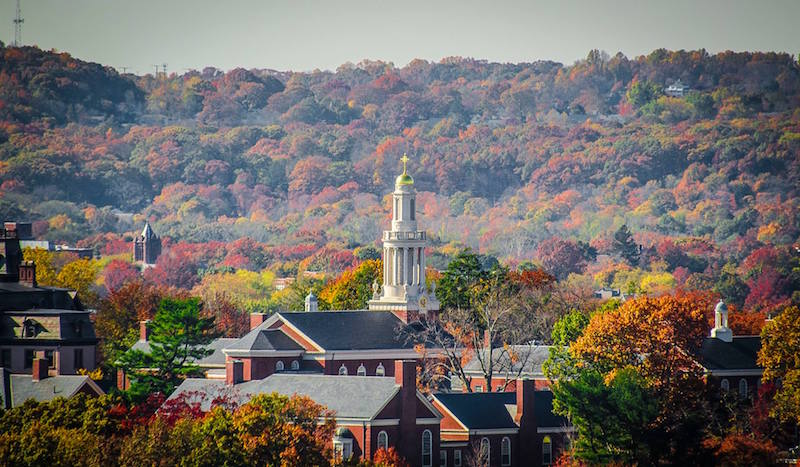
This is the pseudo-monastic walkway at the old seminary building.
Augustana Seminary merged into the Lutheran School of Theology in Chicago, in the 1960s, but LSTC dropped all the Augie profs. The ULCA element of the LCA hated Augustana, in part for its history of opposing the Masonic Lodge. Mention Augie and the Masons go into rants.

Augustana College, Rock Island, Illinois, where the Ichabods met on their first day of classes. Hearing this, Bergendoff said, "It was fore-ordained." Mrs. I. saw him again before he died at the age of 102.
The Swedish Augustana Synod was named for the Latin title of our first Lutheran symbol - Confessio Augustana - the Augsburg Confession of 1530.
Swedes came over in the 19th century to look for new opportunities. The Church of Sweden turned into the typical state church. Alcoholism was a major social disease in Sweden. The founder of the temperance society was a minister who witnessed a drunken fight in front of the pulpit during the sermon - the belligerents were women.
An English Methodist named George Scott was influential in bringing Pietism to Sweden. Many Swedish pastors saw the methods of Pietism as a solution for social ills. Pietistic cell groups grew so disturbing to the government that they enforced a anti-conventicle act. The Pietists loved to tell this story - Police broke into a place where a conventicle was supposed to be meeting. They saw cards on the table and liquor being served. Tobacco was evident. They said, "There is no conventicle here. These are good Lutherans."
Pietistic mission societies and the yearning for freedom motivated Swedes to take the trip to America. John Deere helped by inventing a plow that would throw off the sticky prairie soil of the Midwest, establishing his factories in Moline, Illinois. He hired Swedes coming over, and many Swedes established farms in the Great Plains.
Only about 20% of the Swedes made it into the Augustana Synod. The Bethel (Methodist) ship awaited them in New York City, helping the newbies and steering them into Methodist - not a tough battle for cell group members. Mormons were also successful with Swedes.
The Swedes came over as Pietists but they had many rude awakenings in America. In Sweden, it was the state church versus the people who took matters seriously (Pietism). In America, the free-wheeling religious atmosphere led to many disturbing events. The General Synod (Muhlenberg Pietistic tradition, later ELCA) was hotter than an Illinois cornfield for revivals. Some Swedish-American churches required a testimony about an adult born-again experience in order to be communing members.
Several people moved the Swedes into the confession orbit of the General Council, which opposed the revivalism of the General Synod. (Recall that the last straw was the General Synod letting in the Franckean Synod, the equivalent of giving Parlow the dogmatics professorship at Mequon.) Lars Esbjorn did not like what was going on, and went back to Sweden, but the grumpy guy had a point. He helped the change take place.
William Passavant, one of the great American Lutheran leaders, bumped the Swedes into confessionalism. They formed the Augustana Synod to show their new emphasis and allied themselves with the General Council.
Eric Norelius studied at Trinity Seminary in Columbus, Ohio (now ELCA). At that time, Capital Seminary was the orthodox Lutheran seminary of the Ohio Synod (1930 American Lutheran Church, 1960 The American Lutheran Church, 1987 ELCA - dizzy? I am, too.) Truly great men like Leupold and Lenski taught there in the early days. Norelius was introduced to repristination theology and took that into Augustana.
Augustana College floated around in Illinois for a time, suffering from money problems and getting established. The fourth location was Rock Island, overlooking the Mississippi River Valley. The prep school, college, and seminary were on one campus. My mother graduated from Augie, and we graduated in 1969.
The Augustana Synod grew and prospered, taking about 400,000 members into the LCA in 1962. The seminary was merged into Passavant's Maywood Seminary in Chicago and the confessional subscription once imposed on faculty at Maywood was dropped.
Augustana never denied its Pietistic roots. As a college library worker, I helped archive Pietisten, the Swedish magazine promoting Pietism. They tried to amalgamate Pietism with Lutheran orthodoxy, with mixed results. They taught traditional Lutheran orthodoxy--very much in the Walther mode--until a student revolt led to the replacement of most faculty members.
The subject of my dissertation at Notre Dame, A. D. Mattson, promoted the Social Gospel Movement, which advocated political activism in the church. The Social Gospel agenda became the political platform of FDR: child labor laws, pure food and drug laws, protection of labor unions, etc.
Pietism turns easily into rationalism, so the conservative methods of Pietism get converted into the liberal methods of apostates. "Service unites, but doctrine divides," as Augie's Conrad Bergendoff used to say.
Early in the 20th century, an Augustana College student could be expelled for owning a deck of cards. No due process was needed because having cards meant playing cards, and there was nothing innocent about that. Early Augustana leaders wrote about "the hellish lure of the card table," and fighting to the death against the repeal of Prohibition. After WWII, dancing on the campus was still an issue to be discussed at conventions.
The social ills were real, and we see the devastating results of various addictions today. However, the Pietistic approach of the Law turned into hypocrisy in the second generation and rebellion in the third. The Social Gospel Movement was even more unionistic than Pietism, uniting Augustana with the National Council of Churches and the World Council of Churches. Bergendoff promoted such cooperation, and the liberals adored him for that.
Augustana Seminary graduate Herb Chilstrom became bishop of ELCA, speeding up its endorsement of homosexual activism. We talked about my dissertation over lunch one day. Like many, he was profoundly influenced by A. D. Mattson and the Social Gospel Movement.
Oddly enough, the dissertation work established for me how anti-Lutheran the LCA was. That began our change from LCA unionism to WELS unionism. Little did I know in 1987 that WELS was in bed with ELCA and loving it. However, SP Schroeder has stopped the insanity of practicing safe sects.
Today ELCA will be taking more steps in endorsing the homosexual agenda, moving in lockstep with its partner the Episcopal Church. I wrote about the Lavender Mafia in "Out of the Depths of ELCA," a complete issue of Christian News. Did I exaggerate? Read the news coming from the convention.