

The Second Sunday after Trinity
Pastor Gregory L. Jackson
The Hymn # 361 O Jesus King 4.1
The Confession of Sins
The Absolution
The Introit p. 16
The Gloria Patri
The Kyrie p. 17
The Gloria in Excelsis
The Salutation and Collect p. 19
The Epistle and Gradual
The Gospel
Glory be to Thee, O Lord!
Praise be to Thee, O Christ!
The Nicene Creed p. 22
The Sermon Hymn #471 Jesus Thy Blood 4.6
The Communion Hymn # 305 Soul Adorn Thyself
The Preface p. 24
The Sanctus p. 26
The Lord's Prayer p. 27
The Words of Institution
The Agnus Dei p. 28
The Nunc Dimittis p. 29
The Benediction p. 31
The Hymn #657 Beautiful Savior 4.24
KJV 1 John 3:13 Marvel not, my brethren, if the world hate you. 14 We know that we have passed from death unto life, because we love the brethren. He that loveth not his brother abideth in death. 15 Whosoever hateth his brother is a murderer: and ye know that no murderer hath eternal life abiding in him. 16 Hereby perceive we the love of God, because he laid down his life for us: and we ought to lay down our lives for the brethren. 17 But whoso hath this world's good, and seeth his brother have need, and shutteth up his bowels of compassion from him, how dwelleth the love of God in him? 18 My little children, let us not love in word, neither in tongue; but in deed and in truth.
KJV Luke 14:16 Then said he unto him, A certain man made a great supper, and bade many: 17 And sent his servant at supper time to say to them that were bidden, Come; for all things are now ready. 18 And they all with one consent began to make excuse. The first said unto him, I have bought a piece of ground, and I must needs go and see it: I pray thee have me excused. 19 And another said, I have bought five yoke of oxen, and I go to prove them: I pray thee have me excused. 20 And another said, I have married a wife, and therefore I cannot come. 21 So that servant came, and shewed his lord these things. Then the master of the house being angry said to his servant, Go out quickly into the streets and lanes of the city, and bring in hither the poor, and the maimed, and the halt, and the blind. 22 And the servant said, Lord, it is done as thou hast commanded, and yet there is room. 23 And the lord said unto the servant, Go out into the highways and hedges, and compel them to come in, that my house may be filled. 24 For I say unto you, That none of those men which were bidden shall taste of my supper.
Second Sunday After Trinity
Lord God, heavenly Father, we give thanks unto Thee, that through Thy holy word Thou hast called us to Thy great supper, and we beseech Thee: Quicken our hearts by Thy Holy Spirit, that we may not hear Thy word without fruit, but that we may prepare ourselves rightly for Thy kingdom, and not suffer ourselves to be hindered by any worldly care, through Thy beloved Son. Jesus Christ, our Lord, who liveth and reigneth with Thee and the Holy Ghost, one true God, world without end. Amen.
 |
| Martin Chemnitz has been quietly forgotten by all the "conservative" Lutherans. |
KJV Luke 14:16 Then said he unto him, A certain man made a great supper, and bade many: 17 And sent his servant at supper time to say to them that were bidden, Come; for all things are now ready.
A certain man means - this is a parable. There are many literary devices in the New Testament that give us clues about the content. They are like - Once upon a time. Every child knows what follows those words - at least we did long ago.
This parable has a double emphasis. One is upon the gracious invitation of God to enjoy the blessings of the Kingdom of God. The other emphasis is the human reaction to the Gospel.
The Gospel is the message of forgiveness and salvation that God sends out through the Holy Spirit. He calls people into the ministry and sends those people to others to bring the Gospel to them.
The terms call and invite are synonymous. The disciples did not sign up to be among the Twelve. Jesus invited them.
I make my Greek students say "Jesus phoned the disciples" because phone comes from the Greek word for invite or call. That makes it more personal and easier to remember.
The invitation is sent with the assurance that everything has already been done for this banquet. All things are ready. When misguided and ignorant clergy make worship a task or obligation, they turn Gospel into law. One belittled worship as not really worship if "you are not using all your talents." That sounds more like qualifying for grace.
This always needs repeating. Christianity is the only religion where God gives to man, instead of man giving to God.
God determined forgiveness and salvation from the beginning of Creation, giving the Promise to Adam and Eve in the midst of the expulsion from the Garden. Abraham believed the Promises of God, and he was counted righteous, forgiven, saved - justified by faith. Genesis 15. The prophets all preached the coming of the Messiah. People heard and believed, although the people treated prophets miserably.
18 And they all with one consent began to make excuse. The first said unto him, I have bought a piece of ground, and I must needs go and see it: I pray thee have me excused. 19 And another said, I have bought five yoke of oxen, and I go to prove them: I pray thee have me excused. 20 And another said, I have married a wife, and therefore I cannot come.
"With one consent" is used for positive actions in Luke, but here it expresses the amount of excuse giving among those who hear the Gospel. The excuses are humorous because they are irrelevant when we match them with the great invitation being given.
The excuses are especially ridiculous because they are not justified - to play on words - and they are a great contrast with what is offered.
This is good parable to remember, because some leaders manipulate people by making them feel guilty for the people who have no interest in the Gospel, in spite of being invited repeatedly. Countries have paid a horrible price for giving up the Gospel from times of persecution or from the invasion of false doctrine.
Northern Africa was Christian until the Muslim invasion. America looked up to the intellectuals of Europe, so Biblical training from Europe was considered a great career move for many generations. That made Biblical Protestant groups Unitarian or worse in outlook. They changed from the top down and no one resisted.
In a blink of an eye, a congregation can become the latest Marxist cell or the newest addition to the Barnum and Bailey Ringling Brothers circus franchise. A few will say, "What happened?" and they are gently told, "We have to adjust to the times."
What has God done? Everything. If we look at the material world - all of Creation exists to provide for us in abundance. Someone with experience can say, "Here are the universal rules. Follow them for an abundant garden with relatively little work."
Watching the intricate coordination of the natural world is a daily lesson in the Word of God. All this was declared by the Son of God - All things came about through Him. Nothing that was made was made apart from Him.
One book I read over and over had this story - My Grandfather's Earthworm Farm. The book included the description of a grandfather who gathered all the crop trash and animal contributions into pits, where he composted them and spread them in his fields. He always had good crops that made it through droughts because the soil retained moisture so well. His crops were healthy and his farm prospered through many different types of crises caused by weather, panics, and crop disease.
Creation means God has arranged our lives thus, "I will do all this for your food, if you only use experience and some common sense. I can beauty your lives with flowers of all types and grow medicine for you form herbs."
This has already been done. And we have glimpses of it from the mineral world. The West was not well explored until the push came to settle new lands. States with relatively few people suddenly had droves of pioneers settling down. Indians found copper lying around on Mingus Mountain, the Jerome Arizona area. Miners found $5 billion worth of copper in that mountain. It had no great use until we began to use electricity.
Other miners found slabs of pure silver under the ground. In Pennysylvania, that annoying rock oil was fractioned at Yale and became a useful fuel - petroleum, kerosine, gasoline.

21 So that servant came, and shewed his lord these things. Then the master of the house being angry said to his servant, Go out quickly into the streets and lanes of the city, and bring in hither the poor, and the maimed, and the halt, and the blind. 22 And the servant said, Lord, it is done as thou hast commanded, and yet there is room. 23 And the lord said unto the servant, Go out into the highways and hedges, and compel them to come in, that my house may be filled. 24 For I say unto you, That none of those men which were bidden shall taste of my supper.
This has been acted out through history. The Gospel rain moves on. Before it does, those who listen sincerely to the Word pay attention to the words of Jesus and study the Scriptures. They guard the Word, to use an expression of Jesus and do not listen to false shepherds, however popular they may be (up until the cops come with arrest warrants).
Those who are invited and excuse themselves away have blinded themselves and hardened their hearts against the Gospel.


.jpg)


 Nematodes: These tiny, cylindrical, often transparent microscopic worms are the most abundant of the physical decomposers - a handful of decaying compost contains several million. It has been estimated that one
  Mites: Mites are the second most common invertebrate found in compost. They have eight leg-like jointed appendages. Some can be seen with the naked eye and others are microscopic. Some can be seen hitching rides on the back of other faster moving invertebrates such as sowbugs, millipedes and beetles. Some scavenge on leaves, rotten wood, and other organic debris. Some species eat fungi, yet others are predators and feed on nematodes, eggs, insect larvae and other mites and springtails. Some are both free living and parasitic. One very common compost mite is globular in appearance, with bristling hairs on its back and red-orange in color.
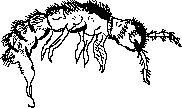 Springtails: Springtails are extremely numerous in compost. They are very small wingless insects and can be distinguished by their ability to jump when disturbed. They run in and around the particles in the compost and have a small spring-like structure under the belly that catapults them into the air when the spring catch is triggered. They chew on decomposing plants, pollen, grains, and fungi. They also eat nematodes and droppings of other arthropods and then meticulously clean themselves after feeding.
 Earthworms: Earthworms do the lion's share of the decomposition work among the larger compost organisms. They are constantly tunneling and feeding on dead plants and decaying insects during the daylight hours. Their tunneling aerates the compost and enables water, nutrients and oxygen to filter down. "As soil or organic matter is passed through an earthworm's digestive system, it is broken up and neutralized by secretions of calcium carbonate from calciferous glands near the worm's gizzard. Once in the gizzard, material is finely ground prior to digestion. Digestive intestinal juices rich in hormones, enzymes, and other fermenting substances continue the breakdown process. The matter passes out of the worm's body in the form of casts, which are the richest and finest quality of all humus material. Fresh casts are markedly higher in bacteria, organic material, and available nitrogen, calcium, magnesium, phosphorus and potassium than soil itself." (Rodale)
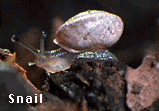 Slugs and snails (left): Slugs and snails generally feed on living plant material but will attack fresh garbage and plant debris and will therefore appear in the compost heap.
 Millipedes: They are slower and more cylindrical than centipedes and have two pairs of appendages on each body segment. They feed mainly on decaying plant tissue but will eat insect carcasses and excrement.
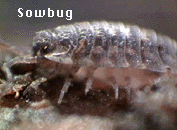 Sow Bugs (right): Sow Bugs are fat bodied crustaceans with delicate plate-like gills along the lower surface of their abdomens which must be kept moist. They move slowly grazing on decaying vegetation.
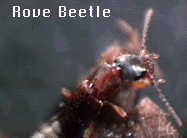 Beetles (left): The most common beetles in compost are the rove beetle, ground beetle and feather-winged beetle. Feather-winged beetles feed on fungal spores, while the larger rove and ground beetles prey on other insects, snails, slugs and other small animals.
 Pseudoscorpions: Pseudoscorpions are predators which seize victims with their visible front claws, then inject poison from glands located at the tips of the claws. Prey include minute nematode worms, mites, larvae, and small earthworms.


