Sunday, March 8, 2020

Pietism Has Been the Engine of Abuse in Lutherdom - Its Sacrament Is Shunning


I ran into a comment from a couple, again, asking for prayers. One had just been dumped from a long-standing church job, where there is no due process. Lutheran synods may be the last vestige of Stalinism today, and there is only a difference of degree between Missouri, WELS, the ELS, the CLC (sic), and the micro-mini sects. They protect their crooked friends and slander their opponents - even suspected opponents - out of that private heaven they control.

I give all the glory to Pietism, which degenerates into a sad muddle of legalism, abuse, and bigotry. One strange manifestation came up in WELS. If someone did not like the preacher's sermon, he refused to take communion. I thought the sacrament came from God, not from a quality control inspection. Another WELS example was this ultimate test, "Would you take communion with Paul Kelm?" If that is not a shunning question, I give up, because the question has nothing to do with the Means of Grace.

If someone is no longer willing to agree with the synods' (note, plural possessive) slide into the arms of ELCA, they are shunned. This is a precious sacrament today, because it gives them total control. Some are given a public, gradual, and then 100% shunning, so the rest are kept quiet and passive.

I wonder how many bristle against the bullying of Matt the Fatt, or snore while Mirthless Mark goes over the feeble finances. No one will know because fear freezes their emotions. They will gladly overlook felonies and waltzing with ELCA, as long as they can keep their salaries and benefits, their friendly greetings at the clergy meetings, the gracious smiles of the pot-bellied pastoral potentates.

Those who defy their synod will not get an answer, except for the kind of feeling one gets from grabbing an electric fence. Want to do that again? The nastiness increases and multiplies.

I post to give some comfort and encouragement to those tossed out without reason. One person said, "You are the only one who understands me." I described how he was being treated and he sobbed loudly because it was true.


 WELS DP Ed Werner was finally imprisoned.

 Martin Luther College is proud of their graduate Ed Werner, featuring him recently on their websty.

David Becker Provided the Latest Hale-Storm - Probably To Be Seen in the Fading, Irrelevant Christian News, Cesspool of Chief Article Denial and Rejection

David Becker - "Comment on background.  I had hoped that Pastor Phil Hale had gotten over gratuitously bashing Gregory Jackson, but I guess not.  Maybe he never will.  The below item was posted on the CN blog yesterday, I just saw.  I thought you should see it if you didn't already.  This one hasn't been in CN yet, I don't think - presumably it will be in the next issue.  Hale seems to be claiming that Jackson doesn't believe that Christ's death and resurrection are important and essential.  My approach to Jackson is different.  Check the attachments from July of last year (pp. 7, 9).  Although I have forwarded links to him, I have intentionally not sent any articles to Hale since he became CN editor.  I doubt that any would be printed, since he probably has "radar" that I don't really agree with articles such as the one below.  Hale seems to believe that objective justification as he describes it is essential to salvation.  "To pit faith and Christ against each other, is to lose everything."  But who is pitting faith and Christ against each other?  In any event, my comments are over.  I'm sure you will be commenting on the below link."


"FAITH WITHOUT CHRIST?


Objective justification is often misportrayed, because what it actually describes has always been assumed by genuine Lutherans. It is the denial of any objective aspect, basis, or foundation to justification that is new, and therefore requires a pointed and emphatic response. It is often assumed that those who hold to this objective aspect of justification require it to be mentioned or made explicit, which is not the case. It is simply the new error that must be rejected. This frustrates those who, in denying it, cannot hold two parallel biblical truths together without pitting them against each other.
Gregory Jackson, the most visible and energetic denier of any objective aspect of justification in Lutheran circles today, recently said “Faith? Faith? Where Is Justification by Faith on Their [the LCMS] Wiki Page?,” on a blog post entitled “Gentlemen — I Refer You to Your Own Document — The Augsburg Confession.” So “faith,” is the magic word, and the phrase “justification by faith” becomes all-important—indeed, everything, to the deniers. But to the upholders of the Lutheran teaching of justification—who confess that righteousness is solely from Christ, not our faith or personal decision—there must be a doctrine and meaning behind these words. Three words, no matter how historical, enshrined, or well-regarded do not make a full-bodied doctrine, especially the central doctrine of the Scriptures.
Hale is detached from reality - Justification by Faith is the Chief Article of Christianity.

Jackson takes issue with this statement describing the Missouri synod: “The synod rejects any attempt to attribute salvation to anything other than Christ’s death and resurrection.” This highlights Jackson’s error most visibly. Faith is not the ultimate cause of salvation, or a factor in bringing about righteousness, but rather faith simply receives what Christ won and gives in the Word. Another way to put it is: Can one have “saving faith” without Christ’s death and resurrection? No.
[GJ - Romans 4 and 10 are the norm for forgiveness and salvation, not the political statement of an apostate sect.]
The context of the Wikipedia page, from which Jackson took the phrase, is: “It [the LCMS] teaches that Jesus is the focus of the entire Bible and that faith in him alone is the way to eternal salvation. The synod rejects any attempt to attribute salvation to anything other than Christ’s death and resurrection.” So while Jackson can only read the emphasis on Christ’s death and resurrection as against faith, faith is correctly upheld as the only way to salvation in Christ. Faith alone is not against Christ, His saving works, or the forgiveness of the world in Him.
In fact, Scripture directly says that faith without Christ’s resurrection does nothing: “And if Christ has not been raised, then our preaching is in vain and your faith is in vain. We are even found to be misrepresenting God, because we testified about God that he raised Christ, whom he did not raise if it is true that the dead are not raised. For if the dead are not raised, not even Christ has been raised. And if Christ has not been raised, your faith is futile and you are still in your sins. Then those also who have fallen asleep in Christ have perished. If in Christ we have hope in this life only, we are of all people most to be pitied” (1 Cor. 15:14-19).
[GJ - Hale, like his ignorant seminary professors, ignores the Scriptures in order to fashion the tattered tapestry of Halle's Objective Justification - universal absolution caused by the resurrection of Christ - without the Word, without faith, without the Means of Grace.]
Christ’s death, by itself, is not our righteousness, according to Scripture. If Christ was still dead, faith in His death would do nothing, according to God’s Word. His death was the payment Christ made while bearing the sins of the world. But payment is not forgiveness or acceptance of the payment. The resurrection of Christ was not an add-on or unnecessary bonus. Easter proclaims that we are free of our sins, for Christ rose for us—not just for Himself. It was the Father’s action, by the Spirit, to raise our Lord, on our behalf. We—all humanity—are forgiven in Christ. His resurrection signals the Father’s acceptance and mankind’s vindication from the guilt of all sin—from God’s side of things. Faith, in the believer, is not the entire picture of justification. Even “justification by faith” does not even mention our Lord at all! Forgiveness is complete and actually available in Christ, though no one is in Christ without faith. The world is reconciled and justified in Christ. This is why anyone can be forgiven, even an unbeliever, so they may trust the Gospel and be justified personally in time by faith.
[GJ - The gassy verbiage above only shows that Hale stays up at night to create a philosophical basis for heresy - rather than deal with the simple, plain wording of the Bible.]
So for the deniers of anything beyond or before faith, like Jackson, the righteousness objectively present and given in the Gospel — whether someone believes it or not—can only sound like a denial of faith. Faith for them has replaced Christ. Since faith is everything for them, nothing is allowed before it. But this is not the scriptural teaching of faith—mankind was absolved in Christ, marking the divine verdict, before we were born! Why? Because of Christ, “who was delivered up for our trespasses and raised for our justification” (Rom. 4:25). Does our faith depend on how well we believe and turn the Father toward us in faith?
[GJ - This pygmy of pugilism cites Romans 4:25 but not Romans 4:24. Hale must get hives - itching, oozing pustules - from the thought of quoting Genesis 15:6 - And he believed in the Lord; and He counted it to him for righteousness. KJV That is the theme of Romans 4, the entire chapter, summarized in Romans 5:1-2.]
No, “All this is from God, who through Christ reconciled us to himself and gave us the ministry of reconciliation; that is, in Christ God was reconciling the world to himself, not counting their trespasses against them, and entrusting to us the message of reconciliation” (2 Cor. 5:18-19). The fact that the Father is already presently reconciled does not mean faith or the preaching of the Gospel is unnecessary. In fact, there could be no faith in a gracious God unless He were already reconciled and not wrathful. We objectively believe in something—that God is truly forgiving toward sinners before anything happens in us. Without this true fact that forgiveness is not incomplete, the Gospel is more law, mere directions about how to go about getting an unfinished righteousness—and faith becomes its completing work.
Cub editor Phil Hale is at work replacing doctrine with dogma.

Christ did not need vindication for His righteousness—that is not why the Son of God became man. Our Lord took on flesh and blood for us—for you and your sin—for the sin of all sinners, every single one. And salvation is not only partially accomplished—forgiveness is for all, even though no one partakes of this righteousness apart from faith, which incorporates in Christ. Faith does not make forgiveness real or the Father appeased—it depends only on Christ. Righteousness, the verdict of justification, exists before faith. Our faith does not create or finish salvation—that would make Christ Himself insignificant. Christian trust is not faith in our faith, as something we do for God—a sort of propitiatory sacrifice. We proclaim Christ crucified, who is not dead and lifeless because of our sins, but alive, risen from the dead for us. So rejoice, there is righteousness for you. It depends only on Christ, who is not dead. Your participation in the Gospel does not make it true, or else you would have a flimsy belief. No, Christ is the content of your faith, and in Him forgiveness is for all mankind. This is what gives the Gospel power—not faith. After all, which comes first: personal faith or the Word which applies Christ’s righteousness? (Rom. 10:14-17)
So is our faith greater than Christ? Must we pick between the two? Is faith unnecessary, because Christ died and rose? No, not at all. No one is saved apart from faith, but faith is not the causesource, or objective foundation of our righteous verdict—that is the error of general Protestantism today: faith (in the believer) is considered more significant than the God who died for our sins and rose for our justification. So the sinner’s response is greater than Christ’s substitution in place of all sinners.
[GJ - The windy editor is in perfect harmony with ELCA and mainline, rationalistic Protestantism.]
So emphasizing the objective aspect of justification is not a denial of faith alone, but simply says that faith (what happens in the believer) is not the sum total content of Christianity. We do not make Christ rise and the Father reconciled to us in, or because of, our act of believing. There is something objective we believe in, before faith: the Son of God, who has been vindicated in our stead.
To pit faith and Christ against each other, is to lose everything. Scripture upholds both aspects of the Gospel, as do our confessions. The tie between faith and Christ’s universal justification is what we actually believe and receive in the Gospel. The Father is not an angry, un-appeased god until we offer Him the work of our faith—that is what the denial of objective justification must lead to. How could one ever believe in such a god? No, the father is reconciled—it already happened—by Christ. Forgiveness is complete and for all the world in Christ already. But we are conceived unreconciled sinners, so we must be presented with the forgiveness of God in Christ. Only when the righteous God offers us His righteousness, which is for all in Christ, can we believe in Him, in any biblical sense. Otherwise faith must become a cursed work of the law—something that replaces the Savior and causes God to turn from His wrath against our sin. If faith changes the Father, the believer becomes his own savior, in place of Jesus. Salvation, then, would be entirely subjective and personal.
 Do you wonder why I blame David Scaer for generations of bellicose, bullying, betrayers of the Chief Article of Christianity? Just read the blabber above.

No one is saved apart from faith. Amen. No one is saved apart from Christ’s works, which were received by the Father for us. Amen. No one is saved apart from faith in the resurrected Lord, in whom there is forgiveness for all. There is no contradiction. Amen. —ed.
for He has redeemed, justified, and saved us from our sins as God and man, through His complete obedience; that therefore the righteousness of faith is the forgiveness of sins, reconciliation with God, and our adoption as God’s children only on account of the obedience of Christ, which through faith alone, out of pure grace, is imputed for righteousness to all true believers, and on account of it they are absolved from all their unrighteousness” (SD 3:4).
his merits have been presented as those which make satisfaction for others, which are bestowed by divine imputation on others, in order that through these, just as by their own merits, they may be accounted righteous. As when any friend pays a debt for a friend, the debtor is freed by the merit of another, as though it were by his own. Thus the merits of Christ are bestowed upon us, in order that, when we believe in Him, we may be accounted righteous by our confidence in Christ’s merits as though we had merits of our own. And from both, namely, from the promise and the bestowing of merits, confidence in mercy arises. Such confidence in the divine promise, and likewise in the merits of Christ, ought to be brought forward when we pray. For we ought to be truly confident, both that for Christ’s sake we are heard, and that by His merits we have a reconciled Father” (AP 20:19-20)."
 The editors of the Book of Concord commended Luther's Galatians for addition study of Justification by Faith. Why did Abraham rejoice to see the day of Christ centuries before? He believed the Messianic Promises and God counted it to him as righteousness. See John 8:56 - "Your father Abraham rejoiced to see My day: and he saw it, and was glad."

David Becker Provided Some Information about Concordia College, Portland - New Defunct

 Two phony doctorates with emperor salaries - I would laugh too! Matt the Fatt sold off properties to bail out the Concordia system.


https://steadfastlutherans.org/2020/02/some-more-news-on-concordia-portland/comment-page-1/#comment-10657

"Sad we have to find out these kind of details from secular news agencies rather than the church body we belong to together.

The Oregonian has been digging into the closing of Concordia, Portland. There is much to be gained from their recent article. Here are some basic summary points:

-We got into deals that did not help us (Hotchalk sounds like a major ripoff).
-Administration apparently hid details (from the looks there were few people who knew details of agreements and so forth). This does not include Pres. Ries who just took over in January.
-We tried to make our college just like any worldly endeavor, with high salaries (for administrators, not teachers) and so forth. Pres. Schlimpert went from 175K a year in 2010 to 310K in 2017. He retired just a while ago, and according to the news article he did so with the financial state of the college in poor shape and a long-term contract only going worse for the college.

Given the lack of information available in minutes (not to mention how long it takes to get official minutes) perhaps “executive session” usage should be lessened across synod’s boards, councils, and commissions.

According to the article, this was years in the making. Why didn’t the 2016 and 2019 Conventions of the LCMS bring synod up to speed? The general message of those conventions when I attended them was something close to “everything is good”. A review needs to be done on how the LCMS is using its communications and what information is being communicated vs. what information is not.

How many other Concordias have made bad deals and are operating in such a worldly fashion? We won’t find out because the LCMS has a track record of not telling us bad news or something that will reflect poorly on the institution. Maybe some individual Concordias can show leadership on this (after all, with two Concordias closing in the last few years, it’s not like continuing the status quo will build more confidence in their long term viability). Maybe some districts could show the greater synod what transparency looks like. No one can offer real help unless they know the real problems we are having. Somewhere along the way, it seems we lost some integrity for the sake of positive spin and advertising. Or maybe we’ve just become incompetent to handle these things. It’s a sad tale, and I am just waiting for the next chapter to unfold. Too bad it will take the world’s media to get us information like this Oregonian article provided."

GJ - This group blog makes it impossible to copy and paste comments, so they can be seen here -

https://steadfastlutherans.org/2020/02/some-more-news-on-concordia-portland/comment-page-1/#comment-10657

Reminiscere Sunday, The Second Sunday in Lent, 2020. Matthew 15:21-28.


Reminiscere Sunday, 
The Second Sunday in Lent, 2020

Pastor Gregory L. Jackson


Hymn # 151        Christ, the Life of All the Living           
The Confession of Sins
The Absolution
The Introit p. 16
The Gloria Patri
The Kyrie p. 17
The Gloria in Excelsis
The Salutation and Collect p. 19
The Epistle and Gradual       
The Gospel              
Glory be to Thee, O Lord!
Praise be to Thee, O Christ!
The Nicene Creed p. 22
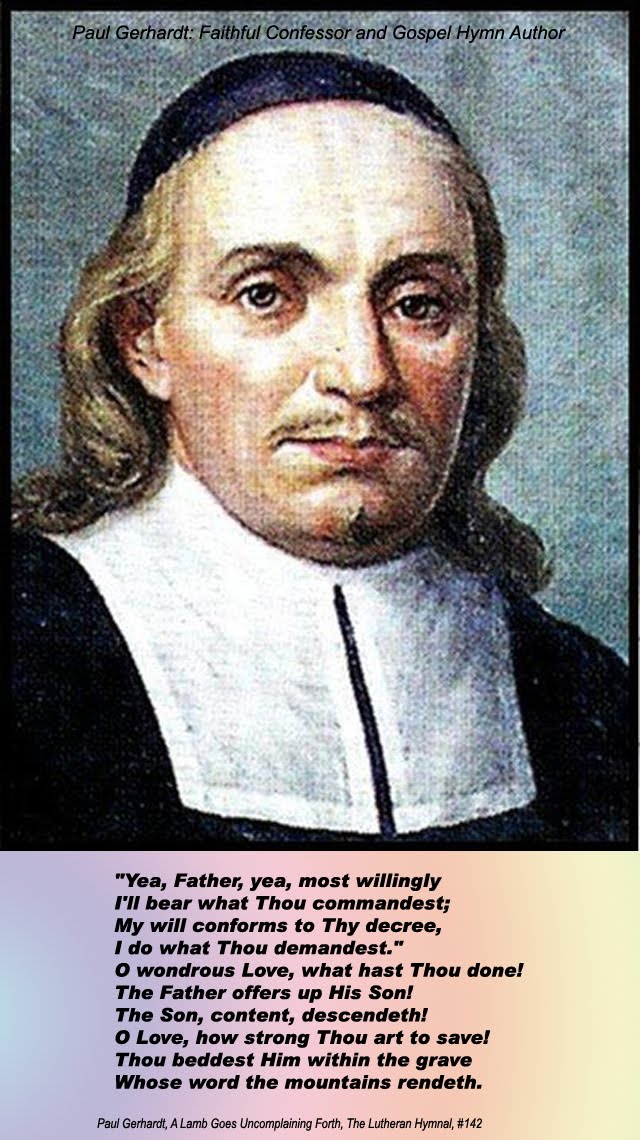
Sermon Hymn #142    A Lamb Goes Uncomplaining - Gerhardt  

Believe and Confess the Faith

Hymn #
454          Prayer Is the Soul's Sincere Desire              
The Sanctus p. 26
The Lord's Prayer p. 27
The Words of Institution
The Agnus Dei p. 28
The Nunc Dimittis p. 29
The Benediction p. 31
Hymn # 50      Lord Dismiss Us with Thy Blessing

Prayers and Announcements

  • Treatment and recovery - Rush Limbaugh, Kermit Way, Christina Jackson. Her radiation is done and some new options may be available. Recovery - John Hicks.
  • In the last stage of cancer and heart disease - Tom Fulcher, Diane Popp's brother-in-law.
  • Surgery - Randy Anderson, Andrea's father.
  • Two brothers, both with health issues.
  • Pray for our country as the major trials begin.
  • Thanksgiving - Glen Kotten is doing well, Pastor Shrader is clear on his scans.
  • Wednesdays are Vespers at 7 PM, followed by The Gospel of John in Greek, starting slowly for newcomers.
  • Pastor Palangyos needed to get started on enclosing the chapel and hiring the welding crew. I sent our contribution plus extra to get the project going, assuming gifts. The day after, gifts came in. They should be able to get going as additional gifts arrive. Some are direct; other gifts are mailed to us and go 100% to the mission.
         

Lutheran Library - Gerhardt's Biography

KJV 1 Thessalonians 4:1 Furthermore then we beseech you, brethren, and exhort you by the Lord Jesus, that as ye have received of us how ye ought to walk and to please God, so ye would abound more and more. 2 For ye know what commandments we gave you by the Lord Jesus. 3 For this is the will of God,even your sanctification, that ye should abstain from fornication: 4 That every one of you should know how to possess his vessel in sanctification and honour; 5 Not in the lust of concupiscence, even as the Gentiles which know not God: 6 That no man go beyond and defraud his brother in any matter: because that the Lord is the avenger of all such, as we also have forewarned you and testified. 7 For God hath not called us unto uncleanness, but unto holiness.

KJV Matthew 15:21 Then Jesus went thence, and departed into the coasts of Tyre and Sidon. 22 And, behold, a woman of Canaan came out of the same coasts, and cried unto him, saying, Have mercy on me, O Lord, thou Son of David; my daughter is grievously vexed with a devil. 23 But he answered her not a word. And his disciples came and besought him, saying, Send her away; for she crieth after us. 24 But he answered and said, I am not sent but unto the lost sheep of the house of Israel. 25 Then came she and worshipped him, saying, Lord, help me. 26 But he answered and said, It is not meet to take the children's bread, and to cast it to dogs. 27 And she said, Truth, Lord: yet the dogs eat of the crumbs which fall from their masters' table. 28 Then Jesus answered and said unto her, O woman, great is thy faith: be it unto thee even as thou wilt. And her daughter was made whole from that very hour.

Second Sunday In Lent

Lord God, heavenly Father, grant us, we beseech Thee, by Thy Holy Spirit, that He may strengthen our hearts and confirm our faith and hope in Thy grace and mercy, so that, although we have reason to fear because of our conscience, our sin, and our unworthiness, we may nevertheless, with the woman of Canaan, hold fast to Thy grace, and in every trial and temptation find Thee a very present help and refuge, through Thy beloved Son, Jesus Christ our Lord, who liveth and reigneth with Thee and the Holy Ghost, one true God, world without end. Amen.

Background for the Gospel Sermon - Divinity of Christ, Matthew 15:21-28

This miracle shows how we can miss the point by not understanding the lesson taught. Therefore, it is often used as an example of the "hard sayings" of Jesus. That is, people have wondered why Jesus spoke the way He did. 

Much of this anxiety comes from the old Quest for the Historical Jesus, Albert Schweitzer, 1906 (and hundreds of similar books). I use Wiki for reference because the basic information is there, but the academic market turns such matters into dissertations.

The Life of Jesus Movement was - and is - engaged in identifying what they could still believe as factual about the Four Gospels. Needless to say, they all miss the point because they disbelieve so much.

Jesus, we read from the Gospels, knows what is in the heart and minds of people, whether they speak or not. As Paul said in 1 Corinthians 13, some day we will know Him as we are already known by Him.

Therefore, the reactions of Jesus to the woman crying out for her daughter's sake - they are His way of eliciting in words what He already knew. That meant, her example could be remembered and written - with the Holy Spirit's guidance - for our benefit. 

So instead of seeing Jesus as mean and hard, we see that - from the beginning - Jesus was impressed with her faith in Him. There are many similar examples in the Gospels, but do not tell the Objective Justification experts. They do not like faith in Jesus and disguise their rationalism with a holiness beyond anyone's comprehension.


Believe and Confess the Faith

KJV Matthew 15:21 Then Jesus went thence, and departed into the coasts of Tyre and Sidon. 22 And, behold, a woman of Canaan came out of the same coasts, and cried unto him, saying, Have mercy on me, O Lord, thou Son of David; my daughter is grievously vexed with a devil.

Jesus' travels are directly connected to His mission, both immediate and long-term. He was following a calendar to fulfill all that the Scriptures predicted about Him. He was also training His disciples and exposing them to His miracles and divinity. Besides that, He was establishing people in the Faith as He taught and worked miracles among them.

Jesus avoided crowds when that provoked too much attention and antagonism. Thus He avoided the masses when He could.

The woman is called Canaanite, after the history of that region being pagan. Mark 7 says "The woman was a Greek, a Syrophenician by nation..." Mark says she heard about Him and fell at His feet (reverencing Him as God).

The work and Word of Jesus were such a magnet, that His presence near her home drew her out to make this plea. He later went through her area, but she took no chances, as Lenski wrote, and came to Him.

Have mercy on me, O Lord, thou Son of David

She asked as though He was divine and included His title as the promised Messiah. She did not begin with - if you are the Son of God, if you are the Christ, if You really care about my troubles...

Luther made Romans 10 one of my favorite chapters. Faith comes from hearing the Report, so the message must go in advance and prepare us for salvation. Faith put her in motion so she sought Him out and addressed Him in adoration. The greater our need, the greater our humility, that God could work such wonders.

23 But he answered her not a word. And his disciples came and besought him, saying, Send her away; for she crieth after us. 

Jesus was not testing her, as some would say, because He already knew exactly what she believed. This is a bit of a parable, because the story informs us. Yes, God can appear to be completely indifference and deaf to our prayers. But that cannot be true, because He is all-knowing and all-merciful. German liturgical prayers begin - Merciful, gracious God... Those are two qualities to remember at all times.

The disciples are not asking Him to give her the Left Foot of Fellowship but to answer her prayer and send her back with His bless - Lord, dismiss us with Thy blessing (hymn).

The woman, not getting an answer, continued to follow and call out her request. This was her Valley of Humiliation, where she had nowhere to turn but kept up, knowing how great her need was.

24 But he answered and said, I am not sent but unto the lost sheep of the house of Israel. 25 Then came she and worshipped him, saying, Lord, help me.

Jesus answered properly, at one level. Silence is the first level of rejection - so we might think. If God has not answered our prayers, yet surely we have let Him know. Jesus' answer is like the turmoil we might feel - the miracles are for others but not for me.

It is easy to have these feelings, because our emotions are misleading, not as powerful and wise as Obe Wan Kenobi teaches in Star Wars. We compare in various ways when others seem to have it better. But we have no way of knowing. One classmate seemed to have a wealthy and glamorous life, until he mentioned playing basketball in his wheelchair. 

She could not change her ethnic group or lay claims to anything promised to Israel. Still she came up to Him and said, "Lord, help me."

Then came she and worshipped him, saying, Lord, help me.

This shows she is putting all her trust in Him. 

4. Now, what does the poor woman do? She turns her eyes from all this unfriendly treatment of Christ; all this does not lead her astray, neither does she take it to heart, but she continues immediately and firmly to cling in her confidence to the good news she had heard and embraced concerning him, and never gives up. We must also do the same and learn firmly to cling to the Word, even though Go with all his creatures appears different than his Word teaches. But, oh, how painful it is to nature and reason, that this woman should strip herself of self and forsake all that she experienced, and cling alone to God’s bare Word, until she experienced the contrary. May God help us in time of need and of death to possess like courage and faith!

26 But he answered and said, It is not meet to take the children's bread, and to cast it to [pet] dogs.

Jesus responded with the words many people would use. She was not from the People of God, but from paganism. Paul had to fight this battle all over again. Certainly this miracle was a good way to argue for his mission to the Gentiles.

The attitude has been repeated many times over. People tell us or assume we know - they are the elect. Sometimes it is from family ties, no matter how weak they might be. Sometimes it is the right group. One pastor glared at me and said, "We have 105 people in our family and every single one belongs to our synod." I thought - but did not say - "Are they all Pharisees like you?" (I will publish what I could have said but didn't - posthumously.)

Sometimes it is racial, and every single race seems to think it is superior, especially in the sub-categories.

Jesus' words are seen to be especially cutting, because dogs were not seen as cute, but as mangy, scrounging pests. Christina and I were having lunch in Jerome, Arizona, near an open window, when a large German Shepherd showed up. We decided to placate him, in case he was short-tempered. He took our bribes with gusto and asked for more. Later we learned he was a regular at lunch and expected to be fed. "He's just a big baby." We did not see GSDs as babies at that time.

Feral dogs are devalued everywhere, taken for granted, dropped off or abandoned as no longer wanted. As Lenski explains, the term used here by Jesus is for pet dogs, which were kept inside and fed from the table.

This term actually touched off a memorable response, and it is often repeated in various ways.

27 And she said, Truth, Lord: yet the [pet] dogs eat of the crumbs which fall from their masters' table.

What might be taken as an insult is her response to open the door. Those little dogs are glad to take whatever falls from the table. We had a glass table we called the begging table, because all three dogs got under it and looked up with their starving eyes while we ate, to remind us of their needs and their love for us. 

More than once I have looked up from work on the computer, with a Sassy paw gently pressed against me. Her face is lit up in a friendly smile, anticipating her evening snack. 

Every scrap - or each teaspoon of ice cream - is seen as a wonderful treat. And it is, because canines see food as love from their parents. Sassy is part dingo, and the ancient traditions remain. Parents go hunting and bring home the food.

28 Then Jesus answered and said unto her, O woman, great is thy faith: be it unto thee even as thou wilt. And her daughter was made whole from that very hour.


10. All this, however, is written for our comfort and instruction, that we may know how deeply God conceals his grace before our face, and that we may not estimate him according to our feelings and thinking, but strictly according to his Word. For here you see, though Christ appears to be even hardhearted, yet he gives no final decision by saying “No.” All his answers indeed sound like no, but they are not no, they remain undecided and pending. For he does not say: I will not hear thee; but is silent and passive, and says neither yes nor no. In like manner he does not say she is not of the house of Israel; but he is sent only to the house of Israel; he leaves it undecided and pending between yes and no. So he does not say, Thou art a dog, one should not give thee of the children’s bread; but it is not meet to take the children’s bread and cast it to the dogs; leaving it undecided whether she is a dog or not. Yet all those trials of her faith sounded more like no than yes; but there was more yea in them than nay; ay, there is only yes in them, but it is very deep and very concealed, while there appears to be nothing but no.

11. By this is set forth the condition of our heart in times of temptation; Christ here represents how it feels. It thinks there is nothing but no and yet that is not true. Therefore it must turn from this feeling and lay hold of and retain the deep spiritual yes under and above the no with a firm faith in God’s Word, as this poor woman does, and say God is right in his judgment which he visits upon us; then we have triumphed and caught Christ in his own words. As for example when we feel in our conscience that God rebukes us as sinners and judges us unworthy of the kingdom of heaven, then we experience hell, and we think we are lost forever. Now whoever understands here the actions of this poor woman and catches God in his own judgment, and says: Lord, it is true, I am a sinner and not worthy of thy grace; but still thou hast promised sinners forgiveness, and thou art come not to call the righteous, but, as St. Paul says in 1 Timothy 1:15, “to save sinners.” Behold, then must God according to his own judgment have mercy upon us.

Another way of expressing this is to say - God gives us many answers of "No" until we are guided into the "Yes." I know of one family I have mentioned before, where the burden is from seizures, horrible seizures. They have gone through every treatment, even brain surgery. And yet it continues. That is the bad side. They have endured in faith. I pray with them over Facebook. They are so proud of their daughter for all she has accomplished growing up, going through so much. They are always celebrating the victories.

The fact is, many lose faith in the midst of plenty and good health. "He has fed the poor, but the rich He has sent empty away." (Magnificat)

Pilgrim's Progress answers this in showing that Christiana wondered why she did not have protection at once on her journey. 
"You did not feel the need then. Once you prayed for help, you received it, and now you are thankful to God. Before, without feeling the need you would have taken help for granted." (Paraphrased from Part II).


Saturday, March 7, 2020

Luther's Sermon on the Canaanite Woman


REMINISCERE. SECOND SUNDAY IN LENT


TEXT:

Matthew 15:21-28. And Jesus went out thence, and withdrew into the parts of Tyre and Sidon. And behold, a Canaanitish woman came out from those borders and cried, saying, Have mercy on me, O Lord, thou son of David; my daughter is grievously vexed with a demon. But he answered her not a word. And his disciples came and besought him, saying, Send her away; for she crieth after us. But he answered and said, I was not sent but unto the lost sheep of the house of Israel. But she came and worshipped him, saying, Lord, help me. And he answered and said, It is not meet to take the children’s bread and cast it to the dogs. But she said, Yea, Lord: for even the dogs eat of the crumbs which fall from their masters’ table. Then Jesus answered and said unto her, O woman, great is thy faith: be it done unto thee even as thou wilt. And her daughter was healed from that hour.


1. This Gospel presents to us a true example of firm and perfect faith. For this woman endures and overcomes in three great and hard battles, and teaches us in a beautiful manner the true way and virtue of faith, namely, that it is a hearty trust in the grace and goodness of God as experienced and revealed through his Word. For St. Mark says, she heard some news about Jesus, Mark 7:25. What kind of news? Without doubt good news, and the good report that Christ was a pious man and cheerfully helped everybody. Such news about God is a true Gospel and a word of grace, out of which sprang the faith of this woman; for had she not believed, she would not have thus run after Christ etc. In like manner we have often heard how St. Paul in Romans 10:17 says that faith cometh by hearing, that the Word must go in advance and be the beginning of our salvation.

2. But how is it that many more have heard this good news concerning Christ, who have not followed him, and did not esteem it as good news?

Answer: The physician is helpful and welcome to the sick; the healthy have no use for him. But this woman felt her need, hence she followed the sweet scent, as is written in the Song of Solomon 1:3. In like manner Moses must precede and teach people to feel their sins in order that grace may be sweet and welcome to them. Therefore all is in vain, however friendly and lovely Christ may be pictured, if man is not first humbled by a knowledge of himself and he possesses no longing for Christ, as Mary’s Song says, “The hungry he hath filled with good things; and the rich he hath sent empty away,” Luke 1:53. All this is spoken and written for the comfort of the distressed, the poor, the needy, the sinful, the despised, so that they may know in all times of need to whom to flee and where to seek comfort and help.

3. But see in this example how Christ like a hunter exercises and chases faith in his followers in order that it may become strong and firm. First when the woman follows him upon hearing of his fame and cries with assured confidence that he would according to his reputation deal mercifully with her, Christ certainly acts differently, as if to let her faith and good confidence be in vain and turn his good reputation into a lie, so that she could have thought: Is this the gracious, friendly man? or: Are these the good words, that I have heard spoken about him, upon which I have depended? It must not be true; he is my enemy and will not receive me; nevertheless he might speak a word and tell me that he will have nothing to do with me. Now he is as silent as a stone. Behold, this is a very hard rebuff, when God appears so earnest and angry and conceals his grace so high and deep; as those know so well, who feel and experience it in their hearts. Therefore she imagines he will not fulfill what he has spoken, and will let his Word be false; as it happened to the children of Israel at the Red Sea and to many other saints.

4. Now, what does the poor woman do? She turns her eyes from all this unfriendly treatment of Christ; all this does not lead her astray, neither does she take it to heart, but she continues immediately and firmly to cling in her confidence to the good news she had heard and embraced concerning him, and never gives up. We must also do the same and learn firmly to cling to the Word, even though Go with all his creatures appears different than his Word teaches. But, oh, how painful it is to nature and reason, that this woman should strip herself of self and forsake all that she experienced, and cling alone to God’s bare Word, until she experienced the contrary. May God help us in time of need and of death to possess like courage and faith!

5. Secondly, since her cry and faith avail nothing, the disciples approach with their faith, and pray for her, and imagine they will surely be heard. But while they thought he should be more tenderhearted, he became only the more indifferent, as we see and think. For now he is silent no more nor leaves them in doubt; he declines their prayer and says: “I was not sent but unto the lost sheep of the house of Israel.” This rebuff is still harder since not only our own person is rejected, but the only comfort that remains to us, namely, the comfort and prayers of pious and holy persons, are rejected. For our last resort, when we feel that God is ungracious or we are in need, is that we go to pious, spiritual persons and there seek counsel and help, and they are willing to help as love demands; and yet, that may amount to nothing, even they may not be heard and our condition becomes only worse.

6. Here one might upbraid Christ with all the words in which he promised to hear his saints, as Matthew 18:19: “If two of you shall agree on earth as touching anything that they shall ask, it shall be done for them.”

Likewise, Mark 11:24: “All things whatsoever ye pray and ask for, believe that ye receive them, and ye shall have them;” and many more like passages. What becomes of such promises in this woman’s case? Christ, however, promptly answers and says: Yes, it is true, I hear all prayers, but I gave these promises only to the house of Israel. What do you think? Is not that a thunderbolt that dashes both heart and faith into a thousand pieces, when one feels that God’s Word, upon which one trusts, was not spoken for him, but applies only to others? Here all saints and prayers must be speechless, yea, here the heart must let go of the Word, to which it would gladly hold, if it would consult its oven feelings.

7. But what does the poor woman do? She does not give up, she clings to the Word although it be torn out of her heart by force, is not turned away by this stern answer, still firmly believes his goodness is yet concealed in that answer, and still she will not pass judgment that Christ is or may be ungracious. That is persevering steadfastness.

8. Thirdly, she follows Christ into the house, as Mark 7:24-25 informs us, perseveres, falls down at his feet, and says: “Lord, help me!” There she received her last mortal blow, in that Christ said in her face, as the words tell, that she was a dog, and not worthy to partake of the children’s bread.

What will she say to this! Here he presents her in a bad light, she is a condemned and an outcast person, who is not to be reckoned among God’s chosen ones.

9. That is an eternally unanswerable reply, to which no one can give a satisfactory answer. Yet she does not despair, but agrees with his judgment and concedes she is a dog, and desires also no more than a dog is entitled to, namely, that she may eat the crumbs that fall from the table of the Lord.

Is not that a masterly stroke as a reply? She catches Christ with his own words. He compares her to a dog, she concedes it, and asks nothing more than that he let her be a dog, as he himself judged her to be. Where will Christ now take refuge? He is caught. Truly, people let the dog have the crumbs under the table; it is entitled to that. Therefore Christ now completely opens his heart to her and yields to her will, so that she is now no dog, but even a child of Israel.

10. All this, however, is written for our comfort and instruction, that we may know how deeply God conceals his grace before our face, and that we may not estimate him according to our feelings and thinking, but strictly according to his Word. For here you see, though Christ appears to be even hardhearted, yet he gives no final decision by saying “No.” All his answers indeed sound like no, but they are not no, they remain undecided and pending. For he does not say: I will not hear thee; but is silent and passive, and says neither yes nor no. In like manner he does not say she is not of the house of Israel; but he is sent only to the house of Israel; he leaves it undecided and pending between yes and no. So he does not say, Thou art a dog, one should not give thee of the children’s bread; but it is not meet to take the children’s bread and cast it to the dogs; leaving it undecided whether she is a dog or not. Yet all those trials of her faith sounded more like no than yes; but there was more yea in them than nay; ay, there is only yes in them, but it is very deep and very concealed, while there appears to be nothing but no.

11. By this is set forth the condition of our heart in times of temptation; Christ here represents how it feels. It thinks there is nothing but no and yet that is not true. Therefore it must turn from this feeling and lay hold of and retain the deep spiritual yes under and above the no with a firm faith in God’s Word, as this poor woman does, and say God is right in his judgment which he visits upon us; then we have triumphed and caught Christ in his own words. As for example when we feel in our conscience that God rebukes us as sinners and judges us unworthy of the kingdom of heaven, then we experience hell, and we think we are lost forever. Now whoever understands here the actions of this poor woman and catches God in his own judgment, and says: Lord, it is true, I am a sinner and not worthy of thy grace; but still thou hast promised sinners forgiveness, and thou art come not to call the righteous, but, as St. Paul says in 1 Timothy 1:15, “to save sinners.” Behold, then must God according to his own judgment have mercy upon us.

12. King Manasseh did likewise in his penitence as his prayer proves; he conceded that God was right in his judgment and accused himself as a great sinner and yet he laid hold of the promised forgiveness of sins. David also does likewise in Psalm 51:4 and says: “Against thee, thee only, have I sinned, and done that which is evil in thy sight; that thou mayest be justified when thou speakest, and be clear when thou judgest.” For God’s disfavor in every way visits us when we cannot agree with his judgment nor say yea and amen, when he considers and judges us to be sinners. If the condemned could do this, they would that very moment be saved. We say indeed with our mouth that we are sinners; but when God himself says it in our hearts, then we are not sinners, and eagerly wish to be considered pious and free from that judgment. But it must be so; if God is to be righteous in his words that teach you are a sinner, then you may claim the rights of all sinners that God has given them, namely, the forgiveness of sins. Then you eat not only the crumbs under the table as the little dogs do; but you are also a child and have God as your portion according to the pleasure of your will.

13. This is the spiritual meaning of our Gospel and the scriptural explanation of it. For what this poor woman experienced in the bodily affliction of her daughter, whom she miraculously caused to be restored to health again by her faith, that we also experience when we wish to be healed of our sins and of our spiritual diseases, which is truly a wicked devil possessing us; here she must become a dog and we become sinners and brands of hell, and then we have already recovered from our sickness and are saved.

14. Whatever more there is in this Gospel worthy of notice, as that one can obtain grace and help through the faith of another without his own personal faith, as took place here in the daughter of this poor woman, has been sufficiently treated elsewhere. Furthermore that Christ and his disciples along with the woman in this Gospel exhibit to us an example of love, in that no one acts, prays and cares for himself but each for others, is also clear enough and worthy of consideration.