Showing posts with label The King James Version Apostolic Texts Precise Translation versus Fraudulent Texts and Heretical Translations. Show all posts

Saturday, February 18, 2023

The Bible Breakers Remind Me of Luther's Greatest Quip about the Roman Empire


One good reason to read, study, save, and post material is to embed those thoughts and critiques. The graphic above is one of my favorites, though the best Luther comment on this topic is about the Pantheon, the temple devoted to all gods, the new version built around 126 AD. The Pantheon is still considered an architectural wonder. Luther said,
"They worshiped every god except the One, True God."

One published statement about the KJV reminds all readers that every denomination has adopted the KJV as its own. But not the Roman Catholics, of course. Instead, we have the "Lutheran" LCMS adopting Codex Vaticanus as its main source for its bloated, heresy-filled commentary on the Gospel of Mark.

The King ordered one Bible for reading from the pulpit and lectern in England. The crown was no longer murdering people for translating the Bible into English - a long-standing order which started with a Pope. Therefore, earlier translations could have continued, but they quickly became museum pieces due to the overwhelming clarity of the (Tyndale) King James.

The majority opinion prevails today - with 60% reading the KJV/NKJV - overwhelming the pathetic Evil Four Plus One - RSV, ESV, NRSV, NIV plus the Otten-Hale-blessed Beck.

The Left-wing denominational leaders - including Matt the Fatt and Mirthless Mark Schroeder - promote and get kickbacks from the Evil Four, while disparaging and ignoring the King James Version. The mainline, apostate denominations venerate every Bible but the King James, because they get kickbacks from the Bible breakers who know they can make a profit by sharing the profits and hating the prophets.

When new, bad Bibles come out, the publishers are anxious to prove how many denominations have listed their professors as Me Too translators. The NIV was surrounded by that glow with John Jeske as one of their "experts" who had to admit in print that some passages were outright stupid. But Mirthless Mark pressed on with the New NIV, even stupider and worser than the original.

Our congregation is distributing free copies of the KJV, the portable sized ones for the jail ministry, the Super Giant Print ones especially favored by veterans of cataract surgery, useful for lecterns and pulpits as well. We just got another box from Christianbook.com. I said to Big John, our Bible distributor, "I am only going to give you KJV Bibles, because the others are inferior." He said, "There is no other."

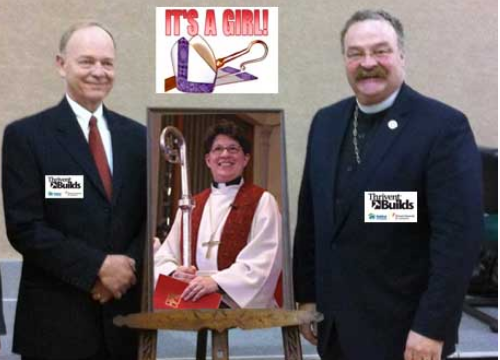
Yes, you can tell this is a Photoshop, because Harrison is 50 pounds lighter and Archbishop Liz is not wearing her Thrivent Builds badge.

This was probably for the dedication of a new donut shop at the Purple Palace. Scholars are divided.


One of the three Lutheran sects is honest about its agenda.

Thursday, February 16, 2023

New Additions for the KJV List - The Sources Thoughtfully Posted at the End of Each Quotation

The Byzantine New Testament in the original Greek preserves the Apostolic or Traditional Text. The New Testament text for the KJV was edited by Erasmus, the greatest Greek scholar of his time.

++

New Additions for The KJV List


What happened to supporters of English-language Bibles?

Although Wycliffe had died in 1384, he did not escape Papal retribution. In 1415 he was declared a heretic, his bones were exhumed and burned along with his books, and the ashes cast into the River Swift at Lutterworth. By then the Lollard movement was in decline and it would be a hundred years before further attempts were made for an English Bible.

British Library 


How did the Tyndale Bible come about?


The preachings of Martin Luther, challenging the authority of the Pope, lit the flames of Protestantism across Europe in the 1520s. In 1521, the Pope condemned Luther's writings and ordered that they be burned. Henry VIII, who had an extensive theological education, opposed Luther's views, and the Pope conferred on Henry the title 'Defender of the Faith'. There were public burnings of Luther's books in London.

Flouting the ban on translating the Bible by working abroad, William Tyndale published his English version of the New Testament in Germany in 1525. Some copies were smuggled in to Britain, but many were burned – as was Tyndale, at the stake, in 1536, after being betrayed while working on his translation of the Old Testament. His last words were reportedly, “Lord! Open the King of England's eyes”.

British Library

++

How did the King James version come about?


But by Shakespeare's time, England had split with Rome, and the political scenery had changed markedly. Bibles in English were now available, such as Henry VIII's authorised 'Great Bible'; the 'Geneva Bible', copiously furnished with Protestant footnotes.

King James I (r. 1603–25; he was also James VI of Scotland) abolished the death penalty attached to English Bible translation, and commissioned a new version that would use the best available translations and sources, and importantly, be free of biased footnotes and commentaries.

The translation committee of 50 scholars drew on many sources, especially Tyndale's New Testament (as much as 80% of Tyndale's translation is reused in the King James version). The result was first printed in 1611, and was 'appointed to be read in churches'. For this purpose, it was published in a large format, suitable for public use, and without illustrations. The use of the antiquated 'black letter' font was intended to add status and authority to the new version.

British Library

++

Impact of the KJV

Today, when Americans reach for their Bibles, more than half (55%) of them still reach for the King James Version. Many Christians were brought up with the King James Version and appreciate the familiarity of it. Its language is a part of their spiritual vocabulary.

In Psalm 119:1, David says, “Thy Word have I hid in mine heart that I might not sin against thee.” The cadence, rhythm, and flow of the King James Version has helped facilitate that “hiding” process in countless hearts. Its memorable phrasing has a timeless appeal.

Alexander Geddes, a Roman Catholic priest and translation scholar, summarized it best in 1792 when he wrote of the King James Bible:

“If accuracy, fidelity, and the strictest attention to the letter of the text, be supposed to constitute the qualities of an excellent version, this of all versions, must, in general, be accounted the most excellent. Every sentence, every word, every syllable, and every letter and point, seems to have been weighed with the nicest exactitude; and expressed, either in the text, or margin, with the greatest precision.”

Thomas Nelson Bibles 

++

King James Bible: How it changed the way we speak

 - BBC

The impact of the King James Bible, which was published 400 years ago, is still being felt in the way we speak and write, says Stephen Tomkins.

No other book, or indeed any piece of culture, seems to have influenced the English language as much as the King James Bible. Its turns of phrase have permeated the everyday language of English speakers, whether or not they've ever opened a copy.

The Sun says Aston Villa "refused to give up the ghost". Wendy Richard calls her EastEnders character Pauline Fowler "the salt of the earth". The England cricket coach tells reporters, "You can't put words in my mouth." Daily Mirror fashion pages call Tilda Swinton "a law unto herself".

Though each of those phrases was begotten of the loins of the English Bible, it's safe to say that none of those speakers was deliberately quoting the Bible to people they expected to be familiar with its contents.


And while a 2009 survey by Durham University found that only 38% of us know the parable of prodigal son, a recent book by the linguist David Crystal, appropriately called Begat: The King James Bible and the English language, counts 257 phrases from the King James Bible in contemporary English idiom.

Such statistics take us back to days of old when this Bible was the daily reading of millions of people throughout the English speaking world, from Northamptonshire cobblers to US presidents - though not perhaps so far distant in the latter case.

Readers absorbed its language both directly and through other reading. Tennyson considered Bible reading "an education in itself", while Dickens called the New Testament "the very best book that ever was or ever will be known in the world."

The US statesman Daniel Webster said: "If there is anything in my thoughts or style to commend, the credit is due to my parents for instilling in me an early love of the Scriptures." Equally celebrated as a British orator, TB Macaulay said that the translation demonstrated "the whole extent of [the] beauty and power" of the English language.

Why has its influence been so marked? Alister McGrath, professor of theology, ministry and education at King's College, London, is the author of In the Beginning: the Story of the King James Bible and how it changed a Nation, a Language and a Culture.

He points to several reasons. The Bible was "a very public text", he says. "It would have been read aloud in churches very, very extensively, which would have imprinted it on people's minds."

Then, going back to the likes of Dickens and Webster, there's the way influential people mediated and amplified the effect.

"The King James Bible" says McGrath, "had a very significant influence on the movers and shakers, particularly in London, who had a huge influence on what ordinary people took to be good English."

Another reason was that the time was ripe. "English was in a particularly fluid state. Both the works of Shakespeare and the King James Bible appeared around this formative time and stamped their imprint on the newer forms of the language."


BBC

++


Baylor Baptist University


How the King James Bible changed the world


The year 2011 marks the 400th anniversary of the publication of the King James translation of the Bible, one of the landmark events in the history of Christianity -- in the history of the faith in England, in Europe, and ultimately on a global scale. To commemorate the event, Baylor University recently played host to a remarkable international conference on "The King James Bible and the World it Made, 1611-2011." The need for such a celebration seemed obvious enough, given the translation's vast importance in shaping Anglo-American culture and literature, language and politics; but it was of course the book's central religious element that made it such a natural fit for Baylor. It is scarcely too much to say that the King James Bible represents a critical foundation of Protestant Christianity in the English-speaking world, and the book's influence ranges deep into other traditions. How could we let such an epochal moment pass without proper notice?

In 1611, the new British state headed by King James I issued its translation of the complete Bible, "newly translated out of the original tongues, and with the former translations diligently compared and revised. By His Majesty's special command. Appointed to be read in churches." The book gave English-speaking Christians a common standard through which they could express their faith. Soon, the spread of printing technology meant that this translation above all became the definitive Bible that believers kept in their houses, and before too long, carried in their pockets. Although originally intended for Anglicans, the new translation soon spread its influence across the spectrum of emerging denominations and sects, as it gave voice to Presbyterians and Congregationalists, Quakers and Baptists. After all, King James's reign coincided with an astonishingly spiritual ferment, as Protestants debated furiously their relationship with the state and whether it was even possible for faithful Christians to accept the decisions of secular power. The year 1609, for instance, marked the beginning of the Baptist churches in the English-speaking world.

"England has two books, the Bible and Shakespeare. England made Shakespeare, but the Bible made England."

- Victor Hugo

And of course, there was a vast global dimension. When we recall how English colonies were beginning to spread around the world in 1611 -- how a settlement was already developing tentatively in Virginia (from 1607), with Massachusetts only a few years away -- we realize how wonderfully the translators timed their work, how providentially. Over the coming centuries, the Christianity of the British Isles would become a driving force in Christian expansion worldwide -- in North America, in Africa, in the Caribbean, in South Asia -- and wherever those believers went, they brought with them the structures and cadences of the King James Bible. Whenever and wherever English-speaking Christians debated their faith, when they debated the nuances of words and phrases, the words over which they battled were those of a common Bible translation, the one that appeared in 1611.

The King James Bible formed the emerging Protestant Christianity of the Anglo-American world, and that claim is stunning in its own right. But the text had an impact even beyond that, shaping the whole culture of the English-speaking world. As even its bitterest detractors concede, the 1611 Bible is a literary masterpiece of the first order, a triumph of both prose and verse. If the year 1611 coincided with the beginnings of the British Empire, it also marked the high point of the English Renaissance. The new Bible translation appeared within a couple of years of the first performance of some of the greatest plays in English -- William Shakespeare's "The Tempest" and "The Winter's Tale," John Webster's "The White Devil" and "The Duchess of Malfi," Ben Jonson's "The Alchemist" -- and at the time of John Donne's poetry, and the philosophy and science of Sir Francis Bacon. (Even this list does not begin to mention the contemporary achievements in music, architecture and the visual arts.)

The Bible translators were working in an era of staggering literary accomplishment, but moreover at a time when writers felt no inhibitions about restructuring the language and its literary forms, or of coining hundreds of new words as it fitted their moods and met their purposes. Nor did they have the slightest hesitation about borrowing freely from foreign cultures, or about drawing from the humble plebeian forms they saw all around them; all was grist. In the hands of these linguistic entrepreneurs, the English language was passing through an intoxicating period of transformation and re-creation.

What a moment in history! Rudyard Kipling celebrated the making of England in a once-famous poem, which appeared in the tercentennial year of the King James Version, in 1911: "England's on the anvil! Heavy are the blows! (But the work will be a marvel when it's done.) ... England's being hammered, hammered, hammered into shape!"

To adapt his words slightly, around 1611 the English language likewise was being hammered into shape, and the Bible translators were both the beneficiaries of this process and its craftsmen. The King James Bible survives as a definitive monument of the process of invention -- and the work was, indeed, a marvel when it was done. This was the work that would soon find itself on the shelves of millions of ordinary, faithful believers, and even for those who could not read, these were the words they would hear in the church and marketplace. French writer Victor Hugo thought that "England has two books, the Bible and Shakespeare. England made Shakespeare, but the Bible made England."

The new Bible indeed shaped the emerging English language, and spread those patterns of speech, thought and meter throughout the world. And the fact that this Bible, of course, proclaimed the core Judeo-Christian message and worldview meant that those were the irreducible, foundational ideas of the English-speaking world. Noting the power that speech and language possess in shaping thought and behavior, linguistic scholars declare not that we speak language, but rather that "language speaks us." After the King James Bible, English speakers had no option but to declare that Scripture speaks us. The quirks of the King James translators became a basic part of our everyday speech and thought.

Most observers would say that this heritage has been vastly beneficial in linking religious truth so closely with linguistic majesty, aesthetic splendor and verbal precision. Among other things, the King James Bible established a universally familiar pattern of what "religious speech" should sound like in English. The model would be followed by virtually every alternative gospel and new prophetic revelation over the centuries to come, although the results would often represent a pastiche. Of course, it is implied, God must be speaking in this bold new text: Does He not sound like He did in 1611?

Just how fundamental a part of our language the Bible's words have become is hard to exaggerate. In a recent piece in the British newspaper The Independent, journalist Boyd Tonkin illustrates the point:

"In a secular age where ignorance of religion goes from strength to strength (Psalms 84:7) among lovers of filthy lucre (1 Timothy 3:8) who only want to eat, drink and be merry (Luke 12:19), we know for a certainty (Joshua 23:13) that these resonant words endure as a fly in the ointment (Ecclesiastes 10:1) and a thorn in the flesh
(2 Corinthians 12:7) of the powers that be (Romans 13:1). They can still set the teeth on edge (Jeremiah 31:29) of those who try to worship God and Mammon (Matthew 6:24). But does this ancient book, proof that there is no new thing under the sun (Ecclesiastes 1:9), now cast its pearls before swine (Matthew 7:6), and act as a voice crying in the wilderness (Luke 3:4) -- a drop in a bucket (Isaiah 40:15) of unbelief, no longer a sign of the times (Matthew 16:3) but a verbal stumbling-block (Leviticus 19:14)?"

Yet while Christianity might be on the defensive in some parts of the world, it is clearly thriving and expanding elsewhere. Indeed, we live at an astonishing time in the expansion of Christianity beyond its historic heartlands, as the church grows with astonishing rapidity in Africa, Asia and Latin America.

Even thinkers not sympathetic to the Bible's message still praise its language. Famous skeptic H. L. Mencken found in the King James "a mine of lordly and incomparable poetry, at once the most stirring and the most touching ever heard of." Another remarkable testimonial to the influence of the KJV comes from New Atheist thinker Richard Dawkins, who normally has nothing good to say about any aspect of religion. On the King James, however, he becomes lyrical, so much so that he prays, apologetically, "Forgive me, spirit of science!" But as he asks, how on earth can anyone who cares about language be so ignorant and insensitive as not to appreciate the magnificent tones of the KJV? He continues, again freely quoting King James-isms, "If my words fall on stony ground -- if you pass me by as a voice crying in the wilderness -- be sure your sin will find you out. Between us there is a great gulf fixed and you are a thorn in my flesh. We have come to the parting of the ways. I fear it is a sign of the times." And those are the words of a declared mortal enemy of the Bible!

No serious study of literature in English can neglect the impact of the 1611 Bible, and that is equally true for any century from the 17th through the 20th. All the great canonical authors are immersed in that Bible, even (or especially) those who reject its fundamental religious message. To put it ironically, the Bible they reject is the 1611 version, which created the literary air we breathe. The King James language informs and inspires American literature, from Herman Melville and Nathaniel Hawthorne through Ernest Hemingway and William Faulkner. It has its special power in African American tradition, from Frederick Douglass through Alice Walker.

Scientists too, as well as literary giants, found their awestruck vision of the universe in this Bible. When Samuel Morse sent his first revolutionary telegraph message in 1844, it quoted the Book of Numbers in -- what else? -- King James English: "What hath God wrought!" Historians sometimes use that phrase to encapsulate the ecstatic spirit of joy in discovery that characterized 19th-century America, but the innovation was rooted in that ancient English-speaking past.

Politically, too, the language of the 1611 Bible is inextricably bound up with the evolving discourse in freedom, in Britain and its Commonwealth, but above all in the American colonies and the later United States. John Winthrop famously envisaged a "city upon a hill." As the Liberty Bell proclaims -- quoting the King James translation of Leviticus -- "Proclaim freedom throughout the land!" And the prophetic visions of Abraham Lincoln, Martin Luther King and other radical reformers were, almost infallibly, framed in the language of King James. The dreams they had owed their shape to the visionary translators of 1611. If, generally, Scripture speaks us, then specifically, the King James Bible spoke America.

Given the central role of the 1611 translation, its quadricentennial naturally demands celebration, with an added sense of rededication. But beyond commemoration, the anniversary also calls for a rethinking of the text and its importance in the 21st century, and these themes have stimulated much recent writing and research. For example, the original King James Bible owed its success to the development of new media forms that massively democratized access to knowledge in the form of cheap printing. That era began the great era of printed text, an epoch that may be drawing to its end in our day. We must think just how the Bible adapts to new forms of media technology.

In wider terms, we look at the Christian world which relies on the Bible, whether the King James or some later version. For centuries, the King James stood at the heart of Christian culture in the Anglosphere, the English-speaking world. But what is the role of Christian culture in much of that world today, in the face of widespread secularization? Countries like Great Britain and Australia are today among the most secular on the planet. We must ask what relevance that history has in these post-Christian cultures: At what point does the Bible cease to be the anchor of a Christian culture?

Yet while Christianity might be on the defensive in some parts of the world, it is clearly thriving and expanding elsewhere. Indeed, we live at an astonishing time in the expansion of Christianity beyond its historic heartlands, as the church grows with astonishing rapidity in Africa, Asia and Latin America. Many of these, particularly in Africa, have tremendous devotion to the King James tradition, in a world in which English is becoming a lingua franca. As scholars, we must explore how the experiences of these newer churches compare with the historical record of the English-speaking world. What can we in the global North learn from them -- or they from us?

Four hundred years after the King James Bible, it would be tempting to consign its story to the past, to see it as fading into antiquity. Yet the more we consider the King James phenomenon, the truer we may find the words of William Faulkner: "The past is never dead. It's not even past." If we do not understand where our Christian tradition comes from, we cannot begin to understand our future.

Baylor University

Sunday, January 29, 2023

Anyone Attend a Lutheran College or Seminary And Hear
The King James Version Given Its Proper Place in the History of Bibles?
Hear Lectures about William Tyndale? Bueller, Bueller, Anyone? Anyone?


I was going over the KJV quotations I gathered in one blog post which is also sticky posted on the left.

This marks the sticky post on the left column.

One way to treasure the English language is to appreciate the two pillars - Shakespeare (aka Oxford) and the King James Version (aka Tyndale). I find it amusing that some want to make Tyndale insignificant because there were so many English Bibles floating around. Most of those were Tyndale derived because the King had him murdered. Translating was a capital crime so no one wanted to sign on as a Tyndalean. The WELS-ELS-LCMS pastors know exactly what I mean. "Oh please do not name me in a blog post, Greg. Better yet, not even a hint of who I am or where I live."

At least one expert has argued that Tyndale and Luther were independent creators of their basic languages and styles, and that makes more sense than what I wrote for the graphic above, years ago. Both men were uncommon language geniuses, and German does not easily translate into English. Two countries were blessed with groups of dedicated translators before the horrid Jesuit Douai-Rheims came in late.

Funds come in regularly to support the free copies of KJV Bibles which I send to people for free and give away locally. People in prison appreciate the comfort and guidance of a Bible, so we are giving them 10 at a time.

If you want a KJV Bible in the normal size, with easy-to-read print, let me know by email, and it will be sent free of charge. The funds are already there. You may want to send one or more to others, so that can be done too. There is nothing better than getting them around to people, who may have none, or no translations except the Evil Four (RSV, NRSV, ESV, NIV) plus One (Beck).

Three of the Evil Four are licensed by the gay Marxist National Council of Churches, not that anyone should shun these delightful, creative, and completely erroneous paraphrases.

The King James Version - free copies are available.


Wednesday, January 18, 2023

Here Is a Lesson for Everyone - A Book - The Book of Books - The KJV for Everyone at Every Age


Today I was thinking about books - they arrive faster than I can read, and I have a backlog of favorite books I could read again. I thought of the boxed edition of The Byzantine Empire, by John Julius Norwich, fascinating and appealing in every way. However, I gave it for Christmas to someone equally a bookworm. I read the volumes twice already.

I will read Moby Dick another time in the future, just because it is the gold standard of novels, fun, full of information, and loaded with droll observations. I didn't give it away? I gave it away at least five times and got it again, because "used" copies of it float along the used book market. Like The Pilgrim's Progress, I can get it for a bargain.

Walther gladly followed Bishop Martin Stephan, STD, until CFW had a chance to steal Stephan's land, gold, books, house, and personal possessions. The Great Walther was a great thief, liar, and kidnapper - his niece and nephew.

When I think about books to read at this stage in life, I start with the only one where God is speaking directly, inerrantly, and efficaciously. Moreover, the beautiful language of the KJV is clear and powerful. The book buskers have weaned several generations of Bible readers away from the KJV because of the profiteers' lust for the loot grabbed by their uninspired, tawdry paraphrases: ESV, RSV, NRSV, NIV and Beck.

Is not the wisest of all books the only one where God speaks to us directly? I have nixed several hundred articles with evidence about the synods, sects, and diocesan costume parties. Why? Because they simply keep repeating their corruption through osmosis, moving from one location to another, without much difference. The semi-permeable membrane is called "moving to a better synod." Excuse me. I have to stop for a few minutes to stop laughing.


Church history is fascinating but too much like a bag of Fritos - hard to stop after the first few crunches, but utterly lacking in nutrition. Objective (faithless) Justification has been taught by all the synods and the high Roman church with great pleasure by the leaders and their Grima Wormtongues. The best counter to the anti-Gospel Universalism of the day is the KJV.

Yes, little children can read the KJV. We translate words for children all the time, and their teen elders explain new words to parents and grandparents, without trying to halt the ever-changing English language. 

I was amused in reading the Psalms by the claim we cannot understand the KJV. In a Psalm about evil people, two words were as clear as could be - "aha aha" and "wink." Aha, aha is used in a popular German rock song, called "Da, da, da" - an earworm of the worst kind. 

KJV Psalm 35:19 Let not them that are mine enemies wrongfully rejoice over me: neither let them wink with the eye that hate me without a cause.

KJV Psalm 35: 20 For they speak not peace: but they devise deceitful matters against them that are quiet in the land. 21 Yea, they opened their mouth wide against me, and said, Aha, aha, our eye hath seen it.

The wink is used when people are sharing a lie together. I have seen that wink in solemn church conferences and doctors' offices.

We do not harm people by using the KJV, but we damage the transmission of the Gospel by using the corrupted Greek New Testament promoted by  the fraudulent deceiver Count Tischendorf, the anti-Christian Westcott-Hort team, and the German apostate Kurt Aland. Professor Beck followed the same blind alleys and is still making money for the Otten Foundation.

The Jewish scholars were and are fanatical about the transmission of the Old Testament. Do Christians really believe that God allowed the Greek New Testament to be so utterly lost that Billy Graham could stupidly say, "The originals are lost, so we no longer have the original Gospel"? 

Was God so lax with the ultimate revelation of the New Testament that he let heretics confuse, muddle, and betray the 27 books from the Apostles? "Heaven and earth will pass away, but My Word will never pass away." 

KJV Matthew 24:35 Heaven and earth shall pass away, but my words shall not pass away.

Those who whine when bemoaning the loss of the true New Testament are just like the Mormons, lying to lead everyone down their own cultish dark path.


Saturday, January 14, 2023

The Only Universal English Bible Is the King James Version.
Therefore, Only the KJV Can Unite the Denominations


Many claim that the Bible is the purest and most direct form of the Word of God, but they actually worship and bow down to their denomination. The American denominations are a Tower of Babel, so confused, their modern Bibles conflict with each other. The Evil Four Plus One are uninspired and based on corrupted and fraudulent texts.

The answer to true ecumenists is to park their Evil Four (NIV, ESV, RSV, NRSV) Plus One (Beck) in a damp and unlit cellar.

The KJV New Testament is the Apostolic Text. The Evil Four Plus One are the bastard offspring of the National Council of Churches and the Church of Rome, which together gently guide the Protestants toward the goals of the Antichrist.


Tischendorf "discovered" this fake codex, which had no history and was revealed as a recent invention created on fresh parchment, but later artificially aged. Tischendorf claimed to have rescued some pages which were going to be burned. Has anyone seen or smelled leather burning? Please write and tell the readers how and when you warmed a room with burning leather.


Tischendorf was such a grandiose fraudster that I doubt whether any of his famous "discoveries" were genuine as presented - Ephraim, Sinaiticus, and Vaticanus. Yes, Vaticanus was an old fake kept under wraps by the Antichrist, but Tischendorf was the first to be allowed to promote it. And now, Vaticanus and Sinaiticus are advertized as the bedrock of the Greek New Testament and the Apostolic Traditional (Byzantine) text as something to shun.

Wednesday, January 11, 2023

Notice the Changing Quotations about the King James Version of the Bible


I change the blog template every so often, to make it easier for readers to find worship and book information, quotations, essays, and graphics. On the template, I am going through quotations about the KJV, from the list I posted here. Click on graphic on the side (same as above) to find the complete list.

The radicals have been trying to pry us away from the KJV for 70+ years - since the birth of the NCC's RSV - so we need to offer the reason for our trust in the Apostolic (Traditional) text. The Westcott-Hort-Nestle-Aland is an outrageous botch and bundle of deceptions. Yes, the Greek New Testament behind the Evil Four, plus Beck, never existed. It was cobbled together by the unchristian Westcott and Hort, with all kinds of wild guesses and fanciful reasons for cutting out NT passages about the divinity of Christ and faith in Him.

The main "sources" of the Evil Four Plus Beck are

  1. Codex Sinaiticus - which never existed until Count von Tischendorf found it.
  2. Codex Vaticanus - which is actually a Greek translation of the Latin, to calm nerves over which was better. But - since the Greek uses the much later Latin version, the pope's New Testament is a joke, not a source, as faithful as a Hollywood movie star.

Readers are welcome to remind me if they see one of those extremely rare typos that occasionally appear on the blog.

All The Radicals Needed Were Bad Bibles from the Marxist
National Council of Churches - RSV, ESV, NRSV.
NIV and Beck - Bonus Bad Bible Paraphrases

What could be more full of meaning?- for the pulpit is ever this earth’s foremost part; all the rest comes in its rear; the pulpit leads the world. From thence it is the storm of God’s quick wrath is first descried, and the bow must bear the earliest brunt. From thence it is the God of breezes fair or foul is first invoked for favorable winds. Yes, the world’s a ship on its passage out, and not a voyage complete; and the pulpit is its prow.

Herman Melville, Moby Dick, Chapter 8

I was going to write about the downfall of Augustana College, but that involves obscure histories of people most readers do not recognize, from college presidents Dr. Andreen (Yale genius) to Tom Tredway (Methodist academic politician). Instead, let us focus on Bibles since the pulpit is the forefront of the world, as Herman Melville wrote in Moby Dick.


The Scriptures are the foundation of all Christian organizations, and that book - now politically warped - has proved to be the supreme document of apostasy. We have 150+ years of turning away from the Apostolic Greek New Testament Text (aka Byzantine, Traditional, or Received Text) and clinging to a deliberately warped text relying on paraphrasing to avoid the clarity and accuracy of the King James Version - the Westcott-Hort Greek New Testament.

 They were ordained unbelievers. Hort favored a Mary religion over a Jesus religion - his words. Westcott merged polytheism from India with Christianity.


The Westcott-Hort butchered text was secretly published in 1870 for the translators of the Revised KJV. We never hear of that Bible edition, because the Revised KJV in 1880 was a total disaster, a flop, unsellable in America or Britain. The leaders of that fiasco could not figure how to fix it, so it became the wallflower of Bibles, "sinking beneath the waves, unknelled, uncoffined, and unknown." (Lord Byron)

The Westcott-Hort text was unveiled the moment the Revised KJV was published for everyone, so the two publications were aligned with each other, though both failed while becoming the start of a new age of Bibles. The Nestle-Aland Greek New Testament text of today hardly varies from the errors of the Westcott-Hort, and the English Bibles of today show the same arrogance cutting, pasting, and paraphrasing. 

The Evil Four (RSV, ESV, NRSV, NIV) Plus One (Beck) are consummate frauds that still do not add up their sales to the readership of the KJV. And the KJV alone outsells the pathetic Evil Four Plus One.

Three of the Evil Four are licensed by the extreme Left Wing National Council of Churches. If you look at what mainline churches are doing now (including WELS and LCMS)...the NCC was doing that and more 30+ years ago. This is funny, as a factory worker asked - "Why do they excuse the ESV when it is only slightly better than the NIV? Why not simply use the KJV?" 

The Revised KJV tanked and sank in the 1880s - unfixable, so how did Biblical changes happen to take place so much later? 

All of us little Baby Boomers were being born after WWII. Our parents were from the generation that fought Germany and Japan - patriotic, hard-working, frugal, and church oriented. Boomers became the petri dishes on which modernism could grow and enjoy metastasis without much interference. Teachers and ministers were gently encouraged to embrace whatever was new and different.

This gentle encouragement allowed the radical forces to change foundation of Biblical teaching and preaching. Billy Graham gave the impression of rock-ribbed Biblical purity, but he went along with shocking claim that the original Bible texts were lost and impossible to recover. That not only went against the extreme accuracy of the Jewish transmission of the Old Testament, but also against the Word of God - "Heaven and earth may pass away, but My Word will never pass away." (Matthew 24:24) That is not just a Biblical verse but the theme of the entire Bible. 

Unsurprisingly, the efficacy of the Word was gradually dropped by the Lutherans and all other denominations. Many people - including the conservative Lutherans - have told me that they never heard of the efficacy of the Word. That makes it so much easier for the apostate leaders of today (ELCA-LCMS-WELS-ELS-CLC-ELDONUTs) to reject the efficacy, clarity, and inerrancy of the Scriptures.

 Liberalism Its Cause and Cure


The mainline church bodies gladly participated in all radical changes. Just remember, the National Council of Churches is hardly mentioned anymore, because their funding was cut back so severely and their reputation at their own headquarters was shot to pieces over 30 years ago. Yes, I read the books about the NCC and included some of it in Liberalism Its Cause and Cure.

A member of the Wisconsin abusive sect will say, "I have nothing to do with the National Council of Churches or the United Nations." However, that New NIV is worse than any doctrinal roadmap published by the NCC. WELS has sent money to UNICEF, aka the United Nations. 

If your congregation is using the RSV, ESV, or NRSV, you are funding the ultra-left National Council of Churches. If your parish is using the New NIV (because the NIV was yanked), you are using a paraphrase even worse than the NCC versions. Little by little, your congregation is undermining the Scriptures. In many cases, the pastor is blowing up the foundations of the Faith.

Once upon a time, a Presbyterian minister told me his denomination was against conservative ministers. I asked, "How do you define conservative?" He said, "Someone who attended Fuller Seminary." Incredibly, I restrained myself from laughing. 

Fuller Seminary formally rejected Biblical inerrancy just as the Church Growth Movement was initiated by Donald McGavran, Disciples of Christ advocate of Planned Parenthood. The son of a Mordor professor said, when I mentioned Fuller apostasy, "Weren't you a member of the Disciples at one time?" That is a typical WELS answer to any doubt about its purity and superiority. I left the Disciples on my own, shocking my family, to join a liturgical, Biblical Lutheran congregation across the street. 

We few, we happy few, we band of KJVers, joined the KJV fan club upon learning how bad all these toxins were, served up like gourmet food when they were really roadkill. Ditto The Lutheran Hymnal, still a classic.

Traditional Baptists (not Calvinist Baptist, a strange amalgam) have two things in common. They know the KJV is the best Bible and they teach Justification by Faith. The Chief Article can easily be ignored by congregations using Evil Four paraphrases, but the KJV is the unifying Bible because it even retains the Greek text - the Faith of Jesus. If the Evil Four Bibles are so slap-happy good, why do they corrupt so many clear terms?


 The King James Version