Showing posts with label beneficial insects. Show all posts

Friday, June 29, 2018

Roses at the Doctor's Office

 Two Mr. Lincoln roses were enough to drop-kick some fragrance into the room, but I included a secret weapon - posted below.
We visited a doctor today. He grows a lot of KnockOut roses, which are a prolific shrub rose, almost disease free. KnockOuts are also fragrance free, so he smelled the roses as soon as he walked into the room.

The secret weapon added to the potency of the perfume - Fragrant Cloud.

Fragrant Cloud is another rose that will perfume a bouquet.
Most of our roses are fragrant, but when they are not, I include Fragrant Cloud or Mr. Lincoln.


I filled in with Shasta Daisies again. This is my first planting from last year, which has multiplied into 12 clumps by dividing them (very easy to do). Cutting the flowers will generate even more, just like roses and Crepe Myrtle.

Two Boosts for Roses in a Hot Summer
Roses need plenty of water, and mulch will help keep that moisture in the soil longer. A drought means two waterings per week.

For roses or any plant needing intensive care, I use several gallons of rainwater. They sell all kinds of additives to help plants, to protect against shock, for example. God already invented rainwater for that - a combination of newly formed water and usable nitrogen - and it is free.

Sassy's Laotian friends came across the street to see her and look through the garden. Most have fenced off gardens, but I have mulched walk-through gardening. Another new surprise is always popping up to show what fertile soil can do. For example, the Trumpet Vines decided to flower this year, providing a second favorite flower - with Hostas - for hummingbirds

A second boost is constant pruning. My pruning shears and the shovel are both near the front door. If I am making a bouquet for someone, I also look for dead wood to trim away, completed roses to trim away from the stems.

 Ichneumon Wasps: every gardener sees them,
but how many notice and value them?

Creation Software Experiment
I try to imagine what makes an individual plant or animal distinctive. Variety seems almost endless. Witness the Ichneumon Wasp, a tiny beneficial insect, which is helping you in your garden, unless you suppress it with toxic insecticides. There are 100,000 species - and last I read - possibly more ichneumon species to be discovered.

The Snoring Bird: My Family's Journey Through a Century of Biology (Ecco, $30), by biologist Bernd Heinrich.

 Ichneumon Wasp: beautiful, delicate, tiny - but a deadly tracker of pests.

Finding and cataloging them was quite a chore by itself - I would stop at 50,000! I can imagine Little Ichabod saying, "Dad! Enough with the wasps!" But even better than their variety is the engineering and management of these delicate insects. How do they know how to flourish while attacking insect pests? They do not really "know" but they do accomplish specific tasks with remarkable determination. They follow roses into the vase when I am gathering flowers for neighbors, friends, and doctors.

Etymology

Ichneumon (ἰχνεύμων) means "tracker" in Greek. Cockatrice, a name for another mythical beast, derives from calcatrix, a Latin translation of this. The Ichneumon was one of the few who can look at a cockatrice without turning to stone.

Cultural significance

In the eighteenth century Ichneumon was regarded as an instance of the God-given balance in nature; in the nineteenth the possibility of using it as a form of biocontrol was briefly entertained. It was used as the symbol of the reformed Entomological Society of London in 1833.[1]

Put Down Your iPhone and Read Slowly and Carefully about Some of These Remarkable Little Wasps - Wiki

  • Chemical Warfare
  • Underground Warfare
  • Tracking a parasite, killing, evading with "pot vapors"


Many species use polydnaviruses to suppress the immune systems of their host insects. Due to the wide variety in hosts and lifestyles, see subfamily pages for more detail.
The female ichneumonoid finds a host and lays an egg on, near, or inside the host's body.[8] The ovipositor of ichneumonoids generally cannot deliver a sting as many wasps or bees do. It can be used to bore wood and lay eggs on hosts deep inside, or reach hosts hidden inside leaf shelters. Upon hatching, the larva feeds either externally or internally, killing the host when it is ready to pupate.
Various ichneumonoids are used as biological control agents in controlling horticultural or forest pests.
An interesting example is the relationship between the species Ichneumon eumerus and its host butterfly Phengaris rebeli.[9] The butterfly larva is a parasite within Myrmica ant nests. The adult Ichneumon eumerus searches for ant nests and only enters when they contain P. rebeli caterpillars.[9] Once inside, they oviposit their eggs within the caterpillars and escape the nest by releasing a chemical which causes the worker ants to fight each other rather than the intruding wasp.[9] The wasp eggs then hatch inside the caterpillar and eventually consume and kill the host.

Ichneumon wasps FAMILY Ichneumonidae NORTH AMERICAN SPECIES 3300 While many species of ichneumon wasps are extremely tiny, others are very large (up to 1.5 inches or 40 mm!). All are slender with long antennae. Many females have a highly noticeable ovipositor; it is sometimes longer than the insect’s body. Ichneumon wasps can be yellow to black or have patterns of various colors. They use caterpillars, the wood-boring grubs of various beetles, and other insects as hosts.

Walliser, Jessica. Attracting Beneficial Bugs to Your Garden: A Natural Approach to Pest Control (Kindle Locations 1139-1144). Timber Press. Kindle Edition. 
 Dill - teeny, tiny beneficials need teeny, tiny flowers
for the adults to enjoy. Fresh raw meat is normally for the hatchlings.

--

Tiny parasitoids, like the minuscule parasitic wasps on this dill, require exposed nectaries and shallow flowers to access nectar. Open nectaries, such as those present in members of the carrot family (Apiaceae), are among the most user friendly to the largest diversity of beneficial insects.

Walliser, Jessica. Attracting Beneficial Bugs to Your Garden: A Natural Approach to Pest Control (Kindle Locations 1519-1521). Timber Press. Kindle Edition. 
Know your carrot family - here is a cousin of dill.
Queen Ann's Lace evolved a bug painting to fool bugs into landing on it. Sure it did ↘😀- but how did QAL know how to form that little bit of make-up and pass it on to all royal heirs? Ask the faculty at Concordia, St. Louis. They know everything. No, they really do.

That Is Why
I do whatever I can to keep the beneficial insects happy and protected. As I wrote before, Jessica Walliser expanded my knowledge of beneficial insects by connecting specific beneficials to their favorite plants.

 Giant Hogweed and Poison Hemlock are also carrot family hosts of a zillion insects. Both are large and impressive, but horribly toxic. Thus the Lutherans with their ordinary size Means of Grace congregations were drawn to the giant, toxic Church Growth blobs and converted into Enthusiasts of the worst kind: third-rate generic Protestants, fourth-rate faux-Lutherans. Ask WELS/ELS and LCMS how they did this while denying/praising it at the same time.

Friday, June 15, 2018

Fun with Pollinators in the Creation Garden


Sassy wants her morning walk by 7 AM, and I finish a mug of pour-over coffee by that time. She interprets certain signals favorably, such as donning socks and speaking certain words, such as go, walk, and morning crunchies.

We inspect the rose garden at the same time, for different reasons. I look for the latest blooms. She noses about, looking for signs of wild life.

On Friday I wonder about what will be blooming Sunday morning. In hot weather the new rose blooms appear rapidly. If I want more roses,

  1. I prune mature rose flowers, 
  2. look for death stars (blooms with no petals, ready to develop hips), and 
  3. cut away dead wood. 

All three suppress new blooms, so I follow John 15 and cleanse the fruitful to make them more fruitful. But Sassy is a busy executive, with people to meet and places to explore. She hurries me along with some happy barks. Pruning waits for her permission, later.

I am watching the plants I obtained for pollinators. At Almost Eden, that word came up often - pollinators. That includes bees, butterflies, and hummingbirds. The gardening sites all work very hard at exploiting those categories, especially butterflies and hummingbirds.

Hummingbirds love three plants I am promoting in the rose garden:

  • Hostas - for their trumpet flowers;
  • Bee Balm - for their trumpet flowers;
  • Trumpet Vine - for their trumpet flowers.

The common factor seems to be...Bueller, Bueller, anyone? anyone? Worth mentioning is the hummingbirds' need for tiny insects. Hummingbird feeders offer sugar water, but flowers offer nectar and tiny insects.

Hummingbird flowers will also be popular with bees, and I like having a constant cycle of blooming, which start with early spring weeds, mints, and dandelions.

Butterflies seem to need a specific plant for each kind:

  1. Milkweed for the Monarch eggs and caterpillers, 
  2. Parsley for the Black Swallowtails.

I am working on Butterfly Weed (related to Milkweed) now and Milkweed for next year.


Teeny-Tiny Insects
Joe Pye and Mountain Mint draw groups of tiny insects and butterflies. I wondered why they sold a small version of Joe Pye called Little Joe. Now I know why. My mature Joe Pye is ready to bloom and almost 6 feet tall.

Likewise, Mountain Mint is so tall that people ask what it is. Do not laugh, but I have made three attempts to divide and replant some. I missed the one day of spring for that, and the roots are welded to the clay soil for now. Laugh all day - I have Mountain Mint and most people do not know how valuable it is.

 Cletha - aka Summersweet aka Sweet Pepperbush, etc.
Poke a bloom and see a tiny insect cloud.

But I also like the tiny insects that do so much to attack insect pests. Their small size contributes to overlooking their value. If I wiggle the right plants, a tiny cloud of them will take flight and settle down again - quite a sight.

About Clethra - From Gardening in Tune with Nature

If I had space in a small garden for only one woody plant, I would grow summersweet.  I’ve always grown it and frequently written about the heady perfume of its summer flowers and its unique brassy yellow autumn leaves, but its status as a “must have” plant for the garden insectary was secured last August as I stood among a colony of the cultivar ‘Hokie Pink’ flowering in Marjorie’s Garden.  I recalled the summer day ten years earlier when we knocked each of the five small plants out of its one-gallon pot and planted them around the bole of the old white pine growing off the porch steps.  A decade later, as I twisted my way into head-high branches crowded with racemes of soft pink flowers, it was impossible to say where one plant stopped and another took over.  Even a chipmunk has a hard time weaving through the interlaced stems to reach the base of the pine.

Carefully moving branches aside, I positioned my legs and those of my tripod in the middle of the summersweet colony and waited for the wake of my disturbance to settle.  Soon the spikes of flowers, only a few inches from my nose, were crawling with bees, wasps, hoverflies, beetles, and several insects whose images remain on my computer desktop, waiting to be identified.  Bumblebees of all sizes and colored markings outnumbered all other insects.  A lonely honeybee joined the symphony of buzzing, along with several small native bees, some metallic green, others gray or black.  Two distinctly different hoverflies tormented me with their inability to settle down long enough for a photograph, but a tachinid fly obliged, stopping in its frenetic foraging for nectar long enough for me to get a decent shot.  (Both hoverflies and tachinid flies are predators of herbivores such as aphids and various leaf-munching caterpillars.  Hoverflies feed on nectar and pollen as adults, but their larvae feed on other insects.  Tachinid fly females lay their eggs on other insect adults or larvae.  When these eggs hatch, the tachinid larvae bore into the host’s body and slowly consume it.)
In terms of diversity of insects attracted to a single plant in bloom, nothing in my experience compares to what I witnessed on that August afternoon.  Through the tangle of summersweet branches I could see the vegetable garden a hundred feet away, the bright orange squash flowers beckoning.  When a bumblebee in my viewfinder took wing and disappeared, I knew where it was heading.
More about Clethra from another writer. I have two mature Clethras.

Where Yah Going on Vacation?
I am there.

Saturday, May 27, 2017

Rescues and Roses in the Creation Garden

This year has improved the start of the John Paul II roses,
which were aphid magnets last year.

I was overly optimistic about the rain forecast, pouring out the stored rainwater in all my barrels. Checking on two Crepe Myrtle twigs, I decided they needed more rainwater, if I could find some. I gathered all the rain from the latest, stingy precipitation in one five-gallon pail. Both myrtle twigs were growing, snuggled in a thick blanket of peat humus, cut clover and grass. The peat mixture absorbed all the rainwater.

 Cinco de Mayo rose


Mrs. Ichabod needed some roses for her cancer support group, which votes on who gets them each time. The winner was an 89 year-old who was having a surgical procedure. Her roses were Cinco de Mayo and Easy Does It.

 Mr. Lincoln has the most powerful fragrance
of all the roses we grow.

Our Army Ranger neighbor was admiring our Veterans Honor and John Paul II roses, so I gave him a vase to take to the cemetery. He said, "You grow beautiful roses." He received a Mr. Lincoln, two Veterans Honor, and two JP IIs in one vase. The red-white contrast was impressive, and the collective fragrance from all five was powerful.

 Veterans Honor glows red in the garden,
lasts forever in the vase, and is fragrant as well.

Diversity in the Garden Attracts More Beneficial Insects
Last year I let the aphids attack the John Paul and Peace roses on the first bloom. Beneficial insects are attracted to battle-zones, where they lay their eggs on, in, or near the pests. Ideally, beneficial insects will grow up on a diet of pests and stick around for pollen and nectar, repeating the babies' pest-eating cycle, only faster, the next time.

Here are the pollinator plants, as they are called, which support the beneficial insect adults and also attract bees, butterflies, and some hummingbirds:

  • Cat Mint looks like lavender and blooms early.
  • Mountain Mint has an intense aroma when crushed.
  • Monarda blooms purple.
  • Spirea is a low growing border plant with many compound flowers.
  • Buckwheat is sown throughout, for weed suppression and pollinators.
  • Dandelions mine calcium and improve the soil.
  • Butterfly Weed hosts the Monarchs.
  • Borage provides a constant supply of fllowers and seed, known for increasing the overall numbers of beneficial insects.
  • Shasta Daisies are attractive to humans and beneficial insects. As soon as I planted them, in bloom, Tachinid flies were feasting on the flowers. Their eggs hatch into pest-eaters.
 Tachinid Fly


Adult tachinids feed on pollen, nectar, and honeydew and are important pollinators. They are very active fliers and are often seen alighting on flowers, fences, rocks, and people. All species of tachinids are parasitoids that use various insects as larval hosts. Most species use caterpillars (cabbage loopers, corn borers, gypsy moths, cutworms, fall armyworms, coddling moth larvae, leaf rollers, bollworms, and many, many others) as hosts while other species parasitize adult and larval beetles, and even various true bugs and sawfly larvae. Tachinids can be generalists that use assorted species as larval hosts or specialists relying on only one species to feed their developing young.

Walliser, Jessica. Attracting Beneficial Bugs to Your Garden: A Natural Approach to Pest Control (Kindle Locations 862-867). Timber Press. Kindle Edition. 


Wednesday, August 26, 2015

Seeing What Was Always There - And Far More Yet To Discover.

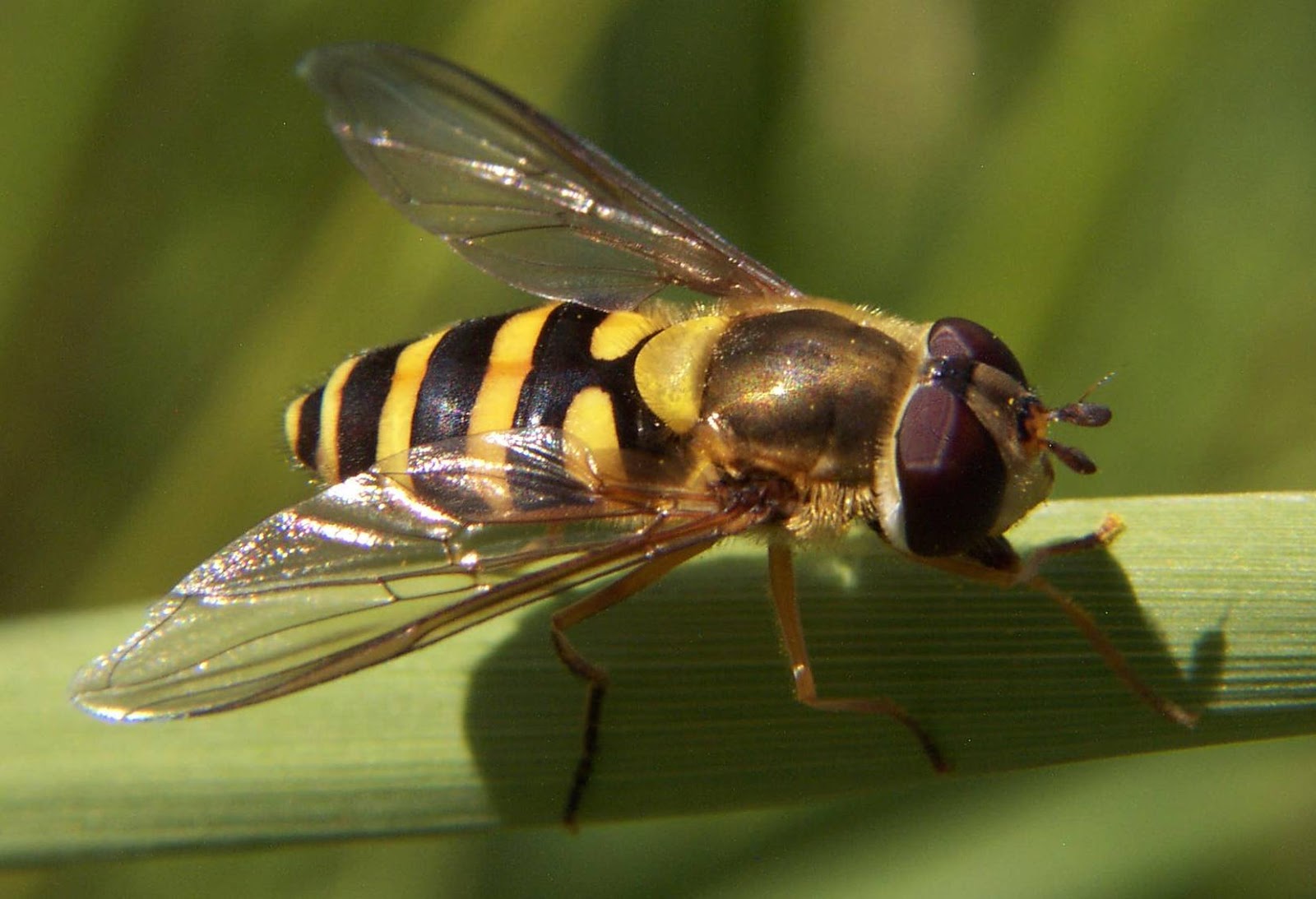
This hover fly or flower fly is easy to find on a calm, sunny day, 
unless the gardener uses insectides and systemic poisons.
Celebrity beneficials like the ladybug do not do as much for us as the
lessen known players - like this hover fly.

Here is a great summary, with photos. of beneficial insects.

I bent over the cone flowers growing in Norma Boeckler's front yard. As I got closer I could see the hover flies and Ichneumon wasps tending to business.

Cone flowers are good for beneficial insects, but I did not notice the flowers or insects until this year. I had a vague recollection of both. If I tried to explain them to grandson Alex, as my mother did to me, he would probably register some interest and go on to other subjects.

Jessica Walliser wrote about the dynamics of beneficial insects becoming more interesting than the plants that were her original passion.

My most recent discovery is the existence of cursorial (webless) spiders and roving beetles. They go out like recon forces in the military, killing pests and returning to their bases. I kept the back area in long grass, weeds, berries, and vines. That section was jumping with insect life this summer.

The key to having these beetles and spiders is giving them a base where their homes are not disturbed - aka a wild area of grasses, weeds, vines, and tall herbs.

Now I am working on a total environment for all forms of life in the front and back yards.

The Ichneumon wasp is tiny and hovers near flowers, just like the flower fly.
Darwin was disturbed that God would create parisitoid insects,
so he began to believe in Evolution instead.

Moving from Vegetables to Birds, Butterflies, and Hummingbirds.

The two areas planted for vegetables did not produce very well, perhaps because they are shaded by the house in the morning and by our super-abundant trees in the afternoon. We cut back the tree shade in the back but our neighbors to the West also have very tall trees.

I plan to move the Wright Rose Garden to the rustic fence area. New roses will go around the maple tree, a second ring around the rosie, with some Veterans Honor moved from the sunny garden.

The sunny garden has the richest soil, the composted straw from this year, and raspberry canes eager to fruit.

Putting tomatoes and some sunflowers in the sunny garden will take advantage of the warmest and most sun-soaked area on the property. Tomatoes on the north side might get along well too. That area is surprisingly sunny and yet not sun-baked and dry.


The ladybug is the most religious insect - named after Mary.
My wife has a great idea about putting the favorite plants where they are seen the most. I began doing that in the backyard with Bee Balm and new insect or bird-friendly plants.

Instead of growing corn, tomatoes, and pumpkins in the back, I will plant more of the fun flowers that entice so many birds, bees, butterflies, and hummingbirds. Many of them are easy to propagate for free, while vegetable seeds are alarmingly expensive.

Maybe I can learn more bugs this winter - big-eyed, pirate, assassin, and so forth. After all, some off-season reading changed a chemical gardener forever. He saw a fungus trap a nematode with a well engineered trap. Thus - Jeff Lowenfels -


Saturday, June 27, 2015

Pleasant Rose Surprises

Sweetheart calladiums like the shade.
Their pink matches the crepe myrtle blooms above.

Our cul-de-sac neighbor had a garage sale, so we took the old computer desk down for the sale. I cut some roses and we discussed gardening a bit. "You and your wife garden a lot. Does she like to garden?"

I said, "She likes the effect of gardening, and she encourages me to grow roses. I got 10 new rose bushes for Father's Day."

She said, "Roses are hard to grow, aren't they?" I answered, "Not at all. We don't use any poisons, just mulch and earthworms."

We talked about the crepe myrtle bush, which is tree-like in many parts of the South. She liked the deep pink blooms, now forming, and the Sweetheart calladiums growing below in the shade.

I brought back sacks and sacks of pine cones. Several  people asked me, "What are those for?"

When the wild garden is expanded, after the dead tree is cut up, pine cones will make good decorations and a contribution to the mulch. Think insects, folks. The increase of natural ingredients will affect the variety of wildlife.

I was coveting a flowering weed along my walk with Sassy and thought of borrowing the seeds. The flowers look like little daisies. Soon after I found them growing next to the bird spa, which raised my suspicions about how they spread.

The Father's Day roses, $5 each, are leafing out well, and all the others are in various stages of blooming. The Knockouts are six feet tall and full of blooms and buds, not only the reds, but also the pinks and whites.

I trust the beneficial insects to do most of the work, but I have been astonished at the transformation of the white and yellow roses. The aphids and chewing beetles massacred the Pope John Paul II roses during the first round of blooms. I did nothing and now the papal roses are perfect, gleaming white. and stronger than the rest in budding and flowering.

Two white KnockOut roses were disgusting from the damage caused. All the blooms were distorted, eaten, drained, I used the pruning shears and chopped them in half, leaving all the blooms and branches to add to the mulch and feed the beneficial insect brood. Often the babies do the pest control. Those same roses are pristine now and provide a pleasant contrast to the pink and red KnockOuts.

Peace roses were also hit hard at first, and they are producing well.

I learned this month that the beneficial insects answers the chemical call of damaged plants. They do not lay eggs unless the damage is detected. They lay eggs on or near the pests, and the hatching larvae eat the pests alive.

I also learned that the beneficial insect adults need nectar and pollen since most of them do not attack the pests directly. Like bishops in chess and in the church, they move obliquely.

I was cutting a junk bush growing along the fertile and well watered path of the Jackson Aqueduct. As I bent down, a tiny flower fly hovered. One side said, "Spare the bush. The beneficials are hunting and hiding there." The other side said, "They have a thousand other plants left for shelter and food."
The bush lost.

A few weeks ago I was becoming aware of this interplay between plants, pests, and beneficial creatures. I suggested to one reader, bend over close to the flowers on a sunny day, you will see a flower fly hovering (also called a hover fly). And guess what? She did.

I did not even try to harm the beetles I found chewing on the rose blooms, though I was tempted to burn, fry, spray, chop, and smack them. I even saw obvious earwigs hiding in the blooms. "A little Sevin, if I had it, and boom, Gone." But I would have killed the pest-food that brings the beneficial creatures by inciting the plants to send chemical help signals.

Meat Market Suet
The two least expensive bird foods are finch mix for the little ones and suet, for -

  1. Grackles
  2. Starlings
  3. Woodpeckers.
Suet is good year around because it entices the bug eaters to stay, nest, rest, and raise their young. Stingy food means fewer birds supported in the avian Air Force. Plenty of water leads to splashing, more bird gossip, and greater numbers of creatures.

I bought five pounds of suet today and put it in my metal and wooden suet holders. In the trees the starlings were chatting about it. Everything was quiet while I gathered roses for the altar tomorrow, but when I got out the suet and the seed, the avian gossip began. 

The grackle looks like a crow until the light strikes him right,
highlighting the yellow eyes and the metallic colors.

Good and Bad Ways To Kill Beetle Grubs

Bad:
  • Use traps with scent to attract the love-struck bugs, clearing the yard for more.
  • Poison the ground to kill all the grubs, though many of them are beneficial. The poisons will likely harm all the healthy soil creatures as well.

Good:
  1. Attract birds with slug spearing beaks - grackles and starlings.
  2. Provide plenty of water for drinking, bathing, and dropping their disposable baby diapers.
  3. Feed them suet, fruit, nuts, bread, all kinds of food - but suet most of all.


Tuesday, June 23, 2015

Weeds, Bunnies, and Another Beer Party for the Slugs


This is our week of sunshine while the north suffers from severe storms. Our helper brought his son over to pull baby tree weeds. Sometimes the ice cream truck comes by just as they are finishing a job. If the truck does not appear, I yell, "Where the ice cream when we need it?"

Just before the weeding, I was watering the Father's Day roses that we got for $5 each. New roses need almost daily watering for several weeks, I heard the oddest squealing. Two little bunnies came out of the mulch because I was getting them wet. Sassy was amused, so she followed one around until it hopped under the car. Once she found a pet duck at someone's house. Her canine instinct is to check out the scent from the back, so I saw Sassy use the same method on the bunny as she did on the duck, which meant the animals felt pushed along by that curious nose. Chickens got the same treatment at another house, but Sassy has never harmed any creature.

Roses
The roses are doing well. Mrs. Wright got the roses from the altar. She watches the service each Sunday. Mrs. Gardener got another vase. The chiro got a third vase. Nevertheless, we have about 100 red KnockOut blooms and many hybrid teas blooming.

I still feel the twinge of the amateur when I cut roses - this is still such a small plant. But rose bushes thrive from pruning and grow even more. If blooms are spent and start going to seed, hormones tell the plant to shift away from blooming. Pruning also stimulates the roots and exposes dead wood to cut away.

I have some blackspot, but that is the price of having roses with Persian DNA. They are prone to blackspot. I prune more heavily to remove the darkened leaves and canes, but that is not a big worry.

Roses need nourishment from a good root system. Once they are established, they really produce wiht a combination of rain, sunshine, mulch, and earthworms.

At first I had heavy aphid damage and some chewing insect on the lightest roses - John Paul II and Peace. They looked pathetic, shriveled, eaten. I did nothing except encourage beneficial insects every way I could. Now most of the roses are damage free, and the heavily attacked ones are blooming with perfection.

Yesterday I bent over one rose and found a teeny tiny flower fly (hover fly) hovering around the blooms. It looked like a wee little bee, but it was fixin' to lay some eggs and have its babies destroy more aphids.

Note how clever plants are. When they are damaged, they send up chemical signals that attract beneficial insects to feed on the pests causing the damage. If there is no damage, the beneficials lay no eggs.

This incredibly complex system reminds me of the hawk-rabbit relationship. We were taught - wrongly - that hawks and other predators control the rabbit population. But the opposite is true. When rabbits flourish, so do the predators at the top of the food chain. When the rabbit population crashes, as it does from time to time, the predators go away - lacking a foodstamp program.

Long before I knew the details, I counted on beneficials to control the pests. Therefore I have almost never sprayed. Now that we know more, how foolish it looks to kill aphids which are busy attracting free pest controls - flower flies, ichneumon wasps, spiders, and ladybeetles.

Thank you hover flies, flower flies,
all beneficials.
Pope John Paul II rose blesses you
and gives you a plenary indulgence.


Beer Party, II
I hosted another beer party for slugs in the back yard - three bowls, one bottle of Bud.

By the way, the formula for Bud Lite is Bud plus water. That's it. The top chemist told me and later denied it. I said, "But you told me yourself." He conceded that he did.

One reader offered last night, hearing about the party, that slugs and beer would both be gone by morning. I checked on it late at night. Very large slugs were crawling in. I counted 10.

The last time I saw about 30 gather and die. Then the pan lost most of the dead slugs and beer, next all the rest of the slugs and beer.

This time the beer and slug reduction happened in one night. This morning, a trace of beer and a couple of dead slugs were left. Skunks? Raccoons? I am not sure.

The first backyard slug party drew them in from all directions. The mulch was covered with slow-moving slugs moving toward the beer. It looked like registration day for Lutherans at Fuller Seminary.

Slugs can go anywhere because they have no spine. Think about that - so fitting for synodical plutocrats too.


Friday, June 12, 2015

"Your Yard Is a Wildlife Sanctuary - All the Birds Flew Up
When My Son and I Came Back Here"

Raspberries, gooseberries, strawberries, blackberries, and many more plants
are growing to feed us and the birds.

Our helper brought his son to assist in some new projects. Weeds burst through the mulch in Mrs. Gardener's roses. They were dandelions and unusually robust. Our helper and his son were waiting when I finished a front yard chore, then he said, "Your yard is a wildlife sanctuary now. It was nothing when you moved here. All the birds flew up when my son and I opened the gate and came back here." He was quite excited and happy, which is one of the benefits of having help in various ways. Many have some ownership in the efforts.

Sassy and I went to Lowe's for the mulch. They know her by name and called out to her. Of course, when a woman makes a fuss over Sassy and kneels down to pet her, Sassy responds with a big show of love.

Today we waited a bit in the dentist's office, so I brushed up on plants to grow for beneficial insects. I was glad no insecticide was around when I looked over the roses at night. I saw many creatures that were probably enemies of the pests. It is so easy to wipe them all out and then spray even more when the pests return in triumph.

Sunflowers and coreopsis are two flowers that host beneficial insects. Sunflowers are more like aircraft carriers for beneficial insects. They have so much nectar and pollen that many can varieties dine there while waiting to attack the pests - often by letting their eggs hatch on or near the destructive insects.

Walliser thinks my Queen Ann's Lace, imported from Lowe's empty lot,
belongs near semis on the Interstate.

The plant, from which all edible carrots were cultivated, is a native of Europe that has naturalized in every part of the continental United States and Canada, a biennial whose seeds are readily dispersed. Its tough nature makes it perfectly suited to disturbed sites, but it is now listed as a noxious weed in several states and the sale and import of its seeds are prohibited in others. Ammi majus and D. carota were found to attract an equal number of minute pirate bugs in field studies, so I suggest you introduce A. majus to your insectary border and leave the D. carota next to the semis on the interstate. [GJ - Haha. Garden writers can be so caustic.]

Walliser, Jessica (2014-02-26). Attracting Beneficial Bugs to Your Garden: A Natural Approach to Pest Control (Kindle Locations 1821-1825). Timber Press. Kindle Edition. 


Coreopsis is an easy bloomer -
mine bloomed the day after planting.

Called tickseed for their buggy-looking seeds, these North American natives may already have a home in your garden. Several dozen species of coreopsis exist, and quite a few of them are common garden perennials. They have become so popular because of their ease of growth, long flowering period, drought tolerance, deer resistance, and all-around good looks. Nearly all coreopsis are attractive to good bugs of all sorts, including minute pirate bugs, parasitic wasps, soldier beetles, syrphid flies, lacewings, and spiders.


Walliser, Jessica (2014-02-26). Attracting Beneficial Bugs to Your Garden: A Natural Approach to Pest Control (Kindle Locations 2075-2079). Timber Press. Kindle Edition. 


Cilantro for eating and for beneficial insects.

Cilantro does best in full to partial sun and average garden soil. Because cilantro production is best in cool weather, plant seeds in early spring or fall in northern climes, and in fall or winter in the South. Once the plant begins to send up a flower stalk, stop harvesting and allow the flowers to open. Soon the plant will be buzzing with lacewings, ladybugs, syrphid flies, parasitic wasps, tachinid flies, soldier beetles, minute pirate bugs, and lots of other natural enemies and pollinators.


Walliser, Jessica (2014-02-26). Attracting Beneficial Bugs to Your Garden: A Natural Approach to Pest Control (Kindle Locations 2127-2128). Timber Press. Kindle Edition. 


Easily sown, fasting growing, buckwheat.


Some are perennials or shrubs, while others are annuals. However, most are resistant to drought; thrive in hot, arid climates; and are magnets for butterflies and natural enemies, including lacewings, ladybugs, syrphid flies, parasitic wasps, tachinid flies, big-eyed bugs, damsel bugs, and minute pirate bugs. I’ll mention just a handful of the many valuable insectary species here. Eriogonum annuum, annual native buckwheat, has a very broad native range...


Walliser, Jessica (2014-02-26). Attracting Beneficial Bugs to Your Garden: A Natural Approach to Pest Control (Kindle Locations 2192-2196). Timber Press. Kindle Edition. 


Each sunflower is an aircraft carrier for beneficial insects,
not just the bumblebees seed in this photo.


Sunflowers are a pollen and nectar source for a large diversity of natural enemies. In addition to their flower-based nutrition, sunflowers also provide natural enemies and other insects with extrafloral nectar produced via glands on the undersides of their leaves. The presence of sunflowers in cropping systems is known to significantly increase the population of many natural enemies, including lacewings, big-eyed bugs, assassin bugs, spiders, predaceous stink bugs, minute pirate bugs, robber flies, soldier beetles, and parasitoids of all sorts. Hundreds of species of pollinators also find them highly attractive. The blossoms of sunflowers are not a single large flower but rather a grouping of thousands of tiny individual flowers organized into a central disc shape. Careful examination shows a pattern of two opposite flower spirals in each flower head (fabulous Fibonacci!). These small disk flowers are then surrounded with one or more rows of ray flowers (petals). Each of the tiny disk flowers requires pollination to produce a seed, and the nectary within each flower is fully concealed at the base of the style (the tube that separates the ovary from the pollen-receiving stigma).


Walliser, Jessica (2014-02-26). Attracting Beneficial Bugs to Your Garden: A Natural Approach to Pest Control (Kindle Locations 2320-2329). Timber Press. Kindle Edition. 

Shastas and other plants for beneficial insects.


Shastas are classic-looking daisies—a central core of tiny yellow disk flowers surrounded by white ray flowers. Each of these inflorescences measures 2 or more inches (5 cm) across. The plant’s glossy dark green leaves have small teeth on their margins and create good habitat for predatory bugs like assassin, damsel, and spined soldier bugs. The nectar and pollen from the flowers is preferred by some species of parasitic wasps, minute pirate bugs, lacewings, soldier beetles, ladybugs, and syrphid flies. I propose that you plant this daisy instead of the oxeye daisy (Chrysanthemum leucanthemum, syn. Leucanthemum vulgare), which is often recommended for insectary plantings but is also on the noxious weed list for many states. Oxeye daisy does, indeed, support beneficials, but it is an aggressive grower that overtakes pastures and displaces native plant species. Although the Shasta daisy, too, is a European introduction, it is far less assertive and is also an attractive garden plant and cut flower.


Walliser, Jessica (2014-02-26). Attracting Beneficial Bugs to Your Garden: A Natural Approach to Pest Control (Kindle Locations 2382-2390). Timber Press. Kindle Edition. 

Scarlet Runner beans need to be ordered early in the season.
They sell out fast because they attract hummingbirds.