Showing posts with label Luther's sermon. Show all posts

Sunday, March 10, 2024

Luther's Sermon on Laetare - The Fourth Sunday in Lent


Laetare. Fourth Sunday in Lent. John 6:1-5. Jesus Feeds 5000 People 

LAETARE. FOURTH SUNDAY IN LENT


TEXT: John 6:1-15. After these things Jesus went away to the other side of the sea of Galilee, which is the sea of Tiberias. And a great multitude followed him, because they beheld the signs which he did on them that were sick. And Jesus went up into the mountain, and there he sat with his disciples. Now the passover, the feast of the Jews, was at hand. Jesus therefore lifting up his eyes, and seeing that a great multitude cometh unto him, saith unto Philip, Whence are we to buy bread, that these may eat? And this he said to prove him: for he himself knew what he would do. Philip answered him, Two hundred shillings worth of bread is not sufficient for them, that every one may take a little. One of his disciples, Andrew, Simon Peter’s brother, saith unto him, There is a lad here, who hath five barley loaves, and two fishes: but what are these among so many? Jesus said, Make the people sit down.

Now there was much grass in the place: So the men sat down, in number about five thousand. Jesus therefore took the loaves; and having given thanks, he distributed to them that were set down; likewise also of the fishes as much as they would. And when they were filled, he saith unto his disciples, Gather up the broken pieces which remain over, that nothing be lost. So they gathered them up, and filled twelve baskets with broken pieces from the five barley loaves, which remained over unto them that had eaten. When therefore the people saw the sign which he did, they said, This is of a truth the prophet that cometh into the world.

Jesus therefore perceiving that they were about to come and take him by force, to make him king, withdrew again into the mountain himself alone.


I. THE FEEDING OF THE FIVE THOUSAND.

1. In today’s Gospel Christ gives us another lesson in faith, that we should not be over-anxious about our daily bread and our temporal existence, and stirs us up by means of a miracle; as though to say by his act what he says by his words in Matthew 6:33: “Seek ye first the Kingdom of God, and his righteousness, and all these things shall be added unto you.” For here we see, since the people followed Christ for the sake of God’s Word and the signs, and thus sought the Kingdom of God, he did not forsake them but richly fed them. He hereby also shows that, rather than those who seek the Kingdom of God should suffer need, the grass in the desert would become wheat, or a crumb of bread would be turned into a thousand loaves; or a morsel of bread would feed as many people and just as satisfactorily as a thousand loaves; in order that the words in Matthew 4:4 might stand firm, that “Man shall not live by bread alone, but by every word that proceedeth out of the mouth of God.” And to confirm these words Christ is the first to be concerned about the people, as to what they should eat, and asks Philip, before they complain or ask him; so that we may indeed let him care for us, remembering that he cares more and sooner for us than we do for ourselves.

2. Secondly, he gives an example of great love, and he does this in many ways. First, in that he lets not only the pious, who followed him because of the signs and the Word, enjoy the food; but also the slaves of appetite, who only eat and drink, and seek in him temporal honor; as follows later when they disputed with him at Capernaum about the food, and he said to them in John 6:26: “Ye seek me, not because ye saw signs, but because ye ate of the loaves,” etc., also because they desired to make him king; thus here also he lets his sun shine on the evil and the good, Matthew 5:45.

Secondly, in that he bears with the rudeness and weak faith of his disciples in such a friendly manner. For that he tests Philip, who thus comes with his reason, and Andrew speaks so childishly on the subject, all is done to bring to light the imperfections of the disciples, and on the contrary to set forth his love and dealings with them in a more beautiful and loving light, to encourage us to believe in him, and to give us an example to do likewise; as the members of our body and all God’s creatures in their relation to one another teach us. For these are full of love, so that one bears with the other, helps and preserves what God has created.

3. That he now takes the five loaves and gives thanks etc., teaches that nothing is too small and insignificant for him to do for his followers, and he can indeed so bless their pittance that they have an abundance, whereas even the rich have not enough with all their riches; as Psalm 34:11 says: “They that seek Jehovah shall not want any good thing; but the rich must suffer hunger.” And Mary in her song of praise says: “The hungry he hath filled with good things; and the rich he hath sent empty away.” Luke 1:53.

4. Again, that he tells them so faithfully to gather up the fragments, teaches us to be frugal and to preserve and use his gifts, in order that we may not tempt God. For just as it is God’s will that we should believe when we have nothing and be assured that he will provide; so he does not desire to be tempted, nor to allow the blessings he has bestowed to be despised, or lie unused and spoil, while we expect other blessings from heaven by means of miracles. Whatever he gives, we should receive and use, and what he does not give, we should believe and expect he will bestow.

II. THE ALLEGORICAL INTERPRETATION.

5. That Christ by the miraculous feeding of the five thousand has encouraged us to partake of a spiritual food, and taught that we should seek and expect from him nourishment for the soul, is clearly proved by the whole sixth chapter of John, in which he calls himself the bread from heaven and the true food, and says: “Verily, verily, I say unto you, ye seek me, not because ye saw signs, but because ye ate of the loaves, and were filled. Work not for the food which perisheth, but for the food which abideth unto eternal life, which the Son of man shall give unto you.” John 6:26-27. In harmony with these words we will, explain also this evangelical history in its spiritual meaning and significance.

6. First, there was much hay or grass in the place. The Evangelist could not fail to mention that, although it appears to be unnecessary; however it signifies the Jewish people, who flourished and blossomed like the grass through their outward holiness, wisdom, honor, riches etc., as Isaiah 40:6-7, says: “All flesh is grass, and all the goodliness thereof is as the flower of the field. The grass withereth, the flower fadeth, because the breath of Jehovah bloweth upon it; surely the people is grass.” From the Jewish people the Word of God went forth and the true food was given to us; for salvation is of the Jews, John 4:22. Now, as grass is not food for man, but for cattle; so is all the holiness of the outward Jewish righteousness nothing but food for animals, for fleshly hearts, who know and possess nothing of the Spirit.

7. The very same is taught by the people sitting on the grass; for the true saints despise outward holiness, as Paul does in Philippians 3:8, in that he counted his former righteousness to be filth and even a hindrance. Only common and hungry people receive the Word of God and are nourished by it. For here you see that neither Caiaphas nor Anna, neither the Pharisees nor the Scribes follow Christ and see Christ’s Signs; but they disregard them, they are grass and feed on grass. This miracle was also performed near the festive time of the Jewish passover; for the true Easter festival, when Christ should be offered as a sacrifice, was near, when he began to feed them with the Word of God.

8. The five loaves signify the outward, natural word formed by the voice and understood by man’s senses; for the number five signifies outward things pertaining to the five senses of man by which he lives; as also the five and five virgins illustrate in Matthew 25:1. These loaves are in the basket, that is, locked up in the Scriptures. And a lad carries them, that means the servant class and the priesthood among the Jews, who possessed the sayings of God, which were placed in their charge and entrusted to them, Romans 3:2, although they did not enjoy them. But that Christ took these into his own hands, and they were thereby blessed and increased, signifies that by Christ’s works and deeds, and not by our deeds or reason, are the Scriptures explained, rightly understood and preached.

This he gives to his disciples, and the disciples to the people. For Christ takes the Word out of the Scriptures; so all teachers receive it from Christ and give it to the people, by which is confirmed what Matthew 23:10 says: “For one is your master, even the Christ,” who sits in heaven, and he teaches all only through the mouth and the word of preachers by his Spirit, that is, against false teachers, who teach their own wisdom.

9. The two fishes are the example and witness of the patriarchs and prophets, who are also in the basket; for by them the Apostles confirm and strengthen their doctrine and the believers like St. Paul does in Romans 4:2-6, where he cites Abraham and David etc. But there are two, because the examples of the saints are full of love, which cannot be alone, as faith can, but must go out in exercise to its neighbor. Furthermore the fishes were prepared and cooked; for such examples are indeed put to death by many sufferings and martyrdoms, so that we find nothing carnal in them, and they comfort none by a false faith in his own works, but always point to faith and put to death works and their assurance.

10. The twelve baskets of fragments are all the writings and books the Apostles and Evangelists bequeathed to us; therefore they are twelve, like the Apostles, and these books are nothing but that which remains from and has been developed out of the Old Testament. The fishes are also signified by the number five (Moses’ books); as John 21:25 says: “Even the world itself would not contain the books that should be written” concerning Christ, all which nevertheless was written and proclaimed before in the Old Testament concerning Christ.

11. That Philip gives counsel as how to feed the people with his few shillings, and yet doubts, signifies human teachers, who would gladly aid the soul with their teachings; but their conscience feels it helps nothing. For the discussion Christ here holds with his disciples takes place in order that we may see and understand that it is naturally impossible to feed so many people through our own counsel, and that this sign might be the more public. Thus he lets us also disgrace ourselves and labor with human doctrines, that we may see and understand how necessary and precious God’s Word is and how doctrines do not help the least without God’s Word.

12. That Andrew pointed out the lad and the loaves, and yet doubted still more than Philip, signifies the teachers who wish to make the people pious and to quiet them with God’s laws; but their conscience has no satisfaction or peace in them; but only becomes continually worse, until Christ comes with his Word of grace. He is the one, and he alone, who makes satisfaction, delivers from sin and death, gives peace and fullness of joy, and does it all of his own free will, gratuitously, against and above all hope and presumption, that we may know that the Gospel is devised and bestowed, not through our own merit, but out of pure grace.

13. Finally, you see in this Gospel that Christ, though he held Gospel poverty in the highest esteem and was not anxious about the morrow, as he teaches in Matthew 6:34, had still some provisions, as the two hundred shillings, the five loaves and the two fishes; in order that we may learn how such poverty and freedom from care consist not in having nothing at all, as the barefooted fanatics and monks profess, and yet they themselves do not hold to it; but it consists in a free heart and a poor spirit. For even Abraham and Isaac had great possessions, and yet they lived without worry and in poverty, like the best Christians do.

Sunday, August 13, 2023

Luther's Complete Sermon - Parable of the Publican and the Pharisee

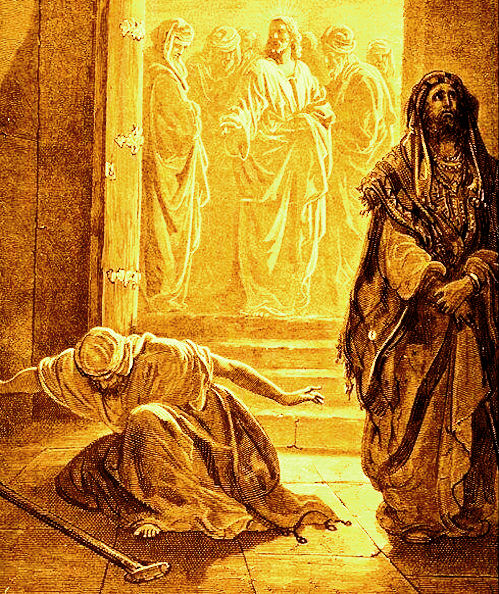
The Pharisee and the Tax Collector - by Dore.


ELEVENTH SUNDAY AFTER TRINITY


Text. Luke 18:9-14. And he spake also this parable unto certain who trusted in themselves that they were righteous, and set all others at nought: Two men went up into the temple to pray; the one a Pharisee, and the other a publican. The Pharisee stood and prayed thus with himself, God, I thank thee, that I am not as the rest of men, extortioners, unjust, adulterers, or even as this publican. I fast twice in the week; I give tithes of all that I get. But the publican, standing afar off, would not lift up so much as his eyes unto heaven, but smote his breast, saying, God, be thou merciful to me a sinner. I say unto you, This man went down to his house justified rather than the other: for every one that exalteth himself shall be humbled; but he that humbleth himself shall be exalted.


1. Here again we have a picture and an example of the divine judgment on saints and good people. Two extraordinary persons are presented to us in this Gospel; one thoroughly good and truly pious; and one hypocritically pious. But before we take up the example and consider the terrible sentence, we must first notice that Luke here makes the impression as though righteousness came by works. For Luke is most accustomed to do this, as when we at present preach that faith alone saves, he observes that people are led to desire only to believe, and to neglect the power and fruit of faith. This John also does in his Epistle and James, where they show that faith cannot exist without works.

Thus Luke, in the beginning of his introduction, would speak as follows: I see indeed that many have preached how faith alone saves, by which they have brought the people to strive for a fictitious faith; hence I must also speak of works by which they can be assured of their faith, and prove it to the people by their acts. Consequently it sounds as though Luke everywhere taught that righteousness came by works; as you have recently heard: Forgive, and ye shall be forgiven; and, make unto yourselves friends of the mammon of unrighteousness. And here it appears as though the publican had obtained his goodness by praying and smiting his breast. So this Gospel appears as though we should become good or pious by our works.

2. Now you have heard that a man, before he can do anything good, must by all means first be good. For the truth must always stand: “A good tree cannot bring forth evil fruit;” and again, “An evil tree cannot bring forth good fruit.” Thus a man must first be good, before he can do good. So he also firmly concludes that the publican smote his breast, which proves the conclusion, that he had been good.

3. This has taken place and has been written to the end that we should open our eyes and not judge the people according to their outward appearance. To do this in this instance it is necessary to examine the hearts of both, and not judge according to mere external works. For when the heart is good, the whole man is good. For if I judged the publican according to his works, my judgment would soon be false. For nothing appears in him but sin. Again, if I judge the hypocrite or Pharisee according to his works, I will also miss the mark. For he stands at the holy place, makes the best prayer imaginable, for he praises and thanks God with grand works, he fasts, gives the tenth of all his goods, harms no one; in short, everything, both outwardly and inwardly, appears well with him.

4. As he judges, all men judge; no one can condemn such an upright and virtuous life. Who dare say that fasting is not good; or that to praise God and give everyone what we owe them is evil? When I see a priest, monk, or nun with such apparent noble conduct, I regard them as pious. Who can say otherwise? Hence if I am to judge whether this one is good and the other evil, I must be able to look into the hearts of both. But I cannot see into the heart, and must make the proper distinction from their works, as Christ says: “By their fruits ye shall know them.” Matthew 7:20.

5. He speaks of the publican as though he must have previously heard a word from God that touched his heart so that he believed it and thus became pious, as St. Paul says, Romans 10:17: “So faith cometh by hearing, and hearing by the word of Christ.” When the Word falls into the heart, then man becomes pure and good. But the Evangelist does not indicate that he now first heard the Gospel here, but that he heard it somewhere, it matters not where. For he says: “God be merciful to me a sinner.” This knowledge is above the powers of reason. And yet it must previously have been known to him that God is merciful, gracious and friendly to all those who confess their sins, who call upon him and long for grace. As he heard that God is gracious by virtue of his very nature, to all those who humble themselves and seek comfort in him. But to preach thus is always the pure Gospel.

6. Hence the beginning of goodness or godliness is not in us, but in the Word of God. God must first let his Word sound in our hearts by which we learn to know and to believe him, and afterwards do good works. So we must believe from this that the publican had learned God’s Word. If not, it would certainly have been impossible for him to acknowledge himself to be a poor sinner, as this Gospel reports. Indeed, it has a different appearance here, because St. Luke seems to insist more strongly on external works and appearances than on faith, and lays the emphasis more on the outward character and conduct than on the root and on the faith of the heart within.

Nevertheless we must conclude that the publican had previously heard the Gospel. Otherwise his smiting his breast and his humble confession would not have occurred, had he not previously had faith in his heart.

7. This is also proper fruit, since it promotes God’s honor; as God desires nothing but the offering of praise, as Psalm 50:23, says: “Whoso offereth the sacrifice of thanksgiving glorifieth me, and to him that ordereth his way aright, will I show the salvation of God.” In this way the publican also proceeds, gives God the offering of thanksgiving and secures to himself the forgiveness of sin, and praises God, puts himself to shame and exalts the truth above himself.

Therefore we must praise and commend his work, because he gives God the highest honor and true worship. For he says: “God, be thou merciful to me a sinner.” As though he would say: I am a rogue, this I confess, as you yourself know. Here you see that he confesses the truth, and is willing that God should reprove and revile him; yea, he does this himself, and casts himself down the very lowest, and with God he again rises upward, gives glory to God that he is gracious, kind and merciful. But in himself he finds nothing but sin. Wherefore these are the true fruits of faith.

8. Thus we have learned from his fruits the publican’s faith. But how shall we understand what Christ says: “This man went down to his house justified,” as he had already been just through faith, before he smote his breast? He certainly must have been just before. Why then does Christ say here: “He went down to his house justified?” This is what I have often said, if faith be true, it will break forth and bear fruit. If the tree is green and good, it will not cease to blossom forth in leaves and fruit. It does this by nature. I need not first command it and say: Look here, tree, bear apples.

For if the tree is there and is good, the fruit will follow unbidden. If faith is present works must follow. If I confess that I am a sinner, it must follow that I will say: Alas God! I am a rogue, do thou cause me to be good. So this publican cares for nothing and speaks freely, though he puts himself to shame before all people, he does not care for that, as Psalm 116:10 says: “I believe, for I will speak. I was greatly afflicted,” and says: “God, be thou merciful to me a sinner!” As though he would say: I now see that I am lost, for I am a bad man, and acknowledge my sins. Unless I believe and hold to God’s mercy, and take the cup of the Savior and call upon God’s grace, I will be ruined.

9. Thus faith casts itself on God, and breaks forth and becomes certain through its works. When this takes place a person becomes known to me and to other people. For when I thus break forth I spare neither man nor devil, I cast myself down, and will have nothing to do with lofty affairs, and will regard myself as the poorest sinner on earth. This assures me of my faith. For this is what it says: “This man went down to his house justified.” Thus we attribute salvation as the principal thing to faith, and works as the witnesses of faith. They make one so certain that he concludes from the outward life that the faith is genuine.

10. We find this also in Abraham when he offers his son Isaac. Then God said: “For now I know that thou fearest God,” Genesis 22:12. Surely, if he had not feared God, he would not have offered his son; and by this we know the fruit to be thoroughly good. Let us now heartily apply this to ourselves.

11. This is why St. Luke and St. James have so much to say about works, so that one says: Yes, I will now believe, and then he goes and fabricates for himself a fictitious delusion, which hovers only on the lips as the foam on the water. No, no; faith is a living and an essential thing, which makes a new creature of man, changes his spirit and wholly and completely converts him. It goes to the foundation and there accomplishes a renewal of the entire man; so, if I have previously seen a sinner, I now see in his changed conduct, manner and life, that he believes. So high and great a thing is faith.

For this reason the Holy Spirit urges works, that they may be witnesses of faith. In those therefore in whom we cannot realize good works, we can immediately say and conclude: they heard of faith, but it did not sink into good soil. For if you continue in pride and lewdness, in greed and anger, and yet talk much of faith, St. Paul will come and say, 1 Corinthians 4:20, look here my dear sir, “the kingdom of God is not in word but in power.” It requires life and action, and is not brought about by mere talk.

12. Thus we err on both sides in saying, a person must only believe, then he will neglect to do good works and bring forth good fruits. Again, if you preach works, the people immediately comfort themselves and trust in works. Therefore we must walk upon the common path. Faith alone must make us good and save us. But to know whether faith is right and true, you must show it by your works. God cannot endure your dissembling, for this reason he has appointed you a sermon which praises works, which are only witnesses that you believe, and must be performed not thereby to merit anything, but they should be done freely and gratuitously toward our neighbor.

13. This must be practiced until it becomes a second nature with us. For thus God has also introduced works, as though he would say: if you believe, then you have the kingdom of heaven; and yet, in order that you may not deceive yourselves, do the works. To this the Lord refers in John 15:17, when he says to his disciples: “These things I command you, that ye may love one another.” And previous to this at the supper he said, John 13:34-35: “A new commandment I give unto you, that ye love one another: even as I have loved you, that ye also love one another.

By this shall all men know that ye are my disciples, if ye have love one to another.” And shortly before this he said, 5:5: “For I have given you an example, that ye also should do as I have done to you.”

As though he would say: Ye are my friends, but this the people will not know by your faith, but when you show the fruits of faith, and break forth in love, then they will know you. The fruits will not save you nor make you any friends, but they must show and prove that you are saved and are my friends. Therefore mark this well, that faith alone makes us good; but as faith lies concealed within me, and is a great life, a great treasure, therefore the works must come forth and bear witness of the faith, to praise God’s grace and condemn the works of men. You must cast your eyes to the earth and humiliate yourself before everyone, that you may also win your neighbor by your services; for this reason God lets you live, otherwise nothing would be better for you than to die and go to heaven. This you now also observe clearly in the good publican.

14. So you find two judgments: one according to faith, the other according to outward works. The foundation you have in that faith is concealed; this he feels, who believes; but that is not enough, it must express itself as you see above in the publican, who breaks forth in humility, so much as not to lift his eyes to heaven, smites on his breast and praises God, by which he helps me to say when my sins oppress me: Behold, the publican also was a sinner and said: “God, be thou merciful to me a sinner;” thus too, I will do.

By this will I also be strengthened so that when I see my sins I will think of his example, and with it comfort and strengthen myself, so that I can say:

Oh God, I see in the publican that thou art gracious to poor sinners. Faith the believer keeps for himself, but externally he communicates its fruits to other people.

15. The publican is on the right road and is twice justified; once through faith before God, and again by his works to me. Here he gives unto God his glory, and by faith repays him with praise. Also toward me he performs the duty of love, and puts words into my mouth and teaches me how to pray. Now he has paid all his debts toward God and man. So faith urges him to do; without however requiring anything from God as a reward of faith.

16. This is one character of the publican, who, according to faith which is the spiritual judgment, is acknowledged justified, while according to the flesh he is unprofitable. For the Pharisee passes and does not notice him, sees not his faith, lets him stand way back, and sees him alone in his sins, and knows not that God has been gracious to him, and converted and reformed him. So when a carnally minded man would condemn a sinner according to his sins, it is otherwise impossible, he must fail.

17. Let us now consider the fool, the Pharisee. Here are most beautiful works. In the first place he thanks God, fasts twice in the week, and all this to honor God, not St. Nicholas or St. Barnabas, he gives the tenth of all his goods, nor has he at any time committed adultery, has never done any one violence or robbed him of his goods. Thus he has conducted himself in an exemplary manner. This is a beautiful honest life, and excites our wonder and surprise. Truly, after the fashion of the world no one could find fault with him, yea, one must praise him. Yes, to be sure he does this himself.

18. But God is the first to come and say, that all the work of the Pharisee is blasphemy. God help us, what an awful sentence this is! Priests and nuns may well be terrified by it, and all their bones quake, as you scarcely ever find one of them as pious as this Pharisee. Would to God we could have many such hypocrites and Pharisees; for then they could be taught better things.

19. Well, what is the matter with the good man? Only this, he does not know his own heart. Here you see that we are our own greatest enemies, who close our eyes and hearts, and think we are as we feel. For if I should ask any such hypocrite: Sir, do you mean just what you say? he would take an oath, that it is not otherwise. But behold, see how deep God’s sword cuts, and pierces through all the recesses of the soul, Hebrews 4:12.

Here everything must go to ruin, or fall to the earth in humiliation, otherwise nothing can stand before God. Thus a pious woman must here fall down and kiss the vilest harlot’s feet, yea, her footprints.

20. Now let us better see and hear what the Lord says to this. There stands the publican and humbles himself, says nothing of fasting, nothing of his good works, nor of anything. Yet the Lord says that his sins are not so great as the sins of the hypocrite; even in spite of anyone now exalting himself above the lowest sinner. If I exalt myself a finger’s breadth above my neighbor, or the vilest sinner, then am I cast down. For the publican during his whole life did not do as many and as great sins as this Pharisee does here when he says: I thank thee God that I am not as other men are; and lies enough to burst all heaven. From him you hear no word like: “God, be thou merciful to me a sinner?’ God’s mercy, sympathy, patience and love are all forgotten by him, while God is nothing but pure mercy, and he who does not know this, thinks there is no God, as in Psalm 14:1: “The fool hath said in his heart, There is no God.” So it is with an unbeliever who does not know himself. Therefore I say one thing more, if he had committed the vilest sin and deflowered virgins, it would not have been as bad as when he says: “I thank thee God, that I am not as the rest of men, extortioners, unjust, adulterers, or even as this publican.” Yes, yes, do I hear you have no need of God and despise his goodness, mercy, love and everything that God is? Behold, these are thy sins. Hence the public gross sins that break out are insignificant; but unbelief which is in the heart and we cannot see, this is the real sin in which monks and priests strut forth; these lost and corrupt ones are sunk head and ears in this sin, and pretend to be entirely free from it.

21. Further, since he has now blasphemed God and lied to him, because he is unwilling to confess his sins, he falls further and sins against love to his neighbor, in that he says: “Even as this publican.” He could not bear his presence without blaming and condemning him. Here all commandments are abolished and transgressed, for he denies God and does his neighbor no good. In this way he goes to ruin, because he has not obeyed a letter of the law. For if he had said: Oh God, we are all sinners, this poor sinner is also like myself and all the rest: and had he joined the congregation and said:

Oh God, be merciful unto us! then he would have fulfilled God’s commandment, namely, the first, in that he gave God the honor and the praise, and had he afterwards said: Oh God, I see this one is a sinner, in the jaws of the devil; dear Lord, help him! and had he thus brought him to God and prayed to God for him, he would then also have obeyed the other commandment of Christian love as Paul says, Galatians 6:2, and teaches: “Bear ye one another’s burdens, and so fulfill the law of Christ.”

22. Now he comes and praises himself that he is just. He has a poisonous, wicked heart, who praises himself most gloriously on account of his pretended good works, how he fasted and gave the tenth of all he had.

Hence he is so full of hatred to his neighbor, if God allowed him to judge, he would plunge the poor publican down into the deepest hell. Behold, is not this a wicked heart and terrible to hear, that I would all men should go to ruin, if only I be praised? Yet all this is so finely decorated and adorned by external conduct, that no one can censure it. Here we see how we are to know the tree from its fruits. For when I view his heart with spiritual eyes, I recognize it is full of blasphemy and hatred to his neighbor. From these fruits I know that the tree is evil. For works would not be evil in themselves, but the evil root in the heart makes them evil. This is set before us that we may beware and guard ourselves against it.

23. Again, on the other hand, examine the heart also of the publican. Here we find that he believes. Hence his works are good and of service to the whole world, for he teaches that a man should humble himself and praise God. On the contrary the other with his works makes saints who are puffed up and proud of heart; for he is entrapped in sins, his soul is condemned, and is fast in the jaws of the devil, and the high minded knave steps forth and praises himself, because his neighbor over there is a sinner. To sum up all, he misleads the whole world with his hypocritical life. Thus we must judge the fruits with spiritual eyes as we have now judged these two; then we will know the tree whether it be good or evil.

24. Now, where did I obtain this judgment? Here: God has given me his law like a mirror, in which I see what is good and evil. It says: Love the Lord thy God with all thy heart, and with all thy soul, and with all thy mind, and thy neighbor as thyself,” Deuteronomy 6:5, Matthew 22:37. ‘Now the works of the publican praise God and benefit the whole world, because they teach us to know, and show us the way of God our Savior. Therefore they are good because they praise God and benefit our neighbor. On the other hand, the hypocrite struts forth and blasphemes God, and with his corrupt life misleads the whole world.

25. I should also speak of the great and shameful vice of slander, when one belies another, exposes him and speaks evil of him; while we are all alike after all, and no one has a reason to exalt himself above another. But that the government judges and punishes crime, it does by virtue of its office.

For it wields the sword to make the transgressor fear. For God will not tolerate sin, and desires that the wicked have no rest, as the prophet Isaiah says, Isaiah48:22: “There is no peace, saith Jehovah, to the wicked.”

Therefore where God does not internally disturb sinners, he will wipe out sin by fire and water, that they can have no peace from without. When such sins are to be punished, the officers, judges and people should think thus:

Oh God! although I myself am a poor sinner and a much greater one than this person, and a much greater thief and adulterer than this one; still I will execute my office and leave him no rest in his sins and belabor him; for this is thy divine command. Concerning this I have said more on other occasions, especially in my book on the Civil Government, which you can read yourself; for the present let this suffice, and pray God for grace.

Thursday, April 13, 2023

Quotation - From Luther's Sermon


Link - Luther's Sermon on the Unbelief of Thomas - The First Sunday after Easter 


And yet it is such horrible and dreadful wrath that all creatures are terrified by it. Therefore it is certainly true that no stone, steel, adamant, yea, nothing on earth is as hard as the impenitent heart of man.

7. On the other hand, if the heart loses courage and is terrified it is softer than water and oil, so that, as Scripture says, it is frightened at a rustling leaf. And when such a person is alone in a room and hears a little cracking of a rafter or a beam, he thinks thunder and lightning are striking him and he is in such anxiety and fear (as I have often seen), that no one can comfort or strengthen him, and all the preachers and all consoling proverbs are too few to calm him. So there is no moderation with the human heart; it is either entirely too hard like wood and stone, that it inquires about neither God nor Satan, or, on the other hand, it is entirely too timid, fickle and despondent.

8. Thus the apostles are here too scared and terror-stricken by the scandal they saw in their Lord being so ignominiously mocked, spit upon, scourged, pierced and finally crucified, so that they no longer had a heart in their bodies, who before while they had Christ among them were so bold and courageous, that James and John ventured to bid fire to come down from heaven and consume the Samaritans who would not receive Christ, Luke 9:54. They also knew how gloriously to boast that the devils were in the name of Jesus subject unto them; and Thomas admonished the others and said: “Let us go that we may die with him;” and Peter, more impetuous than the others, smites with the sword among the crowd when they wished to seize and take Christ captive. But now they lie prostrate in great fear and terror, locked up, and will let no one come to them. For this reason they were also terrified at the Lord when he comes and greets them, and they still think (which is indeed a sign that they are completely overcome by fear and despair) they see a spirit or a ghost. So soon they had forgotten all the miracles, signs and words they had seen and heard from him, that the Lord had enough to do during the forty days after his resurrection before he separated from them, in his appearances and revelations in various ways, now to the women, then to the disciples, both individually and collectively, besides eating and drinking with them; all for the purpose that they might be assured that he is risen. Yet it is so hard for this truth to enter their hearts.


Saturday, December 25, 2021

Luther's Gospel Sermon on St. Stephen's Day. December 26.


ST. STEPHEN’S DAY.

TEXT:

Matthew 23:34-39. Therefore, behold, I send unto you prophets, and wise men, and scribes: some of them shall ye kill and crucify; and some of them shall ye scourge in your synagogues, and persecute from city to city: that upon you may come all the righteous blood shed on the earth, from the blood of Abel the righteous unto the blood of Zachariah son of Barachiah, whom ye slew between the sanctuary and the altar. Verily I say unto you, All these things shall come upon this generation.

O Jerusalem, Jerusalem, that killeth the prophets, and stoneth them that are sent unto her! how often would I have gathered thy children together, even as a hen gathereth her chickens under her wings, and ye would not! Behold, your house is left unto you desolate. For I say unto you, ye ,hall not see me henceforth, till ye shall say, Blessed is he that cometh in the name of the Lord.

CONTENTS:

THE TEACHING CONCERNING REASON AND OUR NATURAL LIGHT; FOUR QUESTIONS; AND THE TEACHING CONCERNING FAITH.

I. THE TEACHING CONCERNING REASON AND OUR NATURAL LIGHT.


1. This Gospel is severe against the persecutors of faith. Yet, the severer it is against them, the more comforting it is to the believers who are persecuted. It teaches how obstinate the natural light, our own fancy and reason is; for when it falls into works and commands, it no longer listens to any one, as is set forth in the following Gospel. But the work and fancy of reason claim to be in the right, and it does not matter how much is preached, how many prophets God sends to her; all must be persecuted and put to death, that oppose the great red murderess, as she is pictured in Revelation of St. John 17:4. Here she is called Babylon the Great, the Mother of Harlots, arrayed in purple and scarlet, sitting upon a beast, that was also red, and having in her hand a golden cup full of the abominations and the unclean things of her fornications, that is, the teachings of men, by which she leads pure believing souls from faith and puts them to shame and strangles every one that tries to restrain her.

2. Such stiff-necked murderous obstinacy is set forth in this Gospel; first, in that God tries to convert her in every way possible, sends to her all kinds of preachers, who are mentioned by three names; prophets, wise men, and scribes.

3. The prophets are those who preach, being moved only by the Holy Spirit, who have not taken their sermon from the Scriptures or from human reason, as were Moses and Amos. And these men are the highest and the best, they are wise, and they make others wise, write Scriptures, and explain them. Such were nearly all the fathers before and at the time of Moses, and also many after him, especially the apostles, who were laymen and common uneducated people, as Luke says in Acts 4:13: They were unlearned in the Scriptures.

4. The wise men are those who have received their message not only from God but also through the Scriptures and of men, and they are the disciples and followers of the prophets, but they themselves also preach and teach with their mouth and in living words. Such an one was Aaron, who spoke everything that Moses told him as we read in Exodus 4:15-16, that God says to Moses: “Thou shalt put my words in his mouth; and he shall be thy spokesman unto the people, and thou shall be to him as God.” So also all the priests are to be wise men, as we read in the eleventh chapter of Zechariah.

5. The writers or scribes are those who teach by means of writings and books, when they cannot teach in person or by the word of their mouth.

Such men were also the apostles, and before them the Evangelists and their followers, and also the holy fathers; however, they do not write about or. treat of their own imaginations, but of God’s Word, which they have learned from the wise men and out of the Scriptures. These now are the three ways by which the truth may be revealed: by writing, by word, by thought; by the writing in books, by the words of their mouth, by thoughts of the heart. One can not in any other way grasp instruction save with the heart, the mouth, and writings.

6. Now all this is of no avail with obstinate reason; she listens neither to words, writings, nor to enlightenment, with which God tries to convert her.

The writings and books she suppresses and burns as the King Jehudi did with the books of Jeremiah, Jeremiah 36:23. Reason forbids, silences and condemns words; enlightenment she banishes and slays together with the prophets. And it is remarkable that no prophet has been slain, banished, or persecuted, because he reproved the coarse sins of the people except John the Baptist, whom Herodias permitted to be put to death, because he had reproved the sin of her adultery. Such a great man had to die for the most disgraceful reason. Still the Jews also did not hate him because of this one fact, but because he had reproved their sins also, and therefore they said that he had a devil.

7. In like manner there has ever been numberless disputes about true and false worship. Abel was slain by Cain in order that his worship might not be acknowledged by God. In like manner have all the prophets, the wise and the educated, reproved that worship of God as idolatry, which springs from reason and human works, being without any faith; natural reason came and said that this worship was done for the honor of God and was right. Therefore the prophets had to die as such who prohibited and reproved the service and honor of God and good works; as Christ says in John 16:2, “Yea, the hour cometh, that whosoever killeth you shall think that he offereth service unto God.” In like manner all the idolatry of the Old Testament was started by them not because they wished to bow down to wood and stones, but because they thereby wished to worship the true God. Since, however, God had forbidden this, and since this had been a creation of their own fancy, independent of faith, it was certainly of Satan and not of God. Therefore the prophet said that this was not a service of God but one of idols. This, however, they would not suffer nor listen to, and so, according to God’s command, the prophets did not dare to be silent, hence they therefore had to die, be banished, and persecuted.

8. Therefore the whole dispute consists in this, that the false saints quarrelled with the true saints about the worship of God and good works, the former saying this is divine worship; the latter saying no, it is idolatry and unbelief. Thus it has been from the beginning, and it will also continue unto the end.

9. This same thing we see even in our day; the Papists themselves have devised good works and divine worship with their outward deeds and laws, all of which, however, are faithless things, founded only upon works and without God’s command, mere human prattle. So we say, they do not serve God, but themselves and Satan, as is the case with all idolatry; and they only mislead the people from their Christian faith and common brother love; but they will not suffer us to say that, and thus begins the misery that reigns now. Both agree that they are to serve God and do good works; but as to the definition, what is the service of God and good works, they will never agree. For these say, faith is nothing, nature with her works is good and right. Moreover, they also agreed that the open coarse sins, as murder, adultery, and robbery are not right; but in the principal works that pertain to divine worship, there they separate as far from one another as winter is from summer. The first hold to God and his mercy, and fear him; the others run to wood and stones, food and clothing, days and seasons and wish to win the favor of God by building, by bequests, by fastings, by their blaring voices and by their shaven heads. They fear nothing, are impudent and full of every kind of presumption. Oh! what a holy, wise, learned people, for whom God himself is neither sufficiently holy, wise nor learned, with all his prophets, wise men and scribes.

II. FOUR QUESTIONS.

10. There are several questions which arise in this Gospel that we must examine. The first is, Why does Christ say that all the righteous blood from Abel on shall come upon the Jews, since they have not shed it all ?

11. The answer is, that the words of Christ are directed to the whole multitude and to the whole generation of all those who from the beginning on have persecuted the prophets. This is proved by the fact that he addressed not only those of his own time but entire Jerusalem: “O Jerusalem, Jerusalem, that killeth the prophets, and stoneth them that are sent unto her! how often would I have gathered thy children together,” etc.

This applies not only to the present, but also to the previous inhabitants of Jerusalem. Likewise, when he says, ye slew Zachariah between the sanctuary and the altar, yet, this Zachariah was slain by the King Joash ( 2 Chronicles 24:21) over 800 years before Christ’s birth, and still he says, you have slain him. Likewise, they have also put to death Abel and will put to death the prophets and the wise men. As if he would say they are one people, one class, one generation; as the fathers so also the children. For the stiffneckedness that contended against God and his prophets in the time of the fathers, also contends in their children; the mouse is like its mother. And when the Lord says that all the righteous blood shall come upon them, he means to say as much as, the people must shed all righteous blood, it is their nature to do so, they cannot do otherwise. All blood that is shed, they shed, therefore will all blood come upon them.

12. But why does he cite only these two, Abel and Zachariah? Zachariah was not the last whose blood was shed, but after him Isaiah, Jeremiah, Ezekiel, Uriah, and Micah, and nearly all those who received a divine call in the Scriptures. And indeed, Zachariah is the first among the prophets whose martyrdom is mentioned by name in the Scriptures. However, Christ does not speak here only of the prophets, but of the blood of all the righteous, of whom there were many under King Saul; likewise many prophets, whose names are not mentioned, were put to death under King Ahab.

18. In answer to this question I can say nothing except that Christ here holds to the usage of Scripture and places before us an example how we ought not to speak, hold, or mention what is not founded in the Scriptures.

For although Isaiah and other prophets have been put to death, yet we find no mention in the Scriptures of the manner of death of any one after Zachariah. And thus, though he was not the last whose blood was shed, yet he is the last who is described by name how he preached in his days and suffered death. Thus Christ cites the first and the last righteous person, mentioned in the Scriptures, and thereby other righteous blood that was not mentioned, yet was shed before and after them. It has indeed been written of Uriah the prophet in Jeremiah 26:23, that he was slain by King Jehoiakim long after Zachariah, but this is told by others as a story which occured long ago. But at his time the Scriptures say nothing about him, they do not even mention that he ever lived, although they describe the time and history of the same king in the history of 2 Chronicles 36:4ff; 2 Kings 24:1ff. Therefore the Lord does not speak of him.

14. It is also asked: Why does Christ mention the son of Barachiah, since the Scriptures call him the son of Jehoiada; for thus the text reads in Chronicles 24:20-21, “And the Spirit of God came upon Zachariah the son of Jehoiada the priest; and he stood above the people, and said unto them.

Thus saith God, Why transgress ye the commandments of Jehovah, so that ye cannot prosper? because ye have forsaken Jehovah, he hath also forsaken you, And they conspired against him, and stoned him with stones at the commandment of the king in the court of the house of Jehovah.”

When he died he said, “Jehovah, look upon it, and require it.” He also was killed, because he reproved the worship they had established.

15. St. Jerome thinks he was called the son of Zachariah for spiritual reasons, because Zachariah means in Latin benedictus, the blessed. But others speak more lightly and say, that his father Jehoiada received the additional name of Barachiah because he did great good to the King and the people. Therefore they called him the blessed and after his death, out of gratitude, put his son to death; as is the way of the world according to the saying: Whoever helps another off the gallows him the other will help on again. Thus it happened to the Son of God. After God had done nothing but good for the whole world, they crucified his dear beloved Son, as is typified in this story.

16. Finally it is asked: No one can withstand God’s will, why then does he say: “How often would I have gathered thy children together, and ye would not?” This passage has been interpreted in various ways. Some have founded it upon the free will and its ability, so that it really appears that not free will but obstinate will is reproved, and that it is base liberty that is only contrary to God, and is so severely condemned and reproved.

17. St. Augustine forces the words to apply to reason, as if the Lord means to say very much, thus: “As many of thy children as I have gathered I have gathered against thy will. But such an interpretation of this simple passage is too forced. It could be much more easily understood, if one said: Christ speaks here as a man, who has taken all human care upon himself. He did very much as to his human nature that did not become his divinity; for example, that he had to eat, drink, sleep, walk, weep, suffer, and die. So one could say here that he spoke after the manner of our human nature and its emotions: I would, but ye would not.

18. For, as I have often said, we must give special attention to the words of Christ, some of which refer to his divine, others only to his human nature.

But here he introduces himself to us as God, since he says, “I send unto you prophets” etc.; for the sending of prophets is a work that belongs to God alone. And Luke 11:49 says he spoke thus: “Therefore also said the wisdom of God, I will send unto them prophets” etc. Moreover, his words read as if he not only wished to gather his children at the present time, but had also often wished to do so in the past, so that this is to be understood as referring to the divine will. Therefore we shall answer thus:

These words are to be understood in the plainest and simplest manner as referring to the divine will, according to the usage of Scripture, which speaks of God as of a man for the sake of the simple minded; as we read in Genesis 6:6 that it repented Jehovah that he had made man on the earth, and yet there is no repentance in God. Also, that he was angry, yet in God there is no human anger. Likewise Genesis 11:5, that he came down from heaven and saw the building of the tower at Babylon, yet he remains ever sitting on his throne. And in Psalm 59:5-6, the prophet often says: “Awake, why sleepest thou so long?” Again: Arise, come to me, and similar passages; and yet he sleeps not, lies not down, is not far away.

Again, Psalm 1:6: “Jehovah knoweth not the way of the unrighteous,” yet he knows all things. All these passages are uttered in harmony with our feelings and fancy, and not according to the real state of the divine nature.

Therefore they are not to be perverted by lofty speculation as utterances of the divine nature; but should be understood as spoken to common people here upon earth according to our human understanding. For we are to feel that he does just as the words read; and this is a beautiful and comforting way to think of God, one which is neither terrifying nor difficult to understand. Thus also: “How often would I,” is also to be understood as meaning that he acted so that no one could think or feel otherwise than that he would gladly gather them, did gather them, as a man might do who eagerly wished to do such a thing. Therefore dismiss high things and remain by the milk and simple meaning of the Scriptures III. THE TEACHING CONCERNING FAITH.

19. In order, however, that we may all take our doctrine out of the Gospel, the Lord has given us here a lovely picture and parable of what he does for the sake of faith and believers so that I do not know of a more beautiful passage in all the Scriptures. He spoke in his anger and indignation very severe words to the Jews in this chapter, and pronounced his terrible woe upon their unbelief; therefore he does, as angry men are accustomed to do, and speaks to those ungrateful of his good acts and good will in the strongest terms possible; namely thus: I would gladly have imparted the heart in my body to them etc. Thus also the Lord here, in the most hearty way possible, emphasizes his good will and favor to the Jews, and says he would have gladly been their mother hen had they wished to be his little chickens.

20. Oh man! note well these words and this parable, how he pours it forth with great earnestness and with his whole soul. In this picture you will see, how you are to conduct your self towards Christ and to what end he is of benefit to you, how you should make use of him and enjoy him. Behold the hen and her chickens, and there you see Christ and yourself painted and portrayed better than any painter can portray them.

21. In the first place, it is certain that our souls are the chickens; and Satan and wicked spirits are the buzzards in the air; with only this exception that we are not as wise as the chickens to flee under our hen. The spirits of Satan are more subtle to rob us of our souls than the buzzards are to steal the chickens. Now it was said before in an Epistle how it is not sufficient that we are pious, do good works, and live in grace. For our righteousness cannot stand before God’s eyes and judgment, much less our unrighteousness. Therefore I have said: Faith, if it is true faith, is of such a nature that it does not rely upon itself nor upon the faith; but holds to Christ, and takes refuge under his righteousness; and he lets this righteousness be its shield and protection just like the little chicken never trusts in its own life and efforts, but takes refuge under the body and wings of the hen.

22. It is not sufficient for one who is to stand before the judgment of God, to say, I believe and have grace; for all that is within him is not able to protect him; but he proffers to this judgment Christ’s own righteousness which he permits to plead for him at the judgment seat of God. This stands in all honor before him forever, as <19B103> Psalm 111:3, and <19B203> Psalm 112:3, say: “His righteousness endureth forever.” Under this righteousness he creeps, crouches, and stoops, he confides in Christ’s righteousness and believes without the least doubt that it will sustain him and so it really comes to pass that he will be sustained by the same faith, not for his sake nor for the sake of such faith, but for the sake of Christ and his righteousness under which he takes refuge. Moreover faith that does not this, is not true faith. See that is the meaning of the Scriptures when they say in Psalm 91:1-7, “He that dwelleth in the secret place of the Most High shall abide under the shadow of the Almighty. I will say of Jehovah, he is my refuge and my fortress; my God, in whom I trust. For he will deliver thee from the snare of the fowler, and from the deadly pestilence.

He will cover thee with his pinions, and under his wings shalt thou take refuge; his truth is a shield and a buckler. Thou shalt not be afraid for the terror by night, nor for the arrow that flieth by day; for the pestilence that walketh in darkness, nor for the destruction that wasteth at noonday. A thousand shall fall at thy side, and ten thousand at thy right hand; but it shall not come nigh thee.”

23. Behold all this is spoken concerning faith in Christ, how it alone will stand and protect us from all danger and ruin, false doctrine, bodily and spiritual temptations of Satan, on the right hand and on the left, so that all others must fall and perish, because they do not take refuge under the wing and shoulders of Christ and there find shelter and anchor their trust. In like manner Malachi 4:2, says: “But unto you that fear my name shall the sun of righteousness arise with healing in its wings;” therefore St. Paul calls him in Romans 13:25, our propitiation, the throne of grace, and teaches everywhere how we must be sustained through him and under him. If then believers and saints are in need of such a great shield, what will become of those who go ahead with their own free will and their own good works, independent of Christ? Oh! we must remain in Christ, upon Christ and under Christ, never stray from our mother hen, or all is lost. St. Peter says in his first Epistle 4:8: “The righteous is scarcely saved;” so hard it is to abide under this hen. For many different temptations, temporal and spiritual, tear us from her; as the Psalm above points out.

24. Now notice how the natural clucking hen acts; hardly any other creature is so anxious about her young. She changes her natural voice and takes a pitiable and complaining voice; she seeks, scratches, and calls her little chickens; when she finds anything, she does not eat it herself, she leaves it for her little ones; with all earnestness she battles and cries against the buzzard, and spreads her wings out so willingly and lets her chicks crawl under and upon her, and gladly suffers them to .stay there. This is indeed a lovely picture. So it is also with Christ. He has changed his voice to a pitiable tone, has sighed for us and preached repentance, pointed out to everyone their sins and misery, he scratches in the Scriptures and calls us unto them and permits us to eat; he spreads his wings with all his righteousness, merit and grace over us, and takes us so lovingly under his protection, warms us with his own natural heat, that is, with his Holy Spirit, who alone comes through him, and fights for us against the devil in the air.

25. Where and how does he do this? Without doubt he does it not bodily, but spiritually. His two wings are the two Testaments of the holy Scriptures; they spread over us his righteousness and bring us under his protection. This takes place in that the Scriptures teach this and nothing else, how Christ is such a mother hen, how we are to be sustained in faith under him and through his righteousness. Therefore the Psalm mentioned above, explains the wings and shoulders, and says; “his faithfulness or truth”, that is, the Scriptures embraced by faith “are a shield and a buckler” against all fear and danger. For we must lay hold of Christ in his Word and in the preaching of it and cleave to the same with a firm faith that he is just as is spoken now of him; then we are certainly in him, under his wings and truth, and shall be also well sustained under him 26. This Gospel therefore is also his wings or truth as well as all other Gospels; for they all teach Christ in this manner, yet in some places clearer than in others. Heretofore he was called a light and life; also a Lord and helper, now he is called a mother hen, and the emphasis is continually laid upon faith. Thus his body is himself, or the Christian church; his warmth, his grace and the Holy Spirit.

27. Behold, the church is the most loving hen, who is always anxious to gather us under her protection; she spreads her wings out and calls, that is, she preaches and lets both Testaments be preached, sends out prophets, wise men, and scribes to Jerusalem, yea into all the world. But what happens? We will not be her chickens; above all, the proud saints, who contended against her especially with their good works, who had no desire to know anything about faith, that it is so greatly needed and so blessed; and who neither know anything of their danger nor admit their doings to be unrighteous; yea, they themselves therefore become buzzards and swine, they devour and persecute the chickens along with their mother, tear their wings and body, slay the prophets, and stone those who are sent unto them. But what will be their reward? Listen, terrible things: “Behold, your house is left unto you desolate.”

28. Oh! a terrible visitation! which is also illustrated in the instance of the Jews. They killed the prophets so long that God sent them no more; he suffered them to be without any preaching, without any prophets 1,500 years, he took his Word from them and his wings he drew to himself. And thus their house is left desolate and no one builds up their souls, God no longer dwells among them. It has happened to them as they wished; as <19A917> Psalm 109:17 says concerning them: “Yea, he loved cursing, and it came unto him; and he delighted not in blessing, and it was far from him.”

Here all the righteous blood shed upon the earth is come upon them, and this Gospel is fulfilled in them.

29. In like manner also Isaiah 5:5-6, speaks of them: “And now I will tell you what I will do to my vineyard: I will take away the hedge thereof, and it shall be eaten up; I will break the wall thereof, and it shall be trodden down: and I will lay it waste; it shall not be pruned nor hoed; but there shall come up briers and thorns: I will also command the clouds that they rain no rain upon it.” Terrible words! What can it mean that no rain shall come upon them, except that they should not hear the Gospel and learn of faith? They shall be neither pruned nor cultivated. What can this mean, except that no one shall punish them in their error and make manifest their transgressions? Therefore the vineyard is left to the doctrines of men, these tear and trample it under foot so that it must remain desolate, brings forth nothing but briars and thorns, that is, workrighteous people, who are without faith. They bear no fruit of the Spirit, but they grow and are prepared only for eternal fire.

30. However, all this we Gentiles may also take well to heart. We have also persecuted our mother hen and have not continued in faith. Therefore it has also happened to us that God has left our house lie desolate and our vineyard is forsaken. There is no longer any rain in all the world, the Gospel and faith are put to silence; here there is neither pruning nor grubbing; no one preaches against false works and the doctrines of men, and prunes off such unnecessary things; but he permits us to be torn and trodden under foot by the pope, bishops, priests and monks of whom the whole world is full, full, full; and yet they do no more than trample down and tear to pieces the vineyard. One who teaches this, another that, one treads down this place and another that; everyone wishes to establish his own sect, his own order, his own calling, his own doctrine, his own point, his own works. By these we are so trodden under foot that there is no longer any knowledge of faith, no Christian life, no love, no fruit of the Spirit; but mere firefuel, briars, and thorns, that is dissemblers, who by virtue of their vigils, masses, endowments, bells, churches, psalms, rosaries, saint-worship, celebrations, hoods, shaven-heads, clothing, fastings, pilgrimages and numberless other foolish works, presume to be Christians.

31. O, Lord God, we are too greatly torn to atoms, too sorely crushed; O, Christ, our Lord, we poor miserable people are too desert-like and too forsaken in these last days of thy wrath. Our shepherds are wolves, our watchmen traitors, our protectors enemies, our fathers murderers, and our teachers mislead us, Oh! Oh! Oh! When, when, when will thy severe wrath have an end ?

32. Finally comfort is spoken here to the Jews, when the Evangelist adds: “Verily I say unto you, Ye shall not see me henceforth, till ye shall say, Blessed is he that cometh in the name of the Lord”. Christ spake these words on Tuesday, after Palm Sunday, and they form the conclusion and the last words of his preaching upon earth; hence they are not yet fulfilled but they must be fulfilled. True they did once receive him on Palm Sunday, but these words were not fulfilled on that occasion. “Ye shall not see me henceforth” is not to be understood in the sense that they never saw him afterwards in the body, because they did, in that they afterwards crucified him. He means, they shall not see him again as a preacher and as Christ, to which end he was sent; his office and he in his office were never seen again by them. In this he gave them his last, his farewell, sermon, and his office, for which he came, was now closed.

33. Thus it is certain, that the Jews must yet say to Christ, “Blessed is he that cometh in the name of the Lord.” This very truth Moses proclaimed in Deuteronomy 4:30-31: “In the latter days thou shalt return to Jehovah thy God, and hearken unto his voice; for Jehovah thy God is a merciful God; he will not fail thee, neither destroy thee, nor forget the covenant of thy fathers which he sware unto them.” It was also preached in Hosea 3:4-5: “The children of Israel shall abide many days without king, and without prince, and without sacrifice, and without pillar, and without ephod or teraphim: afterward shall the children of Israel return, and seek Jehovah their God, and David their king, and shall come with fear unto Jehovah and to his goodness in the latter days.” Likewise Azariah declared this truth in 2 Chronicles 15:2-5 thus: “If ye forsake Jehovah, he will forsake you. Now for a long season Israel was without the true God, and without a teaching priest, and without law: but when in their distress they turned unto Jehovah, the God of Israel, and sought him, he was found of them.” This passage cannot be understood as referring to the Jews of the present time: They were never before without princes, without prophets, without priests, and without teachers and the law, St. Paul in Romans 11:25-26 agrees with this thought and says: “A hardening in part hath befallen Israel until the fullness of the Gentiles be come in; and so all Israel shall be saved.” God grant that this time may be near at hand, as we hope it is. Amen.

Sunday, December 12, 2021

Luther's Epistle Sermon for the the Third Sunday in Advent

Norma Boeckler


THIRD SUNDAY IN ADVENT


EPISTLE TEXT: 1 CORINTHIANS 4:1-5. 1 Let a man so account of us, as of ministers of Christ, and stewards of the mysteries of God. 2 Here, moreover, it is required in stewards, that a man be found faithful. 3 But with me it is a very small thing that I should be judged of you, or of man’s judgment; yea, I judge not mine own self. 4 For I know nothing against myself; yet am I not hereby justified: but he that judgeth me is the Lord. 5 Wherefore judge nothing before the time, until the Lord come, who will both bring to light the hidden things of darkness, and make manifest the counsels of the hearts; and then shall each man have his praise from God.

STEWARDS OF THE MYSTERIES OF GOD.

1. This epistle selection illustrates the Gospel lesson for the first Sunday in Advent, wherein we learned the disciples did not themselves ride on the colt, but led it to Christ and set him thereon. That is what the apostle does here. The Corinthians had come to divisions among themselves and to boasting of certain apostles as their leaders. With one party it was Peter, with another Paul, and with yet another Apollos. Each one exalted the apostle by whom he was baptized or was taught, or the one he regarded most eminent. Now comes Paul and interposes, permitting no one to boast of any apostle, and teaching them to laud Christ alone. He tells them it matters not by whom they were baptized and taught, but it is of the utmost importance that they all hold to Christ together and own allegiance to him alone. Paul beautifully teaches how the apostles are to be regarded. The whole passage is a fierce thrust at Popery and the clerical government, as we shall see. “Let a man so account of us, as of the ministers of Christ, and stewards of the mysteries of God.”

2. The reference is to all apostles and all heirs to the apostolic chair, whether Peter, Paul or any other. Let us, then, be very careful how we regard the apostles and bishops; we must attach neither too much nor yet too little importance to them. Not without reason did Paul ¾ the Holy Spirit, in fact ¾ make this restriction; and without doubt we are under obligation to follow it. The same limit here made concerning apostles applies to bishops. It designates the character of their office and the extent of their power. So when we see a bishop assuming more than this text gives him warrant for, we may safely regard him, as a wolf, and an apostle of the devil, and avoid him as such. Unquestionably he must be Antichrist who in ecclesiastical government exceeds the authority here prescribed.

3. First, Paul warns us against receiving apostles or bishops as anything but “ministers of Christ;” nor should they desire to be regarded otherwise. But the term “minister of Christ” must not in this connection be understood as one who serves God, in the present acceptation of the phrase ¾ praying, fasting, attendance upon Church services, and all the things styled “divine service” by ecclesiastical rites, institutions and cloisters, and by the whole clerical order. Theirs are merely humanly devised works and words, whereby Paul’s teaching here and elsewhere is wholly obscured, even to the extent of making it impossible to know what he means by the “ministry of Christ.” He has reference to the ministry that is an office. All Christians serve God but all are not in office. In Romans 11:13, also, he terms his office a ministry: “Inasmuch as I am an apostle of Gentiles, I glorify my ministry.” And in the epistle selection preceding this ( Romans 15:8) he says: “I say that Christ hath been made a minister of the circumcision.”

Again ( 2 Corinthians 3:6): “Who also made us sufficient as ministers of a new convenant; not of the letter, but of the spirit.”

4. What language is forcible enough to serve me in the attempt to eradicate from the hearts of all Christians that error so deeply impressed of Popery wherein they interpret the ministry of Christ ¾ or the service of God ¾ in no other light than as their own works, performed to Christ without any authority to do them? Mark you, beloved, to serve Christ, or to serve God, is defined by Paul himself as to fulfill a Christ-ordained office, the office of preaching. This office is a service or ministry proceeding from Christ to us, and not from us to Christ. Note this carefully; it is important. Otherwise you cannot understand the design of the Pauline words, “ministry, ministration, to minister.” So he always has it. Seldom does he speak of the service or ministry rendered primarily above them to God; it is usually of the ministry beneath them, to men. Christ, too, in the Gospel bids the apostles to be submissive and servants of others. Luke 22:26.

To make himself clearly understood in this matter of service, or ministry, Paul carefully adds to the word “ministers” the explanatory one “stewards,” which can be understood in no other way than as referring to the office of the ministry.

5. He terms his office “service or ministry of Christ” and himself “minister of Christ,” because he was ordained of God to the office of preaching. So all apostles and bishops are ministers of Christ; that is preachers, messengers, officers of Christ, sent to the people with his message. The meaning of the verse, then, is: “Let every individual take heed not to institute another leader, to set up another Lord, to constitute another Christ. Rather be unanimously loyal to the one and only Christ. For we apostles are not your lords, nor your masters; we are not your leaders. We do not preach our own interests, nor teach our own doctrines. We do not seek to have you obey us, or give us allegiance and accept our doctrine.

No, indeed. We are messengers and ministers of him who is your Master, your Lord and Leader. We preach his Word, enlist men to follow his commandments, and lead only into obedience. And in this light should you regard us, expecting of us nothing else than to bring the message. Though we are other persons than Christ, yet you do not receive through us another doctrine than his; another word, another government, nor another authority than his. He who so receives and regards us, holds the right attitude toward us, and receives, not us, but Christ, whom alone we preach. But he who does not so regard us, does us injustice, discards Christ, the one true Leader, sets up another in his stead and makes gods of us.”

6. In Judges 8:22-23 we read that the children of Israel said to Gideon: “Rule thou over us, both thou, and thy son, and thy son’s son also,” to which Gideon answered, “I will not rule over you, neither shall my son rule over you: Jehovah shall rule over you.” And in 1 Samuel 8:7 we are told that when the children of Israel desired a king of Samuel, God said: “They have not rejected thee, but they have rejected me, that I should not be king over them.” Thus we see God cannot permit any authority to usurp his own among his people.

7. But perhaps you ask: “Where was the sin of the people when they desired Gideon to rule over them? Had not God given Gideon leadership in the contest, and did he not later provide many holy kings expressly for them?” I reply it was not a sin for the children of Israel to have sovereigns; it was not contrary to God’s will; for there must be temporal authorities.

But the sin consisted in the fact that, not content with God’s government, they chose human government instead. Gideon and the holy kings did not extend their authority as rulers a hair’s breadth farther than God’s command warranted, and they did not regard themselves in any other light than as the servants or ministers of God; that is, they ruled according to God’s direction and not according to their own. Thus was perpetuated God’s government in its purity, and they were servants in it; as were the apostles servants in the word of Christ. Hence David sings of his own kingdom as identical with God’s. He says: “Arise, O Jehovah, in thine anger: lift up thyself against the rage of mine adversaries, and awake for me; thou hast commanded judgment. And let the congregation of the peoples compass thee about; and over them return thou on high. Jehovah ministereth judgment to the peoples.” Psalm 7:6-8.

8. But where more authority is assumed than God’s command gives, and where the magistrate attempts to rule according to human doctrines, or the subjects seek such leadership, idolatry results and the leader assumes a new character. The magistrate is no longer a servant or minister, but rules arbitrarily, without command of God. God says of them as he said to Samuel concerning the children of Israel: “They have not rejected the magistrate, but they have rejected me, that I should not reign over them.” I refer here to spiritual matters, to the sovereignty of the soul, which must stand before God. Civil government is a matter that does not pertain to nor concern the soul.

9. Where divine leadership is shared with any other than God or Christ, there must also be doctrine and commandments differing from the doctrine and command of Christ. Service of Christ must immediately fail; Christ must be rejected for the establishment of a new sovereignty. Plainly enough, no one can be servant of Christ and at the same time teacher of his own message. The two conditions cannot exist at the same time. How can one be a servant of Christ if he does not teach Christ’s message? Or how can he teach his own message when he is under obligation to teach only Christ’s? If he advocates his own counsels, he makes himself lord and does not serve Christ. If he advocates Christ’s counsels, he cannot himself be lord.

10. From this you may judge for yourself whence arises Popery and its ecclesiastical authority, with all its priests, monks and high schools. If these can prove they teach nothing but the message of Christ, we must regard them as his ministers or servants. But if we can prove they do not so teach, we must regard them as not his servants. Now it certainly is clear that their teaching is not the doctrine of Christ, but their own doctrine. Hence it is evident they constitute the kingdom of Antichrist and are servants of the devil. For Paul makes a firm stand here and declares: “Let a man so account of us as of the ministers of Christ.”

11. Their claim that in addition to the teachings of Christ, the commandments of the Church may be taught ¾ and they intimate that their teachings are the doctrines of the Church ¾ is of no significance. Paul’s teaching here continues to stand, that the Church belongs neither to Peter nor Paul, but to Christ only, and acknowledges none but the servants or ministers of Christ. You see, then, the blasphemy of the Pope in crying obedience to his doctrines as the road to salvation, and disobedience to them the road to damnation. Paul here makes obedience to these things a work of the devil; as he does also in 1 Timothy 4:1-3: “But the Spirit saith expressly, that in later times some shall fall away from the faith, giving heed to seducing spirits and doctrines of demons, through the hypocrisy of men that speak lies, branded in their own conscience as with a hot iron; forbidding to marry, and commanding to abstain from meats, which God created to be received with thanksgiving by them that believe and know the truth.” And Christ says: “My sheep hear my voice, and a stranger will they not follow, but will flee from him; for they know not the voice of strangers. I know mine own, and mine own know me.” John 10:5-14.

12. Note the harmony between Paul’s teaching and this statement of Christ’s that any other than the voice of Christ is a strange voice, the doctrine of the devil, and to be avoided. You see here Christ’s own verdict in regard to doctrines, what his Church hears and teaches, and what are and what are not the commandments of the Church. The Church has no other doctrine than that of Christ, and no other obedience than to obey him. All the Papists say, then, concerning obedience to the commandments of the Church is in the same class with what Paul calls speaking lies in hypocrisy, moved by false spirits and doctrines of devils.

13. The same is the meaning of the phrase “stewards of the mysteries of God.” The word “steward” here signifies one who has charge of his lord’s domestics; one whose office is the same as that of stewards in monasteries at the present day, or provosts in nunneries, or governors, managers and overseers of the sort. For “oekonomus” is Greek and signifies in English a steward, or one capable of providing for a house and ruling the domestics.

Christ in Matthew 24:45 calls such a one simply a servant: “Who then is the faithful and wise servant, whom his lord hath set over his household, to give them their food in due season?” Such a servant was Eliezer, the steward of Abram’s house. Genesis 15.

14. Now, God’s household is the Christian Church ¾ ourselves. It includes pastors and bishops, overseers and stewards, whose office is to have charge of the household, to provide nourishment for it and to direct its members, but in a spiritual sense. Paul puts a distinction between the stewards of God and temporal stewards. The latter provide material nourishment, and exercise control of the physical person; but the former provide spiritual food and exercise control over souls. Paul calls the spiritual food “mysteries.” The practice of providing it has so long been discontinued we do not now know what a steward is nor what is meant by “mysteries.” Church officials imagine that when they baptize, celebrate mass and administer other sacraments, they exercise the mysteries, and that now there is no proper mystery but the mass. At the same time they know not the meaning of the term in this connection.

15. I cannot just now find a word in German equivalent to “mysterion,” and it will be well to retain the Greek form, as we have with many other words. It is equivalent to “secret,” something hidden from our eyes, invisible to all, and generally pertaining to words. For instance, a saying not easily understood is said to contain a hidden meaning, a secret, a “mysterion” ¾ something is concealed therein. The concealment itself may properly be termed “mystery”; I call it a secret.

16. What, then, constitutes the mysteries of God? Simply Christ himself; that is, faith and the Gospel concerning Christ. The whole Gospel teaching is far beyond the grasp of our reason and our physical sense; it is hidden to the world. It can be apprehended only by faith; as Christ says in Matthew 11:25: “I thank thee, O father, Lord of heaven and earth, that thou didst hide these things from the wise and understanding, and didst reveal them unto babes.” And as Paul tells us ( 1 Corinthians 2:7-8): “We speak God’s wisdom in a mystery, which none of the rulers of this world hath known.”

17. Expressed in the clearest manner possible, “mystery” is the reception of the things of faith ¾ that Christ the Son of God was born of a virgin, died and rose again, and all this that our sins might be forgiven. These things eye sees not nor reason comprehends. Indeed, as Paul says ( Corinthians 1:23), they are mere foolishness to the wise, and simply an offense to the self-righteous saints.

How can the natural man perceive, or reason acknowledge, that the man Christ is our life and salvation, our peace, our righteousness and redemption, our strength and wisdom, Lord of all creatures ¾ that he is even God ¾ and everything else the Scriptures testify of him? None can apprehend these truths except he hears and believes them through the Gospel. They are too far beyond sense and reason to be grasped by the natural man.

18. So, then, the mysteries of God are simply the blessings in Christ as preached through the Gospel and apprehended and retained by faith alone.

Paul says relative to the matter, speaking on how men should behave themselves in the house of God: “Without controversy great is the mystery of godliness; he who was manifested in the flesh, justified in the spirit, seen of angels, preached among the nations, believed on in the world, received up in glory.” 1 Timothy 3:16. This is spoken of Christ, who was manifest in the flesh. He dwelt among men who had flesh and blood like himself, yet he was still a mystery. That he was Christ, the Son of God, the life, the way, the truth and all good, was hidden.

19. Yet he was “justified in the Spirit;” that is, through the Spirit’s influence believers received, acknowledged and retained him as all we have mentioned. “To justify” means simply to pronounce just, or at least to admit as just; as we have in Luke 7:29: “All the people when they heard, and the publicans, justified God.” Again, in Psalm 51:4: “That thou mayest be justified when thou speakest.” This is equivalent to saying:

The believer in Christ justifies him, and acknowledges the truth that Christ alone is our life and righteousness and wisdom, and that we are sinners, condemned and perishing. For such Christ is, and such is his claim. He who acknowledges this his claim justifies him in the Spirit; but he who does not justify him relies upon his own works; he does not see himself condemned but contends against and condemns Christ. [This justification of Christ is effected by no one unless he possesses the Holy Spirit, whose work alone it is. Flesh and blood cannot do it, even if it be publicly presented to our eyes and preached into our ears.]

20. The statement in Romans 1:4, “Christ was declared to be the Son of God with power, according to the spirit of holiness,” has reference to justification. As if to say: “In unbelievers Christ is nothing; not only despised, but utterly condemned. But the saints whose life is in the Spirit who sanctifies them, strongly and boastfully maintain that he is the Son of God. To them it is proved and firmly, settled.”

21. Paul might have said: “We are the the stewards of the wisdom of God, or of the righteousness of God,” and so on. For all this Christ is; as he says ( 1 Corinthians 1:30): “Who was made unto us wisdom from God, and righteousness and sanctification, and redemption.” But this would have been specifying, and he desired to embrace in one word all the blessings in Christ which the preaching of the Gospel brings; so he styles them “mysteries.” We may understand it as if he said: “We are spiritual stewards whose duty it is to minister the grace of God, the truth of God ¾ but who can enumerate all? Let us briefly sum them up and say, the mysteries of God; mysteries and hidden things because faith alone can attain them.”

He adopts the same style in Romans 1:4 when he comprises in one word how Christ was manifest in the flesh, justified in the Spirit, preached to the gentiles, and so on. Similarly, in 1 Timothy 3:16 he expresses it briefly in Greek, “oristheis,” determined. In short, Christ was declared and determined, was received and regarded, as the Son of God, by angels, gentiles, the world, heaven and all things; since for this purpose he was manifested, justified, revealed, preached, believed, received, and so on.

Hence he indicates it here by the plural word “mysteries,” and in Timothy 3:16 by the singular “mystery.” The words are, however, equivalent in this connection. Christ is all in all, one mystery, and many mysteries, as expressed in the many mysterious blessings we have from him.

22. It is worthy of note that Paul adds to “mysteries” the modifier “of God;” he means the hidden things God grants and which exist in him. For the devil also has his mysteries, as Revelation 17:5 says: “Upon her forehead a name written, Mystery, Babylon the Great,” etc. And again, in the seventh verse, “I will tell thee the mystery of the woman;” The things over which the Pope and his priests now preside as stewards are mysteries of the latter class; for they intimate that their doctrine and deeds win heaven, when in reality they but conceal death and hell for all who trust therein. But the mysteries of God enfold life and salvation.

23. Thus we arrive at the apostle’s meaning in the assertion that a minister of Christ is a steward in the mysteries of God. He should regard himself and insist that others regard him as one who administers to the household of God nothing but Christ and the things of Christ. In other words, he should preach the pure Gospel, the true faith, that Christ alone is our life, our way, our wisdom, power, glory, salvation; and that all we can accomplish of ourselves is but death, error, foolishness, weakness, shame and condemnation. Whosoever preaches otherwise should be regarded by none as a servant of Christ or a steward of the divine treasurer; he should be avoided as a messenger of the devil. So it follows:

FAITHFULNESS IN STEWARDS.

“Moreover, it is required in stewards, that a man be found faithful.”

24. Upon this all depends. After faithfulness God inquires. Angels, men and all creatures look for and demand it; not the mere name or honor of steward will answer. The question is not whether one’s bishopric be large or small; nor is it particularly important whether or no he be outwardly pious. The question is, does he faithfully execute the duties of his office, acting as a steward in the blessings of God? Paul here permits us much liberty to judge the doctrines and lives of our bishops, cardinals and all Papists. The same faithfulness is also required by Christ: “Who then is the faithful and wise servant, whom his lord hath set over his household, to give them their food in due season?” Matthew 24:45.

25. What is the nature of the faithfulness of the Papists ¾ how does it measure up? Tell me, who would be reformed or profited were any one bishop to have prominence and power enough to possess every bishopric, as the Pope tries to do? Who would be benefited if a bishop were so holy that his shadow would raise the dead? Who would be the gainer if he had wisdom equal to all the apostles and prophets? But none of these things are inquired after; the question is, Is he a faithful bishop? does he administer to the household of faith the Word of God? does he preach the Gospel and dispense the mysteries of God? Emphatically the inquiry is made upon these points. Here is where the individual is benefited. Above all things, then, faithfulness is demanded of stewards.

26. Now, measure the Pope and all the ecclesiasts by the requirements of this text. Tell me, what is the Pope seeking? Is not the sole purpose of all his grasping and raging to enable him to rule supremely and arbitrarily? His whole concern is for fame, power, position and wealth, for authority over all men. Through the Pope’s blasphemous lips the devil deceitfully endeavors to emphasize the importance of obedience to popish laws, and the danger to the soul’s salvation from disobedience. The Pope is not concerned about faithfulness to the Christian household. For tell me where in all his innumerable laws and commands ¾ a veritable flood of them ¾ where in the whole extent of his government, did you ever learn of his touching with a single word upon the mysteries of God? or where has he preached the Gospel? All his utterances relate to quarrels, to prebends, or at best to the matter of pates and apparel. Indeed, he openly condemns the Gospel and the mysteries of God. And the bishops and ecclesiasts follow him with their endowments, cloisters and high schools.

27. They have so perverted apostolic faithfulness that with them a faithful bishop, abbot or ecclesiastical prelate is one who loyally manages, guards, improves and increases their temporal possessions ¾ the heritage of St.

Peter, the Castle of St. Moretz, the land of the holy cross, the interests of the Virgin and other concerns of the Church, in a word, their own emolument ¾ under the name of God and of the saints; the world, even in its most sordid state, bears no comparison to them. Such are the princes, the bishops and prelates who have the credit of having governed well the Church; it matters not whether or no they have, during their whole lives, read or heard the Gospel, not to mention their disregard for their duty to preach it. The blasphemous tongue of the Pope, in its world-wide unrestraint, calls them good stewards of the blessings of God who are utterly useless, unless it be to fill the place of treasurer, assessor, guardian, bailiff, architect, mayor, plowman, butler or kitchen steward for some temporal lord. Such is their apostolic fidelity; this and nothing more.

In the meantime, souls are perishing. Divine interests are going to ruin. The wolf reigns and devours. In spiritual affairs the popish stewards see no danger and afford no security. They sit unconcernedly counting over their profits, attending to the interests of St. Laurence and with extreme faithfulness providing for the property of the Church ¾ a faithfulness in return for which they are certain Christ has prepared for them no inferior seat in heaven. O wretched, lost, blinded multitude, how securely you are going on toward hell!

28. I cannot pass without notice here ¾ for I must relate it as a warning against similar attempts ¾ a trick of the devil which, I heard it said, he exhibited in time past at Merseburg, in our own country. It had to do with the golden cup of Emperor Henry. The Pope’s beloved people zealously relate a certain falsehood, for which they obtain indulgences. They assert that the roasted Laurence, by casting the golden cup into the balance, got so much the better of the devil that he was forced to release the soul of the Emperor, in consequence of which he (the devil) was enraged to the extent of breaking an ear off the cup. Such gross, foolish, idle falsehoods are intended to blind us Christians from perceiving the devil’s trickery. What is the devil’s purpose in this fabrication? The whole thing is a design to establish by the miraculous, the wealth, luxury and delicate faithfulness of the prelates of which we have spoken. Thereby the weak-minded are to be induced to believe they can overcome the devil by presenting gifts to the Church. But Peter says this conquest is only to be effected by the power of faith. These are the signs Christ and Paul predicted would accompany the misleading of the elect from the faith.

29. A fidelity even more beautiful to contemplate exists among unspiritual lords and faithful stewards of the same class actively engaged in directing the spiritual welfare of souls. Certainly these are true stewards and the right sort! So extremely holy are they, St. Peter will have to be on his guard if he holds his place with them. They are our spiritual fathers ¾ priests, monks and nuns ¾ who exercise themselves in obedience to the Pope, the holy Church and every form of human institutions and orders and statutes. Among them are the paragon, the quintessence, the kernel, the marrow, the foundation ¾ and how shall I enumerate all the honorable titles which they assume and hold from custom? Yes, far enough from custom! The beautiful little cat has pretty, smooth fur.

30. Here is where we find our good stewards and our unheard-of fidelity.

How tenaciously, how rigorously and earnestly, they adhere to that sort of obedience and maintain those traditions. Yes, indeed, they are the proper saints. Few bishops who rigidly observe the holy, spiritual law can rank with them. But when we investigate their cloisters and review their doctrines and conduct, we find that no people on earth are less acquainted with the mysteries of God and farther from Christ. Indeed, they act as if mad, maliciously storming Christ with their own inventions. They are the Gog and Magog of the Revelation of John, contending against the Lamb of God. For they exalt their own works to the extermination of faith, and are termed the faithful stewards of God, as the wolf among the sheep is the shepherd.

31. Now, he that hath ears, let him hear what Paul says: “It is required in stewards, that a man be found faithful”; but he is faithful who is occupied with the mysteries of God. The conclusion, then, is: the Pope, the bishops, monks and nuns, the founders and inmates of universities, and all who with them build upon anything or are occupied with anything but Christ, the Gospel and true faith, though they may have indeed the name of servants and stewards of Christ, are in reality servants and stewards of the devil, their lord, and are engaged with his mysteries or secrets. Christ, in the saying we have quoted from Matthew, tells us further, the servant of the household should be not only faithful, but also wise, able to discern between the mysteries of God and the mysteries of the devil, that he may safely guard and keep himself and those committed to his care. For, as Paul says in 2 Corinthians 11:13-14, false apostles sometimes fashion themselves into true apostles of Christ, even as the devil transforms himself into an angel of light.

32. Where wisdom to discern the mysteries of God is lacking, the greater the faithfulness the greater the danger; as we perceive in the two mentioned cases of false, seductive faithfulness on the part of the unspiritual saints.

Paul well knew how the mysteries of the devil would prevail; so, while silent in regard to every other qualification necessary for stewards, he points out faithfulness. Had our bishops remained faithful stewards of God, popery and its peculiar spiritual orders undoubtedly would not have been introduced; the common spiritual order and life of faith would have been maintained. And were they now to return to faithfulness the strange special orders would soon pass, and the true common ones be restored.

MAN’S JUDGMENT AND GOD’S.

“But with me it is a very small thing that I should be judged of you, or of man’s judgment.”

33. First, we must understand Paul’s language here, and explain the terms of the original, with which we need to be as familiar as with our mother tongue. He employs the word “judge,” or sentence, in a worthy sense; that is, as carrying the thought of esteem. “Judgment,” as generally understood, conveys the idea of condemnation. But this is true: Every public judgment operates in two ways. One party is condemned, the other liberated; one is punished, the other rewarded; one dishonored, the other honored. The same is true in private judgment. While the Pharisee in the Gospel praised himself, he censured the publican and others; while he honored himself, he dishonored others. And the attitude of everyone toward his neighbor is either praise or censure. Judgment must involve these two things. Hence, Paul here says he is judged, or sentenced, by the Corinthians; that is, their judgment renders honor and praise unto him. By extolling Paul above the other apostles, decision is made between him and the others, to his advantage and with prejudice against them. Some, however, judged in favor of Peter, others of Apollos. That “judgment” is here equivalent to “praise” is evident from the conclusion of the passage: “Judge nothing before the time, until the Lord come, then shall each man have his praise from God.” What is this but saying, Praise not, let God praise? It is God’s prerogative to judge, to praise and to crown man; we are not to perform that office for one another.

34. The expression “man’s judgment” (“menschliche Tag”) implies that judgment of approval whereby man exalts and makes illustrious and renowned those he esteems. The thought is suggestive of the illumination or glory of day, which renders visible things unrevealed in darkness. In the Latin, illustrious people ¾ they who are on everyone’s tongue ¾ are called “praeclari,” “nobiles,” “illustres.” In German, “durchlauchtige” stands for those of high renown, those having name and reputation superior to others. On the other hand, the unrenowned are called “obscuri,” “ignobles,” humiles” ¾ insignificant, unknown, humble.

The holy Scriptures term kings and princes “doxas,” “glorias,” “claritates,” indicative of glory, splendor and popularity. Peter ( 2 Peter 2:10) says of the Pope and his adherents that they tremble not to rail at glories. That means they will curse dignitaries ¾ kings, princes, and all exalted in earthly glory; this when Christ has commanded us to love our enemies, to bless them that curse us, to do good to our persecutors. We see how the Pope defames on Maundy-Thursday in the “Bulla Caenae Domini”; and, indeed, whenever it pleases him.

35. Man’s judgment, then, is expressed in the clamor and ostentation men make before the world. Jeremiah says ( Jeremiah 17:16), “Neither have I desired the woeful day; thou knowest.” In other words, “They accuse me of preaching new doctrines solely to gain a name, and honor and praise before men; to win their esteem. But thou knowest it is not so; I have not sought such honor and praise.” Christ says ( John 5:41), “I receive not glory from men.” That is, “I do not desire men to laud and extol me.” And ( John 8:50), “I seek not mine own glory.” Again ( John 5:35), speaking of John the Baptist, “Ye were willing to rejoice for a season in his light.” The meaning is, “It would have pleased you to have John’s testimony contribute to your honor and praise; you would have liked to enjoy for a short season the esteem of the people. This is what you sought.”

36. Paul regards it a very trivial matter to command the clamorous honor and praise of men, to gain a reputation with them. He aptly calls such popularity “man’s judgment,” or human glory. For it is of human origin and not directed of God; and, with men, it shall pass. Paul would say: “I do not desire your praise, nor the praise of all the world.” Let men seek for that.

Servants of Christ and stewards of God look to Christ and to a divine glory for their judgment.

37. But the apostle surely manifests ingratitude in not sending the Corinthians a bagful of bulls or letters; in not blessing them nor distributing indulgences among them in recognition of their great honoring of the apostolic see. The Pope would have conducted himself in a manner much more worthy of an apostle. Yes, indeed; he would have anathematized them had they not illumined him with the glory of their judgment. He would have said, “I am a Papist; the Pope is the highest, the holiest, the mightiest.” Had Paul so desired he might have become pope, might have held supremacy; he had but to utter a single word. He had only to receive them who desired to join themselves to him; the others would have been obliged to yield. But in his stewardship he strove for faithfulness rather than for exaltation. Hence he had to remain a common tent-maker and to travel on foot.

38. From this verse, clearly the Corinthians judged with distinction of persons, preferring that baptism and Gospel which they had themselves received. They intimated that Paul, or Peter, or Apollos, was supreme. This Paul could not admit. He holds the apostles equal, whatever their individualities. He who is baptized and taught by Paul is as much a Christian as one baptized and taught of Peter, or Apollos, or anyone else.

In opposition to this teaching, the Pope fiercely rants, admitting no one a Christian unless instructed of himself. At the same time he teaches mere infidelity and the foolish works of men.

39. Now, Paul condemns undue respect of persons, and in the matter of stewardship for God is concerned only about faithfulness. By these very teachings, he removes every reason for divisions; his Church cannot be disunited, but must remain harmonious, allowing equality in all things.

How can there be divisions when one minister of Christ is like another, when he is equally a steward of God? So long as there is no difference in privilege, even if one does exceed another in faithfulness, it will not create sects; it will only publish the common Gospel with greater efficiency.

40. Paul’s words have reference not to one apostle only, but to every apostle. He does not say, “Let a man so account of me,” but “Let a man so account of us;” of “us,” mark you. Who is meant by “us”? Himself, Peter, Apollos ¾ they about whom the matter arose. The conclusion necessarily is that Peter and Paul are to be considered equal. Then either Paul’s teaching is wrong when he regards all apostles equal servants of Christ and stewards of God, or the claims and proceedings of the Pope must be false and this text a powerful enemy of popedom. “Yea, I judge not mine own self.”

41. You may inquire how it is that Paul should look upon his own judgment of himself as truer than the judgment of any other; for we see how the majority of men praise or highly approve themselves. Naturally one is pleased with himself, but few receive the glory of “man’s judgment” ¾ are honored in the sentence of others. We might expect Paul to reverse the statement, saying: “With me it is a very small thing that I should judge myself; I desire neither this human glory of man’s judgment, nor the praise of yourselves or of all the world.” But he speaks, rather, as a Christian and according to the state of his own conscience before God. The Corinthians exalted Paul in the things acceptable to God. They insisted he was higher, greater and better before God than the other apostles; but certain other Christians extolled Peter.

Now, there is with God no better evidence of the soul’s condition than what the conscience reveals. God judges not, like men, according to appearance, but according to the heart; as we learn from 1 Samuel 16:7: “Man 1ooketh on the outward appearance, but Jehovah looketh on the heart.” So it is plain the evidence of our consciences is of greater weight before God than the testimony of all the world. And this evidence alone will stand; as said in Romans 2:15: “Their conscience bearing witness therewith, and their thoughts one with another accusing or else excusing them; in the day when God shall judge the secrets of men.”

42. Paul would ask: “Why should divisions arise among you concerning us? What if one is preferred of men before another? It is altogether immaterial. For even our own consciences refrain from judging as to who ranks first in God’s sight.” Solomon says, “He that trusteth in his own heart is a fool.” Proverbs 28:26. There are no grounds for divisions. No one knows who ranks first with God. Christ himself does not claim the right to set one soul on the right hand and the other on the left. Matthew 20:23. Since all the apostles are alike before God, since one is a minister of Christ as well as another, and since we may not know who ranks first in God’s estimation, let no one presume to judge, much less to exalt himself above another because of temporal power, wealth or popularity. The exaltation of the Pope and the claim that his eminence is from God is in violation of this principle; Paul’s words dispute it, teaching that no one is able to know nor judge until the last day.

43. But here the keen tongues of the Papists seek to effect a breach. They assume that Paul does not deny the supremacy of Peter, or of the Pope, but forbids judgment of the person himself as to how good or bad he is in God’s sight. I admit that Paul does forbid such judgment, nevertheless the design of the Corinthians for which he rebukes them was to exalt the office, the baptism and the doctrine, wholly because of the person; otherwise they would not have said, “I am a good follower of Paul,” “I am a good follower of Peter,” and so on. Well they knew that doctrine, baptism and office were the same with all the apostles, but their object was to exalt the office and its efficacy with the standing of the individual. Paul, however, takes the opposite stand; he assumes equality of office upon the very ground of equality of individuals in man’s sight, since none can know another’s standing before God. Had the Corinthians desired to exalt the individual only, and not the office, they would not have created sects and said, “I am of Paul,” etc. Just as we may hold St. Peter holier in person than St. Augustine and yet not cause division thereby. But it is creating sects for one to say, “I am of Peter,” and another, “I am of Augustine,” meaning, “The doctrine taught me is superior to what is taught you.”

44. The hypocritical Papists, being well aware that their false claim for the supremacy of the Pope cannot stand unless backed by his personal holiness, proceed to bolster up that falsehood by a greater one. They endeavor to give him the reputation of personal goodness by saying he cannot err, for the Holy Spirit never forsakes him, and Christ is ever with and in him.

Some of them, knowing the absurdity of denying that the Pope does openly sin, are so bold in their blasphemous utterances as to declare it is impossible for him to remain in mortal sins for a quarter of an hour. Thus accurately have they measured with hour-glass and compasses the extent of the Holy Spirit’s presence in the Pope. Why do they tell such blasphemous falsehoods? Doubtless because they are aware of the futility of attempting to maintain supremacy without personal goodness; they would be compelled to admit that exaltation without piety must be of the devil. It cannot be said the Corinthians exalted the person independently of the office; it was because of his office.

45. Do you ask further concerning Paul, who desired to be regarded a minister of Christ and a steward of God, Why did he not judge himself? I reply: As before stated, the ministry and the office are not his but God’s, who enjoined them upon him. As no man can create the Word of God, so no man has authority to send it forth, or constitute an apostle. God has himself accomplished the work; he has constituted the apostles. Hence we should own the work, glory in it, confess it, and give to publish abroad the news of the priceless blessing the one God has bestowed. To illustrate:

Though I cannot constitute myself a living soul, I ought to glory in and confess the fact that God has created me a human being. But just as I am incapable of judging how I stand and will stand in the sight of God, so I cannot judge which apostle or steward is greatest before God.

46. But you object: You teach, however, that a Christian should not doubt his acceptance with God, and he that doubts is no Christian; for faith assures that God is our Father and that as we believe so shall it be unto us.

I reply: Indeed, I would have you hold fast the assurance of faith in the grace of God; faith is simply a steadfast, indubitable, sure confidence in divine grace. But this is what I say: the Corinthians’ intent was to judge the apostles by their personal goodness and works, that according to one’s holiness, rank and merit might his office be exalted and his followers secure some honor above others. But Paul overthrows all works and merit, leaving them to God’s judgment, and places every apostle in the same rank as to office and faith. They fill one and the same office and are justified by one and the same faith. The question of who ranks first in goodness, position, merit and achievement must be left to God; it is not an occasion for divisions in the community. Hence follows: “For I know nothing against myself; yet am I not hereby justified.”

47. This verse also implies that the Corinthians judged the apostles in regard to the worthiness of person and works; Paul admits his conscience does not reproach him, and confesses to the truth of their judgment so far as his person and conscience are concerned. But, he teaches that such judgment does not suffice before God; and that all decisions based on the same principle are false.

48. Much might be said on this verse. It shows us all works are rejected and no one is made godly and happy by any of them. The fact that Paul dared say “I know nothing against myself” proves him certainly to have abounded in good works; nevertheless he says, “I am not hereby justified.”

By what is he justified, then? By faith alone. Could one be justified upon the grounds of a clear conscience ¾ knowing nothing against himself ¾ his confidence would rest in himself. He could judge and extol his own character, as do presumptuous saints. Then faith and God’s grace would be unnecessary; we would have in ourselves all essentials and could easily dispense with God. The fact is, however, all depends on our reliance upon the grace of God. Thereby are we justified. The subsequent judgment of our works and character, of our calling and worthiness, must be left to God. We are certain we are vindicated by none of these things, and uncertain how God will estimate them.

49. It is easily evident to all, I presume, that Paul refers to his character after conversion when he says he knows nothing against himself; for, concerning his previous life, he tells us ( 1 Timothy 1:13) he was an unbeliever, a blasphemer and a persecutor of the first Christians.

50. The question, however, arises, How can it be that he is not justified by his clear conscience when he declares ( 2 Corinthians 1:12): “For our glorying is this, the testimony of our conscience, that in holiness and sincerity of God, not in fleshly wisdom but in the grace of God, we behaved ourselves in the world, and more abundantly to you-ward”? This quotation contains the answer. The words, “in the grace of God,” give it.

We are indeed to rejoice in the grace of God, to boast of and glory in it; since it is founded upon the glorying of our conscience. Even had not these words been included, it must necessarily be understood that reference is to the glorying in grace or else to honor before the world.

It is the privilege and the duty of everyone to acknowledge before men his innocence, to rejoice in having injured no one. And he should not call evil what he knows to be good. At the same time such glorying avails nothing before God; he must judge the heart, though men are satisfied with deeds.

Before God, then, something more than a good conscience is necessary.

Moses says ( Exodus 34:7), “Forgiving iniquity and transgression and sin; and that will by no means clear the guilty.” We read ( Romans 3:27), “Where then is the glorying?” And again ( 1 Corinthians 1:31), “He that glorieth, let him glory in the Lord”; that is, in his grace. “But he that judgeth me is the Lord.”

51. The thought here is, “I will wait for God’s judgment and praise.” Paul says also ( 2 Corinthians 10:18), “For not he that commendeth himself is approved, but whom the Lord commendeth.” His intent, however, is not to deter them from godly living but rather to incite thereto. Although no man is capable of judging and commending another, yet none shall go unjudged and uncommended. God himself will judge and praise right living. We should be so much the more faithful in doing good because God is to be judge; we are not to be remiss here even though uncertain as to how he judges us. “Wherefore judge nothing before the time, until the Lord come, who will both bring to light the hidden things of darkness, and make manifest the counsels of the hearts; and then shall each man have praise of God.”

52. We may well ask, Are we not to give praise to one another? Paul says ( Romans 12:10), “In love of the brethren be tenderly affectioned one to another.” And Christ ( Matthew 5:16): “Even so let your light shine before men; that they may see your good works, and glorify your Father who is in heaven.” And the apostle also tells us ( 2 Corinthians 6:8) we must here upon earth walk “by evil report and good report.” But, we reply our faith alone, not our works, is the chief thing to be honored in all cases.

Good works are imperative, and we should extol them in others; but no one is to be judged, justified or preferred because of them. The farmer at his plow sometimes may be better in God’s sight than the chaste nun.

53. The five foolish virgins ( Matthew 25:2), despite their virginity, are condemned. The widow who threw into the treasury two mites ( Mark 12:42) did more than all the others who cast in much greater amounts. The work of the woman who was a sinner ( Luke 7:37) is extolled above any work of the Pharisees. It is impossible for us mortals to discern the relative merits of individuals and the value of their works; we ought to praise all, giving equal honors and not preferring one above another. We should humble ourselves before one another, ever esteeming our neighbor above ourselves. Then we are to leave it to God to judge who ranks first. True, he has declared that whoever humbles himself shall be exalted, yet it is not evident who humbles and who exalts himself; for the heart, by which God judges, is not manifest. One may humble himself when secretly in his heart he is haughty, and again the meek-hearted may exalt himself.

54. So Paul says: “The Lord comes, who will both bring to light the hidden things of darkness, and make manifest the counsels of the hearts.” Then it will appear who is really worthier, superior and better, and whose works excel.

55. It is most unchristianlike to base our estimation of one upon his outward appearance and visible works; to say, for instance, that the Carthusian leads a life essentially better than the farmer, or than any married man. Indeed, the Carthusian if he does right will esteem his own life inferior to that of the married man. For God judges not according to outward expression, but according to the secrets of darkness and the counsels of the heart, and how can the Carthusian know which is the humbler and holier, his own heart or the farmer’s?

56. Applicable here are two instances, in my opinion the best in all the “Lives of the Fathers.” One is of St. Anthony, to whom it was revealed that a tanner at Alexandria, a humble, honest mechanic, but one in no wise illustrious, was far superior to the saint because of his humility of heart.

The other relates to Paphnutio, who, despite all his austerity of life, was not superior to a fifer nor to either of two married women. It was a special manifestation of grace that God revealed these two incidents at a time when monastic life was most intense, and works prodigious. His purpose was to deter us from judging by outward appearances ¾ by works ¾ and to teach us to value all works alike and to prefer others above ourselves.

57. Now you will say: If all stations are alike and all works of the same value, none to have preference, what advantage is it to us to forsake the world and enter the holiest orders, to become monks, nuns and priests, in the effort to serve God? I reply: Did not Christ and Paul foretell that false Christs and prophets should arise and deceive many? Had the doctrine of equal service to God under all conditions and in all works continued to stand, certainly no monasteries and cloisters would have been established ¾ or at least they would not have increased so rapidly ¾ to create the illusion that service to God consists only in meeting their requirements.

Who would have become a priest, who a monk, yes, who a pope and bishop, had he realized that in such capacity his position and its works are no more meritorious than those of the poorest nurse maid who rocks children and washes swaddling clothes?

It would grievously distress, yes, and shame, the Pope had he to humble himself to a nurse maid, esteeming his works inferior to hers ¾ he whose position and works are so meritorious that kings, and even God’s saints, are scarce worthy to kiss his feet. The holy Papists, then, must institute something superior to Paul’s teaching here. They are compelled to judge themselves, and to proclaim their position and works supreme, else they cannot sell their merits and procure heaven for poor laymen, married persons and individuals in various stations, implying that these do not in their lives serve God.

58. Now, seeing how impossible it is for the present ecclesiastical order to stand unless it disposes of this passage from Paul and exalts its religious life with distinction above that of other Christians, it is certainly clear enough that popery, with its monasteries and cloisters, is based on mere falsehoods and blasphemies. The Papists style themselves “ecclesiastical” or “spiritual” and others “secular,” when God sees none as ecclesiasts or churchmen, but as believers; and believers are found for the most part not among the clergy but among the laity. What greater deception than to call the clerical order spiritual, and to separate it from the class among whom true spiritual life exists? God alone is to judge who is holiest and best. The clerical order assumes the title “spiritual” simply because they have shaved heads and wear long cloaks. What folly ¾ even insanity!

59. You will say: If this be true, it were better for us to leave the cloisters and monasteries. I reply: There are but two things for you. Follow the teaching of this lesson, commending not yourselves. Regard your order and station no better than as if you were not an ecclesiastic, and your chastity not superior to that of an honest, loyal wife and mother; if you are not willing so to humble your ecclesiasticism, then discard caps, bald pates, cloisters and all. Either adopt this course or know that your ecclesiasticism, your spirituality, has its origin, not with a good spirit, but with an evil spirit. You will never overthrow Paul’s doctrine here. It is better to be a mother among the common believers in Christ than to remain a virgin in the devil’s cause. Paul stands firm on the point that we must not judge ourselves.

60. But you will loudly object: Jerome and many others have highly commended virginity; and Paul, too ( 1 Corinthians 7:38), teaches it is better to be a virgin than to marry. I answer: Let Jerome be here or there, Augustine here or Ambrose there, you have learned what God here says through Paul, that no one shall judge himself or anyone else to be best.

God’s command should have more weight than the sayings of many Jeromes, were they as numerous as the sand grains upon the seashore or the leaves of the forest. True, Paul says it is better to be continent than to marry, but he does not say “in God’s sight.” If he did, it would be a contradiction of his words here. He who lives continently, it is true, is freer to publish the Gospel than the married man; and it was with the thought of Gospel furtherance that Paul applauded virginity, or continence. He says: “He that is unmarried is careful for the things of the Lord.” Corinthians 7:32.

Christ also applauds the eunuchs ( Matthew 19:12), not for the sake of their condition but for the sake of their profit to the kingdom of heaven; that is, for the sake of their furtherance of the Gospel. Now, although none cares less for the Gospel than do these ecclesiasts, they continue to exalt their position above that of others, and to extol continence for the mere sake of the merit in denial, not for the end it serves. To illustrate the advantage of continence: It is better to learn a trade than to be a servant; and why? Not because it is a condition more acceptable to God, but because it offers less hindrances to his service. It is in this light that Paul applauds virginity and continence; but only in those who have a desire for it through the grace of God.

61. At present no one cares whether continence is a help or a hindrance; everyone plunges into it, thinking only of how exalted, worthy and great it makes them. All is done with such pains and danger, unwillingness and impurity, that an adequate cry and protest cannot be raised against the evil.

Still they wish to be better than other people. Thus they have brought such reproach upon the marriage state that it is considered an impure and disgraceful life. As a reward God permits their continence to pollute their garments and beds continually. Really there is no greater or more polluted incontinence than theirs, inordinate, imprisoned, restrained and intolerable as it is. “Bring to light the hidden things of darkness, and make manifest the counsels of the hearts.”

62. Paul gives the reason we should refrain from commending ourselves or any other when he declares that the hidden things of darkness and the counsels of the hearts are not yet brought to light. Since God judges according to the secrets of the heart which we cannot know, we should withhold judgment of the. various stations and works of men, and not make distinction. The virgin is not to exalt her state of virginity above the station of the wife. The Pope ought to humble his eminence below the position of the plow-boy. No one should presume to regard his own station, or that of another, as better before God than the occupations of other men.

63. Every person should be free to choose and live in the state that suits him, all being alike until the Lord comes. But, were this principle to be carried out where would the holy fathers and the spiritual lords obtain their daily bread, not being accustomed to labor? They secure their subsistence by making the impression that the common man is in error and by separating from him their states and position. They judge themselves to be the best people, confident of enjoying the common man’s treasures, because his state is nothing. Hence arise so many institutions, and gifts flow to the cloisters, chapels and churches for the especial benefit of these idle, beloved gluttons and gormandizers. All this would fall were Paul’s teachings introduced.

64. By the “hidden things of darkness” and the “counsels of the hearts” Paul refers to the two powers commonly but not very intelligibly termed “will” and “reason.” Man possesses in his inmost being two capacities: he loves, delights, desires, wills; and he understands, perceives, judges, decides. I shall term these capacities “motive” and “thought.”

65. The motives and desires of man are deep and deceitful beyond recognition; no saint, even, can wholly comprehend them. Jeremiah says ( Jeremiah 17:9-10): “The heart is deceitful above all things, and it is exceedingly corrupt: who can know it? I, Jehovah, search the mind, I try the heart.” And David ( Psalm 32:2): “Blessed is the man in whose spirit there is no guile.”

Many pious individuals perform great works from a selfish motive or desire. They seek their own interests, yet never with assurance. They serve God not purely for love of him, but for the sake of personal honor or profit; of gaining heaven and escaping the tortures of hell. One cannot realize the falseness of his motives until God permits him to endure many severe temptations. So Paul calls such motives “hidden things of darkness,” a most appropriate name. Not only are they concealed, but in darkness, in the inmost heart, where they are unperceived by the individual himself and known to God alone.

66. Remembering this deplorable secret motive of the heart, we should be induced to submit ourselves one to another and not to contrast any particular work or station with others. The motive determines the force and judgment of every work, every station, of all conduct, of every life. As solomon says ( Proverbs 16:2): “Jehovah weigheth the spirits” ¾ God is the weigh-master of the spirits. Since there may be something of good concealed in the secret heart of the wife and likewise something of evil in the virgin’s heart, it is absurd and unchristian to exalt a virgin above a wife because of her continence, a purely external virtue. It is just as unreasonable to measure the two by their external life as to compare the weight of eggs by putting the shells into the balance and leaving out the contents.

67. Now, according to our secret motives so are our thoughts ¾ good or evil. Our motives and desires control our aims, decisions and reasonings.

These latter Paul terms “counsels of the heart” ¾ the thoughts we arrive at in consequence of our secret motives and desires.

68. Of these two, Mary hints in her song of praise ( Luke 1:51): “He hath scattered the proud in the imagination of their heart.” She calls intent or motive of the heart the “hidden things of darkness” ¾ her desire, while the “counsels” and imaginations are the heart’s expression. Moses, referring to man’s heart, says ( Genesis 6:5): “Every imagination of the thoughts of his heart was only evil continually.” And Christ ( Matthew 6:22-23) earnestly warns us against the same false motive: “The lamp of the body is the eye: if therefore thine eye be single, thy whole body shall be full of light. But if thine eye be evil, thy whole body shall be full of darkness. If therefore the light that is in thee be darkness, how great is the darkness!” The reference in this whole quotation is to the secret workings of darkness, which are not to be overcome in any way but by despair of our own works, and strong faith in the pure grace of God. Nothing is more conducive to this end than sufferings severe and many, and all manner of misfortunes. Under such influences man may learn, to some extent, to know himself; otherwise all is lost.