Showing posts with label vines. Show all posts

Friday, August 12, 2016

Join the Ivy League. Be a Vine - Go to the Sunny Side.
Vertical Gardening


Creation gardeners use and admire vines. The grounds are bound to fill up with various plants and flowers. Nothing compares to vines, because they work so hard, though slowly, at accomplishing their God-given mission in the yard.
Good for birds, a nightmare for the grounds crew.


We began with English Ivy on the front of the house. Time and watering of roses gave the English Ivy a chance to grow a little more. We had to cut it from the front porch, bury it under mulch in the rose garden. But the funniest was not even the slow climb up the front-door jam. Our grandson found that amusing. I looked at the picture-window ledge, and there was the vine, growing indoors and lifting up new leaves to the light.

English Ivy is invasive, but it is also attractive to bugs and birds. One bird sits on the vine and pecks at the rival he finds reflected back at him.

This is why I am growing my Hummingbird feeders
Trumpet Vine.


Trumpet Vine is both a nostalgia plant (my mother grew it) and a Hummingbird favorite. The catalog forgot to tell me that the vine grows slowly and will not flower until the third year. Last year the three plants grew a tiny bit and put out some leaves. This year the vine has grown far more in three locations without flowering. One vine likes the fence, with lots of support and access to sunlight and water. The Trumpet Vine on the maple, in the front-yard, is covering more area on the ground and climbing up the tree. I completely ignore the third location, with almost no watering, and the vine is growing there as well, but not as productively - less sun and water.


Morning Glories are always popular and easy to grow. Mr. Gardener stored his old vines near the fence last fall, and now we have them growing in abundance on the other side of the roses. He was worried that I might mind, but I was glad to see them. Every day I prune roses I look for vines reaching through the stabilize themselves on a rose bush. "Unhand that lady, you predator!" I mutter as I cut the rose loose from the vine.

The architecture of fast-growing vines is fascinating. The looping tendrils are delicate but strong. I had Pumpkin vines that tried to own Mrs. Wright's gate, since we shared fence, by wrapping itself firmly and redundantly around the mechanisms. The infrequent mowing by a friend allowed the vine to establish itself. Tearing a few vines loose only encouraged it to grow in other directions, but always upward toward the sun. Flowers and fruits also dominated on the sunny side.

Vines always grow toward the sun. Boston Ivy, which came from Japan, decorated Harvard at first, then Yale. Everyone liked it until the plant began to outgrow the maintenance teams. When they formed a league for football schools with more brain than brawn, they called it the Ivy League, which is now used to describe the group academically.

Vine growing directions are often - "plant on the shady side of the house." Boston Ivy will sit there and not grow in bright sunlight, but give it a challenge and it will reach for more light. The same is true of English Ivy.

Our Pumpkin Vine grew right to the top of the chain link fence and spread its largest leaves out on top to catch the most sun.

Norma Boeckler's butterfly.
Butterflies need specific plants for laying eggs
and for adult food. Some require specific vines.
Some people are content to stay where they are and never question anything. After all, look at how a bit of intellectual curiosity has created so much trouble for some.

But like vines, we were created to reach for the light. In Genesis 1, light was created before the sun and stars. From the Biblical viewpoint, Christ is the True Light that extinguishes darkness. That is completely consistent with Genesis 1 and John 1.

John 1:3 All things were made by Him; and without Him was not any thing made that was made.
4 In him was life; and the life was the light of men.
--
John 8:12 Then spake Jesus again unto them, saying, I am the Light of the World: he that followeth Me shall not walk in darkness, but shall have the light of life.


Friday, July 22, 2016

Vines and Asparagus - A Long Wait But Worth It

 I will need to rent a truck to harvest the asparagus.

Many refuse to grow asparagus because they have to wait to start harvesting it. My experience is that there is nothing better than asparagus from the yard. In fact, we ate most of it raw in Midland.

Asparagus is better now. One can buy male plants that do not use up energy in going to seed. The plants are sent fairly well developed and ready to grow. The old instructions made asparagus growing sound like building the Great Wall of China. I simply dig shallow holes, plant the rubbery crowns, cover and mulch them.

Birds plant asparagus in the wild, along fences. If you need more information, send me an email. When we visited our farm cousins, we looked for asparagus along the fences.

Vines Take Time Too
I have learned that vines also take time. That goes against our assumptions. Don't many homes have vines growing on them. We had English ivy on the front of our house, just a little. It has taken four years for it to cover the front porch and picture window area. From there it decided to invade the rose garden. Like Burmuda grass and Blackberries, a can grow from its tips by rooting itself, and expanding form there.

Trumpet
God created vines for vertical use of the sun. I bought three Trumpet Vine sticks, which arrived looking dead. I soaked them overnight in rainwater and they began to grow. Last year they made modest progress, even though I doted on them, like a worried nurse reviving a weak and pale patient.

In the second year the vine began to show its strength. As I hoped, the one planted under the maple tree is now climbing the tree and covering part of the Maple Tree Rose Garden. I reckon the third year of growth will bring some flowers to attract hummingbirds.

Honeysuckle

Honeysuckle Vines are slow to get established and then take over if left alone. Last year the vine bloomed a bit and that was all. Now it is starting to spread a little. I expect a lot more blooms and growth next year.

Morning Glory
We ended up with a glorious display of Morning Glories from Mr. Gardener parking some old vines next to the fence. They planted themselves, got going on my earthworm fertilized, mulch enhanced soil, and grew fast. That happened so fast that I asked him if he deliberately planted them there. He laughed and explained the accident and worried I did not like them.

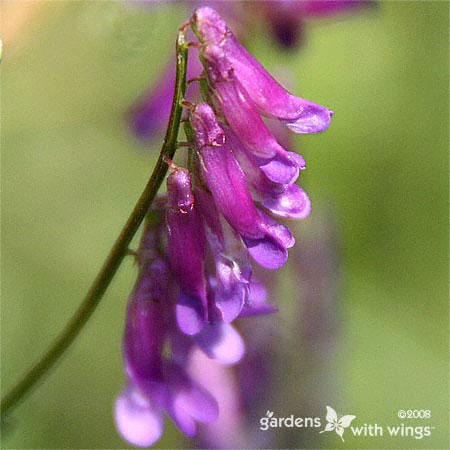
Cow Vetch is a delicate plant but some consider it invasive.

Cow Vetch seeds are harvested for budgies.


Cow Vetch
Vetches are related to beans, so they are good for the soil. I had climbing beans come back this year, just because I let them go to seed last year. The seeds stayed safe in the soil and mild winter, then took off.

Cow Vetch is wild here. Some grew and bloomed in the front yard and the back fence. On the back fence we had a blue waterfall of flowers for time. This year I have not seen it, perhaps because birds love the seeds.

Gardeners agree that they see cycles of growth. Some years nothing can stop a certain plant. The next year, nothing will make it grow.

True Diversity
The Creating Word created genuine diversity in the plant and animal world to take care of all contingencies. Nothing is allowed to dominate for long.

For example, Starlings are aggressive and work in large flocks. But they do not take over the bird population. When plants are truly invasive, it is because they are brought into a country where they do not belong - like Kudzu  Vine (US Government) or the Chinese Multiflora Rose (US Government).

Control-freak sects do not allow diversity of thought. That threatens the insecure leaders. In dominating the members and ministers, these petite tyrants deny the gifts of the Spirit and ultimately pay the price.

One layman said of the WELS District Presidents - "They have to be alcoholics. It's the only way they can live with what they have done to others."

WELS planted the Kudzu Vine of Church Growth
and is now dying of staff infections from Larry Olson, DMin Fuller.

Vines and Asparagus - A Long Wait But Worth It

 I will need to rent a truck to harvest the asparagus.

Many refuse to grow asparagus because they have to wait to start harvesting it. My experience is that there is nothing better than asparagus from the yard. In fact, we ate most of it raw in Midland.

Asparagus is better now. One can buy male plants that do not use up energy in going to seed. The plants are sent fairly well developed and ready to grow. The old instructions made asparagus growing sound like building the Great Wall of China. I simply dig shallow holes, plant the rubbery crowns, cover and mulch them.

Birds plant asparagus in the wild, along fences. If you need more information, send me an email. When we visited our farm cousins, we looked for asparagus along the fences.

Vines Take Time Too
I have learned that vines also take time. That goes against our assumptions. Don't many homes have vines growing on them. We had English ivy on the front of our house, just a little. It has taken four years for it to cover the front porch and picture window area. From there it decided to invade the rose garden. Like Burmuda grass and Blackberries, a can grow from its tips by rooting itself, and expanding form there.

Trumpet
God created vines for vertical use of the sun. I bought three Trumpet Vine sticks, which arrived looking dead. I soaked them overnight in rainwater and they began to grow. Last year they made modest progress, even though I doted on them, like a worried nurse reviving a weak and pale patient.

In the second year the vine began to show its strength. As I hoped, the one planted under the maple tree is now climbing the tree and covering part of the Maple Tree Rose Garden. I reckon the third year of growth will bring some flowers to attract hummingbirds.

Honeysuckle

Honeysuckle Vines are slow to get established and then take over if left alone. Last year the vine bloomed a bit and that was all. Now it is starting to spread a little. I expect a lot more blooms and growth next year.

Morning Glory
We ended up with a glorious display of Morning Glories from Mr. Gardener parking some old vines next to the fence. They planted themselves, got going on my earthworm fertilized, mulch enhanced soil, and grew fast. That happened so fast that I asked him if he deliberately planted them there. He laughed and explained the accident and worried I did not like them.

Cow Vetch is a delicate plant but some consider it invasive.

Cow Vetch seeds are harvested for budgies.


Cow Vetch
Vetches are related to beans, so they are good for the soil. I had climbing beans come back this year, just because I let them go to seed last year. The seeds stayed safe in the soil and mild winter, then took off.

Cow Vetch is wild here. Some grew and bloomed in the front yard and the back fence. On the back fence we had a blue waterfall of flowers for time. This year I have not seen it, perhaps because birds love the seeds.

Gardeners agree that they see cycles of growth. Some years nothing can stop a certain plant. The next year, nothing will make it grow.

True Diversity
The Creating Word created genuine diversity in the plant and animal world to take care of all contingencies. Nothing is allowed to dominate for long.

For example, Starlings are aggressive and work in large flocks. But they do not take over the bird population. When plants are truly invasive, it is because they are brought into a country where they do not belong - like Kudzu  Vine (US Government) or the Chinese Multiflora Rose (US Government).

Control-freak sects to not allow diversity of thought. That threatens the insecure leaders. In dominating the members and ministers, these petite tyrants deny the gifts of the Spirit and ultimately pay the price.

One layman said of the WELS District Presidents - "They have to be alcoholics. It's the only way they can live with what they have done to others."

WELS planted the Kudzu Vine of Church Growth
and is now dying of staff infections from Larry Olson, DMin Fuller.

Tuesday, September 8, 2015

Free Mulch Found Next Door

Most plants love mulch - some cats love dogs.

We used a few bags of cyprus mulch to finish the main rose bed. The eight KnockOut roses had about 280 blooms altogether, decorating the front yard. The hybrid tea roses were blooming shyly, a few blooms for each rose, providing quite a selection in roses, color, and fragrance.

Every few days I cut more roses for neighbors and friends, which keeps all the bushes in production and looking great. I leave the blooms on the KnockOuts a little longer, for color, and they are also good for bouquets.

The recently trimmed crepe myrtle showed off its first new bloom, more like a tiny pink feather for now.

My other concern was the blueberry patch. Lowe's did not have acidic peat moss for digging in the blueberries, so I settled for peat compost, a combination of peat and horse manure. Blueberries like acid, but Almost Eden advised me that mulching with pine needles would help. He followed the same recipe to show customers that mulching alone was sufficient, if not the ultimate.

Our neighbor has pine trees, so they have needles galore and pine cones too. Our helper took the wheelbarrow over and filled it with mulch, just as I nabbed the same amount in grass clippings from our landscaper neighbor. The grass went for the sunny garden, and leaves will provide another blanket for the soil creatures.

The pine needles now fill the blueberry row with a potent aroma of Pinesol. I never used pine before, so I was startled that dried pine needles retained so much fragrance.

Vines
English Ivy
Most of our vines are doing well. The English Ivy on the front porch is completely neglected, not even trimmed. One little stem has grown under the door. One of our first concerns when moving was filtering light through the picture window. Our special wooden shelves are there, and sunlight would eventually eat away at them. I put on a plastic window treatment that would eliminate most of the rays and let sunlight through.

The vine began framing and decorating the window, even though the growing area is the little front porch - no soil except on the far side. This spring a bird sat on the vine and pecked away at its rival mirrored in the semi-opaque glass, every day. He had to be a male seeking dominance for his lady love.

The nectar and pollen are bound to attract insects,
hummingbird baby food.


Trumpet Vine
The three Trumpet Vines have begun to grow. I laughed at a column I saw on the Net, making Trumpet Vine sound like The Kudzu Vine That Swallowed Atlanta. The vines arrived looking like dried sticks, but I soaked them in rainwater for several hours and planted them. One is climbing on the Wright fence. One is climbing the maple in the front yard. The third one was planted in the shade of a tree in the backyard, mostly neglected. I made a point of watering the first two, which also enjoy sunlight. The third vine is doing almost as well, without much water or sunlight.

Norma Boeckler has a Trumpet Vine, with beautiful orange blooms, very attractive to hummingbirds, whose little ones grow on insects - not sugarwater. No, I am not condemning those who support the hummingbird feeder industry. For good results, plants for the nestlings and shelter for the parents should be considered.

Boston Ivy is wonderful, full employment for the groundskeepers.


Boston Ivy
The hated and loved Boston (Japanese) Ivy, which adorns so much of the Ivy League, sits in the sun and grows like crazy when planted in the shade, trying to reach the sun. Since it really is wild grape, Boston Ivy provides fruit for birds. I do not mind inheriting it, but I am leery of starting a plant that groundskeepers curse later.

Honeysuckle gets compost this fall.
It will grow over the dead tree stump, which is fairly tall.
When our landscaper friend was cutting up the dead tree, which had fallen over,
I said, "Woodman spare that tree. I want a vine trellis for free."


Honeysuckle Vine
Like most vines, Honeysuckle has a romantic image and steely roots. I was trying to dig some for a friend to grow. It was more like a tangle of cable, one big tenacious unit. I patted it back down - later, maybe after the rain.

Passion Flower Vine - Maypop
Mine was chewed by slugs and never made it past Baltic Avenue. I may try again next year, but not likely.

Cow Vetch

The fence is colorful when the Cow Vetch blooms.


Cow Vetch
This homely name is owned by a member of the bean family. Its seeds are loved by budgies but hated by those who consider it an aggressive pest. On its own, Cow Vetch climbed my back fence and flowered. Later a group of birds were eating the seed sown by the vine.

Morning Glory, like Cow Vetch,
wins by sowing seed.


Morning Glory
This vine entered the backyard, unbidden. Mr. Gardener tells me it was growing when he moved nextdoor 35 years ago. Last year, during fall cleanup, he put all his extra Morning Glory vines in my compost. When I saw the pile of vines there, I thought, "Yes,  I have them too."


Friday, May 15, 2015

More Answers from the Intensive Creation Unit of Jackson Rose Gardens


Boston Ivy - U. of Chicago.
I do not envy the groundskeepers.


Questions about Vines
One reader asked about which vines to use, to form a screen between his grumpy WELS neighbors and his home. The vines should also be bird-friendly. Here are some considerations:

  • Boston Ivy (Parthenocissus tricuspidata, aka Japanese Ivy, aka Wild Grape). This is the ivy of the Ivy League. One fellow loved it in Japan and brought it to Harvard University, causing Yale to covet and later to loathe it. This vine is a member of the grape family, so birds love it. The ideal use of the vine is to cover ugly, broken down stone surfaces. The vine likes to head for the sun, so planting it in a shady place will motivate it to grow, but not when planted in a sunny location. The vine holds itself up with little glue pads that can be removed with an aggressive use of explosives or chisels or fulminating acids - something to consider when planting near a home.
  • English Ivy (Hedera helix) grows on the front of our house, and I like it. This ivy can be invasive. It grows in the sun and climbs well. English Ivy can choke and kill a tree, but birds and insects love it. We have a bird that sits on the vine in the front window and pecks at his male rival reflected back at him. Oregon has banned the use of English Ivy.
  • Honeysuckle Vine (Lonicera) is a vigorous vine that needs support. I bought some tape made for that. Some suggest old nylons - where can anyone find those? Honeysuckle is extremely popular for a number of reasons. I bought a vine (Scentsation) and found it vigorous and quick to bloom, even before it was ready to climb. Hummingbirds, bees, and butterflies love its blooms, fragrance, and nectar. Wait - there's more. People like to sip the sweet nectar too. This vine can also be used as ground cover. 
  • Trumpet Vine (Campsis radicans) can be planted if the gardener intends to control it. We had growing on the garage of the historic Jackson Home in Moline. I remember its tendrils coming up in the lawn, and the mower kept it under control. Hummingbirds love the flower, sipping its nectar and nabbing insects attracted to the flower. People like to fill hummingbird feeders. I like to grow them. This vine can spread, and it climbs on its own. They drop seed easily. This website suggests not planting the vine along the house.

Most authorities suggest keeping an eye on these vines and pruning them. People seem to think a plant needs no care. When grown in the right place for the right reason, the characteristics of that plant will be a blessing. Like trees, plants need attention and occasional pruning. Nothing looks worse than shabby trees, rampant choking vines, and unkempt roses.

There are many vetches - 140 - but this one is mine - Cow Vetch.

Yesterday I identified an odd looking plant that appeared in the front rose garden and also climbing the fence in the backyard. The plant flowered, so I took the purple flower inside and began using Google Images to identify it. I came up with Cow Vetch (Vicia cracca, pea family). I was tempted to pull it from the ground before I studied the plant, even though it looked fragile and harmless.  Cow Vetch is another vine, which butterflies love for its prolific blooms. Consequently, it drops seed like a champion. Hundreds of blooms, hundreds of seeds. Bees and butterflies love it. So Cow Vetch can be vexing in the wrong place, but it is ideal for the backyard fence, which I plan to cover with vining growth of one type or another.

A wild area with so-called weeds, herbs, and long grass will increase the diversity of bees, butterflies, birds, and insects.


Mulch Is the Answer
Sassy and I visited Lowe's gardening department yesterday - she was welcomed as a celebrity. "I remember Sassy," said one young clerk. A mother and grandmother wanted their little girl to look at Sassy, who went from person to person looking for new friends.

We were there for clay flower pots and some mulch. Looking around, I was struck by the piles of toxins sold - stinking combinations of inorganic fertilizer and pesticides. Most gardening articles in the popular press will recommend both for any problem, and more of the same when they do not work. Inorganics kill - they work against the gardener.

I came back with an armful of flower pots and told the young woman, "My grandson and I will make toad houses with these, crack them in half and set them up as shelters. Each toad consumes 10,000 insects per summer.

She was staggered by the figures, having no idea about the power of a resident toad. I also bought a flat clay tray (normally under a flower pot) for the toad to use for hydration. They are not swimmers and do not drink water. They sit in shallow water and absorb it. A dish under the soaker hose will fill itself and stay reasonably clean. I dump them out regularly ( to remove skeeter eggs or babies).

How does a gardener start with mulch? One reader was thinking about getting some wood mulch to hold down the newspapers. Being short of one item can stall plans for the garden.

I suggested branches to hold down the newspapers. Leaves and grass and soil can be used, too. Leaves and grass are often too light, but they are good additions if the newspapers remain soggy and heavy. If I am short of mulch, I use mushroom compost to hold down and cover up newspapers.

Stick piles are good. We are tempted to throw them all away. Instead, toss them in the same pile. Birds love to sit on them, and insects will accumulate there - an added attraction for birds. Logs rotting into the soil are especially good for the garden. I have a  massive one serving as the barrier in front of the back, back garden area. I have another large one that curves upward to waist height, near the Jackson Bird Spa. Birds perch on it all day long. A pile of sticks is also next to the spa.

This is Scentsation Honeysuckle Vine.
It began growing at once and bloomed quickly.

Tuesday, May 5, 2015

De Vines - Trumpet, Honeysuckle, Passion - Grow Hummingbird Feeders Instead of Filling Them

Trumpet Vine


I was getting my last section of the Jackson Aerial Aqueduct when I drifted over to bird food for a bag of sunflower seeds. On the left was a large display of hummingbird nectar, plus any number of feeders, which are known to attract ants and bees. Not that there is anything wrong with that.

Climbing roses are slow to bloom and yet some are known to become obnoxious in their prolific growth once established.

We have hummingbirds in the neighborhood, fed by the landscaper (bottled nectar, of course), so upon being urged to host a few with feeders, I said, "I grow them."

Vines are a great way to decorate trees. Ever since I read about using a tree as a living trellis, I wanted to send vines up the easy way.

Trumpet vines are an easy choice. They know how to climb on their own, and hummingbirds love them. They provide nectar and insects looking for pollen and natural cola. They do not require bleachy washing and refilling. We had them at home in Moline and kept them in check by mowing their sprouts in the grass. They like to send runners and drop seeds.


Honeysuckle, Scentsation


Honeysuckle is new to me. I have often heard of it as a hummingbird plant, but I have not grown it.
Mine came early and I have nurtured it with rainwater. Real growth is starting now.

Passion Flower


Passion Flower is another new one, but most people can identify it from the radically ornate flowers.

Butterflies, bees, and hummingbirds often enjoy the same plants, although butterflies seem very particular about which food their babies will grow up on. Therefore a variety of plants will favor an entire convention of entertaining, beautiful, and useful creatures, as God intended.


Butterfly larvae love the maypop, the fruit of the Passion Flower,
and people eat it too.

Monday, January 19, 2015

Vines for the Hummingbirds and Butterflies.
New Feeder and Job One for the Garden

Honeysuckle - Scentsation - Lonicera.
The time has come to try various vines. I know the trees will be trimmed to give more sunlight, so I have two living tree candidates, one dead tree (best of all for sun), and one baby tree. I have no idea what the last one is - one of those tall but useless plants that appear in untended yards.

I was tempted to saw it down, but then I saw the plant as a living trellis, much cheaper than buying one, much easier than building one.

The three best guesses are pictured here, and I ordered them. Trumpet vine was the easiest first choice. I have seen it growing and climbing. Everyone names it as a great hummingbird plant. I was looking for two others that grow well, make butterflies happy, and attract hummingbirds.

I like the baroque complexity of the Maypop flower. Honeysuckle vine has a good reputation for attracting birds and butterflies. In Phoenix we had a Honeysuckle bush that produced orange flowers and hummingbirds all the time, growing from a sprout to a 9 foot tall bush.

Diversified planting helps because blooms develop at different times and favored species like a variety of food.

Some others in this category (but not vines) are Butterfly Bush, Butterfly Weed, dill, Bee Balm, and various herbs like borage.  Queen Ann's Lace is officially a weed, but I like its dill-like flowers and appeal to bees.


Maypop or Passion Flower - Passiflora.

Trumpet Vine - Campsis.
Some of you fill hummingbird feeders. I grow them.

New Bird and Squirrel Feeder
I found a filing cabinet to replace the free one I got from LI. The pull out drawer struck me as a good device for bird and squirrel feeding. The top level keeps seed dry. The drawer tempts the squirrel inside for additional treats.

They took to the new feeder at once. Starlings, blue jays, and cardinals are happily feeding every morning, along with chickadees, doves, and some other species.

Peas - Plant for the Cold
The bulbs are not even peeking out of the soil yet, reason to plant snowflakes, snowdrops, or crocus, to build up gardening self-esteem.  But I did not, so I need to plant some peas. Rain will be coming but insects are not inclined to come out when nights are near freezing.

So I will plant peas today, God willing, and have a new set of plants to watch. At the very worst I will be adding nitrogen to the soil and softening it for beans, but I imagine it will be more like, "Do you want some peas?" Mrs. I "No! Not another pod until next year."


Thursday, January 15, 2015

Vines and Trees - Another Form of Vertical Gardening

Boston Ivy, U. of Chicago building.

Having 200 linear feet of chain-link fencing certainly made me think of vertical gardening - peas, beans, gourds, pumpkins, and Malabar spinach.  Our six trees also encourage vertical gardening.

Long ago, my initial effort did not work out, growing a vine up a tree. I made a rookie mistake, thinking one vine and one tree would equal a vine-covered tree.

The first step is to begin planting the vine where it will have a good base for roots to grow, farther away from the tree, and where more sunlight will reach at first.

Boston Ivy (really Japanese - and a grape) has an interesting characteristic. The vine grows fast in the shade because it looks for sunlight and heads toward it. Someone from Harvard saw it growing in Japan and brought it to Harvard. Yale liked the look and added it to its buildings, now cursing the day they copied their rival. Boston Ivy is great for birds and old crumbling structures, but it is terribly invasive and destructive for buildings.

The Ivy League was started as a football association, so the more scholarly students could play their peers instead of the brutes in the South and Big 10 universities.

Boston Ivy is not on my list, and I already have English Ivy on the front of the house, inherited from a previous renter.

Trumpet Vine is one of several hummingbird plants I will grow as living feeders.

My first choice is Trumpet Vine, because we grew it at home in Moline. I remember mowing the lawn and seeing the plants coming up, never reaching another location, but doing well on our tiny garage. When we tore the vines down to paint the garage, the vines grew back fast, because the roots were well established in that location.

I began in the fall by covering the base of the dead tree, alive with crabgrass, with Jackson mulch: newspapers to compost the crabgrass, wood mulch to hold down the newspapers and promote fungi in the soil. Much later, a new supply of newspapers meant an enlarged circle and all the wet autumn leaves we could gather. The rain fell for several days afterwards - composters' weather.

The dead tree is a few feet from the compost pile, my earthworm dormitory and cafeteria. I will choose spot where the soil is deep, plant one or two vines, and fence around it until the vine is established. The advantage of a pre-mulched area is having a fertile and protected zone to plant, where the new project will have an easy time getting established, with moisture moderated by mulch.

Gardening companies and books have all kinds of gadgets to deliver water to plants outside. I use mulch to hold water and slowly add nutrition to the soil.

I am not sure which vines to try in the future, so ideas from the readers are welcome. I have thought about Maypop or Passion Flower.

Maypop or Passion Flower.