Showing posts with label Schmauk. Show all posts

Saturday, November 7, 2020

Steal These Quotations


Quotations


Preaching of the Gospel – Stone in a Pond

"The preaching of this message may be likened to a stone thrown into the water, producing ripples which circle outward from it, the waves rolling always on and on, one driving the other, till they come to the shore. Although the center becomes quiet, the waves do not rest, but move forward. So it is with the preaching of the Word. It was begun by the apostles, and it constantly goes forward, is pushed on farther and farther by the preachers, driven hither and thither into the world, yet always being made known to those who never heard it before, although it be arrested in the midst of its course and is condemned as heresy." 
Sermons of Martin Luther, 8 vols., ed., John Nicholas Lenker, Grand Rapids: Baker Book House, 1983, III, p. 202. Ascension Day Mark 16:14-20. 

"Shall we permit this to be done! in the name of Christian unity! and by a latitudinarianism that is our own heritage, which rises ever anew from the embers of the past to find such veiled support and strength in the citadel of Zion that Confessionalism is told to whisper low in Jerusalem lest she be heard on the streets of Gath." 
Theodore E. Schmauk and C. Theodore Benze, The Confessional Principle and the Confessions, as Embodying the Evangelical Confession of the Christian Church, Philadelphia: 1911, p. 941. 

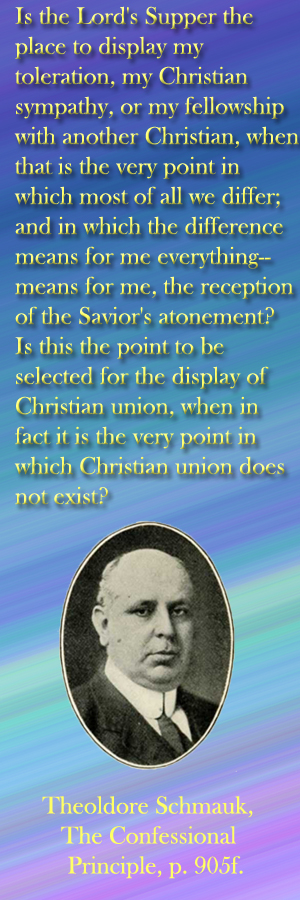
"Is the Lord's Supper the place to display my toleration, my Christian sympathy, or my fellowship with another Christian, when that is the very point in which most of all we differ; and in which the difference means for me everything--means for me, the reception of the Savior's atonement? Is this the point to be selected for the display of Christian union, when in fact it is the very point in which Christian union does not exist?" 
Theodore E. Schmauk and C. Theodore Benze, The Confessional Principle and the Confessions, as Embodying the Evangelical Confession of the Christian Church, Philadelphia: 1911, p. 905f. 


"The modern radical spirit which would sweep away the Formula of Concord as a Confession of the Church, will not, in the end, be curbed, until it has swept away the Augsburg Confession, and the ancient Confessions of the Church--yea, not until it has crossed the borders of Scripture itself, and swept out of the Word whatsoever is not in accord with its own critical mode of thinking. The far-sighted rationalist theologian and Dresden court preacher, Ammon, grasped the logic of a mere spirit of progress, when he said: 'Experience teaches us that those who reject a Creed, will speedily reject the Scriptures themselves.'" 
Theodore E. Schmauk and C. Theodore Benze, The Confessional Principle and the Confessions, as Embodying the Evangelical Confession of the Christian Church, Philadelphia: General Council Publication Board, 1911, p. 685. Trinity 

"The real question is not what do you subscribe, but what do you believe and publicly teach, and what are you transmitting to those who come after? If it is the complete Lutheran faith and practice, the name and number of the standards is less important. If it is not, the burden of proof rests upon you to show that your more incomplete standard does not indicate an incomplete Lutheran faith." 
Theodore E. Schmauk and C. Theodore Benze, The Confessional Principle and the Confessions, as Embodying the Evangelical Confession of the Christian Church, Philadelphia: 1911, p. 890. 


[Selnecker, who wrote "Ach bleib bei uns" (TLH #292) was bitterly attacked and severely persecuted by the Reformed, deposed when Augustus died, reduced to poverty, and not allowed to remain in Leipzig as a private citizen.] GJ – Imagine that! 
Theodore E. Schmauk and C. Theodore Benze, The Confessional Principle and the Confessions, as Embodying the Evangelical Confession of the Christian Church, Philadelphia: General Council Publication Board, 1911, p. 310ff. 

"It is not the devil's aim to plague us physically; he is a spirit who is always thirsting for the tears and the drops of blood that come from our hearts. He wants us to despair and to perish from sadness. This would be his joy and delight. But he will not succeed."
Martin Luther, What Luther Says, An Anthology, 3 vols., ed., Ewald Plass, St. Louis: Concordia Publishing House, 1959, III, p. 1244. John 15:19.


"Hence the Pope is the true Antichrist, and his high schools are the devil's own taverns and brothels. What does Christ signify if by effort of my own human nature I can obtain God's grace? Or, having grace, what more will I desire?" Martin Luther, Sermons of Martin Luther, 8 vols., ed., John Nicholaus Lenker, Grand Rapids: Baker Book House, 1983, VI, p. 284. New Year's Day, Galatians 3:23-29 

"So when we see a bishop assuming more than this text gives him warrant for, we may safely regard him as a wolf, and an apostle of the devil, and avoid him as such. Unquestionably he must be Antichrist who in ecclesiastical government exceeds the authority here prescribed." Martin Luther, Sermons of Martin Luther, 8 vols., ed., John Nicholaus Lenker, Grand Rapids: Baker Book House, 1983, VI, p. 65 Third Sunday in Advent, 1 Corinthians 4:1-5 

"Observe, however, what the devil has accomplished through the Papists. It was not enough for them to throw the Bible under the table, to make it so rare that few doctors of the holy Scriptures possessed a copy, much less read it; but lest it be brought to public notice they have branded it with infamy. For they blasphemously say it is obscure; we must follow the interpretations of men and not the pure Scriptures. What else is their proceeding but giving Paul the lie here where he says the Bible is our manual of instruction? They say it is obscure and calculated to mislead." Martin Luther, Sermons of Martin Luther, 8 vols., ed., John Nicholas Lenker, Grand Rapids: Baker Book House, 1983, VI, p. 41 Second Sunday in Advent Romans 15:4-13 

"THE DEVIL'S DIRTY DOZEN: TWELVE WAYS (AND MORE) TO KEEP YOUR CHURCH FROM GROWING..."Limit worship experience only to pages 5 and 15...Bulletin should be 'worship service' oriented rather than 'announcement oriented'...Expect unchurched to accept traditions as though they were doctrine." School of Outreach IV, Notebook, WELS Evangelism Commission p. O-1. 

"Let us, then, prepare ourselves to be patient and learn to bear the furious attacks and the blows of Satan, who is trying to tear the church of Christ to pieces and to establish his own church. We are not any better than the fathers. At the cost of much sweat and labor they, too, scarcely succeeded in their effort to preserve the Word and to snatch a few souls from the jaws of Satan." Martin Luther, What Luther Says, An Anthology, 3 vols., ed., Ewald Plass, St. Louis: Concordia Publishing House, 1959, I, p. 280. W 42, 425. Genesis 11:10ff. 

"Therefore nothing but a satanic, seductive, and sinister strategy is involved when we are called upon to yield a bit and to connive at an error for the sake of unity. In this way the devil is trying cunningly to lead us away from the Word. For if we adopt this course and get together in this matter he has already gained ground; and if we were to yield him a fingerbreadth, he would soon have an ell." Martin Luther, What Luther Says, An Anthology, 3 vols., ed., Ewald Plass, St. Louis: Concordia Publishing House, 1959, III, p. 1411f. Ephesians 6:10-17. 

"The devil has the advantage of being able to find pupils for a doctrine or a dream no matter how absurd the doctrine or the dream may be. The more absurd it is the sooner he finds pupils." Martin Luther, What Luther Says, An Anthology, 3 vols., ed., Ewald Plass, St. Louis: Concordia Publishing House, 1959, II, p. 632. WLS #1940 Mark 7:31-37. 

"If the devil were to identify himself and show himself as black as he is, who would want to follow him? But now he peddles his poison and false doctrine under the cover of God's name and does so with an impressiveness greater than that with which the true doctrine is presented." Martin Luther, What Luther Says, An Anthology, 3 vols., ed., Ewald Plass, St. Louis: Concordia Publishing House, 1959, II, p. 633. 2 Corinthians 11:14. 


Saturday, December 28, 2019

Lutheran Layman Enoys The Lutheran Library Publishing Ministry.
Portable Library, Free Ebooks

The Confessional Principal - he fought the battle which the synodicals gave up - in the name of appealing to everyone.
"Theodore Emanuel Schmauk, D.D., LL.D. (1860-1920) was one of the foremost theologians in American Lutheranism. He was editor of the Lutheran Church Review, president of the General Council and of the Board of Directors of the Lutheran Seminary at Philadelphia."

Good morning Pastor Jackson,

In this day and age, reading and access to good material is easier than it ever has been. But, as you have alluded to in this morning's post, fewer people are reading. I have found many copies of the 1941 TLH buried in a box at a relative's house. They were given to me when my former congregation went to using the CW hymnal. Now, I can put one in the trunk of each car, to have available if travelling. 

The 1941 TLH is the center of my morning devotions. If I cannot remember the tune, I can recite the hymn like reading poetry.  There is so much more in the 1941 TLH than just hymns. 

I have downloaded and printed out the pdf file of many of the offerings from the Lutheran Librarian. A layman can become so knowledgeable on doctrine from all of this without the need for the dogmatics textbooks. The authors from the 19th century General Council mostly wrote in English and it even gives us all the chance to build our vocabularies with terms that have fallen into disuse. Still, their styles are mostly easy and free flowing.

 Gerberding's The Way of Salvation was a monster best-seller.
"George Henry Gerberding (1847-1927) studied under Charles Krauth and C. F. Schaeffer and assisted the Rev. Passavant. An indefatigable worker, he established and restored churches in Pennsylvania, Ohio, and Fargo, ND. His Way of Salvation in the Lutheran Church was one of the most successful books ever published by the English Lutheran Church."

New Testament Conversions, by Gerberding, is great for sermon ideas and for its content.

Presently, I am working my way through Schmauk's Confessional Principle and Gerberding's The Way of Salvation in the Lutheran Church. Thank you for making this available through links on Ichabod.

In Christ,

 Pilgrim's Progress is the most read book in English, after the Bible, and remains extremely influential.
"John Bunyan (1628-1688) was one of the most influential authors of the seventeenth century. He was jailed for a dozen years for “teaching men to worship God contrary to the law,” during which time he wrote The Pilgrim’s Progress, which has been continuously in print for more than 300 years. Bunyan was a great lover of the teachings of Martin Luther. His conversion experience is found in Grace Abounding to the Chief of Sinners."

Sunday, October 8, 2017

Schmauk on "No Creed but the Bobble"


The Bible raises ten thousand questions. If you answer any one of them in your own way only, and without looking farther, and say, “This is what I believe,” you are setting up a personal creed of your own. If you simply content yourself with the assertion, “The Bible is my creed,” you are leaving unanswered many of the most important and vital questions of faith and life. And a Church’s answer, more than your own, must be ample to meet all questions. When you refuse to take a definite stand on vital issues in the Christian Faith, but say, “The Bible is my creed,” are you really confessing Christ, or are you taking the problems of religious life easy, and evading the unpleasant but important doctrines which the Spirit of God has brought to an issue in the development of the Faith and His Church in history?
-Schmauk. The Confessional Principle. 

Monday, August 14, 2017

Why care about the Nicene, Apostles’, and Athanasian, Creeds? - Comfort for Christians


WELS and the LCMS (with ELCA) say "Yes!
Our gurus at Fuller, Willow Creek, and Exponential have teached us to avoid displaying our confession of faith. The cross is a big turn-off, too.
Let's use cool names like GracePoint, Time of Grace, and The CORE."


Why care about the Nicene, Apostles’, and Athanasian, Creeds? - Comfort for Christians:


"The Apostles’ Creed, the Athanasian Creed, the Nicene Creed, and the Sixteenth Century Confessions of our Church are each and every one of them the product of the greatest upheavals and the most intense crises in the Church of Christ. Creeds are born, not made. They are wrung in the agony and anxiety of a Confession at an epoch fraught with the possibility of perilous consequences to the confessors.

Such creeds, the mighty foundations of our Fathers, do not bind us, but they plant us on solid ground. They do not throttle, but they protect us. They specialize, differentiate and qualify our Church’s activity, render it more effective, and save much experimental waste. They no more hem us in and bind us down than noble old trees, planted by our fathers, hem in, destroy and narrow down the landscape. -Theodore Schmauk. The Confessional Principle. pp. 22-23

The Confessional Principle is now being prepared for publication as an e-book."


'via Blog this'

Sunday, August 13, 2017

Schmauk on the two kinds of anti-Christian tyranny - Comfort for Christians


Schmauk on the two kinds of anti-Christian tyranny - Comfort for Christians:


"Schmauk on the two kinds of anti-Christian tyranny

1 minute read
In this passage from great Christian teacher Theodore Schmauk, we see a large part of the underlying conflict going on around us in America. The false choice between authoritarianism or romanticism is no choice at all.

Without authority – for direction, appeal, and decision, – no step of intellectual, spiritual or social activity is possible. The question is not really as to authority, but as to its proper seat and location. The motto of the ancient pre-Christian, of the medieval, and of modern Roman, civilization, is “Society above the individual.” This ancient tyranny repeats itself today in scientific form in the motto, “The race above the individual”; in sociological form, when the State assumes to encroach upon the rights of the individual, and passes laws which propose to regulate the personal life, health, education, acts, interests, and happiness of the individual; and in political form, when the axiom of authority, “The majority rules”, is pressed ruthlessly against the minority. The same tyranny is found or imported into nature as the seat of authority, when its laws are interpreted as reducible to the axiom that “Might makes right”, or “The strongest survive.”

The reaction against this tyranny over the individual, so characteristic of the ancient world, and manifesting itself in modern sociology and science, is the extreme Romantic, or revolutionary, position, well expressed in the motto of Rousseau : “The individual above society.” If the absolute enforcement of authority upon the individual is Romanism, this elevation of the individual to the supreme seat is Protestantism gone to seed. It was already inherent in the humanism of the Reformation, and occasioned the controversies with Fanaticism in theology, and the Peasants’ War in sociology, in Luther’s day.

Theodore E. Schmauk. “The Confessional Principle”, 1911.
The Confessional Principle is now being prepared for publication as an e-book.

Originally published at: Comfort for Christians"


'via Blog this'

Tuesday, July 25, 2017

Schmauk on the General Council


“THE ONE CONSERVATIVE LUTHERAN BODY”

The future work of the General Council will devolve more and more upon the second generation, and by them and by all Lutherans in this land, two facts should not be forgotten:
The first is this, that the General Council is the one conservative Lutheran body in this country, accepting unreservedly both the Confessions and the history of the Church. As over against any radicalism, which would cut away the Confessional fullness of our Lutheran Church, or which would make a syncretistic combination between parts of our heritage and other doctrinal elements in America which are not our own, the General Council stands firmly for the complete and concordant sum of Lutheran truth. With equal firmness does it accept and build upon the historical past, both in Europe and in this country, and avoid that other radicalism which, instead of purging the hay, straw and stubble from the old foundations, would begin, without just recognition of the good that is in the past, to erect, by means of an exclusive ecclesiastical organization, a new Lutheranism, without regard to any previous or contemporary work of Providence in the land...
The attitude of Luther toward the Catholic Church in the Sixteenth Century is the attitude of the General Council toward all forms of Lutheranism today. It would conserve the past and upbuild the future on the basis of a sound faith. Its depth is the depth of salvation which is in Jesus Christ. Its length is the length of history, and its breadth is the breadth of our own land and our own time.”

From George W. Sandt, Theodore Emanuel Schmauk A Biographical Sketch, Chapter 12.

Anti-Confessions: So ELCA, So WELS


From the biography of Schmauk:
The Minister of Christ will manifest Christ in the strength of individuality. He will not follow the stream whichever way it leads. From the cut of his coat to the formation of his opinion, from the most trifling act to the weightiest decision, he will not do only as others do. He will not dread being in a minority. He will not become a mere reflection, an echo, a shadow of those with whom he mingles. He will not imitate either preacher or thinker. Rooted firmly in the Word, he will develop and proceed in his own way, as God intended he should. — Schmauk.

From George W. Sandt, Theodore Emanuel Schmauk A Biographical Sketch, Chapter 5.

***
GJ - I was reading a little of the ALPB Online, about the latest scandal in ELCA. Their star ELCA pastor, who is also a journalist, began yapping about the Book of Concord:
"Can we trust anything in the Bible, Pastor Fienen, that is not verified by that collection of Lutheran partisan documents written to historically specific situations 500 years ago?" 
If someone presses a WELS pastor to offer a class on the Book of Concord, he will snort and say, "The Confessions are old, boring, and irrelevant." When using their double-talk, which they perfect in their hazing sacrament at Mordor, a WELS pastor will declaim about a quia subscription to the Book of Concord, a book he has barely opened and secretly despises - as he was taught by the profs.
Pastor Austin's attitude is exactly the same as taught in the LCA in the 1970s. The LCA assumed - Nothing mattered after 1530. Chemnitz, in the LCA, was not a genius faithful to Biblical theology, but a retrograde placing cast iron over every Biblical phrase.
The dunderheads in WELS motivated me to study Chemnitz, the Book of Concord, and the confessional struggles in the General Council/General Synod (which also involved WELS' history).
Schmauk represents the battle which he and others were fighting but losing to the future ULCA. Nevertheless - Schmauk, Krauth, and Henry E. Jacobs are worth reading and quoting today.
 "Beyond them..." opens the gates to UOJ, Church Growth,
and everything else.

Monday, July 24, 2017

The Tyranny of Liberal Protestism - Schmauk


While the tyranny of Rome is the supreme authority of the Church over conscience, the tyranny of liberal Protestantism is the supreme authority of every man’s conscience over the Scripture and the Church. Both positions are extreme and sceptical. That of Rome distrusts the Truth in its power over the individual conscience, while that of liberal Protestantism suspects the Truth of Scripture and the Church, and does not believe that there is one objective and stable center of truth revealed from above in which the consciences of all perfect men can believe and unite.
Since one of the essential elements of religion, as of all truth, is unchangeableness; and since in religion there must be both unchangeableness and finality, even this Twentieth Century should see that, if it is to keep any religion at all, it must not be a religion of individualism, of poetic values, of speculative outlook, of temperamental trust, but a religion of authority. However, this authority must have the freedom of an unrestrained and living faith and a voluntary trust, as its corollary. Neither Romanism, nor the axiom, “Religion ist Privatasche” (religion is a private matter), will meet the case. (emphasis added) 2
2 Theodore Schmauk and Theodore Benze. The Confessional principle and the Confessions of the Lutheran Church. 1911. Introduction

Thursday, February 16, 2017

Mequon Needs Schmauks


Hi Pastor,

I found another jewel from T. E. Schmauk in A Biographical Sketch by George W. Sandt:

The minister of Christ will manifest Christ in the strength of individuality. He will not follow the stream whichever way it leads. From the cut of his coat to the formation of his opinion, from the most trifling act to the weightiest decision, he will not do only as others do. He will not dread being in a minority. He will not become a mere reflection, an echo, a shadow of those with whom he mingles. He will not imitate either preacher of thinker. Rooted firmly in the Word, he will develop and proceed in his own way, as God intended he should.


What a radical idea. My prayer to the Lord of the Church is that He would fill Mequon with Schmauks.


***

GJ - The Pietists are quick to condemn brilliant quotations like these, saying, "They are not from our group, so they come from false teachers.

Pietists are "respecters of persons" - literally "appearance people," a very serious sin in the New Testament. They condemn the outside and ignore the statement itself.

Romans 2:11King James Version (KJV)

11 For there is no respect of persons with God.

Acts 10:34King James Version (KJV)

34 Then Peter opened his mouth, and said, Of a truth I perceive that God is no respecter of persons:

Schmauk, Krauth, and Reu are ignored, and even condemned by the "conservative" Lutheran leaders, but these three battled for Luther's doctrine and the Book of Concord. Those years of turmoil - dealing with the Church Growthers of their era - gave them a profound appreciation for the Confessions.

Funny how the numerous felonies of Walther - and his papal ambitions -are swept away in paroxyms of joy, because the LCMS has another printing of CFW's Pastoral Theology.

In the LCMS-ELCA-ELS-WELS, Zion is read even less often than Luther's Sermons and the Book of Concord.

Friday, December 9, 2016

Bring Back Schmauk


From a Reader:
I was perusing the link to Sandt's book on Schmauk that Pastor Jackson recently provided on the Ichabod blog. Thought it was worth sharing. Written in 1912, yet a hundred years later the Lutheran synods insist on grafting a WARRENSTANLEYFULLER shoot. Sad! (as Donald Trump might tweet)


“If conservatism has become too fossilized and degenerated, it may be necessary to graft a more vigorous shoot in the old stock, but it should be a shoot of the same species, and should look to the bringing forth of its own perfections, and not to an imitation of the perfections which are found in other species of spiritual vitality.

The Lutheran Church will never grow as long as we are looking for our progressiveness to what others outside of us are doing and are using up our strength in adopting their devices and in imitating them. We shall never be able to reproduce their finest fruit or flower, and we shall be depreciating and failing to give attention to our own.

Let us take the strong elements and qualities and character of faith and life that inhere in our own Gospel, in our own confession, and in our own Church; let us plant this seed without doubt. Let us be assured that it is the richest, the strongest, and the most genuine Christianity in the world. Let us labor patiently to keep the soil cultivated, to prune the trees, to keep them free from all parasitic and other destroyers, and our own inherent vitality will assert itself and bring forth splendid results. 

Progressive conservatism is the application of our own treasures in an up-to-date way, to the problems of the Kingdom of God and of the life about us. This application should not be antiquated, but should be vigorous and enlightened."

Excerpt From: George Washington Sandt. “Theodore Emanuel Schmauk, D.D., LL. D.” United Lutheran publication house. iBooks. 


Wednesday, December 7, 2016

Going Back in Time - Works with the Media and Lutheran Writers

 Look for these authors - Reu, Tappert, Krauth, Schmauk, Henry E. Jacobs,
Gerberding, Lenski, and Gerberding. Older Lutheran church histories
are also worth reading - the scales may fall off one's SynCon eyes.

My wife and I have been going to movies since our first date, 50 years ago, when I took her to a Quad-City cinema. We scan the previews on the Net to look for good movies. We favor ones based on the facts, such as "Hacksaw Ridge." Another factual film was "Florence Foster Jenkins," with Meryl Streep. That film was uncomfortably close to the history of Hershey Chocolate and the LCMS. But that is what I get for reading too much and too often.

Boo hiss - Iowa Synod - but Reu was a genius.
His book on Luther and inerrancy was far ahead of the
mainline Lutherans, both the backstabbing Missouri  and
waffling WELS clergy.


Lately we have watched a lot more on Turner Classic Movies, because few of the new films have any merit. The old movies seem rather dated in various ways, but they radiate high quality, due to the demands upon veteran actors and script-writers. The old system was a gigantic machine for producing excellent films that have lasting appeal. I know much of the bad stuff about Old Hollywood, which is far worse than most people imagine - because I read - but those scandals are small compared to today's.

So we will watch a TCM film that sounds interesting but is new to us, and really enjoy the movie's humor, drama, acting, lighting.


Lutheran books are similar. Today's books are not worth buying. I keep asking my friends, "Why is each new hymnal worse than The Lutheran Hymnal?" The LCA and ALC could not improve on their Service Book and Hymnal either, but I am sure WELS could improve on CW. Hint - edit the hymnal while sober.

Here are some titles that may crop up at book sales, church libraries, on Alibris and Amazon used books. I have obtained carloads of old Lutheran books many times and distributed them.

Gerberding - The Lutheran Pastor. He was highly respected in the LCA tradition, with good insights about being a Lutheran pastor, as compared to copying the non-Lutheran celebrity clergy of the day. Lutherans were copying gimmicks back then, too.

The Encyclopedia of the Lutheran Church - 3 volumes. The ALC produced some good books until Augsburg merged with Fortress. In fact, Fortress was printing a lot of required reading at Notre Dame theology when I was there. This work is packed with good information, the kind that specialty encyclopedias are good at offering. I gave my set of Mennonite encyclopedias to WLS at Mordor, where they probably still reside, unread, in the unused and lonely library.

Theodore Schmauk is one of my favorites among overlooked authors, but now many  of his books have been reprinted. George Sandt wrote a fascinating biography of this Lutheran leader, a man who fought against the anti-Lutheran trends of his age - instead of enrolling at the hottest fad school to learn the latest in undermining the Means of Grace. The ebook linked is free. I bought a used copy once owned by a faculty member and gave it to Paul Rydecki.  ELDONA has probably not vetted it yet, but the book is worth reading - if only to get out of the mindset of the sun rising and setting on the Synodical Conference.

Henry Eyster Jacobs is probably kosher to read in the Synodical Conference because his communion hymn is found in The Lutheran Hymnal. Need some Lutheran commentaries? His set is linked for free on the Net. His Summary of the Christian Faith is often found at book sales when old pastors die and leave their libraries to the seminary. WELS pastors often left ALC and General Council/Conference classics - not notebooks from Fuller Seminary.

Here is a true story worth noting. A 1987 graduate of WELS' Wisconsin Lutheran Seminary was looking over my library. He said, "Greg, your library is so Lutheran!" I wondered about his shock. "Why is that so strange?" He said, "All our required books at Mequon were Reformed." Yes, Mequon aka Mordor did just what the frauds in the Crypto-Calvinistic era perpetrated. They made Calvinistic books mandatory, supplanting the Lutheran classics. So much the better for laying a foundation of UOJ rationalism and Church Growth. They paid Valleskey to bury them alive.

Old General Council and General Synod books are worth grabbing and keeping. The older ALC books from Augsburg Press are often very good tool. Augsburg printed Lenski and Sasse, after all, giving up both when they got the fever to unite with the worst elements of the LCA.

Monday, July 4, 2016

Offered Holy Communion in WELS


...

A WELS pastor said he would commune me - as if I would crawl through a minefield mulch by broken glass to receive the Sacrament from a WELS pastor!

I agree with Schmauk, and I continue to be troubled that he is unknown and unread in Lutherdom today.

Here is a one-sentence description of WELS, a sect that mocks the Confessions
as "boring and irrelevant" and now embraces the apostate New NIV.

Sunday, February 22, 2015

Some People Misunderstand This Great Statement by Schmauk.
See His Other Great Quotations

Some people have a fetish about confessional subscriptions and play with words.
Schmauk properly states - what we believe and practice matters the most.
Notice how the Shrinkers hide behind words to carry out their nefarious
popcorn, cola, and rock music "ministries."

This is WELS is one clear statement -
a total rejection of the Confessions and a rapid sliding into the abyss
of Rob Bell, Mark Driscoll, Robert Schuller. 

The ULCA merger of 1981 was a triumph of Confessional, liturgical Lutherdom,
so the apostates quickly turned that into an opportunity for mischief.


***

GJ - The poor seminarians at Mequon are brain-washed against the Book of Concord, to such an extent that justification by faith quotations are marked in their materials as MISLEADING!

Yet they claim to be "Confessional" and "Orthodox" - and I am a blue heron.

Tuesday, June 12, 2012

Brett Meyer - On Schmauk


Brett Meyer has left a new comment on your post "Schmauk - The Real Question":

I believe Theodore Schmauk is actually touching on a very pertinent issue for today. That is, there are many false teachers and apostates leading the Lutheran Synods today  - who claim a subsciption to the Christian Book of Concord but in their teaching and practice they ape the decision theology and new age religions.

As much as an orthodox Lutheran claims a quia subscription to the entire Book of Concord, the orthodox Lutheran will also acknowledge by that very subscription that the BOC is also the Christian Book of Concord because  of its faithfulness, by the grace and mercy of God, is for all Christians in Christ's Church and all Lutherans in Christ's Church. If there were such a thing as a Glendite who subscribes to a confession which is completely faithful to Scripture it would then also be completely faithful to the Christian Book of Concord and what it is called would not make a difference. But, if that confession - and certainly they confess in doctrine and practice - is contrary to the Christian Book of Concord - then it is required that they prove their doctrine in as much as it's everyone's responsibility to prove his public teaching and practice.

I'm liking this bold Theodore Schmauk more and more.

***

GJ - He is greatly neglected. He did not belong to Walther's cult, so he is ignored by the SynConference. Besides, that is one big book to read. People do not sign onto apostasy because they like to work hard.

ELCA would learn a lot from Schmauk, but he is positively Medieval to them.

I re-read some modern theology books in the last week. They have a completely different spirit. They do not blush when they express their abiding admiration for Karl Barth and like-minded apostates. My Anglican friend from Notre Dame put it this way - "Faith without belief." He pointed out a good book for me to read, Blessed Rage for Order. I was shocked until he said, "That is perfect for Christians with a sentimental attachment to the Bible."

Monday, June 11, 2012

Schmauk - Tell It Not in Gath


"Shall we permit this to be done! in the name of Christian unity! and by a latitudinarianism that is our own heritage, which rises ever anew from the embers of the past to find such veiled support and strength in the citadel of Zion that Confessionalism is told to whisper low in Jerusalem lest she be heard on the streets of Gath." Theodore E. Schmauk and C. Theodore Benze, The Confessional Principle and the Confessions, as Embodying the Evangelical Confession of the Christian Church, Philadelphia: 1911, p. 941.                                                        

Schmauk - On Demi-Semi Close Communion


"Is the Lord's Supper the place to display my toleration, my Christian sympathy, or my fellowship with another Christian, when that is the very point in which most of all we differ; and in which the difference means for me everything--means for me, the reception of the Savior's atonement? Is this the point to be selected for the display of Christian union, when in fact it is the very point in which Christian union does not exist?" Theodore E. Schmauk and C. Theodore Benze, The Confessional Principle and the Confessions, as Embodying the Evangelical Confession of the Christian Church, Philadelphia: 1911, p. 905f.                                                       

Theodore Schmauk - Modern Radical Spirit


"The modern radical spirit which would sweep away the Formula of Concord as a Confession of the Church, will not, in the end, be curbed, until it has swept away the Augsburg Confession, and the ancient Confessions of the Church--yea, not until it has crossed the borders of Scripture itself, and swept out of the Word whatsoever is not in accord with its own critical mode of thinking. The far-sighted rationalist theologian and Dresden court preacher, Ammon, grasped the logic of a mere spirit of progress, when he said: 'Experience teaches us that those who reject a Creed, will speedily reject the Scriptures themselves.'" Theodore E. Schmauk and C. Theodore Benze, The Confessional Principle and the Confessions, as Embodying the Evangelical Confession of the Christian Church, Philadelphia: General Council Publication Board, 1911, p. 685. 

Schmauk - The Real Question


"The real question is not what do you subscribe, but what do you believe and publicly teach, and what are you transmitting to those who come after? If it is the complete Lutheran faith and practice, the name and number of the standards is less important. If it is not, the burden of proof rests upon you to show that your more incomplete standard does not indicate an incomplete Lutheran faith." Theodore E. Schmauk and C. Theodore Benze, The Confessional Principle and the Confessions, as Embodying the Evangelical Confession of the Christian Church, Philadelphia: 1911, p. 890.       


Wednesday, April 27, 2011

Tell It Not in Gath

WELS Fox Valley Circuit, 2017

Theodore Schmauk Is Not Quoted in ELCA -
But Luther Is Not Quoted in Any Synod Today

Augustana College gave Theodore Schauk an honorary Doctor of Divinity degree for his great scholarship.


This sentence completes his brilliant statement in the graphic above.