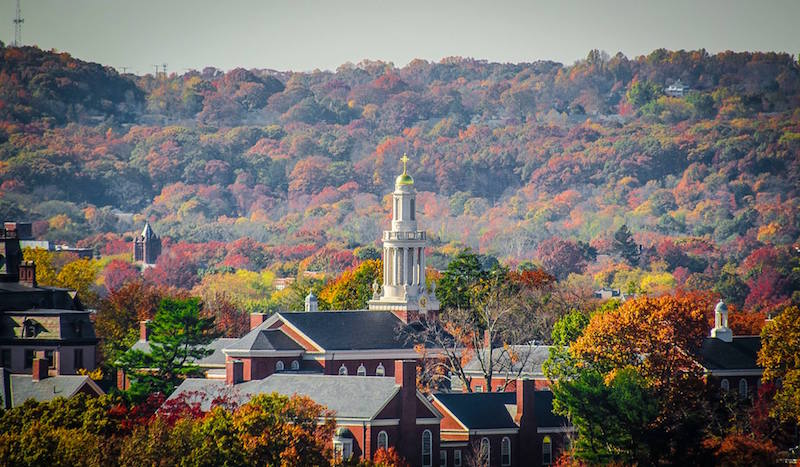
YDS Chapel - below the hill was the congregation where I worked for the year.
Sterling Library is now even more glorious inside (no mouse-scented card catalogues.
Harkness Bell Tower is perhaps a substitute for Gothic buildings.
I have the best memories of YDS and the students. Someone who attended later wrote to me, "You had the best professors. They were gone when I went there."
An official, paid guide for our anniversary gathering sent a poorly organized memory page to help make up the book. My only comment - "I am very disappointed in what YDS has become."
I have told others that I would not suggest even a 100% paid tuition for someone to attend now. To make things worse, they are completing an eco-planet- friendly new building that is already an eyesore.
Nils A. Dahl was my New Testament professor and the leader of his department, world known and highly regarded.
Ethics professor Paul Holmer was so good that I went back to take a summer course from him.
Many arguments are unedifying. They remind me of toy balloons filled with hot air and let loose.
They make some rude noises,
Fly around unpredictably, and
Quickly run out of energy.
One clue is the leading argument, a series of personal attacks followed by an equally weak series of straw man logical fallacies. The straw man fallacy flops by claiming, "You are saying..." and filling in the blank with nonsense. In contrast, a good argument offers a fair summary, often with quotations, and then uses evidence to refute the opponents' position.
Has anyone seen an article or book promoting Objective Justification which lays out the arguments for Justification by Faith as expressed in the Scriptures and Lutheran Reformation? No, they communicate the attitude that there is only one position, which was always there. As WELS claims, the NIV finally has the wording Paul would have used if he were a better writer - as in "all are justified." Paul was OJ - who knew?
Ignoring Academic Truths
The genius of current argumentation is ignoring academic truths and rushing ahead with their substitution for those truths, an effort to establish their opinions as the new canon, undeniable eternal truths.
I was thinking last night about academic truths ignored in various discussions. By academic, I mean a body of evidence that can be easily uncovered if there is a desire to do so, often by research or writing by well known leaders of the past.
Biblical Inerrancy
This was the universal belief of various Christian confessions, opposed only by small sects such as the Socianians and early Unitarians. This changed very slowly from the influence of Halle University Pietists who ushered in an era of rationalism at their school. British rationalists also contributed to this change, hailed by the modern New Testament scholars. Their heroes came mostly from rationalistic Halle.
The change in America began with attacks on the traditional New Testament text. The three frauds - Tischendorf, Westcott, and Hort - invented their own style of text, hailed as scientific. The vast majority of Christian leaders and scholars advocate this "scientific" text and refuse to use or name anything (KJV family) using the traditional text. If the actual text of the Old and New Testaments are voted upon by post-moderns, why take its meaning seriously. The same blunt instruments have been applied to the canon, the number of books in the Bible, with similar results.
Creation
When we read the history of science, the current authors fail to explain - their heroes and heroines believed God created the universe. That position is not allowed in any science curriculum or science department today.
But that is also true at Concordia, St. Louis, where Creation is watered down and those who object are labeled slanderers. The confessional chameleon, Matt Harris, responded, "I believe, help Thou my unbelief."
Justification by Faith
Apart from the sterile, mummified domains of Midwestern Lutheran sects, everyone else has known and taught that Justification by Faith was the foundation of the Lutheran Reformation. Zwingli's and Calvin's alleged improvements only show that they hitched a ride and tried to feign allegiance because the work and sacrifices had been made.
But lo, the heirs of the syphilitic bishop, Martin Stephan, continue to leverage their Easter absolution of the world against the Bible, Reformation, and Book of Concord. They only magnify their errors by picking one moment after another for their Objective Justification. When asked to prove their thesis, they run like cowards and cry like Brownies whose cookies were stolen.
Not everyone gets to know world famous Yale church historians like Roland Bainton and Jaroslav Pelikan, but the unenlightened could take a peek at the books and articles they published.
Remember that David Scaer sneered at Walter Maier and his family, though the patriarch earned a PhD in Semitics (Old Testament languages) and established a world-famous radio ministry. He did not fail his PhD thesis and come home to a G.E.D. (good enough degree) from Concordia, St. Louis. Perhaps one should pay some attention to the scholar-broadcaster instead of rehearsing grudges like Waldo Werning in his last book. They are hilariously similar in tone and doctrinal confusion, Scaer's and Werning's.
Avoid Sectarian Thinking
True scholars avoid sectarian thinking, but the rebels get punished - even in science.
The problem with religious sects is that the opinions of one become the canonized truths of the entire group, an effect enhanced by the outrage of relatives and descendants.
A scholar is not someone with a PhD. That is an American obsession. The word "scholar" comes from the Greek word for leisure, because their scholars did not have degrees but original thoughts and creations.
The clergy, from MDivs on down to DMins from Fuller, are the least likely to be scholars. The interested laity are the most likely to study the Word of God, the Book of Concord, and faithful books, without being tied down to the political opinions of the seminary faculty.
The Lutheran clergy are have already taken their denominations down the road to Perdition. There is no essential difference between the OJ of ELCA and the OJ of WELS-ELS-LCMS-OLCC-CLC (sic). Their Church Growth was learned at the same schools, like Fuller,Trinity Divinity, and Willow Creek. Take the photo quiz below and ask, "Which synod is superior to the other?"
Future ELCA pastor Anders Nelson danced at the Luther Seminary chapel, the hoots and applause of his friends in the recording.
WELS Keynote speaker at the Leadership Conference not only had a cross-dressing congregational picnic, but they still post all the photos.
A. D. Mattson was the subject of my PhD dissertation at Notre Dame.
I was looking for information about one of the early feminist radicals in the LCA, because they chose her to give the A. D. Mattson Lectures at the LCA's Chicago Seminary. That led me to a journal article where they talked about the Augustana (Swedish-American) Synod as rather small. It had 600,000 baptized members at the time of the 1962 merger.
I wonder if Lutherans will remember Roland Bainton's Here I Stand during this year of ignoring the Reformation's 500th.
The YDS chapel rises above the Georgian style campus.
I zoomed around the Net for a time, going from one article to the next, a combination of nostalgia about
Yale (where A. D. and his brother Karl were),
the Quad Cities, where I am from, and
various overlapping figures.
The Mattson and Bergendoff families were related. At one point Conrad Bergendoff was president of Augustana College, Karl Mattson was president of Augustana Seminary, and A. D. Mattson taught at the seminary.
Our son posed with the ever-gracious Paul L. Holmer.
Another connection was Gustav Andreen, the Augustana college president who left a full professorship at Yale University to lead their struggling college. His daughter and my mother were friends via the local teachers' network. I met Andreen's daughter at Augustana and she said, "Are you going to be a teacher like your mother?" I said, "No," and now I am teaching at three institutions.
My dissertation advisor at Notre Dame had some of the same professors at Yale that I had. And he taught at Augustana College - Stan Hauerwas.
I was on the staff at Bethesda Lutheran Church in New Haven, just down the hill from Yale Divinity School. The pastor became the Bishop of the district once it was ELCA. Mattson's brother Karl was the pastor of that congregation. When we were there, all the Lutheran YDS professors worshiped at Bethesda -
Paul L. Holmer - Theology and ethics.
Nils A. Dahl - New Testament.
Sydney Ahlstrom - Church History.
George Lindbeck - Theology, Official observer at Vatican II.
Jaroslav Pelikan - Church History.
Roland Bainton had an apartment just around the corner from the church, and he was often around the campus. He was dubbed an honorary Lutheran, and we all came to hear him when he gave lectures. The Lutheran divinity students were numerous. My classmate in New Testament, Stan Olson, became a seminary professor, a bishop, one of the top ELCA leaders in NYC, finishing as the president at the failing Luther Seminary in Iowa.
Harvard New Testament scholar Krister Stendahl called Nils Dahl the best exegete in the world.
I wonder if any of those who established these church and educational institutions would recognize who is currently living off those endowments today. Some of the endowment consists of gifts accumulated over the centuries. Most important is another endowment - the heritage squandered, with all traces expelled. But naturally, they want to be associated with the respect earned in the past. They will drain that away with their hysterical hatred of the past.
ELCA is no different from the LCMS, WELS, or Little Sect on the Prairie. ELCA is just a few years ahead of the rest. I could add details, but I have covered that ground many times before. That is why I write about apostasy rather than the glories of Holy Mother Sect.
The main library at Yale is awe-inspiring, fashioned like a "temple of wisdom," as Bainton said. But now, that wisdom is largely repudiated.
“The
single work for which Latourette is most remembered is the seven-volume "A
History of the Expansion of Christianity".[9]Latourette noted within Volume 4 that only 5% of Americans in 1790
had formal ties to churches or synagogues.” Wiki Latourette was prolific in writing, very much loved by students at Yale, and a genuine believer.
Jaroslav Pelikan, LCMS, ELCA, Eastern Orthodox
Jaroslav
Pelikan was very famous. We often saw him at Bethesda Lutheran Church. I think
he was more of an opportunist. He became “senior editor” of Luther’s Works then
left that to be at Yale, if I remember the facts correctly. Someone else
continued the work, and Pelikan got most of the credit.
One
long-term history professor at Yale thought Pelikan’s history of Christianity
was not good at all. He published a tough review in the Yale Divinity magazine. It
was a shock for Yale to have a Yale professor say the Great Pelikan was not that
good. Pelikan wanted to be Yale President, I think, and devoted a lot of time to
that. Pelikan became Eastern Orthodox after leaving the LCMS for ELCA. He won a $500,000 prize and gave it to the Russian Orthodoxy Seminary in America.
Sydney Ahlstrom, (Augustana Synod) another Lutheran, wrote his famous American Church History book. A bit
too general for me. The joke was “A elephant conceived and bore a mouse.”
Ahlstrom had serious neurological problems and that may have blunted his
efforts. Still, it was a best seller.