Showing posts with label Faith. Show all posts

Tuesday, January 20, 2026

Grace - The Most Abused Word in the New Testament - Our Fault!


How easily we use the word "grace" while letting the concept wither and fade. Repetition of "grace" is even more likely to miss the connection.

5 Therefore being justified by faith, we have peace with God through our Lord Jesus Christ:

By whom also we have access by faith into this grace wherein we stand, and rejoice in hope of the glory of God.

"Boi Gollie!" as my father-in-law used to say. The only way we can enjoy grace is by faith in Jesus Christ. The abundance of grace is from the greatness of His. 

And not only so, but we glory in tribulations also: knowing that tribulation worketh patience;

And patience, experience; and experience, hope:

And hope maketh not ashamed; because the love of God is shed abroad in our hearts by the Holy Ghost which is given unto us.


Friday, May 5, 2023

Fools Rush In


Champion porkers run to get the latest, whether Unstuck or another tasty treat for their ever growing tummies. Paul and Luther wrote about that.

The porkers have something much better than faith in Jesus Christ. Their gimmicks work faster and delight the dullest crowd. 

In time, the people - even the clergy - begin to question the poison being offered and guaranteed to work.

  1. Why do we need coffee, soft drinks, and munchies to worship the Father, Son, and Holy Spirit?
  2. Why are we adding an ice cream soda fountain?
  3. Where is the cross? Willow Creek is so big, why can't they afford a cross?
  4. Why do they copy the same things our sales people do to make money?
  5. Why are they unclear about the Bible and tell us to work it out on our own?
  6. Why did Pastor Joel help break up a marriage so two men could be together and stay in the church?
  7. Where does the money come from to settle lawsuits?
  8. Is it normal for the worship professor to be arrested for drunken driving?
  9. Do all our missionaries drive into utility poles before leaving for Russia?
  10. Why are we told not to use one Bible, the KJV, when we have to buy or bring ONE Bible, the NIV?
  11. Where did the seminarians go?
  12. Where did all the highly touted missions go?
  13. Why was grandma told she was giving away her estate to the "church" when they meant the synod, not the congregation?
  14. Why are Missouri and WELS congregations asking about women taking over, just like ELCA?


Thursday, October 27, 2022

Reason instead of Faith - From Lenski, More Than a Century Ago


If I have a friend who thinks he is a Christian, and yet believes in this latter kind of (delusional) faith, do you think going over the following passage with him would do any good?

Any suggestions welcome.

quote:

"The adepts of faith-cure look upon disease as something subject to “faith,” namely to what they call faith. This faith simply appears to be a conviction that what they want shall and will take place. This is not the faith of which the Scriptures speak, it is not Christian faith. It is a man-made thing, and when mistaken for Christian faith a terrible delusion. Disease is not subject to this man-made faith of faith-curists any more than to strong mental impressions generally. Christianity has nothing to do with it, for pagans may have this faith. Disease is not subject even to Christian faith, so that when a faithful Christian prays to be healed, healing will certainly take place. St. Paul had faith, and prayed in faith to be healed of a thorn in the flesh, yet God answered him by allowing the affliction to remain, declaring: “My grace is sufficient for thee.” 2 Cor. 12:7-9. The great function of Christian faith is not to shake off disease, but to trust in Christ, to embrace forgiveness and salvation, and to submit to His will, which is often that we shall be sick and suffer. The plea of faith-curists, when they fail, that the patient had not faith, is an empty excuse to explain away failure. Some have the “faith” of the faith-curists, and yet remain sick and die; others get well without it."

From: Lenski. “Faith Cure and Christian Science” in Loy, ed. The Columbus Theological Magazine. Vol. 18, 1898. LutheranLibrary.org

***

GJ - Lenski was ahead of the rationalists, who were plentiful back then as well. The essence of curing by faith in the Bible is the idea that believing - or having positive thoughts - is curing. 

I have often heard people write on Facebook, "I am sending positive thoughts to you," which sounds like a new and emission-free power source. I am not the target, so I have not had the chance to test it.

The original New Testament, in Greek, is mostly comprised of common words from the time, so it is called Koine Greek, common Greek. Most of the time, the Greek word in use at the time is what we read in the Scriptures. People will focus on one word and use the word out of context. The extremists of this style are said to suffer from studying Kittel, an alphabetical set of volumes practicing this magic.

The meaning comes from the context and familiarity with it. That is why so few pastors know the New Testament. They look at a Greek word they do not know and fly away with the claims of some source. There are also entire verses removed for the sake of clarity! - typical ESV and NIV, plus RSV and NRSV, and Beck.

I follow Luther's approach of knowing the entire Bible serves as a unified truth, the Book of the Holy Spirit. That is God's intention, in contrast to those who pick a verse - or just a phrase - and run off in every direction without anchoring the claim with various Scriptures. 

The vacuous Objective Justification parsons and their Church Growth allies are prisoners of rationalistic nonsense. It is not surprise that some of the loudest advocates of both have become atheists.


Sunday, December 27, 2020

Luther Quotation - On Faith


8. Do you ask: “What then am I to do? How shall I make myself good and acceptable in person to begin with? how secure that justification? The Gospel replies: “Hear Christ and believe in him, utterly despairing of yourself and resting assured you will be changed some Cain to an Abel and then present your offerings.” Just as faith is proclaimed without merit or work on your part, it is also bestowed regardless of your works, without any of your merits. It is given of pure grace. Note, faith justifies the individual; faith is justification. Because of faith God remits all sins, and forgives the old Adam and the Cain in our nature, for the sake of Christ his beloved Son, whose name faith represents. More, he bestows his Holy Spirit. The Holy Spirit changes the individual into a new creature, one with different reason and different will, and inclined to the good. Such a one, wherever he is, performs wholly good works, and all his works are good; as taught in the preceding epistle lesson.


I was reminded of Hebrews 11:1 -

"Now faith is the substance of things hoped for, the evidence of things not seen."

Monday, January 14, 2019

The UOJ Agenda - Secretive and Dishonest. Destructive Dogma.
"Faith Is Not a Work, Believe It or Not!" - Christina Jackson

 Dead Last Lutherans will not allow anyone to post about Justification by Faith: it gets their didies in a knot.

Example 1:
One person read the posts on WELS' secret hazing rites, which begin at the prep schools and continue to seminary at Mordor in Mequon. Response? - jaw dropping. No one knows about GA, now called HB, because squealers are punished and complainers are never forgiven for hating GA/HB and all it stands for.

Example 2: 
A conservative LCMS pastor had no idea about UOJ. He was near retirement, a friend of Otten. When he heard the details from a layman, he was appalled and thought UOJ was nonsense. However, once the UOJ palace guards were alerted, someone re-educated the pastor. If anything, he ended up confused. He became quite hostile toward anyone who doubted UOJ.


The Destructive Dogma of UOJ
Consider this, readers - I was a student at Mordor, second semester, and took Panning's class on Romans. I knew some details about the Kokomo Statements, but somehow we got through Romans 6 without ever discussing it. Therefore, no feathers were ruffled, no little boats rocked. Mequon, so ossified and mummified, did not want doctrinal discussions.

For some time I thought Objective Justification was simply another name for the Atonement. Wrong!

By the way - OJ, UOJ, General Justification, and the Justification of the World are all the same bucket of Dreck. The salesmen rest their dogma on God declaring the entire world forgiven and saved, without the Means of Grace, without faith. Of course, they are not so clear and simple in their wording. Note these two things:

  1. The declaration by God is justification language.
  2. The forgiveness language is from Justification by Faith but ripped from its original place in the Scriptures. The UOJ salesmen hate to say the dreaded words - Justification by Faith. They make people feel bad about faith.

The Attack on Faith
As Brett Meyer pointed out many times, the LCMS like to repeat the Waltherian version of faith as cold, dead fingers clinging to forgiveness.

Walther's version of faith is agreeing, making a decision, that the entire world has already been forgiven. Agreeing to false doctrine is not faith, but stupidity and error.

There are constant, ominous warnings that "You are making faith a work." One version is "Your faith is in faith. You are not a Christian, you are a Faithian." Luther called himself a Sola-fide-ist, so that would make him a Faithian too.

My wife Christina summed it up, saying, "Faith is not a work, believe it or not." That is worth remembering - catechism with humor.

Faith comes from God, the Holy Spirit at work in the Gospel Word, so impugning faith is dishonest, heretical, and ignorant. And yet, that is the reigning dogma of the LCMS, WELS, and Little Sect on the Prairie.

 Edward Preuss became a Roman Catholic lay leader, a very important editor. The UOJ salesmen love E.P., who left teaching at Concordia, St. Louis - for the Church of Rome.


The Attack on the Atonement
The UOJ salesmen would like everyone to think they are overflowing with grace and experts on the Atonement. But that is not so. They abuse and distort the Atonement.

The Old Testament Gospel shows how wrong they are. Let us simply read it here.

---

Isaiah 52 13 Behold, my servant shall deal prudently, he shall be exalted and extolled, and be very high.


14 As many were astonied at thee; his visage was so marred more than any man, and his form more than the sons of men:

15 So shall he sprinkle many nations; the kings shall shut their mouths at him: for that which had not been told them shall they see; and that which they had not heard shall they consider.


53 Who hath believed our report? and to whom is the arm of the Lord revealed?

2 For he shall grow up before him as a tender plant, and as a root out of a dry ground: he hath no form nor comeliness; and when we shall see him, there is no beauty that we should desire him.

3 He is despised and rejected of men; a man of sorrows, and acquainted with grief: and we hid as it were our faces from him; he was despised, and we esteemed him not.

4 Surely he hath borne our griefs, and carried our sorrows: yet we did esteem him stricken, smitten of God, and afflicted.

5 But he was wounded for our transgressions, he was bruised for our iniquities: the chastisement of our peace was upon him; and with his stripes we are healed.

6 All we like sheep have gone astray; we have turned every one to his own way; and the Lord hath laid on him the iniquity of us all.

7 He was oppressed, and he was afflicted, yet he opened not his mouth: he is brought as a lamb to the slaughter, and as a sheep before her shearers is dumb, so he openeth not his mouth.

8 He was taken from prison and from judgment: and who shall declare his generation? for he was cut off out of the land of the living: for the transgression of my people was he stricken.

9 And he made his grave with the wicked, and with the rich in his death; because he had done no violence, neither was any deceit in his mouth.

10 Yet it pleased the Lord to bruise him; he hath put him to grief: when thou shalt make his soul an offering for sin, he shall see his seed, he shall prolong his days, and the pleasure of the Lord shall prosper in his hand.

11 He shall see of the travail of his soul, and shall be satisfied: by his knowledge shall my righteous servant justify many; for he shall bear their iniquities.

12 Therefore will I divide him a portion with the great, and he shall divide the spoil with the strong; because he hath poured out his soul unto death: and he was numbered with the transgressors; and he bare the sin of many, and made intercession for the transgressors.

---


The Old Testament Gospel, central to converting Jews to Christianity, is not "God's declaration of the entire world of unbelievers being forgiven and saved" (Walther, Pieper, Sig Becker, Bivens, Jon-Boy Buchholz, Webber, Valleskey). It is the Atonement. Missing above is any kind of Universalism, universal forgiveness, universal absolution. No one is born forgiven, as Edward Preuss claimed.

How can someone be forgiven unless they believe the Gospel? Romans 10 connects to this Isaiah passage. How can they believe unless the Gospel (above passage) is preached to them?

Consider for a moment how many Lutheran pastors and professors do not comprehend Romans 10, Romans 3 - 5, and Romans 1.

The Atonement is the act of God the Father and God the Son, taught to us by God the Holy Spirit. The efficacious Word of the Gospel creates faith in our hearts (unless it evolves, as St. Louis professors might claim). And this same Gospel Word nurtures our faith and keeps it alive and energetic. 

UOJ Stormtroopers seize every Atonement passage and try to brand it UOJ. Not so, never works. Therefore, they have kicked the true Atonement teaching to the curb to merge it with Justification by Faith.


Notice how this Fuller alumnus dishonestly moves from the Atonement to universal forgiveness without faith.

 Decision Theology - from C.F.W. Walther. He used the Halle Pietism formula - the entire world was declared forgiven when Christ rose from the dead. Walther did not know the Biblical languages and replaced Biblical exposition with his theses.


Wednesday, December 26, 2018

Luther on Faith - St. Stephen's Day


Luther's Sermons - Acts 6:8-14 and Acts 7:54-60.
St. Stephen's Day


ST. STEPHEN’S EPISTLE TEXT

TEXT: ACTS 6:8-14, AND ACTS 7:54-60. 8 And Stephen, full of grace and power, wrought great wonders and signs among the people. 9 But there arose certain of them that were of the synagogue called the synagogue of the Libertines, and of the Cyrenians, and of the Alexandrians, and of them of Cilicia and Asia, disputing with Stephen. 10 And they were not able to withstand the wisdom and the Spirit by which he spoke. 11 Then they suborned men, who said, We have heard him speak blasphemous words against Moses, and against God. 12 And they stirred up the people, and the elders, and the scribes, and came upon him, and seized him, and brought him into the council,13 and set up false witnesses, who said, This man ceaseth not to speak words against this holy place, and the law: 14 for we have heard him say, that this Jesus of Nazareth shall destroy this place, and shall change the customs which Moses delivered unto us. 54 Now when they heard these things, they were cut to the heart, and they gnashed on him with their teeth. 55 But he, being full of the Holy Spirit, looked up steadfastly into heaven, and saw the glory of God, and Jesus standing on the right hand of God,56 and said, Behold, I see the heavens opened, and the Son of man standing on the right hand of God. 57 But they cried out with a loud voice, and stopped their ears, and rushed upon him with one accord; 58 and they cast him out of the city, and stoned him: and the witnesses laid down their garments at the feet of a young man named Saul. 59 And they stoned Stephen, calling upon the Lord, and saying, Lord Jesus, receive my spirit. 60 And he kneeled down, and cried with a loud voice, Lord, lay not this sin to their charge.

And when he had said this, he fell asleep.

STEPHEN’S EXAMPLE OF FAITH.

1. It is necessary to the understanding of this epistle lesson to introduce something of what is omitted and to present in connection with the narrative the things which gave rise to it. The dispute arose from Stephen’s assertion that whatsoever proceeds not from faith does not profit, and that men cannot serve God by the erection of churches, or by works independent of faith in Jesus Christ. Faith alone renders us godly; faith alone builds the temple of God — the believing hearts. The Jews opposed the doctrine of faith, adducing the law of Moses and the temple at Jerusalem. For the Bible makes frequent mention of Jerusalem as God’s chosen city, toward which his eyes are always directed, a city called the house of God. Such argument they presumed to be conclusive.

2. Stephen, however, opposes them by citing Isaiah 66:1-2: “Heaven is my throne, and the earth is my footstool: what manner of house will ye build unto me? and what place shall be my rest? For all these things hath my hand made, and so all these things came to be, saith Jehovah.” This statement is clear and forcible beyond gainsaying. It shows God does not dwell in houses made with hands, for the essential elements of these are, in the first place, of his own creating and belong to him. Further, if heaven nor earth can contain him — and he here asserts that heaven is not his house but his throne, and the earth not his habitation but his footstool — how can he be expected to dwell in a house made by men? Solomon speaks to the same purpose in 1 Kings 8:27, referring to the house he has himself built.

3. Defeated by the power of this passage from Isaiah, and similar citations they could not gainsay, the Jews proceeded to misconstrue Stephen’s words, making out that he declared Jesus would destroy the temple and change the customs of Moses. Yet Stephen had no intention of giving such impression. He simply asserted that we are saved not by the Law or the temple, but by faith in Jesus Christ; and that having faith we may rightly observe the Law, whether there be temple or not. Stephen’s purpose was merely to remove the Jews’ false confidence in their own works and in the temple.

4. Similar to them, the Papists of today, when they hear it claimed that works are not effectual and that faith in Christ must precede and must be of sole efficacy, cry out that good works are prohibited, and God’s commandments blasphemed. Were Stephen a preacher of today he might not, it is true, be stoned, but he would be burned, or dismembered with tongs, by the enraged Papists.

5. Stephen replies to the false accusation of the Jews. Beginning with Abraham, he goes on through the Scriptures, showing how, previous to the time of Solomon who built a house for God, neither Abraham nor any other of the patriarchs ever built a house for his service, but they were not for that reason the less regarded of God. Then Stephen adds the quotation from Isaiah. He says: “But Solomon built him a house. Howbeit the Most High dwelleth not in houses made with hands; as saith the prophet, The heaven is my throne, and the earth the footstool of my feet: what manner of house will ye build me? saith the Lord: or what is the place of my rest?

Did not my hand make all these things?”

6. After these words he rebukes them, saying: “Ye stiffnecked and uncircumcised in heart and ears, ye do always resist the Holy Spirit: as your fathers did, so do ye. Which of the prophets did not your fathers persecute? and they killed them that showed before of the coming of the Righteous One; of whom ye have now become betrayers and murderers; ye who received the law as it was ordained by angels, and kept it not.”

7. Now follows the latter part of our lesson, beginning, “Now when they heard these things, they were cut to the heart, and they gnashed on him with their teeth.” Evidently, then, the dispute was in regard to faith and good works. But how is it with the Papists, who have not the least semblance of grounds for their position other than their own human laws and doctrines? If they could produce for themselves a shadow of support such as the Jews had in adducing that God gave the law of Moses and chose the temple at Jerusalem, they would instantly raise a cry of, “By divine right” (de jure divino), as in fact did their forefathers the Jews.

BUILDING CHURCHES DOES NOT SECURE GOD’S FAVOR.

8. This epistle text seems to be not at all difficult; it is plain. It presents in Stephen an example of the faith of Christ. Little comment is necessary. We shall examine it briefly. The first principle it teaches is, we cannot secure the favor of God by erecting churches and other institutions. Stephen makes this fact plain in his citation from Isaiah.

9. But if we are to take this position and maintain it, we must incur the same risk Stephen did. Such position calls for the doing away with the bulls of the Pope, with innumerable indulgences, laws of the ecclesiasts and incessant preaching about churches, altars, institutions, cloisters, chalices, bells, tables, candles and apparel. Thus would the holiness of the Pope and his adherents be offended, and not without reason. For in consequence, luxuries of kitchen and cellar would be diminished, and all temporal possessions as well. In course of time idleness, voluptuousness and ease would have to give place to labor, poverty and unrest. The clerical order would be obliged to! study and pray, or support themselves like other people do. Such a course would not be agreeable to them. The holy Christian Church would be despised, as were Christ and the apostles. Her officials could no longer live in royal pomp, waging war, plundering, and shedding blood, all under the pretext of honoring God and exalting the holy Church. For this have the most holy fathers in God done, and still do.

10. We must not, however, be led to conclude it is wrong to build and endow churches. But it is wrong to go to the extreme of forfeiting faith and love in the effort, presuming thereby to do good works meriting God’s favor. It results in abuses precluding all moderation. Every nook and corner is filled with churches and cloisters, regardless of the object of church-building.

11. There is no other reason for building churches than to afford a place where Christians may assemble to pray, to hear the Gospel and to receive the sacraments; if indeed there is a reason. When churches cease to be used for these purposes they should be pulled down, as other buildings are when no longer of use. As it is now, the desire of every individual in the world is to establish his own chapel or altar, even his own mass, with a view of securing salvation, of purchasing heaven.

12. Is it not a miserable, a deplorable, error and delusion to teach innocent people to depend on their works to the great disparagement of their Christian faith? Better to destroy all the churches and cathedrals in the world, to burn them to ashes — it is less sinful even when done through ma-lice-than to allow one soul to be misled and lost by such error. God has given no special command in regard to the building of churches, but he has issued his commands in reference to our souls — his real and peculiar churches. Paul says concerning them ( 1 Corinthians 3:16-17): “Ye are a temple [church] of God If any man destroyeth the temple of God, him shall God destroy.”

13. But observe the holiness of the Papists. The foundation of every soul is disturbed by their error, and the real Church of God is overthrown. This fact does not deter the Papists; indeed, they willingly contribute to the overthrow of the Church. By their doctrine of works they effect nothing else but the destruction everywhere of the true Church. Then they proceed to substitute for it church buildings, of wood and stone. They misuse the conscience until it believes the trivial defacement by knife of such wood and stone is a profanation of the whole church, and the expense and labor of reconsecration must be incurred. Are not the individuals who have no conscientious scruples about the destruction of the actual Church, who even convert that great sin into eternal merit, and at the same time are extremely conscientious about the vain juggling of their own church building — are they not raving, raging, foolish and fanatical? yes, frantic, infuriated?

I continue to assert that for the sake of exterminating the error mentioned, it would be well to overthrow at once all the churches in the world, and to utilize ordinary dwellings or the open air for preaching, praying and baptizing, and for all Christian requirements.

14. Especially is there justification for so doing because of the worthless reason the Papists assign for building churches. Christ preached for over three years, but only three days in the temple at Jerusalem. The remainder of the time he spoke in the schools of the Jews, in the wilderness, on the mountains, in ships, at the feasts and otherwise in private dwellings. John the Baptist never entered the temple; he preached by the Jordan River and in all places. The apostles preached in the market-place and streets of Jerusalem on the day of Pentecost. Philip preached in a chariot to the eunuch. Paul preached to the people by the riverside; in the Philippian jail and in various private dwellings. In fact, Christ commanded the apostles ( Matthew 10:12) to preach in private houses. I presume the preachers mentioned were equally good with those of today.

15. But it must be that costly buildings with magnificent arches are required for the false preachers and diabolical teachers of today, though the Word of God could find in all Bethlehem no inn wherein to be born.

Should we not, then, with Stephen cry unto these unreasonable creatures: “Ye stiff necked and uncircumcised in heart and ears, ye do always resist the Holy Spirit. Ye are betrayers and murderers of innocent, harmless Christian souls. Though having received the commandments from the apostles, ye have observed none of them”? I suppose, should we do so, their hearts would be ready to burst with rage and they would gnash their teeth, saying we had blasphemed against God and spoken against the holy place; yes, had profaned all churches. O God, the blind leaders, and murderers of souls, who rule under the accursed popery!

16. You see now some reason why lightning strikes the costly Papist churches more frequently than it does other buildings. Apparently the wrath of God especially rests upon them because there greater sins are committed, more blasphemies uttered and greater destruction of souls and of churches wrought than take place in brothels and in thieves’ dens. The keeper of a public brothel is less a sinner than the preacher who does not deliver the true Gospel, and the brothel is not so bad as the false preacher’s Church. Even were the proprietor of the brothel daily to prostitute virgins, godly wives and nuns, awful and abominable as such action would be, he would not be any worse nor would he work more harm than those papistical preachers.

17. Does this astonish you? Remember, the false preacher’s doctrine effects nothing but daily to lead astray and to violate souls newly born in baptism — young Christians, tender souls, the pure, consecrated virgin brides of Christ. Since the evil is wrought spiritually, not bodily, no one observes it; but God is beyond measure displeased. In his wrath he cries, through the prophets, in unmistakable terms, Thou harlot who invitest every passer-by! So little can God tolerate false preaching. Jeremiah in his prayer ( Lamentations 5:11) makes this complaint, “They ravished the women in Zion, the virgins in the cities of Judah.” Now, spiritual virginity, the Christian faith, is immeasurably superior to bodily purity; for it alone can obtain heaven.

18. The false doctrines and works of the Papists are destructive not only of faith, but also of Christian love. The fool may always be known by his cap.

Many a man passes by his poor neighbor who has a sick child or wife, or is otherwise in need of assistance, and makes no effort to minister to him, but instead contributes to endow some church. Or else while health remains he endeavors to heap up treasures, and when he comes at last to his deathbed makes a will bequeathing his estate to some certain institution. He will be surrounded by priests and monks. They will extol his act, absolve the religious man, administer the Sacrament and bury him with honors. They will proclaim his name from the pulpit and during mass, and will cry: “Here is worthy conduct indeed! The man has made ample provision for his soul.

Many blessings will hereafter be conferred upon him.” Yes, hereafter but, alas, eternally too late.

19. But no one while he is living warns of the man’s sins in not administering to the wants of his neighbor when it lies in his power to relieve; in passing him by, and ignoring him as the rich man did Lazarus in the Gospel. And he does not himself recognize his sins. Hence they must remain unconfessed, unrepented of and unabsolved, however many bulls, indulgences and spiritual fathers may have served. This neglect is the very sin concerning which Christ on the day of judgment will say: “I was... naked, and ye clothed me not.” Matthew 25:43. The religious one will then reply, “I heaped up treasures to establish an institution for thee, in obedience to the Pope’s decree, and hence he has absolved me from all my sins.” What can individuals such as he expect to hear but the sentence: “Depart from me, ye cursed, into everlasting fire”? For by their works they destroy the Christian faith, and for the sake of mere wood and stone despise Christian love.

20. Let us, therefore, beloved friends, be wise; wisdom is essential. Let us truly learn we are saved through faith in Christ and that alone. This fact has been made sufficiently manifest. Then let no one rely upon his own works.

Let us in our lifetime engage only in such works as shall profit our neighbors, being indifferent to testament and institution, and direct our efforts to bettering the full course of our neighbors’ lives.

21. It is related of a pious woman, St. Elizabeth, that once upon entering a cloister and seeing on the wall a fine painting portraying the sufferings of our Lord, she exclaimed: “The cost of this painting should have been saved for the sustenance of the body; the sufferings of Christ are to be painted on your hearts.” How forcibly this godly utterance is directed against the things generally regarded precious! Were St. Elizabeth so to speak today, the Papists assuredly would burn her for blaspheming against the sufferings of Christ and for condemning good works. She would be denounced as a heretic, though her merits were to surpass the combined merits of ten saints.

GOD’S COMMANDMENTS CANNOT BE FULFILLED BY MAN’S WORKS.

22. Stephen not only rejects the conceptions of the Jews in regard to churches and their erection, but also denounces all their works, saying they have received the Law by the disposition of angels and have not kept it. So the Jews in return reprove Stephen as if he had spoken against the temple and, further, blasphemed the law of Moses and would teach strange works.

True, Stephen could not rightly have charged them with failure to observe the Law, so far as external works are considered. For they were circumcised, and observed the rules in regard to meats, apparel and festivals, and all Moses’ commands. It was their consciousness of having observed the Law that led them to stone him.

23. But Stephen’s words were prompted by the same spirit that moved Paul when he said ( Romans 3:20ff) that by the deeds of the Law no one is justified in the sight of God, faith alone being the justifier. Where the Holy Spirit is not present to grant grace, man’s heart cannot favor the Law of God; it would prefer the Law did not exist. Every individual is conscious of his own apathy and disinclination toward what is good, and of his readiness to do evil. As Moses says ( Genesis 8:21), “The imagination of man’s heart is evil from his youth.” Man, then, being unwilling, he has no real delight in doing the works of the Law. Lacking right motive, he is constrained to works through fear of punishment, of shame and hell, or else through gainful motive and hope of salvation; not through love of God and desire to honor him. All works so wrought are sheer hypocrisy, and in God’s sight are not good. But the Holy Spirit is promised to the believer in Christ, and through Christ’s grace the Spirit produces in the heart a desire for good. Under its influence the individual voluntarily and without expectation of reward performs his good works for the honor of God.

Through faith and the Spirit he is already justified and in a saved condition, a state he could never have attained by any works. In accordance with this principle, we may readily conclude that all who lack faith and grace fail to observe the Law, even though they torture themselves to death with its requirements.

24. When Stephen declares the Jews always resist the Holy Spirit, he means to imply that through their works they become presumptuous, are not inclined to accept the Spirit’s aid and are unwilling their works be rejected as ineffectual. Ever working and working to satisfy the demands of the Law, but without fulfilling its least requirement, they remain hypocrites to the end. Unwilling to embrace the faith whereby they would be able to accomplish good works, and the grace of the Spirit that would create a love for the Law, they make impossible the free, spontaneous observance of it. But the voluntary observer of the Law, and no other, God accepts.

25. Stephen calls the Jews “stiff necked, uncircumcised in heart and ears” because they refuse to listen and understand. They continually cry, “Good works, good works! Law, Law!” though not effecting the least thing themselves. Just so do our Papists. As their forefathers did, so do the descendants, the mass of this generation; they persecute the righteous and boast it is done for the sake of God and his Law. Now we have the substance of this lesson. But let us examine it a little further.

AN EXAMPLE OF GODLY ZEAL AND CHRISTIAN LOVE.

26. First, we see in Stephen’s conduct love toward God and man. He manifests his love to God by earnestly and severely censuring the Jews, calling them betrayers, murderers and transgressors of the whole Law, yes stiffnecked, and saying they resist the fulfillment of the Law and resist also the Holy Spirit himself. More than that, he calls them “uncircumcised in heart and ears.” How could he have censured them any more severely? So completely does he strip them of every creditable thing, it would seem as if he were moved by impatience and wrath.

27. But who today would the world tolerate were he to attempt such censure of the Papists? Stephen’s love for God constrained him to his act.

No one who possesses the same degree of love can be silent and calmly permit the rejection of God’s commandments. He cannot dissemble. He must censure and rebuke every opposer of God. Such conduct he cannot permit even if he risks his life to rebuke it. Love of this kind the Scriptures term “zelum Dei,” a holy indignation. For rejection of God’s commands is a slight upon his love and intolerably disparages the honor and obedience due him, honor and obedience which the zealous individual ardently seeks to promote. We have an instance of such a one in the prophet Elijah, who was remarkable for his holy indignation against the false prophets.

28. We must infer from Stephen’s example that he who silently ignores the transgression of God’s commands, or any sin, has no love for him. Then how is it with the hypocrites who applaud transgression? and with calumniators and those who laugh and eagerly listen to and speak about the faults of others?

29. That the Pope in his absurd laws enjoins the Papists against censuring governors, is not sufficient reason for any man to refrain from administering proper reproof. Whom does Stephen censure here? Is it not the governors of Jerusalem? Yet he was just an ordinary man; not ordained, not clothed with the priestly office. His example teaches the right of every Christian to justly censure the Pope and the governors. Indeed, he is under obligation to do so. Then let no one be content to think he has not such privilege. Especially should spiritual sins be rebuked. Stephen’s reproof was not directed against gross sins, but against hypocrisy; for the Jews in unbelief resisted the Holy Spirit. Thus they wrought more harm than comes from gross sins. By their laws and their works they misled themselves and the multitude.

30. Similarly do the Pope, the bishops and all the Papists deserve public censure as stiff necked and uncircumcised hypocrites, resisting the Holy Spirit and dishonoring all God’s commandments, betraying and murdering Christian souls; thereby being betrayers and murderers of the Christ who bought them with his own blood.

31. We have just had occasion to state that Stephen was a layman, an ordinary Christian, not a priest. But the Papists sing his praises as a Levite, who read the epistle or the Gospel lesson at the altar. The Papists, however, pervert the truth entirely. It is necessary for us, therefore, to know what Luke says in Acts 4 and 5. He tells how the Christians in the inception of the Church, at Jerusalem, made all their possessions common property and the apostles distributed to each member of the congregation as he needed, But, as it happened, the widows of the Grecian Jews were not provided for as were the Hebrew widows; hence arose complaint. The apostles, seeing how the duty of providing for these things would be so burdensome as to interfere in a measure with their duties of praying and preaching, assembled the multitude of the disciples and said: “It is not fit that we should forsake the Word of God, and serve tables. Look ye out therefore, brethren, from among you seven men of good report, full of the Spirit and of wisdom, whom we may appoint over this business. But we will continue steadfastly in prayer, and in the ministry of the word.” Acts 6:2-4. So Stephen, in connection with six others, was chosen to distribute the goods. Thence comes the word “deacon,” servant or minister. For these men served the congregation, ministering to their temporal wants.

32. Plainly, then, Stephen was a steward, or an administrator and guardian of the temporal goods of the Christians his duty was to administer them to those in need. In course of time his office was perverted into that of a priest who reads the epistle and Gospel lessons. The only trace left of Stephen’s office is the slight resemblance found in the duty of the nuns’ provosts, and in that of the administrators of hospitals and of the guardians of the poor. The readers of the epistle and Gospel selections should be, not the consecrated, the shorn, the bearers of dalmatics and brushers of flies at the altar, but ordinary godly laymen who keep a record of the needy and have charge of the common fund for distribution as necessity requires.

Such was the actual office of Stephen. He never dreamed of reading epistles and Gospels, or of bald pates and dalmatics. Those are all human devices.

THE AUTHORITY OF LAYMEN TO PREACH.

33. As to the question that may arise whether an ordinary layman may be allowed to preach: Though Stephen was not appointed to preach — the apostles, as stated, reserved that office to themselves — but to perform the duties of a steward, yet when he went to the market-place and mingled among the people, he immediately created a stir by performing signs and wonders, as the epistle says, and he even censured the rulers. Had the Pope and his followers been present, they certainly would have inquired as to his credentials — his Church passport and his ecclesiastical character; and had he been lacking a bald pate and a prayer-book, undoubtedly he would have been committed to the flames as a heretic since he was not a priest nor a clergyman. These titles, which the Scriptures accord all Christians, the Papists have appropriated to themselves alone, terming all other men “the laity,” and themselves “the Church,” as if the laity were not a part of the Church. At the same time these people of boasted refinement and nobility do not in a single instance fill the office or do the work of a priest, of a clergyman or of the Church. They but dupe the world with their human devices.

34. The precedent of Stephen holds good. His example gives all men authority to preach wherever they can find hearers, whether it be in a building or at the market-place. He does not confine the preaching of God’s Word to bald pates and long gowns. At the same time he does not interfere with the preaching of the apostles. He attends to the duties of his own office and is readily silent where it is the place of the apostles to preach.

True, order must be observed. All cannot speak at once. Paul writes in the fourteenth chapter of 1 Corinthians ( 1 Corinthians 14) that one or two are to be permitted to speak, and that if a revelation be made to a listener the speaker is to keep silence. That such was the practice of the apostles is evident from Acts 15, where we read how, after the discourses of certain Pharisees, Peter preached, and when he ceased Barnabas and Paul followed, and lastly James. Each spoke in his turn. To a very slight extent the custom still exists in the debates of colleges, but at present sermons are only idle talk about Dietrich of Bern or some dream of the speaker.

35. A sermon proper should be conducted as a dissertation upon any subject at the social board. Christ, therefore, instituted the Holy Supper as an occasion where we might treat of his Word as we sit at table. But now all is perverted and divine order is superseded by arrangements merely human. But let this suffice on this point.

36. In the second place, Stephen’s conduct is a beautiful example of love for fellowmen in that he entertains no ill-will toward even his murderers.

However severely he rebukes them in his zeal for the honor of God, such is the kindly feeling he has for them that in the very agonies of death, having made provision for himself by commending his Spirit to God, he has no further thought about himself but is all concern for them. Under the influence of that love he yields up his spirit. Not undesignedly does Luke place Stephen’s prayer for his murderers at the close of the narrative. Note also, when praying for himself and commending his spirit to God he stood, but he knelt to pray for his murderers. Further, he cried with a loud voice as he prayed for them, which he did not do for himself.

37. How much more fervently he prayed for his enemies than for himself!

How his heart must have burned, his eyes have overflowed and his entire body been agitated and moved with compassion as he beheld the wretchedness of his enemies! It is the opinion of St. Augustine that Paul was saved by this prayer. And it is not unreasonable to believe that God truly heard it and that from eternity he foresaw a great result from this dispensation. The person of Paul is evidence of God’s answer to Stephen’s prayer. It could not be denied, though all may not have been saved.

38. Stephen aptly chooses his words, saying, “Lay not this sin to their charge;” that is, make not their sin unremovable, like a pillar or a foundation. By these words Stephen makes confession, repents and renders satisfaction for sin, in behalf of his murderers. His words imply: “Beloved Lord, truly they commit a sin, a wrong. This cannot be denied.” Just as it is customary in repentance and confession simply to deplore and confess the guilt. Stephen then prays, offering himself up that abundant satisfaction may surely be made for sin.

39. Note how great an enemy and at the same time how great a friend true love can be; how severe its censures and how sweet its aid. It is like a nut with a hard shell and a sweet kernel. Bitter to our old Adam nature, it is exceedingly sweet to the new man in us.

EXAMPLE OF COMFORT AND ENCOURAGEMENT.

40. This epistle lesson, by the example given, inculcates the forcible doctrine of faith and love; and more, it affords comfort and encouragement. It not only teaches; it incites and impels. Death, the terror of the world, it styles a sleep; Luke says, “He fell asleep.” That is, Stephen’s death was quiet and painless; he departed as one goes to sleep, unknowing how — unconsciously falls asleep.

41. The theory that the Christian’s death is a sleep, a peaceful passing, has safe foundation in the declaration of the Spirit. The Spirit will not deceive us. Christ’s grace and power make death peaceful. Its bitterness is far re. moved by Christ’s death when we believe in him. He says ( John 8:51), “If a man keep my word, he shall never see death.” Why shall he not see it?

Because the soul, embraced in his living Word and filled with that life, cannot be sensible of death. The Word lives and knows no death; so the soul which believes in that Word and lives in it, likewise does not taste death. This is why Christ’s words are called words of life. They are the words of life; he who hangs upon them, who believes in them, must live.

42. Comfort and encouragement are further increased by Stephen’s assertion, “I see the heavens opened, and the Son of man standing on the right hand of God.” Here we see how faithfully and lovingly Christ watches over us, and how ready he is to aid us if we but believe in him and will cheerfully risk our lives for his sake. The vision was not given solely on Stephen’s account; it was not recorded for his profit. It was for our consolation, to remove all doubt of our privilege to enjoy the same happy results, provided we conduct ourselves as Stephen did.

43. The fact that the heavens are open affords us the greatest comfort and removes all terror of death. What should not stand open and ready for us when the heavens, the supreme work of creation, are waiting wide for us and rejoicing at our approach? It may be your desire to see them visibly open to you. But were everyone to behold, where would faith be? That the vision was once given to man is enough for the comfort of all Christians, for the comfort and strengthening of their faith and for the removal of all death’s terrors. For as we believe, so shall we experience, even though we see not physically.

44. Would not the angels, yes all creatures, lend willing assistance when the Lord himself stands ready to help? Remarkably, Stephen saw not an angel, not God himself, but the man Christ, he who most delights humanity and who affords man the strongest comfort. Man, especially when in distress, welcomes the sight of another man in preference to that of angels or other creatures.

45. Our artful teachers who would measure the works of God by their own reason, or the seas with a spoon, ask: “How could Stephen look into the heavens when our vision cannot discern a bird when it soars a little high?

How could he see Christ distinctly enough to recognize him for a certainty?

A man upon a high steeple appears to us a child, and we cannot recognize his person.” They attempt to settle the question by declaring Stephen’s vision must have been supernaturally quickened, permitting him to see clearly into infinite space. But suppose Stephen had been under a roof or within a vault? Away with such human nonsense! Paul when near Damascus certainly heard the voice of Christ from heaven and his hearing was not quickened for the occasion. The apostles on Mount Tabor, John the Baptist ( Luke 3:22) and again the people ( John 12:29) — these all heard the voice of the Father with their ordinary hearing. Is it not more difficult to hear a voice from a great distance above than to see an object in the same place? The range of our vision is immeasurably wider than the scope of our hearing.

46. When God desires to reveal himself, heaven and everything else requisite are near. It matters not whether Stephen were beneath a roof or in the open air, heaven was near to him. Abnormal vision was not necessary.

God is everywhere; there is no need that he come down from heaven. A vision, at close range, of God actually in heaven is easily possible without the quickening or perverting of the senses.

47. It matters not whether or no we fully comprehend how such a vision is effected. It is not intended that the wonders of God be brought within our grasp; they are manifested to induce in us belief and confidence. Explain to me, ye of boasted wisdom, how the comparatively large apple or pear or cherry can be grown through the tiny stem; or even explain less mysterious things. But permit God to work; believe in his wonders and do not presume to bring him within your comprehension.

48. Who can number the virtues illustrated in Stephen’s example? There loom up all the fruits of the Spirit. We find love, faith, patience, benevolence, peace, meekness, wisdom, truth, simplicity, strength, consolation, philanthropy. We see there also hatred and censure for all forms of evil. We note a disposition not to value worldly advantage nor to dread the terrors of death. Liberty, tranquility and all the noble virtues and graces are in evidence. There is no virtue but is illustrated in this example; no vice it does not rebuke. Well may the evangelist say Stephen was full of faith and power. Power here implies activity. Luke would says, “His faith was great; hence his many and mighty works.” For when faith truly exists, its fruits must follow. The greater the faith, the more abundant its fruits.

49. True faith is a strong, active and efficacious principle. Nothing is impossible to it. It rests not nor hesitates. Stephen, because of the superior activity of his faith, performed not merely ordinary works, but wrought wonders and signs publicly — great wonders and signs, as Luke says. This is written for a sign that the inactive individual lacks in faith, and has no right to boast of having it. Not undesignedly is the word “faith” placed before the word “power.” The intention was to show that works are evidence of faith, and that without faith nothing good can be accomplished.

Faith must be primary in every act. To this end may God assist us. Amen. 

Saturday, December 1, 2018

Now Let Us Pose the Three Apostates with Luther's Sermon for Advent 1

They agree in opposing Justification by Faith, and they call their obstinate opposition to the Gospel the Chief Article of Christianity!


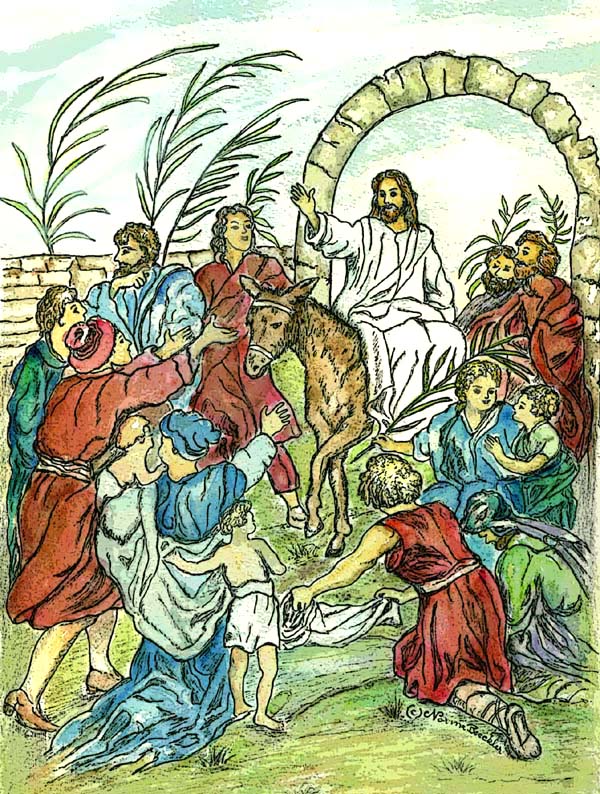
2. This Gospel encourages and demands faith, for it prefigures Christ coming with grace, whom none may receive or accept save he who believes him to be the man, and has the mind, as this Gospel portrays in Christ. Nothing but the mercy, tenderness and kindness of Christ are here shown, and he who so receives and believes on him is saved. He sits not upon a proud steed, an animal of war, nor does he come in great pomp and power, but sitting upon an ass, an animal of peace fit only for burdens and labor and a help to man. He indicates by this that he comes not to frighten man, nor to drive or crush him, but to help him and to carry his burden for him. And although it was the custom of the country to ride on asses and to use horses for war, as the Scriptures often tell us, yet here the object is to show that the entrance of this king shall be meek and lowly.


15. Let us receive first and hold fast this picture in which the nature of faith is placed before us. For as the appearance and object of faith as here presented is contrary to nature and reason, so the same ineffectual and unreasonable appearance is to be found in all articles and instances of faith.

It would be no faith if it appeared and acted as faith acts and as the words indicate. It is faith because it does not appear and deport itself as faith and as the words declare.

If Christ had entered in splendor like a king of earth, the appearance and the words would have been according to nature and reason and would have seemed to the eye according to the words, but then there would have been no room for faith. He who believes in Christ must find riches in poverty, honor in dishonor, joy in sorrow, life in death, and hold fast to them in that faith which clings to the Word and expects such things.


--

18. See, such great things are contained in these seemingly unimportant words: “Behold, thy king.” Such boundless gifts are brought by this poor and despised king. All this reason does not understand, nor nature comprehend, but faith alone does. Therefore he is called thy king; thine, who art vexed and harrassed by sin, Satan, death and hell, the flesh and the world, so that thou mayest be governed and directed in the grace, in the spirit, in life, in heaven, in God.

With this word, therefore, he demands faith in order that you may be certain that he is such a king to you, has such a kingdom, and has come and is proclaimed for this purpose. If you do not believe this of him, you will never acquire such faith by any work of yours. What you think of him you will have; what you expect of him you will find; and as you believe so shall it be to you. He will still remain what he is, the King of life, of grace, and of salvation, whether he is believed on or not.


 From Jay Webber's chasuble Facebook page:
she matches the altar. Why are UOJ salesmen keener than mustard for expensive costumes?

Tuesday, May 8, 2018

Faith, the Neos, and the Quasis

 "UOJ is in here somewhere."

The pivotal issue in modern theology is faith, because the modern theologians are against it. As Professor Charles Caldwell said, "Faith without belief," and "Radicalism with a sentimental attachment to the Bible."

The origin? Calvin, his double-predestination, and his rationalism. He was Walther before Walther, which is why LCemessians should not study Calvin. They would see too much of their idol Walther in the Great Calvin.

When I hear Lutheran pastors warn against "making faith a work of man," I am reminded of all those Calvinism liberal apostate theologians. They have their little slogans too, the chief one being, "Do not allow for a contingency, because then grace is no longer grace." A contingency clause starts with if, so the modern theologians and Synodical Conference blind guides emphasize universal grace, universal forgiveness, universal salvation. But that does not mean Universalism!?

Paul did not raise himself to the level of being God's counselors, but these quacks do. So let us look at one verse which endangers their false doctrine so much that they purposefully ignore it. Yes, purpose-driven false exegesis.

Romans 4:24-25 King James Version (KJV)

24 But for us also, to whom it shall be imputed, if we believe on him that raised up Jesus our Lord from the dead;
25 Who was delivered for our offences, and was raised again for our justification.

QED (therefore, it is demonstrated that) - God speaks about forgiveness if we believe. See just a few of the passages in the Bible that address this directly, opposed to UOJ.

On the Biblical side - the Holy Spirit works through the invisible Word of teaching and preaching to bring Jesus and His grace to individuals. The Holy Spirit also works throug the visible Word (the Sacraments) as instruments of God's grace.

The Enthusiasts of Rome, Geneva, Wheaton, and Pasadena do not acknowledge or teach the efficacy of the Word in the Means of Grace. Therefore, they mill about in confusion about the way in which people are converted to the Gospel, forgiven, and saved. 

Almost all modern theologians are neos - they work against faith and deny faith - but they imagine their work is a collection of fabulous wisdom. Although it may be interesting to read the imaginative literature of C. S. Lewis, he was a neo, enchanted with his own views, which are are dog-eared ideas from Calvinism.

Those who identify as conservative Lutherans and even call themselves orthodox or confessional...wait, I have to pause to stop laughing - they are quasi-Lutheran at best. They know a little more about Luther than the average Unitarian, but not much. They just remember a few more talking points from Dogmatics 101. They do not read or study Luther's sermons, which are the key to everything the Reformer did.

Didja ever walk home from junior or senior high school, starved for somethign to eat? We often had donuts in a box, sometimes days old and hard as rocks. El donuts can be harder than granite when left alone a few days.When nothing was immediately available to eat, I warmed up the donuts.  I satisfied my immediate hunger, but that was not exactly nutrition. 

The Quasi-Lutherans are always looking for something, because they utterly neglect Luther and the Confessions. They see their Calvinistic Bible (probably NIV or ESV) as their guide, and grab anti-Means of Grace material as their snackfood.

On vacation in Florida, in the old days, my parents got lower and lower in cash. We were only eating fast food on the way home to Moline. What seems to appealing gets tiresome in time. Even as a kid I missed having a real, home cooked meal. Could that be the reason so few people want to sit through another amateur music hour, another meal of spiritual Twinkies and Diet Dr. Thunder?
 "We have apprehended the Justification by Faith rebel, Lord Vader. He is resisting arrest, so we will have to make him a little more eager to listen to your wisdom."

Beware of Knocking "Faith as a Work of Man"

John 6:27 Labour not for the meat which perisheth, but for that meat which endureth unto everlasting life, which the Son of man shall give unto you: for him hath God the Father sealed.
28 Then said they unto him, What shall we do, that we might work the works of God?
29 Jesus answered and said unto them, This is the work of God, that ye believe on him whom he hath sent.
30 They said therefore unto him, What sign shewest thou then, that we may see, and believe thee? what dost thou work?
31 Our fathers did eat manna in the desert; as it is written, He gave them bread from heaven to eat.
32 Then Jesus said unto them, Verily, verily, I say unto you, Moses gave you not that bread from heaven; but my Father giveth you the true bread from heaven.
33 For the bread of God is he which cometh down from heaven, and giveth life unto the world.
34 Then said they unto him, Lord, evermore give us this bread.
35 And Jesus said unto them, I am the bread of life: he that cometh to me shall never hunger; and he that believeth on me shall never thirst.

As anyone can plainly see, believing in Him is connected to the Bread of Life, never hungering, never thirsting.

 Eating three donuts will make someone hungry for three more. Donut ask how I know.