Friday, June 27, 2014

Creation and Doctrine


The Michigander writes:

The bird posts and flower posts combining care and feeding and doctrine are excellent.  They are becoming my favorites.  I have a bird question.

Are your feeders close to windows?  Mine are some 7 feet front the living room window and birds keep flying into the window pane.  Some learn that's not the direction to leave the feeders, some don't.  I wonder, with the feeders were closer to the window, if the birds would not fly away toward the window.  Or should the feeders be farther away from the house, spoiling the viewing prospects?

***

GJ - I am guessing that the birds, after feeding, see the sky in the reflection in the windows. They fly into the image. When my windows had a mirror effect in Phoenix, from a reflective film, we had quite a few bird strikes.

I keep feeders close to the window. They get used to flying there for rest and a snack. In the summer the feeder is empty because the starlings and squirrels eat everything. In Bella Vista I had so many feeders going at once that driving up to the house was like arriving at a bird sanctuary. That was ideal for birds, since we had a creek, a lawn, bushes, and oak trees - all convenient for their food and housing.

I will use a lot of suet for the winter, since fat-eating birds are also insect-eaters. I will hang a number of mesh bags on trees if I can get suet for a good price and the raccoons do not feast on them.

For now I am growing sunflowers in three different places. I enjoy watching them grow so tall (except for the Japanese one-footers) and turn into seedheads of massive size.

Writing about Creation and doctrine is easy, because so many illustrations from the Bible are based upon common knowledge of the natural world.

Mark's Gospel is known for the seed growing secretly parable - the only passage truly unique to Mark.

Mark 4:26 And he said, So is the kingdom of God, as if a man should cast seed into the ground;
27 And should sleep, and rise night and day, and the seed should spring and grow up, he knoweth not how.
28 For the earth bringeth forth fruit of herself; first the blade, then the ear, after that the full corn in the ear.
29 But when the fruit is brought forth, immediately he putteth in the sickle, because the harvest is come.
The living seed is like the Word, ready to grow when broadcast.
We are like the sower who has no idea how this happens. We can look at charts and study terms. But the complexity of the seed waking up in moisture and soil, sending down a little root and a tiny plant upward - that is a mystery to us.
We know as little about how the Word will grow as we do about the seed growing.
I planted a lot of seed along the fenceline, because the dead leaves and grass formed a natural mulch. Some of them will use the support of the chain-link fence. But most of those seeds have not shown up. Some weeds responded well to the watering, so I am suspicious that my bird friends watched my work a little too carefully.
Still, some plants will germinate slowly. Some seeds will rot in the soil. Some will definitely be eaten by a wide variety of animals. Seed purchases are estimated thus - an old gardeners rhyme:
1. One for the mouse.
2. One for the crow.
3. One to rot.
4. One to grow.
Malabar spinach is good for soups.

I now have some spinach, lettuce, and a place to plant them. Some will say, "Why did you wait until it was hot, when spinach and lettuce will bolt (go to seed)?"
Like Hamlet, I was dithering about how to open up garden space. I did not want to rototill - or shovel until I experienced once more the pain of rotator cuff injuries. One might harm the utilities, flagged or not. The other might force me to drink coffee two-handed, again. That happened with snow-shoveling. One day of glory, one year of pain.
If I do a really bad job with both crops, I will still have a fair amount of fresh lettuce and spinach before they go to seed. After that, I will have Malabar spinach growing and loving the heat, providing huge leaves that some people prefer to spinach.
I can count on many failures and successes in the garden, but even the poor performances are far better than not sowing seed at all, not planting anything.
I need a good Delphic saying like, "If you are not planting, you are still planting, because the weeds are planting theirselves." Bad grammar makes it more homespun, and user-friendly for WELS.
I still get troubled when clergy tell me they are disappointed by their numbers. I learned early to count anything above zero as a success. Why scowl and get upset at those who are there for the Means of Grace? How can we measure how the living seed of the Word will flourish and grow in the future?
Equally alarming are those assemblies where the participants are gulled into accepting their Babtist training at the hands of "conservative" Lutherans. The leaders will say, "It was a great success!" And I will say - for which Kingdom, the Kingdom of Christ or the Kingdom of Satan? Those are the Two Kingdoms at war with each other until the end of time, according to Luther.


Sowing seed abundantly is always going to favor the birds, butterflies, and bees. Food is concentrated. Insects flourish, and so do their predators. Those hated spiders spin beautiful webs that glisten in the morning dew. Birds wake up to sing Matins each morning and turn the insect population into little songbirds, a good equation.
When I spend time in the garden, birds become friendly and do not rush away. They quickly learn that the rose garden will have treats from berries and grapes too old to eat. Scraps from the peanut jar go outside as well. 
The result is hearing bird-calls when I go outside. Bluejays and robins have landed above me in a tree and called out, something like, "Where's my snack?"
The compost pile becomes another feeder when the materials are almost finished. The moist interior supports a crop of noisy, moving arthropods (all joint-footed creatures). Birds perch on the wire and dive in for a real meal.
I have seen several "compost piles" that were really garbage piles. The clergy owners did not understand the concept, so they produced a smelly pile of rotting food.
So it is when people want to be teachers of the Word but do not understand what they are handling. They wander from one fad to another, one popular writer after another.
Here are the basics for compost:
  • It might as well be fairly large, because there will never be enough of it when finished - perhaps five feet high and seven feet across. I enclose mine in chicken-wire. Other designs require more labor.
  • Compost should be in the shade as much as possible.
  • The materials rest on bare soil or sod, because the soil creatures climb into the pile as required - or as designed by the Creator.
  • Good materials include anything that has been alive, but not meat. Food garbage will attract bigger animals, unless it is just leafy leftovers. Kids - help the compost with your stewed, creamed spinach. 
  • Animal manures are good, except for cat and dog offerings, which may host organisms that spread to humans. 
  • Fresh green materials like grass are hot - warming up the compost fast and starting the process. Weeds can go in, and their seeds will be killed if everything is done well. I would put in dandelions, which are really an herb, but not witchgrass. Some interesting flowers will spread through compost if they are put in. Feverfew is one.
  • Dead leaves are great in compost but do not heat up. Some mix green stuff with leaves. I toss it all in together.
  • Soil can be added in layers, since it is alive with bacteria, molds, and soil creatures. Soil has the effect of sanitizing rot and suppressing bad aromas.
  • I put a few rotten fruits in the compost from time to time, but I fire them into the soft inner core of leaves, so we do not create a village dump aroma. A rotten apple is mostly water and will help keep the compost moist and the creatures of rot happy. "You eat my apple, but centipedes will eat you. Bwa-ha-ha."
  • Here are the denizens of compost - a great chart from Cornell.

Invertebrates of the Compost Pile

  • In small-scale outdoor composting systems, such as backyard compost piles, soil invertebrates are likely to contribute to the decomposition process. Together with bacteria, fungi, and other microbes, these organisms make up a complex food web or energy pyramid with primary, secondary, and tertiary level consumers. The base of the pyramid, or energy source, is made up of organic matter including plant and animal residues.


    Tertiary Consumers
    (organisms that eat secondary consumers)
    centipedes, predatory mites,
    rove beetles, fomicid ants,
    carabid beetles

    Secondary Consumers
    (organisms that eat primary consumers)
    springtails, some types of mites, feather-winged beetles
    nematodes, protozoa, rotifera, soil flatworms

    Primary Consumers
    (organisms that eat organic residues)
    bacteria, fungi, actinomycetes,
    nematodes, some types of mites, snails, slugs,
    earthworms, millipedes, sowbugs, whiteworms

    Organic Residues
    leaves, grass clippings, other plant debris,
    food scraps,
    fecal matter and animal bodies including those of soil invertebrates

    As you can see in this pyramid, organic residues such leaves or other plant materials are eaten by some types of invertebrates such as millipedes, sow bugs, snails and slugs. These invertebrates shred the plant materials, creating more surface area for action by fungi, bacteria, and actinomycetes (a group of organisms intermediate between bacteria and true fungi), which are in turn eaten by organisms such as mites and springtails.
    Many kinds of worms, including earthworms, nematodes, red worms and potworms eat decaying vegetation and microbes and excrete organic compounds that enrich compost. Their tunneling aerates the compost, and their feeding increases the surface area of organic matter for microbes to act upon. As each decomposer dies or excretes, more food is added to web for other decomposers.

    Nematodes: These tiny, cylindrical, often transparent microscopic worms are the most abundant of the physical decomposers - a handful of decaying compost contains several million. It has been estimated that one rotting apple contains 90,000. Under a magnifying lens they resemble fine human hair.
    Some species scavenge on decaying vegetation, some feed on bacteria, fungi, protozoa and other nematodes, and some suck the juices of plant roots, especially root vegetables.

    Mites: Mites are the second most common invertebrate found in compost. They have eight leg-like jointed appendages. Some can be seen with the naked eye and others are microscopic. Some can be seen hitching rides on the back of other faster moving invertebrates such as sowbugs, millipedes and beetles. Some scavenge on leaves, rotten wood, and other organic debris. Some species eat fungi, yet others are predators and feed on nematodes, eggs, insect larvae and other mites and springtails. Some are both free living and parasitic. One very common compost mite is globular in appearance, with bristling hairs on its back and red-orange in color.

    Springtails: Springtails are extremely numerous in compost. They are very small wingless insects and can be distinguished by their ability to jump when disturbed. They run in and around the particles in the compost and have a small spring-like structure under the belly that catapults them into the air when the spring catch is triggered. They chew on decomposing plants, pollen, grains, and fungi. They also eat nematodes and droppings of other arthropods and then meticulously clean themselves after feeding.
    Earthworms: Earthworms do the lion's share of the decomposition work among the larger compost organisms. They are constantly tunneling and feeding on dead plants and decaying insects during the daylight hours. Their tunneling aerates the compost and enables water, nutrients and oxygen to filter down. "As soil or organic matter is passed through an earthworm's digestive system, it is broken up and neutralized by secretions of calcium carbonate from calciferous glands near the worm's gizzard. Once in the gizzard, material is finely ground prior to digestion. Digestive intestinal juices rich in hormones, enzymes, and other fermenting substances continue the breakdown process. The matter passes out of the worm's body in the form of casts, which are the richest and finest quality of all humus material. Fresh casts are markedly higher in bacteria, organic material, and available nitrogen, calcium, magnesium, phosphorus and potassium than soil itself." (Rodale)
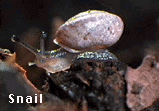
    Slugs and snails (left): Slugs and snails generally feed on living plant material but will attack fresh garbage and plant debris and will therefore appear in the compost heap.

    Centipedes (right): Centipedes are fast moving predators found mostly in the top few inches of the compost heap. They have formidable claws behind their head which possess poison glands that paralyze small red worms, insect larvae, newly hatched earthworms, and arthropods - mainly insects and spiders. To view a QuickTime movie of the centipede click on this image


    Millipedes: They are slower and more cylindrical than centipedes and have two pairs of appendages on each body segment. They feed mainly on decaying plant tissue but will eat insect carcasses and excrement.
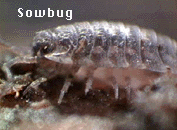
    Sow Bugs (right): Sow Bugs are fat bodied crustaceans with delicate plate-like gills along the lower surface of their abdomens which must be kept moist. They move slowly grazing on decaying vegetation.
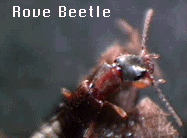
    Beetles (left): The most common beetles in compost are the rove beetle, ground beetle and feather-winged beetle. Feather-winged beetles feed on fungal spores, while the larger rove and ground beetles prey on other insects, snails, slugs and other small animals.

    Ants: Ants feed on aphid honey-dew, fungi, seeds, sweets, scraps, other insects and sometimes other ants. Compost provides some of these foods and it also provides shelter for nests and hills. Ants may benefit the compost heap by moving minerals especially phosphorus and potassium around by bringing fungi and other organisms into their nests.
    Flies: During the early stages of the composting process, flies provide ideal airborne transportation for bacteria on their way to the pile. Flies spend their larval phase in compost as maggots, which do not survive thermophilic temperatures. Adults feed upon organic vegetation.
    Spiders: Spiders feed on insects and other small invertebrates.

    Pseudoscorpions: Pseudoscorpions are predators which seize victims with their visible front claws, then inject poison from glands located at the tips of the claws. Prey include minute nematode worms, mites, larvae, and small earthworms.
    Earwigs: Earwigs are large predators, easily seen with the naked eye. They move about quickly. Some are predators. Others feed chiefly on decayed vegetation.


Compost liturgy
The creatures do their work in the proper order. Have you even sung a recessional hymn first? It may be a great hymn, but it does not feel exactly right, like singing "How Firm a Foundation" to "O Come All Ye Faithful."
Earthworms are going to melt during the initial warmup. They stay away. In fact, their appearance means the compost is mostly complete, so they can feast. They should be called Blister, because they don't show up until the work is done. But they do work hard in the soil itself, which is why all gardeners love them.
Thermophilic organisms love nitrogen and help heat up the compost to break it down. Put hot (high nitrogen) ingredients in and the compost will smoke. Grass plus rabbit manure = smoke signals. Pure sod will heat up and break down quickly - simply because all the ingredients are present in each lump. That is why I mulch to kill sod, because it is actually acquiring a new life as composted soil teeming with earthworms. Or perhaps teaming with earthworms. Either way, composted sod is great.
I read various scientific posts to support my information. Most of them spout evolutionary doctrine while describing a well organized, self-directed process, which happens all over the world. What if the organisms did not arrive? The soil would stop rejuvenating; the plants would grow weaker, and the entire foundation of life on earth would fade into blackness.
That is why Luther said God was a good manager, Someone we should trust to keep things going well.


WELS Rocking Out for Jesus - Facebook Link


The cradle roll at Christ the Rock, where Ski reigns supreme now.


Rocking out for Jesus!! Amazing song! Amazing grace! Keep faith hope and love! Thank you Koine for helping keep the fire going reminding us of Christ's love and work for our salvation through God's Word in song!


Here is the Facebook link for Koine. They were so loud that one youth's ears were ringing the rest of the day.

Confidential to the deaf Koine players - you are damaging the hearing of thousands with your cacophony.

We know you cannot hear or you would resign from rock and give back your $3,000 fees.


Creation Works for the Material and the Spiritual World

Calov is no longer being cited as a UOJ Stormtrooper.
I found this quotation in Robert Preus' Justification and Rome.

Mulch turning into compost, feeding the soil - that is quite a story.

The wooden fragments begin to change as soon as they rest on the surface of the lawn or garden.

Mold and bacteria attack. The mulch absorbs nitrogen to help its own decay. Soil creatures, emboldened by the darkness and moisture above, rise up to devour the mulch and blend it into soil.

God wrote the software that runs our physical world. All things were created through Him. Nothing was created apart from Him - the Logos - the Creating Word - Jesus.

The Wormhaven Gardening Book shows that by understanding Creation we can garden cheaply and easily, letting God's governance produce the best flowers and food.

These reactions in nature simply have to happen because of divine design. The wood has to rot on top of soil, absorbing nitrogen, giving it back as it finishes its transformation. The mold, bacteria, and soil creatures are compelled to do their duty, to take their turn, to work without complaint so we can enjoy their labor.


Spiritual Rules
God's Creation includes spiritual matters. Just as rain and snow necessarily have an effect in God's plan, so does His Word.

The bankrupt view of the Scriptures makes every confession a matter of opinion. It depends on how people feel about it - purely subjective.

Willow Creek Community Church patented this approach and bragged about it. LCMS and WELS sent their dimmest dimwits there for training - and it worked. Nature abhors a vacuum, so their empty heads were quickly filled with user-friendliness, marketing concepts, and demographics. Instead of studying the Word, they studied graphs, charts, and zip codes.

If God determines the length of day by the earth's rotation, He also determines how we are forgiven, no matters what Uncle Fritz wrote in a conference essay.

If the rules of Creation cannot be set aside - except for miracles - then one cannot take the plain Word and make it say something else about forgiveness.

The Holy Spirit clearly teaches the efficacy of the Word in the Means of Grace. And yet the toadies of Walther want us to think that the Reformation established justification without faith as the Gospel. Just as Walther had to be the abusive bishop's toady, so the Walther toadies have to surround themselves with equally subservient toadies.

Glende and Ski stopped at the Crab Pot
while attending the Mark Driscoll conference.
Mark is the potty-mouthed preacher who brags about the "corpses" left by his abusive cult.

Setting aside faith in Christ as irrelevant for justification and salvation, these wolves will promote anything that fills their bellies. They know a lot more about salivation than salvation.

Lutheran leaders have lost their nerve when it comes to teaching the Faith. That can be clearly seen by the 99.9% teaching justification without faith and viewing the fruit of their false doctrine.

If you do not believe what I say about their dogma, then look at the results.


Matthew 7:15 Beware of false prophets, which come to you in sheep's clothing, but inwardly they are ravening wolves.
16 Ye shall know them by their fruits. Do men gather grapes of thorns, or figs of thistles?
17 Even so every good tree bringeth forth good fruit; but a corrupt tree bringeth forth evil fruit.
18 A good tree cannot bring forth evil fruit, neither can a corrupt tree bring forth good fruit.
19 Every tree that bringeth not forth good fruit is hewn down, and cast into the fire.
20 Wherefore by their fruits ye shall know them.
21 Not every one that saith unto me, Lord, Lord, shall enter into the kingdom of heaven; but he that doeth the will of my Father which is in heaven.

No one is allowed to get to this point in the discussion, because the wolves begin to howl for blood.

No one in WELS wanted to review Valleskey's horrible We Believe, Therefore We Speak. That is pretty ironic, since he began with his rave in favor of UOJ.

I chose the theme Figs From Thistles, publishing it in Steve Spencer's Orthodox Lutheran Forum and in Christian News. The results were volcanic, as the WELS and LCMS Church Growth freaks engaged in a joint assault on the truth.

Theological illiterates like Jay Webber and Jon-Boy Buchholz
imagine that Ambrose teaches UOJ.

Thursday, June 26, 2014

Classic Ichabod - How Two Abusive Cults Worked Together To Promote More Abuse.
WELS, ELS, LCMS


Fuller-trained Jim Huebner came to Columbus at the instigation of Rich Krause--
who was earning his union DMin under the supervision of Larry Olson. 
Huebner, like all the WELS officials, considered Floyd a victim of persecution.


Why did Doctrinal Pussycat Robert Mueller, VP Kuske, and the Michigan District pastors do nothing about Stolzenburg? The Columbus pastors almost had a cow when I suggested showing some friendship to Rev. Steve Archer, who was the legitimate called pastor at Emmanuel before Floyd got hired for a year to replace him. Floyd failed to tell his buddies on the Michigan District praesidium that he only had a provisional job for a year. It is ironic when liars are startled by lies from a brother wolf.

All this happened before the Bill Clinton scandals and the Roman Catholic Church priestly debacle. So, was I surprised about the cover-ups with either one? Not at all.

Step One
Floyd Luther Stolzenburg was forced to resign, for cause, from the LCMS ministerium and from his call at Salem in Florissant, Missouri. 1984.
Source: the District President who forced the resignation and preached for Floyd the next day. Other details were added by: Dr. J. A. O. Preus; Pastor Herman Otten; Floyd's assistant pastor; and a conservative LCMS pastor in Milwaukee.

Separation agreement, July 24, 1986. Floyd Luther Stolzenburg and Jane Dorothy Stolzenburg. Sole care, custody and control of the minor children given to Jane.

Lawsuit filed by Alvin E. Wendt, plaintiff, against Reverend Floyd Stolzenburg, 243 S. Stanwood Road, Bexley, Ohio, 43209; Salem Lutheran Church, 5180 Parker Road, Florissant, Missouri, 63033; The Lutheran Church Missouri Synod, 1333 S. Kirkwood Road, St. Louis, Misouri, 63122. FS left Salem Dec 15, 1984 "19. Stolzenburg continues to hold an improper influence over Plaintiff's wife through Stolzenburg's affirmative acts of writing letters, sending gifts, and making phone calls to Vicki Wendt." p. 3.
In the Circuit Court of the County of St. Louis, Missouri.

Step Two

Floyd was promoting the Church Growth Movement at St. Paul, German Village, Columbus.

"IT'S COLOSSAL! IT'S GIGANTIC! IT'S SPECTACULAR! A PERSONAL NOTE FROM
WM. J. BRITTON, RE: CHURCH GROWTH SEMINAR, FEB. 24-25, 1985. Registration is
347! We prayed for response - the Lord gave it to us!...Win Arn says, 'We are
not here to make you work harder, but only to help you work smarter.'"
CG Conference, attended by St. Paul, Columbus, members and pastor.

46 from St. Paul's attended the Win Arn Church Growth seminar, including Floyd Stolzenburg, George Skestos, Vicar Mike Nitz, etc. March and April, 1985.

Stolzenburg Taught Church Growth at St. Paul, German Village.

"WELCOME TO CHURCH GROWTH. Our study is designed to help all of us gain a new perspective of what God has always had in mind for His Church. Church Growth is not new." Floyd L. Stolzenburg, "What the Bible Says about CHURCH GROWTH," Taught at St. Paul's Lutheran Church, Columbus, Ohio p. 1.

"We have discovered that the Early Church was an institution that unknowingly saw its world through Church Growth eyes. We have some benefits they did not have in that we can look back today and analyze their successes and failures."
Floyd L. Stolzenburg, "Church Growth - the Acts of the Apostles," Taught at St. Paul's Lutheran Church, Columbus, Ohio. [GJ - Doctrinal question: When did the Word of God ever fail? Floyd failed this question at a meeting and WELS kept him as a pseudo-pastor in his pseudo-pastoral position.]

"As you read, pick out the principles of Church Growth in this "FOCUS ON A GREAT CHURCH" (Acts 11:19-30)...11:26 tells us this studies the Word 'in great numbers.' How can we improve our numbers?"
Floyd L. Stolzenburg, "Church Growth - the Acts of the Apostles," Taught at St. Paul's Lutheran Church, Columbus, Ohio January, 1986.

District VP Paul Kuske
made sure Floyd was treated like a pastor
and endorsed him in a letter for the Emanuel position.
Kuske denied doing this, of course. Wink. Wink.


Step Three

Stolzenburg started looking for grants, because no church would hire him and no school system would let him work.

"He has served as pastor of Trinity Lutheran Church in St. Charles, Missouri and Senior Pastor of Salem Lutheran Church in Florissant, Missouri...He is trained in the Bethel Bible Series, Church Growth program and Dialogue Evangelism. As a member of St. Paul's Lutheran Church in Columbus, he now seeks a different form of Christian service, outside the pastoral office."
Floyd L. Stolzenburg, "The Homewood Church Enrichment Program."

"People Person: Have been recognized as a counselor and mediator. Brought harmony to what was once described as 'the most troubled Lutheran church in America. Personal: Born, December 6, 1941, Columbus. Married, three children. Spiritual gifts: Exhortation, teaching, administration and evangelism. Floyd Luther Stolzenburg 2904 Maryland Avenue Columbus, Ohio 43209-1157 614-235-5200.

Lutheran Parish Resources

"In the autumn of 1985 and the winter of 1985-1986, a truly momentous step was taken by the five Wisconsin Evangelical Lutheran Synod (WELS) congregations in the metropolitan area of Columbus, Ohio. The five pastors and lay representatives of those churches organized and incorporated Lutheran Parish Resources, Inc., the first Church Growth institute in the WELS." David G. Peters, "Lutheran Parish Resources: Pilot Program in Church Growth," Mequon: Wisconsin Lutheran Seminary, April 27, 1987 p. 1.

"Lutheran Parish Resources, Inc. (LPR) is dedicated to the concepts of the Church Growth movement only insofar as they agree with the Scriptures and as taught by the WELS--that is, Church Growth with Lutheran theology rather than Evangelical, and without the typical Church Growth emphasis on quantitative measurement of growth. Kent R. Hunter's definition of 'Church Growth' justifies the use of this term in describing LPR: 'Church Growth: That science which investigates the nature, function and health of Christian churches as they relate specifically to the effective implementation of God's commission to make disciples of all peoples (Matt. 28:19). Church Growth is simultaneously a theological conviction and an applied science,....' Foundations for Church Growth, p. 187.
David G. Peters, "Lutheran Parish Resources: Pilot Program in Church Growth," Mequon: Wisconsin Lutheran Seminary, April 27, 1987 p. 1.

"CHURCH GROWTH. This program was basically the beginning of L.P.R. at St. Paul's. Certainly a church growth consciousness exists in all of the congregations which was not there four years ago. It is also evident that most of the congregations are not really willing to make church growth a major priority of their ministry. Some new people who visit our churches are turned off by the comments of church members. It would seem that many members will 'tolerate' growth if it does not upset the church's traditions."
Floyd Stolzenburg, Consultant's Annual Report, 1-12-89 Lutheran Parish Resources. [GJ - Kuske denied that LPR had anything to do with Church Growth. In Sheepshead, that is called mollering, but in WELS, it is called Muellering.]

"...Your share of Floyd's accommodations..." [Floyd Stolzenburg leading the Buckeye Circuit LWMS retreat]
Buckeye Circuit LWMS December 10, 1989.

"Most pastors and members do not seem willing to pay the price for growth and new life."
Floyd Luther Stolzenburg, Consultant's Annual Report, 1-12-89 Lutheran Parish Resources

"The area L.W.M.S. annual retreat has been created and led by L.P.R. General successes in this area have been very positive."
Floyd Luther Stolzenburg, Consultant's Annual Report, 1-12-89 Lutheran Parish Resources.

"There is a strong feeling of strength in tradition. Even non-doctrinal issues bring fear to the membership and an unwillingness on the part of staff to 'buck the system.' In a church that opposes other groups who trust in traditions, are we raising 'We've always done it that way' to the level of Scripture? Is it possible for our faith to be exciting and still be traditional?"
Floyd Luther Stolzenburg, Consultant's Annual Report, 1-12-89 Lutheran Parish Resources.

"In the doctrinal sense, the word 'fellowship' may have hindered some growth by the fear of new techniques and ministries. There seems to be an openness to new programs but also a fear that such new ideas may destroy some facets of the doctrine of church fellowship. Will that inevitably happen?"
Floyd Stolzenburg, Consultant's Annual Report, 1-12-89 Lutheran Parish Resources.

A photo for Pilgrim is not available, since Floyd's little playpen failed to attract anyone. Last known attendance - three (3).

Pilgrim Community Church

"A major part of LPR involvement currently centers around assistance with Beautiful Savior's establishment of a new experimental mission on the west side. Named 'Pilgrim Community Church' by the committee from Grove City, the new congregation will maintain solid Lutheran doctrine without an up front emphasis on the Lutheran name. All materials identify sponsorship by Beautiful Savior Lutheran Church." [note: in very, very small print] On the same page, artwork for the area Reformation service at St. Paul's: "STANDING WHERE LUTHER STOOD"
LPR UPDATE October, 1989.

"L.P.R. is due to play a major role in the West Side Mission." [Pilgrim Community Church]
Floyd Stolzenburg, Consultant's Annual Report, 1-12-89 Lutheran Parish Resources

"Initial services will be less formal than our traditional worship services. LPR Director Roger Zehms has been requested by Beautiful Savior to serve as pastor of the new mission with Floyd Stolzenburg serving as evangelist and music consultant. Please include this new approach project in your prayers."
LPR UPDATE October, 1989. [GJ - I prayed all the time about Pilgrim, and my prayers were answered when three (3) people showed up for worship there.]

"Mr. Floyd Stolzenburg will serve under Rev Zehms providing such services as are appropriate for a person who is not 'CRM.' As a layperson Mr. Stolzenburg can under appropriate supervision do anything that a layman in your congregation can. -- We also reject any inference that Pastor Zehms will not be able to stand up to pressure from Mr. Stolzenburg, or from the donor who provides the funds for LPR. -- We also question the procedure in which the reason for Mr. Stolzenburg's resignation has been broadcast, even though the issues had been addressed by LPR." [GJ - Not true. People were told Floyd had a Scriptural divorce, that the divorce was the fault of his first wife.]
Pastor Paul Kuske Letter to the Ohio Conference Pilgrim Community Church, sponsored from Grove City by Beautiful Savior Lutheran Church Fall Conference, Gibsonia, 1989

"The administrative committee has applied to Lutheran Parish Resources for the services of Rev Roger Zehms. This application is the equivalent of a (limited) call. The committee has also applied for the services of Mr. Floyd Stolzenburg to act in a supportive role in the mission. Both of these applications have been approved."
Pastor Paul Kuske Letter to the Ohio Conference Pilgrim Community Church, sponsored from Grove City by Beautiful Savior Lutheran Church Fall Conference, Gibsonia, 1989


“I think it was the last letter I wrote you in which I said 'It would be a disaster if you left the ministerium of the synod.' I retract the entire letter. I have owed you great debts in the past. I consider them all discharged by the times I have protected you from the consequences of your own bad decisions. I'm not going to run interference anymore. Suffer your own consequences hereafter. Speaking of consequences, I have never heard, or heard of, one of our brethren getting a public reprimand in writing such as the one Kuske gave. I wonder who Kuske was talking about." [The reference is to Kuske's remarks supporting Floyd Stolzenburg and Pilgrim Community Church.]
Pastor Roger Kovaciny, Letter to Gregory Jackson, October 17, 1989.

"Are pastor's (sic) bound by the 8th Commandment? LPR knew about Floyd's background from the beginning. What right did Pastor Jackson have to assume that we were being duped? What right did Pastor Jackson have to investigate, without even asking people at LPR about their knowledge? What right did Pastor Jackson have spreading this investigative information to the young pastors of the Ohio Conference? What right did he have to spread it to the DMB?"

[GJ - I was not told the truth about Floyd being removed from the LCMS ministerium, neither by Paul Kuske, who led the call meeting at Shepherd of Peace, nor by Wally Oelhafen, who discussed the call with me. The mission counselor and others were told that Floyd had a Scriptural divorce. Pastors are supposed to protect their congregations from wolves, but the truth makes enemies, as Walther has said in Law and Gospel.]
Paul Kuske, Letter to Michigan District Mission Board, April 21, 1990 p. 8.

They wanted a Mason-lovin' pastor.

Kuske and Schumann Helped Floyd Get Himself Another Church

"I would also convey to you that I will continue to commune lodge members as long as I feel assured that they know and believe that their salvation is by faith." "Please feel free to contact Pastors Kuske or Schumann or come and hear for yourself."
Floyd Luther Stolzenburg Letter to Emmanuel, 9-20-91, Lutheran Parish Resources letterhead "Serving the congregations of the Wisconsin Evangelical Lutheran Synod"

"The church has not wavered from its theology: The Bible is the inerrant word of God, and everything in it is to be taken literally. Stolzenburg's theology is uncompromising. 'What is written in the Bible stands.'" [GJ - hahahahahahahahahahahahaha!]
Sylvia Brooks, South Side Lutheran Church Goes Its Own Way, Columbus Dispatch, August, 9, 1998 p. 2C.

"Consultant, Lutheran Parish Resources, Inc., Columbus, Ohio, 1985-1991, as a consultant for this program, I worked with the training of pastors and lay people for effective ministry in leadership skills, Sunday School organization and teaching, youth ministry, outreach, stewardship and care ministry. I continue to work with supervision of some of these programs. Senior Pastor, Salem Lutheran Church and School, Florissant, Missouri, 1976-1985. (nothing said about being removed from the ministry) Pastor, Trinity Lutheran Church and School, St. Charles, Missouri, 1968-1976. Floyd Luther Stolzenburg 2904 Maryland Avenue Columbus, Ohio 43209-1157 614-235-5200.

Should I with scoffers join
Her altars to abuse?
No! Better far my tongue were dumb,
My hand its skill should lose.


ELS Happy To Be in Fellowship with Stolzenburg

"Pastor Kovaciny, obviously excited about the possibilities, has agreed that the new church would be named Emmanuel Lutheran and would have a picture of the 'mother church' prominently displayed in the new building." Floyd Luther Stolzenburg, Emmanuel Lutheran Church, Columbus, Ohio #899 for August, 1999 1500 South Third Street Columbus, Ohio 43207 $50,000 to be raised

"In the midst of all the positive, exciting things Pastor Kovaciny had to say about the mission work being done in the Ukraine, he constantly mentioned the most pressing problem, a lack of space...As he spoke to us about the many needs, he mentioned the possibility of building achurch of the approximate square footage of our sanctuary (though not nearly as elaborate) for $50,000...Pastor Kovaciny, obviously excited about the possibility, has agreed that the new church would be named Emmanuel Lutheran and would have a picture of the 'mother church' prominently displayed in the new building."
Floyd Luther Stolzenburg, "From the Mission Committee, Emmanuel Lutheran Church, Kremnetz, Ukraine, Emmanuel Lutheran Church #899, August, 1999 1500 South Third Street, Columbus, Ohio 43207-1000

"About Missions" c. Thoughts of Faith through the Evangelical Lutheran Synod, d. St. Sophia Lutheran Seminary-Ukraine
Floyd Luther Stolzenburg, Cornerstone Emmanuel Lutheran Church Columbus, Ohio August, 1996

"Pastor Kovaciny, in an effort to respond to our request, sent a copy of the third quarter treasurer's report of the Ukrainian congregation, signed by the treasurer and written in his own hand. We thought you might enjoy seeing it! You should be aware that our budget offering goes to pay for Pastor Kovaciny's salary and expenses through 'Thoughts of Faith,' the radio ministry which has been bringing the Gospel to the Ukraine for many years...." Floyd Luther Stolzenburg, Cornerstone, Emmanuel Lutheran Church Columbus, Ohio January, 1995.

"EMMANUEL SAVES BIBLE SCHOOL! A SPECIAL MESSAGE was just received from Pastor Kovaciny to let us know that Emmanuel's Mission offerings have rescued their Bible School this summer!...[Pastor Kovaciny] writes to tell us about it. 'As we looked forward to an even more successful program this coming summer, we were told by our sponsoring organization that our Bible School budget had been cut by $8,000. It seems that some people in charge believe that we have been too successful and they need to put their funds toward programs in other areas which are lagging behind.' (Pastor Kovaciny)"
Floyd Luther Stolzenburg, Cornerstone Emmanuel Lutheran Church Columbus, Ohio June 1998.

"From the Mission Committee...Good News from the Ukraine Reproduced at the bottom of this page is the masthead from the Ukrainian Lutheran, which has now been published by our mission in Ukraine for two years and grows in circulation with each issue." Floyd Luther Stolzenburg, Cornerstone Emmanuel Lutheran Church Columbus, Ohio November 1996

"All designated funds for Thoughts of Faith are spent on the program for which they are designated by the donor. Funds not designated by the donor are used to pay for administrative expenses. Thoughts of Faith would like to thank our congregation for our support towards this important work in spreading the gospel throughout the world." Floyd Luther Stolzenburg, Cornerstone, Emmanuel Lutheran Church Columbus, Ohio November, 1995 Recording secretary, Christine E. Scheiderer; treasurer, Charlotte Proctor. Floyd Luther Stolzenburg, Cornerstone, Emmanuel Lutheran Church Columbus, Ohio November, 1995.

"...the Ukraine project of Thoughts of Faith (Pastor Kovaciny)" Use of mission funds. Charlotte Proctor, treasurer Floyd Luther Stolzenburg, Cornerstone, Emmanuel Lutheran Church Columbus, Ohio November, 1995 "I

"Since the salary of Pastor Kovaciny and their basic expenses are paid through the 'Thoughts of Faith' ministry, we will continue to include the overall work in our regular budget." Floyd Luther Stolzenburg, Cornerstone, Emmanuel Lutheran Church Columbus, Ohio October, 1994 Roger Kovaciny's letter about seed distribution Floyd Luther Stolzenburg, Cornerstone, Emmanuel Lutheran Church Columbus, Ohio October, 1995

The rotten fruit of UOJ smells everywhere.


Quartet performing "Lean On O, King Eternal" at Sunday Services on February 26th, 2012.


GJ - I copied that from the current websty - today. Lean on? 2012?

Wednesday, June 25, 2014

Thunderstorm Breaks While the Roses Are Being Watered

Soaker hoses leak methodically but are most efficient at
the faucet and any joints.


I was skeptical about rain coming today, because the radar showed nothing coming over from Oklahoma or up from Texas and the Gulf. I decided to plant some more seeds in the hot, humid, sunny morning.

I planted hollyhocks against the house in the sunny garden, where sunflowers and tomatoes, cucumbers, and pumpkins were growing.

We started the future corn patch last night, so I had a row to fill in the backyard. I added to the digging of our helper and planted a row of mammoth aka striped aka Russian sunflowers.

Real spinach, Malabar spinach, radish, and lettuce seeds will soon arrive. Radish germinates, pops up, and grows fast. Some use radish as markers when they plant other crops, doubtless to quell planter's panic when the gardener thinks, "Nothing will come up. All is lost."

Lettuce can be sown, it is so easy to grow. Loosen some soil with a rake and fling the seed. "A sower went out to sow..."

The sun was bright, and I felt no cool breeze suggesting an upcoming storm. Coming inside, I saw sunlight dimming in the house as the sky darkened. Soon a loud thunderstorm broke so hard that turning off the water on the front gardens seemed unwise.

The thunderstorm was impressive, bringing hail in another part of the area. The sky was very dark as the rain beat down on the roof.

Outside I could watch the rose garden in the heavy rain, with water already pooling the the backyard. It was pooling in the well drained front yard too, because the hose had been on for some time.

Mulch holds the soil in place during a powerful thunderstorm, and keeps soil from dispersing in the wind when the weather is dry.

Once the plants germinate I can sprinkle cypress mulch in the rows to suppress weed growth from then on.

Some weeds will still grow through mulch. Ruth Stout, the mulch pioneer, said, "Pull the weeds and place them on top, as mulch to keep the rest of the weeds from growing." Doubtless she saw that as making the punishment fit the crime.

Baby radishes say, "Your name is not Agent Orange.
You can grow green things."

Radish Fun
Radishes come in many varieties and shapes, all tasting about the same to me. I have grown the odd ones, only to have people say, "What is that?"

Like carrots, we eat the roots of the plant. We can let radishes bold  and form their seed pods. The pods are radishy in flavor but taste milder.

Radish seed pods will fool most people.
"I can eat that? Really?"
Some seed catalogs offer fun plants to grow, such as giant beets originally raised for cattle. The mangel-wurzel can weigh about 50 pounds, and some people like to eat the improved variety. I grew some for rabbits and they declined the honor.

Mangel wurzel - not catching on in the States.


I like Atlantic Giant pumpkins because even the small ones are large and homely. The leaves are more like umbrellas. Our helper is worried about some weeds in the sunny garden. The pumpkins will shade them out as soon as they get their growth.


The robin was working in a driving rain today,
enjoying no competition for the worms.


The Presentation of the Augsburg Confession - June 25th.
Norma Boeckler's Illustrated Augsburg Confession

Purchase Norma Boeckler's illustrated Augsburg Confession here.

The Augsburg Confession was presented on June 25, 1530. Like all faithful confessions, every effort was made to silence the confessors and keep the words from being heard.


From Wiki:
"The emperor had ordered the confession to be presented to him at the next session, 24 June; but when the Protestant princes asked that it be read in public, their petition was refused, and efforts were made to prevent the public reading of the document altogether. The Protestant princes, however, declared that they would not part with the confession until its reading should be allowed. The 25th was then fixed for the day of its presentation. In order to exclude the people, the little chapel of the episcopal palace was appointed in place of the spacious city hall, where the meetings of the diet were held. The two Saxon chancellors Christian Beyer and Gregor Bruck the former with the plain German copy, the other in traditional Latin language, stepped into the middle of the assembly, and against the wish of the emperor. The reading of the German version of the text by Christian Beyer lasted two hours and was so distinct that every word could be heard outside." 

I used Norma Boeckler's Trinity symbol for this graphic.


Like it or not, the Augsburg Confession is the standard for all Lutherans. The American Lutherans merely pay lip service to it while teaching against justification by faith. The very small ELDONA group is the only organization among Lutherans to endorse justification by faith alone while rejecting the Pietistic rationalism of Universal Objective Justification (forgiveness and salvation without faith).

Recently, SpenerQuest posted a hissy fit warning everyone to avoid ELDONA because of its teaching of justification by faith. The state of Lutheran apostasy is a vast collection of ironic humor.


Most of us at Augustana College did not know how the school got its named. Some really thought it was a blend of August and Anna. The pastor who confirmed me told me it was not necessary to read. "Just say you agree with it."

Nor did anyone then or now realize the struggle behind the naming of the school and synod. They were consciously rejecting the Church Growthism of the 19th century, which was revivalism - entertainment evangelism at its best. 

Those  who do not learn from history are condemned to repeat it. And the rest of us are condemned to watch those who have not learned from history - repeating the same old mistakes.

Every Lutheran has an obligation to read the original document, which Norma Boeckler has illustrated so well. I have posted my old graphics, because they are easily available to me from the blog. 


Luther and the Book of Concord editors called themselves "theologians of the Augsburg Confession."

Lutherans today like to argue over every scrap of history, but they do not read their own classic douments - the Confessions, Luther's sermons, Chemnitz, and Gerhard.

Lex orendi, lex credendi. How we worship - that is what we really believe. From ELCA on up, the Lutherans promote the revivalism of the past, using amateur entertainment to draw people. Lutherans stopped singing Lutheran hymns because they are no longer Lutheran. In fact, they hardly sing hymns at all. They listen to the butchers of music howling about themselves, playing tinny and noisy instruments that belong in a street band or madhouse.

My Lutheran Hymnal can be ordered here.

Rose Grafts and the Engrafted Word

Standard Rose with two grafts - Fragrant Cloud.

KJV James 1:21 Wherefore lay apart all filthiness and superfluity of naughtiness, and receive with meekness the engrafted Word, which is able to save your souls.

Good News James 1:21 So get rid of every filthy habit and all wicked conduct. Submit to God and accept the word that he plants in your hearts, which is able to save you.

Although WELS has blessed every translation (especially the NNIV) this comparison shows how the Gospel can be distorted to become Law. "Receive" which is parallel to "believe" becomes "accept," which is used in "making a decision for Christ."

  1. Get rid of.
  2. Submit.
  3. Accept.

Grafting is one of those on-going wonders of Creation, where two similar plants can be fused together, to obtain the characteristics of both.  

The typical hybrid tea rose has one graft, called the bud union.


The wild rose is used for the roots, because it is hardier than the hybrid tea's foundation. The showy part is grafted so everyone gets the strength of the wild rose and the beauty of hybrid tea.

A standard rose (sometimes called a tree rose) has two grafts. Someone decided they could grow roses for their long canes. The cane is grafted onto the wild rose base, and the hybrid tea is grafted onto the standard.


Pascali as a standard rose.
These cost $50, compared to $30 for a hybrid tea.


Grafting explains why this passage from James is such a beautiful expression of the Gospel. The Holy Spirit grafts the Gospel promises onto our wild base, and the fruits of the Spirit shows themselves, even though the base remains coarse.


Sometimes the hybrid tea part will freeze and die, leaving only the wild rose to grow. If you see a large plant with plenty of small and unattractive blooms, it is likely a rose that has gone wild, as they say. 

Apostates are similar. They give up faith in God's Word but want to show off their vast but unattractive fruits. They praise one another to help convince the population that they are as grand as ever - but they have killed the tender graft. They can only ape believers. No wonder they praise one another while stealing sermons and clawing money into their bottomless pockets.


 The Tricolor standard rose is ideal for the indecisive.

The engrafted Word teaches the efficacy of the Gospel in one, short phrase.

Receive with meekness is another phrase filled with meaning. Receiving is often used in the New Testament as another way to express believing.

John 1:12 Yet to all who did receive him, to those who believedin his name, he gave the right to become children of God—

Meekness is a quality of Christ. When the Gospel is grafted onto us, we also receive His meekness. And we should look to His meekness as something to emulate.

Matthew 11:9 Take My yoke upon you, and learn of Me; for I am meek and lowly in heart: and ye shall find rest unto your souls.

Although the focus of James is living the Gospel, that does not mean the Gospel is absent in this short but vivid epistle. 

James 1:21 has become a classic in the Christian Faith, often quoted. 

In meekness, believe the Gospel, which the Spirit grafted onto your heart.


Queen Elizabeth rose.