Look at the influence of
Pietism and the Easter absolution of the world. A short history of this distortion
and false proclamation follows:
1.
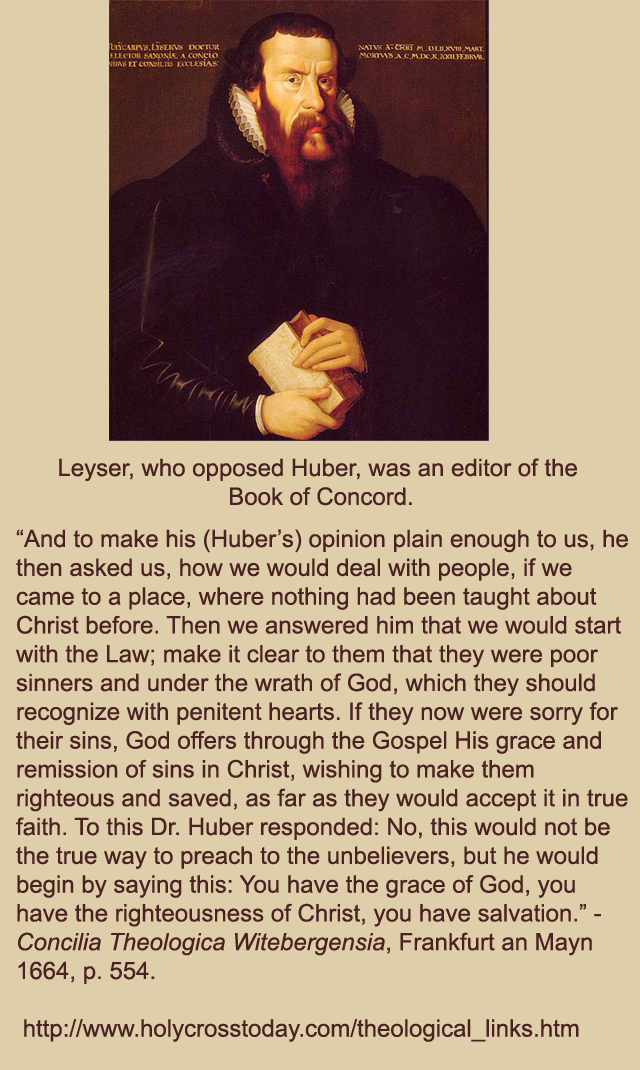
Samuel Huber (1547-1624) was a former Calvinist
who joined the faculty of Wittenberg University, but turned against the Biblical
doctrine of the Reformation to claim this should be said to someone who has no
knowledge of Christ:
“You
have the grace of God, you have the righteousness of Christ, you have
salvation.” Concilia Theologica Witenbergensia,
1664, p. 654.
2.
J. J. Rambach (1693-1795) was a well-known,
prominent figure in Halle, at the height of Pietism. He wrote:
“In
His Person, all mankind was justified and absolved from all sin and curse.” Tom
Hardt, Robert Preus Festschrift, “Easter and Absolution.”
3.
The Pietistic, rationalistic theology of Halle’s
Georg Christian Knapp (1753-1825) became a major doctrinal book in German and
also in English, the translation found in every American theological library in
the 19th century. It remains in print. The Calvinist translator,
explained Knapp’s theology this way, and those italicized justification terms
became normative within the Synodical Conference:
“This
is very conveniently expressed by the terms objective
and subjective justification.
Objective justification is the act of God, by which he proffers pardon to all
through Christ; subjective, is the act of man, by which he accepts the pardon
freely offered in the Gospel. The former is universal, the latter not.”
(Italics in the original)
Lectures on Christian Theology, by
Georg Christian Knapp, Professor of Theology in the University of Halle.
Translated by Leonard Woods, Jr., D.D., President of Bowdoin College,
Brunswick, Maine, later at Andover Seminary, which later became Andover-Newton,
which merged into Yale Divinity School in 2018.
4.
Schleiermacher’s Christian Dogmatics - “According to Schleiermacher, the decree of
redemption already means that human beings are agreeable to God in his Son; an
individual act of justification in time is not first needed in each individual
person. It is only necessary that each individual person become aware that in
God’s decree of redemption in Christ he is already justified and made agreeable
to God.”
Hoenecke,
Dogmatics, III, p. 339.
5.
C.F.W. Walther - "For God has already
forgiven you your sins 1800 years ago when He in Christ absolved all men by
raising Him after He first had gone into bitter death for them. Only one thing
remains on your part so that you also possess the gift. This one thing
is--faith. And this brings me to the second part of today's Easter message, in
which I now would show you that every man who wants to be saved must accept by
faith the general absolution, pronounced 1800 years ago, as an absolution
spoken individually to him."
The Word of His Grace, Sermon Selections,
"Christ's Resurrection--The World's Absolution" Lake Mills: Graphic
Publishing Company, 1978 p. 233. Brosamen, p. 138. Mark 16:1-8.
6.
Barth and Kirschbaum’s Church Dogmatics, IV, 1, p. 638
“There
is not one for whose sin and death he did not die, whose sin and death he did
not remove and obliterate on the cross...There is not one who is not adequately
and perfectly and finally justified in Him. There is not one whose sin is not
forgiven sin in Him, whose death is not a death which has been put to death in
Him...There is not one for whom he has not done everything in His death and
received everything in His resurrection from the dead.” Barth, Church Dogmatics, IV, 1, 638
7. Pieper’s
Christian Dogmatics, II, Concordia Publishing House, 1951, p. 321.
"Now,
then, if the Father raised Christ from the dead, He, by this glorious
resurrection act, declared that the sins of the whole world are fully expiated,
or atoned for, and that all mankind is now regarded as righteous before His
divine tribunal. This gracious reconciliation and justification is clearly
taught in Romans 4:25: 'Who was delivered for our offenses and was raised again
for our justification.' The term dikaiosis
here means the act of divine justification executed through God's act of
raising Christ from the dead, and it is for this reason called the objective
justification of all mankind. This truth Dr. Walther stressed anew in America.
He taught that the resurrection of Christ from the dead is the actual
absolution pronounced upon all sinners. (Evangelienpostille,
p. 160ff.)…
8.
LCA Professor Carl Braaten, who felt ELCA was
too radical for him –
“We
cannot hold a universalism of the unitarian kind. People are not too good to be
damned. There is no necessity for God to save everybody nor to reject anyone.
God is not bound by anything outside of himself. He is not bound to give the
devil his due. If we take into account God's love, he would have all to be
saved. If we reckon with his freedom, he has the power to save whomsoever he
pleases. This does not lead to a dogmatic universalism. But it does mean that
we leave open the possibility that within the power of God's freedom and love,
all people may indeed be saved in the end. This follows as a possibility from
the fact that God is free from all external factors in making up his mind.”
Justification, The Article by Which the
Church Stands or Falls, Fortress Press, 2001.
9.
The LCMS new two-volume dogmatics set, $90.
“To
understand the role of faith in the justification of the sinner, one must first
recall the significance of objective justification or universal reconciliation,
namely, the divine proclamation that God has accepted the sacrifice of his Son
for the sins of the whole world, that his wrath has been appeased, that he is
reconciled to the whole world, and that as a result he has issued a full pardon
for all humanity. Since this pardon is unconditional, it is clear that faith
cannot be a cause of one's justification.” Confessing
the Gospel, volume 1, p. 573.
10. The
LCMS 428 page Small Catechism
“By
‘objective’ or ‘universal’ justification one means that God has declared the whole
world to be righteous for Christ’s sake and that righteousness has thus been
procured for all people. It is objective because this was God’s unilateral act
prior to and in no way dependent upon man’s response to it, and universal
because all human beings are embraced by this verdict. God has acquired the
forgiveness of sins for all people by declaring that the world for Christ’s
sake has been forgiven. The acquiring of forgiveness is the pronouncement of
forgiveness.”
11. J. P.
Meyer, a president of Mequon (WELS), wrote even more extreme statements, three
of which became part of the Kokomo Statements - such as:
I.
"Objectively speaking, without any reference to an individual sinner's
attitude toward Christ's sacrifice, purely on the basis of God's verdict, every
sinner, whether he knows about it or not, whether he believes it or not, has
received the status of a saint. What will be his reaction when he is informed about
this turn of events? Will he accept, or will he decline?" J. P. Meyer, Ministers of Christ, A Commentary on the Second Epistle of Paul to the
Corinthians, Milwaukee: Northwestern Publishing House, 1963, p. 103f. 2
Corinthians 5:18-21.
II.
"Before Christ's intervention took place God regarded him as a
guilt-laden, condemned culprit. After Christ's intervention and through
Christ's intervention He regards him as a guilt-free saint." J. P. Meyer, Ministers of Christ, A Commentary on the
Second Epistle of Paul to the Corinthians, Milwaukee: Northwestern
Publishing House, 1963, p. 107. 2 Corinthians 5:18-21.
III.
"This applies to the whole world, to every individual sinner, whether he
was living in the days of Christ, or had died centuries before His coming, or
had not yet been born, perhaps has not been born to this day. It applies to the
world as such, regardless of whether a particular sinner ever comes to faith or
not."
J. P.
Meyer, Ministers of Christ, A Commentary
on the Second Epistle of Paul to the Corinthians, Milwaukee: Northwestern
Publishing House, 1963, p. 109. 2 Corinthians 5:18-21.
12. David
Valleskey, “In Christ God has effected a universal justification a universal
reconciliation, a universal ransom, a universal atonement. Different terms, but
all conveying the same message: God in Christ has declared the whole world to
be not guilty. We Believe, Therefore We
Speak, Northwestern Publishing House, 1995, p. 71.
At this, the beginning of the
End Times, the LCMS has defined Justification as world absolution without
faith, both in its new dogmatics and its prolix Small Catechism. Yet, no one is
blushing. Praising Luther and Dr. Walter A. Maier in one breath, they promote
Rambach and Knapp in another.