- Money
- Land
- Planning Committees
- S.M.A.R.T. goals
- Surveys
- Fuller Seminary diplomas.
Clearly they trusting in the power of the Word alone. The phrasing of this passage make that clear. Paul's preaching - they heard the report of Isaiah 53. They received it - they believed what God conveyed through the Holy Spirit in the Word. That faith is their foundation for forgiveness and for eternal life - as long as that remains in their minds, as preached by Paul - taught by the Risen Lord. But if they stopped believed, it was in vain that Paul proclaimed those truths.
Comparing this to many modern sermons - Paul's Gospel Word is not at all like success lectures, time management, or getting more friends. It seems reasonable that those attracted to such carnival acts gather for the wrong reasons. Nothing good can come of this, no matter how much they add up the membership, land owned, and other such items.
The older we are, the less we value fungible assets, the more we value eternal treasures. The Book of Concord calls the lessons of the Scriptures - treasures, especially those teaching faith in Christ.
In communicating with Old Testament students, I expect them to look for and find that vein of gold running through the Old Testament. It is not so obvious at first but becomes impossible to miss. Because Jesus Himself taught this at the end of Luke's Gospel.
Luke 24:44 And he said unto them, These are the words which I spake unto you, while I was yet with you, that all things must be fulfilled, which were written in the law of Moses, and in the prophets, and in the psalms, concerning me.
45 Then opened he their understanding, that they might understand the scriptures, 46 And said unto them, Thus it is written, and thus it behooved Christ to suffer, and to rise from the dead the third day: 47 And that repentance and remission of sins should be preached in his name among all nations, beginning at Jerusalem. 48 And ye are witnesses of these things. 49 And, behold, I send the promise of my Father upon you: but tarry ye in the city of Jerusalem, until ye be endued with power from on high.
3 For I delivered unto you first of all that which I also received, how that Christ died for our sins according to the scriptures;
We should especially remember this advantage that they had in the Apostolic Age, better in many ways that our hand-held devices and laptops.
Writing materials were scarce and books were rare in the apostolic age. If a man has to ride a horse without a saddle and stirrups, he must become a superb rider. If someone learns without books he can keep, he must have a highly developed memory to store his knowledge.
Listening was very important and retaining knowledge was crucial. There are many examples of people who memorized entire books. What was put into writing was infinitesimal compared to today, but it was valued and often retained by those who could memorize what mattered most.
Paul cited the Old Testament, which was the only content called Scriptures in the Apostolic Age. The ministry of Christ was based on citing the Old Testament and the Apostles were the same. The Old Testament - without recognizing Christ in its books - has hundreds of passages that make no sense. Those passages cited in the New Testament show that the calendar of events and the description all became true in the ministry of Jesus.
5 And that he was seen of Cephas, then of the twelve: 6 After that, he was seen of above five hundred brethren at once; of whom the greater part remain unto this present, but some are fallen asleep. 7 After that, he was seen of James; then of all the apostles. 8 And last of all he was seen of me also, as of one born out of due time.
Additional confirmation of the empty tomb is found here and elsewhere, besides the Gospels. This is how faith in Christ was generated by the Gospel Promises among people who never saw and never heard Christ. These are the witnesses, and recalling these truths serve as the bridge to Jesus Christ and faith in Him. He rose from the dead (human nature) because He was without sin (divine nature). This was such a great miracle that the disciples had trouble grasping it.
Everything happened in Paul's lifetime but he did not believe until the risen Lord Jesus Christ appeared before him and taught him the Gospel. Evangelism is not someone's sure-fire tactics but witnessing to the truth of the Gospel - without doubting the Bible or changing it into another kind of book.
These are point by point examples of people seeing and hearing Jesus Christ risen from the dead. Persecution could not stop them from speaking.
9 For I am the least of the apostles, that am not meet to be called an apostle, because I persecuted the church of God. 10 But by the grace of God I am what I am: and his grace which was bestowed upon me was not in vain; but I laboured more abundantly than they all: yet not I, but the grace of God which was with me.
Faith in Christ is not generated or strengthened by us but by the actual Gospel Promises. They are grafted onto us at baptism or by the preached Word itself (James - the implanted or grafted Word). This faith gives us access to Christ at all times. He dwells in us and we dwell in Him, just as He is in the Father and the Father in Him.
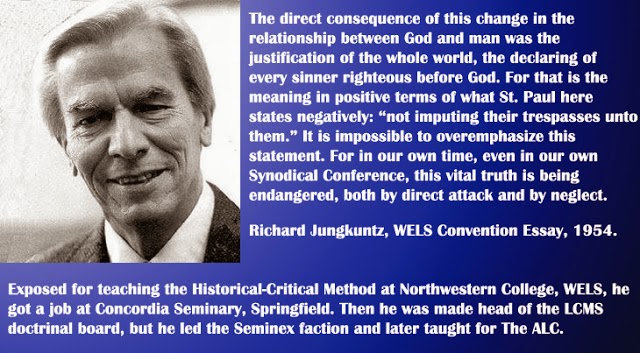
Clearly, the efforts against the text of the Bible, Hebrew and Greek, and the persecution of the best, clear translation, the King James, is the boldest sign of apostasy, because it is being energized by the elite (in their imaginations). They no longer believe.
Every bracket and footnote in modern Bibles is used to cause doubt in the faithful transmission of the Scriptures. That leads to doubt in the message of Paul, though his saint's day is observed with billows of incense and much bowing.
Every Lutheran should wonder why the Sacraments are removed from the NIV and other translations, the basic truths twisted to be the opposite ("all" are justified) and the faith of Jesus erased.
9 For I am the least of the apostles, that am not meet to be called an apostle, because I persecuted the church of God. 10 But by the grace of God I am what I am: and his grace which was bestowed upon me was not in vain; but I laboured more abundantly than they all: yet not I, but the grace of God which was with me.
This was Paul, pleading for the converts to remember what he taught, so they would not fall into apostasy, sin, and ruin. There are two attitudes today.
Apostates - Power is in everything but the Word.
The Faithful - Power is only found in the Word.