
 |
| Why can't you all get along with me? |
The rise and fall of the American seminary (COMMENTARY)

NEW YORK (RNS) General Theological Seminary’s campus in the Chelsea neighborhood of Manhattan is everything you’d want in an urban seminary.
Handsome buildings, a chapel at the center, quiet walkways in a noisy city, calm places to read and pray. All serving a wonderfully diverse student body eager to minister in a changing world.
It’s like the best of historic church properties: harking back to a day of noble architecture and tradition and yet looking outward to a frenetic city and changing religious environment.
Why, then, is GTS on the verge of financial collapse and, now, paralyzing internal conflict? Its dean is under attack, 80 percent of its full-time faculty were dismissed, its board is floundering — all in the glare of press and blogosphere.
Why? For the same reason that historic churches and denominations are trapped in “train wrecks.” Their time has passed.
As other major denominations are finding, the days of the residential three-year seminary are ending. Fewer prospective ordinands can afford the cost and dislocation of attending a residential seminary.
Fewer church bodies are willing to subsidize such an education, because they, too, face budget shortfalls. Fewer congregations have jobs for inexperienced clergy wanting full-time compensation.
Episcopal dioceses have been seeking other ways, such as diocesan training centers, nearby schools run by other denominations and online learning. They’re seeking professional skills training, not academic prowess.

By my rough count, it appears fewer than half of newly ordained Episcopal clergy in recent years came out of the church’s 11 official seminaries. My alma mater — Episcopal Divinity School in Cambridge, Mass., also embroiled in conflict — trained an average of just eight ordinands a year, one-fifth the number when I graduated in 1977.
Does the Episcopal Church — or any mainline denomination — need all of its seminaries? Probably not. To judge by recent graduation rates, it probably needs only four. Two of the eleven have already closed. Hence the anxiety leading to conflict, as tenured faculty, cost-cutting deans and anxious trustees collide.
Many congregations are in the same situation. The needs they filled 60 years ago — neighborhood churches providing a mobile postwar world with a place to belong and to ground the family — have largely vanished.
Some congregations welcomed new purposes in a world of new lifestyles, new expectations, new family structures, new employment patterns and new attitudes toward Sunday morning, and they are thriving.
Most, sad to say, resisted change and now find that time and tide haven’t waited for them. Like GTS, they find themselves broke, conflicted, hoping for a future and yet mired in disdain and distrust.

Seizing a new moment is never easy. It requires entrepreneurial leaders who risk being shot down and declared “other.” It requires mold-breaking ministry providers who move beyond the “way things used to be.” It requires constituents whose drive to serve stirs voices for change.
The tragedy at General Seminary isn’t that its time has passed — for a new time is breaking in, if the seminary will let it. Nor is it that the seminary is trapped in dysfunction and conflict — for God can redeem such moments. Or that money is tight — for God’s work is never limited by money.
The tragedy is that stakeholders at the seminary are belittling each other, questioning each other’s worthiness and allowing hubris to be their guide. Such behavior cannot end well.
Presiding Bishop Katharine Jefferts Schori visited GTS recently and did the right thing: She listened. As combatants issued lengthy statements, she modeled the holy restraint that all need to learn.

(Tom Ehrich is a writer, church consultant and Episcopal priest based in New York. He is the president of Morning Walk Media and publisher of Fresh Day online magazine. His website is www.morningwalkmedia.com. Follow Tom on Twitter @tomehrich.)
KRE/MG END EHRICH
---
Anglicans sign mass 'love letter' to gay bishops - urging them to come out
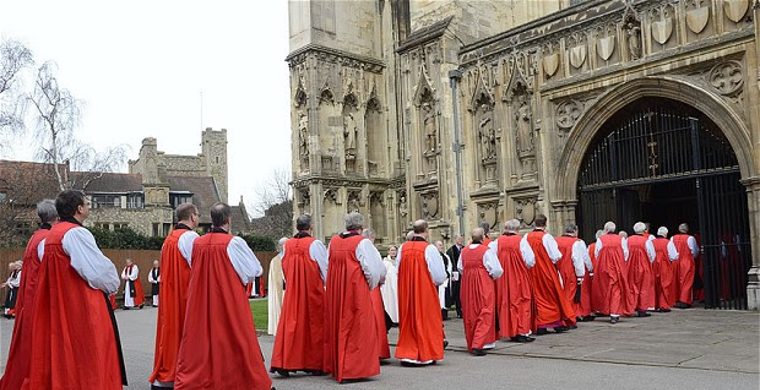
Anglicans sign mass 'love letter' to gay bishops - urging them to come out
300 clergy and parishioners sign unprecedented appeal to Church of England hierarchy, urging gay bishops to publicly acknowledge their sexuality
By John Bingham
Religious Affairs Editor
THE TELEGRAPH
http://www.telegraph.co.uk/
Oct. 4, 2014
More than 300 Anglican priests, parishioners and other Christians have signed an open "love letter" to bishops in the Church of England who are secretly gay urging them to "come out" about their sexuality.
In one of the most unusual petitions ever addressed to the leadership of the established church, they have issued a direct plea to members of the episcopate who are gay or bisexual to have the "courage and conviction" to acknowledge it publicly.
The signatories, who include at least 160 priests and several members of the Church's governing General Synod, pledge to "welcome and embrace" those bishops who decide to go public but strongly object to any attempt to involuntarily "out" anyone.
It follows the publication of a new book by the serving Bishop of Buckingham, the Rt Rev Dr Alan Wilson, last week which said that around one in 10 of his colleagues could be gay but unwilling to speak publicly.
The book sets out a theological argument for a major reassessment of the Church of England's teaching on homosexuality accusing the hierarchy of "hypocrisy" and "duplicity" on the subject.
Dr Wilson remarked that there are currently "said to be a dozen or so gay bishops" but that events had left many trapped behind "episcopal closet door".
The letter, disclosed today in The Sunday Telegraph, will reopen an intense debate within the Church over its stance on sexuality.
The Church of England officially teaches that any sexual relationship outside of traditional heterosexual marriage is "less than God's ideal" - an Anglican euphemism for "sin".
But the Archbishop of Canterbury, the Most Rev Justin Welby, has pledged to clamp down on homophobia in the Church of England.
Although Anglican clergy can be in same-sex civil partnerships, they must claim to be celibate if they wish to become bishops.
There are no openly gay bishops in the Church of England and the current Dean of St Albans, Dr Jeffrey John, who is in a celibate same-sex relationship, was twice forced to turn down promotion to the episcopate because of opposition linked to his sexuality.
The Rev Dr Keith Hebden, a priest from St Mark's and St Peter's Church in Mansfield, Notts, has been gathering signatures for the letter which will be formally submitted to the Church's House of Bishops.
Last night 282 Anglicans, 29 Methodists and around 25 members of other Christian Churches, as well as representatives of Jewish groups, has already signed the letter. Dr Wilson is among the signatories.
It acknowledges "growing pressure" on gay bishops to come out publicly but expresses strong opposition to any threat to "out" them.
"We write to assure those bishops who may choose to openly acknowledge their sexual orientation as gay or bisexual that you will receive our support, prayer, and encouragement," the signatories pledge.
Bishops who have kept their sexuality secret have, they say, having borne a particular personal "cost" and could face "hostility by a vocal minority" if they were to go public.
But they add: "We have no doubt that the vast majority of Anglicans will welcome and embrace those of you who are gay or bisexual for your courage and conviction if you come out: weeping with you for past hurts and rejoicing in God's call as witnesses to Christ's transforming love and compassion.
"If you stand out we will stand beside you."
Rev Hebden said: "I'm a straight, white middle class man -- I'm not saying to particular individuals 'you should come out'.
"What this letter is saying is that if you feel it is the right thing, through your thought and prayer and conversations with people you love, there is an immeasurable number of people out there who will love and support you."
The Rev Colin Coward, director of the Anglican campaign group "Changing Attitude", said: "It is really important for bishops both straight and gay to live with integrity and openness about their identity and their beliefs about the full inclusion of lesbian and gay people in the church.
"Those of us who are lesbian and gay long to be supported by openly gay bishops and we know from our own experience how much energy and Christian integrity is released when you live openly with your sexuality."
---
(RNS) Theologian Stanley Hauerwas has declined a series of lectures he was scheduled to give at New York’s General Theological Seminary in November in the wake of the crisis roiling the school.

On Wednesday (Oct. 8), the Christian ethicist said he does not want to get in the middle of a controversy involving the resignations or firings of eight faculty.
Two weeks ago, the eight faculty members quit teaching classes and attending official seminary meetings or chapel services until they could sit down with the Board of Trustees.
Hauerwas, who is professor emeritus of divinity and law at Duke Divinity School, said he pulled out of the lecture series so he would not appear to take a side.
“I was looking forward to going because I’ve known of General for my whole academic life, but I had never been there. At one time, it represented a commitment to an Anglo-Catholic tradition with which I’m very sympathetic,” said Hauerwas, who attends an Episcopal church in Chapel Hill, N.C. “I think the situation is one of deep pathos; it’s just pathetic. I’m sorry that I’ve gotten caught in it.”
GTS, the flagship seminary that has produced generations of bishops and noted theologians, is the only Episcopal seminary overseen by the national church.
“It’s been the seminary of record for the national church,” Hauerwas said. “Symbolically what’s happening there has reverberations throughout the church. I think that’s the primary reason people are taken aback by the fact that in some ways what has happened is the death toll of General Seminary. What student is going to go there?”
During the turmoil, the board said it accepted the faculty resignations, but the faculty members said they never resigned.
Hauerwas was invited by Joshua Davis, one of the professors whose positions were terminated, to give the seminary’s Paddock Lectures, but Hauerwas wrote Bishop Mark Sisk, chair of the GTS board, to bow out.
“I have not wanted to do anything that might be interpreted as ‘taking sides’ because I am on the outside of this situation,” Hauerwas wrote on Friday. “However, I am aware that the faculty has made a constructive response that might offer a way forward. As things now stand, if there is no possibility of reconciliation, I would find it very difficult to give the Paddock Lectures.”
Hauerwas said that Sisk responded, saying the board is seeking a way forward.
“This is truly sad if not actually tragic situation,” Sisk wrote in his letter.
Hauerwas also wrote to the seminary’s dean and president, the Very Rev. Kurt Dunkle, on Monday, saying he saw little hope in a constructive way forward.
“Bishop Sisk’s letter in return offered little hope that a resolution would be possible between the faculty and administrators,” Hauerwas wrote. “I very much regret that this is the case.”
Dunkle has yet to reply to Hauerwas. A representative for the seminary said Dunkle would not be available for comment.
The eight faculty charged that Dunkle shared a student’s academic records with people who were not authorized to see them, which would violate federal academic privacy standards. The faculty also said he speaks in ways that have made women and some minority groups uncomfortable on several occasions.
“As a longtime faculty person, I can’t help but feel sympathy with the faculty,” Hauerwas added. “I do not know enough about the details of their concerns and about Rev. Dunkle to be able to say I’m on the faculty side. I think it was extremely unfortunate that their letter was phrased in a way that sounded as if they were resigning from their positions.”
Some 900 scholars from across the country have signed a letter of support for the eight faculty, saying they will not lecture or speak at the seminary. Noteworthy scholars who signed the letter include James H. Cone of Union Theological Seminary, Gary Dorrien of Union Theological Seminary and Francis Schüssler Fiorenza of Harvard Divinity School.
During the 2013-14 school year, GTS enrolled 70 students and had $10.6 million in expenditures and $27 million in investments, according to the Association of Theological Schools, an accrediting organization. GTS had faced about $40 million of debt that it was attempting to pay down through property sales and redevelopment.
YS/MG END BAILEY
---
What The Hell Is Happening At General Theological Seminary?
Posted: Updated:

Faculty members at the country’s oldest Episcopal seminary are facing off against the school’s President, blasting him for his allegedly bullying, heavy-handed leadership style.
Eight professors at New York’s General Theological Seminary announced Friday that they are not going to teach, attend meetings, or participate in common worship until they can meet with the school’s Board of Trustees, according Anglican Ink.
In a letter distributed to students, the professors accuse the seminary’s Dean and President, The Very Rev. Kurt H. Dunkle, of failing to collaborate or take their grievances seriously, creating a climate “fraught with conflict, fear, and anxiety.”
“Simply put, the working environment that the Dean and President has created has become unsustainable,” the professors wrote.
After the announcement, Dunkle allegedly told students that the Board of Trustees had accepted the eight faculty members’ resignations. But Dr. Andrew Irving, an assistant professor of church history, countered that the professors had never handed in their resignations.
“We wish to underline that we have not resigned,” Irving wrote in a statement obtained by Episcopal Cafe. “Our letters did not say that we would resign. We requested meetings with the Board.”
Dunkle was installed as the 13th dean of the seminary last October. Before coming to General, his ministry was based in the Episcopal Diocese of Florida, where he claimsto have become particularly adept at managing conflicts that arise between clergy and their congregations.
According to an analysis by Episcopal priest and blogger Rev. Canon Andrew Gerns, Dunkle appears to have a tendency to push through “Lone Ranger” decisions in order to fulfill his vision of what is best for the school.
“The leadership is so intent on their goal and so committed to a single over-riding vision, that they appear to have forgotten who it is they serve, who it is that makes the mission happen and who must live with the decisions in the long run,” Gerns wrote for Episcopal Café.
During his short time at the helm, Dunkle has instituted a number of new initiatives. One of the biggest changes is “The Wisdom Year,” a program that sends third-year seminarians out into the real world to work as part-time ministers.
The faculty members on strike didn’t name a specific policy that they disagree with, instead referencing a “number of very serious incidents and patterns of behavior which have over time caused faculty, students, and staff to feel intimidated, profoundly disrespected, excluded, devalued, and helpless.”
The professors also complain that their concerns haven’t been properly addressed by the school’s Board of Trustees.
“Our work stoppage could be ended immediately if the Board of Trustees would commit to meeting with us for a frank discussion of these serious matters, as previously requested,” the letter stated.
General Theological Seminary has graduated over 7,000 men and women since 1822. The Manhattan institution is the only seminary overseen by the national Episcopal Church, according to RNS.


On another note, I understand your reasoning for not naming your perpetrator...you care enough to protect his wife and family, as well as yourself. However, I do feel you should expose the names of the synod personnel you approached who did not offer you help. They too are perpetrators. Once again, fear of exposure discourages inappropriate actions.