Thursday, June 12, 2025

Luther Seminary! Merged Long with Northwestern Seminary.
Another One Bites the Dust - Oomph - Another One Bites the Dust - Oomph!

One Luther Seminary president was losing money in the millions.
They have been shedding property faster than a California fire.


Someone spontaneously danced at a New York ELCA meeting.


This male dancer at the Luther Seminary chapel was ordained, after he boasted about his chapel dance on Facebook. His buddies in the pews loved it.

Watch each ELCA seminary, the product of mergers upon mergers, will end up on the second floor of a cheap boarding house.

"We are not done shrinking yet. We turned seven Lutheran seminaries into one porta-seminary, lodged at a Catholic merger site of similar mergers."


The Gettysburg-Philadelphia seminaries could not bare the thought of a woman president with heterosexual urges (though deep in the past), so they brought in a real prize - an Osage Indian chief and his wife.


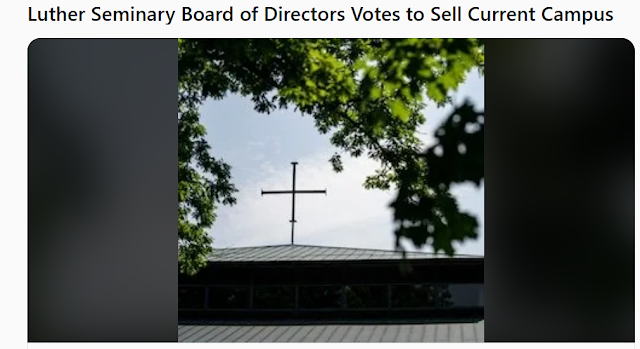
After more than a century in St. Paul, Luther Seminary plans to sell its remaining upper campus and look for property elsewhere in the Twin Cities as it cuts staffing and rethinks the way it delivers education to its students, officials announced Tuesday.

The St. Anthony Park neighborhood has housed the school ― the largest Evangelical Lutheran Church in America (ELCA) seminary in the country ― for more than 100 years. Officials don’t yet have a buyer in mind for the property.

The seminary’s lower campus is already under a purchase agreement with Lifestyle Communities, a residential developer, and the sale is expected to close in early 2026, said the Rev. Robin Steinke, the president of the seminary, which was founded in 1869 by Norwegian Lutheran immigrants.

The school will also cut 11 staff positions as it reorganizes its structure and educational strategy, she said. The upper campus, which has three buildings, a chapel and nine houses on 10 acres, also has aging buildings in need of significant capital investment, she said.

Some of the school’s 370 graduate students are local and take classes on campus while others attend online and visit a few times a year. In 2012, the school enrolled nearly 800 students.

The mission of Luther Seminary “remains as vital and necessary as ever,” Steinke said. The seminary has about 8.3 million users around the world who access its website and online resources, including podcasts, journals, classes and daily devotional materials.

Related video: Luther Seminary to leave St. Paul campus (KARE-TV Minneapolis St. Paul)

“The ‘what we do’ and ‘why we do it’ is remaining the same,” she said. “But how and where is changing.”

Last month, the board voted unanimously to prepare the upper campus for sale and to begin the sales process, she said, in part because they have more space than needed.

Steinke added that the seminary wants to remain in the Twin Cities on a residential campus and is looking at properties.

Current students will still be able to finish their academic work on campus, which won’t change hands for another two years. It’s hard to give up beloved, shared spaces, Steinke said.

“We’ll have time to mourn the space,” she said. “That’s not an easy thing.”

Partner churches in countries where Christianity is growing regularly send students to Luther Seminary for online and in-person classes, she said.

The seminary committed to fully funding tuition for all qualified students seven years ago to reduce student loan debt, Steinke said.

“We need to reimagine the campus footprint so we can continue to provide [that] support,” she said.

©2025 The Minnesota Star Tribune. Visit startribune.com. Distributed by Tribune Content Agency, LLC

Statistics From a Few Home-Made Blogs


Moline Memories - 7,048 last month, over 576,000 views total.

Reformation Seminary (Luther, Melanchthon, Chemnitz) - 66,000 views already.

Bethany Lutheran Worship has been a back-up for many years - 259,000 views now.

Bethany Hymnal - is designed for Norma Boeckler's prize-winning art, the melodies and texts of The Lutheran Hymnal - very handy for the literate - almost 100,000 views.

Ichabod, The Glory Has Departed - claims 12.3 million views. Daily views are often in the thousands and sometimes not.


Reformation Seminary Lecture - KJV Acts 15 Part 2


KJV Acts 15:22-41

22 Then pleased it the apostles and elders with the whole church, to send chosen men of their own company to Antioch with Paul and Barnabas; namely, Judas surnamed Barsabas and Silas, chief men among the brethren:


23 And they wrote letters by them after this manner; The apostles and elders and brethren send greeting unto the brethren which are of the Gentiles in Antioch and Syria and Cilicia.


24 Forasmuch as we have heard, that certain which went out from us have troubled you with words, subverting your souls, saying, Ye must be circumcised, and keep the law: to whom we gave no such commandment:


25 It seemed good unto us, being assembled with one accord, to send chosen men unto you with our beloved Barnabas and Paul,


26 Men that have hazarded their lives for the name of our Lord Jesus Christ.


27 We have sent therefore Judas and Silas, who shall also tell you the same things by mouth.


28 For it seemed good to the Holy Ghost, and to us, to lay upon you no greater burden than these necessary things;


29 That ye abstain from meats offered to idols, and from blood, and from things strangled, and from fornication: from which if ye keep yourselves, ye shall do well. Fare ye well.


30 So when they were dismissed, they came to Antioch: and when they had gathered the multitude together, they delivered the epistle:


31 Which when they had read, they rejoiced for the consolation.


32 And Judas and Silas, being prophets also themselves, exhorted the brethren with many words, and confirmed them.


33 And after they had tarried there a space, they were let go in peace from the brethren unto the apostles.


34 Notwithstanding it pleased Silas to abide there still.


35 Paul also and Barnabas continued in Antioch, teaching and preaching the word of the Lord, with many others also.


36 And some days after Paul said unto Barnabas, Let us go again and visit our brethren in every city where we have preached the word of the Lord, and see how they do.


37 And Barnabas determined to take with them John, whose surname was Mark.


38 But Paul thought not good to take him with them, who departed from them from Pamphylia, and went not with them to the work.


39 And the contention was so sharp between them, that they departed asunder one from the other: and so Barnabas took Mark, and sailed unto Cyprus;


40 And Paul chose Silas, and departed, being recommended by the brethren unto the grace of God.


41 And he went through Syria and Cilicia, confirming the churches.

Daily Luther Sermon Quote - Trinity Sunday - "This word signifies that there are three persons in God. It is a heavenly mystery which the world cannot understand. I have often told you that this, as well as every other article of faith, must not be based upon reason or comparisons, but must be understood and established by means of passages from the Scriptures, for God has the only perfect knowledge and knows how to speak concerning himself."


SUNDAY AFTER PENTECOST, OR TRINITY SUNDAY.


Text: John 3:1-15 There was a man of the Pharisees, named Nicodemus, a ruler of the Jews: 2 The same came to Jesus by night, and said unto him, Rabbi, we know that thou art a teacher come from God: for no man can do these miracles that thou doest, except God be with him. 3 Jesus answered and said unto him, Verily, verily, I say unto thee, Except a man be born again, he cannot see the kingdom of God. 4 Nicodemus saith unto him, How can a man be born when he is old? can he enter the second time into his mother's womb, and be born? 5 Jesus answered, Verily, verily, I say unto thee, Except a man be born of water and of the Spirit, he cannot enter into the kingdom of God. 6 That which is born of the flesh is flesh; and that which is born of the Spirit is spirit. 7 Marvel not that I said unto thee, Ye must be born again. 8 The wind bloweth where it listeth, and thou hearest the sound thereof, but canst not tell whence it cometh, and whither it goeth: so is every one that is born of the Spirit. 9 Nicodemus answered and said unto him, How can these things be? 10 Jesus answered and said unto him, Art thou a master of Israel, and knowest not these things? 11 Verily, verily, I say unto thee, We speak that we do know, and testify that we have seen; and ye receive not our witness. 12 If I have told you earthly things, and ye believe not, how shall ye believe, if I tell you of heavenly things? 13 And no man hath ascended up to heaven, but he that came down from heaven, even the Son of man which is in heaven. 14 And as Moses lifted up the serpent in the wilderness, even so must the Son of man be lifted up: 15 That whosoever believeth in him should not perish, but have eternal life.

I. THE HOLY TRINITY.

1. Today we celebrate the festival of the Holy Trinity, to which we must briefly allude, so that we may not celebrate it in vain. It is indeed true that the name “Trinity” is nowhere to be found in the Holy Scriptures, but has been conceived and invented by man. For this reason it sounds somewhat cold and we had better speak of “God” than of the “Trinity.”

2. This word signifies that there are three persons in God. It is a heavenly mystery which the world cannot understand. I have often told you that this, as well as every other article of faith, must not be based upon reason or comparisons, but must be understood and established by means of passages from the Scriptures, for God has the only perfect knowledge and knows how to speak concerning himself.

3. The great universities have invented manifold distinctions, dreams and fictions by means of which they would explain the Holy Trinity, and have made fools of themselves. We shall therefore quote only passages from the Scriptures in order to determine and establish the divinity of Christ. In the first place, we quote from the New Testament, where we find many proof texts; for instance, John 1:1-3: “In the beginning was the Word, and the Word was God. The same was in the beginning with God. All things were made through him; and without him was not anything made that hath been made.” Now if he is not made, but is himself the Maker, he must indeed be God. John also says afterwards: “And the Word became flesh.”

4. Again, we quote from the Old Testament, where David says, in Psalm 110:1: “Jehovah saith unto my lord, Sit thou at my right hand,” that is, sit upon the royal throne and be a lord and king over all creatures, all which must be subject to thee — “until I make thine enemies thy footstool.” In Psalm 8:4-8, we read: “What is man, that thou art mindful of him? and the son of man, that thou visitest him? For thou hast made him but little lower than God, and crownest him with glory and honor. Thou makest him to have dominion over the works of thy hands; thou hast put all things under his feet: all sheep and oxen, yea, and the beasts of the field, the birds of the heavens, and the fish of the sea, whatsoever passeth through the paths of the seas.” That means: Thou hast made him Lord of the whole world. Paul explains this passage, in Ephesians 1:20 and Colossians 2:9-10, in a masterly way. Now, if God has set him at his right hand and made him lord of all in heaven and on earth, he must indeed be God; for it would not be fitting that he should set him at his right hand and give him as much power over all creatures as he himself possesses, if he were not God. God will not give his glory to another, as he says in Isaiah 48:11. Thus, we have here two persons, the Father, and the Son to whom the Father has given all that is subject to him.

To “sit at the right hand of God” means to be over all God’s creatures; he must therefore be God to whom is given all this.

5. God has also commanded us not to worship strange gods. Now, we read in John that, according to the will of God, we should honor the Son even as we honor the Father. These are the words of John 5:19-23, where Christ says to the Jews: “Verily, Verily, I say unto you, The Son can do nothing of himself, but what he seeth the Father doing: for what things soever he doeth, these the Son also doeth in like manner. For the Father loveth the Son, and showeth him all things that himself doeth: and greater works than these will he show him, that ye may marvel. For as the Father raiseth the dead and giveth them life, even so the Son also giveth life to whom he will. For neither doth the Father judge any man, but he hath given all judgment unto the Son; that all may honor the Son, even as they honor the Father. He that honoreth not the Son honoreth not the Father that sent him.” These are, to my mind, truly clear and distinct words concerning the divinity of Christ. Now, as God commands that we should have only one God, and should not render to any other creature the glory which belongs to God and is due him, and yet he gives this glory to Christ, Christ must indeed be God.

Wednesday, June 11, 2025

The 1700th Anniversary of the Nicene Creed -


Byzantium became known as Constantinople and finally Istanbul (simply The City).


Constantine was crowned Emperor while in England, 306 AD, and he moved his throne to Byzantium, where he became increasingly involved in Christianity as a leader.

Constantine led the Council of Nicea, which is known as the Nicene Creed, 325 AD.

The Apostles Creed, is older and shorter than the Nicene Creed.

The Athanasian Creed is the oldest and longest of the three Creeds, with various opinions on the origin and age.

Lutheran

  1. The Augsburg Confession (1530)
  2. The Apology (Defense) of the Augsburg Confession (1531)
  3. The Smalcald Articles (1537) – including the Treatise on the Power and Primacy of the Pope
  4. The Small Catechism of Dr. Luther (1530)
  5. The Large Catechism of Dr. Luther (1530)
  6. The Formula of Concord (1580)

The Nicene Creed

I believe in one God the Father almighty,

maker of heaven and earth,

And of all things visible and invisible:

And in one Lord, Jesus Christ,

the only begotten Son of God,

begotten of his Father before all worlds,

God of God, Light of Light,

very God of very God,

begotten, not made,

of one substance with the Father,

by whom all things were made;

who for us men and for our salvation

came down from heaven,

and was incarnate by the Holy Ghost of the Virgin Mary,

and was made man,

and was crucified also for us under Pontius Pilate.

He suffered and was buried,

and the third day he rose again

according to the scriptures,

and ascended into heaven,

and sitteth on the right hand of the Father.

And he shall come again with glory

to judge both the quick and the dead;

whose kingdom shall have no end.

And I believe in the Holy Ghost,

the Lord, the giver of life,

who proceedeth from the Father and the Son,

who with the Father and the Son together

is worshiped and glorified,

who spake by the prophets.

And I believe one holy catholic and apostolic Church.

I acknowledge one baptism for the remission of sins.

And I look for the resurrection of the dead,

and the life of the world to come. Amen.

Tuesday, June 10, 2025

Reformation Seminary Lecture - KJV Acts 15 Part 1


 KJV Acts 15

15:1 And certain men which came down from Judaea taught the brethren, and said, Except ye be circumcised after the manner of Moses, ye cannot be saved. [Also an issue in Galatians]


2 When therefore Paul and Barnabas had no small dissension and disputation with them, they determined that Paul and Barnabas, and certain other of them, should go up to Jerusalem unto the apostles and elders about this question.


3 And being brought on their way by the church, they passed through Phenice and Samaria, declaring the conversion of the Gentiles: and they caused great joy unto all the brethren.


4 And when they were come to Jerusalem, they were received of the church, and of the apostles and elders, and they declared all things that God had done with them. [received - means into fellowship]


5 But there rose up certain of the sect of the Pharisees which believed, saying, That it was needful to circumcise them, and to command them to keep the law of Moses.


6 And the apostles and elders came together for to consider of this matter.


7 And when there had been much disputing, Peter rose up, and said unto them, Men and brethren, ye know how that a good while ago God made choice among us, that the Gentiles by my mouth should hear the word of the gospel, and believe.


8 And God, which knoweth the hearts, bare them witness, giving them the Holy Ghost, even as he did unto us;


9 And put no difference between us and them, purifying their hearts by faith.


10 Now therefore why tempt ye God, to put a yoke upon the neck of the disciples, which neither our fathers nor we were able to bear?


11 But we believe that through the grace of the Lord Jesus Christ we shall be saved, even as they.


12 Then all the multitude kept silence, and gave audience to Barnabas and Paul, declaring what miracles and wonders God had wrought among the Gentiles by them.


13 And after they had held their peace, James answered, saying, Men and brethren, hearken unto me:


14 Simeon hath declared how God at the first did visit the Gentiles, to take out of them a people for his name.


15 And to this agree the words of the prophets; as it is written,


16 After this I will return, and will build again the tabernacle of David, which is fallen down; and I will build again the ruins thereof, and I will set it up:


17 That the residue of men might seek after the Lord, and all the Gentiles, upon whom my name is called, saith the Lord, who doeth all these things.


18 Known unto God are all his works from the beginning of the world.


19 Wherefore my sentence is, that we trouble not them, which from among the Gentiles are turned to God:


20 But that we write unto them, that they abstain from pollutions of idols, and from fornication, and from things strangled, and from blood.


21 For Moses of old time hath in every city them that preach him, being read in the synagogues every sabbath day.


22 Then pleased it the apostles and elders with the whole church, to send chosen men of their own company to Antioch with Paul and Barnabas; namely, Judas surnamed Barsabas and Silas, chief men among the brethren:


23 And they wrote letters by them after this manner; The apostles and elders and brethren send greeting unto the brethren which are of the Gentiles in Antioch and Syria and Cilicia.


24 Forasmuch as we have heard, that certain which went out from us have troubled you with words, subverting your souls, saying, Ye must be circumcised, and keep the law: to whom we gave no such commandment:


25 It seemed good unto us, being assembled with one accord, to send chosen men unto you with our beloved Barnabas and Paul,


26 Men that have hazarded their lives for the name of our Lord Jesus Christ.


27 We have sent therefore Judas and Silas, who shall also tell you the same things by mouth.


28 For it seemed good to the Holy Ghost, and to us, to lay upon you no greater burden than these necessary things;


29 That ye abstain from meats offered to idols, and from blood, and from things strangled, and from fornication: from which if ye keep yourselves, ye shall do well. Fare ye well.


30 So when they were dismissed, they came to Antioch: and when they had gathered the multitude together, they delivered the epistle:


31 Which when they had read, they rejoiced for the consolation.


32 And Judas and Silas, being prophets also themselves, exhorted the brethren with many words, and confirmed them.


33 And after they had tarried there a space, they were let go in peace from the brethren unto the apostles.


34 Notwithstanding it pleased Silas to abide there still.


35 Paul also and Barnabas continued in Antioch, teaching and preaching the word of the Lord, with many others also.


36 And some days after Paul said unto Barnabas, Let us go again and visit our brethren in every city where we have preached the word of the Lord, and see how they do.


37 And Barnabas determined to take with them John, whose surname was Mark.


38 But Paul thought not good to take him with them, who departed from them from Pamphylia, and went not with them to the work.


39 And the contention was so sharp between them, that they departed asunder one from the other: and so Barnabas took Mark, and sailed unto Cyprus;


40 And Paul chose Silas, and departed, being recommended by the brethren unto the grace of God.


41 And he went through Syria and Cilicia, confirming the churches.

Daily Luther Sermon Quote - From Pentecost Monday - "This is one of the best and most glorious Gospel lessons, such as John particularly wrote. It is worthy to be written in golden letters, not upon paper, but if possible upon the heart; it ought to be made the daily lesson and meditation of Christians, who should repeat it to strengthen their faith and awaken their hearts to prayer. The words make the sad joyful and the dead alive, if the heart only firmly believes them."


PENTECOST MONDAY.

SECOND SERMON.

JOHN 3:16-21.


KJV John 3:16 For God so loved the world, that he gave his only begotten Son, that whosoever believeth in him should not perish, but have everlasting life. 17 For God sent not his Son into the world to condemn the world; but that the world through him might be saved. 18 He that believeth on him is not condemned: but he that believeth not is condemned already, because he hath not believed in the name of the only begotten Son of God. 19 And this is the condemnation, that light is come into the world, and men loved darkness rather than light, because their deeds were evil. 20 For every one that doeth evil hateth the light, neither cometh to the light, lest his deeds should be reproved. 21 But he that doeth truth cometh to the light, that his deeds may be made manifest, that they are wrought in God.


I. THE GLORIOUS GRACE AND GIFT IN CHRIST.


1. This is one of the best and most glorious Gospel lessons, such as John particularly wrote. It is worthy to be written in golden letters, not upon paper, but if possible upon the heart; it ought to be made the daily lesson and meditation of Christians, who should repeat it to strengthen their faith and awaken their hearts to prayer. The words make the sad joyful and the dead alive, if the heart only firmly believes them.

2. It also gives instruction on the chief article of Christian faith, on the glory and liberty of Christians, whereby sin, the Law, God’s wrath, death and hell are banished from believers and abolished, besides all human wisdom, righteousness and holiness are made futile in that which belongs to God’s kingdom. He says: “Whosoever believeth on the Son of God should not perish, but have eternal life,” death, the devil, the terror of the Law, must be banished forever, our merit and worthiness doing nothing to that end. The excellent, great, eternal and divine treasure is thus portrayed here, which we should possess so as to be without fear before the judgment and condemnation of human nature through Adam’s fall, and instead have salvation and victory, and every blessing besides. All this is offered and bestowed out of pure grace, and thus represented only as a gift that can be secured solely through faith.

I. THIS GLORIOUS GRACE AND GIFT IN GENERAL.

3. In vivid and significant words the evangelist briefly sketches this grace and gift in Christ, that he may magnify it and portray minutely all concerned — the giver, the recipient, the gift, its fruits and benefits. All is so eloquently great that it is indescribable, and it is difficult to believe only because of its very greatness.

4. Before considering this, however, let us hear why and for what purpose Christ so speaks. He expresses it in the following words: “That whosoever believeth on him should not perish” etc. Here he would show the world the misery and helplessness in which it lies; that it is entirely lost, and would have had to remain lost eternally, had Christ not come with this proclamation; for all its wisdom, art, doctrine, law ,and free-will would not avail in this respect; and in spite of all its teaching and endeavors, it is and will remain lost forever. For, from its very birth, it lies in sin, under the wrath of God, in the devil’s kingdom, and under the-power of death, unable to help or free itself from this condition. Indeed it is so dazed and torpid that it would never have known nor realized its misery had this not been revealed to it through the Word.

5. Christ teaches the same truth at greater length in the declaration made to Nicodemus, just preceding this text, where he tells him plainly and clearly, that neither he nor any of the Jews of his kind, though they had the Law, and diligently performed works and outward divine services (which were at that time, indeed, the most commendable in the world), could thereby ever get to heaven, or see the kingdom of God. For such life and woks are still but the works of man, who, in his natural descent from Adam, is but flesh without spirit, that is without true understanding and knowledge of the divine will, and without genuine and heartfelt obedience to God; in short, it cannot convert itself to God, since it has wholly and fully turned away from God. Therefore, through the Law, man could never liberate himself from sin, the wrath of God and eternal death. Accordingly, if he would see the kingdom of God, he must be born anew, and have an entirely different nature, one that does not proceed from the flesh, as the old one did, but from the Spirit, and which is spiritual; and to this end another word and declaration must be received than that which they have in the Law, and a power beyond man’s ability.

6. That we may become new men, he says, we must first be delivered from the curse of the old birth, that is, freed from sin and death. But since we still have flesh and blood, and live on earth, the old birth continues. Of itself, it must remain what it is by nature. Under its thrall, man, at death, must be damned, for no man is able to appease and remove the wrath and condemnation passed upon him; therefore, no one would ever see God, nor enter heaven. As Christ says: “And no one hath ascended into heaven, but he that descended out of heaven” etc. Hence another way had to be found.

It could be only through some heavenly being, righteous and innocent in the fullest sense, pleasing and acceptable to God, who would adapt his perfection’s to our human nature, so that the sin and condemnation that was its by birth might be taken away, and it might be reconciled to God and rescued from eternal death, and might turn to God and begin again rightly to know, love and obey him, and thus experience the beginning of the new birth, and eventually, through death, be thoroughly purified of remaining uncleanness of the old man, forever free from sin.

Monday, June 9, 2025

Clethra Acres - Enhancing Fast Food And Shelter for Birds


  A few years back, we passed out these Clethra shrub flowers
at the oncology clinic: the staff enjoyed the fragrance.


Blocking the biggest window seemed to be a mistake, so I slid the coffee table to an empty space where the hide-a-bed served no purpose. Charlie Sue immediately jumped up onto to the e-z chair (and me) to begin studying the birds.


Slight changes in the garden are remarkable. The birds, squirrels, and butterflies paid very little attention to one another - or us. A young rabbit wandered casually by the Clethra bush and came back home. All it took was the safe haven for us and a couple of bird feeding stations for anything that moved. 

Charlie Sue's PARK aimed at selling plants, but that did not work for them. I read about Clethra and learned how interesting it is - sending out Cinnabon aromas. The original bush is so robust now that it hosts a number of birds, hummingbirds, and insects. Clethra also sprouts ways to multiple the original plant, dividing them in the fall. I will have five of them in the rose garden, since no contraption can equal the attraction of God's Creation inviting places to rest, feed, and mate.


Daily Luther Sermon Quote - John 3:16ff. - Pentecost Monday - "This is another of the true Gospel lessons, such as John is accustomed to write; for he writes in a way to make him alone worthy the name of an evangelist. Now, as you have often heard, the Gospel teaches nothing but that one must learn to know Christ alone, and so the Holy Spirit teaches nothing more. Therefore, examine only the words themselves; they are weighty, precious and comforting beyond measure. First Christ says: “For God so loved the world, that he gave his only begotten Son, that whosoever believeth on him should not perish, but have eternal life.”


Pentecost Monday. John 3:16-21. Christ as Mediator and Savior and his Judgment on the World and Believers


Text: John 3:16-21. For God so loved the world, that He gave his only begotten Son, that whosoever believeth on him should not perish, but have eternal life. For God sent not the Son into the world to judge the world; but that the world should be saved through him. He that believeth on him is not judged: he that believeth not hath been judged already, because he hath not believed on the name of the only begotten Son of God. And this is the judgment, that the light is come into the world, and men loved the darkness rather than the light; for their works were evil. For every one that doeth evil hateth the light, and cometh not to the light, lest his works should be reproved. But he that doeth the truth cometh to the light, that his works may be made manifest, that they have been wrought in God.


I. HOW CHRIST PRESENTS HIMSELF IN THIS SERMON AS MEDIATOR AND SAVIOR.

1. This is another of the true Gospel lessons, such as John is accustomed to write; for he writes in a way to make him alone worthy the name of an evangelist. Now, as you have often heard, the Gospel teaches nothing but that one must learn to know Christ alone, and so the Holy Spirit teaches nothing more. Therefore, examine only the words themselves; they are weighty, precious and comforting beyond measure. First Christ says: “For God so loved the world, that he gave his only begotten Son, that whosoever believeth on him should not perish, but have eternal life.”

2. Now, notice that Christ represents the Father to us as none else than the all-loving and magnetic one, and he brings us through himself to the Father. Everything Christ does tends to help us to acquire a loving confidence in the Father. To simply fear the Father confers no benefit; but to bear to him a companionable love of rare quality makes us blessed.

Now, Christ says here, the Father so loved the world that he gave his beloved child for the world, and instituted for us a way to come to him; that way is Christ. I have often said that faith alone is not sufficient before God, but the price of redemption must also be in evidence. The Turk and Jew, too, believe in God, but without means and mediator.

3. What is now the cost of redemption? Today’s Gospel points this out.

The Holy Spirit teaches everywhere that we do not possess the Father except through a mediator, and he will not allow us to approach the Father without one. Now, the schools teach us to approach the Father without a mediator, through our own good works. That means to reject Christ as a mediator, as Jeremiah tells us did the godless, who thought and said: Let us send wood to him as his food, and we will root him out of the land, and there will be no remembrance of his name. But their plans did not result as they intended they should. Therefore, let us never join them. It would be at the peril of our lives, for we should be despising the priceless sacrifice which the Father made for us. But let us thank the Father for ordering it as he has, and placing between us one who is God and equal with God, and also man, on a level with man; for we are human and he is God. Where God and man oppose each other, man meets with instant destruction, for he cannot stand against God. God has intervened by placing as mediator one who is alike true God and true man. Through him we are to come to the Father; with the price we can pay nothing is accomplished.

4. Now, the schools teach that man is to be saved by his own works; they say: Whosoever becomes a monk or nun, or repeats every day the little prayer of St. Bridget, shall be eternally saved; and all the books are full of like teachings. This is no less than saying: I will work enough to escape perdition; I will turn my sins into vapor, to disappear and open a way into heaven. They wish to discover the sacrifice or price of salvation in themselves and to ignore Christ as mediator. But they must perish, since they fain would come to the Father without a mediator, without Christ, whom the Father holds up before us out of his gracious goodness. Christ teaches here that we are not lost, but have eternal life; that is, that God has so loved us that he allowed the ransom to cost him his only beloved child. Him he placed in our stead to suffer misery, hell and death, and let him drink our cup to the dregs. This is the way we are to be saved.

5. Now, if there were another way to heaven doubtless he would have made it known to us. There is no other. Therefore, let us cling to the words, firmly pilot our hearts along this way and keep within it, and let us close our eyes and say: If I had the merits of all the saints, the sanctity and purity of all virgins, and the piety of St. Peter besides, still I would not give a fig for all I call my own. I must have another foundation on which to build, namely, the words: God has given his Son, that whosoever believeth on him, whom the Father sent out of love, shall be saved. And let us defiantly boast that we must be sustained. Let us fearlessly establish ourselves upon his words, which neither Satan, hell nor death can overthrow, for the Father mightily writes his Word over these terrors and all that clings to them. Come what will, let us say: Here is God’s Word; that is my rock and anchor; to that I cling and that abides; and where that abides, there I abide also. For God cannot lie; sooner would the heavens and earth perish than the smallest letter or tittle of his Word would fail.

6. Notice carefully now that man must have a mediator, and that mediator is Christ. Ascend upon him to the Father, and say: Although! cannot exist before thy majesty nor that of any angel — all must shake and tremble — yet I have here one, Christ, whom thou canst not fail to regard. I am under his protection and rely upon thy Word that thou wilt receive me through him. Thou wilt not reject me, for thou must reject him before thou dost reject me. In this way one must come to the Father through Christ, thereby gaining a beautiful and loving refuge in him.

7. This lifts up and cheers a timid, despairing conscience and gives it peace.

Aside from God’s Word nothing helps, neither cowls nor tonsures, neither the priesthood nor monkery. No human work, be it called ever so holy, is able to silence God’s judgment and give peace to our hearts. God has, out of love, given us his Son, through whom we shall be saved; therefore, let no one make another way than this. Guard yourself against adding to it, for so you would but render it valueless. He who adds to it, leads from the right road upon a branch road that goes into the wilderness. Hence, let not your conscience trust in any work, in any merit of saints, but alone in the Word of God. That will not lie to you, but its promise will be sufficient.

Then you will lay hold upon God with his own words; upon them you can build; to them you can anchor your heart and confidence. Now follows, further, in this Gospel: “For God sent not the Son into the world to judge the world; but that the world should be saved through him.”

8. With these words one can apprehend God as he is to be apprehended. You do not seek him; rather he seeks you, and pictures his Son before you as a Savior and not as a judge. Thus there is developed for you a refuge in the Father.

9. It is a common practice to represent the gracious Savior as a judge, and from this practice has sprung a dependence upon the merits of saints, causing us to turn away from Christ and take refuge in the saints. We fancy that the saints are more gracious and more kindly disposed to us than even God himself. Therefore, one says, St. Peter is my apostle; another says, St.

Paul is my patron; and so on with St. Barbara, St. Erasmus and others. But God cannot permit this; the glory must belong to him. My conscience must rest upon the foundation, the eternal, all-knowing truth, else it is a failure.

Now, God alone is the truth, and the conscience must rest upon him and nothing else.

10. If I picture Christ as only a judge, I shall fear him. The result will be that soon I am constrained before him, grow afraid of him and then hate him, and my heart becomes corrupt and blasphemous. But when I know him as the Gospel pictures him, and long for him as the best friend that my heart can choose, then it is well; love soon follows. No friend can do as much for us as he has. I forget father and mother and love him; then I have a strong confidence in him. But if one simply fears him, then that one falls back on his good works and makes no recognition of Christ as mediator, thinking to run into the presence of God without him. In this way he works his own ruin. It is with him as the psalmist says of the fools and godless, Psalm 53:5: “There were they in great fear, where no fear was.” And in Proverbs 28:1 Solomon says: “The wicked flee when no man pursueth.”

For their stubborn hearts are afraid before Christ, though he is still their best friend, and they run when no one pursues, solely because of their stubborn and false conception of Christ.

11. Then learn from this lesson to know Christ aright and to hold him between yourself and the Father; let him alone be the sacrifice which shall secure heaven and salvation. Oh, when this passage comes to mind in the hour of death, when the test comes, what comfort to meditate on its message — how the Lord came not to condemn the world, but to save it.

He who believes, cannot be lost, but will be saved, since it is true that naught accomplishes our salvation except Christ alone, who came to be our Savior. Then believe on him. In the words we are studying, he calls everybody, and even threatens as well as calls, concluding thus: “He that believeth on him is not judged: he that believeth not hath been judged already, because he hath not believed on the name of the only begotten Son of God.”

II. THE JUDGMENT CHRIST PASSES UPON THE WORLD AND BELIEVERS.

12. When the learned schools would make people godly, they hold before them the judgment, making it as hot as they possibly can; in this way they lead men into terror, where they abandon them, never pointing out a way of escape. Here Christ also presents the judgment and threatens men, but at the same time he tells them how they may flee from wrath. This is his teaching: There will be a judgment, which no one can escape except those who believe without any ifs or ands. If you add anything thereto, you have entered upon the byway into the woods and are lost; for he that believeth not, is lost already. I am the only door that opens into heaven. The way is narrow; you must become small if you wish to pass through the rock.

Those who are decorated with good works, like a work-righteous person with shells, can never force their way through. They must divest themselves and become small. One can meet the conditions only when he despairs of himself. If you come hampered with great burdens of good works, you will never be able to forge a way into heaven; you must lay them aside before you can enter.

13. From this it follows that where faith is, there sin does no harm; for faith makes us Christ’s. But where faith is not, there is either fear and hatred of God, or a profligate, sinful life. We met with this same truth when we learned that the Holy Spirit will convict the world in respect of sin because, as Christ says, they believed not on him. The only sin is unbelief. Faith roots out all sins. Unbelief is the only reason why man does not know God.

Because of it he is in fear in the presence of God. When a man is in fear, he hates and blasphemes God, heaping up his sins and keeping none of the commandments. Now, Christ gives a reason for this judgment; he says: “And this is the judgment, that the light is come into the world, and men loved the darkness rather than the light; for their works were evil.”

14. The light is Christ the Lord, manifest in the knowledge of him, as he is here pictured in this Gospel. As a glance into the sun, we may look into this Gospel and see what God is. This light is come into the world through the preaching of the apostles and has shone through the whole world. Man is its enemy only because of his evil works; the whole world is fast therein.

Why do not the pope and bishops, the priests and monks, permit their deeds to be exposed and their manner of life brought to light? For the reason that their works are evil. Now, the light reveals to us that all our works amount to nothing and we must have Christ alone. When we apply the test of that light, they say: Nay, should I have fasted and prayed so long for nothing? Get out, you heretics! If men no longer believed in the efficacy of works, no one would attend vigils and the mass; then the monks’ kitchens would become small and their cellars empty. Since they cannot tolerate such a possibility, they must hate the light.

15. God has blinded them so that they build on stone and wood, overlooking the foundation of truth and failing to build upon Christ. The Gospel aims, however, to establish the heart upon the eternal foundation truth. Now, if one would overthrow their manner of building, the light must be brought and their works be made manifest, that they may be put to shame. They will never tolerate such inspection, however, but must protect their doings, with the consequence that they become enemies to this light.

That is just what the Lord says: “For every one that doeth evil, hateth the light, and cometh not to the light, lest their works should be reproved.”

16. They hate the light, says Christ; because they do evil; they lead a shameful life, at the same time believing it to be a godly life. The devil, also, would be a fine fellow. He is anxious to sit in a clean place, and not lie before the door; he would come within the heart, but never to the light; he would wear the cloak of respectability, so that his injustice be not seen.

Now, let us take the light of day as an illustration. The sun will not refuse to rise because I am lazy and would gladly sleep an hour or two longer.

No, it goes forth in its course and does not hide its light, although it is not agreeable to me. Likewise will the Sun of righteousness arise; the evildoers are unwilling to come into the light, but they cover and guard their sins and evil deeds. Thereby they merit the judgment; for they have not only done wickedly, but they wish to defend their action, which is a double sin.

17. But the righteous gladly approach the light, willing that all may pass judgment upon their works, and they even let the devil examine them. They have cultivated in good soil, because they possess faith, and they go forth in their faith to help the poor. These works are wrought in them by God, hence they cannot be evil. Thus a righteous person gladly permits all the world to act as judge upon his works. It is a beautiful thing when a believer, finding his work is rejected, says: Yes, there is no good at all in the works of my own doing, but the works that are wrought in me by Christ, my Lord, they are good. He desires no honor, but will ascribe all honor to God; will possess all in God that he should possess, and can, with a good conscience, go to the light and not be put to shame. That is what Christ means in his closing words: “But he that doeth the truth cometh to the light, that his works may be made manifest, that they have been wrought in God.”

18. Now we have heard what our consolation and our final and only refuge is, upon which we should lay our foundation and build. No person who professes to be a Christian dare undertake to do any work, imagining thereby to be saved; he is not saved except through Christ alone, whom it cost his all. We must come to salvation through him and his work, with nothing else added to it. If we build upon human works, we are reckoning directly against God’s grace.

19. On the other hand, we must not abandon works, saying as do the impudent: Aye, then I will do good works no longer in order to be saved.

True, you dare do nothing with the intent of its being meritorious for salvation, for the forgiveness of sin and for the pacifying of the conscience; you have sufficient for these in your faith. But your neighbor has not sufficient; you must extend a helping hand to him. That you may perform such service, God permits you to live; if not so, your execution would soon be called for. You live for the purpose of serving by your life, not yourself, but your neighbor.

20. Christ the Lord had also sufficient; what the world had was his. He might have passed us by, but it is not the nature of true life to do so. Nay, cursed be that life into perdition that lives for self; for to so live is heathenish and not Christian. Then those who have at present their sufficiency from Christ, must follow the example of Christ and with utter sincerity do good to their neighbors, as Christ did to us; freely, without the least thought of obtaining anything thereby, only with the desire that it be pleasing to God.

21. We Christians are like a child born in the father’s house. It brings the title to the inheritance with it, in its flesh and blood; the title to the heritage belongs to it by virtue of its birth. A servant, however, acquires his merit, not in the family, but outside of it. When the child of the house is grown, it must, nevertheless, help to increase and improve the inheritance, making, it more valuable; but it does not, first of all, gain the inheritance by works, for that is acquired already by virtue of its birth. Just so, if we believe on God, then we are already heirs and need not to acquire inheritance by our works; yet we must be co-laborers with the Father to increase it. Paul speaks in like manner to the Philippians: “Have this mind in you, which was also in Christ Jesus: who, existing in the form of God, counted not the being on an equality with God a thing to be grasped, but emptied himself, taking the form of a servant, being made in the likeness of men; and being found in fashion as a man, he humbled himself, becoming obedient even unto death, yea, the death of the cross.” Philippians 2:5ff. That is: Lead such an outward life that it may be like the example of Christ, and help your neighbor with your life and property, thinking not of winning the birthright by your works. Guard your sonship, not by your own foolhardiness, but by faith, and be a co-laborer in extending the kingdom.