Sunday, July 28, 2019

The Sixth Sunday after Trinity, 2019


The Sixth Sunday after Trinity, 2019

Pastor Gregory L. Jackson


The melodies are linked in the hymn title. 
The lyrics are linked in the hymn number.

The Hymn # 331:1-4            Yea, As I Live                                               
The Confession of Sins
The Absolution
The Introit p. 16
The Gloria Patri
The Kyrie p. 17
The Gloria in Excelsis
The Salutation and Collect p. 19
The Epistle and Gradual       
The Gospel              
Glory be to Thee, O Lord!
Praise be to Thee, O Christ!
The Nicene Creed             p. 22
The Sermon Hymn # 331:5-8            Yea, As I Live                         

The Righteousness of Faith


The Communion Hymn # 387:1-5             Dear Christians                   
The Preface p. 24
The Sanctus p. 26
The Lord's Prayer p. 27
The Words of Institution
The Agnus Dei p. 28
The Nunc Dimittis p. 29
The Benediction p. 31
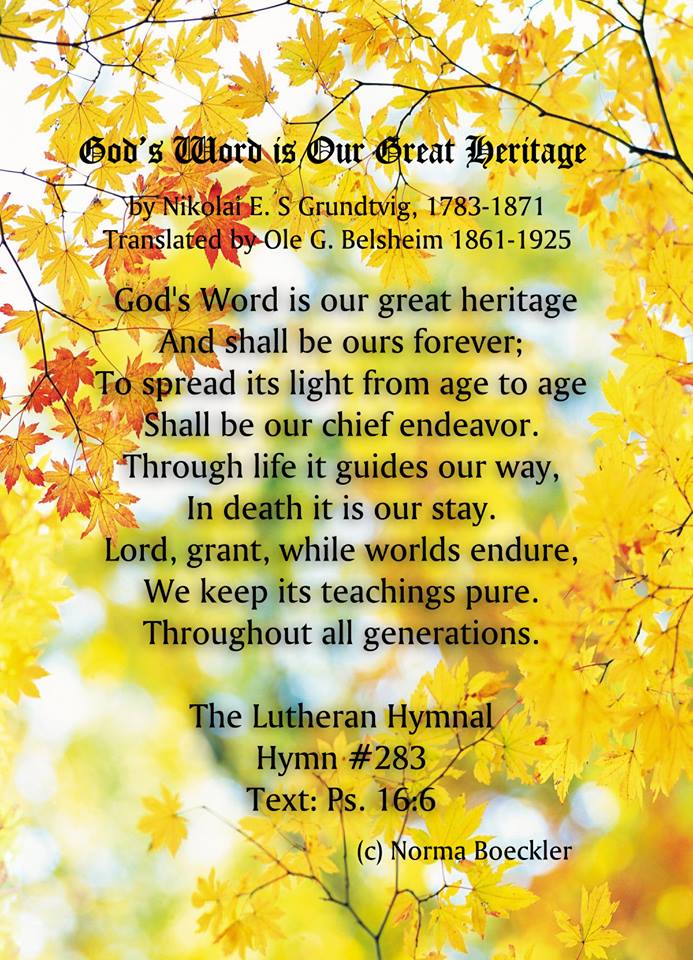
The Hymn #283     God's Word Is Our Great Heritage           


In Our Prayers
  • Andrea had retina surgery this week.
  • Pastor Palangyos' daughter and father-in-law were having medical difficulties. Her name is Jeshra.
  • Elizabeth Mior - has cancer. She is the mother of two small children.
  • Those looking for work and a better income.
  • Glen Kotten is doing well and appreciates your prayers.
  • Carl Roper will have another growth treated.
                                    

Sixth Sunday After Trinity

Lord God, heavenly Father, we confess that we are poor, wretched sinners, and that there is no good in us, our hearts, flesh and blood being so corrupted by sin, that we never in this life can be without sinful lust and concupiscence; therefore we beseech Thee, dear Father, forgive us these sins, and let Thy Holy Spirit so cleanse our hearts that we may desire and love Thy word, abide by it, and thus by Thy grace be forever saved; through our Lord Jesus Christ, Thy Son, who liveth and reigneth with Thee and the Holy Ghost, one true God, world without end. Amen.

KJV Romans 6:3 Know ye not, that so many of us as were baptized into Jesus Christ were baptized into his death? 4 Therefore we are buried with him by baptism into death: that like as Christ was raised up from the dead by the glory of the Father, even so we also should walk in newness of life. 5 For if we have been planted together in the likeness of his death, we shall be also in the likeness of his resurrection: 6 Knowing this, that our old man is crucified with him, that the body of sin might be destroyed, that henceforth we should not serve sin. 7 For he that is dead is freed from sin. 8 Now if we be dead with Christ, we believe that we shall also live with him: 9 Knowing that Christ being raised from the dead dieth no more; death hath no more dominion over him. 10 For in that he died, he died unto sin once: but in that he liveth, he liveth unto God. 11 Likewise reckon ye also yourselves to be dead indeed unto sin, but alive unto God through Jesus Christ our Lord.

KJV Matthew 5:20 For I say unto you, That except your righteousness shall exceed the righteousness of the scribes and Pharisees, ye shall in no case enter into the kingdom of heaven. 21 Ye have heard that it was said by them of old time, Thou shalt not kill; and whosoever shall kill shall be in danger of the judgment: 22 But I say unto you, That whosoever is angry with his brother without a cause shall be in danger of the judgment: and whosoever shall say to his brother, Raca, shall be in danger of the council: but whosoever shall say, Thou fool, shall be in danger of hell fire. 23 Therefore if thou bring thy gift to the altar, and there rememberest that thy brother hath ought against thee; 24 Leave there thy gift before the altar, and go thy way; first be reconciled to thy brother, and then come and offer thy gift. 25 Agree with thine adversary quickly, whiles thou art in the way with him; lest at any time the adversary deliver thee to the judge, and the judge deliver thee to the officer, and thou be cast into prison. 26 Verily I say unto thee, Thou shalt by no means come out thence, till thou hast paid the uttermost farthing.


Background for the Sermon, Matthew 5:20ff.
The key term in the Gospel is righteousness. Jesus said in the Beatitudes - Blessed are those who hunger and thirst for righteousness, for they shall be satisfied. 

Satisfied is the word used for fattening cattle. Those who enjoyed the miraculous Feeding of the Multitude were "satisfied," completely full so they wanted no more - and more was leftover than they started with.

But what is righteousness? Our initial response would be perfection, being able to obey all laws, all rules to perfection, to leave people in awe. Children are told to be "good" with a great emphasis on "good." We were visiting a pastor's family when the oldest, a girl, said to her brother, "TRY to act normal!" That was the funniest admonition I had ever heard. 

Paul explored various forms of righteousness in Romans, such as obeying traditional rules, obeying the religious laws. No one can claim perfection in those areas.

Our tendency is to think in terms of what we do. The Pharisees were a good foreshadowing of how people today put on a show of outward righteous works, but that is not what Jesus is teaching.

To say, your righteousness must exceed that of the Scribes and Pharisees! that sounds arduous, impossible, and unlikely once someone has had a major disaster of some type.

But the righteousness of the Gospel is the righteousness of faith. That is so different and powerful that people - even Lutheran pastors - rail against it and try every possible way to return to being work-saints and work-salesmen.

 "Satisfied" after the Feeding of the Multitudes


The Righteousness of Faith


KJV Matthew 5:20 For I say unto you, That except your righteousness shall exceed the righteousness of the scribes and Pharisees, ye shall in no case enter into the kingdom of heaven. 

Initially, I saw the righteousness of the Scribes and Pharisees to be unattainable. And here, there is this great threat, that someone must exceed their righteousness to enter the Kingdom of Heaven.

The natural response to this - often carried out in various denominations and sects - is to lay down rules and regulations making their man-made righteousness something only a few - the elite - can attain. Certain families can do no wrong and certain schools are the only ones worthwhile, no matter how flea-bag they might be. Conformity is the rule - a perfection in conformity to man-made rules is is their holiness.

That cannot be what Jesus means, because He taught, "Blessed are those who hunger and thirst for righteousness. That represents a genuine desire for spiritual food, not something to be condemned by God. The "because" is is a great Promise of the Gospel - "for they shall be satisfied." That does not mean merely fed, but fed the way the multitudes were in those great miracles, so much they had baskets of leftovers. 

Paul argued against the man-made forms of righteousness in the early chapters of Romans. No matter what standards are set up, even one's own, they cannot be met. Everyone is condemned by any form of the Law, even - and especially - those who make up their own standards.

So there must be another righteousness when the Old Testament and Jesus speak of it. And there is - the righteousness of faith. I wish those poor, deluded souls who teach absolution without faith would grasp that. Because they are blind, they cannot see what is meant by Jesus, Paul, and the Formula of Concord, which they claim to honor.

Faith is not a decision we make but a change caused by God's Word. Spiritual matters are a battlefield where Satan battles to keep his own thralls in darkness - and to confuse and conquer those who believe the truth of God's Word. 

Faith sees God as He is, especially in that special view - seeing Jesus and hearing Jesus as the true representative, the beloved Son of God. One with God, He speaks and acts in harmony with God the Father.

When we study the entire Gospel of John again in Greek, it will be even more apparent how the wording of the Fourth Gospel teaches that harmony, grace, and forgiveness so patiently.

Ranger Bob teaches by drilling - all the time. He was being trained in the Army as a young teenage and took all kinds of training as an Army Ranger. He often describes any effort in steps to be taken, and he repeats those steps often, even parking the car and setting the emergency brake.

The Gospel of John shows how Jesus taught the same way, looking at these spiritual topics from every possible direction. Luther did the same. The result is that - in the Scriptures - we can look at these topics within the entire Bible, in many setting, sometimes with parallel words, to learn what God means.

So righteousness is often talked about but seldom taught correctly.
Jesus made it clear in John 16. The Holy Spirit (meaning the Word, the preaching and teaching of the Word) will condemn/convict the world, because it does not believe.

That is why plain, simple posts or essays or books about the Word of God are so maddening to many who call themselves Lutheran but are really on the fringes. They belong so they can stand on the perimeter and disrupt, accuse, and throw rocks. 

That is not all bad, because sometimes their anger drives them to the Word, and the Word convicts them of that sin - unbelief. But the Spirit is always doing that, always correcting us and taking away our man-made filters, our errors, even our blindness in certain areas.

The Spirit convicts us of our unbelief so He can convict us of our righteousness.

John 16:8 And when he is come, he will reprove the world of sin, and of righteousness, and of judgment:
9 Of sin, because they believe not on me;
10 Of righteousness, because I go to my Father, and ye see me no more;

11 Of judgment, because the prince of this world is judged.

I could not understand this shattering statement for the longest time. Verse 9 was tough too, cryptic until it is seen for what it is.
"i go to My Father..." That could only be true when Jesus rose from the dead and ascended to the Father. That is the ultimate foundation of the Faith - the Son conquered sin and death - proof not only at the empty tomb but also in His post-resurrection teaching, speaking to the disciples and 500 brothers.
The Christian Church began in stages, among believing Jews before He was born, among Jews and Gentiles during His public ministry, and established in the post-resurrection time of teaching as the Risen Lord. When Ascended, all the preparation of the Word was completed and the preaching of the Apostles converted thousands.

One became a dozen disciples, a dozen disciples became 500 witnesses of the resurrection. The 500 witnesses established the truth of the preaching so that thousands were converted, many were persecuted and chased away, even more heard the Word.

To do this, every faithful Christian took away the false comfort in man-made righteousness and replaced that with the Gospel, the righteousness of faith.

People struggle with that today, which is good. The struggle clarifies the truth and dismisses error. I wrote one little piece on the way Romans 4 is summarized by Romans 5:1-2. The person who asked thanked me. Some anonymous person emailed me to call me more names and "explain" to me and condemn me, based on his complete lack of understanding. The anger means the Spirit is at work convicting, but getting past pride and blindness is hard work, even for the Holy Spirit.

The truth is always met with opposition. Our righteousness mus be better than than of the scribes and Pharisees. Faith means we trust not in ourselves but in God. Moreover, we trust in God being in charge of all events. 
Someone said to me the other day, "You never know what the future holds."
I said, "True but we know Who holds the future." God can change things in a moment and make everything so different we know that it could only have come from God.
Luther made references to the "holy, precious cross" which Christians must bear. I found his language strange and even repugnant. But in time I could see that the truth brought on the cross and ended false friendships, security.
God replaced that with true friendship based on faith and an insecurity that was always balanced with miracles big and small, most of all the satisfaction of being able to write to a mixed crowd - those who love the Gospel, those seeking the peace of the Gospel, and those bitterly opposed to the righteousness of faith. 
In two days, there were 4,000 views of the blog, which is good, because we cannot afford a nave that big. The bill for coffee and donuts would be a king's ransom.

Here is another aspect of the faith taught by Jesus - always looking outward means thinking first of the needs of others. It is not a virtue (in the old civic righteousness sense; celebrity charities are fund-raisers or worse). The Gospel multiplies the blessings of others because everyone (ideally) is looking to another's needs and not to the self.


Saturday, July 27, 2019

Luther's Sermon on the Difference Between True Piety and Hypocrisy


SIXTH SUNDAY AFTER TRINITY.

Text. Matthew 5:20-26. For I say unto you, that except your righteousness shall exceed the righteousness of the scribes and Pharisees, ye shall in no wise enter into the kingdom of heaven.
Ye have heard that it was said to them of old time Thou shalt not kill; and whosoever shall kill shall be in danger of the judgment: but I say unto you, that every one who is angry with his brother shall be in danger of the judgment; and whosoever shall say to his brother, Raca, shall be in danger of the council; and whosoever shall say, Thou fool, shall be in danger of the hell of fire. If therefore thou art offering thy gift at the altar, and there rememberest that thy brother hath aught against thee, leave there thy gift before the altar, and go thy way, first be reconciled to thy brother, and then come and offer thy gift. Agree with thine adversary quickly, while thou art with him in the way; lest haply the adversary deliver thee to the fudge, and the judge deliver thee to the officer, and thou be cast into prison. Verily I say unto thee, thou shalt by no means come out thence, till thou have paid the last farthing.


1. This Gospel teaches us the difference between true piety and dissimulation, or hypocrisy. And it is one of the best Gospels for teaching how our works cannot render us pious; something higher than anything we can do is re-required. For the Pharisees also led a pious life; they did what they should, externally; they did not break any of the commandments of God, abstained from property not their own, went about in fine showy clothes, and hence derived their name, being called Pharisees, meaning those set apart, or the select.

2. In like manner he also attacks the scribes, the flower of the Jews, who were so well versed in the law of God and the Scriptures as to teach other people, lay down rules for the community and render decisions in all matters. To sum up, we here have the best, the most learned and the most pious of the Jews. These Christ attacks, whom of all men he should least have attacked. But he says of them to his disciples: “Unless your righteousness shall exceed the righteousness of the scribes and Pharisees. ye shall in no wise enter into the kingdom of heaven.”

3. As though he would say, Behold the Pharisees and scribes lead such a good life that both they and other people believe they will possess the kingdom; but they are wide of the mark. Therefore he reproves them and says: Verily, I say unto you, if you will not be more pious than the scribes and Pharisees, you will never enter heaven. Here the question of those is disposed of who ask, What shall we do in order that we may be pious? For here all works that man can do are overthrown and disposed of, and the most holy of the sanctimonious are cast to the’ ground. Hence you cannot do any deed by means of which one may be saved and rescued from sin. If a man now says that, he surely is a heretic.

PART 1 THE OCCASION FOR THIS EXPLANATION.

4. They at that time might have said, Well, you are a heretic; ate you going to reject good deeds? He pays no attention to that, however, but freely concluded that their works are nought. They might now have said, Pray, if works do not make us holy, why have we the law through which we hope to be saved, if we live up to it? This now gives Christ an occasion to introduce the commandments, explaining them, telling us how they are to be understood. He says: “Ye have heard that it was said to them of old time, Thou shalt not kill and whosoever shall kill shall be in danger of the judgment; and whosoever shall say to his brother, Raca, shall be in danger of the council; and whosoever shalt say, Thou fool, shall be in danger of hell-fire.”

PART 2. THE EXPLANATION.

5. These words are too high and too deep for any one fully to put into practice. To this our Lord not only here testifies, but every man’s experience and his very emotions. Four points are here presented, to-wit:

Thoughts, demeanor, words and deeds; which no one can avoid; he must be guilty. As though he would say, You might find persons that do not kill with their hands; but to be without hatred, not to be angry, be of smiling countenance, not to snub persons — of such a nature none is to be found.

Now, experience teaches this.

6. For take a godly man or a godly woman; as long as everybody keeps his distance, peace and harmony prevail, but if one comes along that speaks harshly and possibly intrudes, even to the extent of the smallest word, he cannot keep from becoming angry; and follows this up by irritating and enraging the offender. Our reason can never come to the conclusion that we are to be considerate to the wicked. Peruse all your heathen books, enter into your own experience, and you will find it so, we cannot refrain from becoming angry, if not against our friends, then against our enemies.

Now God is not satisfied with this, nor can my flesh and blood evade the question, for mark the wording closely when he says, “Thou shalt not kill.”

Who is “thou?” Your hand? No. Your tongue? No; but thou, thou and all that is in thee and with thee; thine hand, heart, and thoughts shall not kill.

7. Thus Christ interprets the law saying with authority, “Every one who is angry with his brother shall be in danger of the judgment. “This sentence pertains to the whole world, for I ask, Who is there on this earth that is not a debtor to this commandment? Seeing that we are to comply with it and cannot, what are we to do? For we can never remove the filth. Then despair must be ours, depend on that. So the commandments of God are but a mirror, wherein we behold our filth and wickedness; for they conclude us all under sin, we being unable to work our way out by our own efforts and free will; unless something else comes to our assistance.

This is the first point.

8. The Lord continues: “Whosoever shall say to his brother, Raca,” which indicates various manifestations of wrath and hatred. But no one is free from this. For if I am told to be friendly to the person I hate, they can tell it on me that my heart is not in it. For you cannot confine the heart; it will out, and show its presence by signs or words. It does not hide itself, and it cannot be hidden. Hence we conclude that we are found guilty of saying Raca, that is, of not being kind to both friend and foe. Now go to past experiences and see this in other people and in yourselves, namely, that no one can deliver himself out of this condition, from this wicked heart, which is planted so deeply in the nature of man. You may act friendly toward your brother; but for you to give him your heart, this you cannot do though you should rend yourself to pieces. Therefore no man can here help himself.

9. Following this he says, “Whosoever shall say, Thou fool, shall be in danger of the hell of fire.” This too makes you appear as nought, without the grace of God, for nobody is so fraught with loving-kindness as never to utter an unseemly word, if not to his friends then to his enemies. Even when you are compelled to speak kindly to your neighbor, your heart is not in it, and whenever you with seeming propriety can do so, you will say, “Thou fool.” That already is contrary to this commandment, embracing, as it does, both friend and foe, since it reads, “Thy brother. “We all, you know, are brethren, descended from one common father, and Scripture brings us so closely together as to call us all one flesh. Isaiah says, 58:7, “When thou seest the naked, that thou cover him; and that thou hide not thyself from thine own flesh. “Here the prophet is speaking of your neighbor; and the word “fool” is to embrace all manner of infamy, cursing, slandering, abuse, judging, maligning and all reviling.

10. It clearly follows that we all are guilty of the commandment: “Thou shalt not kill,” and whoever is not born again of God cannot abstain from murder. Though he desist from the act itself, he cannot banish thoughts and inclinations, for if our enemy meet with death, we will be ready to say, This served him right! And soldiers compose a song on the enemy they have slain or put to flight. But that again conflicts with this commandment, for God does not look at the outward act, but at the heart. Hence much is contained in the words: “Thou shalt not kill,” as much as to say: You must be born again and become a new creature.

11. So the Gospel always reverts to this question, What shall a man do that he may become pious? For, pray as long as you will; fast as long as you will; give alms as long as you will; pay for masses and build churches as many as you will; you are, nevertheless, still a murderer, for you hate your brother; you cannot give him a kind look nor a kind word. It follows that your righteousness is nought; it is of and pertains to perdition.

And now we have two more points that are about as severe as the preceding. We read: “If therefore thou art offering thy gift at the altar, and there remeberest that thy brother hath aught against thee, leave there thy gift before the altar, and go thy way; first be reconciled to thy brother, and then come and offer thy gift. Agree with thine adversary quickly, while thou art with him in the way; lest haply the adversary deliver thee to the judge, and thou be cast into prison.

Verily, I say unto thee, thou shalt by no means come out thence, till thou have paid the last farthing.”

12. Here are two things that go against our nature. The first: When I am angry, my brother is to conciliate me. The other: My feelings being hurt, I am to forgive my brother, though he offer no apology; I am to have a kind heart toward him, so he does not deliver me to the judge, as you have just heard. This last part they formerly severed from this Gospel, and I hold that Augustine did so in writing, as appears from his book, “De spiritu et litera. “ The sense of the passage is as follows: 13. Here are two persons: the one offending is to ask pardon. The other being offended, is to forgive kindly and willingly, even though he be not asked to do so. By nature we can do neither. Our nature may prompt us to go and say, My dear friend, forgive me! but doing this under compulsion, in fear of hell and God’s wrath, hatred still remains in our heart. On the other hand, the one offended cannot forgive from his heart; and as the one acts the hypocrite in asking forgiveness, so does the other in granting it.

But that certainly is of no avail before God, for thus says our text: “If therefore thou art offering thy gift at the altar, and there rememberest that thy brother hath aught against thee, leave there thy gift before the altar, and go thy way; first be reconciled to thy brother, and then come and offer thy gift. And this reconciliation must proceed from the heart; mark well the words of the text.

14. The passage conveys the meaning that God does not want you to come and serve him without having previously been reconciled with your brother; “then come and offer thy gift.” As though he said: “Behold, man, I have created and redeemed thee; recognize this, and shape thine whole life toward serving thy neighbor. If not, do not serve me either. If thou wilt not do the one (serve thy neighbor), seeing that is needed, you had better not do the other (serve me), since that is not needed. “So God would much rather be deprived of his service than of the service you owe your neighbor, and would sooner see you less stringent in your service toward himself, if you are pious at the expense of serving your neighbor. Summing up, God wishes you to see first to your neighbor’s service and interests.

15. Now, there are many ways of harming our neighbor, as for instance, when I do not protect his reputation, being well able to do so; when I am not kind to him, or fail to aid him; I am already his antagonist. So, if I want to be agreeable to God, I must, in the first place, be reconciled to my brother; if not, I cannot be pleasing to him. For God rejects the service rendered him, if the service due our neighbor is not performed.

16. Now look at the kind of life we have led hitherto. We have been going to St. James, to Aix-la-Chapelle, to Rome, to Jerusalem, have built churches, paid for masses, and withal have forgotten our neighbor; this now is the wrong side up. The Lord, however, here says, Go and take the money with which you were about to build a church and give it to thy neighbor. Look to your neighbor how you may serve him. It is not a matter of moment to God if you never build him a church, as long as you are of service to your neighbor. But all this is now being neglected, and only the contrary is observed. Oh, the miserable, perverted life that we have learned from the Papists! This is why no one wants to enter the married state, for nobody lends him a helping hand, nobody offers him any aid, so that he might support himself and get along. Hence it comes to pass that the one turns monk, the other nun, the third a priest, a thing we could indeed obviate if we would but show works of love. Thus they go along, forgetful of maidservants and manservants, and finally bequeath a legacy and go to perdition with their legacy.

17. It follows that God simply wants you to serve your neighbor, doing your duty to him, so that matters are righted first of all between yourself and him and you be first reconciled to him; or God will neither see nor hear you. Furthermore, if my adversary come to me, I am to forgive him willingly; if he does not come, I am still to be conciliatory and kind to him, while I am on the way with him, in this life, so that he does not deliver me to the judge.

18. How does that come about? He does not take me by the hand and conduct me to the judge; but when I face judgment my conscience realizes that it had been unwilling to forgive the neighbor, entertaining secret but inveterate hate even then. My conscience over against my neighbor delivers me to the judge; he delivers me to the officer; and he, in turn, casts me into prison, that is to say, into hellfire, until I pay the uttermost farthing, which means forever; for there the liquidation of the debt and deliverance are impossible. Here you see the exalted works that no one can attain, neither by work righteousness nor by the law. For works, if alone, will make hypocrites and dissemblers; the law, if alone, brings forth despair.

19. But what am I to do? Do I hear correctly: am I to be damned? Do as follows: Flee to Christ when thus conscious of iniquity, saying: Oh, my God, thy law is now a mirror to me, whence I see how perverted and lost a being I am! Oh God, now save me for thine only begotten Son’s sake.

Thus, by faith God gives you the Spirit, who changes your heart, so that you will be very kind to your neighbor and will argue thus: Behold, if God has acted thus toward me, forgiving me more than I can ever hope to forgive, why should I not be willing to forgive my neighbor a little?

PART 3. AN OBJECTION AND THE ANSWER.

20. Now the sword of the government seems to conflict with this, and the question arises: If I am to forgive, not to hate, not to kill, how then am I to correct and chastise? If I am to wield the sword and with it execute, how can I help being angry? This question is in order, for the Gospel here seemingly subverts the sword of the government. But we are to bear this in mind: Christ is here a spiritual teacher, solely guiding the consciences, showing them how much hatred, envy and wrath they contain, and how to get rid of it. That is his office in which he is engaged; with the worldly sword he has nothing to do, he lets those see to it whose duty it is.

21. Well, this doctrine does not enter all hearts; most of it remains on the surface. But those, into whose heart it falls, prostrate themselves before God and cry to him for help, are at once pious and have no need of the worldly sword, for they are being ruled by words. Now those who do not grasp this but lead an outwardly wicked life, there the worldly sword must be used. Thus you are now to understand that a secular prince or whoever he be that wields the worldly sword, must conform to what is here taught, namely, not to be angry and not to kill.

22. How then are they to conduct themselves who wield the sword in God’s stead? Thus: the fact that they wield the sword is a part of their office. In a sense, the Gospel has claims on them’, and then they are to be very kind in heart; meek and compassionate; then again, when duty calls, they are to be grave, punishing with alacrity, without regard to friend, foe, beauty, riches or learning. We see this in the case of Moses. He was the meekest man that has ever lived, so much so as to fall down and ask to be blotted out of the Book of Life, Exodus 32:32, if only the multitude be saved. Behold, was he not a mild, sweet and kind man, being willing to go to perdition and be condemned in body and soul that the people might be spared? But, when placed as chief in command, he, in questions of government, took energetic measures, executing three and twenty thousand, by which he might appease the wrath of God.

St. Paul acted in like manner. He too was ready to surrender his soul’s salvation for the Jews, as shown by Romans 9:3. But on learning that a man at Corinth “had his father’s wife,” he wrote so stern and severe an epistle as he had never done before, ordering that such a one be delivered unto Satan, “that the spirit may be saved in the day of the Lord Jesus,” 1 Corinthians 5:5. Likewise David and others acted. In fact, we find a number of such in the Old Testament as would, externally, use the sword in full rigor, executing the people as they would kill chickens, and at the same time be very tender and kind at heart.

23. Let us take a bold illustration, that you may see how a person in authority is to conduct himself. Take the coat of arms of the Elector of Saxony. It shows, two swords in a white and black field, so arranged as to have the hilt below on a white background, and the blade above on a black background. These indicate how you are to conduct yourself when in authority: below, holding the sword by the hilt, you are to be clean, white, tender-hearted and gracious, having the best of intentions; above, when on duty, you have the blade in a black field, that is to say, a determined and strict enforcement is called for, in order outwardly to stay transgressors.

And the red color of the swords indicate that blood is to be shed. Moses, David and others have thus beautifully handled the sword by the hilt in the white field, being sober, mild and kind at heart; and have wielded the blade in the black field, being grave and austere in their official duties.

24. Just so should a citizen or civil judge also do. When dealing with a wicked person that will not be controlled by words, his thoughts are to be: “Oh, my God, how gladly I would die for this man, if it could be done! He has a soul that I cannot succor; besides, he leads a wicked life, not being able to bring his flesh and blood under subjection to the spirit. “And then when comparing the two and seeing which outweighs the other, he will find that it is an easy thing for the man to die, but a grave matter for the soul to die, for the soul’s dying is eternal. Hence his thoughts and words should be: “Ah, see how your soul might enter into judgment; see, how you might enter into perdition. For that reason, in order that sin may make no further inroads, I must divest you of your body, and see to the saving of your soul, since I cannot save your body. “And then we must strike hard, resolutely take to the sword, so that we may prevent wrath and stern judgment, as did Moses with the children of Israel. In that event you are carrying your swords in a white and a black field.

25. The design of the two swords crossing each other, as though one would stay the other, is well conceived. This is to teach that a judge should be wise and prudent, and see, where he must temper and modify a harsh sentence, where it is just and right. It is like two sentences clashing when one will annul the other. You are not always to proceed secundum strictum jus, strictly according to law, but see what is just and right, and where a case can be adjusted, there he should also give his attention.

26. Take an example. The disciples of the Lord plucked ears of corn and ate, when passing through the fields. Now the Sabbath was by divine command to be observed under pain of death, Numbers 15:35; but the disciples were hungry, so one law cancelled the other. For that reason the Lord excuses them over against the Pharisees, saying: “The Son of man is Lord even of the Sabbath day,” Matthew 12:8. Although the observance of the Sabbath was a matter of divine command, the disciples nevertheless were excused, inasmuch as the Sabbath was not to be so strictly observed as to prevent them from eating and thus to cause them to perish because of this very observance. The same holds true of David, who partook of the consecrated bread which no layman was allowed to eat, 1 Samuel 21:6. This was a case of the two swords clashing, it being necessary for one law to give room to the other. For this reason David and also the disciples were excused. For no law has been established by God for the ruin of man, but for his bodily and spiritual welfare.

27. Hence, to sum up all, civil authorities should be severe externally, staying transgressions; but internally, they should harbor a tender, gentle, Christian, amiable spirit; withal they are to be wise and prudent, so that they may know how to temper stern justice, in accord with what is right and proper. This may suffice on this Gospel. Let us pray God for grace.

End of Chapter 4 in Romans - Not the Great Wall of China

 The Great Wall of China, seen from below

Some authors see the ending of Romans 4 as the Great Wall of China, as if the topic changes in Romans 5:1-2. Moreover, they seldom view Chapter 4 as a unit or Romans 3 - 5 as a larger unit.

A formal letter, a doctrinal epistle, is going to have transitions. Survivors of my ongoing Greek class know that I emphasize the  use of words to substitute for the punctuation we use today. Post-positives like gar and de alert us to breaks. Alla is a contrasting big break. Kai is often a marker for a big break. Oun is therefore, a word which we use today to create a conclusion or a transition. Therefore, I will demonstrate this.

Romans 4:24-5:2 King James Version (KJV)
4:24 But for us also, to whom it shall be imputed, if we believe on him that raised up Jesus our Lord from the dead;
25 Who was delivered for our offences, and was raised again for our justification.
5 Therefore, being justified by faith, we have peace with God through our Lord Jesus Christ:
2 By whom also we have access by faith into this grace wherein we stand, and rejoice in hope of the glory of God.
The conclusion cannot be that the entire world has been justified, because the whole world does not have faith. Romans 4 is summarized by the first two verses of Romans 5

  • We are justified by faith
  • We have peace with Christ as a result
  • We have access to grace through faith
  • We stand on this faith in Him and rejoice in the glory of God.
Various terms are used for the Jesus atoning for the sins of the world, but they are not the divine declaration of innocence. The debt wass paid by Christ, once for all. As Luther said so plainly - and plainly missed by the Rationalists, Calvinists, Pietists, OJists - the treasure of the Gospel lies in one heap until it is distributed by the Spirit through the Means of Grace.


The Holy Spirit  teaches Justification by Faith in Romans, using the same Greek words for Abraham in Genesis 15:6 (Septuagint)

Genesis 15:6 And he believed in the Lord; and He counted it to him for righteousness.

Romans 4:3 For what saith the scripture? Abraham believed God, and it was counted unto him for righteousness.

In both Scriptures, many centuries apart - the same three words - believed, counted, righteousness.

LXX Genesis 15:6 καὶ ἐπίστευσεν ῞Αβραμ τῷ Θεῷ, καὶ ἐλογίσθη αὐτῷ εἰς δικαιοσύνην.

Romans 4:3 τι γαρ η γραφη λεγει - επιστευσεν δε αβρααμ τω θεω και ελογισθη αυτω εις δικαιοσυνην

In Septuagint Greek and St. Paul's own words, the same three words - believed, counted, righteousness.


Strange Convergence - Or the Typical Final Stage of Apostasy?


I do not worry much about other denominations, because there are always people who ignore the official dogma or the current thinking of their Left-wing clergy. Forgiveness and salvation come to those who trust in Christ alone. I asked a Roman Catholic nurse a series of doctrinal questions about Christianity. She was on our side and even came to our worship services in Columbus to hear the sermons, smiling in appreciation while the Stolzenburg fan club glowered with hate.

What does bother me is the dishonesty of the so-called conservative Lutheran leaders and professors who fake their devotion to the Scriptures while mocking the Bible, the Book of Concord, and the Lutheran Reformation.

The conservative Lutheran leaders have their Talmud, the device used to make the Scripture as distant as possible from the Jewish people after the death and resurrection of Christ.

The Talmud has a tiny bit of Scripture on the page, surrounded by commentary, plus commentary upon the commentary. The proclaimed idea was "to build a hedge around the Torah," but it was really to keep the Messianic Promises away from the Jewish people - the Old and New Testament unity being so obvious to see (Isaiah 53, Psalm 22).


The Olde Synodical Conference has turned the Gospel inside-out with the same approach.

Is this doctrine true to the Reformation, the Bible?
They answer by naming or quoting obscure Pietists, promoted to the status of "orthodox."

Is this true to Luther?
They answer with Johann Gerhard, who is not found in the Book of Concord (unlike Melanchthon and Chemnitz) because Gerhard was born two years after the Book of Concord was published.

But what about the origin of Justification by Faith?
They answer, "Romans 4:25" (a partial verse) "is all you need to know." Who are you to question a Missouri convention document?

"Therefore, we are justified by faith" is so clear, no?
All you need to know is the word "many" and "many" will answer all questions once we tell you what it means.

The Stephanite migration and the Bishop Hill settlement were quite similar in being led by charismatic but promiscuous prophets, half-educated but proclaiming they were The Truth.

The Stephanites and Bishop Hill followers were extreme Pietists who wanted to create their own paradise. When Walther toppled Bishop Stephan with a riot and forced the leader to Illinois at gunpoint, he took over the group, as pope rather than bishop.

Bishop Hill kept Jannson's belongings as sacred objects. The Missouri Synod has multiple statues of "The Great Walther", plus a creepy shrine for him.


Hummingbirds - Plant It and They Will Come - Feeders Add To the Attraction


I am prepared to transplant this autumn, when the weather is cooler. Last year I left the newly transplanted Hostas alone, and they began their leap year in 2019. The leaping includes stalks of flowers the hummingbirds love, tubes to sip from.

I also planted a wild number of Bee Balms, thanks to an autumn sale. Rain-drenched, they reached five feet and were all over the driveway side of the garden. Most of them are blue, but the color does not matter as much as the pollen and nectar. They are great for bees, butterflies, and hummingbirds.

Ranger Bob, Sassy, and I sit on the front porch in the afternoon, enjoying the shade, the breezes, and the hum of activity. One hummingbird checks us out each day.

The backyard began getting hummingbirds first, because I had some scarlet Bee Balm (floppy and quick to run wild) and Hostas. Once I learned how much hummingbirds love Hosta flowers, I began transplanting some from Mrs. Gardener.

 Crepe Myrtle - Picotee


I bought a feeder and hung it under the kitchen window. Thanks to planning and planting ahead, I now have a Crepe Myrtle blooming at eye level, outside the window - picotee, white and red flowers. The feeder seemed to be ignored for two weeks (normal for wary birds). Now I see a tiny hummer flitting over for a sip each day.

The Crepe Myrtle will be a good place for hummingbirds to rest before making a feeding run.


The squirrels have lost 95% of their feeding privileges for tearing up bird feeders and the Jackson EZ Bird Swings. They were well behaved for the longest time, with juveniles sitting on the window sill to get seeds, reluctant to work for their supper. The mature squirrels saw the baby fat on their offspring and decided to cash in on sunflower seeds.

Squirrels are vindictive. I shut down the supply for one, who came into the garage in New Ulm and feasted on the barrel of sunflower seeds. When I shut the barrel tight, he tore up the area and left a dropping on the very top of the barrel lid. That message was easy to translate.

Anyone can pick a bird and marvel at God's Creation, so evident in the colors, habit, and nesting of that evolute creature. The hummingbird is tiny, like a flying leaf, brave, and friendly. I used to give them showers with the hose in Phoenix. They would fly near me to get my attention, their wings sounding like electrical hum.

After going over hummingbird and butterfly books, I concluded that Joe Pye Weed was the best investment. JP is perennial and gains strength each year. My oldest plant reached seven feet this year, but I also planted knee-high Baby Joe Pye Weed, which bloomed at the same time.

The flowers that expand in clumps (daisies, Cat Mint, Mountain Mint, Hosta, Bee Balm) are easy to divide and spread around the garden. They provide a constant supply of flowers for butterflies and hummingbirds.

Similar to broadcasting the Word, something is going to happen when we plant many types of flowers at once. The surprises never end.

No, I have not given up on roses. The June Bug season is over and so is our mutual destruction of rose blooms. Every time I caught a promiscuous pair in their rosy love nest, I smashed it with two books brought together with great force and wrath. They had already spoiled the bloom, so I spoiled their honeymoon. Each pair can produce 60 more of the vile beetles, which also gnaw at the roots in the grub stage.

 Joe Pye is named Weed, but is an herb.
So faithful Christians are labeled obnoxious, troublesome, and worthless, but they are taught by the Spirit in the Word and bear the cross.

Friday, July 26, 2019

Some Samples of Dishonest Conversation

 "Faith is an organ," says LQ's Nadler, fainting from the strain of his outbursts.


Rev. David R. Boisclair (Drboisclair)
Advanced Member
Username: Drboisclair

Post Number: 673
Registered: 1-2002
Posted on Saturday, July 27, 2019 - 12:01 am:   Edit Post Delete Post Print Post


Thank you, Steve Schmidt! At least Luther is quoted properly here. Luther is misused by those who deny the scriptural doctrine of Objective Justification. They make use of Luther like other errorists who quote Luther against himself. Luther predicted that this would happen.

They lie that say that we who believe, teach, and confess Objective Justification deny Justification by faith alone.

Objective Justification, which is scriptural (2 Cor. 5:19, Romans 4:25; 5:18) cannot be accused of being a Pietistic, Synergistic, or Arminian doctrine as Ichabod alleges. It is a biblical doctrine that is centered in Christ not in man as the doctrine of Ichabod is with their unscriptural exaltation of faith to be a condition that induces God to forgive an individual. Faith is not a condition but a God-created receiving organ.
***

GJ - I was going to list some basic samples of dishonest conversations among Lutherans, so Nadler stimulated an earlier listing.


  1. It is widely known that the Reformation's theme was Justification by Faith. No scholar has tried to prove that Luther or St. Paul nursed a passion for Objective Justification.
  2. The disciples of Stephan and Walther pretend the migration was a battle for religious freedom, a re-establishment of Lutheran doctrine. The Stephan sex cult was Pietistic, not unlike the Wheat Flour Messiah of Sweden, whose mind was righteous and whose body was adulterous. His followers revered Jannson and kept his possessions as religious relics.
  3. The Hive speaks constantly of the "doctrine of Objective Justification and Subjective Justification," but there is no such language or doctrine in the Bible.
  4. The OJ revelation is so sublime, so mysterious that no one in the cult can solve the issue of when OJ happened - or how many times it happened. 
  5. The OJ guru David Scaer has solemnly stated that OJ is the peculiar dogma of Midwestern Lutherans. However, his OJ partner Robert Preus sought out non-Lutheran Evangelicals and Calvinists for help in his OJ battle against WAM II.
  6. WELS-ELS-LCMS! They love to boast about how conservative they are, but they share the same basic concept of all mainline denominations (an honest category for the "conservative" Lutherans too) - God's grace has already pardoned the entire world.
  7. They pretend the WELS-ELS-LCMS leaders have always taught OJ, but WELS-LCMS officially taught Justification by Faith until the OJ Hive took over, step by step.
  8. These groups are conservative and Bible, swearing to the Scriptures as the ruling norm, the norma normata. Wonderful - let them teach about forgiveness and salvation without their philosophical terms, borrowed from sects and cults.

LutherQuest's Nadler Denounces St. Paul and the Holy Spirit as "Synergists" -
They Cry Like Starving Orphans - "Even Worse than Fideism!"

Synergism!


"We have a Q.E.D., quod erat demonstrandum, "that which was to be demonstrated," of Synergism on the Ichabod website: In one of their exquisitely decorated text boxes they quote Romans 4:24-25 ("But for us also, to whom it shall be imputed, if we believe on him that raised up Jesus our Lord from the dead; Who was delivered for our offences, and was raised again for our justification") and put the subscription: "'If we believe on Him ..' is a condition." This is more than Fideism. It is pure Synergism. Faith is not a condition of God's forgiveness of us. The statement implies that it is up to man to provide the condition or requirement of faith." 
David Boisclair, Advanced LutherQuisling, 640 hopelessly confused posts

 The evidence!

 Even more evidence!

***

GJ - I mentioned on Facebook - the opponents switch to philosophy when someone mentions the Scriptures. 

The Gospel creates faith by the power of the Holy Spirit in the Word. That is not synergism.

I do not want to get into Greek, because the Ft. Wayne graduates do not even know English.

Below are two graphics, examples of synergism, though bizarre - making a decision for Objective Justification.

 "Must accept" OJ.


 Will he accept or will he decline?

PS - Boisclair, hopelessly illiterate about Biblical teaching, labels all the Atonement passages as Objective Justification.

PPS - Expecting the LutherQuislings to understand Luther is like asking AOC to explain the US Constitution. Just like their brutalizing the Book of Concord, they take Luther's Atonement passages for an OJ he never taught.

It is a typical Calvinist technique to cling to a Christian doctrine and insert a parallel, erroneous interpretation while pretending to be the true Christians.

CFW (Calvinist False-Teaching Windbag) - he was raised by a Rationalist pastor, trained in Rationalism, and passed the exams of the Rationalists to become a Rationalist pastor. The German territories were Union Church, a combination of Lutheran and Calvinist, with the emphasis on Calvinism. Walther sought spiritual guidance from his Pietist friends and two Pietist gurus, the second one being Martin Stephan.

Thus Walther was really a combination of Rationalism, Calvinism, and Pietism. He did not repristinate Luther but sought to become a new Luther, the Great Prophet who answers all questions.


Another Calvinist Insight from the Cascione Hive

 "On a personal note I wish to say that it was Francis Pieper's Christian Dogmatics that got me in my seminary studies to grasp the astounding truth that God's forgiveness of us comes to us WITH NO CONDITIONS, LIMITATIONS, OR ANY 'STRINGS ATTACHED.' Praise God for this boundless and amazing mercy!"
LutherQuisling Boisclair


***

GJ -

 "If we believe on Him.." is a condition.


---

Pastor,

The link below takes you to the papers from the 2018 ELDoNA colloquium.  Of particular interest is Pastor Paul Rydecki's paper "On Francis Pieper's Misuse of Romans 4:25 as a Biblical Basis for Objective Justification" in relation to the quote above.


Best,


Let Your Yes Be Yes - The Satanic Genius of Double Talk.
Dishonest Communication

 WELS: "GA? There is no GA."
At graduation, "Remember the pond?"


Matthew 5:37 But let your communication [logos, statement] be, Yea, yea; Nay, nay: for whatsoever is more than these cometh of evil.

37 εστω δε ο λογος υμων ναι ναι ου ου το δε περισσον τουτων εκ του πονηρου εστιν.

The perfect verse for WELS is Matthew 5:37, because that one verse goes against their entire GA culture.

GA is their secret initiation week, where the sympathetic seniors pretend to be "hards," and the mean seniors act as though they will protect and help the new seminary students. They begin with a fake debate over whether they will have GA. Wink, wink. Oldster pastors come back to watch the antics, remembering perhaps the gay GA pope who is now Michigan DP. One of the standard pranks is "losing the pope's bowling ball" in the pond full of raw sewage. The new students have to look for it. The new students are told to take off their sewage-soaked clothes outside the dorm, and the female kitchen staff watch the nude students from the kitchen windows. 

When a WELS leader declares something to be true, and every pastor knows it is a lie, that sends a message. "We will do this and you will be quiet." WELS pastors will go into a meeting, misleading a layman, and suddenly switch sides after being super-sympathetic. All meetings in WELS are fake, because the outcome is decided beforehand in the pre-meeting.

WELS is not unique, just highly polished after decades of practice and winnowing out the bad eggs. They have fewer, but better members this way.

The synod politician is easy to spot. He wants to be buddy-buddy (Paul McCain, Jay Webber, Jon-Boy Buchholz, Steve Spencer, Jack Cascione, John Shep, Paul Fleischer, His Holiness James Heiser) - until he is the opposite.

These synod politicians seek to gain the advantage through dishonesty. The trouble is, the dishonesty habit is tough to break. When Jack Cascione wanted me to review his book on lists in the Bible, he printed my name as "Pastor Gregory Jackson, PhD Yale". That was a lie, and he knew it. I told him that was wrong - he must have thought that gave his book cover more credibility. Later, he decided I was a bad guy, and he dropped my name from his vanity press book.

The LutherQuisling blog invited me, in a friendly way, to post on their odious site. I did, and they answered by attacking me. I did not mind their attacks, but their initial deception gave them away for what they were. A friend said to me, "Why should you waste your time posting with those skunks?" I once had a pet skunk - maybe I was nostalgic about Hilda.

Mrs. Ichabod likes to keep up with the latest debates. I read her some samples from LQ, the cloaca maxima.

She said, "How does that make you feel when they call you all those names?"

I said, "It is very encouraging." She burst out laughing. Over the years she gradually learned that getting flak is a sign of being right over the target.

I even had an ankle-biter send a friendly email about Romans 5, claiming the entire issue depended on one word - "many." (Calvinistic Claw Machine alert) The next message was - I had never dealt with the word. Then the name-calling began, followed by an incoherent rant that supposedly proved his case.

Two things are consistently true about Objective Justification addicts:

  • They are pathological liars.
  • They are perpetually angry.

One would guess that their gushing about grace would make them full of grace. But that is what Luther warned about the sectarians. They talk about Jesus all day but they tear down the bridge to Him, the Means of Grace. 

No one needs the Word, according to OJ, because God has already declared the entire world righteous, forgiven, saved.  Once upon a time, there was one Moment of Universal Absolution without Faith - Easter (Halle Pietism).

Now there are many Moments - 

  1. The Cross - "It is finished."
  2. The angelic choir "good will to men," 
  3. The Garden of Eden. "He denies Garden of Eden OJ!"


And why not? Their guru Calvin has all salvation and all damnation determined before the world began - or maybe after the Fall was when that "horrible decree" was announced. Calvin's dogmatic sources, like OJ's, are invisible in the Bible and seen only by the elite.

Calvinism and OJism make faith and the Means of Grace irrelevant. OJ faith (sometimes marketed as SJ) is merely faith in the sublime truth of OJ. 

Could this be why the WELS pastors are notorious for alcoholism, adultery, and uncouth behavior? (Source - Father Steve Spencer)


 Easter is all about petting baby bunnies and other gimmicks, like meeting in a cemetery.

Thursday, July 25, 2019

The Oracle Is Hyped by Casione, Who Has a Flair for Fraud


Rolf David Preus: “4. Do you subscribe unconditionally to Luther's Small Catechism ~because~ it is in total agreement with the Holy Scriptures?” 

The Oracle - No, because it is NOT in total agreement with the Holy Scriptures. 

In a previous discussion, I detailed where Luther’s Small Catechism differs from Scripture.   

***

GJ - Of course, the LutherQuislings just pretend to agree with the Book of Concord. They reject the Chief Article and continue their war against the Gospel. So why would they not attract a fraud like The Oracle?


---


A Reader:
Thought they couldn't get any better, and then this bombshell:
http://ichabodthegloryhasdeparted.blogspot.com/2019/07/the-oracle-is-hyped-by-casione-who-has.html

That's it - you "nailed it".  Someone who denies the Lutheran Book of Concord is no Lutheran.

Someone who denies the chief article is by definition not in accord with the Augsburg Confession, and so, is no Lutheran, no matter what he calls himself.


If he calls himself a Lutheran, he is either self-deluded or a wolf.


---

Another Reader:

I find it rather ironic that Jack “No Synod” Cascione would dare to compare Pastor Jackson to R. C. Sproul when Cascione himself is an admitted (UOJ) universalist and Pastor Jackson’s JBFA assertion is based on Scripture. This comment by Cascione is simply absurd, but if one wants to find absurdity LutherQuest may be the best place to find it. I find the use of the name Luther being used by these people offensive, it is an insult to Dr. Luther who clearly taught and believed in justification by faith alone as clearly recorded in the 
Bible. The LQ heterodox blog can continue to say whatever they want, I am rather confident that nobody is listening.

Feel free to publish:

Sincerely,

Justified By Faith Alone

***

GJ - I have never read R. C. Sproul. I knew a Missouri Synod layman who was in their Delta (I think) program for lay ministers. He talked about R. C. Sproul - as the greatest - every time we were together. One of the LCMS editors warned the pastors to stop reading so much Calvinistic material in the name of "improving their English."

When I saw pastor pals with Calvin's Commentaries or Spoonfuls on Purpose, I said, "Get rid of this crap."

The Perryville cult was formed around Pietistic cell groups.