Tuesday, March 20, 2012

Bivens on UOJ.
Confusing the Atonement and Justification,
Omitting the Means of Grace

F. Bivens


AC V has left a new comment on your post "Bivens, McCain, and Kilcrease Have No Concept of t...":

More Bivens here:

"Regarding the proclamation of explicit gospel, no finer example of this can perhaps be found than in the way we announce absolution in our worship assemblies. To illustrate this point, a question and answer drawn from the Q & A service on the WELS Web site is here reproduced:

Q: Hello, A Baptist friend of mine is having trouble with pastors forgiving a congregation's sins. Could you please explain to me what gives pastors or others the right to forgive sins. I see James 5:16 and John 20:23. Still kind of confused. Thank you.

A: The Bible verses you mention are appropriate. It may also be said that all passages that invite and urge us to preach the gospel are also rightly mentioned. To preach the gospel is to proclaim the forgiveness of sins for the sake of Christ and his atoning work. No one will really understand what the Lutheran church teaches about "absolution" (declaring forgiveness of sins) unless he clearly understands the truth of objective or universal justification. That is at the very heart of what we believe and teach. Long ago God has already forgiven every human being his or her sins. Christ's life
and death as our substitute is finished. Nothing more needs to be done by the sinner himself. A Christian can go to any person on earth and rightly say to him, "Your sins are forgiven." To put it another way: The forgiveness of sins is not a potential fact that becomes a reality only when sinners
do something to qualify for it, or even when the gospel is proclaimed and personally received through faith. It has long been a reality to be proclaimed to sinners without conditions. When Jesus Christ rose from the dead - 2000 years ago, he was raised because of our justification - because we had already been justified (Romans 4:25). 2 Corinthians 5:19-21 and Romans 3:22-23 stress the same truth. This is why we may speak to one another to say "Your sins are forgiven" or "In the name of God, I forgive your sins." This is why a pastor, acting on behalf of all the Christians in the assembly, says the same thing.


This is not arrogance or trying to "play God." It is serving as God's ambassadors and messengers, which is what we are. Perhaps your Baptist friend is thinking, "This should not be done in a large group, since there may be people who are really not repentant or who are hypocrites in that church. You cannot tell them they are forgiven, can you?" 


We answer in this way: "Yes, we can and must say this, for God has invited and commanded us to do so. Jesus died and took away their sins, reconciling them to him - whether they believe it or not." Lest we be misunderstood, we also say that if we know someone to be impenitent or a hypocrite, we will first speak to that person about sin, God's wrath, and eternal damnation in hell to expose his sinfulness and allow the Holy Spirit to convict him. That is also why the absolution in our public assemblies is always preceded by a general confession of sins and expression of repentance. But the fact remains - From God's standpoint Christ died for them and took away their guilt. We tell people this whether they are believers or unbelievers. And we hope and pray that this time they will believe us so that they too will know it is true and rejoice with us in the amazing grace of God" (F. Bivens, Archived in "Forgiveness and Repentance Section," Set 11).

http://wlsessays.net/files/BivensMessage.pdf

***

Mequon is breeding the next generation of
UOJ Stormtroopers.


GJ - UOJ simply means the entire world is absolved. Everything after that is a matter of indifference, an adiaphoron.

Nevertheless, the UOJ Stormtroopers engage in a constant Ministry of Condemnation. When the LaughQuesters are not denouncing everyone else, they are busy denouncing each other, biting and devouring with unwholesome glee.

The UOJ-Fuller-Jeske coalition will not rest until they remove every single layman or pastor who dares to raise an eyebrow about their fantasies. It is not just a WELS fetish. UOJ is LCMS, ELS, and ELCA, too.

---

RE: GJ - "UOJ simply means the entire world is absolved. Everything after that is a matter of indifference, an adiaphoron."

Here's "Bivens on UOJ: Omitting the Means of Grace." At the first WELS National Conference on Worship, Music and the Arts in 1996 Bivens presented an essay entitled "The Primary Doctrine in Its Primary Setting: Objective Justification and Lutheran Worship"
[Carthage College, Kenosha, Wisconsin, July 23, 1996]. Not a whiff about the sacraments in this foundational essay. Instead UOJ's influence on worship principles leads to these conclusions:

"Aside from 'substance,' however, may we or should we change our worship style? If so, to what degree? The doctrine of justification doesn’t address this question directly other than pointing us to the freedom
we possess in Christ and calling us to exercise that freedom in love and for the edification of souls.
(AC V - JBFA answers the question! Christ achieved forgiveness on the cross and he distributes it through the means of grace! No need for the means of grace if the purpose of the divine service is only to remind people of forgiveness achieved and distributed 2,000 years ago on the cross!) What must be stressed is that, in matters of genuine adiaphora, we are to cultivate truly evangelical and truly ecumenical perspectives. There is no such thing as 'the Lutheran liturgy.' Purely external forms are legitimately influenced by histories of nations, peoples, cultures and languages. A key is to seek and find forms that are appropriate for communicating the truth of the gospel in its fullness, in a particular setting. Some words, tunes and actions are ill suited in certain situations, at best give mixed signals, and will disrupt serious efforts at educating and edifying.

And what do we possess that can bring about such a change in people? The gospel, the truth of justification. So what the unconverted likes least, he needs most. What doesn’t attract him at all is what he desperately needs to be attracted to. Our task, as always, is to seek some point of contact where we can present the gospel to people who aren’t explicitly interested in it. Our gracious God has justified every individual person. God’s will and our desire is that each person be brought to understand and embrace this truth. So the primary doctrine does point us to care for and strive to deal with people individually."


So, self-centered worship forms and gimmicks are fair game so long as they educate people of Christ's forgiveness imputed to all people 2,000 years ago whether they believe it or not. Your job is to convince them of that truth. Now get cracking!

http://www.wlsessays.net/files/BivensPrimary.pdf 

---

LutherRocks has left a new comment on your post "Bivens on UOJ. Confusing the Atonement and Justifi...":

I don't think these guys know what objective and subjective mean. They call it OJ but then speak the whole time in subjective terms. Compare this quote with a definition from Dictionary.com.

"A Christian can go to any person on earth and rightly say to him, "Your sins are forgiven." "

"But the fact remains - From God's standpoint Christ died for them and took away their guilt. We tell people this whether they are believers or unbelievers."

"sub·jec·tive   [suhb-jek-tiv] Show IPA
adjective
1.
existing in the mind; belonging to the thinking subject rather than to the object of thought ( opposed to objective).
2.
pertaining to or characteristic of an individual; personal; individual: a subjective evaluation.
3.
placing excessive emphasis on one's own moods, attitudes, opinions, etc.; unduly egocentric.
4.
Philosophy . relating to or of the nature of an object as it is known in the mind as distinct from a thing in itself.
5.
relating to properties or specific conditions of the mind as distinguished from general or universal experience."

Jolly Good Laughs on LutherQuest (sic)


Pastor Rolf Preus demanded that Joe Krohn define Objective Justification

Joe replied:

Pastor Preus...I will capitulate to the late Pastor Vernon Harley who laid it out in his 1986 essay much more eloquently than I could. He stated:

"That which took place prior to and apart from faith is the Vicarious Satisfaction of Christ, the Redemption. Justification, according to Scriptures and our Confessions, is by grace through faith. Truly Objective Justification is the forensic activity of God by which He through the Gospel creates faith in Christ’s redemptive work, clothes the sinner in Christ’s righteousness and so makes the sinner righteous in His sight and in His forum accounts this righteousness of Christ to faith as He did with Abraham. God
declares His believers to be what He Himself has made them to be in His sight -- righteous and holy for Christ’s sake. These are the ones He has given “the status of saints.” Justification belongs where our Lutheran Catechism has it in the Third Article of the Creed." Vernon Harley, LCMS Pastor


GJ - I met with the Kokomo families and also with Pastor Harley and his wife. They lived not far from New Ulm. Pastor Harley pointed out that his essays had circulated and no one had found fault with his explanations or exegesis. He is just one indication of the widespread rejection of UOJ in the LCMS.

Franz Linden responded to Joe Krohn thus:

This is not at all the objective justification of Holy Scripture. It is the lie of Osiander. It turns the judicial and forensic declaration of God into a medical and physical act by Him "making" the sinner righteous through faith rather than declaring the sinner to be righteous for Christ's sake. It causes the sinner to look inwardly for assurance of his justification rather than looking outwardly to the objective declaration of God in His Word and Sacraments. 


I re-read the E. Fredrich essay on Osiander at the WELS Holy of Holies, the Essay Files, a gathering of atheists, Enthuiasts, and one Lutheran (E. Fredrich).

Andreas Osiander

 http://www.wlsessays.net/files/FredrichOsiander.pdf

There is no connection between Osiander and the Harley quotation. Osiander, a brilliant man, criticized Luther on justification and held more of a Roman attitude.

Linden's name-calling is a typical red herring: cite an obscure name and invent a fanciful connection, without giving any source or warrant for the comparison.

The UOJ specialists also reject Luther on justification by faith. One indication is the response to Joe's question about whether the original Sodomites were righteous.

Linden replied:

Yes. Those who perished in Sodom were declared righteous for Christ's sake by God. More than that, everyone who will end up in hell for all eternity have been declared righteous by God for Christ's sake. This is the Bible's clear teaching. 

David, son of Rolf, son of Robert, son of Jake the Governor, thinks Joe is confused! And we supposed to sit and gape in awe at their words.

Those who to study logical fallacies and flimsy argumentation should spend a day at LutherQuest(sic). One ELS member said he read it for laughs. That is why I call it LaughQuest.


---

Eric Phillips correctly told Franz Linden:

Franz, 
Osiander taught that the righteousness of faith is the essential righteousness of God indwelling believers, rather than the personal righteousness of the God-Man being reckoned as their own. There isn't even a whiff of that position in anything Joe's said here.

Bivens, McCain, and Kilcrease Have No Concept of the Keys


Brett Meyer has left a new comment on your post "Bivens - UOJ Jedi Knight, Fuller Alumnus":

UOJ obliterates the Key to Retain Sin given to the entire priesthood of believers. If the emisseries of the Pope, Kilcrease and McCain, didn't provide their rational explanations for the American Lutheran's they'd have no excuse at all for believing and teaching such blasphemy.

The Lutheran Confessions made this statement regarding the current condition of the Lutheran Synods and their similarities to the Roman Catholic church, "6] Let any one of the adversaries come forth and tell us when remission of sins takes place. O good God, what darkness there is! They doubt whether it is in attrition or in contrition that remission of sins occurs. And if it occurs on account of contrition, what need is there of absolution, what does the power of the keys effect, if sins have been already remitted?…" http://www.bookofconcord.org/defense_10_repentance.php

***

GJ - The UOJ forces are getting an acute case of flop-sweat, because their shallow arguments are refuted by:
  1. The clear meaning of the Scriptures.
  2. The writings of Luther.
  3. The Book of Concord - Luther, Melanchthon, Chytraeus, Chemnitz, Andreae
  4. The post-Concord theologians, heirs of Luther, Melanchthon, Chytraeus, Andreae, and Chemnitz.
  5. The historical background of double justification from the Calvinistic Pietism of Halle University.
  6. The simple fact of UOJ not being accepted or taught synod-wide in the Olde Synodical Conference - the old German Missouri catechism, the Gausewitz Catechism, and the current LCMS KJV catechism.
  7. Robert Preus' Justification and Rome, where Huber's UOJ is repudiated.

I Know That My Redeemer Lives


1. I know that my Redeemer lives;
What comfort this sweet sentence gives!
He lives, He lives, who once was dead;
He lives, my ever-living Head.

2. He lives triumphant from the grave,
He lives eternally to save,
He lives all-glorious in the sky,
He lives exalted there on high.

3. He lives to bless me with His love,
He lives to plead for me above.
He lives my hungry soul to feed,
He lives to help in time of need.

4. He lives to grant me rich supply,
He lives to guide me with His eye,
He lives to comfort me when faint,
He lives to hear my soul's complaint.

5. He lives to silence all my fears,
He lives to wipe away my tears
He lives to calm my troubled heart,
He lives all blessings to impart.

6. He lives, my kind, wise, heavenly Friend,
He lives and loves me to the end;
He lives, and while He lives, I'll sing;
He lives, my Prophet, Priest, and King.

7. He lives and grants me daily breath;
He lives, and I shall conquer death:
He lives my mansion to prepare;
He Iives to bring me safely there.

8. He lives, all glory to His name!
He lives, my Jesus, still the same.
Oh, the sweet joy this sentence gives,
"I know that my Redeemer lives!"

Go To Dark Gethsemane


"Go to Dark Gethsemane"
by James Montgomery, 1771-1854

1. Go to dark Gethsemane,
Ye that feel the Tempter's power;
Your Redeemer's conflict see,
Watch with Him one bitter hour;
Turn not from His griefs away,
Learn of Jesus Christ to pray.

2. Follow to the judgment-hall,
View the Lord of life arraigned;
Oh, the wormwood and the gall!
Oh, the pangs His soul sustained!
Shun not suffering, shame, or loss;
Learn of Him to bear the cross.

3. Calvary's mournful mountain climb;
There, adoring at His feet,
Mark that miracle of time,
God's own sacrifice complete.
"It is finished!" bear Him cry;
Learn of Jesus Christ to die.

4. Early hasten to the tomb
Where they laid His breathless clay;
All is solitude and gloom,--
Who hath taken Him away?
Christ is risen! He meets our eyes.
Savior, teach us so to rise
.
The Lutheran Hymnal
Hymn #159
Text: Lam. 3:19
Author: James Montgomery, 1820, 1825
Composer: Richard Redhead, 1853
Tune: "Gethsemane"

Bivens - UOJ Jedi Knight, Fuller Alumnus

Frosty will gladly answer any questions,
then Boba Fett, in the back, will take you out!


AC V has left a new comment on your post ""LutherQuest - For Laughs"":

Confusion of Law and Gospel

or

Bivens' April 2012 FiCL gobbledygook on how to use the Keys.


In the April 2012 Forward in Christ (sssshhhhh: "A Lutheran Voice"), contributing editor Forrest Bivens, a professor at Wisconsin Lutheran Seminary says this in answer to the question:

"Should we forgive others for all the sins they may commit against us? If they show no remorse or repentence, are we still to offer forgivenes?"

In his answer, Bivens bends over backwards to keep UOJ front and center. His practical advice:

"Especially to those who have wronged us yet have given no evidence of contrition before God or reliance on Jesus as their sin-bearer, we may say:

'I fully and freely forgive you, sinner to sinner. I hold no grudge against you, seek no retaliation, and will keep no record of wrongs. I have no desire or need for this. My Lord Jesus is my ultimate Protector, and he will satisfy justice in the end. Vengeance is his to give, not mine.

'But please understand that this actually may mean very little for your long-term well-being. If and as long as you do not repent before God of your sin, you do not enjoy the forgiveness Christ earned for you. You forfeit personal benefit of his pardon. You have my forgiveness, given cheerfully in love. But just like me, a sinner like you, you need the personal enjoyment of Christ's forgiveness, which is also freely given. I am willing to do anything I can to help you enjoy this.'"


Biven concludes:

"Our responsibility is to forgive others fully, unconditionally. As we communicate this, let us also speak wisely as well as lovingly so that we will best serve our neighbor."

I have a simpler way, the words of Jesus himself: "If you forgive the sins of any, they are forgiven them; if you withhold forgiveness from any, it is withheld" (John 20:23).

---

AC V has left a new comment on your post "Bivens - UOJ Jedi Knight, Fuller Alumnus":

Let's back up a little. In the paragraphs preceding the advice on how we must "unconditionally" forgive the unrepentant, Bivens reluctantly says,

"You might also be thinking of our high privilege to forgive or not forgive sinners in administering 'the keys' in ways that reflect prior repentance or impenitence (see Matthew 18:15-20; John 20:21-23). This tells us much about how we are to communicate with fellow sinners as God's representatives on earth, (UOJ drum roll please) but nothing removes from us the sacred, personal obligation to forgive unconditionally."

He goes on to explain that "unconditionally" means we give forgiveness "especially to those who have wronged us yet have given no evidence of contrition before God or reliance on Jesus as their sin-bearer."

Wow, just, wow!

UOJ advocate Jungkuntz (Northwestern College) became chairman of the board
of the first Lutheran seminary to train open homosexuals.


***

GJ - I have to dab my eyes when I read such touching stories of forgiveness from WELS. They are tears of laughter, not wracking sobs of heart-felt relief. No sect is more nasty, vindictive, and unforgiving than WELS.

Bivens is another UOJ deceiver, bragging to his entire circuit that he went to Fuller Seminary, then wondering at Mequon where I got that story from.

Few people write as poorly about doctrine as Bivens. I hope he keeps this up and exposes the doctrinal depravity of WELS even more vigorously.

---

bruce-church (http://bruce-church.myopenid.com/) has left a new comment on your post "Bivens - UOJ Jedi Knight, Fuller Alumnus":

Frosty Biven's argument is illogical. First he says that we must forgive a brother unconditionally though he shows no sign of contrition, and then that brother enjoys our forgiveness, but then he says that God also forgives unconditionally, yet that person does NOT enjoy that forgiveness unless there is contrition and faith. Thus they dress up the very conditional forgiveness on God's part as though it were unconditioned by the presence of active faith reacting to law and gospel preaching.

By the way, since God supplies the faith ("with God belief is possible" - Matt 19:29; the Gospel is the power of God - 2 Tim 1:8), this doctrine taught by Orthodox "Old" Lutherans is not synergism as the later Pietistic Reformed Lutherans like CFW Walther charged.

Another Means of Grace Message from Mark Jeske

From Time of Grace, Mark Jeske.
Or was it Oprah Winfrey?


Not we or thee,
but must Jeske-me.
The Photoshop came from elsewhere.

Venerable Bede - A Hymn of Glory Let Us Sing


"A Hymn of Glory Let Us Sing"
by The Venerable Bede, 673-735

Translated by Benjamin Webb, 1820-1885

1. A Hymn of glory let us sing:
New songs throughout the world shall ring:
Alleluia! Alleluia!
Chirst, by a road before untrod,
Ascendeth to the throne of God.
Alleluia! Alleluia! Alleluia! Alleluia! Alleluia!

2. The holy apostolic band
Upon the Mount of Olives stand;
Alleluia! Alleluia!
And with His followers they see
Jesus' resplendent majesty.
Alleluia! Alleluia! Alleluia! Alleluia! Alleluia!

3. To whom the angels, drawing nigh,
"Why stand and gaze upon the sky?
Alleluia! Alleluia!
This is the Savior!" thus they say;
"This is His noble triumph-day."
Alleluia! Alleluia! Alleluia! Alleluia! Alleluia!

4. "Again shall ye behold Him so
As ye today have seen Him go,
Alleluia! Alleluia!
In glorious pomp ascending high,
Up to the portals of the sky."
Alleluia! Alleluia! Alleluia! Alleluia! Alleluia!

5. Oh, grant us thitherward to tend
And with unwearied hearts ascend
Alleluia! Alleluia!
Unto Thy kingdom's throne, where Thou,
As is our faith, art seated now.
Alleluia! Alleluia! Alleluia! Alleluia! Alleluia!

6. Be Thou our Joy and strong Defense
Who art our future Recompense:
Alleluia! Alleluia!
So shall the light that springs from Thee
Be ours through all eternity.
Alleluia! Alleluia! Alleluia! Alleluia! Alleluia!

7. O risen Christ, ascended Lord,
All praise to Thee let earth accord,
Alleluia! Alleluia!
Who art, while endless ages run,
With Father and with Spirit One.
Alleluia! Alleluia! Alleluia! Alleluia! Alleluia!

The Lutheran Hymnal
Hymn #212
Text: Acts 1: 11
Author: The Venerable Bede, 735
Translated by: Benjamin Webb, 1854, alt.
Titled: "Hymnum canamus gloriae"
Tune: "Lasst uns erfreuen"
1st Published in: _Geistliche Kirchengesaeng_
Town: Cologne, 1623

VirtueOnline - News - Exclusives - New Hampshire Episcopal Diocese Could Elect Another Gay Bishop

Rev. William Rich, Senior Associate Rector for Christian Formation at Trinity Church in Boston in the Diocese of Massachusetts .
 

VirtueOnline - News - Exclusives - New Hampshire Episcopal Diocese Could Elect Another Gay Bishop:


When the Episcopal House of Bishops and Standing Committees in the Episcopal Church cast their votes for a new bishop in the Diocese of New Hampshire, they will have an opportunity to vote for yet another non-celibate homogenital bishop to replace Bishop Gene Robinson. It will be déjà vu all over again for this diocese.

On the short ballot of three nominees is the Rev. William Rich, Senior Associate Rector for Christian Formation at Trinity Church in Boston in the Diocese of Massachusetts. Massachusetts is one of the most revisionist dioceses in the Episcopal Church. If he wins, he will bring his "husband", Dr. Donald Schiermer, along to the party.

The other two candidates are the Rev. A. Robert Hirschfeld, who serves as rector of Grace Episcopal Church in Amherst, MA, and the Rev. Penelope Bridges, the rector of St. Francis Episcopal Church in Great Falls, VA. None of the candidates are from the Diocese of New Hampshire.

A shrewd observer noted that the other two nominees acknowledged going through divorce. "I'm quite accustomed to liberal dioceses not bothering to offer even a token conservative, but this is the first time (at least since I began watching) that a diocese did not present a heterosexual nominee who is divorce-free."


In a statement Rich said, "I am honored and humbled by the trust New Hampshire is placing in me."

Should he win, and there is every likelihood that he will, Rich will replace Bishop Gene Robinson, who has been the bishop of Diocese of New Hampshire since 2004. Robinson is the first consecrated gay bishop in the Episcopal Church. If elected, Rich would be the third gay bishop following the election last year of Mary Glasspool, Assistant Bishop of the Diocese of Los Angeles, an avowed lesbian.

At the beginning of May, the three nominees will take part in three "Meet and Greet" events that will take place at various locations in the Diocese. The diocese votes May 19. The new bishop will be consecrated Tenth Bishop of New Hampshire at St. Paul's Church in Concord on Jan. 5, 2013.

Figures from the Episcopal Church's Office of Congregational Vitality indicate that the diocese lost members from 2004 to 2007 and began regaining them in 2007. As of 2010, both baptized members and average Sunday attendance remained lower than in 2003. Pledge and plate income, however, steadily increased from 2004 to 2007, and remained higher than in 2003.

Hirschfeld has compared Robinson's election to the parting of the Red Sea.

"It seems to me that something in our Church has been split wide open for all God's children to step in," Hirschfeld wrote. "And it happened in New Hampshire, and the good people of your diocese bravely, miraculously set forth."

Hirschfeld has followed other priests in The Episcopal Church by declaring a moratorium on presiding at heterosexual weddings maintaining that homosexuals are disqualified from such blessings. He described it as a "justice issue."

Jeff Walton, a spokesman from the Institute on Religion and Democracy's "Anglican Action" program, said he was skeptical that any of the three nominees would be able to help revive a diocese that, like the rest of its denomination, is suffering from declining membership.

"The parishes that Bridges and Hirschfeld led have had either flat or declining attendance during their tenure, while the large Boston parish that Rich serves has seen an almost 40 percent drop in attendance over the past decade," said Walton.

"Considering that the Diocese of New Hampshire has struggled with a 13 percent membership decline and almost 20 percent attendance decline over the past decade, I don't see how any of these three candidates bring the needed experience to revitalize the diocese."

The consecration of Robinson tore the fabric of the Anglican Communion from which it has never recovered. Every act such as this only distances itself further from the Anglican mainstream. Next month GAFCON archbishops from the Global South will meet in London and will consider, among other things, their place and future in the Anglican Communion.

This past week Archbishop Rowan Williams announced he is fleeing back to academia nine years before his retirement age. It seems he is unable to handle the growing schism in the Anglican Communion and his failure to bring to heel errant provinces like The Episcopal Church for their communion breaking acts like these consecrations.


'via Blog this'

"LutherQuest - For Laughs"

Art by Norma Boeckler.


"The only people I know who have a problem with OJ/SJ are here on LQ. All 4 of you."

You haven't been here yet.

Dennis Boettcher, Kantor (Boettden)


Monday, March 19, 2012

Come Holy Ghost, God and Lord


"Come, Holy Ghost, God and Lord!"
by Martin Luther, 1483-1546

1. Come, Holy Ghost, God and Lord!
Be all Thy graces now out poured
On each believer's mind and heart;
Thy fervent love to them impart.
Lord, by the brightness of Thy light,
Thou in the faith dost men unite
Of every land and every tongue;
This to Thy praise, O Lord, our God, be sung.
Hallelujah! Hallelujah!

2. Thou holy Light, Guide Divine,
Oh, cause the Word of Life to shine!
Teach us to know our God aright
And call Him Father with delight.
From every error keep us free;
Let none but Christ our Master be
That we in living faith abide,
In Him, our Lord, with all our might confide.
Hallelujah! Hallelujah!

3. Thou holy Fire, Comfort true,
Grant us the will Thy work to do
And in Thy service to abide;
Let trials turn us not aside.
Lord, by Thy power prepare each heart
And to our weakness strength impart
That bravely here we may contend,
Through life and death to Thee, our Lord, ascend.
Hallelujah! Hallelujah!

Hymn 224
The Lutheran Hymnal
Text: Acts 2: 4
Author: Martin Luther
Translated by: composite
Titled: "Komm, Heiliger Geist, Herre Gott"
Tune: "Komm, Heiliger Geist, Herre Gott"
15th-century melody

KJV Acts 2:4 And they were all filled with the Holy Ghost, and began to speak with other tongues, as the Spirit gave them utterance.

WELS Interlocking Directorates

Add the WELS rule - "Always defend the classmate!"
and the interlocking relationships are easily forged.
Add feminist John Hartwig to the list, plus a few others.
Yellow means - known apostates.


rlschultz has left a new comment on your post "Burning Down the Sect":

A friend of mine who has retired from OHSA once told me about the Interlocking Directorates Handbook.
A good description of it is here:

http://en.wikipedia.org/wiki/Interlocking_directorate

Since WELS is such a tiny sect, and the other players are small in number and tightly knit, postings here on Ichabod are usually sufficient to expose this network.

In the Austrian School of Economics, this can also be called the "Rothbardian Analysis", so named after Murray Rothbard. Old Murray had a way of finding out how unsavory characters were connected to each other and exposed it in his writings.

I would affectionately call the vetting process here on this blog the "Ichabodian Analysis".

***

GJ - Mr. Schultz often adds great insights from corporate life. This certainly fits WELS.

The unifying effect among all Lutherans is derived from a doctrinal source - UOJ - and a money source - Thrivent.

All the synod leaders (ELCA, LCMS, WELS, ELS) have been trained at Fuller Seminary and its anti-Lutheran clones. If anyone has remained pure and spotless (in his mind), he has condoned the training of his colleagues.

I know the insurance companies, now combined into Thrivent, have always used Church Growth MBO training, with the agenda set by ELCA.

How It Works for Shunning

The interlocking effect is perfect for pan-Lutheran shunning of all those who might rock the boat. The person who knocks Thrivent is a threat to all little WELS businesses that depend on mutual back-scratching. Drop kick him into the outer darkness. I know of one WELS pastor who was kicked out for questioning the influenced of the fraternal insurance businesses. No one in the Big Four will knock Thrivent, or Jeske, on the Thrivent board.

If someone questions Paul Kelm in a meeting, one of his minions will jump up to defend him. Long ago, DP Robert Mueller said Kelm was in trouble for false doctrine. Now Kelm is in charge of Leadership at Wisconsin Lutheran College, another salary on top of his undeserved position as college chaplain.

That is exactly why the Big Four are burning themselves down. They know precisely how to liquidate dissent. That is their only skill. But they do not know how to teach the Gospel, administer the Means of Grace, discipline the erring, and gather the spiritually inert.

Direct interlocks in business are illegal, but they happen all the time. The Big Four pretend that the others are tainted, evil, and perdition itself, so it is illegal to fellowship with the others - except all the leaders are gonzo for working with the rest.

Some of you will object and say, "But the Little Sect and the Wisconsin Sect are in fellowship. They cherish their fellowship. They say that all the time." But I know what they say in private. They really loathe each other. Nevertheless, WELS makes sure that the ELS leaders are their lapdogs.

Reform Leaders are Reformed Leaders

SP Schroeder and DP Buchholz were supposed to be different, but the machine that produced them is also the machine that controls them.

One WELS college student told me, "All the Church and Change leaders you write about on Ichabod are the big heroes brought to the campus. We are supposed to imitate them. And the same thing is true at the seminary." I told that to Buchholz, face-to-face, and he dismissed that as false. Whether he was delusional or covering up - it does not matter.

The Concordists answered the false doctrine of Huber,
but Huber's error is clearly reproduced here.
No wonder WELS hates the Book of Concord.

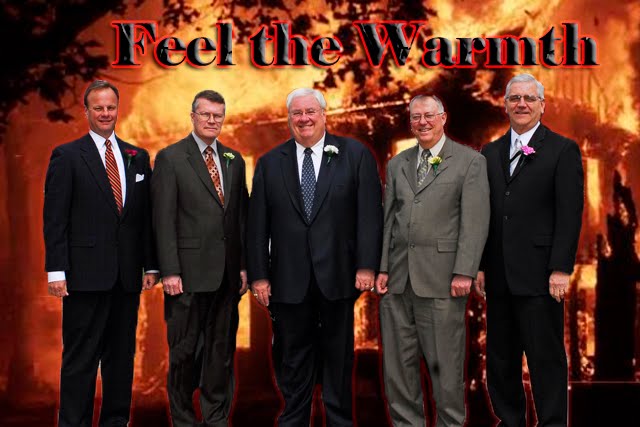
Burning Down the Sect

WELS Martin Luther College faculty are hotter than Georgia asphalt
for UOJ and Church Growth.
Larry Olson, on the far left, teaches on the strength
of a drive-by DMin from Fuller Seminary.
Is this a $72,000 degree?

One long-time observer of WELS behavior has noticed that the synod exists to line the pockets of a few.

The ones who benefit from this system have a series of overlapping businesses that draw from the loyalty of the synod while making money from the synod.

One way they make money is by manning the boards and delivering grants to their buddies. Church and Change began with synod offering money, got their buddies into the juicy jobs at The Love Shack, and those people steered even more money their way.

The Planned Giving Counselors (estate grabbers) are licensed insurance salesmen who make commissions from their sales. Thrivent "sponsors" them. Is that funny?

Jeff Davis was on the Church and Change board,
rubbing elbows with Bruce Becker (WELS Perish Services)
and running his money-raising business with the late Ron Roth, CG Founder.


The WELS consultants charge huge fees to steer congregations into using Cornerstone, a WELS-LCMS business that charges commissions to raise money for costly building projects recommended by their fellow consultants.

WELS also has "education consultants" who charge huge fees, quite a racket.

The overlapping boards make sure that every synod entity is dominated by Church and Changers, who also end up on foundation committees as well. How convenient. WELS Kingdom Workers has millions to spend. Where does it go? Who decides?

Mark Jeske's question proves he left the Lutheran Church
a long time ago.


Mark Jeske has his Time of Grace tentacles in everything, because he is the man behind Church and Change, the big cahoona on the Thrivent board.


Supposedly WELS Lutherans for Life was started to keep the pure away from the taint of the Missouri Synod. But now it is generic Christian Life Resources, using WELS as a base to make money from all denominations - preferring 50's and 100's, of course.

Lutherans for High Lifestyle CEO spins gold at his non-profit organization.


When I was leaving the LCA, I pointed out that the entire organization was budgeted and programmed for failure. One of the pastors turned to a district staffmember and asked, "Is that true?" The staffer, who was in business all his life, said, "Yes, that is true."

WELS is in the exact same position. While the Church and Changers are looting the congregations to feather their nests, the whole apparatus is burning down. Considering the extraordinary level of abuse in the synod, that is good. More than one pastor will say so, too - but not in print.

Meanwhile, many will suffer from the incompetent doctrinal and moral leadership of the synod.

The Frog in the Kettle book argues
that congregations and synods can be changed slowly -
boil the frog before he notices the difference.
WELS-LCMS-ELS members are cooked
instead of being boiling mad.

KJV 1 Timothy 6:10 For the love of money is the root of all evil: which while some coveted after, they have erred from the faith, and pierced themselves through with many sorrows.
KJV 1 Timothy 6:7 For we brought nothing into this world, and it is certain we can carry nothing out. 8 And having food and raiment let us be therewith content.

---

rlschultz has left a new comment on your post "Burning Down the Sect":

A friend of mine who has retired from OHSA once told me about the Interlocking Directorates Handbook.
A good description of it is here:

http://en.wikipedia.org/wiki/Interlocking_directorate

Since WELS is such a tiny sect, and the other players are small in number and tightly knit, postings here on Ichabod are usually sufficient to expose this network.

In the Austrian School of Economics, this can also be called the "Rothbardian Analysis", so named after Murray Rothbard. Old Murray had a way of finding out how unsavory characters were connected to each other and exposed it in his writings.

I would affectionately call the vetting process here on this blog the "Ichabodian Analysis".

Another YouTube Video for WELS:
Joel Hochmuth Plea Bargain,
As Predicted on Ichabod


I told Mrs. Ichabod that WELS had another video on YouTube, the one embedded above. I said, "Someone uploaded it. I never upload to YouTube."

She said, "No one will believe you."

I clicked on the link, since people have accounts with YouTube and upload on their accounts, so they can have their own channel, as they call it.

SNAPWisconsin is the account holder. Click on that link and you will find videos associated with abusive clergy.

Congratulations WELS - after complaining--sanctimoniously--about ELCA and the Roman Catholics, you are now listed by the prime lobbying group - Survivors Network of those Abused by Priests - SNAP. The Roman hierarchy hates SNAP because SNAP has networked the victims with great effect. The group uploaded the arrest video to YouTube, which combined the defense attorney's lie about adult pornography when the charge was swapping files showing man-boy rape.


SNAP Wisconsin is the state-wide group. If you have a problem with WELS, contact SNAP and an attorney, not the cover-up magicians of WELS.

Wisconsin Lutheran College (WELS when fund-raising) featured one of the worst archbishops, Weakland, as their speaker in a widely promoted series, which also included various priests. Weakland had an affair with a young man and used church funds to pay blackmail to his lover, claiming the funds came from his own account. WELS deceived everyone about the lectures, never explaining why an official of Rome was speaking on behalf of the Wisconsin Sect.

Years ago, Wisconsin Lutheran College featured Weakland as their speaker, along with some of his priests.
Weakland claimed that children invited sex with adults.
The Hochmuth story is full of holes. My vast intelligence-gathering network cannot find out where he got counseling, which is part of every news story. His wife caught him and they went into counseling. But counselors are supposed to report heinous crimes against children. Was it the WELS agency? Silence. Nobody knew this was going on? Silence.

This page used to link to the SP Schroeder/Hochmuth letter against ELCA for supporting homosexual clergy. Just as I expected, the page was removed. That is the WELS approach - hide the evidence, spin the story, and punish anyone who asks more than once about the corruption.

But relax. I found another copy on the Net, thanks to my extensive experience in tracking down synodical lies:

FOR IMMEDIATE RELEASE Aug. 21, 2009 Contact: Joel Hochmuth Director of Communications Wisconsin Evangelical Lutheran Synod joel.hochmuth@wels.net 


WELS president expresses regret at ELCA decision on gay clergy

Milwaukee, Wis.—Rev. Mark Schroeder, president of the Wisconsin Evangelical Lutheran Synod (WELS), is expressing regret at the vote of the Evangelical Lutheran Church in America (ELCA) convention regarding homosexual clergy. Friday, delegates approved a resolution committing the church to find a way for “people in such publicly accountable, lifelong, monogamous, same-gender relationships” to serve as professional leaders of the church.


“To view same-sex relationships as acceptable to God is to place cultural viewpoint and human opinions above the clear Word of God,” says Schroeder. “The Wisconsin Evangelical Lutheran Synod, along with The Lutheran Church—Missouri Synod, the Evangelical Lutheran Synod, and other smaller Lutheran synods, maintains and upholds the clear teaching of the Bible that homosexuality is not in keeping with God’s design and is sinful in God’s eyes.”


At the same time, Schroeder says WELS congregations stand ready to support those struggling with same-sex attractions. “As with any sin, it is the church’s responsibility to show love and compassion to sinners, not by condoning or justifying the sin, but by calling the sinner to repent and by assuring the sinner that there is full forgiveness in Jesus Christ,” Schroeder says.


WELS, with about 390,000 members and nearly 1,300 congregations nationwide, is the third largest Lutheran church body in the United States. In Wisconsin alone, there are more than 201,000 members and 417 congregations. “It’s unfortunate that many headlines have referred to the recent decisions of the Evangelical Lutheran Church in America as something ‘Lutherans’ have decided,” Schroeder says. “In fact, the ELCA is only one of many Lutheran denominations. We are saddened that a group with the name Lutheran would take another decisive step away from the clear teaching of the Bible, which was the foundation of the Lutheran Reformation.”


Schroeder says that WELS is firmly committed to upholding God’s design for marriage as outlined in Scripture—a design intended for one man and one woman. “We believe, and the Bible teaches, that God designed this relationship to be a blessing for men and women and for society. Any departure from what God himself has designed does two things: it denies the clear teachings of Scriptures and it undermines God’s desire that the man/woman relationship in marriage be a blessing.”

---


On the WELS.net site I found a reaction to that news release, but not the news release itself.

Feedback to a WELS news release quoting Pres. Mark Schroeder's reaction to the Evangelical Lutheran Church in America's (ELCA) decision to allow homosexuals in "lifelong, monogamous" relationships to serve as pastors continues to flow in.

On Aug. 21, the day the ELCA churchwide assembly approved the resolution, Communication Services posted Pres. Schroeder's response expressing WELS opposition based on clear biblical principles on the synod's Web site. A news release was also sent to Religion News Service for worldwide distribution.
So far, the reaction has been almost universally positive, with statements of support coming from both WELS and non-WELS members. "I appreciate your statement and share your disappointment," writes one woman from Michigan. "Thank you for posting the statement with a clear Biblical viewpoint."

"As a member of an ELCA church, I applaud you standing up for the Word of God and having the backbone to speak up and put your 8/21 letter on your Web site," writes another woman from Minnesota.
While it is impossible to gauge precisely how widely published Schroeder's comments were, the news release was printed virtually verbatim on more than a dozen blogs. Schroeder's comments were quoted in an MSNBC.com article (link no longer available) on the reaction to the ELCA decision from both WELS and the Lutheran Church—Missouri Synod.

---


Hochmuth was not excommunicated, but Rick Techlin and the Krohns were.

SP Schroeder:
Christians are not immune to Satan’s temptations. David, Paul, and Peter all knew from personal experience that believers can and do commit terrible and unspeakable sin. But they also knew and experienced the restoring power of God’s grace. Joel Hochmuth knows this as well. Joel is receiving pastoral care from his pastors and others. We are confident that the powerful working of the Holy Spirit in God’s Word has brought him to recognize and repent of his sin, and we also know that he has sought and received the comfort of forgiveness in the redeeming sacrifice of our Savior. Please pray that Joel will continue to be assured of forgiveness at the foot of the cross and that God’s grace will restore him, renew him, and strengthen his faith.

 Serving in Christ, Rev. Mark Schroeder, WELS President

The Grace of God Comes to Us Through Faith Alone


The biggest problem with the Internet is total access to all the historical documents. Various Lutherans have found sources that reveal what the UOJ Stormtroopers want concealed (if they even know those sources exist).

I was going to buy the Vehse document about the Saxons when I found it anew on the Net. So I thought, "I have a coupon - I will buy a Stellhorn book instead." The Stellhorn was already on my hard drive as a PDF.

The first thing Vehse wrote about was Stephan's strange megalomania when they got to America. That fits with the diagnosis of third-stage syphillis. By comparing all the documents, easily available today, one can see that Walther was part of an immoral cult, which he was eager to take over as the new cult leader.

"The child is the father of the man." Walther's earlier exploits were duplicated in his later career as the American Pope. Questions about character applied to him and the other Stephan followers.

The bigger issue is the doctrinal one, because justification by faith has been a battle since the beginning. Anyone can trace what theologians have written for and against.

Luther anticipated the born forgiven and universal absolution errors of UOJ. The Concordists battled against the same.

Walther, like all unprincipled false teachers, skipped the main issue and burrowed into predestination in a manner that would alert the UOJ minions while keeping the vast majority comatose. When the discerning saw Walther's game, he denounced them as false teachers and drove them away. Walther locutus est, causa finita est - The pope has spoken, the case is closed.

The public statue in Missouri says it all. Stephan, who led the group to Perry County, is designated a false teacher. CFW is inscribed as the Great Walther.

The Holy Land (Perry County) says in their official, lying tours that Stephan was given three choices. In fact, the Walther mob invaded his home, threatened his life, forced him across the river at gunpoint, and left him to starve. Remember that the next time a pastor says "Matthew 18" or "Eighth Commandment."

The Bronze Age is different in WELS.

Sunday, March 18, 2012

I Am Jesus Little Lamb


Bethany Joan Marie Jackson beamed for every photograph.

"I Am Jesus; Little Lamb"
by Henrietta L. von Hayn, 1724-1782

1. I am Jesus' little lamb,
Ever glad at heart I am;
For my Shepherd gently guides me,
Knows my need, and well provides me,
Loves me every day the same,
Even calls me by my name.

2. Day by day, at home, away,
Jesus is my Staff and Stay.
When I hunger, Jesus feeds me,
Into pleasant pastures leads me;
When I thirst, He bids me go
Where the quiet waters flow.

3. Who so happy as I am,
Even now the Shepherd's lamb?
And when my short life is ended,
By His angel host attended,
He shall fold me to His breast,
There within His arms to rest.

Hymn #648 
The Lutheran Hymnal
Text: John 21:15
Author: Henriette L. von Hayn, 1778
Translated by: composite
Titled: "Weil ich Jesu Schaeflein bin"
1st Published in: Brueder Choral-Buch, 1784
Tune: "Weil ich Jesu Schaeflein bin"

Erin Joy Jackson loved to be pushed in her swing.

Goldstream News Gazette - Langford Lutheran church closed to make way for seniors complex

Goldstream News Gazette - Langford Lutheran church closed to make way for seniors complex:

'via Blog this'

For April Fools Day - Palm Sunday


The Donkey -
a poem by G.K. Chesterton


WHEN fishes flew and forests walked
And figs grew upon thorn,
Some moment when the moon was blood
Then surely I was born.


With monstrous head and sickening cry
And ears like errant wings,
The devil's walking parody
On all four-footed things.


The tattered outlaw of the earth,
Of ancient crooked will,
Starve, scourge, deride me I am dumb,
I keep my secret still.


Fools, for I also had my hour,
One far fierce hour and sweet,
There was a shout about my ears
And palms before my feet.

Laetare: The Fourth Sunday in Lent.
John 6:1ff


Laetare Sunday, The Fourth Sunday in Lent, 2012


Pastor Gregory L. Jackson


Bethany Lutheran Church, 10 AM Central Time


The Hymn # 151                  Christ the Life                       2:78
The Confession of Sins
The Absolution
The Introit p. 16
The Gloria Patri
The Kyrie p. 17
The Gloria in Excelsis
The Salutation and Collect p. 19
The Epistle and Gradual        
The Gospel              
Glory be to Thee, O Lord!
Praise be to Thee, O Christ!
The Nicene Creed p. 22
The Sermon Hymn #429    Lord Thee I Love                  2:54 

The Power of God's Word

The Communion Hymn #311       Huss Hymn               2:79
The Preface p. 24
The Sanctus p. 26
The Lord's Prayer p. 27
The Words of Institution
The Agnus Dei p. 28
The Nunc Dimittis p. 29
The Benediction p. 31
The Hymn # 45                    Now the Hour                      2:95

KJV Galatians 4:21 Tell me, ye that desire to be under the law, do ye not hear the law? 22 For it is written, that Abraham had two sons, the one by a bondmaid, the other by a freewoman. 23 But he who was of the bondwoman was born after the flesh; but he of the freewoman was by promise. 24 Which things are an allegory: for these are the two covenants; the one from the mount Sinai, which gendereth to bondage, which is Agar. 25 For this Agar is mount Sinai in Arabia, and answereth to Jerusalem which now is, and is in bondage with her children. 26 But Jerusalem which is above is free, which is the mother of us all. 27 For it is written, Rejoice, thou barren that bearest not; break forth and cry, thou that travailest not: for the desolate hath many more children than she which hath an husband. 28 Now we, brethren, as Isaac was, are the children of promise. 29 But as then he that was born after the flesh persecuted him that was born after the Spirit, even so it is now. 30 Nevertheless what saith the scripture? Cast out the bondwoman and her son: for the son of the bondwoman shall not be heir with the son of the freewoman. 31 So then, brethren, we are not children of the bondwoman, but of the free.

KJV John 6:1 After these things Jesus went over the sea of Galilee, which is the sea of Tiberias. 2 And a great multitude followed him, because they saw his miracles which he did on them that were diseased. 3 And Jesus went up into a mountain, and there he sat with his disciples. 4 And the passover, a feast of the Jews, was nigh. 5 When Jesus then lifted up his eyes, and saw a great company come unto him, he saith unto Philip, Whence shall we buy bread, that these may eat? 6 And this he said to prove him: for he himself knew what he would do. 7 Philip answered him, Two hundred pennyworth of bread is not sufficient for them, that every one of them may take a little. 8 One of his disciples, Andrew, Simon Peter's brother, saith unto him, 9 There is a lad here, which hath five barley loaves, and two small fishes: but what are they among so many? 10 And Jesus said, Make the men sit down. Now there was much grass in the place. So the men sat down, in number about five thousand. 11 And Jesus took the loaves; and when he had given thanks, he distributed to the disciples, and the disciples to them that were set down; and likewise of the fishes as much as they would. 12 When they were filled, he said unto his disciples, Gather up the fragments that remain, that nothing be lost. 13 Therefore they gathered them together, and filled twelve baskets with the fragments of the five barley loaves, which remained over and above unto them that had eaten. 14 Then those men, when they had seen the miracle that Jesus did, said, This is of a truth that prophet that should come into the world. 15 When Jesus therefore perceived that they would come and take him by force, to make him a king, he departed again into a mountain himself alone.

Fourth Sunday in Lent

Lord God, heavenly Father, who by Thy Son didst feed five thousand men in the desert with five loaves and two fishes: We beseech Thee to abide graciously also with us in the fullness of Thy blessing. Preserve us from avarice and the cares of this life, that we may seek first Thy kingdom and Thy righteousness, and in all things perceive Thy fatherly goodness, through Jesus Christ, who liveth and reigneth with Thee and the Holy Ghost, one true God world without end. Amen.

The Power of the Word

John 6:1 After these things Jesus went over the sea of Galilee, which is the sea of Tiberias.

Jesus crossed in a boat, while the crowd had to walk around the sea. The crowd had twice as far to travel, so Jesus had some rest from being with them so much.
2 And a great multitude followed him, because they saw his miracles which he did on them that were diseased.

Lenski:
The three imperfect tenses picture Jesus in the full exercise of his activity at this period, including, of course, the present crossing of the Sea. The statement that the crowds were attracted by “beholding the signs he was doing” is intended to parallel 2:23 and to show that in general the situation here in Galilee was a duplication of the previous one which occurred in Jerusalem. Not the teaching but merely the signs were the great attraction. This John wants us to bear in mind for the sake of what follows.
            Lenski, R. C. H.: The Interpretation of St. John's Gospel. Minneapolis, MN : Augsburg Publishing House, 1961, S. 428.

“Doing signs” has always seemed to be weak, in my opinion. The meaning of that phrase is “performing miracles.”

We have diminished the meaning of “sign from heaven.” People interpret anything as a “sign,” just as Eduard Preuss (UOJ guru) did when he saw a glorious sunset. To him that was a sign from heaven to join the Roman Catholic Church and leave the Lutheran Church. But apparently it was not a day of mass conversions to Romanism, even if two Concordia Seminary professors in a row “poped.”

A miracle is our best word today for something that defies the laws of physics, such as walking on water, turning water into wine, or stilling the storm. The crowds saw these miracles and enjoyed them. They wanted more. As Lenski noted, they were more interested in the show than the teaching.

Jesus taught and performed miracles together, to confirm people in their knowledge that He was indeed the Son of God and Savior. Those who only wanted miracles were bound to be disappointed. Even when they witnessed miracles that kings and philosophers would have loved to see, they wanted even more.

3 And Jesus went up into a mountain, and there he sat with his disciples.

Hills surround the Sea of Galilee, which gave Jesus a view of the crowds working their way around the seashore. Probably a path helped them, but it was the long way around and a long distance to go.

4 And the passover, a feast of the Jews, was nigh.

The Fourth Gospel gives us a calendar (unlike Matthew, Mark, and Luke) so we know about a three-year public ministry of Jesus, while the other three conflated the three years into one trip toward Jerusalem. In many ways the Gospel of John supplements the first three Gospels and gives us additional facts, as well as many long sermons to study and meditate upon.

One of our regular readers (and emailers) said he loved the material in John 16 about the work of the Holy Spirit.

5 When Jesus then lifted up his eyes, and saw a great company come unto him, he saith unto Philip, Whence shall we buy bread, that these may eat? 6 And this he said to prove him: for he himself knew what he would do.

Jesus brought up a problem that the disciples could not solve on their own. By questioning them, Jesus set the agenda. Unprepared, they thought of it solely in human terms.

There is no human answer. They are far away from a settlement. There are many other problems as well.

Jesus had the answer and knew what He would do.  Instead of a confession of faith, He received a statement of doubt.

7 Philip answered him, Two hundred pennyworth of bread is not sufficient for them, that every one of them may take a little.

Philip answered the way any finance committee would. They did not have enough money to give the crowd a little bit of food. The other impossibility was obtaining enough for that little bit of food for each one. Therefore, it was doubly impossible.

Naturally, this Gospel lesson is one that teaches the efficacy of the Word, contrasting it with the cleverness of man. Philip was not at all foolish in what he said. Everything was logical and based upon fact. The only thing missing was faith in Christ.

The efficacy of the Word is not incidental in Scripture, but foundational. Every passage in the entire Bible rests upon the concept of the divine power of the Word and its supremacy over anything man can imagine or design.

The rationalists are bit more honest than the apostate Lutherans. The rationalists are consistent in saying, “This cannot happen, given the laws of physics.”

The apostate Lutherans say, “This is a wonderful miracle. Now this is what we learned about marketing the Gospel at Fuller Seminary.”  (Or Willow Creek, Mars Hill, Granger, Life Church, Saddleback, or NorthPoint.)


8 One of his disciples, Andrew, Simon Peter's brother, saith unto him, 9 There is a lad here, which hath five barley loaves, and two small fishes: but what are they among so many?

The dialogue does not show the disciples to be foolish but just like us. That is exactly what we would say.

Some would say, “But they had Jesus with them. That makes them foolish. He can do anything.”

But we have Jesus with us, too. He is not limited to His visible presence. The centurion knew this better than most. He said, “You do not need to come to my house to heal my servant. And I am not worthy to have you enter there, Lord. Speak the Word and he will be healed.”

KJV Luke 7:6 Then Jesus went with them. And when he was now not far from the house, the centurion sent friends to him, saying unto him, Lord, trouble not thyself: for I am not worthy that thou shouldest enter under my roof: 7 Wherefore neither thought I myself worthy to come unto thee: but say in a word, and my servant shall be healed. 8 For I also am a man set under authority, having under me soldiers, and I say unto one, Go, and he goeth; and to another, Come, and he cometh; and to my servant, Do this, and he doeth it. 9 When Jesus heard these things, he marvelled at him, and turned him about, and said unto the people that followed him, I say unto you, I have not found so great faith, no, not in Israel. 10 And they that were sent, returning to the house, found the servant whole that had been sick.

When pretend-Lutherans assail our little group for being small, for not having gold ornaments and marble altars, they are just revealing their lack of trust in God’s Word. Jesus said, “Wherever two or three are gathered together, there am I in the midst of them.”

KJV Matthew 18:20 For where two or three are gathered together in my name, there am I in the midst of them.

Mocking God’s Word is not good practice. It is as dangerous as playing with high voltage lines, like the lineman who took off his gloves for a second and lost both arms in a flash of current. God’s Word is more powerful than a power line.

Any time we are tempted to say, “What are we among so many?” or “Who am I to question all these leaders?” or “How can we have any influence when we have no money to persuade people?” – we should look at this response. The disciple says – We have a little food, but it amounts to nothing in this enormous crowd. True, it amounts to nothing, but God’s Word turns nothing into something, as He did at Creation, as He does whenever the elements are consecrated as the Body and Blood of Christ.


10 And Jesus said, Make the men sit down. Now there was much grass in the place. So the men sat down, in number about five thousand.
Here we see a little detail worth noting. This was a grassy area, so it was well watered, by a spring or a well. In Arizona there are areas where the rock traps and stores water. They are called “tanks.” Outside of Phoenix are the White Tank Mountains. If you read the novels of Louis Lamour, you will see that the heroes look for tanks where they can water their horses and get refreshed themselves.

The reality of a desert is that the grassy areas give away where the water is. Certain plants also indicate underground water, easily accessed. (It is not true that someone can chop up a barrel cactus and eat it like watermelon.)

The place where they sat down was large, grassy. They sat in ranks so the food could be distributed. There were 5000 men (fully humans in WELS-speak), so the total number of people could have been 15,000.

This vast throng made the tiny bit of food even more comical, in comparison with the needs. At first a large sum of money was not enough to give everyone a tiny bit. But they could not buy food out there, so the donation of one child was even smaller, reminding us of the fall of Jericho.

God reduces the number, money, and power of the people involved to reveal His power in the Word. Otherwise, people would praise themselves for their own abilities and wealth rather than God for His ability to transcend all rules and principles to reveal Himself as He is.

11 And Jesus took the loaves; and when he had given thanks, he distributed to the disciples, and the disciples to them that were set down; and likewise of the fishes as much as they would. 12 When they were filled, he said unto his disciples, Gather up the fragments that remain, that nothing be lost.

This is not a communion service in John 6, but it shows us how God provides the Body and Blood of Christ in the consecrated elements. All the objections to Holy Communion as a sacrament are answered by this miracle and by many other passages (such as the healing of the centurion’s servant).

  1. How can God provide the Body and Blood of Christ for millions across the centuries?  Answer – By His Word, the same way He provided for 15,000 people with some bread and fish.
  2. How can God forgive sins through those elements? Answer – It is His will to give us a visible form of His Word. God reveals His will to us; we do not manage God or give Him advice.
  3. Why are there so many Means of Grace among you Lutherans? Answer – why did Jesus provide us with so many miracles? Why did God leave us four Gospels? Why have a dozen or so Pauline letters instead of just Romans? The answer is God’s overwhelming bounty. He gives in abundance so we are never deprived or lacking in anything that will be a blessing for us.
  4. It looks like bread and wine to me, after the consecration. I think it is just symbolic. Answer – Then the feeding of the multitude was also symbolic. They ate symbolic bread and symbolic fish and they were satisfied in a dream-like way when they went home on water alone. If the Real Presence is rejected, the miraculous feeding is rejected. If the miraculous feeding is accepted as true, then the Real Presence and Holy Communion as a Means of Grace are both true. Likewise, if God cannot consecrate the elements with His Word, and Jesus be present in both natures in the elements, then the Savior was locked in the cave until the angels opened the stone lid and let Him out of the grave.

The central human problem is turning God’s Word into man’s word – that people believe according to their rational limits.

12 When they were filled, he said unto his disciples, Gather up the fragments that remain, that nothing be lost. 13 Therefore they gathered them together, and filled twelve baskets with the fragments of the five barley loaves, which remained over and above unto them that had eaten.

The gathering was just as important as the distribution, because it showed that the disciples ended up with more food than they had in the beginning. The people were famished when they arrived. Walking along a lake for hours, the hot sun beating down – that eats up a lot of calories. That was the idea about fainting on the way back, recorded in another Gospel. They were all completely satisfied, but they had more than at the beginning – 12 times more.

This shows us that God takes a little, because He honors His Name this way, and multiplies it beyond all human imagination. And we have enough to share. And the more we share, the greater the abundance.

I can say now that many people are blessed and participating through study, worship, and the production of new books establish Lutheran orthodoxy for the next generation.

14 Then those men, when they had seen the miracle that Jesus did, said, This is of a truth that prophet that should come into the world. 15 When Jesus therefore perceived that they would come and take him by force, to make him a king, he departed again into a mountain himself alone.

This was God’s timing and not man’s. The people wanted a king who fed them with miracles, and only some remained believers. That should not shock us. Many use church to feed them in a material way – and not all of them are ministers  - some are laity too. I read about one (name omitted) who used his many church affiliations to stay out of prison. He had loads of character witnesses on his behalf because they were on his payroll.

This is a passage, like each one in John’s Gospel, designed by the Holy Spirit to created and deepen our trust in Christ as our Savior, to depend on Him for love and mercy, to set aside our human logic and doubts when trusting in Him.

Quotations

"So it goes in the spiritual government of the Church, as specially indicated in the narrative now before us.  Where I have preached and taught during the past ten or twenty years, there another could perhaps, have done more in one year; and one sermon may bring forth more fruit than many others.  Here, also, it is true that our labor, diligence and effort can accomplish nothing These two things must go together, namely, that each one does his duty, and that he, nevertheless, acknowledges with Peter: 'My labor cannot bring forth anything, if thou dost not give the increase.'"
            Martin Luther, Sermons of Martin Luther, 8 vols., ed., John Nicholas Lenker, Grand Rapids:  Baker Book House, 1983, IV,  p. 153. Fifth Sunday after Trinity Luke 5:1‑11.        

"A hardened heart will not be instructed, no matter how plainly and clearly the truth is presented; but the faith of the righteous is strengthened when they see that the ground of their faith is right and good."
            Martin Luther, Sermons of Martin Luther, 8 vols., ed., John Nicholas Lenker, Grand Rapids:  Baker Book House, 1983, II,  p. 157. Third Sunday in Lent Luke 11:14‑23.                  

"All preaching of sin and God's wrath is a preaching of the Law, no matter how or when it may be done.  On the other hand, the Gospel is such preaching as sets forth and bestows nothing but grace and forgiveness in Christ. And yet it is true that the Apostles and preachers of the Gospel sanctioned the preaching of the Law, as Christ Himself did, and began with this in the case of those who had not yet acknowledged their sins and had felt no fear of God's anger."
            Martin Luther, Sermons of Martin Luther, 8 vols., ed., John Nicholas Lenker, Grand Rapids:  Baker Book House, 1983, IV,  p. 158. Fifth Sunday after Trinity Luke 5:1‑11.          

"The unavoidable conclusion then is that, as long as the Holy Spirit does not enter our hearts, we are not only incapable of any good, but are of necessity in the kingdom of Satan."
            Martin Luther, Sermons of Martin Luther, 8 vols., ed., John Nicholas Lenker, Grand Rapids:  Baker Book House, 1983, II,  p. 159. Third Sunday in Lent Luke 11:14‑23.                  

[The office of preaching]...cannot produce profitable or fruitful results in all men; yet great power and much fruit are found in those who remain steadfast and are kept to the end."
            Martin Luther, Sermons of Martin Luther, 8 vols., ed., John Nicholas Lenker, Grand Rapids:  Baker Book House, 1983, IV,  p. 165. Fifth Sunday after Trinity Luke 5:1‑11.                  

"The preaching of this message may be likened to a stone thrown into the water, producing ripples which circle outward from it, the waves rolling always on and on, one driving the other, till they come to the shore.  Although the center becomes quiet, the waves do not rest, but move forward. So it is with the preaching of the Word.  It was begun by the apostles, and it constantly goes forward, is pushed on farther and farther by the preachers, driven hither and thither into the world, yet always being made known to those who never heard it before, although it be arrested in the midst of its course and is condemned as heresy."
            Martin Luther, Sermons of Martin Luther, 8 vols., ed., John Nicholas Lenker, Grand Rapids:  Baker Book House, 1983, III,  p. 202. Ascension Day Mark 16:14‑20.      

"You may tie a hog ever so well, but you cannot prevent it from grunting, until it is strangled and killed.  Thus it is with the sins of the flesh."
            Martin Luther, Sermons of Martin Luther, 8 vols., ed., John Nicholas Lenker, Grand Rapids:  Baker Book House, 1983, II,  p. 247. Easter, Second Sermon Mark 16:1‑8.


"Therefore the Holy Spirit must come to our rescue, not only to preach the Word to us, but also to enlarge and impel us from within, yea, even to employ the devil, the world and all kinds of afflictions and persecutions to this end.  Just as a pig's bladder must be rubbed with salt and thoroughly worked to distend it, so this old hide of ours must be well salted and plagued until we call for help and cry aloud, and so stretch and expand ourselves, both through internal and through external suffering,that we may finally succeed and attain this heart and cheer, joy and consolation, from Christ's resurrection."
            Martin Luther, Sermons of Martin Luther, 8 vols., ed., John Nicholas Lenker, Grand Rapids:  Baker Book House, 1983, II,  p. 253. Easter, Third Sermon Mark 16:1‑8.        

"If I do not believe it, I will not receive its benefits; but that neither renders it false nor proves that anything is lacking in Christ."
            Martin Luther, Sermons of Martin Luther, 8 vols., ed., John Nicholas Lenker, Grand Rapids:  Baker Book House, 1983, II,  p. 258. Easter, Third Sermon Mark 16:1‑8.

"Learn then from this Gospel what takes place when God begins to make us godly, and what the first step is in becoming godly.  There is no other beginning than that your king comes to you and begins to work in you.  It is done in this way:  The Gospel must be the first, this must be preached and heard.  In it you hear and learn how all your works count for nothing before God and that everything is sinful that you work and do.  Your king must first be in you and rule you.  Behold, here is the beginning of your salvation; you relinquish your works and despair of yourself, because you hear and see that all you do is sin and amounts to nothing, as the Gospel tells you, and you receive your king in faith, cling to him, implore his grace and find consolation in his mercy alone."
            Martin Luther, Sermons of Martin Luther, 8 vols., ed., John Nicholas Lenker, Grand Rapids:  Baker Book House, 1983, I,  p. 26. First Sunday in Advent Matthew 21:1‑9.  

"It is a faithful saying that Christ has accomplished everything, has removed sin and overcome every enemy, so that through Him we are lords over all things.  But the treasure lies yet in one pile; it is not yet distributed nor invested.  Consequently, if we are to possess it, the Holy Spirit must come and teach our hearts to believe and say:  I, too, am one of those who are to have this treasure. When we feel that God has thus helped us and given the treasure to us, everything goes well, and it cannot be otherwise than that man's heart rejoices in God and lifts itself up, saying:  Dear Father, if it is Thy will to show toward me such great love and faithfulness, which I cannot fully fathom, then will I also love Thee with all my heart and be joyful, and cheerfully do what pleases Thee.  Thus, the heart does not now look at God with evil eyes, does not imagine He will cast us into hell, as it did before the HS came...."
            Martin Luther, Sermons of Martin Luther, 8 vols., ed., John Nicholas Lenker, Grand Rapids:  Baker Book House, 1983, III,  p. 279. Pentecost Sunday John 14:23‑31.

"The Holy Spirit teaches man better than all the books; He teaches him to understand the Scriptures better than he can understand them from the teaching of any other; and of his own accord he does everything God wills he should, so the Law dare make no demands upon him."
            Martin Luther, Sermons of Martin Luther, 8 vols., ed., John Nicholas Lenker, Grand Rapids:  Baker Book House, 1983, III,  p. 280. Pentecost Sunday John 14:23‑31.                

"The Holy Spirit is given to none except to those who are in sorrow and fear; in them it produces good fruit.  This gift is so precious and worthy that God does not cast it before dogs.  Though the unrepentant discover it themselves, hearing it preached, they devour it and know not what they devour."
            Martin Luther, Sermons of Martin Luther, 8 vols., ed., John Nicholas Lenker, Grand Rapids:  Baker Book House, 1983, III,  p. 281f. Pentecost Sunday John 14:23‑31.                

"He permits it to happen that many great saints err and stumble, in order that we may not trust in men, though they be many, great, and holy.  We must be led to rely upon the Word that is sure and cannot deceive, as here these two men, and all the others afterward, were directed to the Scriptures."
            Martin Luther, Sermons of Martin Luther, 8 vols., ed., John Nicholas Lenker, Grand Rapids:  Baker Book House, 1983, II,  p. 290. Easter Monday Luke 24:13‑35.                

"Thus, we know how and where the Holy Spirit is to be found, and we need not be in doubt nor waver, gazing here and there for special revelations or illuminations. Each one should hold to the Word, and should know that through it alone, and through no other means, does the Spirit enlighten hearts and is He ready to dwell in them and to give true knowledge and comfort through faith in Christ."          Martin Luther, Sermons of Martin Luther, 8 vols., ed., John Nicholas Lenker, Grand Rapids:  Baker Book House, 1983, III,  p. 300. Pentecost, Third Sermon John 14:23‑31.            

"Be not worried because of this! for even though a man preach and continue in the Gospel for many years, he must still lament and say:  Aye, no one will come, and all continue in their former state.  Therefore you must not let that grieve or terrify you."   Martin Luther, Sermons of Martin Luther, 8 vols., ed., John Nicholas Lenker, Grand Rapids:  Baker Book House, 1983, II,  p. 305. Easter Tuesday Luke 24:36‑47.                

"But when St. Peter stood up and preached, they made a mockery of it and considered the apostles drunken fools.  When they had urged the Gospel a long time, they gathered together three thousand men and women.  But what were they among so many?  Yea, no one could discern that the Gospel had accomplished anything, for all things continued in the same state as before.  No change was seen, and scarcely anyone knew that there were Christians there.  And so it will be at all times."
            Martin Luther, Sermons of Martin Luther, 8 vols., ed., John Nicholas Lenker, Grand Rapids:  Baker Book House, 1983, II,  p. 306. Easter Tuesday Luke 24:36‑47.          

"The Word and the gifts of the Holy Spirit are materials with which He builds.  Though the dwelling is not altogether completed, yet through His grace and love it is accepted of God."
            Martin Luther, Sermons of Martin Luther, 8 vols., ed., John Nicholas Lenker, Grand Rapids:  Baker Book House, 1983, III,  p. 322. Pentecost, Third Sermon John 14:23‑31.                  

"Secondly, it is shown here that this Word precedes, or must be spoken beforehand, and that afterwards the Holy Spirit works through the Word.  One must not reverse the order and dream of a Holy Spirit who works without the Word and before the Word, but one who comes with and through the Word and goes no farther than the Word goes."
            Martin Luther, Sermons of Martin Luther, 8 vols., ed., John Nicholas Lenker, Grand Rapids:  Baker Book House, 1983, III,  p. 329. Pentecost, Third Sermon John 14:23‑31.              

"We hear God's Word, which is in fact the preaching of the Holy Spirit, who is at all times present with it, but it does not always at once reach the heart and be accepted by faith; yea, in the case of those who are moved by the Holy Spirit and gladly receive the Word, it does not at once bear fruit."
            Martin Luther, Sermons of Martin Luther, 8 vols., ed., John Nicholas Lenker, Grand Rapids:  Baker Book House, 1983, III,  p. 330. Pentecost, Third Sermon John 14:23‑31.                

"This is going through closed doors, when He comes into the heart through the Word, not breaking nor displacing anything.  For when the Word of God comes, it neither injures the conscience, nor deranges the understanding of the heart and the external senses; as the false teachers do who break all the doors and windows, breaking through like thieves, leaving nothing whole and undamaged, and perverting, falsifying and injuring all life, conscience, reason, and the senses.  Christ does not do thus."
            Martin Luther, Sermons of Martin Luther, 8 vols., ed., John Nicholas Lenker, Grand Rapids:  Baker Book House, 1983, II,  p. 355. First Sunday after Easter John 20:19‑31.          

"Thus we have two parts, preaching and believing.  His coming to us is preaching; His standing in our hearts is faith.  For it is not sufficient that He stand before our eyes and ears; He must stand in the midst of us in our hearts, and offer and impart to us peace."      Martin Luther, Sermons of Martin Luther, 8 vols., xd., John Nicholas Lenker, Grand Rapids:  Baker Book House, 1983, II,  p. 355. First Sunday after Easter John 20:19‑31.                

"The first and highest work of love a Christian ought to do when he has become a believer, is to bring others also to believe in the way he himself came to believe. And here you notice Christ begins and institutes the office of the ministry of the external Word in every Christian; for He Himself came with this office  and the external Word."
            Martin Luther, Sermons of Martin Luther, 8 vols., ed., John Nicholas Lenker, Grand Rapids:  Baker Book House, 1983, II,  p. 359. First Sunday after Easter John 20:19‑31.              

"But ye have not the power to create faith.  For there is a great difference between planting and giving the growth; as Paul says to the Corinthians: 'I planted, Apollos watered; but God gave the increase.' 1 Corinthians 3:6"
            Martin Luther, Sermons of Martin Luther, 8 vols., ed., John Nicholas Lenker, Grand Rapids:  Baker Book House, 1983, II,  p. 362. First Sunday after Easter John 20:19‑31; 1 Corinthians 3:6.                
"Now God drives us to this by holding the law before us, in order that through the law we may come to a knowledge of ourselves.  For where there is not this knowledge, one can never be saved.  He that is well needs no physician; but if a man is sick and desires to become well, he must know that he is weak and sick, otherwise he cannot be helped."
            Martin Luther, Sermons of Martin Luther, 8 vols., ed., John Nicholas Lenker, Grand Rapids:  Baker Book House, 1983, II,  p. 370. Second Sunday after Easter, Second Sermon John 20:19‑31.              
"There are the infants, bare and naked in body and soul, having neither faith nor works.  Then the Christian Church comes forward and prays, that God would pour faith into the child; not that our faith should help the child, but that it may obtain a faith of its own.  If it has faith, then after that whatever it does is well done, whether it suckle its mother's breast, or whether it soil itself, or whatever it may please to do."
            Martin Luther, Sermons of Martin Luther, 8 vols., ed., John Nicholas Lenker, Grand Rapids:  Baker Book House, 1983, IV,  p. 378. Twelfth Sunday after Trinity Mark 7:31‑37.            


"If God does not take me alone to a separate place, and give me the Holy Spirit, so that I cling to the Word which I have heard, then all preaching is in vain."
            Martin Luther, Sermons of Martin Luther, 8 vols., ed., John Nicholas Lenker, Grand Rapids:  Baker Book House, 1983, IV,  p. 380. Twelfth Sunday after Trinity Mark 7:31‑37.                   

"Observe from this text how Christ in plain words ascribes to baptism, which He calls water, such glory and power as to say that the Holy Spirit is present in it, and that by its means a person is born anew.  By this statement all false doctrines and errors against the doctrine of faith and baptism are overthrown."
            Martin Luther, Sermons of Martin Luther, 8 vols., ed., John Nicholas Lenker, Grand Rapids:  Baker Book House, 1983, III,  p. 434. Trinity Sunday John 3:1‑15.              

"Nor does He send such trial upon you in order to cast you off, but that you may the better learn to know and the more closely cling to His Word, to punish your lack of understanding and that you may experience how earnestly and faithfully He cares for you."
            Martin Luther, Sermons of Martin Luther, 8 vols., ed., John Nicholas Lenker, Grand Rapids:  Baker Book House, 1983, II,  p. 44. First Sunday after Epiphany, Second Sermon Luke 2:41‑52.                
"But the Lord refutes this and says:  Go ye there and preach what does it matter if it is against you?  You will find there what I say.  We should now do likewise. Although the masses storm against the Gospel and there is no hope that they will be better, yet we must preach, there will yet be found those who listen and become converted."
            Martin Luther, Sermons of Martin Luther, 8 vols., ed., John Nicholas Lenker, Grand Rapids:  Baker Book House, 1983, I,  p. 48. First Sunday in Advent Matthew 21:1‑9.              

"But here you come to the Word of God which is sure and infallible, where you shall certainly find Christ and the Holy Spirit, and can be and remain firmly fortified against sin, death, and the devil."        Martin Luther, Sermons of Martin Luther, 8 vols., ed., John Nicholas Lenker, Grand Rapids:  Baker Book House, 1983, II, p. 51. First Sunday after Epiphany, Second Sermon Luke 2:41‑52.                  
"That the Holy Spirit works in the heart is true; nevertheless He intends ordinarily and usually to do so in no other way than through the spoken Word. St. Paul says that a man cannot believe unless he has previously heard (Romans 10:14)."
            Martin Luther, What Luther Says, An Anthology, 3 vols., ed., Ewald Plass, St. Louis:  Concordia Publishing House, 1959, II,  p. 664. Romans 10:14.                  


"Whoever comes to faith can only say that the Holy Spirit comes when and where and to whom He pleases at the time He pleases.  He comes when and where He pleases, and also gives a person as many gifts as He pleases."
            Martin Luther, What Luther Says, An Anthology, 3 vols., ed., Ewald Plass, St. Louis:  Concordia Publishing House, 1959, II,  p. 665.  

"Indeed, because its course is contrary to reason, sense and thought, the world regards the doctrine as pure folly and delusion, and condemns and persecutes all who adhere to it and are unwilling to follow the world's own opinion."
            Martin Luther, Sermons of Martin Luther, 8 vols., ed., John Nicholas Lenker, Grand Rapids:  Baker Book House, 1983, III,  p. 67. Second Sunday after Easter John 10:11‑16.                

"The worse of all is, that we must not only suffer shame, persecution and death; but that the world rejoices because of our great loss and misfortunes. This is indeed very hard and bitter.  Sure it shall thus come to pass, for the world will rejoice when it goes ill with us; but this comfort we have that their joy shall not last long, and our sorrow shall be turned into eternal joy."
            Martin Luther, Sermons of Martin Luther, 8 vols., ed., John Nicholas Lenker, Grand Rapids:  Baker Book House, 1983, III,  p. 80. Second Sunday after Easter John 10:11‑16.              

"Hence everything here depends only upon this, that you rightly learn to look upon Christ according to the Word, and not according to your own thoughts and feelings, for human thoughts are frauds and lies, but His Word is true and cannot lie."
            Martin Luther, Sermons of Martin Luther, 8 vols., ed., John Nicholas Lenker, Grand Rapids:  Baker Book House, 1983, IV,  p. 92. Third Sunday after Trinity, Second Sermon Luke 15:1‑10.                
"Now it is the consolation of Christians, and especially of preachers, to be sure and ponder well that when they present and preach Christ, that they must suffer persecution, and nothing can prevent it; and that it is a very good sign of the preaching being truly Christian, when they are thus persecuted, especially by the great, the saintly, the learned and the wise."
            Martin Luther, Sermons of Martin Luther, 8 vols., ed., John Nicholas Lenker, Grand Rapids:  Baker Book House, 1983, II,  p. 97. Fourth Sunday after Epiphany Matthew 8:23‑27.