Sunday, February 24, 2013

Reminiscere - The Second Sunday in Lent. Matthew 15:21-28.
The Canaainite Woman

http://www.normaboecklerart.com


Reminiscere Sunday, The Second Sunday in Lent, 2013


Pastor Gregory L. Jackson


Bethany Lutheran Church, 10 AM Central Time


The Hymn #652   I Lay My Sins on Jesus              1:24
The Confession of Sins
The Absolution
The Introit p. 16
The Gloria Patri
The Kyrie p. 17
The Gloria in Excelsis
The Salutation and Collect p. 19
The Epistle and Gradual       
The Gospel              
Glory be to Thee, O Lord!
Praise be to Thee, O Christ!
The Nicene Creed p. 22
The Sermon Hymn # 454            Prayer Is the Soul's Sincere Desire     1:41


Feeling the Frown

The Hymn # 281                 The Savior Calls               1:29
The Preface p. 24
The Sanctus p. 26
The Lord's Prayer p. 27
The Words of Institution
The Agnus Dei p. 28
The Nunc Dimittis p. 29
The Benediction p. 31
The Hymn # 374                 Grace Tis a Charming Sound 1:91

KJV 1 Thessalonians 4:1 Furthermore then we beseech you, brethren, and exhort you by the Lord Jesus, that as ye have received of us how ye ought to walk and to please God, so ye would abound more and more. 2 For ye know what commandments we gave you by the Lord Jesus. 3 For this is the will of God, even your sanctification, that ye should abstain from fornication: 4 That every one of you should know how to possess his vessel in sanctification and honour; 5 Not in the lust of concupiscence, even as the Gentiles which know not God: 6 That no man go beyond and defraud his brother in any matter: because that the Lord is the avenger of all such, as we also have forewarned you and testified. 7 For God hath not called us unto uncleanness, but unto holiness.

KJV Matthew 15:21 Then Jesus went thence, and departed into the coasts of Tyre and Sidon. 22 And, behold, a woman of Canaan came out of the same coasts, and cried unto him, saying, Have mercy on me, O Lord, thou Son of David; my daughter is grievously vexed with a devil. 23 But he answered her not a word. And his disciples came and besought him, saying, Send her away; for she crieth after us. 24 But he answered and said, I am not sent but unto the lost sheep of the house of Israel. 25 Then came she and worshipped him, saying, Lord, help me. 26 But he answered and said, It is not meet to take the children's bread, and to cast it to dogs. 27 And she said, Truth, Lord: yet the dogs eat of the crumbs which fall from their masters' table. 28 Then Jesus answered and said unto her, O woman, great is thy faith: be it unto thee even as thou wilt. And her daughter was made whole from that very hour.

Second Sunday In Lent

Lord God, heavenly Father, grant us, we beseech Thee, by Thy Holy Spirit, that He may strengthen our hearts and confirm our faith and hope in Thy grace and mercy, so that, although we have reason to fear because of our conscience, our sin, and our unworthiness, we may nevertheless, with the woman of Canaan, hold fast to Thy grace, and in every trial and temptation find Thee a very present help and refuge, through Thy beloved Son, Jesus Christ our Lord, who liveth and reigneth with Thee and the Holy Ghost, one true God, world without end. Amen.


Feeling the Frown

KJV Matthew 15:21 Then Jesus went thence, and departed into the coasts of Tyre and Sidon.

Lessons like this one make me wonder if the Lutheran leaders have ever cracked open a Bible. I had a church member who used to say, “What translation are they using?” He was always mystified about how the synod officials could turn a passage upside-down to excuse their horrid behavior and worse doctrine.

This lesson focuses on faith and the characteristics of faith, and yet it is communicated in such a dark and bitter setting that many wonder about its meaning and shy away from it.

First, we have to consider – does the Bible ever wander from its one message of presenting Christ to us? Did Matthew and the Evangelists stumble upon some dark and forbidding story that served as an exception?
Not at all. Those who pick apart the Bible for their own agenda will try to say that, but they give themselves away in a few words.

The energy center for justification without faith is Halle University, a school created to promote Pietism. This movement called Pietism began when Spener used Arndt (an orthodox Lutheran writer) to promote a new agenda, just as Luther is used today to advance justification without faith (UOJ).

Spener was anti-confessional, justly called “the first union theologian,” because he blended Lutheran doctrine with Calvinism. This anti-confessional amalgamation created the Historical-Critical Method at Halle University (or fostered HCM). And what is the genius of HCM? – Picking apart each verse and assigning a meaning to it that is contrary to the Gospel.

WELS-LCMS-ELCA historical note: The WELS professor who adored UOJ, Richard Jungkuntz, was also the chairman of the board of the first gay Lutheran seminary, Seminex. He moved from WELS to LCMS to ELCA. His rationalistic approach to the Bible kept tripping him up and giving him away.

So I am getting back to the main theme. The purpose of the entire Bible, and each part, is to convey Christ to us and to bring us to faith through the power of the Holy Spirit in the Gospel Word. Be it ever so weak, that faith grasps Christ and all His benefits. And that Gospel continues to build and deepen our faith, which is God’s creation and handiwork.

Since faith in Christ is always good in the Bible, and Christ is always gracious, why does this lesson seem so harsh?

Luther says it well – this is a portrait of a person of faith, to show us the trials that lie before us, and how we should behave as believers. Christ seems to be distant, cold, and uncaring, because we often experience that in difficult times. So this lesson puts us in this woman’s place, so we say, “Yes I have been there” or “Now I can anticipate this” and we learn from God how to believe and think.

If we hear this lesson as children and teens, we may not realize the depth of feeling expressed. But it is good to know the lesson first, to know its real meaning, and apply it later as events unfold.

22 And, behold, a woman of Canaan came out of the same coasts, and cried unto him, saying, Have mercy on me, O Lord, thou Son of David; my daughter is grievously vexed with a devil.

This woman was an outsider, which is good. We often experience that. You were not born here. You were not born in this denomination. You are not related to one of the founders. You are not a charter member of the congregation.

There is another parable for the insiders – The Pharisee and the Publican.

The Canaanite woman was not a Jew, and that is crucial to this miracle, but she was a believer. She gave a correct confession of her faith, “O Lord, Son of David” and trusted in Him to heal her daughter, who was possessed.


Mark says, she heard some news about Jesus, Mark 7:25. What kind of news? Without doubt good news, and the good report that Christ was a pious man and cheerfully helped everybody. Such news about God is a true Gospel and a word of grace, out of which sprang the faith of this woman; for had she not believed, she would not have thus run after Christ etc. In like manner we have often heard how St. Paul in Romans 10:17 says that faith cometh by hearing, that the Word must go in advance and be the beginning of our salvation.

http://www.normaboecklerart.com

23 But he answered her not a word. And his disciples came and besought him, saying, Send her away; for she crieth after us.

This shows us what it feels like to ask God and not seem to get an answer. Faith moves us to prayer based upon the Promises of God. But there can be long periods of apparent silence.

Not only that – the woman could feel or even hear the scorn of the disciples. They begged Jesus to send her away, because she was annoying them with her cries. Let’s say she did not understand their dialect or hear exactly what the disciples were saying. Their expressions gave them away, if nothing else.

Lenski:
Yet the disciples had never seen Jesus deny anyone pleading for help, although at times he had delayed a little while (John 4:47, etc.; Matt. 8:5, etc.), namely whenever some question had first to be settled. It is fair, therefore, to conclude that the disciples think of a dismissal by granting the woman’s prayer. They indicate, however, that they are not moved entirely by pity for her distress.
Lenski, R. C. H.: The Interpretation of St. Matthew's Gospel. Minneapolis, MN. : Augsburg Publishing House, 1961, S. 595.

Luther was inclined to see this as “Give her what she wants and send her away.” But this cannot be understood as a positive and affirming response.


And Jesus did not even answer her, either with a yes or no.


3. But see in this example how Christ like a hunter exercises and chases faith in his followers in order that it may become strong and firm. First when the woman follows him upon hearing of his fame and cries with assured confidence that he would according to his reputation deal mercifully with her, Christ certainly acts differently, as if to let her faith and good confidence be in vain and turn his good reputation into a lie, so that she could have thought: Is this the gracious, friendly man? or: Are these the good words, that I have heard spoken about him, upon which I have depended? It must not be true; he is my enemy and will not receive me; nevertheless he might speak a word and tell me that he will have nothing to do with me. Now he is as silent as a stone. Behold, this is a very hard rebuff, when God appears so earnest and angry and conceals his grace so high and deep; as those know so well, who feel and experience it in their hearts. Therefore she imagines he will not fulfill what he has spoken, and will let his Word be false; as it happened to the children of Israel at the Red Sea and to many other saints.

This battle is often lost at this stage. It is easy to become a believer, but difficult to remain one in the face of many struggles. If we demand that God act in a certain way and in a certain amount of time, He is no longer God for us, or at least no longer gracious and tender-hearted, so we lose faith in the God of the Scriptures and strike out on our own.

Many have said, “I did not have my prayers answered, so I stopped believing.” This lesson is an antidote, to show us a different attitude on our part and the real nature of Christ.

Waiting is another part of faith in God. Little children trust, but they have trouble with impulse control. They want it now! I remember our granddaughter, now a young lady, saying to me, “You have to wait.” I thought at the time – she has heard that from parents…often. The little finger went in the air in a magisterial way “You have to wait.”

http://www.normaboecklerart.com


24 But he answered and said, I am not sent but unto the lost sheep of the house of Israel.

When Jesus finally spoke, the response seemed to be total rejection.

She was not a Jew. Jesus was not sent for her but for the lost sheep of Israel. She was outside that circle.

How many have felt this way? I am not good enough. I am not favored. Things have been so bad for so long, that only proves that I am rejected for being unworthy.

Many think that prayers are answered only for the previously perfect, misunderstanding that we are righteous and forgiven in Christ, perfect in the sight of God, through faith. If we are already perfect, forgiven, righteous, and saved without faith in Christ, then we have no need of Him.

As one man said, “I will join the church when I am good enough.”

This woman’s faith was created by the Word that Christ came to people, gracious, and kindly, powerful in answering prayers.

25 Then came she and worshipped him, saying, Lord, help me.

Do we worship God because He gives us what we want, when we want it? That is why people (especially denominational officials)) worship money, because the Money-God gives them what they want, when they want it.

The mother’s faith did not waver. She wanted her daughter healed.

26 But he answered and said, It is not meet to take the children's bread, and to cast it to dogs.

Is Jesus calling her a dog? Lenski’s point is that the language is not derogatory. Here it means little dogs (pets) in the household rather than dogs as an insult.
In other words – this does not mean wild dogs in the street (bad) but the pets within the house (secondary to the children).  Who would take the children’s food and toss it in the street? That would invite all the mongrels to hang around the home for more.

Although this is not as harsh as it has been portrayed, the response is not exactly a Kodak moment in the Bible.

Many times clergy have been set aside and not given a chance at all. Loehe was stuck in a remote, rural village. But he was able to start foreign missions around the world and two seminaries in America (Wartburg and Ft. Wayne). The Loehe missionaries actually started the Missouri Synod and invited the Missouri people to join.

Likewise, two great pioneers of the Inner Mission were in bad situations. Necessity drove them develop some of the most remarkable charities, which influenced Europe and America. The idea of Lutheran hospitals, nursing homes, orphanages, soldier and sailor missions – came from those two men. Passavant, in America, took their ideas and did the work of several denominational headquarters. He was so sought after that he could have had the best and most secure parish call, but he chose to live for others and get by on his own. Passavant is the one who did not pay his assistant all summer long. The student wondered if he would ever get paid and really suffered like the Canaanite woman until the train was ready to leave. Passavant gave him his money then – enough for the entire year at school. That taught him not to worry about money but to trust in God’s providence.

That is how this woman turned the statement around – in faith.

27 And she said, Truth, Lord: yet the dogs eat of the crumbs which fall from their masters' table.

She used the same word to express her faith in Him. She was content to apply that Word to herself, because the crumbs would be enough.

Pet dogs always expect the best from their owners. A dog will listen to a dozen “No’s” and still be cheerful, positive, and anxious to show love. I have had dogs check out my work as I started a grill, watch me through the windows when I open a bag of chicken, drop by when the meat was cooking, and sit under a glass table and stare up with big grins (the begging table).

This is an example of confidence in God’s goodness, which is the main teaching of the Scriptures. God commands what is good for us in the Ten Commandments. He gives us the Gospel for our sinful condition, and He pursues us with His teaching so that we remain in the fold of the Good Shepherd. In every case of providing, He provides many times more than what we need – especially about our spiritual wealth. In the meantime He also provides for our material needs.

This is another case of Jesus never refusing a plea from a believer. The Holy Spirit has preserved this miracle so we identify with the Canaanite woman and learn from her example.

28 Then Jesus answered and said unto her, O woman, great is thy faith: be it unto thee even as thou wilt. And her daughter was made whole from that very hour.

Jesus commended the faith of this woman, this outsider. Patience is directly related to faith.

This woman did not have to prove her faith to Jesus. He already knew her thoughts and intentions. By waiting and challenging her, Jesus brought out the public example of her inner faith. Otherwise, it would have remained between the Savior and the woman. The disciples witnessed this and recorded it, as a great example for them in the future and for all believers.

The true Gospel has always been persecuted and the cross will continue until the end of time.

The biggest trial is the emotional one. The inner turmoil, the battle between faith and doubt, is often won by Satan wearing down the patience of the believer. These doubts or questions voiced by Jesus are all part of the believer’s battle.

Silence is one – I am getting no answer.

Waiting for an answer.

Hearing an apparent rejection – not for you, because you do not belong somehow.

“It must be because I do not count. I am one of the little pets, not a child of this household.”

But even the least receive generously from God. The pruning events make us more fruitful, while a life of ease makes us go to seed and do nothing for the Kingdom.

Struggles with health, business, and daily life cause anxiety and stress, yet God builds up great experiences out of apparent doom. It is not because believing is a virtue or a merit, but because God chooses to use believers to carry out His will in His way.

http://www.normaboecklerart.com


               A HARD SAYING

"But see in this example how Christ like a hunter exercises and chases faith in His followers in order that it may become strong and firm."
     Sermons of Martin Luther, ed., John Nicholas Lenker, Grand Rapids:  Baker Book House, 1983 II,  p. 149.  Matthew 15:21‑28.

"In like manner Moses must precede and teach people to feel their sins in order that grace may be sweet and welcome to them.  Therefore all is in vain, however friendly and lovely Christ may be pictured, if man is not first humbled by a knowledge of himself and he possesses no longing for Christ, as Mary's Song says, 'The hungry he hath filled with good things; and the rich he hath sent
empty away,' Luke 1:53."
     Sermons of Martin Luther, II, p. 149.
         
"All this is spoken and written for the comfort of the distressed, the poor, the needy, the sinful, the despised, so that they may know in all times of need to whom to flee and where to seek comfort and help."
     Sermons of Martin Luther, II,  p. 149.

"Now what does the poor woman do?  She turns her eyes from all this unfriendly treatment of Christ; all this does not lead her astray, neither does she take it to heart, but she continues immediately and firmly to cling in her confidence to the good news she had heard and embraced concerning Him, and never gives up.  We must also do the same and learn firmly to cling to the Word, even though God with all His creatures appears different than His Word teaches.  But, oh, how painful it is to nature and reason, that this woman should strip herself of self and forsake all that she experienced, and cling along to God's bare Word, until she experienced the contrary.  May God help us in time of need and of death to possess courage and faith!"
     Sermons of Martin Luther,  II,  p. 150. 
               WHAT WE LEARN

"As for example when we feel in our conscience that God rebukes us as sinners and judges us unworthy of the kingdom of heaven, then we experience hell, and we think we are lost forever.  Now whoever understands here the actions of this poor woman and catches God in His own judgment, and says, Lord, it is true, I am a sinner and not worthy of Thy grace; but still Thou hast promised sinners forgiveness, and Thou art come not to call the righteous, but, as St. Paul says in 1 Timothy 1:15, 'to save sinners.'  Behold, then must God according to His own judgment have mercy upon us."
     Sermons of Martin Luther, ed., John Nicholas Lenker, Grand Rapids:  Baker Book House, 1983 II,  p. 153. Matthew 15:21‑28; 1 Timothy 1:15 

http://www.normaboecklerart.com


WELS and Missouri Moving Faster Toward Self-Destruction.
No Better Than the Vatican in Worshiping the Money-God


I have changed oil in better clothes.
St. Peter in Freedom is one of the mother churches of
Church and Change.
Someday it will be a Pennzoil 10 Minute Oil Change.

KJV Mark 13:14 But when ye shall see the abomination of desolation, spoken of by Daniel the prophet, standing where it ought not, (let him that readeth understand,) then let them that be in Judaea flee to the mountains:

Watch for the same pious pronouncements about the papacy--issued from the Love Shack and Purple Palace--as we read about the ELCA.

The LCMS took a major step toward self-dissolution with the publication of Martin Chemnitz works, now being promoted amid the drivel they print for Vacation Bobble School.

Their only hope is that no one ever reads the Chemnitz set, or in reading, fails to notice the Grand Canyon gap between the Second Luther and the New Quislings.

The LCMS teaches the opposite of Chemnitz in every possible way, starting with the Chief Article of Christianity, the Master and Prince - justification by faith. Examination of the Council of Trent? Have they read that masterpiece by Chemnitz? How can they invite sodomite slaves of the Antichrist to teach in their institutions and march in their religious processions?

WELS selectively excommunicates those who teach justification by faith. Doug Lindee of the Intrepids was not kicked out for justification by faith, but Paul Rydecki of the Intrepids was. Pastor Nathan Bickel publishes against UOJ all the time, but he has not joined the Kokomo families in WELSish perdition as a guilt-free saint.

The foundational SynCon perversion is teaching against faith in Christ, and the associated sin is worshiping the Money-God. The most dangerous place to be in Lutherdom is standing between the SynCon Lutherans and their money - or between the SynCons and their UOJ. The two perversions go well together and support one another.

WELS has established that no one graduates from the Love Shack with any knowledge of the Book of Concord. What little they pretend to have is exhausted in denouncing the Confessions as "boring and irrelevant." And yet they claim to be "confessional," another reason why no one should use that meaningless term.


Why Cardinal Turkson of Ghana won't be the next pope | Andrew Brown | Comment is free | guardian.co.uk

Why Cardinal Turkson of Ghana won't be the next pope | Andrew Brown | Comment is free | guardian.co.uk:


Cardinal Turkson
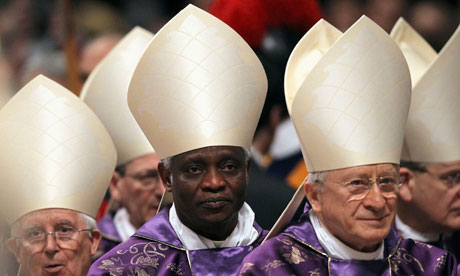
Cardinal Peter Turkson, centre, was the early favourite to be the next pope. Photograph: Alessandro Bianchi/Reuters
After a week of more or less discreet jockeying for position in the conclave, it's possible to discern some developments in the struggle for the papacy. For starters, I will stick my neck out and say that anyone who put money on Cardinal Turkson of Ghana can write it off now. There are three reasons for this. The first is that he was the early bookies' favourite and talked up his own chances in the most indiscreet and ill-advised way.
The second is that he has managed to offend both factions of the American church: the right suspect him of sympathy with the victims of capitalism and the left has been scandalised by his remark that the African church has been spared sex abuse scandals in part because of the very strong cultural taboos against homosexuality. Quite apart from any question of homophobia, his theory is nonsense empirically. If strong cultural taboos against gay people protect the church from scandal, how to explain Ireland in the 1960s and 1970s? No, if Americans want a candidate from the developing world, they are much more likely to put weight behind a Spanish-speaking one from Latin America or thePhilippines.
Finally, and tastelessly, I don't think that there is any enthusiasm in Italy for a black African pope. Nearly a third of the electors (39 of the 118) this time around work in the Curia – among them Turkson himself – and most will be Italians with an Italian attitude. None of the other candidates have attracted the same kind of media interest, though Cardinal Ouellet of Quebec, another early favourite, had his record subject to a rather devastating scrutiny in the Toronto Globe and Mail. The problem is not that he is a bad man or even a bad archbishop – but the church he grew up in and was formed by has simply vanished. Even in his home village, the church at its centre was shut two years ago and taken over as a community centre instead.
If fighting back against secularisation is a priority for the conclave, the church in Quebec has a record of almost unremitting failure. It may not appear like that to the cardinals of the electorate, though. For me the most revealing news item since Benedict's resignation was his farewell speech to the clergy of Rome in which he distinguished between the Vatican council as God saw and intended it, and the "council of the media" which the rest of the world and most of the Catholic intelligentsia saw.
It is the "council of the media" which has politics and pressure groups, and the "council of the media" which "created many calamities, so many problems, so much misery, in reality: seminaries closed, convents closed, liturgy trivialised". I'm not a huge fan of my own trade. I know we're often horrible and amoral. But, really, what did for the Catholic church in the west was not the media, it was a combination of the triumph of consumerism and a Catholic church steeped in its own pride and self-absorption.
Before that passage came an anecdote which, with the laughter, reveals that the Vatican has no idea how the outside world sees it. This is from Vatican Radio's transcript. Benedict is talking about a cardinal he had advised as a young theologian in 1961:
"Shortly after – he continued – Pope John invited [Cardinal Frings] to Rome and he was afraid he had perhaps said maybe something incorrect, false and that he had been asked to come for a reprimand, perhaps even to deprive him of his red hat … [priests laughing] Yes … when his secretary dressed him for the audience, he said: 'Perhaps now I will be wearing this stuff for the last time' … [the priests laugh]. Then he went in. Pope John came towards him and hugged him, saying, 'Thank you, Your Eminence, you said things I have wanted to say, but I had not found the words to say' … [the priests laugh, applaud]."
This is funny only because the pope can sack anyone he feels like in the church. So naturally, he doesn't hear very much that he does not want to hear. It seems to me that the profoundest task before the conclave is to find a pope who does not believe his own propaganda. I don't mean one who isn't a Roman Catholic – I mean one who does not see the world from behind the fortifications of the Vatican but who is at the same time a strong and experienced enough administrator to reform its dysfunctional bureaucracy. No, I don't know who that might be.
'via Blog this'

***

GJ - There will be another push for a Third World cardinal, but the last effort in that direction ended with a German.


---

http://www.guardian.co.uk/world/2013/feb/13/catholic-church-pope-ghanaian-cardinal


Peter Turkson, second left
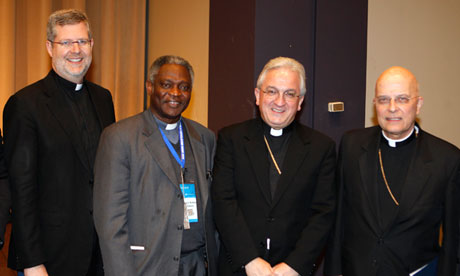
Ghanaian cardinal Peter Turkson, second left, is among the bookmakers' favourites to replace Benedict XVI as pope. Photograph: Handout/Getty Images
One of the developing world's leading candidates for the pope's successor has declared the Catholic church ready to have its first non-European Pope - and said that he will gladly take on the role "if it's the will of God". [GJ - That is not how popes get elected.]
Ghanaian cardinal Peter Turkson, president of the Vatican's pontifical council for justice and peace, said he believed the the churches of Africa and Asia had grown in strength to the extent they had produced "mature clergymen and prelates that are capable of exercising leadership also of this world institution."
"I think in a way the church is always and has forever been ready for a non-European pope," the 64-year-old, a favourite of Benedict XVI, told the Associated Press on Tuesday. He did not think the prospect was "too far away", he added.
Asked about speculation that he could himself emerge from next month's conclave as Benedict's successor, he said: "I've always answered 'if it's the will of God.'"
However, although Turkson is an early favourite of the bookmakers in a very open field of candidates, there are question marks over his credentials, which some Vatican observers say could hold him back. He was forced to apologise last year after screening a YouTube video at a meeting of bishops which made alarmist predictions about the rise of Islam in Europe. It claimed, among other things, that France would be an Islamic republic within 39 years.

UK's top cardinal accused of 'inappropriate acts' by priests | World news | The Observer

UK's top cardinal accused of 'inappropriate acts' by priests | World news | The Observer:


Cardinal Keith O'Brien
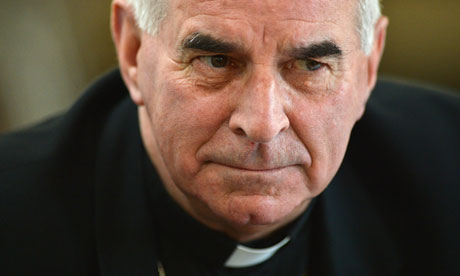
Cardinal Keith O'Brien, Britain's most senior Catholic clergyman. Photograph: Jeff J Mitchell/Getty Images
Three priests and a former priest in Scotland have reported the most senior Catholic clergyman in Britain, Cardinal Keith O'Brien, to theVatican over allegations of inappropriate behaviour stretching back 30 years.
The four, from the diocese of St Andrews and Edinburgh, have complained to nuncio Antonio Mennini, the Vatican's ambassador to Britain, and demanded O'Brien's immediate resignation. A spokesman for the cardinal said that the claims were contested.
O'Brien, who is due to retire next month, has been an outspoken opponent of gay rights, condemning homosexuality as immoral, opposing gay adoption, and most recently arguing that same-sex marriages would be "harmful to the physical, mental and spiritual well-being of those involved". Last year he was named "bigot of the year" by the gay rights charity Stonewall.
One of the complainants, it is understood, alleges that the cardinal developed an inappropriate relationship with him, resulting in a need for long-term psychological counselling.
The four submitted statements containing their claims to the nuncio's office the week before Pope Benedict's resignation on 11 February. They fear that, if O'Brien travels to the forthcoming papal conclave to elect a new pope, the church will not fully address their complaints.
"It tends to cover up and protect the system at all costs," said one of the complainants. "The church is beautiful, but it has a dark side and that has to do with accountability. If the system is to be improved, maybe it needs to be dismantled a bit."
The revelation of the priests' complaints will be met with consternation in the Vatican. Allegations of sexual abuse by members of the church have dogged the papacy of Benedict XVI, who is to step down as pope at the end of this month. Following the announcement, rumours have swirled in Rome that Benedict's shock move may be connected to further scandals to come.
The four priests asked a senior figure in the diocese to act as their representative to the nuncio's office. Through this representative, the nuncio replied, in emails seen by the Observer, that he appreciated their courage.
It is understood that the first allegation against the cardinal dates back to 1980. The complainant, who is now married, was then a 20-year-old seminarian at St Andrew's College, Drygrange, where O'Brien was his "spiritual director". The Observer understands that the statement claims O'Brien made an inappropriate approach after night prayers.
The seminarian says he was too frightened to report the incident, but says his personality changed afterwards, and his teachers regularly noted that he seemed depressed. He was ordained, but he told the nuncio in his statement that he resigned when O'Brien was promoted to bishop. "I knew then he would always have power over me. It was assumed I left the priesthood to get married. I did not. I left to preserve my integrity."
In a second statement, "Priest A" describes being happily settled in a parish when he claims he was visited by O'Brien and inappropriate contact between the two took place.
In a third statement, "Priest B" claims that he was starting his ministry in the 1980s when he was invited to spend a week "getting to know" O'Brien at the archbishop's residence. His statement alleges that he found himself dealing with what he describes as unwanted behaviour by the cardinal after a late-night drinking session.
"Priest C" was a young priest the cardinal was counselling over personal problems. Priest C's statement claims that O'Brien used night prayers as an excuse for inappropriate contact.
The cardinal maintained contact with Priest C over a period of time, and the statement to the nuncio's office alleges that he engineered at least one other intimate situation. O'Brien is, says Priest C, very charismatic, and being sought out by the superior who was supposed to be guiding him was both troubling and flattering.
Those involved believe the cardinal abused his position. "You have to understand," explains the ex-priest, "the relationship between a bishop and a priest. At your ordination, you take a vow to be obedient to him.
"He's more than your boss, more than the CEO of your company. He has immense power over you. He can move you, freeze you out, bring you into the fold … he controls every aspect of your life. You can't just kick him in the balls."
All four have been reluctant to raise their concerns. They are, though, concerned that the church will ignore their complaints, and want the conclave electing the new pope to be "clean". According to canon law, no cardinal who is eligible to vote can be prevented from doing so.


'via Blog this'

Not Just the SynCon Lutherans.
Vatican dismisses reports linking pope's resignation to gay conclave discovery | World news | guardian.co.uk

Vatican dismisses reports linking pope's resignation to gay conclave discovery | World news | guardian.co.uk:


Pope Benedict XVI
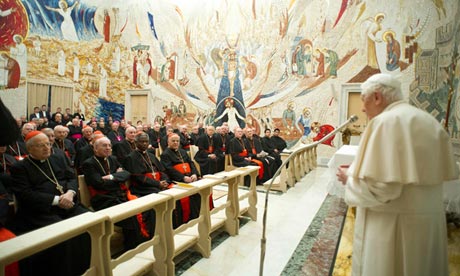
Pope Benedict XVI speaks to cardinals during the closing day of spiritual exercises at the Vatican. Photograph: Osservatore Romano/Reuters
The Vatican has attacked reports in the Italian media linking Pope Benedict XVI's resignation to the alleged discovery of a network of gay prelates as attempts to influence the cardinals in their choice of a new pontiff.
The Vatican secretariat of state said in a statement: "It is deplorable that as we draw closer to the time of the beginning of the conclave … that there be a widespread distribution of often unverified, unverifiable or completely false news stories that cause serious damage to persons and institutions."
The statement was made as Pope Benedict XVI had his final meeting with senior clerics, lamenting the "evil, suffering and corruption" that have defaced God's creation in a final address to Vatican officials.
Benedict spoke on Saturday at the end of a week-long spiritual retreat coinciding with Lent, the period of 40 days (excluding Sundays) leading up to Easter. For the past week, Italian cardinal Gianfranco Ravasi has led the Vatican on meditations that have covered everything from the family to denouncing the "divisions, dissent, careerism, jealousies" that afflict the Vatican bureaucracy.
Ravasi's blunt critique of the dysfunction within the Vatican Curia comes as cardinals from around the world are arriving for the final days of Benedict's papacy and the conclave to elect his successor. Bureaucratic reform is a high priority for the next pope.
The pontiff's speech follows a report that has linked his resignation to the discovery of a network of gay prelates in the Vatican, some of whom have reportedly been targeted by blackmailers.
The Italian daily newspaper La Republica said the pope decided to resign on 17 December – the day he received a dossier compiled by three cardinals delegated to look into the so-called "Vatileaks" affair.
Last May Pope Benedict's butler, Paolo Gabriele, was arrested and charged with stealing leaked papal correspondence that depicted the Vatican as a seething hotbed of intrigue and infighting.
The newspaper said the cardinals described a number of factions, including one whose members were "united by sexual orientation". It added that some Vatican officials had been subjected to "external influence" from laymen with whom they had links of a "worldly nature". La Republica said this was a clear reference to blackmail.
'via Blog this'

***

GJ - Most SynCon Lutherans would like to believe their leaders are all straight, but the evidence points in another direction. Every arrest or scandal is explained as some isolated, tragic incident - so people forget how many isolated, tragic incidences there are.

The comfort level of WELS and Missouri in working with ELCA should tell people all they need to know.

Dr. Lito Cruz on UOJ and Romans 4:25

P. Leyser was an editor of the Book of Concord
and the biographer of Martin Chemnitz.
He knew something about justification by faith.


LPC has left a new comment on your post "David Clearwood Boisclair - Trying To Rescue Roman...":

Rev. Boisclair says
As to the "us" of Romans 4:25 it could also refer to the "us" of all humanity as well as to the "us" of the regenerated (renati).

Are we reading the same verse? There is no "us" in 4:25. There is "our", the our there - the "our" which harkens back to "us" in 4:24. Perhaps that is what you mean.

However, the "us" refers to the Romans including St. Paul who is addressing the Roman Christians. So the "us" there does not refer to generic humanity it refers to those who (present tense) believe in Jesus. The KJV "if" is euphemistic.

It refers to those who believe in God who raised Jesus from the dead, and note the "our" that can not refer to the whole world which includes unbelievers, St. Paul says "who raised Jesus OUR Lord from the dead".

That is the OUR that mitigates against your theory
of 1932 Article 17 of the LC-MS Brief statement which states

Scripture teaches that God has already declared the whole world to be righteous in Christ, Rom. 5:19; 2 Cor. 5:18-21; Rom. 4:25;

Because in this verse(v.24) it clearly speaks of a future justification not a past one that has already occurred without reference to faith as your LC-MS doctrine of 1932 teaches.

In view of this, Romans 4:25 means that Jesus was raised with the view of the justification of those who would believe, not that the whole world has already been justified as a past event which your UOJ doctrine is teaching.

If Jesus did not rise from the dead, there is nothing for the sinner to believe and having nothing to believe, he has no justification to have. This is the central testimony of Christianity as St. Paul says in 1 Cor 15:17.

You can talk about what is not common to Huber and your UOJ but let us not discount, that this is something you have in common with him - the belief that all have already been justified at Jesus's resurrection. Do not comfort yourself on the things you differ from Huber, instead be bothered in the things you have in common with him!!!

Let us deal with the passage you believe teaches a justification that first happened without reference to faith, we can talk about the BoC etc next time. Let us first agree that Scripture is prima facie evidence first in any doctrinal discussion.

LPC


Saturday, February 23, 2013

Roma Downey and Mark Burnett To Broadcast "The Bible" in March.
Guests at Walmart Saturday Meeting Today.
Sean Combs Spoke about His Efforts To Succeed

Roma Downey is known for "Touched by an Angel,"
and her husband is known for many series and specials.
LI and I attended the Saturday Morning Meeting for Walmart, followed by a fun family day.

I knew nothing of Mark Burnett, so I learned quite a bit when he was introduced. Roma Downey also came to the meeting, causing all the women to ooh and aah.

Little did I realize that they finished a TV project on The Bible, for The History Channel, to be shown next month, climaxing on Easter Sunday, March 31.


The Bible starts in March.
We also heard quite a bit from Sean Combs, who described his childhood, getting five newspaper routes going so he could buy tennis shoes and support his mother.

He impressed the audience with his dedication to work and creating opportunities for others. I knew a little about him as an entertainer, but he is more of a businessman who has used celebrity to branch into many new opportunities.


Sean Combs spoke today in Bentonville, Arkansas.

WELS and Missouri Use the Same Stewardship Principles.
Local megachurch navigates precarious path : Munster News

Local megachurch navigates precarious path : Munster News:


MUNSTER | While the Family Christian Center was spending millions of dollars annually on leadership compensation, travel, meals and jet fuel, it was falling behind on its mortgage payments and racking up a list of past-due bills, a Times investigation found.
Five properties owned by the megachurch were sold last year in the Lake County treasurer's tax sale because of unpaid property taxes, though Family Christian Center later reclaimed four of them, county records show.
Family Christian Center's financial situation grew so precarious, it agreed to turn all its money and financial records over to a court-appointed administrator in 2012.
"When I saw some of the expenditures being made in this church when there was a mortgage not being paid, I was astounded," Lake Superior Court Judge Diane Kavadias Schneider told attorneys during a Dec. 4 hearing relating to a California-based credit union's attempt to foreclose on the church.
At the time the mortgage foreclosure case started in 2011, Family Christian Center had been bringing in about $10 million per year and had a $98,000 monthly mortgage payment, a transcript of the Dec. 4, 2012, hearing states.
'via Blog this'

Reminiscere: The Second Sunday in Lent. Matthew 15:21-28.
Then Jesus answered and said unto her,
O woman, great is thy faith: be it done unto thee even as thou wilt.


REMINISCERE. SECOND SUNDAY IN LENT

German text: Erlangen edition 11:121; Walch 11:744; St. Louis 11:544.

TEXT:

Matthew 15:21-28. And Jesus went out thence, and withdrew into the parts of Tyre and Sidon. And behold, a Canaanitish woman came out from those borders and cried, saying, Have mercy on me, O Lord, thou son of David; my daughter is grievously vexed with a demon. But he answered her not a word. And his disciples came and besought him, saying, Send her away; for she crieth after us. But he answered and said, I was not sent but unto the lost sheep of the house of Israel. But she came and worshipped him, saying, Lord, help me. And he answered and said, It is not meet to take the children’s bread and cast it to the dogs. But she said, Yea, Lord: for even the dogs eat of the crumbs which fall from their masters’ table. Then Jesus answered and said unto her, O woman, great is thy faith: be it done unto thee even as thou wilt. And her daughter was healed from that hour.

CONTENTS:

THE FAITH OF THE SYROPHENICIAN WOMAN, AND THE SPIRITUAL INTERPRETATION OF THIS GOSPEL.
I. HER FAITH.

1. Her faith was truly perfect

2. How and whence her faith originated 2-3.

3. How Christ tries her faith.

A. The First Trial. a. The trial itself 4. b. The conduct of the woman during this trial 5.

B. The Second Trial. a. The trial itself 5-6. b. The conduct of the woman during this trial 7.

C. The Third Trial. a. The trial itself 8. b. The conduct of the woman during this trial 9.

II. THE SPIRITUAL INTERPRETATION OF THIS GOSPEL.

1. The first part of this interpretation 10-12.

2. The second part of this interpretation 13.

3. The conclusion of this discourse

1. This Gospel presents to us a true example of firm and perfect faith. For this woman endures and overcomes in three great and hard battles, and teaches us in a beautiful manner the true way and virtue of faith, namely, that it is a hearty trust in the grace and goodness of God as experienced and revealed through his Word. For St. Mark says, she heard some news about Jesus, Mark 7:25. What kind of news? Without doubt good news, and the good report that Christ was a pious man and cheerfully helped everybody. Such news about God is a true Gospel and a word of grace, out of which sprang the faith of this woman; for had she not believed, she would not have thus run after Christ etc. In like manner we have often heard how St. Paul in Romans 10:17 says that faith cometh by hearing, that the Word must go in advance and be the beginning of our salvation.

2. But how is it that many more have heard this good news concerning Christ, who have not followed him, and did not esteem it as good news?

Answer: The physician is helpful and welcome to the sick; the healthy have no use for him. But this woman felt her need, hence she followed the sweet scent, as is written in the Song of Solomon 1:3. In like manner Moses must precede and teach people to feel their sins in order that grace may be sweet and welcome to them. Therefore all is in vain, however friendly and lovely Christ may be pictured, if man is not first humbled by a knowledge of himself and he possesses no longing for Christ, as Mary’s Song says, “The hungry he hath filled with good things; and the rich he hath sent empty away,” Luke 1:53. All this is spoken and written for the comfort of the distressed, the poor, the needy, the sinful, the despised, so that they may know in all times of need to whom to flee and where to seek comfort and help.

3. But see in this example how Christ like a hunter exercises and chases faith in his followers in order that it may become strong and firm. First when the woman follows him upon hearing of his fame and cries with assured confidence that he would according to his reputation deal mercifully with her, Christ certainly acts differently, as if to let her faith and good confidence be in vain and turn his good reputation into a lie, so that she could have thought: Is this the gracious, friendly man? or: Are these the good words, that I have heard spoken about him, upon which I have depended? It must not be true; he is my enemy and will not receive me; nevertheless he might speak a word and tell me that he will have nothing to do with me. Now he is as silent as a stone. Behold, this is a very hard rebuff, when God appears so earnest and angry and conceals his grace so high and deep; as those know so well, who feel and experience it in their hearts. Therefore she imagines he will not fulfill what he has spoken, and will let his Word be false; as it happened to the children of Israel at the Red Sea and to many other saints.

4. Now, what does the poor woman do? She turns her eyes from all this unfriendly treatment of Christ; all this does not lead her astray, neither does she take it to heart, but she continues immediately and firmly to cling in her confidence to the good news she had heard and embraced concerning him, and never gives up. We must also do the same and learn firmly to cling to the Word, even though Go with all his creatures appears different than his Word teaches. But, oh, how painful it is to nature and reason, that this woman should strip herself of self and forsake all that she experienced, and cling alone to God’s bare Word, until she experienced the contrary. May God help us in time of need and of death to possess like courage and faith!

5. Secondly, since her cry and faith avail nothing, the disciples approach with their faith, and pray for her, and imagine they will surely be heard. But while they thought he should be more tenderhearted, he became only the more indifferent, as we see and think. For now he is silent no more nor leaves them in doubt; he declines their prayer and says: “I was not sent but unto the lost sheep of the house of Israel.” This rebuff is still harder since not only our own person is rejected, but the only comfort that remains to us, namely, the comfort and prayers of pious and holy persons, are rejected. For our last resort, when we feel that God is ungracious or we are in need, is that we go to pious, spiritual persons and there seek counsel and help, and they are willing to help as love demands; and yet, that may amount to nothing, even they may not be heard and our condition becomes only worse.

6. Here one might upbraid Christ with all the words in which he promised to hear his saints, as Matthew 18:19: “If two of you shall agree on earth as touching anything that they shall ask, it shall be done for them.”

Likewise, Mark 11:24: “All things whatsoever ye pray and ask for, believe that ye receive them, and ye shall have them;” and many more like passages. What becomes of such promises in this woman’s case? Christ, however, promptly answers and says: Yes, it is true, I hear all prayers, but I gave these promises only to the house of Israel. What do you think? Is not that a thunderbolt that dashes both heart and faith into a thousand pieces, when one feels that God’s Word, upon which one trusts, was not spoken for him, but applies only to others? Here all saints and prayers must be speechless, yea, here the heart must let go of the Word, to which it would gladly hold, if it would consult its oven feelings.

7. But what does the poor woman do? She does not give up, she clings to the Word although it be torn out of her heart by force, is not turned away by this stern answer, still firmly believes his goodness is yet concealed in that answer, and still she will not pass judgment that Christ is or may be ungracious. That is persevering steadfastness.

8. Thirdly, she follows Christ into the house, as Mark 7:24-25 informs us, perseveres, falls down at his feet, and says: “Lord, help me!” There she received her last mortal blow, in that Christ said in her face, as the words tell, that she was a dog, and not worthy to partake of the children’s bread.

What will she say to this! Here he presents her in a bad light, she is a condemned and an outcast person, who is not to be reckoned among God’s chosen ones.

9. That is an eternally unanswerable reply, to which no one can give a satisfactory answer. Yet she does not despair, but agrees with his judgment and concedes she is a dog, and desires also no more than a dog is entitled to, namely, that she may eat the crumbs that fall from the table of the Lord.

Is not that a masterly stroke as a reply? She catches Christ with his own words. He compares her to a dog, she concedes it, and asks nothing more than that he let her be a dog, as he himself judged her to be. Where will Christ now take refuge? He is caught. Truly, people let the dog have the crumbs under the table; it is entitled to that. Therefore Christ now completely opens his heart to her and yields to her will, so that she is now no dog, but even a child of Israel.

10. All this, however, is written for our comfort and instruction, that we may know how deeply God conceals his grace before our face, and that we may not estimate him according to our feelings and thinking, but strictly according to his Word. For here you see, though Christ appears to be even hardhearted, yet he gives no final decision by saying “No.” All his answers indeed sound like no, but they are not no, they remain undecided and pending. For he does not say: I will not hear thee; but is silent and passive, and says neither yes nor no. In like manner he does not say she is not of the house of Israel; but he is sent only to the house of Israel; he leaves it undecided and pending between yes and no. So he does not say, Thou art a dog, one should not give thee of the children’s bread; but it is not meet to take the children’s bread and cast it to the dogs; leaving it undecided whether she is a dog or not. Yet all those trials of her faith sounded more like no than yes; but there was more yea in them than nay; ay, there is only yes in them, but it is very deep and very concealed, while there appears to be nothing but no.

11. By this is set forth the condition of our heart in times of temptation; Christ here represents how it feels. It thinks there is nothing but no and yet that is not true. Therefore it must turn from this feeling and lay hold of and retain the deep spiritual yes under and above the no with a firm faith in God’s Word, as this poor woman does, and say God is right in his judgment which he visits upon us; then we have triumphed and caught Christ in his own words. As for example when we feel in our conscience that God rebukes us as sinners and judges us unworthy of the kingdom of heaven, then we experience hell, and we think we are lost forever. Now whoever understands here the actions of this poor woman and catches God in his own judgment, and says: Lord, it is true, I am a sinner and not worthy of thy grace; but still thou hast promised sinners forgiveness, and thou art come not to call the righteous, but, as St. Paul says in 1 Timothy 1:15, “to save sinners.” Behold, then must God according to his own judgment have mercy upon us.

12. King Manasseh did likewise in his penitence as his prayer proves; he conceded that God was right in his judgment and accused himself as a great sinner and yet he laid hold of the promised forgiveness of sins. David also does likewise in Psalm 51:4 and says: “Against thee, thee only, have I sinned, and done that which is evil in thy sight; that thou mayest be justified when thou speakest, and be clear when thou judgest.” For God’s disfavor in every way visits us when we cannot agree with his judgment nor say yea and amen, when he considers and judges us to be sinners. If the condemned could do this, they would that very moment be saved. We say indeed with our mouth that we are sinners; but when God himself says it in our hearts, then we are not sinners, and eagerly wish to be considered pious and free from that judgment. But it must be so; if God is to be righteous in his words that teach you are a sinner, then you may claim the rights of all sinners that God has given them, namely, the forgiveness of sins. Then you eat not only the crumbs under the table as the little dogs do; but you are also a child and have God as your portion according to the pleasure of your will.

13. This is the spiritual meaning of our Gospel and the scriptural explanation of it. For what this poor woman experienced in the bodily affliction of her daughter, whom she miraculously caused to be restored to health again by her faith, that we also experience when we wish to be healed of our ,sins and of our spiritual diseases, which is truly a wicked devil possessing us; here she must become a dog and we become sinners and brands of hell, and then we have already recovered from our sickness and are saved.

14. Whatever more there is in this Gospel worthy of notice, as that one can obtain grace and help through the faith of another without his own personal faith, as took place here in the daughter of this poor woman, has been sufficiently treated elsewhere. Furthermore that Christ and his disciples along with the woman in this Gospel exhibit to us an example of love, in that no one acts, prays and cares for himself but each for others, is also clear enough and worthy of consideration.


Hiding The Decline | Orphans of Liberty


Hiding The Decline | Orphans of Liberty:

"I’ve just finished Andrew Montford’s book Hiding The Decline, about the Climategate affair, its background, impact and the various inquiries it stimulated. The author is of course the chap who runs the well-known and respected climate blog Bishop Hill.

As with Montford’s earlier work, The Hockey Stick Illusion, Hiding The Decline is clearly written with technicalities kept to a bare minimum, making it easy to read if a little dry in places.

The two books complement each other, but it is not essential to have read the earlier book in order to understand Hiding The Decline. In fact the first part of Hiding The Decline covers the Hockey Stick story in order to set the scene for those extraordinary Climategate revelations.

Most people interested in the subject will already know "

'via Blog this'

One of the Worst Degrees - Return on Investment.
Best ROI - Fuller or Trinity Divinity - in the WELS/LCMS/ELS

"MDiv from our seminary?
Sorry - we do not want you now.
Too bad about all that debt."


bruce-church (https://bruce-church.myopenid.com/) has left a new comment on your post "LCMS Seminary Cost Scandal: Fabulous Costs To Supp...":

A Theology Degree is the degree with the fifth worst Return on Investment (ROI), but that's assuming it's just a 4-year degree for comparison purposes. If eight years of schooling were assumed before one could obtain a decent job, and a pricey education at private colleges and seminaries rather than state schools were assumed, the formula would judge it to be the degree with the worst ROI by far:

5. Religious Studies/Theology Degree 5th Worst ROI:

http://salary.com/8-college-degrees-with-the-worst-return-on-investment/slide/6/

Methodology/Formula:

http://salary.com/8-college-degrees-with-the-worst-return-on-investment/slide/2/


To determine ROI, we subtracted the cost of the degree from the gains over 30 years, then divided that figure by cost.

Using data from a recent College Board study, we assigned a figure of $37,343 as an average cost of a four-year public liberal arts degree, and a figure of $121,930 for degrees earned at four-year private colleges.

"What if we go multi-cultural?"

David Clearwood Boisclair - Trying To Rescue Romans 4:25 for UOJ


David Boisclair has left a new comment on your post "Another Plea for UOJ: Tragedy, Pity, Incomplete Se...":

I appreciate the courteous conversation, which LPC continues. As to the "us" of Romans 4:25 it could also refer to the "us" of all humanity as well as to the "us" of the regenerated (renati).

LPC states, "...there is no justification of the unbleiver (sic) while he is in the state of unbelief" is true if one speaks of justification here as the conferral and reception of forgiveness by saving faith--such conferral and reception is necessary for salvation. When a person is an unbeliever, he is not saved (Heb. 11:6). I reiterate: I am not a Universalist.

The doctrine of Objective Justification is solidly opposed to Calvinism with its teaching of a limited atonement. Objective Justification is the perfect atonement of Christ that is the object of saving faith. Christ died for the sins of the whole world of sinners, and His resurrection is God's declaration that all sins are atoned for.

Lutheran doctrine also opposes the Calvinist doctrine of Irresistible Grace because it is the biblical doctrine of the resistibility of grace as it comes to us through means, the means of grace. While we teach the divine monergism that if a person is saved it is all God's doing (sola gratia) yet we believe that the person does have the power of resisting God's saving grace as it comes to him in the means of grace. I would add too that God only comes to us by Gospel Word and Sacrament. As you can see I am not an Enthusiast (Schwaermer).

Another point is that it is wrong to speak of two justifications: there is only one. It involves the following: 1) God's saving grace, 2) Christ's perfect vicarious atonement, 3) the Gospel of Christ, and 4) the Holy Spirit's gift of saving faith in the heart of the individual who hears that Gospel or who receives Baptism or the Lord's Supper.  


---

Brett Meyer has left a new comment on your post "David Clearwood Boisclair - Trying To Rescue Roman...":

Rev. Boisclair, your entire statement is contrary to Scripture. They are classic UOJ defenses but because Scripture never teaches Objective Justification they are taken out of context and thereby change and pervert Christ’s Word.

You state that “us” in Romans 4:25 could mean all of humanity and thereby teach the whole unbelieving world has been justified by Christ’s atonement. Here is the context of that verse:

Romans 4: 22 through Romans 5:2
22 And therefore it was imputed to him for righteousness.
23 Now it was not written for his sake alone, that it was imputed to him;
24 But for us also, to whom it shall be imputed, if we believe on him that raised up Jesus our Lord from the dead;
25 Who was delivered for our offences, and was raised again for our justification
1 Therefore being justified by faith, we have peace with God through our Lord Jesus Christ:
2 By whom also we have access by faith into this grace wherein we stand, and rejoice in hope of the glory of God.

Dr. Cruz was correct when asserting Rom. 4:25 refers only to believers. Verse 22-24: the imputation of Christ’s righteousness is only through faith unto those who believe in Christ. Verse 1 of Chapter 5 extends and clarifies the declaration in verse 25 of Chapter 24 that the justification in 24 is by faith alone. And the peace, or grace, with God through Christ’s atonement is a result of being justified by faith.

Rev. Boisclair states, ”LPC states, "...there is no justification of the unbeliever (sic) while he is in the state of unbelief" is true if one speaks of justification here as the conferral and reception of forgiveness by saving faith—“

Please note that the BOC rejects UOJ’s perversion and only acknowledges two teachings regarding the use of Justification in Scripture and neither apply to unbelievers as Rev. Boisclair and the false gospel of UOJ would have everyone believe.
The Christian Book of Concord, 71] “but we maintain this, that properly and truly, by faith itself, we are for Christ's sake accounted righteous, or are acceptable to God. And because "to be justified" means that out of unjust men just men are made, or born again, it means also that they are pronounced or accounted just. For Scripture speaks in both ways. [The term "to be justified" is used in two ways: to denote, being converted or regenerated; again, being accounted righteous. Accordingly we wish first to show this, that faith alone makes of an unjust, a just man, i.e., receives remission of sins".
http://www.bookofconcord.org/defense_4_justification.php

Rev. Boisclair, “Objective Justification is the perfect atonement of Christ that is the object of saving faith.”
No, it is false teaching to make OJ the object of faith. Throughout Scripture, as you were abundantly shown during the Intrepid discussion, the object of faith is Christ. UOJ: false object, false gospel.

Cont... 


---

Brett Meyer has left a new comment on your post "David Clearwood Boisclair - Trying To Rescue Roman...":

Cont...

You deny being an enthusiast but the doctrine of UOJ teaches the whole world of unbelievers were declared by God’s divine verdict to be forgiven all sin: justified, righteous and guiltless before God and worthy of eternal life – all while remaining under the Law, at war with Christ, alive to sin, under the dominion of the Devil and under God’s wrath and condemnation. You deny being a Universalist but you have used Romans 5:18, “Therefore as by the offence of one judgment came upon all men to condemnation; even so by the righteousness of one the free gift came upon all men unto justification of life.” as a sedes passage for Objective Justification which applies to the whole unbelieving world – when Rom 5:18 teaches that the justification spoken of is eternal life – “…unto justification of life.” You claim not be a Universalist (as most UOJists attempt) just as Jeffrey Dahmer said he wasn’t a cannibal. Your confession speaks for itself.

An important point for everyone studying the doctrine of Objective Justification. UOJists definition of Atonement, Redemption, Faith and the three solas are all contrary to Scripture’s definitions. Note how Rev. Boisclair’s phrase, ”saving faith.” The faith of a UOJist is not the righteousness of Christ by which an individual clings to Christ alone for the forgiveness of his sins. Faith is simply the receiving instrument by which the individual receives the benefit of the forgiveness God already bestowed – eternal life. So the phrase “saving faith” is a denial of Christ’s righteousness, the effect of being forgiven by God and the Gospel of Christ.  

Romans 4:25 Teaches Against UOJ - Dr. Lito Cruz

Walther - Now you must make a decision for UOJ,
and you will be saved.


LPC has left a new comment on your post "Another Plea for UOJ: Tragedy, Pity, Incomplete Se...":

I imagine Rev. Bosclair knows the original text and was taught proper exegesis in Seminary such as respecting context, or was he?

Romans 4:25 refers to believers and it is prospective. In fact even if it is taken as retrospective, it is blocked by the meaning of "our" in that verse - it refers to believers. Ichabod pointed out also that the continuing verse in Romans 5:1 shows that there is no justification of the unbeliever while he is in the state of unbelief.

This is indeed where the UOJ Lutherans are so peculiar to the rest of the 

a.) the Lutheran world, 
b.) to the rest of the Protestant world also.

I (as a former Calvinist) admonish Rev. Bosclair -- that if he buys the dual justification scheme, he has adopted unwittingly the presuppositions of Calvinism's central doctrine of their church, predestination and rationalism, not Justification By Faith Alone.

LPC


***

GJ - Dr. Lito Cruz is correct. Calvin's divine decree of double-predestination is completely separate from the Word of God and from faith in Christ. As many Calvinists teach, this "terrible decree" (Calvin's words) was uttered before the Creation of the universe.

No wonder it was never recorded in the Scriptures.

According to Calvin, God decreed that the vast majority were doomed to eternal punishment before they were born, while the elite were elected to eternal bliss, apart from faith. That sounds terribly UOJish. Read and marvel at Walther separating election from the Gospel and faith. Compare and contrast. 

Calvin even calculated that only 20% of Christians were really saved, an opinion that has plagued his followers ever since. They wonder, "How do I really know?" Faith in Christ has nothing to do with the terrible decree. Nor does church membership, although it is a plus. One would hope that the elect actually belonged to a church.

Twain remarked humorously that a good Calvinist sermon whittled down the numbers of the elect to such a tiny number that it was not worth the effort to be one.


KJV Romans 4:22 And therefore it was imputed to him [Abraham] for righteousness. 23 Now it was not written for his sake alone, that it was imputed to him; 24 But for us also, to whom it shall be imputed, if we believe on Him that raised up Jesus our Lord from the dead; 25 Who was delivered for our offences, and was raised again for our justification.

[The argument continues with the next two verses and all of Romans 5.]


5:1 Therefore being justified by faith, we have peace with God through our Lord Jesus Christ: 2 By whom also we have access by faith into this grace wherein we stand, and rejoice in hope of the glory of God.