Wednesday, June 7, 2017

They Are Rooting for You.
Propagation Demonstrates God's Creation

These are my own Beautyberries,
starting to bloom and bud now, berries for the birds in the fall.


Their botanical name is Callicarpa, which is easy for the Greek class - beautiful fruit. An early saint was Polycarp - fruitful. These bushes belong to the larger mint family and come in Japanese and American varieties. I got the faulty notion they were toxic berries, but they are known instead for being mosquito and insect repellent. The American variety was used as a natural repellent long ago, and one component is patented for that purpose.

So I had a problem, and they may solve it. The plants along the Wright fence are true deplorables and partly my fault. I planted asparagus, but I have yet to harvest a stalk. Too many weedy bushes want to grow around it and hide it until it leafs out. Besides, I planted an insipid variety of raspberry (ever-bearing) and have it sprouting new canes with glee. Squirrels love to plant their food in good areas, so I have their work germinating along with the deposits of birds sitting on the fence. One day I took the tree loppers and cut a bunch down.

But I mulched and earthwormed the fenceline at the beginning, so that area will grow anything that germinates - with gusto. Even now people are marveling at another spring of multi-inch rains followed by even more of the same.

Before I tried to move an entrenched Beautyberry, I read up on them. They are so vigorous that some decry their crowding of other plants. As the famous homicide detective says - "Now I am interested." And others love their long-lasting color and fall feeding of animals. The berries can last into winter, and they are stunning from the beginning.

Those who never grew berries wonder at this. But berry veterans know this - berry plants flower and fruit fast. They do not last all summer and into the fall, except for Beautyberries.

This is a low-cost, easy plan, unlike digging up a mature plant with its roots enmeshed in tree roots.

  1. Buy some potatoes - done.
  2. Drill holes in them the diameter of the canes.
  3. Poke the canes in the spuds to root them.
  4. Plant the Beauty-spuds along the Wright fence.

The cost and labor are minimal. But how does it work? Two people volunteered the basics to me, because they knew how to propagate marijuana, which should be considered a plague in America. Obviously they knew from the drug trade, and I believe they wanted to see if I was that kind of gardener. Do not be shocked - a considerable number of gardening books at Barnes and Noble are aimed at potheads, and my Moline classmates defend its use.

Most bushes and many plants will start rooting when cuttings are handled correctly. As I wrote before, I had rose cuttings rooting into the soil when I first tried pruning in the 1970s, knowing nothing about it. The spring rains gave them the moisture they needed and the entire length of the canes rooted into the ground.

I visited rose hobbyists who increased their collection by rooting the canes in glasses of water and planting them. However, I did not want canes in glasses of water and I doubted Mrs. Ichabod's fondness for canes resting in murky water, practically begging to be knocked over.

So I was going to fill in a few spots in the main garden with spud-roses, but my first effort will be spud-berries. Here is a guide aimed at propagating Beautyberries, which some people like to grow along a fence.

To distinguish the desired bushes from the weedy bushes, I will create a cardboard square around the spud-berry and hold it down with little logs from my vast collection. I use tree remnants all the time for this, because new plants are so easy to trample or kick over. Or bury under new mulch. Not every plant will elbow mulch aside to rise up, as the Mountain Mint did. Our helper buried it with newspaper and wood mulch, but now it is waist-high and ready to bloom.

The Miracles of Seeds and Rooting
We should never take plant propagation for granted. The cycle of flowering, fruiting, and forming seeds is quite remarkable by itself, so much that the Savior and the Apostles used seed as a metaphor for the Word of God.


  • Seed is sown and multiplies. The Sower and the Seed. Matthew 13. 
  • The living seed of the Word. "Being born again, not of corruptible seed, but of incorruptible, by the word of God, which liveth and abideth for ever." 1 Peter 1:23
  • Unless the corn dies. "Verily, verily, I say unto you, Except a corn of wheat fall into the ground and die, it abideth alone: but if it die, it bringeth forth much fruit." John 12:24
  • God gives the growth - "I have planted, Apollos watered; but God gave the increase." 1 Corinthians 3:6

Add caption

Rooted and Grounded
Ephesians 3:16 That he would grant you, according to the riches of his glory, to be strengthened with might by his Spirit in the inner man; 17 That Christ may dwell in your hearts by faith; that ye, being rooted and grounded in love18 May be able to comprehend with all saints what is the breadth, and length, and depth, and height; 19 And to know the love of Christ, which passeth knowledge, that ye might be filled with all the fulness of God.
God propagates the Christian Faith through the Word, which has divine energy for germination in each individual, from the baptism of babies to the conversion of adults. The ancient farmers knew they could multiply many plants by rooting them, taking hundreds of slips (as they are called) and creating a farm for no cost except labor and watchfulness.
So it is no surprise that the Creation has its parallel in our lives - in so many ways. Believers are called new creations, and Paul teaches how we are strengthened by being rooted in the love of Christ.
What tells the cane to put out roots to grow another plant? We see the same energy in newly cut logs. As Almost Eden said to me, "They think they are still living trees, so they growth branches and leaves for a while."
The slips in potatoes organize its cells to grow roots, which are pretty fantastic by themselves, and put out leaves, so a new Beautyberry or rose can grow.

How to grow spud-roses.
I do not think it is this complicated, but I am inclined to
plant it, watch it, and water it. Trench? Ha.


Part II - Actually Planting the Spud-Berries

The description motivated me to gather a few tools and plant some spud-berries. I cut four potatoes in half, and connected a drill outside for the stems.

My workbench was the garbage can, the tall kind picked up by city crew, with a fairly large, flat plastic lid.

I cut a number of Beautyberry lateral shoots off, placing them in rainwater. Some gardeners buy a rooting compound, but I decided not to wait for that. The drill made a place to insert the stem and a quick scoop of the shovel gave me a divot for the planting.

I put the spud-berry in the divot, replaced some of the soil, and added peat humus (manure) to the top. I covered that with cardboard shaped around the stem, weighted the cardboard down with mini-logs, and poured rainwater on top. The cardboard and logs give visitors (and me) a way to identify a new planting, and they create a zone friendly to soil creatures.

Trumpet Vine is designed to look like a Hummingbird feeder,
or is it the other way around?

I may add wood mulch later. I used a pile of it to keep the Trumpet Vine moist and protected when the new plant was first growing. Now the vine is bursting with blooms loved by Hummingbirds. I grow feeders instead of filling them.

Wood mulch added immediately might absorb too much of the water that I want to reach the newly forming roots. I put 1-2 gallons of rainwater on each bush after the cardboard and logs were in place.

New plants and fragile ones get the priority for stored rainwater. We may hit a dry spell where I will only have stored rainwater, which is at least better than chlorinated water right from the tap.


Tuesday, June 6, 2017

Pride Still Goes Before a Fall

 Someone from Jeske's tribe enhanced the self-centered graphic that came from
Mark and Avoid Jeske Hisself.

The video introducing the newly defenestrated Mark Ewart is quite illuminating.

First Mark Jeske talks about how ashamed he is of his tribe, which is apparently the Wisconsin Sect. But it could be ELCA or Missouri, since he is a man of all synods. Not the ELS, of course - the ELS is too small for someone so big. Guess what! The link to Jeske's sneering 2016 introduction of Ewart is now missing. Fancy that. Probably just a server glitch, not because Jeske introduced someone kicked out of his tribe. The link to 2016 misfires and aims at 2017, but 2015 works. Nothing to see, move on.

Ewart's church got the Left Foot of Fellowship on May 26th.

The shame comes from the small number of adult confirmations in his tribe. That is the way to measure a congregation. Jeske has not read much of the Bible, and nothing from the Apostle Paul, who said one thing is required - that he be a faithful steward of the Means of Grace.


1 Corinthians 4 Let a man so account of us, as of the ministers of Christ, and stewards of the mysteries of God.
Moreover it is required in stewards, that a man be found faithful.
The mysteries are the doctrines revealed by the Holy Spirit - the Trinity, Incarnation, Virgin Birth, Resurrection, Ascension, the efficacy of the Word in the Means of Grace.
But Jeske has a sneering attitude toward those who have not measured up to his measures. He is clearly a dolt with a big ego. When I heard him speak about Northwestern College, about 20 years ago, he had the same sneering attitude toward his alma mater. He was clearly too good for that school too. Perhaps he could change his TV show from Time of Grace to The Years of Sneer.
And he did this all on Other People's Money. He loves to brag about his urban church, but he owns his own mansion in Plushville, far away from "his people." Haha. So he can gather tax money and foundation money to leverage himself into a pan-Lutheran board member of Thrivent, where he earns $140,000+ for handling money that often lands in his lap.  Truly, Mark is a miracle worker.
Let us not forget that Jeske organized the Church and Changers who administered the synod and paid one another from WELS offering money. But Mirthless Mark Schroeder broke that up, like a starfish, and tossed it back into the WELSian sea to multiply.
The Jeske touch is a warning sign. Glende and Ski worked for Jeske, and look how that turned out. Glende bullied his first parish to death and argued for its closing. His second call was upgraded to senior pastor and that parish is shrinking. Not for nothing I have called these anti-Lutherans Church Shrinkers, leaders in the apostate Church Shrinkage Movement. And Ski - there is a prize product of the peculating peers of WELS. He has had four calls in four districts, a mobility exceeded only by the trouble he has caused others. 
So one Mark introduced another version of himself at the Change or Die! Conference in 2016. Funny how Mark Schroeder enabled Mark Jeske and Jason Ewart, reminding us that in the confidence racket, a "mark" is a fool who falls for a swindle. As long as the swindle keeps moving, everyone makes money - except the mark. But these Marks make sure they get their money and the benefits they deserve.
Mark Jeske moved from Church and Change to Change or Die! without pausing for breath. The constant is change: Mark wants to change everyone but himself. He also charges them, because such wisdom does not come cheaply.
So now the protege Jason Ewart comes on the scene. We should be grateful for the Internet introducing this whole team of con artists. Ewart has learned the Jeske sneer, which he shares so generously. "Why is Ewart's church doing so well while another one in town is not?" - he sneers. Like the gentleman Jeske pretends to be, Ewart will not name the parish he disparages while using Siebert Foundation money. Jeske will likewise not name his tribe, out of shame.


--

2017 Death or Change! Speakers


Rev. Billy Brath

Rev. Billy Brath is an Experience Designer who works with churches, organizations, and leaders to develop and produce ministries that effectively reach the culture today.

Rev. Jodi Houge

In 2008, Rev. Jodi Houge started Humble Walk Lutheran Church in a coffee shop during her last year of seminary and has been running to catch up with where this community leads her ever since.
Pr. Chick Lane and Grace Duddy Pomroy

Rev. Chick Lane and Grace Duddy Pomroy

Rev. Chick Lane serves as Pastor for Stewardship and Generosity at Lord of Life Lutheran Church in Maple Grove, MN, and Grace Duddy Pomroy is a millennial stewardship ministry leader. They co-authored "Embracing Stewardship: How to put stewardship at the heart of your congregation’s life."

2017 Panel: Innovative Ministry Practices

Panelists


Rev. Christopher Bodley

In 2012, Rev. Christopher Bodley accepted the Call from the Michigan District to serve as Missionary-at-large in Detroit for Acts 2 Enterprise, a strategic and holistic urban outreach initiative of the Michigan District, LCMS, and as pastor of Bethany, Detroit.

Dr. John C. Johnson

Dr. John C. Johnson has 40 years of both teaching and counseling experience. He has taught psychology at the undergraduate level and counselor education at Marquette University’s school of graduate studies.

Mr. Peter Johnson

Peter Johnson is serving as the mission developer for Chicken Coop Church, a rural church plant he and his wife started in January of 2014 in the north woods of Wisconsin.

Our 2017 Planning Commitee consists of:

Rev. Walter Baires, Ascension, Milwaukee
Rev. Lisa Bates-Froiland, Redeemer Lutheran Church, Milwaukee
Michelle Burmeister, Siebert Lutheran Foundation
Deborah Engel, Siebert Lutheran Foundation
Gretchen Jameson, Concordia University
Rev. Mark Jeske, Time of Grace Ministry and St. Marcus Lutheran Church, Milwaukee
Rev. D.Min. John Parlow, St. Mark Lutheran Church, De Pere
Rev. Randy Raasch, First Immanuel Lutheran Church, Cedarburg
Rev. Matthew Short, Greater Milwaukee Synod, ELCA
Brenda Skelton, Siebert Lutheran Foundation

Monday, June 5, 2017

Rev. Jason Ewart Introduced by Change or Die! Mark Jeske

Jason E-Wart is now kicked out of WELS.
He has the same arrogant attitude as Mark and Avoid Jeske.
Listen to his children's sermon.


Rev. Jason Ewart:


"Biography
Lead Pastor at Hope Lutheran Church in Oconomowoc, Wis.

Rev. Jason Ewart became the pastor of Hope in 2009. The congregation was started a few years earlier with a vision of reaching people who had given up on church. On Rev. Ewart's first Sunday at Hope, 90 people showed up at the congregation’s rented facility. After six months, he had successfully shrunk the church to 65 people a Sunday. That’s right, more than a quarter of the people had stopped coming within half a year. But that’s when the momentum shifted. It wasn’t a gradual shift. It shifted fast. Today, 450 people attend Hope on a given weekend. This growth has happened while the congregation has strategically chosen to remain portable. They currently rent a middle school gymnasium."


'via Blog this'

The Church Where Ski and Kelm Preached - WELS Gives It the Left Foot of Fellowship


SUSPENDED (REMOVED) FROM SYNOD Church Location Date removed Hope LC Oconomowoc WI 5/26/2017


Staff

Jason Ewart

Lead Pastor

Kathy Ewart

Children's Ministry Director

Judy Gotter

Office Administrator

Jeremy Treuden

Music and Communication Director

Steve Gotter

Video Producer

Jess Rupnow

Nursery Leader


Welcome to the media download section. Please select a file or choose a category below:

Year:      Category:


Click on one of the following files to view the available options:

SORT BY: Title Speaker Text Date 
Wildcard - pt 2 - Answering Skeptics...with Truth

Pastor Paul Kelm 
8/8/2010 
Wildcard - pt 2 - Connection Group Questions

8/8/2010 
Wildcard - pt 1 - Who Do We Say Jesus Is?

Pastor Clark Schultz 
8/1/2010 
Miracles - Part 4 - Opening Blind Eyes

Pastor Jason 
7/25/2010 
Miracles - Part 3 - Water to Wine

Pastor Jason 
7/18/2010 
Miracles - Pt 2 - Poolside Miracle

Pastor Ski 
7/11/2010 
Miracles - Calming the Storm

Pastor Ski 
7/4/2010 
Jonah - Part 4 - Holier Than Thou

Pastor Jason 
6/27/2010 
Jonah - Part 3 - White Flag

Pastor Jason 
6/20/2010 
Jonah - Part 2 - Distress Call

Pastor Jason 
6/13/2010 
Jonah - Part 1 - Resistance is Futile

Pastor Jason 
6/6/2010 
 |  


***

Hope in Jesus is the website name.

GJ - I get the impression this is a Church and Money Changer congregation, with Ski and Kelm preaching, the links to Willowcreek's Little College, etc.

I would listen to the sermons, if someone held a shotgun against my head. Feel free and report back in the comments.

Ski began one with pet peeves. As the Belushi character said in Animal House - "Seven years of college down the drain."

Arkansas college's lawyer calls bid to bar his firm in open-records suit harassment

Arkansas college's lawyer calls bid to bar his firm in open-records suit harassment:


"FAYETTEVILLE -- The attorney for Ecclesia College in Springdale says efforts to disqualify his law firm from a Freedom of Information Act lawsuit against the school amount to harassment and should be met with sanctions.

Arkansas legislators gave nearly $700,000 in taxpayer money from the state's General Improvement Fund to the private Christian college.

Jim Parsons' Freedom of Information lawsuit, filed Feb. 9 in Washington County Circuit Court, seeks documents from the school that are related to those state grants.

The suit contends that private organizations that receive public money, engage in activities of public interest, carry on work intertwined with a government body or receive grants to promote economic development are subject to the requirements of the state's open-records law.

Parsons, a former teacher and board member at the college, lives in Bella Vista. He also contends that Ecclesia's recent claim to be a church rather than a college puts it in violation of the state constitution regarding receipt of state money."


'via Blog this'

Rain on Rain - Another Team Jackson Event

Rachel Platten sang "Fight Song" for everyone at the Walmart
Stockholders Meeting. Next day we sat at the AMP for the
Saturday Morning Meeting.

Team Jackson routinely meets to barbecue at our house, after two or three of us attend the Saturday Morning Meeting. This often provokes grandson Alex to mention the time I turned bacon into ashes on the grill.

This time he said, "Remember the time Grampy burned up all the food?"

I said, "Alex, I just turned the bacon to ashes. Not all the food."

Alex said, "That was like burning all the food, because bacon is life." We all had a good life. The monthly denunciation about bacon will probably continue. His sisters laughed for years because, after being poked by chewing gum in the wrapper, I said, "That is chewing gum, not poking gum."

I was more careful, so the bacon and subsidiary meat survived.

Granddaughter Danielle, said earlier this spring, "The front looks like a graveyard." Nothing was green, so she saw a grim earth-tone landscape of stumps and mulch. This time they took home some roses; even more were ready for the altar on Sunday. Bell Flowers and Cat Mint are blooming, and each rose bush seems to have buds.

Joel Salatin writes about letting the landscape define itself, which is the opposite of most gardening and farming efforts.

I let good weeds grow, such as Hog Peanuts, a legume that does no harm and builds nitrogen in the soil. Many small weeds pop up to flower and seed, with shallow roots that hurt no one.

Crabgrass no longer appalls me. After a rain, the plant is easily uprooted before it creates a bushel of seed.

During a short dry spell, I shoveled the soil that ended up on the sidewalk, feeding some opportunistic weeds. This is the best soil, very fine, so I carefully gathered two shovels-full and put them around the base of new roses.

Someone who reads this blog to object will say, "But I thought you had no erosion." Mulch and cover crops decrease loss of soil from run-off, but when it rains a foot in a few days, some will end up on the sidewalk. My goal is to keep as much of the rain in the yard, and to use soil, even weeds, from the sidewalk.

Many problems with growing plants come from reading gardening books while gardening, paying no attention to the strengths of the yard. So-called weeds will claim areas left fallow. I found the violets surging into the Wild Garden, just as I might have wished. I want plants filling the area, improving the soil, feeding the beneficial creatures.

Instead of asking, "What would I like there?" a gardener should consider, "What would the land like there?" That is how gardeners learn about failures and dig up plants they put in the wrong place.

Of course, being wrong is illuminating in some ways, too. I was not supposed to put roses under the maple tree. Mrs. Ichabod ordered the bargain roses there - twice. My pleas for mercy went unheeded, and now we have wonderful roses growing around the maple. Several things helped:

  1. The area was covered with mushroom compost and earthwormed earlier.
  2. We trimmed the maple twice, to allow more sunlight on them.
  3. I watered the area especially, to help the roses compete with maple roots.

Sometimes we can add sunlight or shade to create conditions. At other times, the dominant feature will define what grows. I am more inclined to study the area first and find out what that part of the yard wants. The part that I want screening plants to grow is ideal for Elderberries, so the giant plants will expand to that area.

Fritillaries are in favor of Violets.


Individual kinds of butterflies demand monoculture for their young, so a diversity of plants will invite more kinds of butterflies. Monarchs want the Milkweed family, but Fritillaries need Violets.

The blessings accumulate. As Kudu Don Patterson would say, after extensive brain-washing at Exponential and other gatherings of Enthusiasts - "It's exponential!"

A large bush - grown for berries, flowers, or screening the yard - becomes a center of influence. Many pollinating insects come to feed, so the birds also come to feast - on the insects. A non-toxic yard without pesticides, herbicides, and insecticides will enjoy God's creatures doing this work for free.

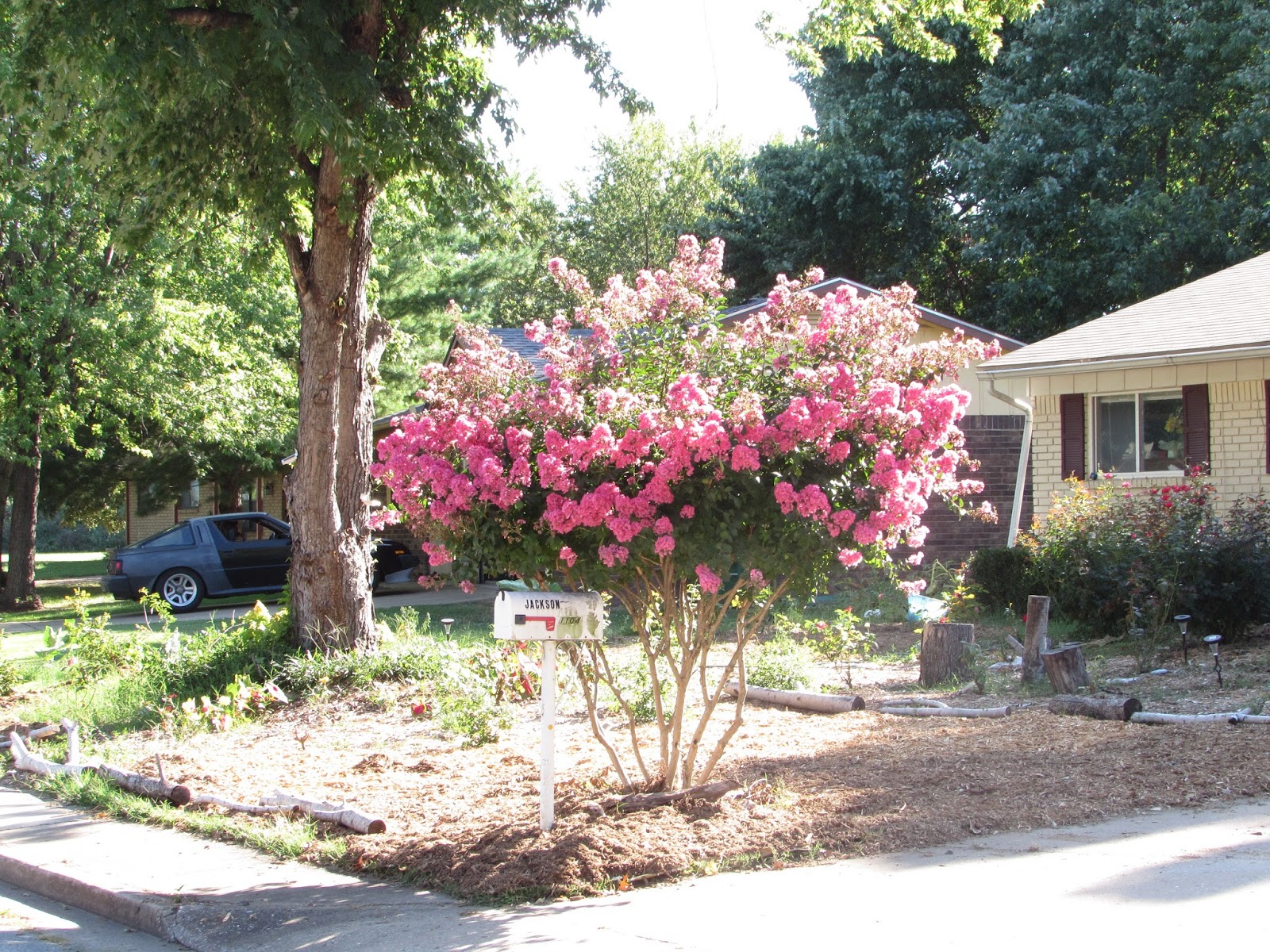
I pruned the lower half to encourage the second bloom,
but I left the upper part alone to go to seed and leave the Cardinals in peace in the Crepe Myrtle.

I doted on the Crepe Myrtle for the blooms, but large bush was perfect for a Cardinal nest. We are happy to provide a spectacular home for the Cardinals (sorry Cubs fans).