Monday, September 19, 2011

Walther Sainthood Project,
Second Installment


In Pursuit of Religious Freedom: Bishop Martin Stephan’s Journey

By Philip G. Stephan (born 1935), New York: Lexington Books, 2008.


My citations will be In Pursuit of Religious Freedom, instead of Stephan, to avoid confusion, since the author is a descendant of the bishop.

Join me in presenting a case for--or against--CFW Walther as the official saint of Olde Synodical Conference, a symbol of Lutheran orthodoxy, standing athwart the crossroads of church history and

Myth: CFW Walther came to America as an orthodox Lutheran pastor.

Facts: 


Walther came to Stephan from a circle of Pietists, whose leader had them doing works of contrition that were literally killing Ferdy in his devotion. Stephan saved Walther's life, as our hero attested, by turning him away from such fanaticism.


Stephan came from Pietism and enhanced the Pietism of the congregation he served in Dresden. The congregation was founded by Pietists and Stephan came from the same tradition of Pietism, whose main attribute is the conventicle or cell group.


Stephan served a congregation for one year, refused a position as the court preacher, and accepted the call to St. John in Dresden, perhaps because the parish developed through the Bohemian Brethren after the edict in 1624. IPRF, p. 39..


He married Julia Haberfeld in 1810. Her family was from St. John, Dresden. IPRF, p. 39f.


The congregation was formed by those not allowed to go back to their territory, IPRF, p. 45. Outside the city walls of Dresden. Services in German and in Czech. Church destroyed by the saturation bombing of Dresden in WWII.


The congregation had a number of conventicle meetings during the week, IPRF, p. 45.

“The roots of these special practices lay in Philip Spener’s pietism that developed especially within the Bohemian and Moravian Brethren Church.” IPRF, p. 46.

“Count von Zinzendorf, who had allowed the Moravian refugees to build a villa on his estates, led the “awakening” aspect of pietism and profoundly affected its tradition. It has an especially marked influenced in the rise of the Moravian Brethren Church Their evangelical work spread from Herrnhut, a town seventy miles from Dresden.” IPRF, p. 46.

“The practice of midweek prayers and study had continued for a century and a half until Stephan became pastor. He gladly and readily continued in this pietistic spirit, for this was his rearing, training, and spiritual lifeblood. He drew on his own ancestral roots so similar to those of the congregation.

When he facilitated these  gatherings he was really in his element. It was here that  the people who attended these meetings had access to the person of Martin Stephan. He was at his relaxed best in these groups.” IPRF, p. 46f.

Sunday, September 18, 2011

Investigating the Walther Case as Devil's Advocte -
Saint or Wolf?


Walther – Saint or Wolf?


In Pursuit of Religious Freedom: Bishop Martin Stephan’s Journey

By Philip G. Stephan (born 1935), New York: Lexington Books, 2008.


My citations will be In Pursuit of Religious Freedom, instead of Stephan, to avoid confusion, since the author is a descendant of the bishop.


I am all for declaring CFW Walther a saint, which may be a demotion. The Bronze Age Missourians treat him as a god. WELS trots him out when convenient.

To declare someone a saint in the Roman Catholic Church, a Devil’s Advocate must argue the opposite side of the case, presenting all the reasons why that person should not be elevated to that status.

An undeclared saint is more dangerous than an undeclared war, so I am starting the sainthood process on my own as the Devil’s Advocate.


Myth – CFW Walther was an orthodox Lutheran who left Europe with the Stephanite group to avoid the persecution of the Prussian Union.

Fact – Stephan’s congregation was directly connected with Pietism, and Walther came to Stephan as an extreme Pietist who was starving himself to death with fanatical acts of contrition.

They landed in New Orleans, April 29, 1839.

Martin Stephan began study at Halle University in 1804 and spent two years there, finishing at the University of Leipzig.  In Pursuit of Religious Freedom, p. 30.

“Stephan’s theological training prior to attending the university was shaped by the Waldensians, Hussites, and Moravian Brethren. He had become a follower of Luther after his parents’ own teaching. The Brethren practices enabled him to feel at home in Lutheran pietism.” IPRF, p. 33.

Thirteenth Sunday after Trinity


The Thirteenth Sunday after Trinity, 2011


Pastor Gregory L. Jackson


The Hymn # 281     The Savior Calls               1:29
The Confession of Sins
The Absolution
The Introit p. 16
The Gloria Patri
The Kyrie p. 17
The Gloria in Excelsis
The Salutation and Collect p. 19
The Epistle and Gradual       
The Gospel              
Glory be to Thee, O Lord!
Praise be to Thee, O Christ!
The Nicene Creed             p. 22
The Sermon Hymn #259            Flung to the Heedless Winds 1:64 

A Gospel Parable – Not Law

The Communion Hymn # 308 Invited, Lord, by Boundless Grace                    1:63
The Preface p. 24
The Sanctus p. 26
The Lord's Prayer p. 27
The Words of Institution
The Agnus Dei p. 28
The Nunc Dimittis p. 29
The Benediction p. 31
The Hymn # 464     Blest Be the Tie That Binds            1:39 

KJV Galatians 3:15 Brethren, I speak after the manner of men; Though it be but a man's covenant, yet if it be confirmed, no man disannulleth, or addeth thereto. 16 Now to Abraham and his seed were the promises made. He saith not, And to seeds, as of many; but as of one, And to thy seed, which is Christ. 17 And this I say, that the covenant, that was confirmed before of God in Christ, the law, which was four hundred and thirty years after, cannot disannul, that it should make the promise of none effect. 18 For if the inheritance be of the law, it is no more of promise: but God gave it to Abraham by promise. 19 Wherefore then serveth the law? It was added because of transgressions, till the seed should come to whom the promise was made; and it was ordained by angels in the hand of a mediator. 20 Now a mediator is not a mediator of one, but God is one. 21 Is the law then against the promises of God? God forbid: for if there had been a law given which could have given life, verily righteousness should have been by the law. 22 But the scripture hath concluded all under sin, that the promise by faith of Jesus Christ might be given to them that believe.

KJV Luke 10:23 And he turned him unto his disciples, and said privately, Blessed are the eyes which see the things that ye see: 24 For I tell you, that many prophets and kings have desired to see those things which ye see, and have not seen them; and to hear those things which ye hear, and have not heard them. 25 And, behold, a certain lawyer stood up, and tempted him, saying, Master, what shall I do to inherit eternal life? 26 He said unto him, What is written in the law? how readest thou? 27 And he answering said, Thou shalt love the Lord thy God with all thy heart, and with all thy soul, and with all thy strength, and with all thy mind; and thy neighbour as thyself. 28 And he said unto him, Thou hast answered right: this do, and thou shalt live. 29 But he, willing to justify himself, said unto Jesus, And who is my neighbour? 30 And Jesus answering said, A certain man went down from Jerusalem to Jericho, and fell among thieves, which stripped him of his raiment, and wounded him, and departed, leaving him half dead. 31 And by chance there came down a certain priest that way: and when he saw him, he passed by on the other side. 32 And likewise a Levite, when he was at the place, came and looked on him, and passed by on the other side. 33 But a certain Samaritan, as he journeyed, came where he was: and when he saw him, he had compassion on him, 34 And went to him, and bound up his wounds, pouring in oil and wine, and set him on his own beast, and brought him to an inn, and took care of him. 35 And on the morrow when he departed, he took out two pence, and gave them to the host, and said unto him, Take care of him; and whatsoever thou spendest more, when I come again, I will repay thee. 36 Which now of these three, thinkest thou, was neighbour unto him that fell among the thieves? 37 And he said, He that shewed mercy on him. Then said Jesus unto him, Go, and do thou likewise.

Thirteenth Sunday After Trinity

Lord God, heavenly Father, we most heartily thank Thee that Thou hast granted us to live in this accepted time, when we may hear Thy holy gospel, know Thy fatherly will, and behold Thy Son, Jesus Christ! We pray Thee, most merciful Father: Let the light of Thy holy word remain with us, and so govern our hearts by Thy Holy Spirit, that we may never forsake Thy word, but remain steadfast in it, and finally obtain eternal salvation; through Thy beloved Son, Jesus Christ, our Lord, who liveth and reigneth with Thee and the Holy Ghost, one true God, world without end. Amen.

A Gospel Parable – Not Law

Luke 10:23 And he turned him unto his disciples, and said privately, Blessed are the eyes which see the things that ye see: 24 For I tell you, that many prophets and kings have desired to see those things which ye see, and have not seen them; and to hear those things which ye hear, and have not heard them.

There are three parts to this Gospel text, and each one is important.
  1. Blessed are the eyes which see these things.
  2. The lawyer and his question.
  3. The Good Samaritan parable.

It is tempting for some to skip the first two parts, because many ministers want to use to Good Samaritan to smite people with the Law and make them feel guilty, so guilty that they get up and do something. But the first two parts prepare the reader or listener for a parable of pure grace.

A similar example can be found in the two brief parables, the Lost Sheep and the Lost Coin, which introduce the Prodigal Son – which is really the Parable of the Gracious, Forgiving Father – Compared to the Self-Righteous Elder Brother.

Part 1. Blessed are the eyes which see the things you see.
Luke 10:23 And he turned him unto his disciples, and said privately, Blessed are the eyes which see the things that ye see: 24 For I tell you, that many prophets and kings have desired to see those things which ye see, and have not seen them; and to hear those things which ye hear, and have not heard them.

Each and every day, we should say to ourselves, “We are so blessed to have this record of God’s will, this pure revelation, because the ancients longed for the comfort of forgiveness and salvation.”

The Scriptures are completely true in a world of uncertainty, deceit, and confusion. When I travel from the computer to the kitchen, I hear the music of Handel’s Messiah, which is on infinite replay near the front door. At any given time I heard phrases from the Old and New Testaments. What a difference it makes, going from the turmoil of today to the truth and certainty of God’s Word.

God’s Word is not only true but full of the Holy Spirit’s energy to create a beneficial effect in us. The blessing at the end of the service is not a holy “Good-bye” but an actual blessing from God. Those who hear and trust in those words receive the blessing imparted. The message is three-fold, The Lord stated each time. Is this not the Trinity?

The Father bless you and keep you.
The Son make His face to shine upon you and be gracious to you.
The Holy Spirit lift up His countenance upon you and give you peace. Numbers 6:23f  - Jackson Living Bible.

If you are a minister or a layman who has been pushed into many fights over Christian doctrine and the Scriptures, this blessing is for you. Blessed are the eyes which see the things you are seeing. You thought you knew the Word and the Confessions, but the battles have made you appreciate the truths of the Scriptures and made you value them more than gold. If these struggles made you study and understand the Book of Concord, so much better. Those who experience no doctrinal struggles will see the Book of Concord as another book to read, instead of appreciating the greatest insights about the Bible ever put in one volume.

I often deal in historical mysteries and the arguments about them. Any historical event is a mystery waiting to be solved, and yet no one can really solve most of them. But the Bible teaches us about everything, from the ancient past to the meaning of today’s world. Every time we open the Bible or hear something from the Scriptures, we are seeing those things that people longed to know.

Part 2. The lawyer and his question.

Luke 10:25 And, behold, a certain lawyer stood up, and tempted him, saying, Master, what shall I do to inherit eternal life?

Asking a question like this has been a Jewish tradition, either asking the rabbi teaching or the head of the household. The advantage is that people listen more closely. The teacher is challenged and the questioner may learn something.

The lawyer is trying to set up Jesus to tell him what a wonderful man he is. The question itself implies a Law answer – What shall I do? One church member, many years ago, was trapped in this line of thinking, not realizing that Jesus let the man trap himself. So the church member said, “The lawyer asked what shall I do? And Jesus answered – do this.”

That is a good example of having the Word but being blind to it. Jesus clearly let the man be the teacher for a moment, to expose the man’s pride and ignorance. The man wanted to show off his knowledge, and Jesus let him.

Luke 10:26 He said unto him, What is written in the law? how readest thou?

Jesus is saying, “Since you know so much already, why not teach everyone here? Tell them your own interpretation of the Law.”

Luke 10:27 And he answering said, Thou shalt love the Lord thy God with all thy heart, and with all thy soul, and with all thy strength, and with all thy mind; and thy neighbour as thyself.

Luther:
The ignorant pretender would have gladly heard a psalm of praise from the man whom the people esteemed, and at whom all men wondered. Thus all hypocrites do, who outwardly parade their excellent, great and noble works. They well say that they do not seek honor and praise, but inwardly in their hearts they are full of ambition, and desire all the world to know of their holiness, and smile very nicely when they hear men speak of it.

12. Yet the Lord does not serve this lawyer thus, but puts him to shame. This Christ is an unfriendly, ungracious man, he tells the people the truth, and well deserves that they should hate him. The pious, holy lawyer still does his utmost, and knows nothing but how to harvest great honors and obtain high renown for his precious life; he thinks he has perfectly fulfilled this commandment, and hopes for a favorable answer, that the Lord will say: Dear Sir, you have done it all. But Christ goes to work and first tells him: "Do this!" That is to say in good German: You are a rogue in the hide, you have not done this during your whole life; yea, you have not kept a single letter of the law; and thus shows him his wickedness. The poor fellow thinks he should sit in the first seat, that he is really pure and beautiful, and by rights should sit among the angels, rather than here among the people. What a wonderful Christ is this! The people regard this lawyer as pious and holy; but Christ says he shall first go and begin to fulfill the law. Be consistent with thyself!

Jesus asked the lawyer to do the teaching and then applying the teaching to himself.

Luke 10:28 And he said unto him, Thou hast answered right: this do, and thou shalt live. 29 But he, willing to justify himself, said unto Jesus, And who is my neighbour?

The combination is impossible to miss, because the lawyer gave himself away – willing to justify himself, he asked, “Who is my neighbor?”

We discussed this in a faculty forum recently. There is an obstinate type who will ask, “Since I have done the assignment, why don’t I have a 100%? You have given me only 95%.” I have said, “I would never give myself 100%.” The response is, “Then the scale only goes to 95, in your class.” I point out – no published work has ever been perfect, let alone homework. The self-justification continues, more as criticism, but sometimes as self-praise. “My other teachers thought I was a good writer.” 

Luther pointed out that this lawyer wanted to be seated with angels, so his holiness would be recognized. He doubtless had the praise of many people, but he wanted more. Luther began his statements about the Ten Commandments with the First Table, which people pass by so easily. They believe in God – all taken care of. But the question is whether we trust, love, and fear God above all things. No one can actually say this honestly, because this is the foundation of all sin. The answer is not to pound away at the sin, but to offer the Gospel solution to sin – justification by faith.
Part 3. The Good Samaritan.

Luke 10:30 And Jesus answering said, A certain man went down from Jerusalem to Jericho, and fell among thieves, which stripped him of his raiment, and wounded him, and departed, leaving him half dead.

The lawyer wanted a definite confirmation of his holiness, so Jesus became the Teacher and taught with this parable. Anyone can identify with this man, traveling to Jericho, falling among thieves, stripped of his clothing, beaten up, and left half-dead on the ground.

Luke 10:31 And by chance there came down a certain priest that way: and when he saw him, he passed by on the other side.

Here the point is made – the priest says he believes in God and the Law. That is his profession, but he will not even pass close by the man, to see how he might help him. No, the beaten man is left to suffer and die on the road. Thus faith in God is not genuine if it cannot be translated into love shown for our neighbor. The outward acts (or paucity of them) reveal how little faith there is.

The Bible does not separate them, as if adherence to the Christian faith in some superficial way can stop at the outward observances. This is a man who performed the sacred rights of Judaism and studied the Law and Prophets, yet he separated his professional life from his actions.

Clergy do this all the time. When another minister is in trouble for being faithful to the Word, they abandon him in droves. Some of Job’s Comforters will even call up and say, “You did it wrong.” Or “You had it coming.” Or – “You should only pick fights you can win.” The same clergy preach on this passage but kick the half-dead fellow pastor in the ribs. At least they don’t cross the road! The come right over and deliver a good kick before walking away.

Luke 10:32 And likewise a Levite, when he was at the place, came and looked on him, and passed by on the other side.

Here is an important detail. There was no missing the beaten man. The Levite looked him over and made sure he walked on the other side of the road.

Lenski:
Used and trained to the heavy work in the Temple as a Levite, also near all its sacred teaching, this man, too, passed by on the other side. This expression in the illustration has become proverbial for refusing aid to sufferers.
Both men had their excuses: robbers were near, and they might be assaulted; the man was too far gone, and what could they do? To be found near the man might cast suspicion on them.
[1]Lenski, R. C. H.: The Interpretation of St. Luke's Gospel. Minneapolis, MN : Augsburg Publishing House, 1961, S. 605

33 But a certain Samaritan, as he journeyed, came where he was: and when he saw him, he had compassion on him,
Lenski:
We naturally lose much of the force of this illustration because we cannot enter into the feeling of hostility that existed between the Jews and the Samaritans. The latter were of pagan stock and not of Jewish blood; were cursed publicly in the synagogue with the prayer that they might have no part in the resurrection of life; were never accepted as proselytes; to eat their food was equal to eating swine’s flesh; it was better to suffer than to accept their help; the Jew wished never to see a Cuthite (base name for Samaritan); and other evidence of this extreme hatred. In John 8:48 the name “Samaritan” was hurled at Jesus. The Samaritans retaliated in kind (9:53). The fact that Jesus made the man who showed love so perfectly in this illustration “a Samaritan” must have caused a sensation.
[1]Lenski, R. C. H.: The Interpretation of St. Luke's Gospel. Minneapolis, MN : Augsburg Publishing House, 1961, S. 605.

This is already starting to answer the question, “Who is my neighbor?” Because faith in God must be so great that we help the Samaritan, the one who is being shunned and abused, instead of passing by on the other side. Every culture, every situation has its own Samaritan.

But this figure is also used to show us God’s grace, because the Samaritan is Jesus. The parable does not solve the problem of sin with the Law but with the Means of Grace, as exemplified by the Samaritan.

Just as everyone in need is a neighbor, so is every neighbor Jesus. “When did we see You hungry, thirsty, naked, and in prison?” As often as you did it for the least of all my brothers, you did it for Me.

Luke 10: 34a And went to him, and bound up his wounds…
This is the part where the political activists use their law to make people feel guilty. The true activists say that helping out is not enough – they must make the road to Jericho safe! Although I fail to see this insight in the parable itself, it was the conclusion of Walther Rauschenbusch, the father of the Social Gospel Movement, which was the agenda of FDR’s administration. I could write a dissertation about that. Wait, I did.

No surprise – Rauschenbusch was a liberal who re-imagined (as they say) every doctrine of the Apostles Creed. Apostasy cries out for a substitute religion, and that is always a religion of works. For example, The CORE in Appleton feeds the hungry, as long as they attend church to help the numbers stay up.

The Samaritan Christ figure first has compassion. Next He goes to him. In the same way, Christ comes to us in the Word and Sacrament, often through family and friends. It may be that an antagonist is the person who breaks through with the Gospel. The wounded man cannot crawl to the Samaritan. Thus the lost, condemned, blinded sinner cannot find Christ, so Christ comes to him.

He binds the wounds. Christ does not begin with blaming the man for traveling to Jericho. “What were you thinking?” If sin could be conquered with accusations and blame, there would be no sin left in the world. The Gospel is first and foremost comfort, the forgiveness of sin.

Because we imagine we do not sin, we are inclined to encounter obvious sin with blame. The Law definitely diagnoses the sin, just as the x-ray shows the broken bones. But the time to turn off the x-ray does not always come for many. They get even more law which they cannot fulfill and they despair.

Luke 10:34b pouring in oil and wine, and set him on his own beast, and brought him to an inn, and took care of him. 35 And on the morrow when he departed, he took out two pence, and gave them to the host, and said unto him, Take care of him; and whatsoever thou spendest more, when I come again, I will repay thee.


The comfort of the Gospel is more than the absolution. Here we see the Samaritan-Christ using both oil (comfort of the Gospel) and wine (the sharpness of the Law) to heal this man.

In “All Creatures Great and Small” the vets often start out with sharp instruments, carving away rotten flesh, infections, and malformations. One farmer had a diseased hoof waved in his face until he fainted and knocked over the poor vet. After the cutting away, the comfort of oil, medicine, and lotions are used.

Christ does not say, “Do whatever you want. You are already forgiven.” That would be like bandaging an infection so it grows under the skin until the limb and the life are lost. But He does not cure sin with the Law, which would be like daily cutting until the limb disappears from surgery and the life is lost. Needless to say, many people identify Christianity with hardness of heart (no compassion) and constant guilt (no forgiveness).

All Gospel (as claimed) is never all Gospel, because man’s own law jumps in, for balance, I suppose. The more the Ten Commandments are broken in the Second Table (4-10), the more new commandments are substituted:
  1. Thou shalt not disagree with Holy Mother Synod.
  2. Thou must not question a false teacher for being a false teacher.
  3. Thou must not telleth the truth about what goeth on here.

The many steps taken by the Samaritan to bring the man back to health represent the many ways in which God takes care of us.
  1. Oil and wine.
  2. Binding the wounds.
  3. Placed on the beast – nearly dead indeed.
  4. Taken to the inn.
  5. Provided care.
  6. Innkeeper promised more compensation if needed

This reveals the abundance of grace showered upon us through the Means of Grace. Thus there is perfect balance between justification by faith and the Christian life.

36 Which now of these three, thinkest thou, was neighbour unto him that fell among the thieves? 37 And he said, He that shewed mercy on him. Then said Jesus unto him, Go, and do thou likewise.

The emphasis is clearly on the connection between the grace and compassion of Christ toward us and the compassion we should have, show, and put into action for others. These are actions motivated by God’s love for us and channeled as our love for the neighbor.


Thirteenth Sunday after Trinity
Covenant and Grace

"The Old Testament dealt with the promises of God to the chosen people. Thereby God placed Himself in 'covenant' relation to Israel (berith). This relation, like the promises and the gifts of God to Israel, is always onesided. It is always God's covenant, not Israel's, and not a mutual agreement, not a suntheke. This promise and covenant indeed obligates Israel, and Israel assumes these obligations, but the covenant emanates entirely from God."
            R. C. H. Lenski, The Interpretation of the Epistle to the Hebrews, Columbus: Lutheran Book Concern, 1938, p. 235. Hebrews 7:22;        

"To be sure, Baptism is so great that if you turn from sins and appeal to the covenant of Baptism, your sins are forgiven. Only see to it--if you sin in this wicked and wanton manner by presuming on God's grace--that the judgment does not lay hold of you and forestall your turning back. And even if you then wanted to believe and trust in your Baptism, your trial might by God's decree, be so great that faith could not stand the strain. If they scarcely remain in the faith who do no sin or who fall because of sheer weakness, where will your brazen wickedness remain, which has challenged and mocked God's grace? Let us, therefore, walk with care and fear that we may hold fast the riches of God's grace with a firm faith and joyfully give thanks to His mercy forever and ever. Amen."
            Martin Luther, What Luther Says, An Anthology, 3 vols., ed., Ewald Plass, St. Louis: Concordia Publishing House, 1959, I, p. 57. Treatise on Baptism, 1519  

"And, in a word, it remains eternally true what the Son of God says, John 15:5: Without Me ye can do nothing. And Paul, Philippians 2:13: It is God which worketh in you both to will and to do of His good pleasure. To all godly Christians who feel and experience in their hearts a small spark or longing for divine grace and eternal salvation this precious passage is very comforting; for they know that God has kindled in their hearts this beginning of true godliness, and that He will further strengthen and help them in their great weakness to persevere in true faith unto the end."
            Formula of Concord, Thorough Declaration, II. 14. Free Will Concordia Triglotta, St. Louis: Concordia Publishing House, 1921, p. 885. Philippians 2:13; John 15:5      

"These treasures are offered us by the Holy Ghost in the promise of the holy Gospel; and faith alone is the only means by which we lay hold upon, accept, and apply, and appropriate them to ourselves. This faith is a gift of God, by which we truly learn to know Christ, our Redeemer, in the Word of the Gospel, and trust in Him, that for the sake of His obedience alone we have the forgiveness of sins by grace, are regarded as godly and righteous by God the Father, and are eternally saved."            
Formula of Concord, Thorough Declaration, III 10 Righteousness Concordia Triglotta, St. Louis: Concordia Publishing House, 1921, p. 919.        

"Moreover, neither contrition nor love or any other virtue, but faith alone is the sole means and instrument by which and through which we can receive and accept the grace of God, the merit of Christ, and the forgiveness of sins, which are offered to us in the promise of the Gospel."
            Formula of Concord, Thorough Declaration, III 31 Righteousness Concordia Triglotta, St. Louis: Concordia Publishing House, 1921, p. 925. 


Saturday, September 17, 2011

WELS Church Growth Stars: Wisconsin Lutheran Seminary, 1970.
The Sausage Factory


How powerful can one group group of classmates be?

I selected these 1970 portraits from Wisconsin Lutheran Seminary gallery for one graduation year.
  • Harold Hagedorn became head of American missions.
  • Wayne Mueller taught at WLS, was removed for being unLutheran, became head of Church Growth Perish Services, promoted to First VP of WELS at $100,000 a year salary.
  • John Lawrenz was head of Michigan Lutheran Seminary, president of Mary Lou College for one month, head of Worker Training, WLS professor and then not and then again, traveling professor, and finally head of the portable Asian seminary. He installed Steve Witt, a founder of Church and Change, as the new president of the Asian seminary. 
  • John Huebner was on the board of Church and Change.
  • Paul Calvin Kelm was Secretary of Church Growth Evangelism for the synod, TELL editor before that, Spiritual Renewal director after that, chaplain at Willowcreek's Liberal College twice, tireless advocate of Fuller doctrine - always.
  • David Rutschow was promoted by the Changers after he endorsed Church Growth in TELL. He is the DP supporting Mark Jeske's pan-religious ministries. Jeske is a Thrivent board member.
By the way, the Church and Change website has been disabled for now. Haha. When TELL was finished, it took on a new title with even more bilge. Does anyone think Fuller doctrine is finished in WELS? They do not even admit to Fuller influence, in spite of hundreds of quotations they have published in direct support of Fuller and its lupine professors.

How many known Fuller alumni have taught at The Sausage Factory - after this class graduated? Joel Gerlach, David Valleskey, and Frosty Bivens - all by their own admission.

Is it an accident that these people all became highly paid senior leaders of WELS?

After growing their kudzu vine of Church Growth for 40+ years, has it been cut back at all? Not one bit.

Twissted Sister Comments on Luther


twissted_sisster has left a new comment on your post "Excerpts - Letters from Paul T. McCain When He Was...":

I have learned lot more about the Scriptures and Confessions, thanks to reading your blog, Pastor Jackson and thank you for your quotes straight from Martin Luther. That guy really hits the nail on the head, doesn't he?

***

GJ - Thank you, Twissted. Luther is the finest of all Biblical theologians, his influence so great that his colleagues and students are also at the top of all Christian theologians: Melanchthon, Chemnitz, Chytraeus, and Gerhard (who worked with Chemnitz).

My two favorite exercises in the week are:
  1. Reading the upcoming Luther sermon to Mrs. Ichabod.
  2. Copying that sermon and illustrating for this blog and the Bethany Lutheran Worship blog.

WELS Pastor in Wasilla, Alaska Becomes Russian Orthodox.
Roger Kovaciny Now LCC, Eh?


Rev. Tim A Kolb  -    King of Kings   -   Wasilla, Alaska  -  4/21/2011   -      Resigned from WELS.

---


Greek studies challenge seminary students in Ukraine


by Oleg Schewtschenko  


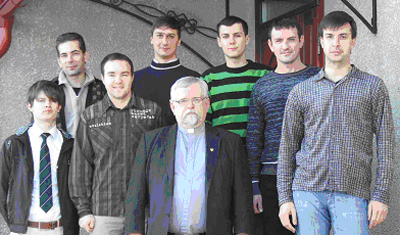
Pastor Roger Kovaciny and seminary students


For more than six-and-a-half weeks Pastor Roger Kovaciny taught biblical Greek at Concordia Seminary in Odessa. The students were  challenged by the totally new language, hard and intensive work, and the short period of time to learn it. Pastor Kovaciny is from the Wisconsin Evangelical Lutheran Synod (WELS) and has lived more than 15 years in Ukraine serving as a professor and president of the Ukrainian Lutheran Church’s seminary in Ternopol. 
This is first time our seminary has taught Greek to the students. Thanks to this class, students could see the New Testament in the new light. They enjoyed reading John´s writings, learning the Greek grammar and they worked on their own translation of the Gospel of St. John.  
We hope this will be a great gift to the church and the pastors making them able to look up some difficult passages in the original Greek Bible and giving them new tools to work with the original language for the benefit of themselves and of their congregations.  

New teacher arrives

The cold February session began with the arrival of a new instructor, Pastor Albert Schmidt from Edmonton, an old friend of our seminary. He has instructed most, if not all of the ordained pastors in the Synod of Evangelical Lutheran Churches in Ukraine. The first time he came to teach was in August 1998.  
Pastor Schmidt is teaching two classes:  Christ in the Synoptic Gospels (Matthew, Mark and Luke) and Pastoral Theology. Our students are enjoying very much his pastoral experience. “I just really love to listen to the stories from his ministry” one of the students shared with me about the stories he heard that day.  
“There is so much we can learn from his teaching and examples,” commented another student.  
Please continuing to pray for the students and their teachers that God would give them unity and a good working atmosphere.  
Rev. Oleg Schewtschenko is pastor of LCC’s partner Lutheran congregation in Odessa, Ukraine, and also assists the seminary program with translating and other arrangements. Support for the educational program comes from Concordia Lutheran Mission Society and Lutheran Church–Canada.

 Guilt by association scan.

LCMS Seminary Cost Scandal:
Fabulous Costs To Support Posh Professor Salaries


Tuition and Fees Notes
General Note on Fees: In the table above, various fees are not included in the fees column in order to make comparisons between seminaries possible. For instance, tuition for pre-sem courses such as summer Greek, refresher courses, extra summer courses. Also, fees not charged every student each year at the seminary, e.g., application, transcript, graduation/diploma, late registration, health insurance, and vehicle parking stickers.

Order of Notes: The order of the seminaries below follows the order of the chart—by most to least expensive over four years with room & board included:
#1: Concordia St. Louis Missouri (LCMS)
P. 17-20: A person must take on average 13.22 credit hours per quarter, and there are three quarters in a year. With 18 credit hours for vicarage, it comes up to 137 credit hours.
p. 70 There now is a tuition cost of $11,070 for vicarage, plus a vicarage fee of $579. Perhaps the vicarage and the person's home congregation helps pay this vicarage cost?
p. 71 $25 and $35 fees are Student Technology Fees.
p. 72 Room & Board charge listed is the cheapest rate available (e.g., double-occupancy dorm room).
This is probably unrelated to the new vicarage tuition charge, but see:
Convention Proceedings 2010, 64th Regular Convention, LCMS, Houston, TX, July 10-17, 2010, Resolution: To Increase Impact of Vicarage Program, p. 133.
Despite the high price, Concordia St. Louis' enrollment is up this year (2011-12), probably due to many students going to pre-seminary and seminary starting in 2007, simply because the economy is bad. The thinking goes that now's the time to go to school when not so much money can be made.  From email:
"The incoming class (2011-2012) is comprised of 133 students, including all those newly enrolled in residential and distance programs: 70 residential M.Div. students; four certificate students; one deaconess student; 10 EIIT (Ethnic Immigrant Institute of Theology) students; 19 SMP (Specific Ministry Pastor Program) students; one DIT (Deaf Institute of Theology) deaconess student; and five CHS (Center for Hispanic Studies) students and one CHS deaconess student. In addition, Concordia Seminary’s Graduate School has 22 new students: five M.A. (Master of Arts) students; eight Ph.D. (Doctor of Philosophy) students, and nine S.T.M. (Master of Sacred Theology) students. The nineteen new SMP students received vicarage assignments during the Opening Service as well."
President Harrison encourages people to identify young adults to enter the ministry (video).
----------
#2: Concordia Ft. Wayne Indiana (LCMS)
Apparently no tuition is charged for vicarage, but the Vicarage Fee/Internship Fee is $579.
-------
#3: Luth. Theo. Sem. at Philadelphia (ELCA)
p. 32: "The expected course load for a full-time first professional student is generally ten course units per year, taken at the rate of four to five units per full semester and between one and two units during the January or Summer Terms."
p. 35: “Affiliation Fee is for attending non-ELCA seminary and only affiliating with an ELCA seminary.”
-----------
#4: Trinity Luth. Sem., Columbus, Ohio (ELCA)
“Trinity is the only ELCA seminary that has no debt and deferred maintenance. This places our school in a strong position for the future. As synod and church-wide support continue to decrease...”
---------------
#5: Luther Seminary, Minneapolis, MN (ELCA)
“Mandatory Annual Fee
Mandatory for all Luther Seminary students registered for three or more semester courses, including interns. Insurance premiums billed annually.
Health Insurance Cost-sharing Plan:
Not available for family coverage: $1,420”
Note:  Luther Seminary in Minneapolis is the only seminary where I saw a cost-sharing plan, though I might have easily missed it looking at the fees of other seminaries. Health insurance through the seminary is a mandatory fee at all ELCA seminaries for full-time students.  Health insurance is commonly available through most seminaries and can be added to the student bill.
P. 80: "A normal course load for the master of divinity degree is 10 courses per year"
P. 158: “Board & Housing”
----------
#6: Pacific Luth. Theo. Sem., Berkeley, California (ELCA)
No meal plan is mentioned.
“Each Wednesday, a community lunch in the PLTS refectory offers the opportunity for our community to share a meal together.”
“There is a common kitchen and dining area on the basement level of Beasom equipped with a gas range and oven, pots, pans, baking equipment, dishes and utensils, and assigned refrigerator, freezer, and shelf space for each resident. “
------------
#7: Lutheran Theological Southern Seminary, Columbia, S.C. (ELCA)
 “Lutheran Theological Southern Seminary will become the university’s  [Lenoir-Rhyne University, Hickory, N.C.] school of theology.”
Note: The merger allows Lenoir-Rhyne U to offer first-year seminary courses before students move on to seminary, which is similar to what the LCMS's Concordia U's want to do:
“The Lutheran Theological Southern Seminary in Columbia, S.C., entered into a collaborative partnership with Lenoir-Rhyne University, making this the first combination of a Lutheran seminary with a university....“My goal is that we would be the primary seminary in the United States,” Miller said.”I hope we can continue to offer excellent education"....The two institutions plan to combine administrative and financial operations. L-R currently manages the financial component of the seminary, but wants to merge its recruiting, registration, fundraising, advancement and academic programs with LTSS....Powell said he hopes to offer first-year seminary courses at L-R that will provide students with the fundamentals to continue their education at Lutheran Theological Southern Seminary. He also hopes with the completion of the merger that L-R can offer graduate programs at LTSS.”
Note: 7 weeks of lunch for summer Greek is $112, so 36 weeks for the 9 months of the regular school year work out to $576 (my guesstimate):
p. 10: My Note: Assuming ELCA member tuition rate
p. 11: Single Room (single occupancy) $2,970
p. 12: My Note: Only lunch is offered in the refectory.
-------------
#8: Luth. Theo. Sem. at Gettysburg, PA (ELCA)
“Tuition $13,050 (Fees included in tuition).
*Based on 30 credits per academic year.
Internship Tuition: 1,000 (est)”
Budget:
“Food & Household Supplies - $3,500”
No meal plan cost is listed:
http://www.ltsg.edu/Students/files/Student-Handbook-2011-2012
p. 121: "All dormitory students must buy the lunch meal plan at the dining hall."
“In the last decade, LTSG has been a model among the ELCA in preparing and living within a balanced budget. As a result of this care, Gettysburg Seminary comes to 2010 with a decade of balanced budgets. By many measures, Gettysburg is first or second among ELCA seminaries in terms of its financial strength....Today, the higher cost of delivering quality degree programs with fewer residential students necessitating more individualized courses of study, and the fact that this school can no longer increase tuition, room and board at the level of the past decade is bothersome. As ATS and MSCHE are well aware, there is a severe crisis in seminary education in this country and Canada, and even a crisis with the M.Div. degree itself, which remains by far the degree most often sought at our school.”
“Lutheran Theological Seminary at Gettysburg, Pa., adopted a budget for 2009-2010...Tuition increased by 5 percent.”
p. 54 “Beginning with the 2011-12 academic year, fees are included in tuition.
Internship Tuition: $ 1,000 per year
p. 55 Room & Board: Dormitory rooms are furnished and dormitory students must purchase the meal plan.”
----------
#9: Wartburg Theo. Sem., Dubuque, IA (ELCA)
I couldn't find any estimate of meal plan, even for lunches.
“Tuition for a Master of Divinity degree is payable at the current rate each year for three years. Shortening the time spent earning the degree does not reduce the cost.”
Residence Hall Units: ranges from 165-235 Sq Ft: $275
Housing:
“You may purchase meals in the kitchen, or you may purchase food and cook for yourself. If you take your meals in the school refectory, you must plan ahead for weekends and vacation periods when the food service is closed. Be sure to save some money to cover food during weekend and holiday times.”
---------------
#10 Lutheran School of Theology at Chicago (ELCA)
Like most ELCA seminaries, their website mentions a refectory, but there's no information about meal plans. Everyone is on their own, apparently:
“During the internship year, a student does not pay tuition, therefore, no financial aid is awarded”
--------------
#11: Bethany Lutheran Seminary, Mankato, MN (ELS)
P. 18 Tuition and Fees.
Note: Not ATS accredited.
-----------
#12: Lutheran Theological Seminary, Saskatoon, Saskatchewan (ELCA)
“Small Room $7,490 per academic year (all meals included)”
“BTh/MDiv/MTS/Certificate Programs Credit: $650 per course
Upgraded MDiv course: $750”
Note: Most Canadian seminaries are associated with universities. Also, one runs into "upgrading" of courses and even of degrees, for example, from B.Th to M.Div. The B. Th. Is the equivalent of MDiv in the Anglosphere (Australia, New Zealand, etc). Sometimes additional coursework or reading is necessary for the upgrade:
“...holders of the B.Th. degree from St. Andrew’s College may apply to the Academic Committee to have their B.Th. upgraded to an M.Div. A new diploma will be issued upon surrender of the B.Th. diploma and payment of a processing fee.”
“Any Continuing Education course which is to be used for academic credit will need to be upgraded by further work to meet the standards of full academic courses.”
2. an accumulated average of not less than 65% over the three or four years of study in residency.
REQUIRED CURRICULUM: 21 COURSES + 9 Electives
So that works out to 10 courses per year for three years (for our tuition and fees calculation purposes).
-------------
#13: Wisconsin Lutheran Seminary, Mequon, WI (WELS)
Note: Not ATS accredited.
------------
#14: Concordia Lutheran Theological Seminary, St. Catharines, Ontario, Canada (LCC)
“p. 52: $735 per three credit hours (graduate),
p. 52: Inasmuch as Concordia is subsidized by Lutheran Church–Canada for the primary purpose of training pastors for LCC, an educational fee surcharge of 10% will be applied to students from partner churches, and 25% to all others.
p. 52: The seminary administration’s need-based disbursal of Concordia’s financial aid funds will endeavour, as appropriate and where possible, to supply 80% of tuition expenses.
p. 53: Student Activity Fee: $1.75 per registered semester hour ($63 for 36 credits)
p. 18: Transfer Students
To qualify for the M.Div. or M.T.S. degree, students who transfer from an accredited seminary or theological school recognized by Brock must complete at least their final 36 credit hours at Concordia.
p. 21: M.Div. Degree Requirements: Successful completion of 111 semester hours (93 required)
p. 23: 36 credit hours per year for years 1, 2 and 4, and vicarage counts as 6 credit hours during the 3rd year.”
--------------
#15: Waterloo Lutheran Seminary, Waterloo, Ontario, Canada (ELCC)
MDiv Program at a Glance:
• Number of courses: 30 courses plus placements for Contextual Stream students
• Format: full-time or part-time studies
• Tuition: approximately $18,000 for program
“Completion of the program includes three years of course work, as well as a one year internship normally in the fourth year of study.
MDiv contextual option requires 31 half-credit courses“
Note: Tuition is $2,386 per term, but every Canadian student receives a scholarship (bursary) of $518, so the real tuition rate is $1,868 per term. I think the vicarage is 3 terms because they want the student interning a full year. Otherwise, the school year is 9 months or two terms (Fall and Winter). There is a vicarage fee of $501, but the placement church usually picks that up.
“Full-Time Tuition $2,386.00 per term
MDiv Internship: $167.00 per term for 3 terms
Bursary* $518.00 per term
International Students: $5,175.00 per term
Normally the placement covers the cost of the Internship tuition. Bursaries are not available to students on MDiv Internships.
Internship tuition: $167.00 per term for 3 terms”
My note: Room and Board for two terms: single dormitory: $4,263.00
-----------
#16: Concordia Luth. Sem., Edmonton, Alberta, Canada (LCC)
Note: I added the field education fee in as a vicarage fee (though field education isn't vicarage) since I don't think other seminaries charge for field education. Also, I suppose the field education fee is a one-time fee, and I want to keep the cost comparison chart meaningful:
Tuition per credit hour: $220.00
Library fee (full-time students): $30.00/semester
Student activity fee (full-time students): $30.00/semester
Vicarage fee (6 hours x tuition rate per hour): $1320.00
Parish Ministry Immersion lab fee: $150.00
Note: A person would have to take 31.33 credit hours per year to come up with 94 credit hours in three academic years. Vicarage year is credited as 6 credit hours:
“The Master of Divinity program is a four-year full-time course of study
The Master of Divinity degree requires satisfactory mastery* of 100 credit hours”
I only came up with $21,999 for tuition for 4 yrs including vicarage tuition. Even with fees it only came up to $22,508. Perhaps they lowered the price from 24,000?:
“Tuition alone for the four years (including vicarage) exceeds $24,000.”
“But the seminaries’ pursuits are more necessary now than ever: now more than 60 of the 320-or-so LCC churches have pastoral vacancies — that’s one in six; what’s more, 50 LCC pastors were eligible to retire during one recent three-year period, and some of them have retired; the situation is not getting better.”
--------------
Other information of Interest:
ELCA NEWS SERVICE: Lilly Endowment Awards ELCA $1 Million to Address Seminarian Debt Concerns, January 5, 2010
“The ELCA has about 2,500 seminarians in its eight seminaries, and supervises the work of another 115 seminarians in other seminaries who are preparing for ordained ELCA ministry....The ELCA Fund for Leaders in Mission is a seminary scholarship program created by the ELCA. Since 2000 it has distributed more than $4.6 million in scholarship support for 516 students enrolled at ELCA seminaries....In general "more seminarians have debt, and their debts are larger," said Donald L. Huber, project coordinator.  Such debts have negative implications for seminaries and for the church as seminary graduates seek to pay loans or default on them, which is already happening, he said....Debts carried by new pastors and professional lay leaders are a significant concern, said the Rev. Paul N. Hanson, director, Fund for Leaders, ELCA Development Services.  "I believe that the research will show that this debt is having an adverse effect on ministry in congregations....The project goal is to reduce the number of students who graduate with debt and to lower the size of that debt, Huber said.  Project leaders plan to develop an overall strategy for fundraising for students, he added.”
End of Notes
This and associated documents can be found here:

---

bruce-church (http://bruce-church.myopenid.com/) has left a new comment on your post "LCMS Seminary Cost Scandal: Fabulous Costs To Supp...":

A couple interesting seminary cost comparison links:

Dallas Theological Seminary has an interactive database that allows one to compare various seminaries by cost and other factors:
http://www.dts.edu/resources/seminarycomparison/

Luther Seminary in Minneapolis compares the cost of living on campus vs. off campus here:

http://www.luthersem.edu/finaid/tuition_costs.aspx

Salaries and Tuition - ELCA and LCMS Compared

---

bruce-church (https://bruce-church.myopenid.com/) has left a new comment on your post "LCMS Seminary Cost Scandal: Fabulous Costs To Supp...":

related posts:

Graduate of Bethany Lutheran College taking on growing student loan debt load:

http://ichabodthegloryhasdeparted.blogspot.com/2012/03/student-take-on-growing-debt-loads.html
---
Report on college loan delinquency rate raises alarms - latimes.com

http://ichabodthegloryhasdeparted.blogspot.com/2012/03/report-on-college-loan-delinquency-rate.html  

---

bruce-church (http://bruce-church.myopenid.com/) has left a new comment on your post "LCMS Seminary Cost Scandal: Fabulous Costs To Supp...":

Comic with SP Harrison visiting student loan debtors in debtors jail, a metaphor for perpetual debt that entraps many M Div students if they don't work at least 10 years in church work or an NPO and have the debt forgiven:

Someone Has Sent an Insider's Report from the LCMS, Jun 17, 2012:

http://ichabodthegloryhasdeparted.blogspot.com/2012/06/someone-has-sent-insiders-report-from.html

---

bruce-church (https://bruce-church.myopenid.com/) has left a new comment on your post "LCMS Seminary Cost Scandal: Fabulous Costs To Supp...":

related post:

CUS-Concordia University System--compensation rates:

http://ichabodthegloryhasdeparted.blogspot.com/2012/05/more-compensation-figures-posts-on.html