Saturday, January 8, 2011

Someone Gave Me What Luther Says.
I Hope Someone Does That For You and Yours


By Norma Boeckler


In my first congregation, Cleveland, a member gave me the three-volume boxed set, What Luther Says.

Like most newbies, I ran out of sermon material, so I often relied on this set to give me ideas. At some point I also bought the Lenker set.

What Luther Says is one of the best Luther publications because the format makes it easy to use. God be thanked, Luther did not want to write a systematics book. He wrote on the topics of the day.

Reading the selections on the Holy Spirit will teach and support the correct, Biblical view of the Holy Spirit.

Engaging in doctrinal issues will turn this work into a worked-over volume (now that it is one instead of three).

The Lenker/Klug set on sermons of Luther is even better.


Part Two: Holy Communion


J-859

"And just as the Word has been given in order to excite this faith, so the Sacrament has been instituted in order that the outward appearance meeting the eyes might move the heart to believe [and strengthen faith]. For through these, namely, through Word and Sacrament, the Holy Ghost works."
Apology Augsburg Confession, XXIV (XII), #70. The Mass. Concordia Triglotta, St. Louis: Concordia Publishing House, 1921, p. 409. Tappert, p. 262. Heiser, p. 123.

Those who have grown up in non-liturgical denominations can understand how unimportant communion has become for the Zwinglians.460 When a Roman Catholic attends a traditional Lutheran communion service, he will respond very favorably to the dignity and Christ-centered nature of the worship. The only real worship service for a Roman Catholic is a Mass, because the Eucharist is dominant in their understanding of Christianity, even though the reasons are warped by Purgatory and the promise of limited forgiveness. In contrast, a non-liturgical Zwinglian service contains only the sermon and some emotional hymns. One Baptist worship professor alienated his pan-denominational audience at Wheaton College by telling the Pentecostals to observe the Sunday of Pentecost, the Evangelicals to have a cycle of Biblical readings, and the entire crowd to consider the value of reciting the Ecumenical Creeds.461 The applause was definitely scattered and hostile.
When I left the Lutheran Church in America, the denomination was moving toward the Episcopalian model of high church Unitarianism. In other words, the ministers believed nothing and each congregation had more doctrinal opinions than members. Nevertheless, rules for the proper conduct of worship were emphasized in many official communications. A 1970s evangelism filmstrip, the grandfather of the video, explained how important a liturgical service and a well prepared sermon were. Some vocal ministers of the LCA and ALC were arguing for every Sunday communion in a legalistic way, but they were talking about worship.462 A few progressives began promoting infant communion, following the Eastern Orthodox. The national LCA conventions redeemed themselves to some degree with their communion services.
Imagine my shock when I joined the Wisconsin Synod and found people repeatedly denouncing more than one congregation as “a page five and fifteen congregation.” Someone had to explain this term to me, because I thought it referred to by-laws. My informant said, “Those are congregations using The Lutheran Hymnal all the time, page five for the normal service and page fifteen for the communion service.” So I asked, “What’s wrong with that?” The WELS pastor said, “They are not being creative in worship.” All too soon I learned what being creative meant. I went to a WELS conference where the worship bulletin cover said that Easter keeps us going and going and going and going, an obvious reference to a battery commercial on TV, one that featured a pink rabbit.463 The Introit for the service was simply invented by the pastor, who is now on the board of the seminary. The Creed could be anything, such as a part of the Small Catechism.
The powerful district mission boards of the Wisconsin Synod, surely no more debased than their LCMS counterparts, could not impress on congregations enough the need to make every visitor happy. Closed communion was converted to “Don’t ask. Don’t tell.” No one bragged about having open communion, but no one mentioned closed communion either. I attended one WELS conference where a pastor explained how congregations could get away from the hymnal altogether—with transparencies on an overhead projector—just like the Assemblies of God. No one really spelled it out, but it was clear that the liturgy was an obstacle in the eyes of the Church Growth groupies.
How far can this trend go? Following are some actual examples.

1.   The Wisconsin and Missouri Synods have endorsed Seeker Services, copying Willow Creek Community Church.
2.    Lutheran hymns have been set aside in favor of treacle like “Take the world but give me Jesus,” featured in the new WELS hymnal, edited by James P. Tiefel and Iver Johnson.
3.    ELS missionary Roger Kovaciny is known for singing and dancing in the pulpit with a basket on his head. Using a pistol or gun-case in the pulpit is another famous example of Kovaciny making the Word relevant. ["Just what we need at Thoughts of Faith!"]

Where did this infuriating display of contempt for the Means of Grace begin? First of all, it started with the denial of the efficacy of the Word. If the foundation is wrong, the worship service is turned into a sad, sick parody of praising God. Lutherans should have a national day of shame and contrition for what they have done to worship in the name of evangelism. God has betrayed them, as He does all the reprobate, by denying them the one thing they desire, numerical growth.464
In the past, no one imagined that Holy Communion was an entitlement for anyone who happened to be in church on a given Sunday, those visiting relatives or the curious and the lost, like a Methodist woman who dropped by St. Paul’s in Columbus and was communed with her young son. Yale professor emeritus George Lindbeck, who regularly attended the early service at Bethesda Lutheran Church, New Haven, where I worked as a student assistant, recently wrote an article on this subject: “The Eucharist Tastes Bitter in the Divided Church.”465 Lindbeck pointed out that the divinity school chapel began to use the eucharistic rite of the Church of South India, which was a union of the Anglican, Presbyterian, Methodist, and Congregationalist confessions. However, one colleague objected to the words of distribution, “This is my body” and “This is my blood.” The dissenter did not believe those words and did not want to participate. Lindbeck wrote: “I had misled him about my belief in the real presence by joining in the old quasi-Zwinglian service just as he felt he had misled others in the opposite direction by eating and drinking in accordance with the new South Indian liturgy. Both of us had in our respective ways borne false witness to our faith and were guilty of mendacity—some would say, blasphemy—by signifying fraudulently with sacred things.” The article’s assumption of ecumenical communion reminds me of the impertinent question asked by a woman at a Greek Orthodox congregation’s open house. She kept saying, “I want to take communion here.” The priest patiently responded more than once, “Then take classes and join if you agree with our confession.” The woman sounded exasperated that the priest took the Lord’s Supper so seriously. No one else does today.
Luther explained why Holy Communion means so much to the individual.

J-860

"For in Confession as in the Lord's Supper you have the additional advantage, that the Word is applied to your person alone. For in preaching it flies out into the whole congregation, and although it strikes you also, yet you are not so sure of it; but here it does not apply to anyone except you. Ought it not to fill your heart with joy to know a place where God is ready to speak to you personally? Yea, if we had a chance to hear an angel speak we would surely run to the ends of the earth."
Sermons of Martin Luther, 8 vols., ed. John Nicholas Lenker, Grand Rapids: Baker Book House, 1983 II, p. 199.

Holy Communion in the Small Catechism


J-861

VI. The Sacrament of the Altar,
As the Head of a Family Should Teach It
in a Simple Way to His Household466

What is the Sacrament of the Altar?
It is the true body and blood of our Lord Jesus Christ, under the bread and wine, for us Christians to eat and to drink, instituted by Christ Himself.

Where is this written?
The holy Evangelists, Matthew, Mark, Luke, and St. Paul, write thus:
Our Lord Jesus Christ, the same night in which He was betrayed, took bread: and when He had given thanks, He brake it, and gave it to His disciples, and said, Take, eat; this is My body, which is given for you. This do in remembrance of Me.
After the same manner also He took the cup, when He had supped, gave thanks, and gave it to them, saying, Take, drink ye all of it. This cup is the new testament in My blood, which is shed for you for the remission of sins. This do ye, as oft as ye drink it, in remembrance of Me.
What is the benefit of such eating and drink?

That is shown us in these words: Given, and shed for you, for the remission of sins; namely, that in the Sacrament forgiveness of sins, life, and salvation are given us through these words. For where there is forgiveness of sins, there is also life and salvation.

How can bodily eating and drinking do such great things?
It is not the eating and drinking, indeed, that does them, but the words which stand here, namely: Given, and shed for you, for the remission of sins. Which words are, beside the bodily eating and drinking, as the chief thing in the Sacrament; and he that believes these words has what they say and express, namely, the forgiveness of sins.

Who, then, receives such Sacrament worthily?
Fasting and bodily preparation is, indeed, a fine outward training; but he is truly worthy and well prepared who has faith in these words: Given, and shed for you, for the remission of sins. But he that does not believe these words, or doubts, is unworthy and unfit; for the words For you require altogether believing hearts.”

Holy Communion in the Large Catechism


J-862

"And all these are established by the words by which Christ has instituted it, and which every one who desires to be a Christian and go to the Sacrament should know. For it is not our intention to admit to it and to administer it to those who know not what they seek, or why they come."
Large Catechism, The Sacrament of the Altar. #2. Concordia Triglotta, St. Louis: Concordia Publishing House, 1921, p. 753. Tappert, p. 447. Heiser, p. 210.

J-863

"For it is not founded upon the holiness of men, but upon the Word of God. And as no saint upon earth, yea, no angel in heaven, can make bread and wine to be the body and blood of Christ, so also can no one change or alter it, even though it be misused. For the Word by which it became a Sacrament and was instituted does not become false because of the person or his unbelief. For He does not say: If you believe or are worthy you receive My body and blood, but: Take, eat and drink; this is My body and blood."
The Large Catechism, Sacrament of the Altar. #16-17. Concordia Triglotta, St. Louis: Concordia Publishing House, 1921, p. 757. Tappert, p. 448. Heiser, p. 211.

J-864

"On this account it is indeed called a food of souls, which nourishes and strengthens the new man. For by Baptism we are first born anew; but (as we said before) there still remains, besides, the old vicious nature of flesh and blood in man, and there are so many hindrances and temptations of the devil and of the world that we often become weary and faint, and sometimes also stumble."
The Large Catechism, Sacrament of the Altar. #23. Concordia Triglotta, St. Louis: Concordia Publishing House, 1921, p. 757. Tappert, p. 449. Heiser, p. 211f.

J-865

"Therefore it {communion}is given for a daily pasture and sustenance, that faith may refresh and strengthen itself so as not to fall back in such a battle, but become ever stronger and stronger. For the new life must be so regulated that it continually increase and progress; but it must suffer much opposition. For the devil is such a furious enemy that when he sees that we oppose him and attack the old man, and that he cannot topple us over by force, he prowls and moves about on all sides, tries all devices, and does not desist, until he finally wearies us, so that we either renounce our faith or yield hands and feet and become listless or impatient. Now to this end the consolation is here given when the heart feels that the burden is becoming too heavy, that it may here obtain new power and refreshment."
The Large Catechism, Sacrament of the Altar. #24-27. Concordia Triglotta, St. Louis: Concordia Publishing House, 1921, p. 759. Tappert, p. 449. Heiser, p. 211.

J-866

"For here in the Sacrament you are to receive from the lips of Christ forgiveness of sin, which contains and brings with it the grace of God and the Spirit with all His gifts, protection, shelter, and power against death and the devil and all misfortune."
The Large Catechism, Sacrament of the Altar. #70. Concordia Triglotta, St. Louis: Concordia Publishing House, 1921, p. 769. Tappert, p. 454. Heiser, p. 214.

J-867

"Therefore, if you cannot feel it {the works of the flesh, Galatians 5:199ff. above}, at least believe the Scriptures; they will not lie to you, and they know your flesh better than you yourself...Yet, as we have said, if you are quite dead to all sensibility, still believe the Scriptures, which pronounce sentence upon you. And, in short, the less you feel your sins and infirmities, the more reason have you to go to the Sacrament to seek help and a remedy."
The Large Catechism, Sacrament of the Altar. #76-78. Concordia Triglotta, St. Louis: Concordia Publishing House, 1921, p. 771. Tappert, p. 455. Heiser, p. 214.

Against the Word, Against the Real Presence


J-868

(1) "Lord Jesus Christ, with us abide, For round us falls the eventide;
Nor let Thy Word, that heavenly light, For us be ever veiled in night.

(2) In these last days of sore distress Grant us, dear Lord, true steadfastness
That pure we keep, till life is spent, Thy holy Word and Sacrament.

(3) Lord Jesus, help, Thy Church uphold, For we are sluggish, thoughtless, cold.
Oh, prosper well Thy Word of grace And spread its truth in every place.

(4)Oh, keep us in Thy Word, we pray; The guile and rage of Satan stay!
Oh, may Thy mercy never cease! Give concord, patience, courage, peace.

(5) O God, how sin’s dread works abound! Throughout the earth no rest is found.
And falsehood’s spirit wide has spread, And error boldly rears its head.

(6) The haughty spirits, Lord, restrain Who over Thy Church with might would reign
And always set forth something new, Devised to change Thy doctrine true.

(8) A trusty weapon is Thy Word, Thy Church's buckler, shield, and sword.
Oh, let us in its power confide That we may seek no other guide!

(9) Oh, grant that in Thy holy Word We here may live and die, dear Lord;
And when our journey endeth here, Receive us into glory there.”

Nikolaus Selnecker et al.,"Lord Jesus Christ, with Us Abide," The Lutheran Hymnal, #292, St. Louis: Concordia Publishing House, 1941.

In the name of love, ecumenical communion prepared the way for the next atrocity in Christian worship, the inter-faith service, where various world religions are recognized and treated as equals. Many examples could also be cited where pagan religion has been added to a Lutheran service in the name of providing relevance and excitement. This is especially true in the ELCA and the sisterhood of the National Council of Churches. The Sophia goddess conference wedded female goddess worship to feminist mainline leadership. However, long before all these blasphemies took place, the efficacy of the Word in Holy Communion was denied.
Huldrich Zwingli began the rejection of God’s work through the visible Word by proudly declaring that the Holy Spirit did not need a vehicle like an oxcart. Zwingli did not know theology very well and he was inordinately jealous of Martin Luther. His Swiss Reformation in Zurich anticipated the more refined rationalism of John Calvin in Geneva. Many of Zwingli’s statements are revolting for their block-headed ignorance, but his move to separate the Holy Spirit from the Word was his foundational error. The Book of Concord calls it Enthusiasm. Whenever someone declares that God works apart from the Word and Sacraments, he is an Enthusiast. Granted, some Christian confessions are closer to the efficacy of the Word and less obnoxious in their statements, but the union of the Holy Spirit and the Word, whether visible in the Sacraments or invisible in preaching, cannot be relinquished because it is Scriptural.

J-869

"Whoever denies the Real Presence of the body and blood of Christ in the Lord's Supper must pervert the words of Institution where Christ the Lord, speaking of that which He gives His Christians to eat, says: 'This is My body,' and, speaking of that which He gives them to drink, says: 'This is My blood.' [Also 1 Corinthians 10:16]
Francis Pieper, The Difference between Orthodox and Heterodox Churches, and Supplement, Coos Bay, Oregon: St. Paul's Lutheran Church, 1981, p. 40. 1 Corinthians 10:16.

John Calvin was an erudite legal scholar before he became a Christian leader, so he lifted Zwingli’s rationalism to a more refined level. He stated this about the Lord’s Supper – that the finite forms of bread and wine cannot contain the infinite of Christ’s body and blood (finitum non capax infinitum, called the extra Calvinisticum).467 If we examine his statements in his Institutes more closely, we can easily find the same mocking tone so familiar in Zwingli. However, few Lutheran pastors read the Institutes, even though they buy and use Calvin’s complete Biblical commentaries.468


J-870

"Calvin was dissatisfied with Zwingli's interpretation of the Lord's Supper, but his own interpretation was also wrong. He said that a person desiring to receive the body and blood of Christ could not get it under the bread and wine, but must by his faith mount up to heaven, where the Holy Spirit would negotiate a way for feeding him with the body and blood of Christ. These are mere vagaries, which originated in Calvin's fancy. But an incident like this shows that men will not believe that God bears us poor sinners such great love that He is willing to come to us."
C. F. W. Walther, The Proper Distinction Between Law and Gospel, trans., W. H. T. Dau, St. Louis: Concordia Publishing House, 1928, p. 185.

J-871

"When the preacher who is administering this holy Sacrament repeats, along with the Lord's Prayer, the words of institution, he first of all is testifying that he does not desire to perform, from his own opinion, a human action and institution; rather, as a householder [steward] of the divine mysteries, he is, in accordance with Christ's command, desiring to administer a holy Sacrament. Accordingly, he sets aside visible bread and wine so that it can be the means and instrument for the distribution and fellowship of the body and blood of Christ. Further, he prays that, in accordance with His institution and promise, Christ would be present in this action, and that by means of the consecrated bread and wine he might distribute Christ's body and blood. Finally, he testifies that by the power of the institution of Christ, the bread and wine in the holy Supper are not [merely] base bread and wine, but rather that Christ's body and Christ's blood are received sacramentally united and present with the bread and wine. He will herewith then point out this institution and ordinance of Christ to the communicants."
Johann Gerhard, A Comprehensive Explanation of Holy Baptism and the Lord's Supper, 1610, ed. D. Berger, J. Heiser, Malone, Texas: Repristination Press, 2000, p. 301f.

Communion Texts


KJV Matthew 26:26 And as they were eating, Jesus took bread, and blessed it, and brake it, and gave it to the disciples, and said, Take, eat; this is my body. 27 And he took the cup, and gave thanks, and gave it to them, saying, Drink ye all of it; 28 For this is my blood of the new testament, which is shed for many for the remission of sins.

It is difficult to improve on Luther’s Small Catechism, but some things need to be noted because of recent developments. One is the use of testament or covenant for the Greek word diatheke. In this context we have to ask about the English meaning of the terms. Testament is clear, suggesting a last will and testament. I can leave my entire fortune to a Lutheran synod, without having a Planned Giving Counselor guide my signature while stepping on my oxygen hose. A last will and testament is a one-sided agreement, made without the permission of the other party. When Jesus instituted the Lord’s Supper, He did not ask for a mutual agreement. He simply announced what He was doing and what it meant. We often use the term covenant for an agreement between two parties. For instance, when I did an Internet search on the word covenant, the first page found was Reformed and concerned the Covenant of Scotland, quoting Joshua 24:25.469 Covenant has been a favorite term for Calvinists. The term is also used now as a legal term for an agreement among two parties. So it arouses my suspicions to have the new Wisconsin Synod hymnal change the Words of Institution to “This is my blood of the new covenant...”470 The Lutheran Hymnal reads: “This cup is the New Testament in My blood...”
The Evangelical Lutheran Synod has had a long-running debate on the Moment of Consecration. The discussion has provided the benefit of avoiding serious doctrinal issues for years. If the ELS understood and believed in the efficacy of the Word, they would not have a debate or use such a term as The Moment of Consecration, a term which by itself sounds Roman Catholic. I have not participated in the ELS discussions or taken sides, since it seems like a replay of the Spanish Civil War. Obviously, the power of the Sacrament of the Altar comes from the Word. One cannot divorce the Real Presence of Christ from the Word. In the days of the old Synodical Conference, people were taught to think in the following way and they still say, “It is not the body and blood of Christ until the communicant receives it.” That belief would make the reception efficacious in effecting the Real Presence. All my quotations about the Lord’s Supper assume the Real Presence before the reception of the elements. Receptionism has even been critiqued by WELS.

J-872
"It should perhaps be mentioned also that some of our Lutheran teachers limited the real presence to the moment of eating and drinking. This, too, goes beyond the specific words of Christ."
            W. Gawrisch, Review of Bjarne Wollan Teigen, The Lord's Supper in the Theology of Martin Chemnitz, Wisconsin Lutheran Quarterly, Spring, 1987, 84, p. 155.

J-873

"This precium nostrae redemptionis, that is, this His true body, which He gave into death for our redemption, and this His true blood, which He poured out for our redemption, the Lord Christ takes and distributes to us by means of the consecrated bread and wine so that thereby we might be strengthened and made sure in faith and so that also the promise of the gracious forgiveness of sins applies to us."
Johann Gerhard, A Comprehensive Explanation of Holy Baptism and the Lord's Supper, 1610, ed. D. Berger, J. Heiser, Malone, Texas: Repristination Press, 2000, p. 369.

J-874

"This consumption of the body of Christ along with the consecrated wine is in no way to be regarded as a natural eating and drinking, much less as a Capernaitic eating and drinking, since Christ's body and blood are not eaten and drunk as one usually receives and uses other food and drink, [i.e.] in a natural manner for the nurture of the body. Rather, such an eating and drinking takes place in a highly incomprehensible mystery, [in an] unfathomable and genuinely spiritual manner. It is, however, called a sacramental eating and drinking because it occurs only in this Sacrament and is due to the sacramental union of the true body of Christ with the consecrated bread and the true blood of Christ with the consecrated wine."
Johann Gerhard, A Comprehensive Explanation of Holy Baptism and the Lord's Supper, 1610, ed. D. Berger, J. Heiser, Malone, Texas: Repristination Press, 2000, p. 336.

J-875

"Human reason, though it ponder,
Cannot fathom this great wonder
That Christ's body ever remaineth
Though it countless souls sustaineth
And that He His blood is giving
With the wine we are receiving.
These great mysteries unsounded
Are by God alone expounded."

Johann Franck, 1649, "Soul, Adorn Thyself with Gladness" The Lutheran Hymnal, #305, St. Louis: Concordia Publishing House, 1941.


J-876

(1) "An aweful mystery is here To challenge faith and waken fear:
The Savior comes as food divine, Concealed in earthly bread and wine.

(2) This world is loveless—but above, What wondrous boundlessness of love!
The King of Glory stoops to me My spirit's life and strength to be.

(3) In consecrated wine and bread No eye perceives the mystery dread;
But Jesus' words are strong and clear: 'My body and My blood are here.'

(4) How dull are all the powers of sense Employed on proofs of love immense!
The richest food remains unseen, And highest gifts appear—how mean!

(5) But here we have no boon on earth, And faith alone discerns its worth.
The Word, not sense, must be our guide, And faith assure since sight's denied."

Matthias Loy, 1880, "An Aweful Mystery Is Here" The Lutheran Hymnal, #304, St. Louis: Concordia Publishing House, 1941.

J-877

"Draw nigh and take the body of the Lord
And drink the holy blood for you outpoured.
Offered was He for greatest and for least,
Himself the Victim and Himself the Priest."

"Draw Night and Take the Body of the Lord," The Lutheran Hymnal, #307, St. Louis: Concordia Publishing House, 1941.

J-878

"We eat this bread and drink this cup, Thy precious Word believing
That Thy true body and Thy blood Our lips are here receiving.
This word remains forever true, And there is naught Thou canst not do;
For Thou, Lord, art almighty."

Samuel Kinner, 1638, "Lord Jesus Christ, Thou Hast Prepared," The Lutheran Hymnal, #306, St. Louis: Concordia Publishing House, 1941.

A cavalier attitude about the efficacy of the Word in the Lord’s Supper has led to many different episodes shocking to anyone who values the liturgical tradition of the Christian Church, a tradition whose foundation rests upon Old Testament worship. For instance, it has been claimed that pastors at conferences have held communion services where the Words of Institution were deliberately omitted, claiming freedom to change the form of worship, as if the words of distribution are an adequate substitute for the Consecration. Another practice indicative of bad doctrine, common of large churches, is that of keeping most of the bread and wine in the sacristy, to be hauled out like extra bulletins when the supply runs low on the altar. Worse, someone runs back to the cupboard and takes out additional wine and bread. One could argue speciously that the Word is efficacious throughout the church building, but slovenly practices leave the definite impression that the Consecration is meaningless, a message reinforced by communion without the Words of Institution. An altar guild or pastor can easily place all of the elements on the altar or on an area adjacent to the altar. The solution to such problems is not a how-to program, but education about why we show utmost respect and awe for the miracle of Holy Communion, the visible Word.

Efficacy or Church Growth Eyes?


KJV 1 Corinthians 11:23 For I have received of the Lord that which also I delivered unto you, That the Lord Jesus the same night in which he was betrayed took bread: 24 And when he had given thanks, he brake it, and said, Take, eat: this is my body, which is broken for you: this do in remembrance of me. 25 After the same manner also he took the cup, when he had supped, saying, This cup is the new testament in my blood: this do ye, as oft as ye drink it, in remembrance of me. 26 For as often as ye eat this bread, and drink this cup, ye do shew the Lord's death till he come. 27 Wherefore whosoever shall eat this bread, and drink this cup of the Lord, unworthily, shall be guilty of the body and blood of the Lord. 28 But let a man examine himself, and so let him eat of that bread, and drink of that cup. 29 For he that eateth and drinketh unworthily, eateth and drinketh damnation to himself, not discerning the Lord's body.

Someone suddenly visiting the remnants of the old Synodical Conference would never know that close communion was once the practice of the entire Christian Church. Paul’s discussion of communion rests upon the efficacy of the Word in the Lord’s Supper, pouring out forgiveness and many blessings upon believers while damning and hardening those who receive Holy Communion unworthily. Proof of this powerful effect can be found everywhere in Christendom. Where the Lord’s Supper has been relegated to a mere ordinance, a human display of piety rather than the reception of God’s grace, Christian doctrine is subordinate to human reason and embarrassing to intelligent people. The lower the view of Holy Communion, the more debased the denomination’s doctrine, a fact admitted ruefully by its own leaders. Once the ELCA had pursued every radical Left advocacy group and every ecumenical mandate, its own leaders began poping and half-poping to escape the ultimate result of Zwinglian doctrine: a church without liturgy, doctrine, direction, or the Sacraments.471
Ask a denomination what it believes about the Lord’s Supper and soon you will find out how frequently and prominently the Sacrament of the Altar is celebrated, if those words can be mentioned at all. The absolute bottom pit of Zwinglianism may be the self-enclosed grape juice and wafer package to be picked up on the way out of church, as seen in various Christian catalogues. The worst extreme needs to be mentioned, because Lutherans have a horrible tendency to veer in the wrong direction. Pietism influenced the Lutherans to participate in Holy Communion less frequently, as infrequently as three times a year. The Temperance Movement caused General Synod Lutherans in the Grape Juice Belt to replace wine with juice in the name of social improvement. When Lutherans start wishing that Holy Communion did not lengthen the service on Sunday nor annoy visitors, they are falling into the slough of despising the Means of Grace.
This passage from Paul promotes a love of the solemn service of Holy Communion. In the Eastern Orthodox service, the priest chants, “The doors. The doors. In wisdom let us attend.” The opening admonition came from the practice of shutting the doors to prevent others from casually hearing or attending the Eucharist.472 There is also evidence from the early Church that Holy Communion was regarded in much the same way. Therefore, if someone cannot discern the body of Christ in the Lord’s Supper, he should not be given Holy Communion. The Church Growth camp followers are so ignorant of God’s Word that they use “discerning the body” to fraudulently promote their concept of Church Growth Eyes. Church Growth gurus are so proud of their Church Growth Eyes that they cannot stop bragging about it. When Lutherans use the term, they appear especially foolish.473


Sacraments Define the True Church


J-879

"But the Church is not only the fellowship of outward objects and rites, as other governments, but it is originally a fellowship of faith and of the Holy Ghost in hearts. [The Christian Church consists not alone in fellowship of outward signs, but it consists especially in the heart, as of the Holy Ghost, of faith, of the fear and love of God]; which fellowship nevertheless has outward marks so that it can be recognized, namely, the pure doctrine of the Gospel, and the administration of the Sacraments in accordance with the Gospel of Christ. [Namely, where God’s Word is pure, and the Sacraments are administered in conformity with the same, there certainly is the Church, and there are Christians.] And this Church alone is called the body of Christ, which Christ renews [Christ is its Head, and] sanctifies and governs by His Spirit, as Paul testifies, Ephesians 1:22..."
Apology Augsburg Confession, VII & VIII. #5. The Church. Concordia Triglotta, St. Louis: Concordia Publishing House, 1921, p. 227. Tappert, p. 169. Heiser, p. 71.

J-880

"Of Ecclesiastical Order they teach that no one should publicly teach in the Church or administer the Sacraments unless he be regularly called."
Augsburg Confession, Article XIV. Ecclesiastical Order. Concordia Triglotta, St. Louis: Concordia Publishing House, 1921, p. 49. Tappert, p. 36. Heiser, p. 14.

J-881

"[We are speaking not of an imaginary Church, which is to be found nowhere; but we say and know certainly that this Church, wherein saints live, is and abides truly upon earth; namely, that some of God's children are here and there in all the world, in various kingdoms, islands, lands, and cities, from the rising of the sun to its setting, who have truly learned to know Christ and His Gospel.] And we add the marks: the pure doctrine of the Gospel [the ministry of the Gospel] and the Sacraments. And this Church is properly the pillar of truth, 1 Timothy 3:15."
Apology Augsburg Confession, VII & VIII. #20. The Church. Concordia Triglotta, St. Louis: Concordia Publishing House, 1921, p. 233. Tappert, p. 171. Heiser, p. 73. 1 Timothy 3:15.

J-882

"That we may obtain this faith, the Ministry of Teaching the Gospel and administering the Sacraments was instituted. For through the Word and Sacraments, as through instruments, the Holy Ghost is given, who works faith, where and when it pleases God, in them that hear the Gospel, to wit, that God, not for our own merits, but for Christ's sake, justifies those who believe that they are received into grace for Christ's sake. They condemn the Anabaptists and others who think that the Holy Ghost comes to men without the external Word, through their own preparation and works."
Augsburg Confession, V. #1-2. The Ministry. Concordia Triglotta, St. Louis: Concordia Publishing House, 1921, p. 45. Tappert, p. 31. Heiser, p. 13.

J-883

"This power {the Keys} is exercised only by teaching or preaching the Gospel and administering the Sacraments, according to their calling, either to many or to individuals. For thereby are granted, not bodily, but eternal things, as eternal righteousness, the Holy Ghost, eternal life. These things cannot come but by the ministry of the Word and the Sacraments, as Paul says, Romans 1:16: The Gospel is the power of God unto salvation to every one that believeth. Therefore, since the power of the Church grants eternal things, and is exercised only by the ministry of the Word, it does not interfere with civil government; no more than the art of singing interferes with civil government."
Augsburg Confession, XXVIII. #8. Concordia Triglotta, St. Louis: Concordia Publishing House, 1921, p. 85. Tappert, p. 82. Heiser, p. 23. Romans 1:16.

J-884

"Now, it is not our faith that makes the Sacrament, but only the true word and institution of our almighty God and Savior Jesus Christ, which always is and remains efficacious in the Christian Church, and is not invalidated or rendered inefficacious by the worthiness or unworthiness of the minister, nor by the unbelief of the one who receives it."
            Formula of Concord, SD VII, #89. Holy Supper. Concordia Triglotta, St. Louis: Concordia Publishing House, 1921, p. 1003. Tappert, p. 585. Heiser, p. 272.

Benefits of Holy Communion 


J-885

"Besides this, you will also have the devil about you, whom you will not entirely tread under foot, because our Lord Christ Himself could not entirely avoid him. Now, what is the devil? Nothing else than what the Scriptures call him, a liar and murderer. A liar, to lead the heart astray from the Word of God, and blind it, that you cannot feel your distress or come to Christ. A murderer, who cannot bear to see you live one single hour. If you could see how many knives, darts, and arrows are every moment aimed at you, you would be glad to come to the Sacrament as often as possible."
The Large Catechism, Sacrament of the Altar. #80-82. Concordia Triglotta, St. Louis: Concordia Publishing House, 1921, p. 771f. Tappert, p. 456. Heiser, p. 214.

J-886

"However, you will be sure as to whether the Sacrament is efficacious in your heart, if you watch your conduct toward your neighbor. If you discover that the words and the symbol soften and move you to be friendly to your enemy, to take an interest in your neighbor's welfare, and to help him bear his suffering and affliction, then all is well. On the other hand, if you do not find it so, you continue uncertain even if you were to commune a hundred times a day with devotions so great as to move you to tears for very joy; for wonderful devotions like this, very sweet to experience, yet as dangerous as sweet, amount to nothing before God. Therefore we must above all be certain for ourselves, as Peter writes in 2 Peter 1:10: 'Give the more diligence to make your calling and election sure.'"
Sermons of Martin Luther, 8 vols., ed. John Nicholas Lenker, Grand Rapids: Baker Book House, 1983 II, p. 211.

J-887

"Accordingly, we say that by virtue of the institution, the holy Supper was established by Christ and was used by the believers chiefly to this end: that the promise of the gracious forgiveness of sins should be sealed and our faith should thus be strengthened. Then, too, we are incorporated in Christ and are thus sustained to eternal life; in addition, subsequently, other end results and benefits of the holy Supper come to pass. Yet, both of the fruits indicated above always remain the foremost."
Johann Gerhard, A Comprehensive Explanation of Holy Baptism and the Lord's Supper, 1610, ed. D. Berger, J. Heiser, Malone, Texas: Repristination Press, 2000, p. 369.

J-888

"O living Bread from heaven,
How richly hast Thou fed Thy guest!
The gifts Thou now hast given
Have filled my heart with joy and rest.
O wondrous food of blessing,
O cup that heals our woes!
My heart, this gift professing,
In thankful songs overflows;
For while the faith within me
Was quickened by this food,
My soul hath gazed upon Thee,
My highest, only Good."

Johann Rist, 1651, "O Living Bread from Heaven," The Lutheran Hymnal, St. Louis: Concordia Publishing House, 1941, Hymn #316. Matthew 26:26-29.

J-889

(1) "Lord Jesus Christ, we humbly pray
That we may feed on Thee today;
Beneath these forms of bread and wine
Enrich us with Thy grace divine.

(2) The chastened peace of sin forgiven,
The filial joy of heirs of heaven,
Grant as we share this wondrous food,
Thy body broken and Thy blood.

(3) Our trembling hearts cleave to Thy Word;
All Thou hast said Thou dost afford,
All that Thou art we here receive,
And all we are to Thee we give."

Henry E. Jacobs, 1910, "Lord Jesus Christ, We Humbly Pray," The Lutheran Hymnal, St. Louis: Concordia Publishing House, 1941, Hymn #314. 1 Corinthians 10:17.

Luther versus the UOJ Pietists: Justification by Faith
And Thy Strong Word Updated

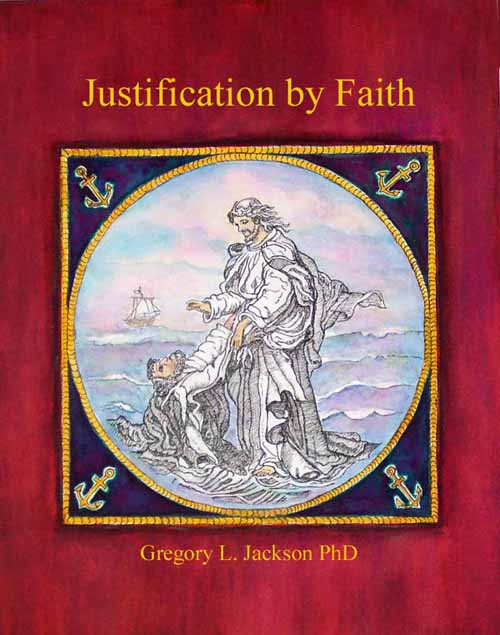
Cover and graphics by Norma Boeckler.


I uploaded the newest versions of Justification By Faith and Thy Strong Word.

Click here for the Martin Chemnitz Press Storefront at Lulu.com

Some friends may be tired of the barrage of files.

Norma Boeckler helped immensely by adding artwork to Justification.

Someone is helping spot typos and other errors in TSW. I managed to spell Sig Becker's first name wrong four times. I fixed that long ago, so I am not sure how the old spellings returned. Now I have a methodical way of keeping track of improved versions.

Justification should be ready for printing at the end of this month.

Anyone is welcome to download the free PDFs and offer comments via email -

gregjackson1948@qwest.net

If you are sufficiently laudatory, I will upgrade you to my private email address.

I appreciate all the help, from good friends and those I cannot name.

I find it funny that the Intrepid Hearts refused to discuss justification any more - very Kelmish of them, don't you think?

Imagine Luther or Chemnitz refusing to discuss Christian doctrine?

If someone has a strong case, he can defend it all day, throughout his life. Luther never changed and never wavered on the efficacy of the Word.

If someone has a weak case, he will hide and pout, the way Kelm did about Leonard Sweet.

I was told that JP Meyer and Sig Becker did not believe in UOJ, even though they published in favor of it.

That must mean that Rydecki, Webber, and others do not believe in UOJ, even though they published in favor of it.

The Law Convicts Us of Unbelief


Part One: Attributes of the Law


The Law Convicts Us of Unbelief


J-909
"However, here the Lord speaks quite differently, and says: 'The Holy Spirit will convict the world in respect of sin, because they believe not on me.' Unbelief only is mentioned here as sin, and faith is praised as suppressing and extinguishing the other sins, even the sins in the saints. Faith is so strong and overpowering that no sin dare put it under any obligation. Although sins are present in pious and believing persons, they are not imputed to them, nor shall their sins condemn them."
Sermons of Martin Luther, 8 vols., ed., John Nicholas Lenker, Grand Rapids: Baker Book House, 1983, III, p. 127. Fourth Sunday after Easter, Second Sermon John 16:5-15.

When the Reformed and Roman Catholics teach about sin, most people think they mean spending too much money on slow horses and fast women. Both confessions place their emphasis upon sanctification rather than faith. However, Jesus taught about sin in a different way.

KJV John 16:7 Nevertheless I tell you the truth; It is expedient for you that I go away: for if I go not away, the Comforter will not come unto you; but if I depart, I will send him unto you. 8 And when he is come, he will reprove the world of sin, and of righteousness, and of judgment: 9 Of sin, because they believe not on me.

Non-Lutheran preaching of the Law focuses upon sins of the flesh, providing a constant source of guilt without a clear sense of forgiveness. Such Law preaching is usually followed by Law solutions. To pay for his sins, a Roman Catholic must do something: acts of contrition, masses, payments (reparations). The Reformed believer is given a variety of Law solutions: he must yield his life to Jesus, become a prayer warrior, or give up a particular habit. The sins identified are outward and easily visible, in contrast to coveting which cannot be seen and yet prompts so many other sins.

J-910
"You may tie a hog ever so well, but you cannot prevent it from grunting, until it is strangled and killed. Thus it is with the sins of the flesh."
Sermons of Martin Luther, 8 vols., ed., John Nicholas Lenker, Grand Rapids: Baker Book House, 1983, II, p. 247.

Luther preached against the sin of not believing the Word of God. False teachers are inclined to exemplify this sentiment, “I will preach about those things which inflame me, but I cannot support parts of the Bible that are contrary to reason or my confession.” Thus there is only a short step between the Reformed who cannot believe in the Real Presence of Christ and the Jehovah’s Witness saying he does not believe in the Trinity. As a recent Jehovah’s Witness said to me, “I cannot believe that Jesus as God prayed to God.” I said, “A cow cannot believe it either.” The greatest work of the Holy Spirit in working through the Law can be seen in showing us that we do not trust the Word completely. We should be thankful that the Holy Spirit has revealed the Gospel to us and nurtured the faith He created. Human reason cannot grasp Christ crucified for our sins.
In the last few decades, conservative Lutherans thought they were mighty fine fellows when they preached in favor of the inerrancy of the Scriptures, a minority view in this age. However, in the Christian Church this is no more remarkable than defending the moistness of water or the color of the sky. A pan-Christian inerrancy conference reveals that the confessions gathered together do not agree on anything except inerrancy, which is also defined in various ways. Lutherans now need to preach against the sin of selective belief in the Bible, showing how the Scriptures are the Book of the Holy Spirit, an integrated and harmonious truth revealed for our salvation and blessings. The sin of unbelief can be seen in many different ways today in the Lutheran Church:

1. People do not trust in the forgiveness of their sins through the atoning death of Christ, so they remain anxious and seek after other cures.

2. Pastors and congregations look for material proof of their success, forcing visible results upon the Gospel when Jesus promised only a cross.

3. Synods, pastors, and congregations do not trust the Gospel, so they lash people with the Law and then provide Law solutions.

4. The constant displays of resentment, grudges, and retaliations in the Lutheran Church indicate that few believe in the forgiveness of sins.

5. Kokomo justification has had such a toxic influence on the Wisconsin Synod, ELS, and parts of the LCMS that faith seems to be something evil rather than the reason for preaching the Gospel.

J-911
"If remission of sins without repentance is preached, the people imagine that they have already forgiveness of sins, and thereby they are made secure and unconcerned. This is a greater error and sin than all error of former times, and it is verily to be feared that we are in that danger which Christ points out when He says, Matthew 12:45: 'The last state of that man shall be worse than the first.'"
C. F. W. Walther, The Proper Distinction Between Law and Gospel, trans., W. H. T. Dau, St. Louis: Concordia Publishing House, 1928, p. 123.

Our carnal nature, because of Original Sin, is tainted and corrupted in every respect. The Reformed and Roman Catholics do not believe this. The Lutherans say they believe in Original Sin but carry on in the worst Pietistic, sanctimonious, holier-than-thou way. A major step in listening to the Holy Spirit speaking through the Law is to confess, “It is true. Even my noblest thoughts and actions are tainted by sin, so I should stop bragging about what I have done and instead confess what Christ has done for me.”

J-912
"No work is so evil that it can damn a man, and no work is so good that it can save a man; but faith alone saves us, and unbelief damns us. The fact that someone falls into adultery does not damn him. Rather the adultery indicates that he has fallen from faith. This damns him; otherwise adultery would be impossible for him. So, then, nothing makes a good tree except faith."
What Luther Says, An Anthology, 3 vols., ed., Ewald Plass, St. Louis: Concordia Publishing House, 1959, I, p. 475. Matthew 7:15-23.

Using the Law to show unbelief is especially important in this age of Pelagianism. People truly believe they can perfect and save themselves. One amusing example was the grim young couple shown on TV who admitted they did not like fish, but forced themselves to eat it twice a week to make themselves healthier. Others are on a campaign to save Planet Earth by recycling, without ever giving God credit for the miracle of compost. Still others have grasped various cures, therapies, clinics, and movements to find their earthly and heavenly Xanadu. Anyone who denies that this movement has invaded Christianity is delirious.
When we met two Fundamentalists at a hotel, they began speaking about Paul Y. Cho, who had just given a speech at some Christian gathering. I tried to tell them that Cho’s occult religion put him outside of the Christian faith, but they smiled glassy-eyed and repeated their devotion to him. In another situation, a Presbyterian woman started asking me about studying the Bible. At one point she asked about reincarnation. I pointed out the pagan and anti-Christian nature of the concept, but she smiled dreamily and said she still believed in it. Later, when I attended a Church Growth seminar, I sat next to a Church of God minister. He had the look of a man just getting off the plane in Las Vegas, grinning in hyperbolic anticipation. The minister asked me what I thought about the seminar, so I responded about Fuller being anti-inerrancy, inviting Cho, and undermining the faith. He fire-walled me with one terse comment, “I like it.”

J-913
"Today nothing is so common as turning right into wrong and wrong into right by employing all sorts of clever expedients and strange tricks."
What Luther Says, An Anthology, 3 vols., ed., Ewald Plass, St. Louis: Concordia Publishing House, 1959, III, p. 1294.

The challenge of Lutheran preaching and teaching today will be to bring this passage—John 16:7—to the forefront. This challenge involves teaching against selective belief and hearing—against cafeteria Christianity where only the favorite dishes are chosen. (No thanks. I do not want that cross. It is much too large for me.) Although this duty will seem to be too difficult for many, and they may likely rebel in many different ways, the message also has within it a source of great comfort. The more we listen to Luther’s sermons, the more we understand how the Holy Spirit alone works contrition through the Law and forgiveness through the Gospel. Luther also helps us see how much pure Gospel is contained in the Old Testament and in each phrase of the epistles (where we may overlook it).
There are really three different styles of preaching in the Christian Church today.

1. The Reformed or Pietistic preacher says, “You are horrible sinners, but if you do what I tell you to do, God may ease up on the judgment you so richly deserve.”

2. The Roman Catholic priest says, “You are horrible sinners, but if you submit to my authority and perform various acts of contrition, I may get you some time off of Purgatory.”

3. The sincere Lutheran pastor says, “We are sinful, weak people, tainted by Original Sin and unable to save ourselves. Nevertheless, Christ has paid for our sins through His death on the cross and has provided the Means of Grace to distribute this forgiveness, which we receive in faith. When God says our sins are forgiven, His efficacious Word removes them forever. Where sin is forgiven, eternal life springs up.”

Many Lutheran pastors now combine the Romanism of the synod with the Pietism of the culture, so their members hear little of God’s Law and even less of the Gospel.

J-914
"A penitent heart is a rare thing and a great grace; one cannot produce it by thinking about sin and hell. Only the Holy Spirit can impart it."
What Luther Says, An Anthology, 3 vols., ed., Ewald Plass, St. Louis: Concordia Publishing House, 1959, III, p. 1212.

J-915
"Now God drives us to this by holding the law before us, in order that through the law we may come to a knowledge of ourselves. For where there is not this knowledge, one can never be saved. He that is well needs no physician; but if a man is sick and desires to become well, he must know that he is weak and sick, otherwise he cannot be helped."
Sermons of Martin Luther, 8 vols., ed., John Nicholas Lenker, Grand Rapids: Baker Book House, 1983, II, p. 370. Second Sunday after Easter, Second Sermon John 20:19-31.

J-916
"For the heart is ever hostile to the law and resists it with inward disobedience."
Sermons of Martin Luther, 8 vols., ed., John Nicholas Lenker, Grand Rapids: Baker Book House, 1983, III, p. 140. Fourth Sunday after Easter, Third Sermon John 16:5-15.

J-917
"Therefore the Holy Spirit rightly and justly convicts, as sinful and condemned, all who have not faith in Christ. For where this is wanting, other sins in abundance must follow: God is despised and hated, and the entire first table is treated with disobedience."
Sermons of Martin Luther, 8 vols., ed., John Nicholas Lenker, Grand Rapids: Baker Book House, 1983, III, p. 141. Fourth Sunday after Easter, Third Sermon John 16:5-15.

J-918
"It breaks in not piecemeal on certain works and actions, but reduces to nothing and condemns everything that reason and worldly wisdom propose. In short, He convicts and censures them in and for the very things they do not wish to be convicted in, but rather praised and lauded, as teaching and doing well and right."
Sermons of Martin Luther, 8 vols., ed., John Nicholas Lenker, Grand Rapids: Baker Book House, 1983, III, p. 138. Fourth Sunday after Easter, Third Sermon. John 16:5-15.

The Law Always Condemns


J-919
"I have often told you, dearly beloved, that the entire Scriptures consist of two parts, of the law and the Gospel. It is the law that teaches us what we are required to do; the Gospel teaches where we shall receive what the law demands. For it is quite a different thing to know what we should have, and to know where to get it. Just as when I am given into the hands of the physicians, where it is quite a different art to tell what my disease is than to tell what medicine I must take so as to recover. Thus it is likewise here. The law discovers the disease, the Gospel ministers the medicine."
Sermons of Martin Luther, 8 vols., ed., John Nicholaus Lenker, Grand Rapids: Baker Book House, 1983, V, p. 31. Thirteenth Sunday after Trinity, Luke 10:23-37.

J-920
"This is the situation with him: the greater his external restraint from evil, the greater his inward hatred of him who restrains. His character is in the scales; when one side goes up, the other goes down. While outward sin decreases, inward sin increases. We know from experience that those youths most strictly reared are, when given liberty, more wicked than young men less rigidly brought up. So impossible it is to improve human nature with commandments and punishments; something else is necessary."
Sermons of Martin Luther, 8 vols., ed., John Nicholaus Lenker, Grand Rapids: Baker Book House, 1983, VI, p. 268. New Year's Day, Galatians 3:23-29.

The Law is the work of the Holy Spirit, but it is limited to condemnation and threats. For that reason, the Law can never provide the perfection it demands. Lutherans should be especially aware of this limitation, because the Reformed solutions provided by mission boards, evangelism experts, and synodical officials are all Law, but man-made law at best. Luther’s analogy, comparing Law and Gospel to diagnosis and treatment, is still good to use today. I was waiting with a family while the head of the household was in surgery. A former Roman Catholic began talking about her change from the Church of Rome to Pentecostalism. She was much happier as a Pentecostal. I knew that my chance to say something was quite limited, so I pointed out that the Law was the same as getting an x-ray, but all the x-rays in the world would not cure an ailment. Only the Gospel of forgiveness could provide healing. She brightened up when she heard this and I hope paid more attention to the Gospel in the future. Many people I know would have said, “You have to quit the Pentecostals and join my synod.” That would be a Law solution and the wrong one, as far as the immediate problem was concerned.
Because the Law always condemns, it can bear no fruit. The Law can be enforced on anyone and often produces comical results. For instance, mission boards love mission reports but seldom read them. Two pastors tested this principle by sending in phony, inflated, and hilarious reports for months. They had the audacity to tell the mission executive that they would not send any more reports because he did not read them. “Of course I have!” They taunted him into opening the file and reading them, provoking an angry response unbecoming to a minister of the Gospel. The Law by itself produces guilt and moves people to obey, but they cannot love God’s Law through hearing the Law alone. Consequently, correct Lutheran teaching includes both Law and Gospel, with the Gospel predominating.

J-921
Luther: "The lawmonger compels by threats and punishments; the preacher of grace persuades and incites men by setting forth the goodness and mercy of God."
Francis Pieper, Christian Dogmatics, 3 vols., trans., Walter W. F. Albrecht, St. Louis: Concordia Publishing House, 1950, I, p. 79.

J-922
"What is said there concerning the servant is true here concerning the pupil. Paul employs the two figures to teach us the office of the Law and what it profits. We must, therefore, again refer to the Law and its works, to the fact that works are of twofold origin. Some are extorted by fear of punishment or prompted by expectation of pleasure and gain; others are spontaneous, cheerful and gratuitous, not performed to escape punishment nor to gain reward, but inspired by pure kindness and a desire for what is good. The first class are the works of servants and pupils; the second class, of children and free heirs."
Sermons of Martin Luther, 8 vols., ed., John Nicholaus Lenker, Grand Rapids: Baker Book House, 1983, VI, p. 267. New Year's Day, Galatians 3:23-29.

J-923
"As for example when we feel in our conscience that God rebukes us as sinners and judges us unworthy of the kingdom of heaven, then we experience hell, and we think we are lost forever. Now whoever understands here the actions of this poor woman and catches God in His own judgment, and says, Lord, it is true, I am a sinner and not worthy of Thy grace; but still Thou hast promised sinners forgiveness, and Thou art come not to call the righteous, but, as St. Paul says in 1 Timothy 1:15, 'to save sinners.' Behold, then must God according to His own judgment have mercy upon us."
Sermons of Martin Luther, ed., John Nicholas Lenker, Grand Rapids: Baker Book House, 1983, II, p. 153. Matthew 15:21-28.

The Holy Spirit Works Efficaciously Through the Law


The Holy Spirit Works Efficaciously Through the Law


J-904
"All Scripture ought to be distributed into these two principal topics, the Law and the promises."
Apology of the Augsburg Confession, Article IV, Justification, Concordia Triglotta, St. Louis: Concordia Publishing House, 1921, p. 121. Tappert, p. 108.

J-905
"But the chief office or force of the Law is that it reveal original sin with all its fruits, and show man how very low his nature has fallen, and has become [fundamentally and] utterly corrupted; as the Law must tell man that he has no God nor regards [cares for] God, and worships other gods, a matter which before and without the Law he would not have believed. In this way he becomes terrified, is humbled, desponds, despairs, and anxiously desires aid, but sees no escape; he begins to be an enemy of [enraged at] God, and to murmur, etc. This is what Paul says, Romans 4:15: 'The Law worketh wrath.' And Romans 5:20: Sin is increased by the Law. [The Law entered that the offense might abound.']
Smalcald Articles, Third Part, I. 3. Of Sin. Concordia Triglotta, St. Louis: Concordia Publishing House, 1921, p. 479. Tappert, p.

J-906
“Thesis VIII. In the fourth place, the Word of God is not rightly divided when the Law is preached to those who are already in terror on account of their sins or the Gospel to those who live securely in their sins."
C. F. W. Walther, The Proper Distinction Between Law and Gospel, trans., W. H. T. Dau, St. Louis: Concordia Publishing House, 1928, p. 101.

When Lutherans speak about the efficacy of the Word, we should never neglect the power of the Holy Spirit in working through the Law. Although Christians in general seem to acknowledge the Law, and Lutherans often mention the concept of Law and Gospel, in practice the Law of God has been almost completely abandoned. Once again, it is because Lutherans have lost their trust in the Holy Spirit working through the Word alone. The evidence is all around us. Lutheran seminaries clamor for counseling expertise in their students. Counseling can be extremely valuable. The Christian faith has a long history of the Care of Souls, called Seelsorge in German. But the counseling which is advocated and put into practice today is a horrible hodge-podge of Freud, Jung, Masters and Johnson, Carl Rogers, and Reformed authors who vainly seek to Christianize a method plainly pagan and materialistic in origin. For instance, the analysis of dreams pioneered by Freud and his disciple Jung is nothing more than a rehash of Jewish occultism from the Kabala. Masters and Johnson, the dreary and sad looking sex experts from St. Louis, have turned the Scriptural revelation of “God is love” into “Love is god,” or rather, to be more precise, “Sex is god.” Carl Rogers, an apostate, bragged that he began a revolution by teaching all counselors to be non-judgmental. Some call his method “aren’t you counseling.” If a boy says he would like to kill his father, the properly trained pastor will respond, in a flat and non-judgmental voice, “You are angry, aren’t you.”
Reformed authors are even worse than the classical secular leaders. The case of the Journal of Pastoral Care is instructive. Clinical Pastoral Education began in part with the work of Anton Boisen, whose mental illness and divinity school background prompted him to work toward helping people by training ministers to be comfortable in the hospital setting. Boisen emphasized the Christian faith and influenced others to create organizations to promote the training of current and future pastors for hospital work and individual counseling. Seward Hiltner, Princeton Seminary, established the Journal of Pastoral Care with this idea in mind. In the 1970s, the Journal of Pastoral Care was written for ministers with an emphasis on theology. Later, the same periodical adopted the style and method of the psychological journals. The message was completely secular, because pastoral counselors look at psychiatrists the way socialists look at Marxists. A psychiatrist is the real thing, the expert who gains everyone’s attention. I recall a speaker in Cleveland stating quite bitterly that Elisabeth Kuebler-Ross got all the credit for grief counseling (from writing On Death and Dying) after working on the subject with two pastoral counselors.
The larger Lutheran synods established required Clinical Pastoral Education quarters for all their students. The standards in training were not Christian, but secular and were based upon the tendencies of the individual chaplain in charge. Most of them were ministers who were eclectic, borrowing a little here and there, depending upon what was popular at the moment. One Waterloo Lutheran Seminary program featured two Methodist ministers in charge of Lutherans, Mennonites, and Dutch Reformed.483 We spent a lot of time studying various therapeutic methods, including Carl Rogers and Masters/Johnson. When I took a second quarter of CPE at Yale’s alcoholism center after the required work at Waterloo, the psychiatrist in our group made fun of my comments about forgiveness through the Gospel, saying, “Should we tell the alcoholic to put his hands on the television and be healed?”
Wisconsin Lutheran Seminary has students studying the so-called Christian counseling books of Reformed authors. Walther’s Law and Gospel would be much better, but the WELS Pietists are smitten and will not be parted from the sanctimony of the Reformed. If we look at their attempt to add a tint of Lutheran doctrine to this effort, in The Counseling Shepherd, we find the Fuller influence writ large. The authors present Presbyterian Jay Adams as if he were a Lutheran who believes in the efficacy of the Word alone! According to this standard WELS and ELS seminary text, Larry Crabb, a favorite psychologist for the Church Growth Movement, is good reading for the shepherd who counsels his sheep.484 Interestingly, false doctrine in The Counseling Shepherd led the Church of the Lutheran Confession into the same error – that God commands us to love ourselves.

J-907
“Low self-esteem enters in when we see things in ourselves that prevent us from having the love of self that we normally have or would like to have…
As objects of God's love, we can properly love ourselves... The same love of God which redeemed me has also reached out to my neighbor. This fact gives motive and meaning to the Lord's command: 'Love your neighbor as yourself.' It leads me to see my neighbor as someone for whom the Savior died, and it compels Gospel outreach. Such love of my neighbor helps me avoid both pride and low self-esteem. It leads me to the kind of self-love that gratefully and humbly rejoices in the gifts, talents, and blessings of God which can be used in loving service to my neighbor."
Armin Schuetze and Frederick Matzke, The Counseling Shepherd, Milwaukee: Northwestern Publishing House, 1988, p. 199. Cited with approval by David Schierenbeck.

Pastors David Schierenbeck and Paul F. Nolting accepted this nonsense and began promoting it in the so-called Church of the Lutheran Confession, causing enormous conflict. Several ministers left or were fired by the CLC. Three congregations left the CLC. Nolting made matters worse with his paper, delivered at an annual clergy meeting in his role as chairman of the board of doctrine. No one promoting self-love or self-esteem in the CLC seemed to care that it was just a regurgitation of WELS rehashing the false doctrine of Fuller Seminary, Robert Schuller, and James Dobson.

J-908
"A man loves his wife because she brings him a variety of pleasures, satisfies his needs, etc. His wife satisfies his love of himself. Is he sinning by loving his wife which satisfies his self-love? A young man desires the office of a bishop. He loves to preach the Gospel. He derives satisfaction and fulfillment from preaching. Is he sinning because preaching satisfies his love of himself? These questions need to be raised because of the contention that all self-love is sinful."485
Paul F. Nolting, "The End-time Heresy of the Cosmic Gospel of Self-Salvation," CLC Pastors' Conference, Eau Claire, Wisconsin, June 20-22, 1995, p. 8.

Therefore, the abandonment of trust in the Law of God has had the effect of letting Lutherans turn to the secular leaders of psychiatry or to the Reformed amalgamation of false doctrine and psychiatry. Either form of leaven spreads quickly and turns into hedonistic Unitarianism. Lutherans have already become used to this leaven and no longer wish to hear the pure Word of God. Once Christians are introduced to self-love in the sermon, the Bible class, and synodical press and thus after being exposed to it at work, they view the irritation of their Old Adam as the sign of bad preaching, bad pastors, and bad karma. They will not abide this and desire only to be praised and told God loves them. In truth, if the Law is removed, the Gospel also vanishes.

Voss Funeral Details


Donna has left a new comment on your post "Fatal Car Crash":

GJ- Here is the info about the Voss' funeral and wake arrangements in Minneapolis. I still don't see any spot to send memorials, but I am assuming that Pilgrim Lutheran in Minneapolis is where they should go.

The Voss Reviewal will be
Monday, January 11th
at St. Michael's Church
9201 Normandale Blvd
from 4:00 PM to 7:00 PM


The Voss funeral will be
Tuesday, January 11th
at St. Michael's Church
9201 Normandale Blvd at 11:00 AM

---

The shooting in Tucson today, with many fatalities already, is another tragedy. Details continue to come in.

As difficult as accidental deaths are, murder is even worse for the survivors.

Discounts on Catholic Lutheran Protestant Orders

Like all the Martin Chemnitz Press books, the leader's Discussion Guide can be downloaded as a free PDF.


Martin Chemnitz Press Storefront at Lulu.com

Someone has just ordered 10 copies of CLP  through me. I was able to take about 50% off the listed price. That works out well for 5 or more copies. I have had pastors and laity order 20 at a time. Lulu has spared me the address, wrap, dash to the PO part of getting books out.

Liberalism and Thy Strong Word have also been ordered by the box. The books are available again.

I am completing some edits on TSW before reloading it again. That is another advantage of Lulu. I can fix up a book, expand or amend it, and upload the file in a few seconds.

Luther versus the UOJ Pietists: Justification by Faith is nearing completion. I expect the print-ready edition to be done this month, d.v.

Helping To Increase the Stampede Out the Doors -
ELCA News Service

ELCA News Service

Paul Egertson, Former ELCA Synod Bishop, Professor and Advocate, Dies

[Click for larger image] The Rev. Paul W. Egertson, 1935-2011. (California Lutheran University photo)    CHICAGO (ELCA) -- The Rev. Dr. Paul W. Egertson, a former synod bishop of the Evangelical Lutheran Church in America (ELCA), college professor and advocate for full inclusion of people who are lesbian, gay, bisexual and transgender in the life of the ELCA, died Jan. 5 after suffering a heart attack. Egertson, 75, died at his home in Thousand Oaks, Calif.

     A memorial service will be held Jan. 15 at California Lutheran University's Samuelson Chapel. The university, located in Thousand Oaks, is one of 26 ELCA colleges and universities.

     He served as bishop of the ELCA Southern California (West) Synod -- now called the ELCA Southwest California Synod -- from 1995 to 2001. He resigned as bishop after participating in the 2001 ordination of Anita C. Hill, who was not eligible at the time to be on the ELCA clergy roster. After his resignation, Egertson continued to advocate for change in ministry policies, which occurred after the decisions of the 2009 ELCA Churchwide Assembly.

     Hill was formally received as an ELCA pastor in 2010 and serves at St. Paul-Reformation Lutheran Church, St. Paul, Minn.

     Egertson also served many years as a professor in the Religion Department at California Lutheran University. He was a full- and part-time teacher in the university's Religion Department since 1984, and was preparing to teach in the upcoming semester in his role as senior lecturer.

     The Rev. Mark S. Hanson, ELCA presiding bishop, said Egertson was doing what he loved to do -- "engaging students in a way that deepened their understanding, broadened their vision, sometimes challenging their convictions, but always trying to instill an unquenchable curiosity about faith and life."

     "I witnessed those same qualities when Paul was a member of the Conference of Bishops," Hanson said. "His deeply held passionate commitment to a church in which lesbian, gay, bisexual and transgendered people are welcomed fully into mission, membership and leadership remains as a defining mark of his leadership." He added that Egertson and wife, Shirley, have been "loving, supportive parents and gracious in their hospitality."

      Emily Eastwood, executive director, Lutherans Concerned/North America, St. Paul, Minn., said Egertson "stood up" for people who were not eligible to serve as ELCA professional leaders. His witness and commitment "are a shining beacon of prophetic righteousness in the face of determined opposition, and he did it with grace and eloquence, as befits a follower of Christ," Eastwood said in a news release from Lutherans Concerned. "He was a friend and mentor -- always available, with words of calming wisdom. He made a profound difference. He will be missed."

      The Rev. Dean W. Nelson, bishop of the ELCA Southwest California Synod, said that in addition to his teaching duties at California Lutheran University, Egertson was a faithful parish pastor and committed to continuing education for pastors and lay members.

     "Much of his life was dedicated to the pursuit of knowledge on behalf of the faith both for rostered leaders and lay leaders," he said. "He did a Bible survey class for our very successful program called Equipping Leaders for Mission." The course was well-received by students, Nelson added.

     The Rev. Howard "Howie" E. Wennes, former bishop of the ELCA Grand Canyon Synod and former acting president of California Lutheran University, knew Egertson well, and is a first cousin. Egertson had a significant impact on many people through various ministries during his life, Wennes said.

     "Pastor and preacher, professor and prophet, bishop and servant leader -- take your pick," Wennes said. "In each role he made a deep impression on people's faith. He inspired faith with his preaching. He informed faith with his teaching. He modeled faith with his prophetic witness. For this gifted and dedicated man of faith we join in a chorus of 'Thanks Be to God.'"

     Egertson was born in Litchville, N.D. He earned a bachelor's degree in 1955 from Pepperdine University, Los Angeles, and a master of theology degree in 1960 from Luther Seminary, St. Paul, one of eight ELCA seminaries. In 1976 he earned a doctoral degree from the Claremont School of Theology, Claremont, Calif.

     Prior to his election as bishop, Egertson taught religion at California Lutheran University, and during that time, he served a shared-time appointment as pastor at St. Matthew Lutheran Church, North Hollywood, Calif.

     For 13 years, Egertson was director of the Center for Theological Study, a continuing education program for Lutheran pastors at California Lutheran University. He also served as pastor at ELCA congregations in Lakewood, Calif., Las Vegas and Hollydale, Calif.
Anita Hill's ordination marked the beginning of the end.

      Egertson is survived by Shirley, a former teacher at California Lutheran University's Early Childhood Center, and their sons Gregory, Scot, Steven, Glen, Jon and Jordan.

MLC - WELS College of Drinking - COS

"Son - fat, drunk, and stupid is a great way to go through life
and get calls.
It worked for me."


Someone sent some information about the WELS "College of Ministry" - aka Martin Lutheran College - and I verified what I could. I know the author's name, address, church, job. I also did some fact checking. Many items are anecdotal, so I am not going to reproduce them. Below are some statements from "Marvin," as I have designated him. The words are mine, based on various reports.

Hazing is still going on today at MLC. Juvenile initiation rites are not bad, if they are harmless. According to someone who knows, a student can evade the unpleasantness now. Northwestern College and The Sausage Factory used to glory in their sado-machostic behavior, especially with GA. There is still a secret GA initiation rite, apparently being kept alive until the Temple is rebuilt. WELS lies about GA, as always.

The big story is alcohol abuse and underage drinking. MLC is really their College of Drinking, and COS is a major factor in organizing alcohol abuse.

COS is the student organization for arranging off-campus alcohol parties. That is its only purpose. They wear t-shirts to promote their events. They have gotten into trouble for stealing corporate trademarks on their shirts. They recently had to pony up several hundred dollars to settle with Heinecken beer. Imagine future WELS ministers stealing legally protected, original content! It is getting hard to imagine WELS doing anything original.

The COS events are not worried about such legal questions as serving alcohol to minors. No IDs are checked. Pig Roasts are additional off-campus events, with the same attitude toward alcohol, with food added. There are many community complaints about MLC student behavior, as the statistics below verify.

Apologists are saying, "College drinking, so what's news?"

There is a required report made available on every campus, as a government requirement.

"Dear Students,

The US Dept. of Education mandates that colleges and universities collect, record and publish statistics on campus related crime and fire incidents. Each year colleges are required to publish an "Annual Security Report" that includes the aforementioned crime/fire statistics along with information concerning the use of illegal drugs and alcohol, sexual assault and violence prevention, security measures on campus, and resources available to students both on campus and in the community. Attached to this email you will find the 2009 Annual Security Report for Martin Luther College. The Annual Security Report can also be accessed via the MLC website. If, after reading, you have any questions or comments about the information presented in the report, please ask me and I will be happy to answer or explain.

Prof. Jeffrey Schone
Vice President for Student Life"

Here are some interesting details from 2009, the last year reported:

Disciplinary Actions – On Campus Student Housing Facilities - 22

Disciplinary Actions – On Campus - Liquor Law Violations - 25

Arrests – Public Property - 7 (down from 16 and 11 previous years)

Disciplinary Actions – Non Campus - Liquor Law Violations - 7

Here's the good news

Arrests – On Campus Student Housing Facilities - none for 2009, 17 for liquor law violations in 2007.

How bad is the abuse at MLC? I told one alumnus that the son of a Church and Change leader was kicked out for alcohol abuse. His shocked response was, "Is that possible?" He was not reflecting upon the sobriety of the campus but the anything-goes attitude, especially when involving the politically connected.


---

bruce-church (https://bruce-church.myopenid.com/) has left a new comment on your post "MLC - WELS College of Drinking - COS":

CoS (Corporation of Seniors) at Northwestern College (closed in 1995) was similar to initiation at Watertown in that the administration tried to distance itself from it for legal purposes, but yet the dean was in charge. It was called CoS because each senior would put in $20+ toward beer money and hall rental, and was supposed to get their money back with profits, if any.

How much was the dean in charge? a court might want to ask. Here's an example: a few years before NWC closed, Dean Lindemann ruled that seniors who didn't help put on the CoS wouldn't get their money back and none of the profits, even if they were never asked to help put on the event by being a bouncer or bartender or cleanup person, and that was never stipulated in the "understood" contract. It was just another anti-pietist measure at NWC. Don't drink and dance in public, huh? Don't attend drinking events, huh? Not only won't you get your money back, but you better watch your step because your student career won't extend all the way until Call Day.

***

GJ - Good luck arguing "I know nozzink" in court, like Sgt. Schultz in Hogan's Heroes. Even church leaders have supervisory responsibilities. If people can sue a bartender for serving an intoxicated adult, under the dram law, victims can sue the college for worse infractions.

Winking at underage drinking is a good example of the Antinomianism promoted by Forgiveness Without Faith, UOJ.

Friday, January 7, 2011

ELCA, Episcopal Church Mark 10th Anniversary of Full Communion - News Releases - Evangelical Lutheran Church in America

"I'll be seeing you
in all the old familiar courtrooms..."
The Episcopal Bishop is busy suing her own congregations.
Likewise, the ELCA Bishop is threatening his own sheep and shepherds.
They have found doctrinal agreement, and it is sweet indeed.


ELCA, Episcopal Church Mark 10th Anniversary of Full Communion - News Releases - Evangelical Lutheran Church in America

ELCA NEWS SERVICE
January 7, 2011
ELCA, Episcopal Church Mark 10th Anniversary of Full Communion


CHICAGO (ELCA) -- Ten years ago this week, the Evangelical Lutheran Church in America (ELCA) and The Episcopal Church launched a relationship of shared mission and ministry in a worship service and ceremony at the National Cathedral in Washington, D.C.

This relationship, known as full communion, is described in Called to Common Mission: A Lutheran Proposal for a Revision of the Concordat of Agreement adopted by both churches. The document states: "We do not know to what new, recovered, or continuing tasks of mission this Concordat will lead our churches, but we give thanks to God for leading us to this point. We entrust ourselves to that leading in the future, confident that our full communion will be a witness to the gift and goal already present in Christ, 'so that God may be all in all' (I Corinthians 15:28)."
Two churches are considered to be in full communion when they "develop a relationship based on a common confessing of the Christian faith, and a mutual recognition of baptism and sharing of the Lord's Supper," according to information on the ELCA website. Full communion is not a merger of the churches, but an agreement in which the churches pledge to celebrate commonalities and respect differences. They engage in joint worship, may exchange clergy, and share a commitment to evangelism, witness and service in the world.

ELCA congregations and Episcopal parishes will mark the anniversary through special joint worship services. Many Lutherans will use prayer resources available on at http://ow.ly/3yOlQ on the ELCA website.

"As we observe the 10th Anniversary of Called to Common Mission, we are able to celebrate the shared mission and shared ministries that have enriched our church bodies," said the Rev. Donald J. McCoid, executive for ELCA Ecumenical and Inter-Religious Relations. "From shared local ministries and shared ordained clergy to campus ministries, disaster relief, ministry education, global mission training, advocacy work, and many daily ministries in and with our full communion partners, we give thanks to God for the many ways that (the agreement) has blessed our churches."

Called to Common Mission acknowledges that the focus of the full communion agreement is on "shared mission," McCoid said.

"As we look to the future, we see the seeds of closer cooperation being sown through mutual mission assessment and planning. We have grown in understanding the traditions and structures of one another. We continue to see the importance of making our commitment to the common mission that our Lord Jesus has given to us," he added.

In August 1999, the ELCA Churchwide Assembly adopted Called to Common Mission, followed by the Episcopal Church General Convention in July 2000. Both meetings took place in Denver.

2 Epiphany pastors resign; one forms a new ministry

Be happy or be ...


2 Epiphany pastors resign; one forms a new ministry

By Jill Kelley, Staff WriterUpdated 11:57 PM Thursday, January 6, 2011
CENTERVILLE — Two Epiphany Lutheran Church pastors, citing a division between their core values and the direction of the Evangelical Lutheran Church in America, resigned this week, and one has started a new ministry.
Senior Pastor John Bradosky has accepted the job of general secretary of the breakaway North American Lutheran Church. Meanwhile, Associate Pastor Todd Kornahrens has started a new ministry in Centerville, the Living Water Lutheran Church.

Living Water will hold its first service at 10:15 a.m. Sunday at Weller Elementary School. It plans to open at 175 E. Franklin St. in February, when that facility is ready.

Kornahrens will be the lead pastor, and the church’s management team is primarily made up of former Epiphany members. Living Water is applying to be recognized as the first NALC congregation in the Dayton area.

The NALC, a more traditionally focused Lutheran denomination, was formed in the wake of the ELCA’s 2009 social statement and policy changes that included the decision to accept noncelibate gay ministers.

The statement proved controversial for many within the Lutheran church who saw it as indicative of the difference of opinion within the ELCA about how Scripture should be interpreted.

Robert Preus Changed


Brett Meyer has left a new comment on your post "Knapp's Double-Justification Has Consequences.":

Robert Preus was kind enough to emphatically disclose that Universal Objective Justification is not synonymous with the Atonement.

"Objective justification which is God’s verdict of acquittal over the whole world is not identical with the atonement, it is not another way of expressing the fact that Christ has redeemed the world. Rather it is based upon the substitutionary work of Christ, or better, it is a part of the atonement itself. It is God’s response to all that Christ died to save us, God’s verdict that Christ’s work is finished, that He has been indeed reconciled, propitiated; His anger has been stilled and He is at peace with the world, and therefore He has declared the entire world in Christ to be righteous."

http://www.reclaimingwalther.org/articles/jmc00225.htm

---

From Luther vs. the UOJ Pietists:


Dr. Robert Preus is known for advocating UOJ in the 1980s, when Concordia Seminary in Ft. Wayne was also deep into Church Growth Enthusiasm. In his last book, in spite of editing from his sons, his clear stances against UOJ is obvious.

But the imputation of Christ's righteousness to the sinner takes place when the Holy Spirit brings him to faith through Baptism and the Word of the Gospel. Our sins were imputed to Christ at His suffering and death, imputed objectively after He, by His active and passive obedience, fulfilled and procured all righteousness for us. But the imputation of His righteousness to us takes place when we are brought to faith.[1] 

The Enthusiasts often mention Calov as their champion, knowing that almost no one has access to Calov’s books. Preus, who knew this period of Lutheran orthodoxy quite well, quoted this statement from Calov with approval -

Although Christ has acquired for us the remission of sins, justification, and sonship, God just the same does not justify us prior to our faith. Nor do we become God's children in Christ in such a way that justification in the mind of God takes place before we believe.[2]

I understand these two passages to be a repudiation of UOJ and an apology for all the harm done in the name of that fad.


[1] Robert D. Preus Justification and Rome, St. Louis: Concordia Academic Press 1997, p. 72.
[2] Apodixis Articulorum Fide, Lueneburg, 1684. Cited in Robert D. Preus Justification and Rome, St. Louis: Concordia Academic Press 1997, p. 131n.                                                                                                              

Concern for the Trucker


bruce-church (https://bruce-church.myopenid.com/) has left a new comment on your post "Fatal Car Crash":

Actually, these anonymous bloggers are all wrong. The concern should be more for the trucker than anyone else, who was made against his (or her) will to take the life of others and will have to deal with it. I doubt anyone in the WELS will be sending him or her money for counselling sessions:

East 46th Street and Portland Avenue South:

http://maps.google.com/maps?q=East+46th+Street+and+Portland+Avenue+South,+minneapolis,+mn&um=1&ie=UTF-8&hq=&hnear=Portland+Ave+S+%26+E+46th+St,+Minneapolis,+MN+55407&gl=us&ei=w9ImTe2LH4rfnQe8nPXUAQ&sa=X&oi=geocode_result&ct=image&resnum=1&ved=0CBQQ8gEwAA

 
***

GJ - One program on TV discussed the devastating impact on railroad engineers when their trains strike and kill passengers in a car. As I recall, one almost ran over a baby because the mother took a flimsy buggy across multiple tracks and got it stuck. The mother stood there working on the wheels instead of taking the baby away. A man rescued them both at the last minute. The engineer did not hurt anyone, but he collapsed when the train stopped and he left the cab.

Similarly, I saw a car slowly drive across tracks when a train was coming, the lights were on, and the engineer was blowing his horn. Once the car was clear, for no apparent reason, the driver slowly crossed the tracks again, just missing a fatal accident.

The truck driver will have to live with two fatalities. The facts revealed so far state that Pastor Voss ran the red light.

Knapp's Double-Justification Has Consequences.

Schleiermacher is a good example of emphasizing universal absolution by itself, as Karl Barth did.


bruce-church (https://bruce-church.myopenid.com/) has left a new comment on your post "On the Notorious Iver Johnson - Editor of WELS' Ch...":

People ask, like Norm did in the past, "What's the big deal over UOJ?" Others try to water it down and make it seem like the scriptural doctrine of Atonement. UOJ, however, leads to immorality and apostasy today just as it did in the case of the immorality of Bishop Stephan Martin and the apostasy of Professor Eduard Preuss in the 19th Century. Dr. Jackson is doing us the favor of documenting some of the damage done by UOJ, and restricts himself to public persons and material, and then only when those persons didn't get clean away with it. What could he reveal if he reported on the hidden mechanizations of the synod that works to ostracize and exile against any student or pastor or critic who is just a bit too moral for the WELS UOJers to tolerate? So that's part I of refuting UOJ, but Part II has barely begun. Rest assured that Dr. Jackson's new release won't be the last word on refuting UOJ, or that you've seen all the historical and doctrinal evidence against UOJ.