Thursday, June 25, 2015

New Improved History of Justification - Shocking, Horrifying, But Edifying

Not unanimous at all - Justification by Faith:
The Gausewitz Catechism
The LCMS KJV Catechism.
The Missouri 1905 German Catechism.

Justification by Faith Book – 

The Real History of Objective Justification

Rough Draft

Webber made a staggering and unbelievable claim when he described his propaganda essay as a work of historical theology. The boggy, verbose, and undisciplined effort avoided key points of history and revealed a lack of knowledge – or candor – about most of it.

The Dogma Is Older Than the Term
First we have to distinguish between the term Objective Justification and the concept. The concept arrived among Lutherans long before the term was used. Since Walther is the gold standard of doctrine for Webber and other synodical drones, it should be added that OJ is a term later adopted by Walther, blessed, by Walther, and used by his minions.
Hoenecke used General Justification, which may sound neutral, but the German word really means :”every single one” so the German term has the same force as universal. To make this redundantly clear, WELS has generally used Universal Objective Justification lately, because the sect has made a fetish of their favorite doctrine. Using Universal and Objective together is repetitive in meaning, similar to saying “a very unique” destination when unique literally means one of a kind.

But WELS has not been blessed with literate writers for a long time, so they have their UOJ and others their OJ. Sig Becker, a Missouri convert to WELS, tried to make distinctions about some of these terms, but his explanations were distinctions without a difference.

Huber the First Professor of OJ in Lutheranism
Some think Objective Justification is very much like Calvinism. Our researcher is working on a separate essay about this. Dr. Lito Cruz believes this to be true, and I would add that Calvin’s scheme is harmonious with OJ.

Calvin separated the Holy Spirit’s work from the Word and Sacraments, using the term sovereign. Because the Spirit is sovereign, He may make a sermon effective or he may not even appear. Calvin did not write this once but many times, as described by a Harvard doctoral researcher and published in his excellent book on this topic. This separation of Word and Spirit is called Enthusiasm by Luther and the Book of Concord in the overlooked Smalcald Articles, where Enthusiasm is condemned.

Notice how Calvinism is remarkably close to Walther’s “election without faith.” For Calvin, God has predestined a small percentage of all church members to eternal salvation and the rest of the world to eternal damnation. That is Calvin’s double predestination. The tiny yield is because of God’s grace, and truly shows God’s grace, they claim. Mark Twain observed that a Calvinistic sermon reduced the number of saved to such a small number that it was not really worth the trouble. The Waltherians like to emphasize Grace! - disparaging the Means of Grace by thought, word, and deed. So their grace is a faux-grace, since they tear down or ignore the Instruments of Grace, the Word and Sacraments. Thus Missouri and its siblings passed easily into Pentecostalism and Church Growthism. Worship has been left behind in favor of entertainment.

The rationalism of Calvin certainly infected his followers, who often live up to the slogan “Young Calvinist, Old Unitarian.” This slogan fits entire countries, as evidenced in the Calvinistic history of New England, and other parts of America. The greater the Calvinistic influence, the more quickly rationalism takes over.

Missouri has often been infatuated with old time Calvinists, because many Calvinists were early to use English in America (unlike Missouri) and the traditional Calvinists seemed to be allies against Modernism.

WELS, Missouri, the Little Sect on the Prairie, and the Coveting Legalistic Cult have all cast longing eyes over the fence at other Protestant groups, the loopier the better. Fuller is their Mecca, and Willow Creek is their local haven. The first one to open the gate was Samuel Huber, and they have yet to admit this fact, quoting their Pietist leader Walther to confirm the truth of their denial.


Samuel Huber, Wittenberg OJ Errorist Defeated by Concordists
Huber was a Calvinist who became a Lutheran, long enough to be on the Wittenberg faculty. He began attacking justification by faith from within, like his descendants in the Synodical Conference. The Objective Justification salesmen of today would like to disassociate themselves from Huber, but they teach essentially the same dogma. Walther also could not accept this, because all the arguments against Huber also address Walther’s errors. The answer, say the OJ Fan Club, is to agree with Walther that Huber was not truly in the OJ camp, just a demi-semi-OJist.

Pastor Paul Rydecki summed up the issue this way on Intrepid Lutherans:

Even so, the Wuerttemberg theologians, as you say, did not like Huber’s terminology, while the Wittenberg theologians unequivocally rejected his terminology. Why, then, did Walther and H.A. Preus go on to adopt that very terminology? And why does it bother the supporters of universal justification so much to be linked to Huber, if, according to Walther, his doctrine was substantively orthodox and nothing for orthodox Lutherans to get bent out of shape about? If Walther’s followers think that Huber was basically orthodox with regard to justification and that the Wittenberg theologians taught justification wrongly (since they rejected Huber’s teaching of it), then it would seem to be the honest thing to just come out and say so.


This post-Concord conflict is summed up well by Pastor Paul Rydecki:


Hunnius takes apart Huber’s (and the official WELS) doctrine piece by piece, concluding with this observation about Huber’s supposed “confessional subscription” to the Lutheran Book of Concord:
And what will Dr. Huber reply to the Book of Concord, which, in citing these very words from Romans, explicitly confirms that those things mean nothing other than that we are justified by faith? This is what the Book of Concord says in the Latin edition, page 666: “Therefore, these statements are equivalent and clearly mean the same thing, when Paul says that we are justified by faith; or that faith is imputed to us for righteousness; and when he teaches that we are justified by the obedience of one Mediator, who is Christ; or that through the righteousness of one man, justification of life comes upon all men. For faith does not justify on account of this, that it is such a good work, or that it is such a splendid virtue, but because it apprehends and embraces the merit of Christ in the promise of the Gospel.” Thus far the Book of Concord.  If the Pauline phrase (that “through the righteousness of one Man, justification of life comes upon all men”) clearly means the same thing as that other statement, “We are justified by faith” (as the Book of Concord clearly and emphatically asserts), then the interpretation is rejected by the sentence of the Book of Concord that imagines from these words of Paul a justification apart from faith—one that extends also to those who have never had faith and never will. Dr. Luther says it even better in [his lectures on] the second chapter to the Galatians: “Where Christ and faith are not present, there is no remission of sins, no refuge, nothing but pure imputation of sins and condemnation.”

Rydecki continued –

According to Hunnius, one cannot honestly claim to be a “confessional” Lutheran while at the same time teaching a justification apart from faith based on Romans 5:18.  His quotation from Luther is also highly relevant.  How long will the WELS continue to claim to be a “confessional Lutheran” church body? How long will the truly confessional Lutheran pastors in the WELS remain in voluntary fellowship with the synod that officially condemns the Gospel of justification by faith alone in Christ as heresy?

A unionist tries to pooh-pooh similarities. In the end, false teachers demand and appreciate a translation of the Bible that repeats their error and appears to canonize it – the New NIV.
However, the core of Objective Justification, however it might be explained, is declaring the entire world forgiven of its sin. That is where Huber started, and that is what Polycarp Leyser and Hunnius opposed.

Leyser was respected enough to be one of the editors of the Book of Concord and an expert in discussions about justification.

Spener founded Pietism, promoting cell groups
and unionistic cooperation with the Calvinists.


Pietism
Pietism really has two major eras in Europe, starting with Spener and his immediate followers, peaking with the establishment of Halle University with the mission of promoting Pietism. Soon after, Halle became the center of rationalism in Europe, and F. Schleiermacher, an alumnus and teacher, earned his place as the pivotal modern theologian – advocating faith without belief.

The second era of Pietism was a reaction to the rationalism that took over clergy training and the institutional church in Europe. Those who dissented were called mystics and Pietists, and many found it difficult to find acceptance or positions in the establishment.

This is very important – all the American Lutheran groups were established with this background of Pietism. The American Luther leaders were either trained at Halle (Hoenecke), trained by Halle students (Walther by Stephan), or associated themselves closely with Halle, - Muhlenberg taught there.

All the American Lutherans groups were greatly influenced by the spirit of union with Calvinism, hiding doctrinal differences among Protestants, and looking for gimmicks like the revival. This rationalistic Pietism was keen on denominational cooperation and allergic to any high church tendencies (as they imagined them) – the liturgy, frequent Holy Communion, and the Book of Concord.

Thus the ingredients of the Wisconsin Synod, the Missouri Synod, and the Evangelical Lutheran Synod were Pietistic. So were the founders of The American Lutheran Church and the Lutheran Church in America.


Hoenecke and Halle University
The passage in Hoenecke’s Dogmatics dealing with General Justification offers no refuge for UOJ, but the author does quote the son-in-law of Johann Bengal (1687-1752), who worked closely with and edited his father-in-law’s work. Bengal was a Wuerttemberg Pietist. Hoenecke studied the Confessions on his own after graduating from Halle University. One of the last of the Pietists, Tholuck was his mentor. Tholuck was a Universalist and admitted it gladly. Hoenecke was not.

Rambach supports Walther, Webber, and Buchholz.


Rambach and Halle University
Rambach is especially important because:
  • Webber quoted him favorably on Objective Justification.
  • The first baptism hymn in The Lutheran Hymnal is Rambach’s.
  • Rambach was a loyal Halle Pietist.
  • Rambach gives us a definite data-point on UOJ being taught at the central school for all Lutherans in North America.
  • Rambach taught – “In His Person all mankind was justified and absolved from sin and curse.
Rambach advocated teaching 1 Timothy 3:16 as all mankind being justified when Christ rose from the dead. Although Bishop Martin Stephan did not graduate from Halle University, we know that his version of justification was life-changing for CFW Walther. We also know that Walther taught the same form of justification all his career. Therefore, the Easter absolution of the entire world, without the Word and without faith, is definitely an effect of Halle’s lasting influence.
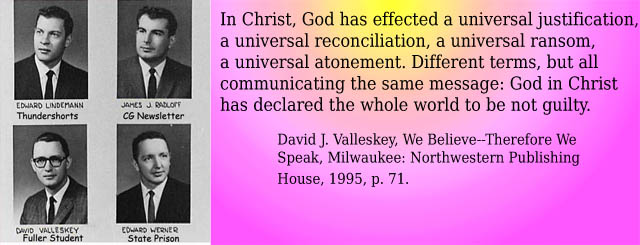


Walther-Pieper
The Synodical Conference mythology has the Great Walther cleansing American Lutheran theology because he actually studied Luther’s works. The official LCMS history site conveniently overlooks Martin Stephan as the real founder of the Synodical Conference and starts with 1847. The Missouri Synod pretends 800 people followed their bishop out of Dresden and Europe so they could remain orthodox, not because he was under house arrest for adultery and financial improprieties.

Walther learned Easter absolution, instead of justification by faith, from Stephan, and never departed from that position. The result of Walther’s loyalty is having a significant percentage of Midwestern Lutherans adhering to the teaching of a university dropout – Stephan. Just as important, and often denied, the Walther circle was exclusively Pietistic, adhering to Stephan after their first cell group leader - Johann Gottlieb Kuehn - died. Stephan was a Bohemian Pietist, called by the Pietist congregation in Dresden, which gave him the legal authority to hold cell group meetings in his congregation.

Walther picked Francis Pieper to follow him and changed the election of seminary professors so that CFW could have his way at the national convention instead of waiting for district conventions to vote on the matter. Pieper and subsequent leaders rehashed the Easter absolution of Halle and Stephan as if it were Luther’s doctrine, faithful to the Scriptures, and in harmony with the Book of Concord.


General Synod and the General Council
The General Synod grew from the Halle Pietism of Muhlenberg and suffered under the unionism of Samuel Smucker’s desire to have an American Lutheranism devoid of the efficacy of the Word and Sacraments.

The General Council broke from the General Synod over these issues and found an anchor in the Book of Concord. Although the Synodical Conference groupies like to toss stink bombs at the Muhlenberg tradition, all Lutheran groups struggled to some degree to deal with the enormous gap between their Pietistic teaching and practices and the Reformation doctrine of Luther and the Concordists.

The Missouri Synod continues to look to Walther as the Great Prophet who explains all doctrine and answers all questions for us. That led them off the cliff while the Muhlenberg descendants looked to the Confessions and resisted naming their youth group the Muhlenberg League, or the Jacobs League, or the Schmauk League.

The General Council rejected the revivalism of the General Synod and led the mother synod back to healthier doctrine and worship – even the liturgy, creeds, and Confessions. That began to water down with the 1918 United Lutheran Church in America merger, which opened the door to mainline Protestantism and Universalism.


Edward Preuss and Herman Amberg Preus
Most UOJ advocates stop at the shrine of Edward (Eduard) Preuss to adore his little book on justification, first published in German. As Pastor Paul Rydecki has pointed out, the essay combines UOJ and a bit of justification by faith, which continues to be the official stance of the LCMS. Some of the most ridiculous statements in Lutheran history can also be found in this essay, and they have been quoted with approval by Robert Preus, Paul McCain, and Jack Casione.

As Ludwig Fuerbringer noted in his early history of the LCMS, Edward Preuss joined the Roman Catholic Church after he saw a particularly bright sunset as a message from God to join the papists – and he did. Edward Preuss became their guy to argue their dogma – and he did. Some might offer him as an Enthusiast who bounced from one false doctrine to another – as he did.

Herman Amberg Preus (1825 - 1894) is a symbolic martyr of Objective Justification. He would not deviate from his Justification of the World writing, so his congregation forced him out on Good Friday, earning him the credentials of a Preus family leader and victim of persecution. Preus and his son came back to the same parish position soon after. His great-grandson was Robert Preus.


Herman’s Great-Grandson Robert Preus, Early Proponent, Later Opponent of OJ
Jack Preus became president of the Missouri Synod and helped his brother Robert become president of the practical seminary, earlier in Springfield, later in Ft. Wayne. Jack attacked Walter A. Maier II for teaching justification by faith, holding up Robert as the expert on Objective Justification. The shaming worked and Robert became president of the seminary. When Ft. Wayne was busy promoting Church Growth under Robert Preus, it was also emphasizing Objective Justification. Kincaid Smith earned his Doctor of Ministry (STM) degree in Church Growth in those years. He said, “The program was all Church Growth.” The Ft. Wayne Trio—Jay Webber, Jack Cascione, and Paul McCain—came from the same era at Ft Wayne: OJ and Church Growth disguised as Lutheran orthodoxy and Confessional doctrine.

McCain and Cascione both argued for Preus being an OJ advocate by publishing his little essay, which glowingly endorsed Edward Preuss’ nonsense on being born already justified – although OJ does say the same thing in other words.

Like Rolf Preus, the Ft. Wayne Trio avoids dealing with Robert Preus’ Justification and Rome, which Rolf and brother Dan edited after their father’s death and published posthumously. The book clearly and decisively rejects justification without faith and articulates justification by faith, not only in Preus’ words but also in the words of those often claimed to be Objective Justification teachers – e.g. Calov.

If someone can comprehend plain English, which is debatable in today’s Lutheran groups, the Preus book shows that the post-Concord theologians knew of Objective Justification and clearly opposed it.

Walther never changed and always wanted to be top dog, but Preus continued to study and he did change. Like the Rambach quotation and Walther’s many statements, the Preus book is a major data-point in the attack on justification by faith.


The Kokomo Statements
Pastor Papenfuss ignited a storm in WELS and Missouri by teaching in the parish what he learned in seminary – and never heard before that.

This is how the controversy developed:
1. Pastor Papenfuss began teaching UOJ, and the two families were alarmed by his claims.
2. Papenfuss gave them J. P. Meyer's Ministers of Christ to study. That made the families even more alarmed. The same book is in print today with the same outrageous statements.
3. The families wrote down the three most offensive statements from J. P. Meyer and asked if that was WELS teaching. They also added the fourth, which was from an old discussion on this, one between the Swedes (justification by faith) and the Norwegians (UOJ). Papenfuss agreed to the fourth statement being added.
4. Eventually the families received separate letters, each one listing the four statements and telling them that they were being kicked out of the congregation for NOT believing those statements. Not believing in Unbelief Justification is an excommunication offense in WELS. The irony is endless.
WELS continues to deceive its members about their false doctrine. At one point WELS told people that the Kokomo Statements were a parody of the synod’s stance, written by the two families, when in fact WELS used them to kick out both families. WELS has called Objective and Subjective Justification “two sides of the same coin,” an explanation not found in the Scriptures and certainly lacking in the Book of Concord and the post-Concordist theologians.

Note this official walking back of the Kokomo Statements, now erased from the WELS.net website:

The so-called Kokomo Statements should not be taken as representative of WELS teaching. Much that has been put out and circulated about the Kokomo Statements has been a misrepresentation of the WELS position. The Kokomo Statements were not drawn up by anyone in WELS as a presentation of our position. They were drawn up by opponents of the WELS position. Three of the statements are taken from WELS sources, but taken out of context, they caricature the WELS position and should not be taken as as (sic) an adequate presentation of WELS teaching. Anyone circulating the Kokomo Statements as a representation of the WELS position is not giving a fair and balanced presentation of WELS teaching.

JP Meyer’s book has been treated as an embarrassment to WELS, but recently the book was re-issued and “edited” by the same seminary professor who agreed with kicking out the two families – Armin Panning. The same professor who never caught on to the Word consecrating the elements of Holy Communion – Sig Becker – aggressively endorsed the Kokomo Statements.

Since then, District President Jon Buchholz has pretended to question JP Meyer while endorsing the same dogma. Jay Webber has written his little essay doing the same, forgetting his earlier loathing of the Kokomo Statements.

Kokomo Flotsam and Jetsam –
Look at the 1978 graduates with Papenfuss - Mark Jeske (Change or Die!), Stroh, Starr, Schumann the Born-Again Atheist, Curia the UOJ Scribe, Jim Witte (DMin in Church Growth, Church and Change founder), Marcus Manthey - Defender of Unfaith. And the faculty - no less than four UOJ fanatics: Gerlach (Fuller alumnus), Becker, Panning, and Kuske. 

The Four Kokomo Statements
I. "Objectively speaking, without any reference to an individual sinner's attitude toward Christ's sacrifice, purely on the basis of God's verdict, every sinner, whether he knows it or not, whether he believes it or not, has received the status of saint."

II. "After Christ's intervention and through Christ's intervention God regards all sinners as guilt-free saints."

III. "When God reconciled the world to Himself through Christ, He individually pronounced forgiveness to each individual sinner whether that sinner ever comes to faith or not."

IV. "At the time of the resurrection of Christ, God looked down in hell and declared Judas, the people destroyed in the flood, and all the ungodly, innocent, not guilty, and forgiven of all sin and gave unto them the status of saints."[34]
Footnote 34: "Every one of the statements can be understood correctly, even though one must swallow a little hard to accede to the fourth [Kokomo Statement]." Sigbert Becker, "Objective Justification," Chicago Pastoral Conference, WELS, Elgin, Illinois, November 9, 1982, unpaginated.


Wednesday, June 24, 2015

Our Doctor Wanted Gardening Advice

Terminex called on me the other day, door to door.
I said, "I use birds and beneficial insects."

Team Ichabod went to the doctor's for a routine visit. Our physician loves Lenski and wants to complete his theology PhD one day.

We are both doing well. He suggested a new diabetic treatment for Chris. He was impressed that I was steadily losing weight on his eat-less-bread diet. I switched away from bread and replaced that with meat and fruits.

Part of my exercise routine is gardening, which is so much fun. The doctor asked about how to deal with his June bugs, since he noticed my copy of Attracting Beneficial Bugs to Your Garden, But he lives in the woods, and his squirrels dominate the bird feeders. I laughed later, recalling how our squirrels used the levers on the squirrel-proof barrier to shake food out for themselves.

I suggested a bunch of bird baths to attract birds to his yard, then described starlings and grackles for him, since both birds love to hunt bugs and grubs. Starlings and grackles gather around water and bathe with great gusto. I simply use clay dishes and a shallow kiddie pool - and they are filthy and almost dry each day.

The doctor tells his patients to adopt healthy habits and "go to church regularly." He said that he could see the difference in health among believers, because there is a direct relationship between faith and habits, - even how the body responds to spiritual nourishment.

Bend down closely to your plants on a sunny day.
That wee little bee is really a flower fly - or hover fly
for the way it hovers.


In Other News
I am adding flowers and beneficial bugs to my gardening lore. Each time I identify a new bug, the rest of them are less mysterious. At first a gardener is going to say, "I saw an insect and have no idea what it is." The same is true of wildflowers and weeds. They all look alike until we know more and more of them.

Just as there are good bugs galore, so are there good weeds to help the beneficial bugs.

Example - the flower flies as adults need pollen and nectar. They lay eggs which hatch into ferocious babies that exist to eat pests. The plant has to give off distress signals from damage to coax the flower flies into laying eggs there. This beneficial insect is reputed to be more effective than better known good insects - like the ladybug, lacewing, and preying mantis.

Also - the beneficial insects may need food in between feasts on pests, so the wise gardener has many different places where these miracle workers can rest and feed.

Some surprises - good plants for beneficial insects - even if they are weeds or hard to control

  • Ragweed
  • Pigweed
  • Goosefoot
  • Dandelion.
  • Cow Vetch
  • Queen Ann's Lace
  • Buckwheat
  • Feverfew.

All four get the praise of  Walliser's Attracting Beneficial Bugs to Your Garden,

Ordinary flowers - good for the good guy insects we need

  • Sunflowers, the aircraft carriers for insect life.
  • Coreopsis, also called tickseed
  • Shasta daisies
  • Dill
  • Anything with tiny flowers for tiny insects.
These are also featured in Attracting Beneficial Bugs to Your Garden


Expanded Version of the Real History of Objective Justificaiton


Justification by Faith Book – The Real History of Objective Justification

Expanded Rough Draft

Webber made a staggering and unbelievable claim when he described his propaganda essay as a work of historical theology. The boggy, verbose, and undisciplined effort avoided key points of history and revealed a lack of knowledge – or candor – about most of it.

The Dogma Is Older Than the Term
First we have to distinguish between the term Objective Justification and the concept. The concept arrived among Lutherans long before the term was used. Since Walther is the gold standard of doctrine for Webber and other synodical drones, it should be added that OJ is a term later adopted by Walther, blessed, by Walther, and used by his minions.

Hoenecke used General Justification, which may sound neutral, but the German word really means :”every single one” so the German term has the same force as universal. To make this redundantly clear, WELS has generally used Universal Objective Justification lately, because the sect has made a fetish of their favorite doctrine. Using Universal and Objective together is repetitive in meaning, similar to saying “a very unique” destination when unique literally means one of a kind.

But WELS has not been blessed with literate writers for a long time, so they have their UOJ and others their OJ. Sig Becker, a Missouri convert to WELS, tried to make distinctions about some of these terms, but his explanations were distinctions without a difference.

Huber the First Professor of OJ in Lutheranism
Some think Objective Justification is very much like Calvinism. Our researcher is working on a separate essay about this. Dr. Lito Cruz believes this to be true, and I would add that Calvin’s scheme is harmonious with OJ.

Calvin separated the Holy Spirit’s work from the Word and Sacraments, using the term sovereign. Because the Spirit is sovereign, He may make a sermon effective or he may not even appear. Calvin did not write this once but many times, as described by a Harvard doctoral researcher and published in his excellent book on this topic. This separation of Word and Spirit is called Enthusiasm by Luther and the Book of Concord in the overlooked Smalcald Articles, where Enthusiasm is condemned.

Notice how Calvinism is remarkably close to Walther’s “election without faith.” For Calvin, God has predestined a small percentage of all church members to eternal salvation and the rest of the world to eternal damnation. That is Calvin’s double predestination. The tiny yield is because of God’s grace, and truly shows God’s grace, they claim. Mark Twain observed that a Calvinistic sermon reduced the number of saved to such a small number that it was not really worth the trouble. The Waltherians like to emphasize Grace! - disparaging the Means of Grace by thought, word, and deed. So their grace is a faux-grace, since they tear down or ignore the Instruments of Grace, the Word and Sacraments. Thus Missouri and its siblings passed easily into Pentecostalism and Church Growthism. Worship has been left behind in favor of entertainment.

The rationalism of Calvin certainly infected his followers, who often live up to the slogan “Young Calvinist, Old Unitarian.” This slogan fits entire countries, as evidenced in the Calvinistic history of New England, and other parts of America. The greater the Calvinistic influence, the more quickly rationalism takes over.

Missouri has often been infatuated with old time Calvinists, because many Calvinists were early to use English in America (unlike Missouri) and the traditional Calvinists seemed to be allies against Modernism.

WELS, Missouri, the Little Sect on the Prairie, and the Coveting Legalistic Cult have all cast longing eyes over the fence at other Protestant groups, the loopier the better. Fuller is their Mecca, and Willow Creek is their local haven. The first one to open the gate was Samuel Huber, and they have yet to admit this fact, quoting their Pietist leader Walther to confirm the truth of their denial.


Samuel Huber, Wittenberg OJ Errorist Defeated by Concordists
Huber was a Calvinist who became a Lutheran, long enough to be on the Wittenberg faculty. He began attacking justification by faith from within, like his descendants in the Synodical Conference. The Objective Justification salesmen of today would like to disassociate themselves from Huber, but they teach essentially the same dogma. Walther also could not accept this, because all the arguments against Huber also address Walther’s errors. The answer, say the OJ Fan Club, is to agree with Walther that Huber was not truly in the OJ camp, just a demi-semi-OJist.

Pastor Paul Rydecki summed up the issue this way on Intrepid Lutherans:

http://www.intrepidlutherans.com/2013/10/exploring-hubers-doctrine-further.html

Even so, the Wuerttemberg theologians, as you say, did not like Huber’s terminology, while the Wittenberg theologians unequivocally rejected his terminology. Why, then, did Walther and H.A. Preus go on to adopt that very terminology? And why does it bother the supporters of universal justification so much to be linked to Huber, if, according to Walther, his doctrine was substantively orthodox and nothing for orthodox Lutherans to get bent out of shape about? If Walther’s followers think that Huber was basically orthodox with regard to justification and that the Wittenberg theologians taught justification wrongly (since they rejected Huber’s teaching of it), then it would seem to be the honest thing to just come out and say so.

This post-Concord conflict is summed up well by Pastor Paul Rydecki:
http://www.faithalonejustifies.com/a-hunnius-on-the-truly-confessional-lutheran-teaching-of-romans-518/
Hunnius takes apart Huber’s (and the official WELS) doctrine piece by piece, concluding with this observation about Huber’s supposed “confessional subscription” to the Lutheran Book of Concord:
And what will Dr. Huber reply to the Book of Concord, which, in citing these very words from Romans, explicitly confirms that those things mean nothing other than that we are justified by faith? This is what the Book of Concord says in the Latin edition, page 666: “Therefore, these statements are equivalent and clearly mean the same thing, when Paul says that we are justified by faith; or that faith is imputed to us for righteousness; and when he teaches that we are justified by the obedience of one Mediator, who is Christ; or that through the righteousness of one man, justification of life comes upon all men. For faith does not justify on account of this, that it is such a good work, or that it is such a splendid virtue, but because it apprehends and embraces the merit of Christ in the promise of the Gospel.” Thus far the Book of Concord.  If the Pauline phrase (that “through the righteousness of one Man, justification of life comes upon all men”) clearly means the same thing as that other statement, “We are justified by faith” (as the Book of Concord clearly and emphatically asserts), then the interpretation is rejected by the sentence of the Book of Concord that imagines from these words of Paul a justification apart from faith—one that extends also to those who have never had faith and never will. Dr. Luther says it even better in [his lectures on] the second chapter to the Galatians: “Where Christ and faith are not present, there is no remission of sins, no refuge, nothing but pure imputation of sins and condemnation.”

Rydecki continued –

According to Hunnius, one cannot honestly claim to be a “confessional” Lutheran while at the same time teaching a justification apart from faith based on Romans 5:18.  His quotation from Luther is also highly relevant.  How long will the WELS continue to claim to be a “confessional Lutheran” church body? How long will the truly confessional Lutheran pastors in the WELS remain in voluntary fellowship with the synod that officially condemns the Gospel of justification by faith alone in Christ as heresy?

A unionist tries to pooh-pooh similarities. In the end, false teachers demand and appreciate a translation of the Bible that repeats their error and appears to canonize it – the New NIV.
However, the core of Objective Justification, however it might be explained, is declaring the entire world forgiven of its sin. That is where Huber started, and that is what Polycarp Leyser and Hunnius opposed.

Leyser was respected enough to be one of the editors of the Book of Concord and an expert in discussions about justification.


Pietism
Pietism really has two major eras in Europe, starting with Spener and his immediate followers, peaking with the establishment of Halle University with the mission of promoting Pietism. Soon after, Halle became the center of rationalism in Europe, and F. Schleiermacher, an alumnus and teacher, earned his place as the pivotal modern theologian – advocating faith without belief.

The second era of Pietism was a reaction to the rationalism that took over clergy training and the institutional church in Europe. Those who dissented were called mystics and Pietists, and many found it difficult to find acceptance or positions in the establishment.
This is very important – all the American Lutheran groups were established with this background of Pietism. The American Luther leaders were either trained at Halle (Hoenecke), trained by Halle students (Walther by Stephan), or associated themselves closely with Halle, - Muhlenberg taught there.

All the American Lutherans groups were greatly influenced by the spirit of union with Calvinism, hiding doctrinal differences among Protestants, and looking for gimmicks like the revival. This rationalistic Pietism was keen on denominational cooperation and allergic to any high church tendencies (as they imagined them) – the liturgy, frequent Holy Communion, and the Book of Concord.

Thus the ingredients of the Wisconsin Synod, the Missouri Synod, and the Evangelical Lutheran Synod were Pietistic. So were the founders of The American Lutheran Church and the Lutheran Church in America.


Hoenecke and Halle University
The passage in Hoenecke’s Dogmatics dealing with General Justification offers no refuge for UOJ, but the author does quote the son-in-law of Johann Bengal (1687-1752), who worked closely with and edited his father-in-law’s work. Bengal was a Wuerttemberg Pietist. Hoenecke studied the Confessions on his own after graduating from Halle University. One of the last of the Pietists, Tholuck was his mentor. Tholuck was a Universalist and admitted it gladly. Hoenecke was not.

Rambach and Halle University
Rambach is especially important because:
·         Webber quoted him favorably on Objective Justification.
·         The first baptism hymn in The Lutheran Hymnal is Rambach’s.
·         Rambach was a loyal Halle Pietist.
·         Rambach gives us a definite data-point on UOJ being taught at the central school for all Lutherans in North America.
Rambach taught – “In His Person all mankind was justified and absolved from sin and curse.
Rambach advocated teaching 1 Timothy 3:16 as all mankind being justified when Christ rose from the dead. Although Bishop Martin Stephan did not graduate from Halle University, we know that his version of justification was life-changing for CFW Walther. We also know that Walther taught the same form of justification all his career. Therefore, the Easter absolution of the entire world, without the Word and without faith, is definitely an effect of Halle’s lasting influence.

Walther-Pieper

Kokomo

Robert Preus CG UOJ, later anti-CG and anti-UOJ

ELCA


Slugs, Bugs, and the Triumphant Roses

The preying mantis may be over-rated,
but he is intimidating, even in a glass jar.

Slugs were crawling into the remnants of beer in three pans, last night, so I added some Bud to each one. Later on, more slugs were crawling in, but the count was much lower.

The backyard beer drinker did not appear to eat the slug chili, when I looked this morning, so I will leave the brew for one more day. I hope the Passion Flower vines will now gain strength, leaf out, and grow up. The slug-chewed Butterfly Bush has now strengthened and started to grow new, more mature leaves. Slugs like the tenderest leaves and rasp the soft parts away, leaving a framework of the leaf.

When we first tried to put solar lights on the dead tree, one slip of the foot broke the string and it stopped working. Our helper, who snagged the wire by mistake, took it home and repaired it, so the lights were put to use again. But when the dead tree fell, all the solar lights remained intact and working. so the dead tree blinks into the night.


Parsley, Sage, Rosemary, and Thyme
I found parsley at Walmart so I brought home a pot, along with more Bee Balm and Fernleaf Dill. Mrs. Ichabod said, "Is the dill dead?" I said, "I bought it for the seed." The seeds had already formed, and dill is famous for seeding itself. I love dill with tomatoes, and dill is favored by beneficial insects.

Many species have a favorite plant. Butterflies seem especially picky. The Black Swallowtail loves parsley, reason enough to buy some. Monarch caterpillars need milkweed and Butterly Weed.

Triumphant Roses
Nothing looks more miserable than an insect riddled rose bloom. I had at least three insects chewing on them - earwigs, aphids, and some chewing beetle. The John Paul II and the Peace roses were hit hardest.

Except for increasing the beneficial insect plants, I have done nothing against the rose pests. Now the roses are free from insect damage, without spraying or picking pests off.  That must work, because a delicate white spider was posing on the roses as I handed them to Mrs. Wright. I flicked it away and she laughed.

Not a wee little bee, but a hover fly, a friend to rosarians -
aka a flower fly.

Tuesday, June 23, 2015

Justified-without-Faith:
Circling the Wagons

Buchholz, Webber, and the entire circus of UOJ clowns
cannot set aside the Confessions, which concisely explain the Gospel,
nor can they claim the Fathers as their Rambach, Huber, and JP Meyer.

The Emmaus Conference serves as a good example of frightened church executives circling the wagons. Their precious UOJ is being picked away, individual by individual, because they cannot force their falsehoods on people who can read, Tweet, blog, and Facebook.

The LCMS, ELS, and WELS forced UOJ upon their lazy and indolent seminary students, but the laity are not being paid and promoted to endorse falsehood, crypto-Universalism - and fellowship with ELCA, Planned Parenthood, Sodom and Gomorrah.

They try to look casual, these UOJ Stormtroopers,
but they are scared out of their minds.

I am glad Webber pushed himself forward to give the lectures. He reminds me of Floyd Luther Stolzenburg, another LCMS trainee, always forcing himself on everyone and calling himself invited to teach what he was slavering to get across.

Webber's treatment of the history of Objective Justification (justification-without-faith) is a confused mixture of evasions, lies, distortions, and ignorance. I should have the more complete version of the real history posted tonight.

As someone said about Jewish mysticism, "It is garbage. But the history of garbage is scholarship."

Objective Justification has a history - not as old as they pretend - but a definite history with battles, villains, and heroes along the way. Webber writes the way I would if I had to deal with the history of knitting or needlework. The difference is - I would decline the chance to share my lack of knowledge.

The truth defends itself, as we will see. The Stormtroopers call up all manner of support for their perverted dogma - which is perfectly harmonious with ELCA's.

All their invented support is quite the opposite. Their cited experts are against UOJ, including Augustine, Luther, St. Paul, Ambrose, Calov, Gerhard, and Robert Preus.

The funny part is this - when Webber finds someone saying exactly what he wants - the man is a Pietist (like Rambach) only the man is dubbed "an orthodox Lutheran theologian." See how easy it is?

That is like saying, "Carl Sagan, an orthodox Christian, says there is no God."


UOJists Patronize Me as They Peddle Their Wares

Master the jargon, master the synod.
Or learn the truth, have faith, forgiveness, and the blessings of the Gospel.


I was writing to a friendly blogger about personal attacks, how they make me laugh out loud. It took Mrs. Ichabod some time to get used to those tactics. Now she realizes the apostates are proving that they have no arguments to make.

One pastor had no problems with a minister verbally abusing his staff, making lewd suggestions, and displaying x-rated porn to them, but he was deeply offended by my publishing an already-published photo. As most people realize, something broadcast to the world on the Internet is not the same as a private confidence.

What I find most disturbing are those messages where a long-time friend begins a UOJ rant, assuming that justification by faith is NOT the Gospel and justification-without-faith is the real Gospel. Of course, moments like that reveal how deep the deception is. That argument comes from a very kindly, considerate, long-term friend.

Years ago, he took the trouble to let me know Robert Preus was in town. We arranged to meet Preus and say hello for a few minutes. I heard about the latest outrage wrought by the McCain-Barry administration. McCain had bragged to me about kneecapping Preus. I was not surprised. We saw Preus one more time at the Bethany lectures.

So this Lutheran pastor began grilling me about how I could possibly offer comfort to the dying with justification by faith, although he avoided those terms. I originally set him off by saying UOJ was the grand deception in the LCMS-ELS-WELS.

He looked up to the late Robert Preus, so I offered a key quotation that eviscerated UOJ - from Justification and Rome. Answer - "He must have changed his position." I have heard this before, "I stand by this man's authority." But when the other pastor studied and saw the error of UOJ, the steadfastness in his scholarship diminished - so it was just a lame excuse to stick with old errors.

The problem is not only the Walther-Pieper-JP Meyer club that taught justification without faith, opposing (but ignoring) dissent from within their own ranks, but those who stopped learning in seminary or learned to adjust their sails to the winds of Enthusiasm.

So I often feel I am writing for the blind and speaking to the deaf, but the truth will defend itself and separate the wormy, corrupted dogma from sound Biblical teaching. I appreciate the encouragement that comes in from various places.


Weeds, Bunnies, and Another Beer Party for the Slugs


This is our week of sunshine while the north suffers from severe storms. Our helper brought his son over to pull baby tree weeds. Sometimes the ice cream truck comes by just as they are finishing a job. If the truck does not appear, I yell, "Where the ice cream when we need it?"

Just before the weeding, I was watering the Father's Day roses that we got for $5 each. New roses need almost daily watering for several weeks, I heard the oddest squealing. Two little bunnies came out of the mulch because I was getting them wet. Sassy was amused, so she followed one around until it hopped under the car. Once she found a pet duck at someone's house. Her canine instinct is to check out the scent from the back, so I saw Sassy use the same method on the bunny as she did on the duck, which meant the animals felt pushed along by that curious nose. Chickens got the same treatment at another house, but Sassy has never harmed any creature.

Roses
The roses are doing well. Mrs. Wright got the roses from the altar. She watches the service each Sunday. Mrs. Gardener got another vase. The chiro got a third vase. Nevertheless, we have about 100 red KnockOut blooms and many hybrid teas blooming.

I still feel the twinge of the amateur when I cut roses - this is still such a small plant. But rose bushes thrive from pruning and grow even more. If blooms are spent and start going to seed, hormones tell the plant to shift away from blooming. Pruning also stimulates the roots and exposes dead wood to cut away.

I have some blackspot, but that is the price of having roses with Persian DNA. They are prone to blackspot. I prune more heavily to remove the darkened leaves and canes, but that is not a big worry.

Roses need nourishment from a good root system. Once they are established, they really produce wiht a combination of rain, sunshine, mulch, and earthworms.

At first I had heavy aphid damage and some chewing insect on the lightest roses - John Paul II and Peace. They looked pathetic, shriveled, eaten. I did nothing except encourage beneficial insects every way I could. Now most of the roses are damage free, and the heavily attacked ones are blooming with perfection.

Yesterday I bent over one rose and found a teeny tiny flower fly (hover fly) hovering around the blooms. It looked like a wee little bee, but it was fixin' to lay some eggs and have its babies destroy more aphids.

Note how clever plants are. When they are damaged, they send up chemical signals that attract beneficial insects to feed on the pests causing the damage. If there is no damage, the beneficials lay no eggs.

This incredibly complex system reminds me of the hawk-rabbit relationship. We were taught - wrongly - that hawks and other predators control the rabbit population. But the opposite is true. When rabbits flourish, so do the predators at the top of the food chain. When the rabbit population crashes, as it does from time to time, the predators go away - lacking a foodstamp program.

Long before I knew the details, I counted on beneficials to control the pests. Therefore I have almost never sprayed. Now that we know more, how foolish it looks to kill aphids which are busy attracting free pest controls - flower flies, ichneumon wasps, spiders, and ladybeetles.

Thank you hover flies, flower flies,
all beneficials.
Pope John Paul II rose blesses you
and gives you a plenary indulgence.


Beer Party, II
I hosted another beer party for slugs in the back yard - three bowls, one bottle of Bud.

By the way, the formula for Bud Lite is Bud plus water. That's it. The top chemist told me and later denied it. I said, "But you told me yourself." He conceded that he did.

One reader offered last night, hearing about the party, that slugs and beer would both be gone by morning. I checked on it late at night. Very large slugs were crawling in. I counted 10.

The last time I saw about 30 gather and die. Then the pan lost most of the dead slugs and beer, next all the rest of the slugs and beer.

This time the beer and slug reduction happened in one night. This morning, a trace of beer and a couple of dead slugs were left. Skunks? Raccoons? I am not sure.

The first backyard slug party drew them in from all directions. The mulch was covered with slow-moving slugs moving toward the beer. It looked like registration day for Lutherans at Fuller Seminary.

Slugs can go anywhere because they have no spine. Think about that - so fitting for synodical plutocrats too.


Blogger Recommends Ichabod, The Glory Has Departed.


Jesus and the Moneychangers – or – How much do you love the truth?

 
 Weeds in the church
Have you ever wondered why the only time in the whole Bible Jesus is shown to be angry was when he threw the moneychangers from the temple? And what does this have to do with us – and the church – right now?
And Jesus went into the temple of God, and cast out all them that sold and bought in the temple, and overthrew the tables of the moneychangers, and the seats of them that sold doves, 13 And said unto them, It is written, My house shall be called the house of prayer; but ye have made it a den of thieves. -Matthew 21.12-13

Sheep ready to be shorn

In the Jerusalem of Jesus’ time, just imagine how many turtle-doves and livestock were sacrificed each day. How much more convenient to buy what you need when you get to the temple? What in the world could have gotten Jesus so upset?
Religious people are credulous 1. They’re easily convinced and tend to go along with what they’re told without checking anything out. This is especially true in the area of religious truth. They don’t suspect – nor do they want to believe – that there are people who love to take advantage of them. Ah, but wolves are found in the church. And they’re nice to look at.
And the lord commended the unjust steward, because he had done wisely: for the children of this world are in their generation wiser than the children of light…13 No servant can serve two masters: for either he will hate the one, and love the other; or else he will hold to the one, and despise the other. Ye cannot serve God and mammon. 14 And the Pharisees also, who were covetous, heard all these things: and they derided him. 15 And he said unto them, Ye are they which justify yourselves before men; but God knoweth your hearts: for that which is highly esteemed among men is abomination in the sight of God. -Luke 16.8,14-15

How much do you love the truth?

I’m going to assume that you’re not like what is truth Pilate 2, but understand that truth exists and can be known. There’s something they don’t tell you about truth. It’s holy. Holiness means set apart. And that’s what truth does to a person. The world at large hates truth. The more truth you wholeheartedly seek – and find – the more separated you become.
No normal person wants to be separate from other people. Human beings are social creatures. God made us this way. One of the first things He said is, It is not good that the man should be alone. 3 But this social tendency has been corrupted by the fall. So step-by-step communities become cliques and cliques become mobs and the first thing to fall is truth. Anyone who tries to tell the truth is punished. If this doesn’t work, the truth-teller is shunned, maligned or worse.

The littlest ones

Ask yourself this: If you had a child who was abused by your pastor or priest, would you:
  • Tell your child it was their own fault (This is the approach of Bill Gothard, the religious authority of the Duggars)
  • Say nothing, but keep your child from being alone with the man
  • Get the man removed before he can do damage to others
How many Protestants – Anglicans, Methodists, Lutherans, Presbyterians – right now know about pedophilia or sex abuse done by pastors or church authorities – and are keeping that information to themselves?
And whosoever shall offend one of [these] little ones that believe in me, it is better for him that a millstone were hanged about his neck, and he were cast into the sea. -Jesus, Mark 9.42
If you are keeping information back that could result in a little boy or girl – or anyone – to be abused, then Jesus is talking about you. It doesn’t matter if you think you are forgiven. I’ll ask you again, how much do you love the truth?

Jesus and the Moneychangers in the 21st Century temple

What would you call a man who tries to tell people about pastors and denominational leaders who betray their members for power or the almighty buck? Would you call this man who’s trying to warn the sheep, “devil-possessed”? Here’s how Jesus might well weigh in on such a scurrilous accusation:
And if Satan cast out Satan, he is divided against himself; how shall then his kingdom stand? -Matthew 12.26

One of the modern day truthtellers

Christians who seek to call out wrongdoing in the Church sometimes call themselves watchmen on the wall. Other times they use the term discernment ministries. One who has patiently sought to uncover harmful and destructive practices in the modern American church is Lutheran Pastor Gregory Jackson. His website is Ichabod the Glory has departed.
Even if you’re not Lutheran, but reformed, evangelical or Catholic, you’ll find much of value at his blog. Bookmark it, read it, and act upon the information. If you find errors, let him know. He’s an honest man, and a Christian. From what I’ve seen, his detractors bring little tangible proof against what he says. Rather they focus on ugly, un-Christian, ad hominem attacks 4.

Here are a few of Pastor Jackson’s posts:

His website also offers a number of significant Lutheran eBooks in PDF format for free download. You can access these on the left side column under the title: Martin Chemnitz Press PDFs – Free to Download and Share.
Please respect and support the truth, wherever it may be found. Lord, please help us to love You, your Truth, and your truthtellers. Amen.
Image credit.

  1. Credulous: Apt to believe on slight evidence; easily imposed upon; unsuspecting. -Websters, 1913. ↩
  2. See John 18.38. ↩
  3. See Genesis 2.18. ↩
  4. The phrase now chiefly describes an argument based on the failings of an adversary rather than on the merits of the case. -American Heritage Dictionary ↩
© 2015, Alec Satin. All rights reserved. Excerpts and links may be used if full and clear credit is given with specific direction to the original content.