ICHABOD, THE GLORY HAS DEPARTED - explores the Age of Apostasy, predicted in 2 Thessalonians 2:3, to attack Objective Faithless Justification, Church Growth Clowns, and their ringmasters. The antidote is trusting the efficacious Word in the Means of Grace. John 16:8. Isaiah 55:8ff. Romans 10. Most readers are WELS, LCMS, ELS, or ELCA. This blog also covers the Roman Catholic Church, Eastern Orthodoxy, and the National Council of Churches.
Martin Luther Sermons
Bethany Lutheran Hymnal Blog
Bethany Lutheran Church Sleepy Eye Assisted Living.
1100 1st Ave S. Apt 243. Sleepy Eye MN 56085-1863 Pastor Gregory Jackson, PhD USA, Canada, Australia, Philippines 10 AM Central - Sunday Service
We use The Lutheran Hymnal and the King James Version
Luther's Sermons: Lenker Edition
Click here for the latest YouTube Videos
Wednesday, November 17, 2010
Pietism and Worship
LutherRocks has left a new comment on your post "Pietism, More Than A Renewal Movement?":
Thanks for posting this. I had a rehearsal with the organist for this coming Sunday worship...Christ the King Sunday. We had a discussion about where Lutheranism seems to be going. She couldn't put her finger on anything, but is aware of a shift in worship practice. She is a member of the worship committee but has stopped going. She is sick of all the 'feelings' music and questionable lyrics. This article is a good primer. I'm going to send her the link.
JK
***
GJ - I am trying to provide a wealth of material, to explain why things are happening this way. I often communicate with people each day about this, by Facebook, email, phone, and blog comments.
Pietism is anti-Confessional. That is why the feelings bunch will express contempt for the Book of Concord, even though it is the best one-volume Biblical commentary we have.
Pietists howl about the souls they want to save, but they argue that unbelievers need false doctrine (plagiarized) to reach their flinty hearts. They are not that obvious, of course. They kelm Ski's favorite motto from Groeschel - anything short of sin to reach them. But false doctrine is the gravest sin of all, far worse than sins against the Second Table.
Labels:
ELCA; ELS; LCMS; WELS
Churchmouse on Mariology
http://churchmousec.wordpress.com/2010/11/17/a-summary-of-mariology-and-the-church/
What follows is not intended to be an exhaustive analysis of Catholic and Reformation views of Mary, the mother of our Lord Jesus Christ. However, it attempts to illustrate a timeline and cautiousness of beliefs, particularly in the papacy, about her role. (Pictured at left is Our Lady of the Way, the Madonna della Strada. She is the patron saint of the Jesuits.)
A summary of Mariology and the Church
November 17, 2010 in Anglican, Calvinism, Catholic, Lutheran, Protestant | Tags:Catholic, Protestant, Anglican, church, Lutheran, Calvinism, John Calvin, Christianity, Pius X, Mary, Martin Luther
What follows is not intended to be an exhaustive analysis of Catholic and Reformation views of Mary, the mother of our Lord Jesus Christ. However, it attempts to illustrate a timeline and cautiousness of beliefs, particularly in the papacy, about her role. (Pictured at left is Our Lady of the Way, the Madonna della Strada. She is the patron saint of the Jesuits.)The Catholic Church
It should be noted that various popes viewed the role of Mary differently:
Popular views like the Assumption and the Immaculate Conceptiondeveloped into Papal teaching over time. In 1674 Pope Clement X (1670–1676) indexed books on Marian piety.[2] After the Council of Trent, Marian fraternities were founded, fostering Marian piety [3], some of which were outlawed by Popes. Not all Popes viewed Marian belief identically. Louis de Montfort was condemned in a Papal bull by Pope Clement X only to be praised by Pope Clement XI, canonized by Pope Pius XII and adored byPope John Paul II.
431: The Council of Ephesus approves devotion to Mary as the ‘mother of God’.
1265-1268: Pope Clement IV composes poem about the seven joys of Mary.
1603: Pope Clement VIII’s papal bull Domenici Gregis condemns negations of Mary. His papacy supports the creation of Marian congregations and praying the Rosary.
1673: Pope Clement X issues a papal bull condemning the type of Marian piety which Louis de Montfort would later embrace and outlaws certain Marian devotions. However, other bulls encouraged the recitation of the Rosary.
1712: Pope Clement XI instructs the Holy Office not to persecute anyone using the words ‘Immaculate Conception’ when referring to Mary. He lays the groundwork for — although does not institute — the dogma of the Immaculate Conception. He establishes the Feast of the Immaculate Conception for the whole Catholic Church. He advocates the Marian teachings and devotions of Louis de Montfort (1673-1716).
1748: Pope Benedict XIV expands indulgences connected with praying the Rosary and furthered the congregations dedicated to the Sodality of Our Lady.
1769-1775: Pope Clement XIV decreed that only the Franciscans in Palermo could celebrate the feast of the Immaculate Conception. This came after much popular unrest in the south of Italy surrounding the feast. He later granted permission to other orders for private Masses only on this feast. Interestingly, it is said that he pledged to dogmatise the Immaculate Conception, however, this did not happen.
1848: Pope Pius IX, bowing to popular clamour, appoints a theological commission to study a possible dogma around the Immaculate Conception. He issues an encyclical, Ubi Primum, in which he asks for his bishops’ views on the Immaculate Conception.
1852: Pius IX appoints a commission of theologians to draft the dogma of the Immaculate Conception. Later that year, he asks a group of selected cardinals to finalise the text.
1854: Pius IX declares the dogma of the Immaculate Conception. He opposes petitions that this dogma be included in the creeds.
1869-1870: Pius IX opposes moves for a dogma of the Assumption (Mary’s physical ascent into Heaven upon her death). Yet, he believed that Mary was a Mediatrix of salvation, as stated in Ubi Primum.
1878-1903: Pope Leo XIII issues a record 11 encyclicals concerning the Rosary. He institutes the Feast of the Queen of the Holy Rosary. He beatifies Louis de Montfort, referring to his Marian teachings, saying that a revival of the Catholic faith (weakening because of Modernism) would not be possible without Mary’s help. He writes that Mary is Mediatrix and co-Redemptrix and is the first pope to fully embrace her role as Mediatrix. He says that she administers all graces on Earth. He relies on the writings of Thomas Aquinas in his justification of Mary as co-Redemptrix and mother of Christians everywhere. Where the Church verified Marian apparitions, Leo XIII supported veneration at those sites.
1903-1914: Pius X affirms that Mary is the spiritual mother of all Christians.
1914-1922: Pope Benedict XV has a strong devotion to Mary and placed the world under her protection during the Great War (WWI). Among other things,he promoted Louis de Montfort’s Marian devotions during the month of May.
1922-1939: Pope Pius XI engages in discussions about a dogma of the Assumption. He often quotes Bernard de Clairvaux, who said that we have everything spiritual we need in Mary.
1944: Pope Pius XII declares the universal feast of the Immaculate Heart of Mary.
1947: Pius XII canonises Louis de Montfort.
1950: Pius XII announces the dogma of the Assumption. He leaves the Mediatrix question open.
1962-1965: The Second Vatican Council declares Mary the Mother of the Church.
1965: Pope Paul VI writes in his encyclical Mense Maio that Mary is the pathway to Christ. Anyone who follows her will encounter Him.
1974: Paul VI promotes Marian devotions and declares that she is the mother of graces and has a special role to play in redemption.
1987: Pope John Paul II affirms Mary as the Mother of the Church in his encyclical Redemptoris Mater.
1997: John Paul II, addressing a public audience, re-emphasises Mary’s role.
Redemptoris Mater reads in part:
- The Church teaches that Mary appeared on the horizon of salvation history before Christ. [57]
- If the greeting and the name “full of grace” say all this, in the context of the angel’s announcement they refer first of all to the election of Mary as Mother of the Son of God. But at the same time the “fullness of grace” indicates all the supernatural munificence from which Mary benefits by being chosen and destined to be the Mother of Christ. If this election is fundamental for the accomplishment of God’s salvific designs for humanity, and if the eternal choice in Christ and the vocation to the dignity of adopted children is the destiny of everyone, then the election of Mary is wholly exceptional and unique. Hence also the singularity and uniqueness of her place in the mystery of Christ. [58]
2002: John Paul II publishes his apostolic letter, Rosarium Virginis Mariae, which cites St Louis de Montfort’s God Alone:
- Our entire perfection consists in being conformed, united and consecrated to Jesus Christ. Hence the most perfect of all devotions is undoubtedly that which conforms, unites and consecrates us most perfectly to Jesus Christ.
- Now, since Mary is of all creatures the one most conformed to Jesus Christ, it follows that among all devotions that which most consecrates and conforms a soul to our Lord is devotion to Mary, his Holy Mother, and that the more a soul is consecrated to her the more will it be consecrated to Jesus Christ.[59]
I have highlighted dates concerning St Louis de Montfort to show how certain perspectives can be in out of favour depending on popes or social movements at the time. More importantly, it is worth noting how long it actually takes for a new dogma to be instituted.
***
GJ - I omitted the part copied from the LCMS website, because I thought it was too mixed around to clarify matters. That was not Churchmouse's fault, but Missouri's. The LCMS cannot get justification by faith right, so we can hardly expect them to deal with lesser matters.
The early Luther still preached on the Assumption of Mary, but his later sermons declared she was a sinner. The Medieval exaggerations had Mary without any actual sin (Immaculate Conception of Mary - try to get that right, Lutherans) and rising into heaven (the Assumption).
Conservative Lutherans have agreed in the past that Mary never had children after Jesus (perpetual virginity) but that is a historical opinion and not a Biblical doctrine.
Obsession with Mary grew after 400 AD and transported newly invented opinions and events back to Biblical times. Many fables grew up about Mary and still exist in traditional Roman Catholic literature.
Pope John Paul II increased the emphasis upon Mary during his pontificate.
Labels:
Roman Catholic
Will the Real Jay Webber Stand Up?

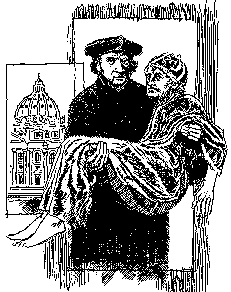
“Luther once said that if the Pope would teach the gospel of justification by faith,
he would kiss his feet and carry him in his hands.”
This was copied kelmed from He Rice Tanned, the Luther-humor branch of Webber's website.
Labels:
Jay Webber
UOJ Caricatures Promoted by Jay
Brett Meyer has left a new comment on your post "Who Is In Charge of Doctrine in the Lutheran Churc...":
I read the Intrepid blog last night and saw that (W)ELS Pastor David Jay Webber was exposed as harboring essays on his website that promoted the exact UOJ caricatures he's been accusing the anti-UOJ Justification by Faith Alone defenders of fabricating.
Here's a quote Frederick Schroeder posted from Webber's theology website:
"On the other hand, this, that God forgives sin, signifies only the action of God that he proclaims to the sinner that his sin is taken away by the death of Christ and that he therefore gives him forgiveness so that he is to believe it, but without regard to whether he has already believed it or not, so that this act of forgiving sin by God cannot only happen without faith being there but first must occur without faith being there since faith cannot be worked otherwise, or know what it is to believe." Page 12
http://www.christforus.org/Papers/Content/HermanAmbergPreusonJustificationofWorld.htm
Pure Gold!
More here from Jay Webber - not websites--as advertised--but branches of the same one.
***
GJ - ELS Pastor Jay Webber and Ex-ELS Pastors Rolf Preus and Roger Kovaciny had no problem collecting money from Floyd Luther Stolzenburg, because UOJ is Antinomian: everyone is forgiven in advance.
Labels:
Jay Webber
Message from WELS Church Lady
WELS church lady has left a new comment on your post "Who Is In Charge of Doctrine in the Lutheran Churc...":
I was beginning to think that Jay Webber was incharge of Lutheran doctrine. Pastor GJ can comment better than Webber.(that's because Pastor Jackson knows what he's talking about) Intrepid needs sound doctrine on those Justification posts. At the moment the best testimony is being led by the laymen. That is unacceptable! Lindee, Heyer, Pastor Spencer, and Pastor Lidke began here on Ichabod.(and even before) We/they need your guidance on an issue that you have studied, preached, and wrote books about. Gregory Jackson IS our modern theologian. His new book on justification has yet to be quoted on the Intrepids. Sweet, Groechel, Hybels, and Driscoll are neither Lutheran nor theologians. One even wonders how Christian these guys profess to be. Yet, it is perfectly okay to quote and TEACH from these characters.
Pastor Jackson is right, the Intrepid pastors need to "man-up!" They are forgetting the reason that the blog was started in the first place.
In Christ,
from WELS church lady
***
GJ - The justification book is still in very rough form, but I promise (d.v.) a polished version after Christmas break.
My theologians are Luther and Chemnitz, not Becker and J. P. Meyer.
Labels:
Justification by Faith
Faithful Service: Help needed for a Church voting for its second, second vote
Faithful Service: Help needed for a Church voting for its second, second vote: "Tuesday, November 16, 2010
Help needed for a Church voting for its second, second vote
Friends,
I am bringing this update on behalf of Zion Lutheran Church in Clear Lake, Iowa. This congregation and these pastors are walking through deep water with their synod. Their first vote to leave was rejected by the elca on a technicality. Their second first vote won easily at 80+%. Their first second vote, lost by 2--they needed 319 and got 317--the people figured it was a done deal, but the bishop of that synod has actively marshaled the opposition.
They are now facing their second, second vote--there is nothing in the constitution that says that if the second vote fails, that you have to start over, the bishop has already said that he will reject their second, second vote, even though there is no reason to do so.
The congregation is wondering if there is any other church who has gone through this (a second, second vote). If so, could you please contact them directly. Their website is: www.zionclearlake.org.
And add them to your prayer lists as well for this weekend! Their pastors names are Pr. Dean Hess and Pastor Derik Yarian.
Mark Vander Tuig
Services Coordinator, LCMC"
Labels:
ELCA; ELS; LCMS; WELS
Who Is In Charge of Doctrine in the Lutheran Church?
Brief Note about Knowing Greek
Mequon graduates like to brow-beat members by saying, "This is true, because I know Greek and you don't."
LI exclaimed, "They don't know Greek!"
Luther made fun of preachers who need to show off, talking about matters the congregation cannot verify.
I received a PowerPoint slide show from a university staffer. It had 50 slides, far too many words, an enormous list of resources, and some of the funniest typos I have ever seen. I thought, "This has to be a doctoral candidate in education." I searched for the credits and there it was, "Robert Fizzlewick, doctoral candidate, education."
The Mequon gambit is a logical fallacy - an appeal to authority. The appeal is not even honest in its dishonesty.
More importantly, the argument is an attack on the perspicuity (clarity) of Scripture. The "I know Greek" (sic) claim declares that the true meaning of the Word is known only to Sausage Factory graduates. Therefore, God speaks to the Wisconsin priesthood, and they communicate--like the priestess at Delphi--with the masses.
The Reformation demolished this attack on the Word of God, only to have the mini-popes revive it. If someone tries it again, laugh.
Labels:
ELCA; ELS; LCMS; WELS
Proof That the Idiot of the Family Goes into the Ministry
ELCA NEWS SERVICE
November 16, 2010
November 16, 2010
ELCA Presiding Bishop Highlights 'Expectations' in Report to Council
10-287-JB
10-287-JB
CHICAGO (ELCA) -- The Rev. Mark S. Hanson, presiding bishop of the Evangelical Lutheran Church in America (ELCA), described his hopes for the church for the next three years -- focusing on expectations -- in a report to the ELCA Church Council Nov. 13.
The Church Council is the ELCA's board of directors and serves as the legislative authority of the church between churchwide assemblies. The council met here Nov. 12-14. Assemblies are held every other year; the next is Aug. 14-20, 2011, in Orlando, Fla.
Hanson organized his report around three questions:
+ What can God expect from the ELCA?
+ What can the ELCA expect from its leaders?
+ What should the church expect from God?
Responding to what God can expect, Hanson noted recent trends in the ELCA such as decreased membership, worship attendance and giving, plus uncertainty for some people about whether there is a place for them in the ELCA.
"Do we want to say to God that we expect past and present trends to continue? Somehow I think God has much higher expectations of us and for us than that," he told the council.
Hanson told the council that God can expect that:
+ members of the ELCA will share the "Good News" of Jesus Christ with family, friends, neighbors and coworkers.
+ members will be "everyday evangelists," and that ELCA pastors will proclaim "the Good News of salvation in Jesus' name with evangelical passion and perseverance, with the creativity of a poet, the wisdom of a sage, the courage of a prophet and the humility of a sinner."
+ the "living word" will be at the heart of the ELCA's life and witness.
+ the ELCA will describe and define itself on the basis of how it relates to other Christians in the body of Christ, not what sets it apart from others.
+ members will join with people of other faiths and those who claim no religious convictions "to work tirelessly to feed the hunger and serve the poor" while addressing root causes of poverty and hunger in the world. During a meeting with President Obama and other Christian leaders Nov. 1, Hanson told the president that the religious community is ready to work in partnership with the public and private sectors to reduce hunger and poverty.
+ the ELCA will describe itself with joy, boldness and courage in "believing, proclaiming and testifying" to the gospel.
On the second question -- What can the ELCA expect from its leaders? -- Hanson said, "In the current culture of fear in which we live both in church and in society, we face the daily challenge of proving ourselves worthy of the trust of the people who have called us into these positions."
The presiding bishop said the church should expect its leaders to welcome people to the church. Hanson recently recorded a video for the "It Gets Better" project on You Tube, addressing bullying of teenagers who are gay and lesbian.
"I never imagined how those words of God's grace would go so viral in a matter of hours and days through the means of social networking. I have been moved by the responses," he told the council, adding, "do you realize how many people out there have never heard and are longing to hear God's gracious word of invitation and salvation in Jesus Christ?"
The Church Council is the ELCA's board of directors and serves as the legislative authority of the church between churchwide assemblies. The council met here Nov. 12-14. Assemblies are held every other year; the next is Aug. 14-20, 2011, in Orlando, Fla.
Hanson organized his report around three questions:
+ What can God expect from the ELCA?
+ What can the ELCA expect from its leaders?
+ What should the church expect from God?
Responding to what God can expect, Hanson noted recent trends in the ELCA such as decreased membership, worship attendance and giving, plus uncertainty for some people about whether there is a place for them in the ELCA.
"Do we want to say to God that we expect past and present trends to continue? Somehow I think God has much higher expectations of us and for us than that," he told the council.
Hanson told the council that God can expect that:
+ members of the ELCA will share the "Good News" of Jesus Christ with family, friends, neighbors and coworkers.
+ members will be "everyday evangelists," and that ELCA pastors will proclaim "the Good News of salvation in Jesus' name with evangelical passion and perseverance, with the creativity of a poet, the wisdom of a sage, the courage of a prophet and the humility of a sinner."
+ the "living word" will be at the heart of the ELCA's life and witness.
+ the ELCA will describe and define itself on the basis of how it relates to other Christians in the body of Christ, not what sets it apart from others.
+ members will join with people of other faiths and those who claim no religious convictions "to work tirelessly to feed the hunger and serve the poor" while addressing root causes of poverty and hunger in the world. During a meeting with President Obama and other Christian leaders Nov. 1, Hanson told the president that the religious community is ready to work in partnership with the public and private sectors to reduce hunger and poverty.
+ the ELCA will describe itself with joy, boldness and courage in "believing, proclaiming and testifying" to the gospel.
On the second question -- What can the ELCA expect from its leaders? -- Hanson said, "In the current culture of fear in which we live both in church and in society, we face the daily challenge of proving ourselves worthy of the trust of the people who have called us into these positions."
The presiding bishop said the church should expect its leaders to welcome people to the church. Hanson recently recorded a video for the "It Gets Better" project on You Tube, addressing bullying of teenagers who are gay and lesbian.
"I never imagined how those words of God's grace would go so viral in a matter of hours and days through the means of social networking. I have been moved by the responses," he told the council, adding, "do you realize how many people out there have never heard and are longing to hear God's gracious word of invitation and salvation in Jesus Christ?"
Labels:
ELCA; ELS; LCMS; WELS; CLC (sic)
Ordinariate article turns into bun fight over the Bible and Mary « Churchmouse Campanologist
In which Churchmouse asks the same questions I do about Protestant clergy joining the Roman Catholic Church...
Labels:
Roman Catholic
Tuesday, November 16, 2010
Pastor Zip's Blog: Reflections on the Panel Discussion at LSTC
- The Rev. Steven P. Tibbetts, STS
- Pastor at Zion Evangelical Lutheran Church of Peoria, Illinois, a congregation of the Evangelical Lutheran Church in America. I am also a pastor of the Societas Trinitatis Sanctae (Society of the Holy Trinity).
"But two of her examples saddened me -- though I hasten to add that my disappointment was not so much in her, as it was yet another confirmation of the state of too much of the ELCA's leadership over many years. The first was an interim pastorate that the then-Bishop of the Metro Chicago Synod wanted her to serve, a parish in a town well-known nationally for being a home to conservative evangelicalism -- where he specifically wanted her, a (then-closeted) lesbian in a committed relationship, to lead the congregation through its discernment in becoming a 'Reconciling in Christ' congregation. The second was her current call, where the parish told the Bishop that they were interested only in calling a gay or lesbian pastor. A request he granted by offering them several choices to consider. Long before Vision and Expectations was to be amended.
And yet to listen to him in person or at the recent ELCA Town Hall forums, Presiding Bishop Hanson seems genuinely baffled that traditionalists don't seem to trust the word of our church's leaders."
Labels:
ELCA; ELS; LCMS; WELS;
Timothy M. Dolan to Lead Catholic Bishops’ Conference - NYTimes.com
Dolan Chosen as President of U.S. Bishops’ Group

Steve Ruark/Associated Press
Bishop Robert F. Vasa left, congratulated Archbishop Timothy M. Dolan after he was elected president of the U.S. Conference of Catholic Bishops on Tuesday in Baltimore.
Labels:
Roman Catholic
Bored But Never Boring
bored has left a new comment on your post "Critical Thinking Needed with Intellectual Honesty...":
Pastor Rydecki has offered a challenge to look into pre-1580 Christians and their understanding of Justification. I was hoping to hear your opinion of my (very) quick analysis of a certain quote:
Chrysostom wrote:
[5.] Ver. 19. “To wit, that God was in Christ reconciling the world unto Himself, not reckoning unto them their tresspasses.”
Seest thou love surpassing all expression, all conception? Who was the aggrieved one? Himself. Who first sought the reconciliation? Himself. ‘And yet,’ saith one, ‘He sent the Son, He did not come Himself.’ The Son indeed it was He sent; still not He alone besought, but both with Him and by Him the Father; wherefore he said, that, “God was reconciling the world unto Himself in Christ:” that is, by Christ. For seeing he had said, “Who gave unto us the ministry of reconciliation;” he here used a corrective, saying, “Think not that we act of our own authority in the business: we are ministers; and He that doeth the whole is God, Who reconciled the world by the Only-Begotten.” And how did He reconcile it unto Himself? For this is the marvel, not that it was made a friend only, but also by this way a friend. This way? What way? Forgiving them their sins; for in no other way was it possible. Wherefore also he added, “Not reckoning unto them their tresspasses.” For had it been His pleasure to require an account of the things we had transgressed in, we should all have perished; for “all died.” But nevertheless though our sins were so great, He not only did not require satisfaction, but even became reconciled; He not only forgave, but He did not even “reckon.” So ought we also to forgive our enemies, that ourselves too may obtain the like forgiveness.
“And having committed unto us the word of reconciliation.”
For neither have we come now on any odious office; but to make all men friends with God. For He saith, ‘Since they were not persuaded by Me, do ye continue beseeching until ye have persuaded them...." (Schaff, Philip: The Nicene and Post-Nicene Fathers Vol. XII. Oak Harbor : Logos Research Systems, 1997, S. 333)
Sure, I'll take that challenge.
2 Cor. 5:19 is one of the main verses used in the defense of Objective Justification. It has been argued by many that a combination of "the world" and "not counting people’s sins against them."(NIV) means that God "has declared them (all sinners) righteous for the sake of Christ" (This We Believe, section IV point 1).
John Chrysostom, archbishop of Constantinople (c. 349-407) disagrees with that understanding of verse 19. Rather, when he describes it in his commentary of 2 Cor., he speaks about the 'not counting' (or reckoning) in reference to Christians. His use of pronouns convinces me of this. He says "we should have all perished" and "we also to forgive our enemies". Chrysostom is speaking to Christians, and implies that verse 19 is not a blanket statement about the supposed (declared) innocence of the whole world, but rather a description of what happens to those who are reconciled: their sins are not counted against them.
***
GJ - Thank you for that contribution. The entire Christian tradition followed that understanding until Pietism merged Calvin with Lutheran lite and invented UOJ.
Now the benighted Synodical Conference starts with an assumption of UOJ and tries to work backwards to the Reformation and the Bible.
I have seen the effect in discussing this with Lutheran students. They start with universal absolution instead of the efficacy of the Word and the Means of Grace.
Once UOJ is assumed, nothing else matters. Everything becomes an adiaphoron, including the most heinous sins.
---
LPC has left a new comment on your post "Critical Thinking Needed with Intellectual Honesty...":
Bored/Pr Greg,
I offer another analysis why UOJ in method and practice is actually Calvinism in method and practice!
Calvinism, when it sees the word "all" in Scripture, fails to read it as all in the sense of all the world indiscriminately when it SHOULD BE!
UOJ when it sees "all", does the opposite mistake of the Calvinist, they read it as all also indiscriminately when it SHOULD NOT BE!.
Lutheran JBFA, in my reading of the BoC and Luther/Chemnitz, properly reads the use of "ALL" because they follow proper exegetical methods.
They know when ALL means all indiscriminately and also when ALL means - all who believe only.
In otherwords UOJers and Calvinist, when it comes to exegesis, do not apply discernment or distinction properly when they see the word ALL.
This is the reason why I LMAO when UOJers claim anti-UOJ people are Calvinists! It is UOJ that is Calvinistic in philosophy and method!
Actually I now ask amongs Lutherans, the joke I used to ask Calvinists - could the REAL Calvinist please stand up!
LPC
Pietism, More Than A Renewal Movement?
David Luecke has advocated pietism as a slice of the Lutheran heritage which holds promise for the renewal of mission, congregational life, and worship. Luecke argues that pietism is the “other story” of worship among Lutherans, a story that he claims has been ignored by the “restorationists” who have written liturgical histories and prepared the hymnals. According to Luecke, pietism is part of a tradition that is finding expression in congregations which have abandoned or radically altered traditional Lutheran liturgical forms and hymnody.
The alternative worship movement which has become so attractive to many within American Lutheranism draws more deeply on revivalism or the “frontier tradition” of worship as James White calls it and Pentecostalism via the charismatic movement than it does on classical pietism. One could only wish that contemporary praise hymns had the theological and spiritual depth of hymns such as Johann Schroeder’s “One Thing’s Needful; Lord this Treasure” (277 LW) which Wilhelm Nelle called “the most blessed hymn of the entire circle of Halle Pietists.” When we compare the changes in liturgical texts and structures introduced by pietism with those brought about by the advocates of so-called alternative worship, we might be tempted to conclude that the innovations of pietism were rather minor. For the most part, pietism did not produce new liturgical orders. What pietism did introduce was a shift away from the centrality of the divine service in the life of the church. This shift was necessitated by a prior shift from justification to sanctification, from the objective reality of the means of grace to the subjective experience of the believer, from beneficium to sacrificium, from the Office of the Holy Ministry to the priesthood of believers. This is the crucial shift which prepares the way for later developments in pietism’s offspring, revivalism and Pentecostalism, which, in turn have exercised a destructive influence in the liturgical life of North American Lutheranism. The central themes of pietism are unable to sustain the liturgical life envisioned in the Book of Concord.
If we are to understand the influence of pietism on the liturgy in contemporary Lutheranism, it is essential that we see that pietism was more than a renewal movement. It was a theological movement. Bengt Haegglund writes “The Pietist movement, which penetrated Lutheran territory in the latter part of the 17th century and contributed to the diminution or the internal transformation of the orthodox Lutheran tradition, was not simply a reaction against certain weaknesses in the church life of the time; it was rather a new theological position, which was based on a new concept of reality and which bore within itself the seeds of the modern point of view.”
Most of the standard treatments of pietism see pietism as a necessary corrective to the alleged frigidity and formality of Lutheran orthodoxy, Pietism is said to have recaptured the vitality of Luther’s evangelical insight. Examples of the living piety of orthodoxy as embodied in Johann Gerhard’s devotional writings or the hymnody of Philip Nicolai and Paul Gerhardt are overlooked or else they are classified as a germinal form of pietism. Pietism’s reliance on a selected slice of the early Luther to the exclusion of his later sacramental writings is overlooked. Whatever deficiencies there may have been in the church life of Lutheran orthodoxy, it cannot be claimed that pietism is a return to Luther. Pietism was seeking something new. Jeremiah Ohl summarizes the outcome of pietism’s search as it relates to worship: “…in a word, what Pietism set out to do finally resulted not in bringing about again a proper union between the objective and the subjective, but in the overthrow of the former and the triumph of the latter. The sacramental and the sacrificial were divorced, and the sacrificial alone remained. Public worship ceased to be a celebration of redemption, and became only an act of edification” (Ohl, 70-71). Pietism succeeded in introducing a new theology of worship grounded not in the delivery of the fruits of Christ’s redeeming work but rather in the edification of the saint.
In his programmatic work, Pia Desideria, Spener does not set forth a plan for liturgical innovation yet we observe a shift away from objective understanding of the divine service in Luther and Lutheran orthodoxy. Spener begins not with the Lord’s gifts but with the Lord’s people and what he sees is lamentable: clergy whose lives do not conform to their teaching, contentiousness among the theologians, worldliness and drunkenness on the part of the common people. When Spener finally comes to discuss the efficacy of the Word of God and the place of Baptism, the Lord’s Supper, and absolution, he focuses not the character of these gifts but on their right use. Spener gives assurances that he has not departed from the orthodox Lutheran understanding of the power of God’s Word: “We also gladly acknowledge the power of the Word of God when it is preached, since it is the power of God for salvation to everyone who has faith (Rom. 1:16). We are bound diligently to hear the Word of God not only because we are commanded to do so but because it is the divine hand which offers and presents grace to the believer, whom the Word itself awakens through the Holy Spirit.” Likewise he affirms baptismal regeneration and the sacramental presence of Christ’s body and blood: “Nor do I know how to praise Baptism and its power highly enough. I believe that it is the real ‘washing of regeneration and renewal in the Holy Spirit’ (Tit. 3:5), or as Luther says in the Catechism, ‘it effects forgiveness of sins, delivers from death, and grants (not merely promises) eternal salvation. Not less gladly do I acknowledge the glorious power in the sacramental , oral, and not merely spiritual eating and drinking of the body and blood of the Lord in the Holy Supper. On this account I heartily reject the position of the Reformed when they deny that we receive such a pledge of salvation in, with, and under the bread and the wine, when they weaken its power, and when they see in it no more than exists outside the holy sacrament in spiritual eating and drinking.”
- excerpt from John Pless, ‘Liturgy & Pietism: Then and Now’
Critical Thinking Needed with Intellectual Honesty
LP Cruz wrote a post below, which never saw the light of day on the Intrepid Lutherans.
Cruz exemplifies critical thinking and intellectual honesty.
Here are some basic guidelines for critical thinking and intellectual honesty in theology:
- The opposite view needs to be identified and described accurately. For instance, if Rydecki wants to promote his vision for UOJ, he needs to state what he arguing against. Instead, he writes about "extreme anti-UOJ statements" and offers his version, to make the other side look ridiculous.
- The evidence has to be presented honestly. If a quotation is borrowed from a source, that source needs to be named. Cloning footnotes or citations is fine, as long as the practice is acknowledged. Otherwise, the author appears to be doing research instead of copying and pasting from a single source.
- Seminary professors and essayists are not in the same league as the great theologians of the Lutheran Church. Repeating seminary dog notes and conference talking points will never advance an argument. The ruled norm is the Book of Concord. Additional theologians worth studying in depth are: Luther, Melanchthon, Chemnitz, and Gerhard. In America we have a few more than Walther - Jacobs, Schmauk, and Krauth. Neglecting the best theologians for the political in-crowd is not productive or edifying. A good rule for theologians cited is - the deader, the better.
- Lutherans should be arguing for doctrinal clarity than an imaginary middle ground. There is no middle ground with false doctrine. All union efforts end in the worst doctrine prevailing. An honest division is better than a dishonest, manufactured unity (to reflect a point by Reu).
The So-Called Intrepid Lutherans Blocked This Comment from Their Blog
Pr. Greg,
What is happening in the IL UOJ discussion is the same thing I have seen in some sections of Calvinism. For example, in Calvinism, there is a movement called Federal Vision. This view advocates an understanding of the sacraments which is similar to the Lutheran position. However, FV people could not cross the line where the Lutherans are, no matter how hard they try. It is because their feet are bolted down to the light post of Calvin. Almost there but not quite.
So now I look at what Rydecki is doing with UOJ at IL and I see the same thing as what is happening in Calvinism regarding certain concepts and teachings. At IL you find a critique of UOJ done by the left hand only to be re-inserted back again by the right hand. Marquart was guilty of the same blunder in calling what Jesus did as Objective Justification. Hence, Rydecki wants to correct and present a proper version of UOJ so that the concept may be saved from sinking but does not quite make it. It is because UOJ/OJ is riddled with unBiblical terminology. It is like the Titanic, everyone knows it is down there at the bottom of the ocean but no one likes to raise it up again.
Marquart's paper was one of the first ones I read in regards to this controversy, I winded up shelving it because he did not arrive at the best conclusion, the ditching of UOJ/OJ both as a term and as a concept.
Also I find it intriguing that UOJ has similar fate and destiny as those concepts I saw in Calvinism. UOJers call anti-UOJ people Calvinists. Unfortunately UOJ people do not know Calvinism even if they have dinner with it.
LPC
– Findings | StanwoodOSLC.org
Our Saviour’s Lutheran Church
of Stanwood, WA
Supporting documentation from the OSLC Task Force
Our Saviour’s Lutheran Church
of Stanwood, WA
Supporting documentation from the OSLC Task Force
The following 34 pages documents the research and analysis conducted by the nine member Task Force over the past 5 months. You are encouraged to read the overview and characteristics for the 14 parameters evaluated in depth. In addition, please use the provided web links that will further expand on those passages quoted and referenced. It has always been the goal and desire of the Task Force to simply provide the materials that each member of the congregation can then use to better inform themselves before the vote on June 13th.. Ultimately it is only through your prayers and thoughtful consideration that we will arrive at a decision that is best for the congregation of Our Saviour’s.
Regardless of which position individual OSLC members have, the Task Force recognizes that these positions are heartfelt and no person should attribute evil to or condemn those who have a position different than their own. The members of the Task Force all care deeply for each and every member of Our Saviour’s congregation and for each and every member and non-member who worships, studies, prays, and serves with us. The Task Force believes that there are many other important subjects that unite us as a congregational family that are central to our ministry of bringing people into a growing relationship with Jesus Christ. After the vote Our Saviour’s will need to refocus on its mission of “encountering God, encouraging believers, extending the Kingdom”, rather than being distracted by divisive political and social issues which were dropped into our lap and do not go to the heart of our faith.
It is our hope that this document will be carefully read and that readers will use the listed websites to go to the sources of the documentation.
In Christ’s name,
OSLC Task Force
Regardless of which position individual OSLC members have, the Task Force recognizes that these positions are heartfelt and no person should attribute evil to or condemn those who have a position different than their own. The members of the Task Force all care deeply for each and every member of Our Saviour’s congregation and for each and every member and non-member who worships, studies, prays, and serves with us. The Task Force believes that there are many other important subjects that unite us as a congregational family that are central to our ministry of bringing people into a growing relationship with Jesus Christ. After the vote Our Saviour’s will need to refocus on its mission of “encountering God, encouraging believers, extending the Kingdom”, rather than being distracted by divisive political and social issues which were dropped into our lap and do not go to the heart of our faith.
It is our hope that this document will be carefully read and that readers will use the listed websites to go to the sources of the documentation.
In Christ’s name,
OSLC Task Force
John Lawrenz, Church and Changer, Installs Steve Witte, DMin, Church and Changer - As SP Schroeder's Doctrinal Revolution Continues Apace
A new president was installed and three students graduated during a special service at Asia Lutheran Seminary (ALS) in Hong Kong Nov. 1.
Dr. Steven Witte, who arrived at ALS in October 2009, will start in his new position as president in January 2011. He will replace Dr. John Lawrenz, who has been serving as president since this seminary operated by WELS World Missions opened in 2005. [Witte earned a DMin in Church Growth at Gordon Conwell. He is a founder of WELS Church and Change.]
"This opportunity to serve brings me great joy and some anxiety," says Witte. "When I look at myself and the challenges of the work, I lose confidence that things will go well for ALS in the future. When I look at God and his promises and the team of workers he has provided around me, I become excited at what God has accomplished in Hong Kong and China—and what the future holds."
Witte says that future goals for ALS are many, including providing a complete seminary education—including Hebrew and Greek—for those in Hong Kong as well as building "education pipelines" to other East Asian countries. He says ALS also will continue translating Lutheran materials into Chinese as well as preparing some of its graduates to serve as professors someday.
Lawrenz, who is already beyond retirement age, says he is stepping down to provide continuity in leadership at ALS. He will continue to serve at ALS as a professor and as an advisor to Witte. He says he is thankful for his experiences as ALS president: "Starting with a mandate and little more, our team has arrived at a point where we can reach for stability with a faculty of four and the staff and learning resources to go with it."
Fifty-six students, plus two people via Skype, are taking classes at ALS. Including the three recent graduates, seven students have now graduated from ALS and are serving at congregations in Hong Kong and Taiwan.
Read more about these recent blessings at ALS from Dr. John Lawrenz's viewpoint on the mission blog.
Dr. Steven Witte, who arrived at ALS in October 2009, will start in his new position as president in January 2011. He will replace Dr. John Lawrenz, who has been serving as president since this seminary operated by WELS World Missions opened in 2005. [Witte earned a DMin in Church Growth at Gordon Conwell. He is a founder of WELS Church and Change.]
"This opportunity to serve brings me great joy and some anxiety," says Witte. "When I look at myself and the challenges of the work, I lose confidence that things will go well for ALS in the future. When I look at God and his promises and the team of workers he has provided around me, I become excited at what God has accomplished in Hong Kong and China—and what the future holds."
Witte says that future goals for ALS are many, including providing a complete seminary education—including Hebrew and Greek—for those in Hong Kong as well as building "education pipelines" to other East Asian countries. He says ALS also will continue translating Lutheran materials into Chinese as well as preparing some of its graduates to serve as professors someday.
Lawrenz, who is already beyond retirement age, says he is stepping down to provide continuity in leadership at ALS. He will continue to serve at ALS as a professor and as an advisor to Witte. He says he is thankful for his experiences as ALS president: "Starting with a mandate and little more, our team has arrived at a point where we can reach for stability with a faculty of four and the staff and learning resources to go with it."
Fifty-six students, plus two people via Skype, are taking classes at ALS. Including the three recent graduates, seven students have now graduated from ALS and are serving at congregations in Hong Kong and Taiwan.
Read more about these recent blessings at ALS from Dr. John Lawrenz's viewpoint on the mission blog.
Labels:
Church and Change
Introduction to the Sig Becker Essays:
UOJ, Semi-UOJ, and Demi-Semi-UOJ
The late Sig Becker is still WELS' point man for UOJ and the Real Presence, and he proved himself to be an Enthusiast in both cases.
The old Synodical Conference cannot get past Enthusiasm, because they always start with their own dubious doctrinal history, make that the ruling norm, and discover Luther and the rest agreeing with them.
UOJ is especially noteworthy, because Walther clearly taught a perversion of justification, borrowed from Halle University's Georg Christian Knapp. The double-justification formula can be found in English, published in America, before Walther landed in New Orleans.
UOJ did not catch on in the Missouri Synod, but grew in influence, finally established as Holy Writ in the Brief Statement of 1932.
I am told that Kuske's blue catechism had the same effect on WELS, establishing UOJ as beyond criticism.
Like the Immaculate Conception of Mary and her blessed Assumption into heaven, UOJ is now discovered as being taught all the way back to Adam. Given its mission creep, we may learn in the future of the pre-existence of UOJ.
There are variations in UOJ, even though each flavor seems to be faux-vanilla:
1. Pure Kokomo UOJ.
2. Post-Kokomo UOJ, since everyone seems to criticize the Kokomo Statements while articulating the exact same principles. That should be called semi-UOJ.
3. Intrepid UOJ, which supports Marquart about his criticism of Darby, a Missouri Synod layman at the time. That would be demi-semi-UOJ.
Elgin UOJ, 1982, Pages 1-3
Milwaukee UOJ, 1984
Sig Becker, Universal Justification, Milwaukee, 1984, Pages 1-4
Labels:
1984,
Becker,
Buchholz UOJ,
Milwaukee
Sig Becker, Universal Justification, Milwaukee, 1984, Pages 5-8
Labels:
1984,
Becker,
Buchholz UOJ,
Milwaukee
Buchholz UOJ Essay - Introduction
I met DP Buchholz about two years ago. We went out to lunch. He introduced me to his church staff the next time, as "The notorious Greg Jackson." That was funny.
He surprised me by talking about the Means of Grace, which seemed to be a forbidden subject in WELS and the entire Synodical Conference. He tried to merge Biblical doctrine with UOJ, criticizing Kokomo, but not giving up the basic UOJ flaw. I told him he was part-way there, but he decided to write Brett Meyer that I agreed with him (Jon) and disagreed with Brett. I disabused him of that notion. We talked before I left Phoenix.
Jon is pleasant and intelligent. He does not put on the stupid act that WELSians find so appealing. However, he is quick to defend notorious types and in full denial about the promotion of Church and Change heroes in all the WELS schools.
The people I blog against are the same ones paraded as super-stars in WELS, starting at the prep level. Thus WELS is busy unraveling itself, with UOJ advocates mildly criticizing the Changers, who agree completely about UOJ.
All UOJ essays are the same mulch, mixed somewhat differently each time. They have one doctrine in common - universal absolution without the Word, without the Means of Grace, pure Enthusiasm, a rehash of Halle University Pietism. No wonder Tholuck was a Universalist, since Knapp's Pietism was one baby step away from that opinion.
Posted here. Mequon graduates. That orangey text is a link. Left click. The essay starts here.
---
Brett Meyer has left a new comment on your post "Buchholz UOJ Essay - Introduction":
When a public error is made in the church, in doctrine or practice, it is imperative that public confession of the error is announced so that those who were affected by the error can learn from it as much as the one who committed it. The public confession needs to include the explanation as to what was said or done that was in error, why it was in error and what will or should be subsequently done to correct it and establish the good and right action in regards to doctrine and/or practice.
If anyone wants to claim they love their neighbor they would follow this, primarily for the sake of their neighbor and to support the cherished gift of pure Doctrine and right practice.
If Buchholz has "grown" in the last five years then we could rightly expect him to have corrected his false teachings and communicated them publicly on at least the same scale with which he disseminated the false teachings. As DP he could request that his 2005 Convention essay did not remain on the (W)ELS essay list in perpetuity but have it removed.
Regardless of what his actions and statements did to me personally this would have been the least he could have accomplished for the sake of his church body. He did not. He has never publicly owned up to the false doctrine he taught in the Convention essay. He has never publicly repudiated any of the teachings which he parroted and taught to thousands of men, women and children.
The laity in the Lutheran Synods are following golden statues that will not publicly admit to personal or synod error. They will gladly say that "some have spoken poorly" or "what he was trying to say is". This is only serves to honor and protect error at the expense of holding alone to Christ and His pure Word.
WELS Church Lady, I can honestly appreciate how strongly you feel about these people. But your feelings need to be tempered by reality. Neither Buchholz nor Schroeder are doing anything publicly to support, promote and defend the Lutheran Confessions. It is only by your admission of what Buchholz is attempting to accomplish that we know of his activities. They are too afraid of people to openly carry the cross. If Schroeder was conservative much less confessional in anything but words, there would be a public example made of the satanic apostacy that is rampant in Appleton and everyone in the (W)ELS would know what is happening, how to protect their families and churches from the apostacy.
IMHO and In Christ,
Brett Meyer
Buchholz UOJ Essay
Labels:
Buchholz UOJ
Subscribe to:
Posts (Atom)