Disciple used by John – not in the Fuller Seminary sense –
after the Bread of Life sermon.
John 6:60 Many therefore of his disciples, when they had
heard this, said, This is an hard saying; who can hear it? 61 When Jesus knew
in himself that his disciples murmured at it, he said unto them, Doth this
offend you? 62 What and if ye shall see the Son of man ascend up where he was
before? 63 It is the spirit that quickeneth; the flesh profiteth nothing: the
words that I speak unto you, they are spirit, and they are life. 64 But there
are some of you that believe not. For Jesus knew from the beginning who they
were that believed not, and who should betray him. 65 And he said, Therefore
said I unto you, that no man can come unto me, except it were given unto him of
my Father.66 From that time many of his disciples went back, and walked no more
with him.
 |
| Hahahahahahahahahahahahahahahahahahahahahahahahahahahahahahaha! |
Cell Groups Come from Pietism – And Fuller Seminary
The essence of Pietism is the
cell group, so the lay-led
· share,
· care,
· koinonia,
· Bible
study,
· home group,
· small group,
· or
grow group
is evidence of a method and a dogma that opposes the Means
of Grace, substituting the little church within the big church as the real
church. My wife and I went to a Lutheran koinonia group presentation where the layman
leading the effort repeatedly emphasized the efficacy of the cell groups in
gathering and doing the real work of the congregation. A good illustration of
this outside of Lutherdom is the Southern Baptist denomination, where someone
may be a layman paid to lead Bible studies at home, and proud of never being
inside the actual church building in 30 years. And why should he? – the real
church is made up of cell groups like his. Whatever the denomination, the cell
group members hold themselves above the rest of the congregation as superior to
the ones who simply worship.
Pietism is
the name of a movement that used Lutheran orthodoxy as a springboard for
launching a new agenda that proved remarkably successful and destructive at the
same time. Spener was asked to write an introduction to the orthodox Lutheran
book of sermons by Johannes Arndt in 1675. Instead, he turned the opportunity
into major opportunity to introduce an entirely new way of looking at the
Christian life (sanctification). The introduction was published separately –
and continues in print – as Pia Desideria,
or Pious Wishes, thus the name Pietism for this movement.
At first glance, the total
difference seems absolutely paltry, but in truth the dangerous direction of
Pietism is made apparent: life over doctrine, sanctification over
justification, and piety not as a consequence but declared as a stipulation of
enlightenment, leading to a kind of synergism and Pelagianism.
Adolf Hoenecke, Evangelische-Lutherische Dogmatik, 4
vols., ed., Walter and Otto Hoenecke, Milwaukee: Northwestern Publishing House,
1912, III, p. 253.
Hoenecke’s summary is brilliant and should be memorized as
the distinctive definition of Pietism’s Trojan Horse, sanctification over
justification, piety not as a consequence but a requirement of enlightenment.
Spener was a
prolific writer and guru to many leading figures in Europe. He suggested the
founding of Halle University, which became the mother ship of Pietism, and had
August Francke appointed as professor there. Three American Lutheran leaders
studied or worked at Halle University:
1. Henry
Melchior Muhlenberg, founder of the General Synod, which became the Lutheran
Church in America (with mergers) and ELCA with additional mergers.
2. Adolph
Hoenecke, the principal theologian of the Wisconsin Synd.
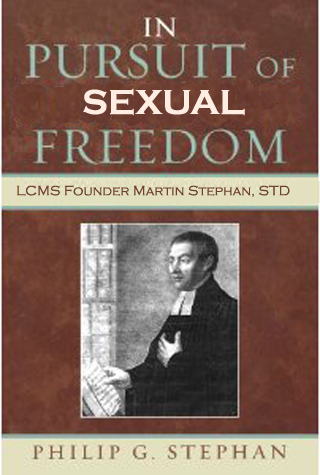
3. Martin
Stephan, the bishop who saved CFW Walther from death by teaching him Objective
Justification, which Walther promoted his entire life. Thus the Lutheran Church
Missouri Synod was born at Halle University and brought to America by a Pietist
leader of cell groups, a fact few in the LCMS admit today.[1]
My dogmatics
professor at Waterloo Lutheran Seminary, a
school founded by Lutheran Pietists, was Otto Heick. He was also a
member of a separate Pietist congregation while belonging to a Lutheran Church
in American congregation in Kitchener-Waterloo. He graduated from a German
Pietist seminary, so he was quite the expert on German Pietism. His History of Christian Doctrine was widely
used in WELS and often showed up at book sales.
Some hallmarks of Pietism are:
1. A
heart religion instead of a head religion. Pietists often mention that false
distinction.[2]
2. Lay-led
conventicles or cell groups, to develop piety through prayer and Bible study.
3. Unionism
- cooperation between Lutherans and the Reformed. Spener was the first union
theologian (Heick, II, p. 23).
4. An
emphasis on good works and foreign missions. "Deeds, not creeds" is a
popular motto.
5. Denial
of the Real Presence and baptismal regeneration, consequences of working with
the Reformed. (Heick, II, p. 24)
6. A
better, higher, or deeper form of Christianity rather than the Sunday
worshiping church. This often made the cell group the real church, the gathered
church.[3]
A member of a Lutheran congregation asked me what was wrong
with cell groups. I said, “They are inherently anti-Lutheran and
anti-Sacrament.” She frowned, not liking the answer at all, since she belonged
to a Lutheran cell group. She suggested a discussion on infant baptism in her
group, but the leader refused and rejected the idea of having both sides
represented in a meeting. The woman had to concede that my observations were
correct.
The various
groups that came to America to form their ethnic Lutheran denominations were
Pietists. The Swedes and Norwegians were Pietists who never denied their
origins. The Swedish Augustana Synod, though remaining Pietistic in many ways,
was influenced by William Passavant, who emphasized the Lutheran Confessions,
and also by an early Augustana leader who was trained in Lutheran orthodoxy.
The Augustana leaders had bitter experiences with the Pietistic spirit in
America - revivals, leaders despising the Means of Grace, shunning the Book of
Concord. Breaking with the revivalists and naming themselves for the Augsburg
Confession (Confessio Augustana),
they tried to strike a balance between Swedish Pietism and Lutheran Orthodoxy.
The bad leaven took over and led to merger into the LCA and leadership in the ELCA
of 1987– Herb Chilstrom, Augustana Seminary graduate, was the first bishop of
ELCA.
Fuller Seminary – The New Mother Ship for Rationalistic
Pietism
Fuller Seminary in Pasadena,
California, opened in 1947, representing the relatively conservative wing of
Evangelicals, using a modified definition of Biblical inerrancy. Given the
overwhelming influence of mainline denominations and the National Council of
Churches, Fuller looked quite conservative on that issue in the 1940s. After
all, the first version of the Revised Standard Version of the Bible, 1946,
changed the Virgin Birth prophesy in Isaiah 7:15 to “a young woman will
conceive.” They reversed themselves but left that in a footnote, as many
modernist translations do.
The first leaders – Harold Ockenga,
Carl F. H. Henry, and Harold Lindsell, were on the side of inerrancy. During
that time, “inerrant in doctrine” sounded pretty good, but that implies –
errant in all other areas, like history, geography, you know – the facts.
Nevertheless, Fuller Seminary broke with that mild confession and repudiated
inerrancy when Church Growth came to the school in the form of Donald McGavran,
a Planned Parenthood supporter, a Disciples of Christ sociologist, and a former
missionary to India. He arrived at Fuller in 1965 and soon involved
denomination mission executives in his Church Growth Movement. The executives
involved their subordinates, great business for Fuller Seminary and the Church
Growth Book-of-the-Month Club.
J-773
"Were we to distinguish
our position from that of some of our brothers and sisters who perceive their
view of Scripture as more orthodox than ours, several points could be made: 1)
we would stress the need to be aware of the historical and literary process by
which God brought the Word to us... 4) we would urge that the emphasis be
placed where the Bible itself places it—on its message of salvation and its
instruction for living, not on its details of geography or science, though we
acknowledge the wonderful reliability of the Bible as a historical source book;
5) we would strive to develop our doctrine of Scripture by hearing all that the
Bible says, rather than by imposing on the Bible a philosophical judgment of
our own as to how God ought to have inspired the Word." David Allan
Hubbard, "What We Believe and Teach," Pasadena, California: Fuller
Theological Seminary, 800-235-2222 Pasadena, CA, 91182. [emphasis added]
Inerrancy Misleading and Inappropriate
J-774
"Where inerrancy refers
to what the Holy Spirit is saying to the churches through the biblical writers,
we support its use. Where the focus switches to an undue emphasis on matters
like chronological details, the precise sequence of events, and numerical
allusions, we would consider the term misleading and inappropriate. Its
dangers, when improperly defined, are: 1) that it implies a precision alien to
the minds of the Bible writers and their own use of Scriptures; 2) that it
diverts attention from the message of salvation and the instruction in
righteousness which are the Bible's key themes;... 5) that too often it has
undermined our confidence in the Bible we have... 6)that it prompts us to an
inordinate defensiveness of Scripture which seems out of keeping with the bold
confidence with which the prophets, the apostles and our Lord proclaimed it."
David Allan Hubbard, "What We Believe and Teach," Pasadena,
California: Fuller Theological Seminary, 1-800-235-2222 Pasadena, CA, 91182.
[emphasis added] Inerrancy Advocates Are Against the Bible and Tick Me Off
J-775
"We resent unnecessary
distractions; we resist unbiblical diversions… Can anyone believe that all
other activities should be suspended until all evangelicals agree on precise
doctrinal statements? We certainly cannot." David Allan Hubbard,
"What We Believe and Teach," Pasadena, California: Fuller Theological
Seminary, Pasadena, CA, 91182. [emphasis added]
Fortunately, Harold Lindsell
was available to chronicle the apostasy and write about it in his famous book Battle for the Bible. The founder’s son
studied under Karl Barth and came back to change the doctrinal stance of the
school. In fact, Karl Barth became the official theologian of Fuller Seminary,
foreshadowing the plagiarism practiced by so many Fuller graduates.[4]
For decades, “conservative” Lutheran leaders have advanced their careers by
studying at Fuller or its clones and copying whatever they heard – Kent Hunter,
Waldo Werning, David Valleskey, Forrest Bivens, Paul Kelms, Wally Oelhafen,
Fred Adrian, Larry Olson, James Huebner, and many more in ELCA and the ELS.
The cell group – not the
Gospel in the Means of Grace – is constantly promoted by these quasi-Lutheran robots
as the one and only way to make the congregation grow. Although these men have
destroyed more churches than the Chicago Fire, they continue to weevil their
way into every program, hymnal, book, and translation. They have convinced
themselves and others that forming cell groups will necessarily make the
congregations and the denominations grow, even though just the opposite has
happened. I have dubbed them Church Shrinkers because they go merrily on their
way, like God’s appointed kamikaze pilots, aiming at one vulnerable target
after another.
J-008
"Jesus did not send his
disciples out to make disciples without first making them disciples. He gave
them a course in disciple making by making them disciples. He knew that you
have to be a disciple yourself before you can help someone else to become a
disciple."
Pastor Joel C. Gerlach,
"The Call into the Discipling Ministry," Yahara Center, April 24-25,
1987, p. 6.6[5]
J-009
"But when our Lord told
us what our mission should be, he was quite clear: Make disciples.”
Lawrence Otto Olson, D. Min.,
Fuller Seminary, The Evangelism Life Line (WELS), Summer, 1988, p. 3.
J-063
"If I were asked: What is
the key thing in the disciple making process that demands our special attention
in our effort to become better disciple makers, without hesitation I'd say it's
the role of modeling. We need more disciple maker models in our classrooms. It
isn't enough just to tell others to go and make disciples. We need to show and
tell them. Modeling is an essential, integral part of showing and
telling."
Pastor Joel C. Gerlach
"The Call into the Discipling Ministry," Yahara Center, April 24-25,
1987, p. 18. Matthew 28:18-20.
J-067
"Pastors become disciples
so they can make disciples. As a proud Pentecostal I thought I had everything
because I belonged to a Full Gospel church. Little did I know how much I had to
learn until I came together with other pastors— 69 Baptists, Presbyterians,
Plymouth Brethren, and Catholics. As a proud Pentecostal I had to become a
humble elder of the church." Juan Carlos Ortiz, Call to Discipleship,
Plainfield: Logos International, 1975, p. 100.
J-068
"In this way, the entire
church is comprised of ministers. The ministers are not a special breed of
sheep coming from the seminary. They are simply believers who go on growing.
Thus the purpose of the pastor is to make disciples who make disciples who make
disciples who make disciples."
Juan Carlos Ortiz, Call to
Discipleship, Plainfield: Logos International, 1975, p. 18.
J-069
“Make disciples, not members.
Our mission is more than baptism, more than bring people in through water and
the word. The scripture mandates us to make disciples—to move people into a
life of meeting Jesus and experiencing faith. Pastor Per Nilsen, Director of
Ministry, Prince of Peace, ELCA. Website at: www.changingchurch.org/perspec/vol28/nilsen.htm.
J-070
“Make Disciples,” What would
it mean if we were to become disciple-making churches? Homiletics website at: http://dev.homileticsonline.com/Installments/jun1696.htm.
J-071
Bring A Friend Sunday
introduced the Core Process of Making Disciples for Jesus Christ to the North
Texas Conference in 1993. Making Disciples 2000 continues the process through
the year 2000 with each of the 323 local churches in the conference invited to
participate in the four expressions of that Core Process… Making Disciples
2000, Matthew 28:16-20. United Methodist Church, North Texas Conference,
website, http://www.ntcumc.org/ListMake.html. J-072 Making Disciples. Website
for the United Pentecostal Church International.
J-073
"Accordingly, when Christ
says, Disciple (matheteusate) all nations by baptizing them, matheteusate can
mean nothing other than to make disciples, to turn unbelievers into believers;
for that is the Spirit-produced effect of baptism."
David J. Valleskey, We Believe—Therefore We Speak, The
Theology and Practice of Evangelism, Milwaukee: Northwestern Publishing
House, 1995, p. 127. Matthew 28:18-20.[6]
A sincere student of the
Scriptures will ask what the word disciple means in the New Testament. The
Valleskey/Gerlach spin cannot possibly be correct, since we have many examples
that are contrary to their agenda. In John 9:28, disciple simply means a
student or follower, not specifically a Christian or a “soul-winning”
Christian.
KJV John 9:28 Then they
reviled him, and said, Thou art his disciple; but we are Moses' disciples. John
1:35 portrays disciples as followers of yet another confession of faith.
KJV John 1:35 Again the next
day after John stood, and two of his disciples; If disciples are a special kind
of Christian, then why did some disciples stop following Jesus?
KJV John 6:66 From that time many of his
disciples went back, and walked no more with him.
J-074
"Is the mission of the
church to preach the Gospel or to make disciples? The two—preaching the Gospel
and making disciples—are closely connected. Making disciples is the goal, or
end result, our Lord had in mind. He does not want any to perish, but all to
come to repentance and faith. He wants all to be saved, to come to a heart
knowledge of the truth. Preaching the Gospel (employing the means of grace) is
the means by which the Lord will achieve his goal of making disciples and so of
gathering in his elect before he returns." David J. Valleskey, We
Believe—Therefore We Speak, The Theology and Practice of Evangelism, Milwaukee:
Northwestern Publishing House, 1995, p. 134.
J-075
"It is true that only God
the Holy Spirit can effect the end result of making a disciple out of an
unbeliever; all we can do is sow the seed. But it is also true that our Lord,
by speaking specifically of making disciples in his commission to his church,
is encouraging it to keep that intended goal in mind when it does its seed
sowing." David J. Valleskey, We Believe—Therefore We Speak, The Theology
and Practice of Evangelism, Milwaukee: Northwestern Publishing House, 1995, p.
135. Matthew 28:18-20.
J-076
"Church growth is that
science which investigates the planting, multiplication, function and health of
Christian churches as they relate specifically to the effective implementation
of God's-commission to 'make disciples of all nations' (Matthew 28:19-20 RSV).
Church growth strives to combine the eternal theological principles of God’s
Word concerning the expansion of the church with the best insights of
contemporary social and behavioral sciences, employing as its initial frame of
reference, the foundational work done by Donald McGavran." Constitution, Academy for American Church
Growth, cited by C. Peter Wagner, Church
Growth and the Whole Gospel, New York: Harper and Row, 1981, p. 75.
J-077
"Body Evangelism. A
perspective which emphasizes the goal of evangelism as making disciples who are
incorporated into the body of Christ, the result of which is church
growth."
C. Peter Wagner, ed., with Win
Arn and Elmer Towns, Church Growth: The State of the Art, Wheaton: Tyndale
House, 1986, p. 283.
J-078
"Follow-up Gap. The
difference between the number of persons who make decisions for Christ in a
given evangelistic effort and those who go on to become disciples."
C. Peter Wagner, ed., with Win
Arn and Elmer Towns, Church Growth: The State of the Art, Wheaton: Tyndale
House, 1986, p. 290.
J-079
"Church. An assembly of
professed believers under the discipline of the Word of God, organized to carry
out the Great Commission, administer the ordinances, and minister with
spiritual gifts."
C. Peter Wagner, ed., with Win
Arn and Elmer Towns, Church Growth: The State of the Art, Wheaton: Tyndale
House, 1986, p. 283f.
J-080
"Your church will grow by
God's grace because members will want it to grow in obedience to God's will and
because you are using strategy and methodology in making disciples. Then
nongrowth will be called nongrowth, and growth will be accepted as a gift from
God."
Waldo J. Werning, The Radical
Nature of Christianity, Church Growth Eyes Look at the Supernatural Mission of
the Christian and the Church, South Pasadena: William Carey Library, 1975, p.
159.
[1]
Stephan’s congregation, which
attracted the Walther circle of pastors, was built on land donated by the
Pietist Count Zinzendorf. That congregation in Dresden had specific rights to
hold cell group meetings at the church – but nowhere else. Stephan built up a
separate group of outsiders intensely loyal to him. He engaged in adultery with
young women followers until he was brought to court and given a sentence of
house arrest. At that point he ordered his group to leave the country with him
and leave Europe without the Means of Grace since the Gospel residing in his
work alone, as he imagined.
[2] Mark Jeske: “We need to loosen up....
Our public worship/praise/prayer style seems stiff, overly formal, unemotional,
smotheringly doctrinal. I personally do not think that our synod in general has
a good balance of head & heart in our worship life. There. I said it.”
Conference remarks, March, 2000. Jeske is the ultimate unionist too, from ELCA
to Judaism.
[3] Otto W. Heick, A History of Christian Thought, two volumes, Philadelphia:
Fortress Press, 1966.
[4] Karl Barth was quickly elevated into
academics after he wrote his best-selling Romans commentary. He used his
assistant, Charlotte Kirschbaum, to do a lot of academic research and
note-taking for him. He lived with her each summer in a remote cabin and moved
her into his home, with his wife and children looking on. When helpers write up
long sections of improvements in his Dogmatics,
he simply took them over as his own work. Frank Fiorenza, my Notre Dame
professor – now at Harvard, concluded that Kirschbaum wrote most of the
Dogmatics herself with Barth providing the large print outlined material.
[5]
"I did attend a Pasadena
forum on Church Growth featuring Win Arn and others." Rev. Norman W. Berg,
former District President and Home Mission Executive, WELS Letter to Gregory L.
Jackson, 3-27-96. "Incidentally, during my mission counselor days in
California during the 80's, I did take a course at Fuller from Carl George and
Peter Wagner." Rev. Joel C. Gerlach (WELS) to Pastor Herman Otten, no
date.
[6] WELS considered this collection of
Universal Objective Justification Fuller Seminary gimmicks – like Friendship
Sunday, with no liturgy – required reading for all congregations and nice
business for Northwestern Publishing House.


 |
| Jay Webber quoted Rambach of Halle against Chemnitz of the Book of Concord. |